flat tire TOYOTA COROLLA 2022 (in English) Owner's Manual
[x] Cancel search | Manufacturer: TOYOTA, Model Year: 2022, Model line: COROLLA, Model: TOYOTA COROLLA 2022Pages: 678, PDF Size: 147.24 MB
Page 444 of 678
4427-3. Do-it-yourself maintenance
■The tire pressure warning sys-
tem must be init ialized in the
following circumstances:
When rotating front and rear tires
which have different tire inflation
pressures.
When changing the tire size.
When the tire inflation pressure
is changed such as when chang-
ing traveling speed or load
weight.
When the tire pressure warning
system is initialized , the current tire
inflation pressure is set as the
benchmark pressure.
■How to initialize the tire pres-
sure warning system
1 Park the vehicle in a safe place
and turn the engine switch off.
Initialization cannot be performed while
the vehicle is moving.
2 Adjust the tire inflation pressure
to the specified co ld tire inflation
pressure level. ( P.533)
Make sure to adjust the tire pressure to
the specified cold tire inflation pressure level. The tire pressure warning system
will operate based on this pressure
level.
3 Turn the engine switch to ON.
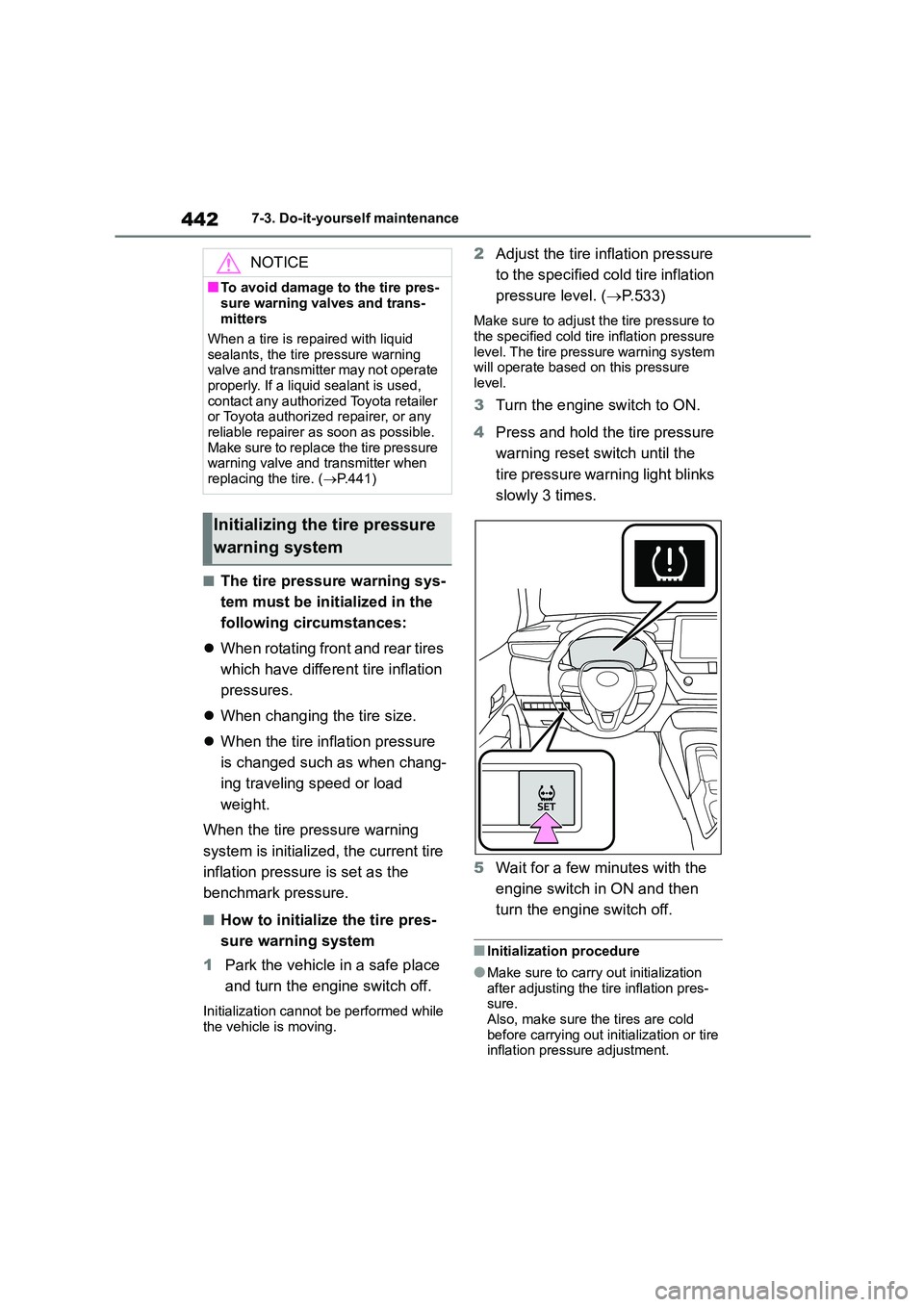
4 Press and hold the tire pressure
warning reset switch until the
tire pressure warning light blinks
slowly 3 times.
5 Wait for a few minutes with the
engine switch in ON and then
turn the engine switch off.
■Initialization procedure
●Make sure to carry out initialization
after adjusting the tire inflation pres- sure.
Also, make sure the tires are cold
before carrying out initialization or tire inflation pressure adjustment.
NOTICE
■To avoid damage to the tire pres-
sure warning valves and trans-
mitters
When a tire is repaired with liquid
sealants, the tire pressure warning
valve and transmitter may not operate properly. If a liquid sealant is used,
contact any authorized Toyota retailer
or Toyota authorized repairer, or any
reliable repairer as soon as possible. Make sure to replace the tire pressure
warning valve and transmitter when
replacing the tire. ( P.441)
Initializing the tire pressure
warning system
Page 445 of 678
443
7
7-3. Do-it-yourself maintenance
Maintenance and care
●If you have accidentally turned the
engine switch off during initialization, it is not necessary to press the reset
switch again as initialization will
restart automatically when the engine switch is turned to ON the next time.
●If you accidentally press the reset switch when initialization is not neces-
sary, adjust the tire inflation pressure
to the specified level when the tires are cold, and conduct initialization
again.
■When initialization of the tire pres-
sure warning system has failed
Initialization can be completed in a few
minutes. However, in the following
cases, the settings have not been recorded and the system will not oper-
ate properly. If repeated attempts to
record tire inflation pressure settings are unsuccessful, have the vehicle
inspected by any authorized Toyota
retailer or Toyota authorized repairer, or any reliable repairer.
●When operating the tire pressure warning reset switch, the tire pressure
warning light does not blink 3 times.
●After driving for a certain period of
time since the initialization has been
completed, the wa rning light comes on after blinking for 1 minute.
The tire pressure warning valve
and transmitter is equipped with a
unique ID code. When replacing a
tire pressure warning valve and
transmitter, it is necessary to regis-
ter the ID code. Have the ID code
registered by any authorized Toyota
retailer or Toyota authorized
repairer, or any reliable repairer.
■Registering ID codes
The ID codes of the tire pressure warn- ing valve and transmitters for two sets of
wheels can be registered.
It is not necessary to register the ID codes when replacing normal tires with
snow tires, if the ID codes for the wheels
of both normal tires and snow tires are registered beforehand.
For information about changing ID
codes, ask any authorized Toyota retailer or Toyota authorized repairer, or
any reliable repairer.
WA R N I N G
■When initializing the tire pres-
sure warning system
Do not operate the tire pressure warn- ing reset switch without first adjusting
the tire inflation pressure to the speci-
fied level. Otherwise, the tire pressure warning light may not come on even if
the tire inflation pressure is low, or it
may come on when the tire inflation pressure is actually normal.
Registering ID codes
Page 446 of 678
4447-3. Do-it-yourself maintenance
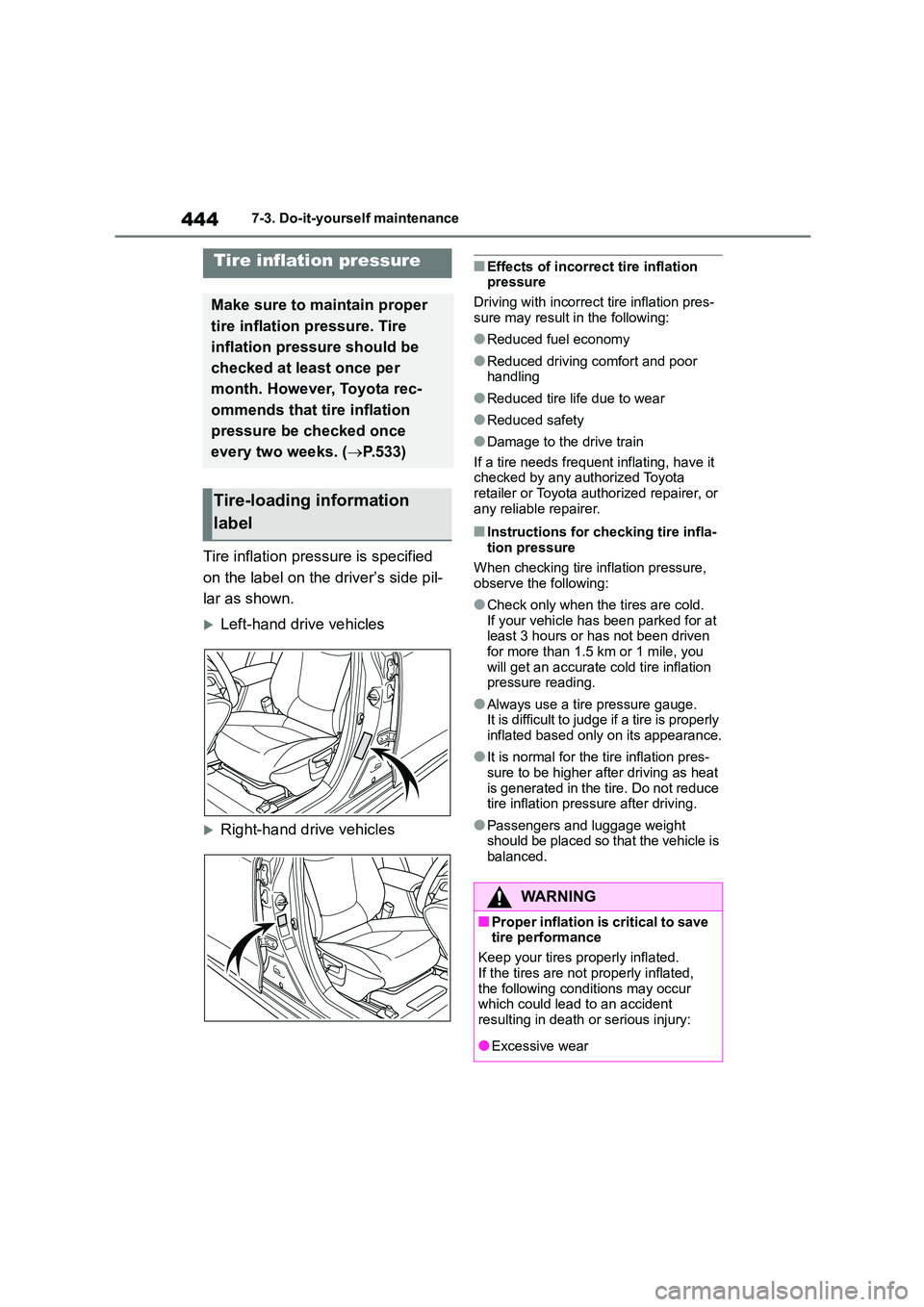
Tire inflation pressure is specified
on the label on the driver’s side pil-
lar as shown.
Left-hand drive vehicles
Right-hand drive vehicles
■Effects of incorrect tire inflation pressure
Driving with incorrect tire inflation pres-
sure may result in the following:
●Reduced fuel economy
●Reduced driving comfort and poor
handling
●Reduced tire life due to wear
●Reduced safety
●Damage to the drive train
If a tire needs frequent inflating, have it checked by any authorized Toyota
retailer or Toyota authorized repairer, or
any reliable repairer.
■Instructions for checking tire infla- tion pressure
When checking tire inflation pressure,
observe the following:
●Check only when the tires are cold.
If your vehicle has been parked for at least 3 hours or has not been driven
for more than 1.5 km or 1 mile, you
will get an accurate cold tire inflation pressure reading.
●Always use a tire pressure gauge.It is difficult to judge if a tire is properly
inflated based only on its appearance.
●It is normal for the tire inflation pres-
sure to be higher after driving as heat
is generated in the tire. Do not reduce
tire inflation pressure after driving.
●Passengers and luggage weight
should be placed so that the vehicle is balanced.
Tire inflation pressure
Make sure to maintain proper
tire inflation pressure. Tire
inflation pressure should be
checked at least once per
month. However, Toyota rec-
ommends that tire inflation
pressure be checked once
every two weeks. ( P.533)
Tire-loading information
label
WA R N I N G
■Proper inflation is critical to save
tire performance
Keep your tires properly inflated.
If the tires are not properly inflated,
the following conditions may occur which could lead to an accident
resulting in death or serious injury:
●Excessive wear
Page 447 of 678
445
7
7-3. Do-it-yourself maintenance
Maintenance and care
When replacing wheels, care
should be taken to ensure that they
are equivalent to those removed in
load capacity, diameter, rim width
and inset*.
Replacement wheels are available
at any authorized Toyota retailer or
Toyota authorized repairer, or any
reliable repairer.
*: Conventionally referred to as offset.
Toyota does not recommend using
the following:
Wheels of different sizes or types
Used wheels
Bent wheels that have been
straightened
■When replacing wheels
The wheels of your vehicle are equipped with tire pressure warning valves and
transmitters that allow the tire pressure
warning system to provide advance warning in the event of a loss in tire
inflation pressure. Whenever wheels are
replaced, the tire pressure warning valves and transmitters must be
installed. ( P.441)
WA R N I N G
●Uneven wear
●Poor handling
●Possibility of blowouts resulting
from overheated tires
●Air leaking from between tire and
wheel
●Wheel deformation and/or tire dam-
age
●Greater possibility of tire damage
while driving (due to road hazards,
expansion joints, sharp edges on the road, etc.)
NOTICE
■When inspecting and adjusting
tire inflation pressure
Be sure to put the tire valve caps back
on.
If a valve cap is not installed, dirt or moisture may get into the valve and
cause an air leak, resulting in
decreased tire inflation pressure.
Wheels
If a wheel is bent, cracked or
heavily corroded, it should be
replaced. Otherwise, the tire
may separate from the wheel
or cause a loss of handling
control.
Wheel selection
Page 452 of 678
4507-3. Do-it-yourself maintenance
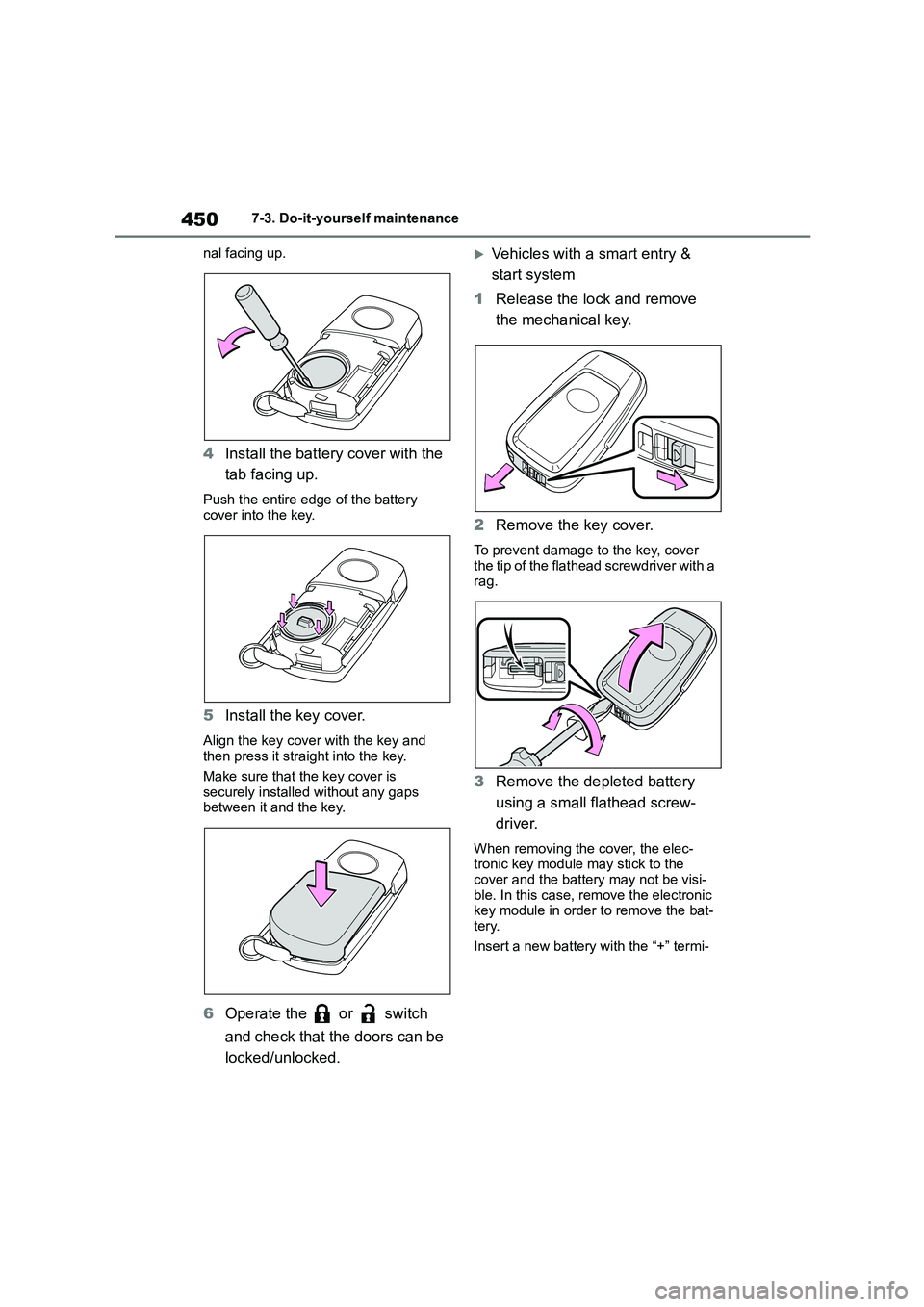
nal facing up.
4 Install the battery cover with the
tab facing up.
Push the entire edge of the battery
cover into the key.
5 Install the key cover.
Align the key cover with the key and
then press it straight into the key.
Make sure that the key cover is securely installed without any gaps
between it and the key.
6 Operate the or switch
and check that the doors can be
locked/unlocked.
Vehicles with a smart entry &
start system
1 Release the lock and remove
the mechanical key.
2 Remove the key cover.
To prevent damage to the key, cover
the tip of the flathead screwdriver with a rag.
3 Remove the depleted battery
using a small flathead screw-
driver.
When removing the cover, the elec- tronic key module may stick to the
cover and the battery may not be visi-
ble. In this case, remove the electronic key module in order to remove the bat-
tery.
Insert a new battery with the “+” termi-
Page 463 of 678
8
461
When trouble arises
8
When trouble arises
.8-1. Essential information
Emergency flashers .......... 462
If your vehicle has to be
stopped in an emergency
....................................... 462
If the vehicle is submerged or
water on the road is rising
....................................... 464
8-2. Steps to take in an emer-
gency
If your vehicle needs to be
towed .............................. 465
If you think something is wrong
....................................... 469
Fuel pump shut off system
....................................... 470
If a warning light turns on or a
warning buzzer sounds... 471
If a warning message is dis-
played ............................. 480
If you have a flat tire (vehicles
with an emergency tire punc-
ture repair kit) ................. 482
If you have a flat tire (vehicles
with a spare tire) ............. 498
If the engine will not start .. 509
If you lose your keys ......... 511
If the electronic key does not
operate properly ............. 511
If the vehicle battery is dis-
charged .......................... 513
If your vehicle overheats ... 518
If the vehicle becomes stuck
....................................... 520
Page 468 of 678
4668-2. Steps to take in an emergency
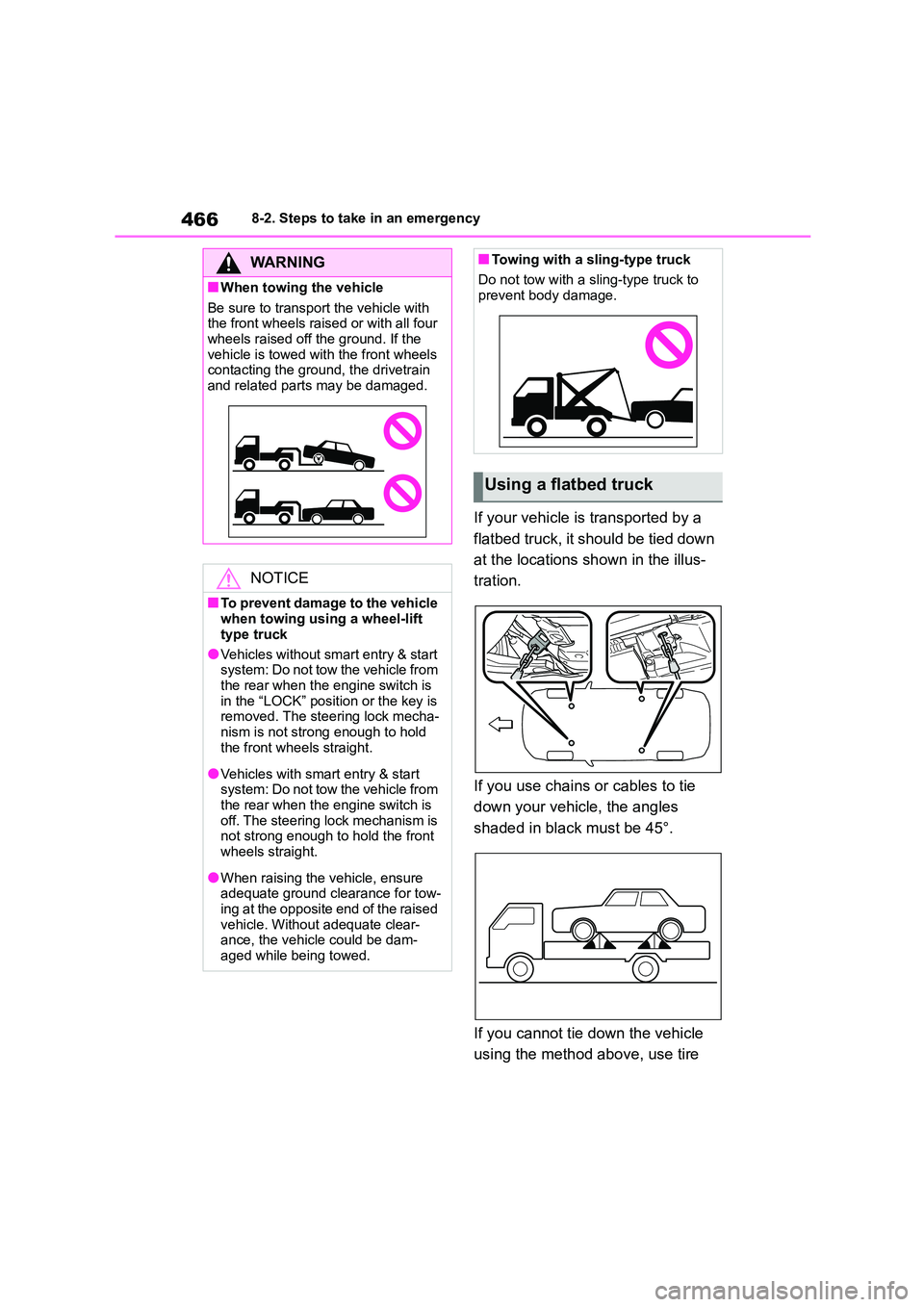
If your vehicle is transported by a
flatbed truck, it should be tied down
at the locations shown in the illus-
tration.
If you use chains or cables to tie
down your vehicle, the angles
shaded in black must be 45°.
If you cannot tie down the vehicle
using the method above, use tire
WA R N I N G
■When towing the vehicle
Be sure to transport the vehicle with
the front wheels raised or with all four wheels raised off the ground. If the
vehicle is towed with the front wheels
contacting the ground, the drivetrain and related parts may be damaged.
NOTICE
■To prevent damage to the vehicle
when towing using a wheel-lift
type truck
●Vehicles without smart entry & start
system: Do not tow the vehicle from
the rear when the engine switch is in the “LOCK” position or the key is
removed. The steering lock mecha-
nism is not strong enough to hold
the front wheels straight.
●Vehicles with smart entry & start
system: Do not tow the vehicle from the rear when the engine switch is
off. The steering lock mechanism is
not strong enough to hold the front wheels straight.
●When raising the vehicle, ensure adequate ground clearance for tow-
ing at the opposite end of the raised
vehicle. Without adequate clear- ance, the vehicle could be dam-
aged while being towed.
■Towing with a sling-type truck
Do not tow with a sling-type truck to
prevent body damage.
Using a flatbed truck
Page 471 of 678
469
8
8-2. Steps to take in an emergency
When trouble arises
Fluid leaks under the vehicle.
(Water dripping from the air con-
ditioning after use is normal.)
Flat-looking tires or uneven tire
wear
Engine coolant temperature
gauge needle continually points
higher than normal.
Changes in exhaust sound
Excessive tire squeal when cor-
nering
Strange noises related to the
suspension system
Pinging or other noises related to
the engine
Engine missing, stumbling or
running roughly
Appreciable loss of power
Vehicle pulls heavily to one side
when braking
Vehicle pulls heavily to one side
when driving on a level road
Loss of brake effectiveness,
spongy feeling, pedal almost
touches the floor
If you think something is
wrong
If you notice any of the follow-
ing symptoms, your vehicle
probably needs adjustment or
repair. Contact any authorized
Toyota retailer or Toyota
authorized repairer, or any reli-
able repairer as soon as possi-
ble.
Visible symptoms
Audible symptoms
Operational symptoms
Page 477 of 678
475
8
8-2. Steps to take in an emergency
When trouble arises
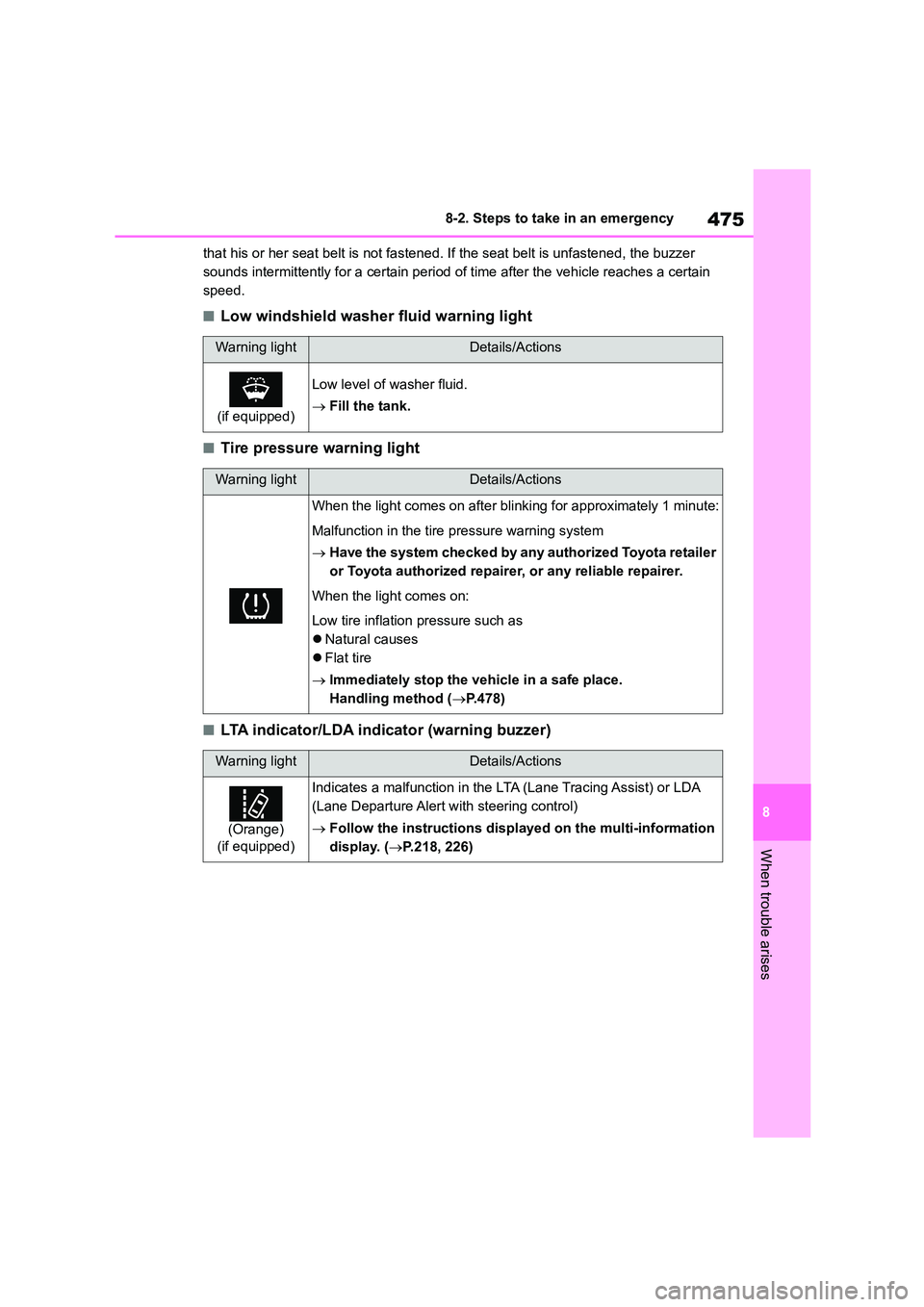
that his or her seat belt is not fastened. If the seat belt is unfastened, the buzzer
sounds intermittently for a certain period of time after the vehicle reaches a certain
speed.
■Low windshield washer fluid warning light
■Tire pressure warning light
■LTA indicator/LDA indicator (warning buzzer)
Warning lightDetails/Actions
(if equipped)
Low level of washer fluid.
Fill the tank.
Warning lightDetails/Actions
When the light comes on after blinking for approximately 1 minute:
Malfunction in the tire pressure warning system
Have the system checked by any authorized Toyota retailer
or Toyota authorized repairer, or any reliable repairer.
When the light comes on:
Low tire inflation pressure such as
Natural causes
Flat tire
Immediately stop the vehicle in a safe place.
Handling method ( P.478)
Warning lightDetails/Actions
(Orange)
(if equipped)
Indicates a malfunction in the LTA (Lane Tracing Assist) or LDA
(Lane Departure Alert with steering control)
Follow the instructions displayed on the multi-information
display. ( P.218, 226)
Page 481 of 678
479
8
8-2. Steps to take in an emergency
When trouble arises
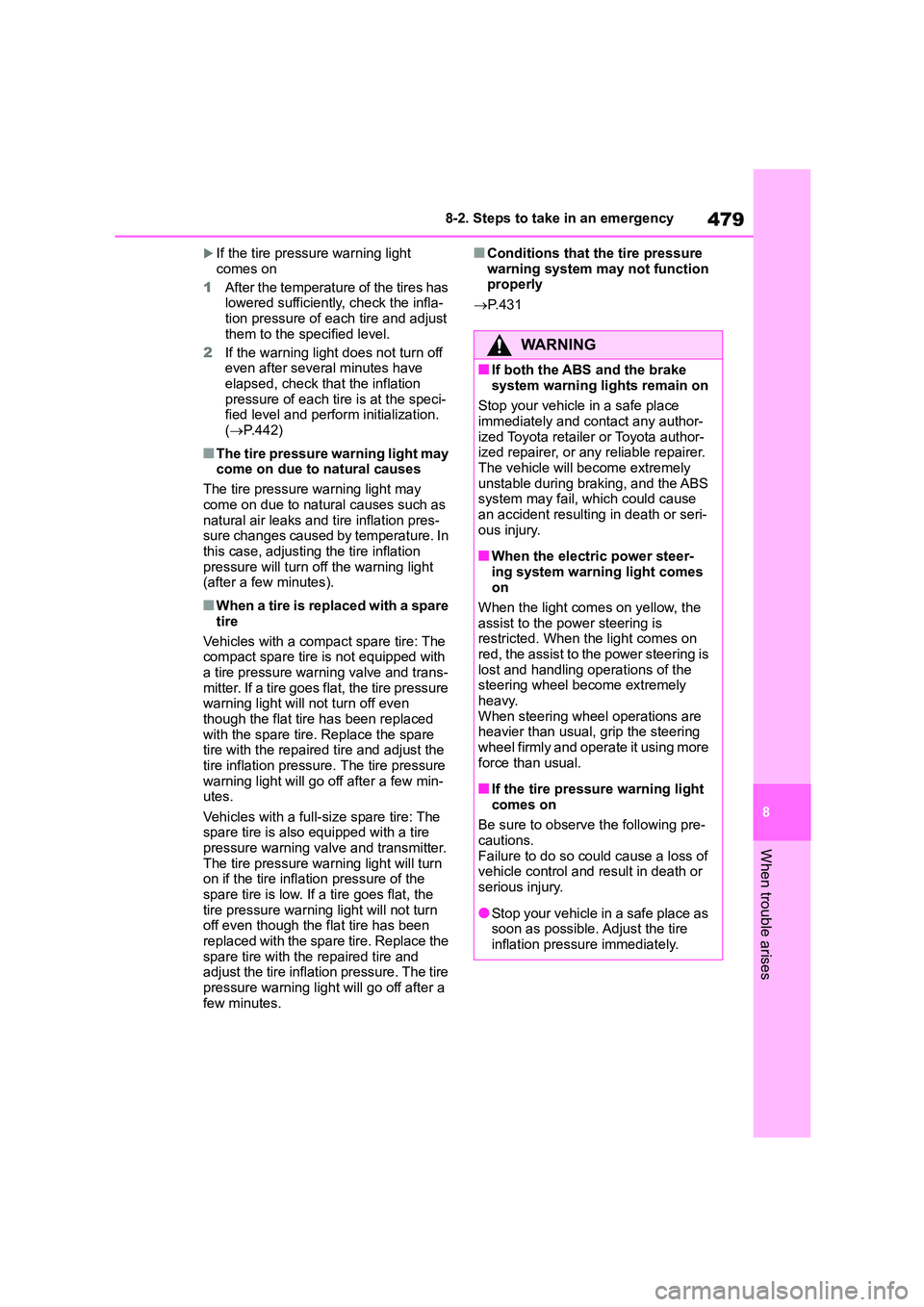
If the tire pressure warning light
comes on
1 After the temperature of the tires has lowered sufficiently, check the infla-
tion pressure of each tire and adjust
them to the specified level.
2 If the warning light does not turn off even after several minutes have
elapsed, check that the inflation
pressure of each tire is at the speci- fied level and perform initialization.
( P.442)
■The tire pressure warning light may
come on due to natural causes
The tire pressure warning light may
come on due to natural causes such as
natural air leaks and tire inflation pres- sure changes caused by temperature. In
this case, adjusting the tire inflation
pressure will turn off the warning light (after a few minutes).
■When a tire is replaced with a spare
tire
Vehicles with a compact spare tire: The compact spare tire is not equipped with
a tire pressure warning valve and trans-
mitter. If a tire goes flat, the tire pressure warning light will not turn off even
though the flat tire has been replaced
with the spare tire. Replace the spare tire with the repaired tire and adjust the
tire inflation pressure. The tire pressure
warning light will go off after a few min- utes.
Vehicles with a full-size spare tire: The
spare tire is also equipped with a tire pressure warning valve and transmitter.
The tire pressure warning light will turn
on if the tire inflation pressure of the spare tire is low. If a tire goes flat, the
tire pressure warning light will not turn
off even though the flat tire has been
replaced with the spare tire. Replace the spare tire with the repaired tire and
adjust the tire inflation pressure. The tire
pressure warning light will go off after a few minutes.
■Conditions that th e tire pressure
warning system may not function properly
P. 4 3 1
WA R N I N G
■If both the ABS and the brake system warning lights remain on
Stop your vehicle in a safe place
immediately and contact any author-
ized Toyota retailer or Toyota author- ized repairer, or any reliable repairer.
The vehicle will become extremely
unstable during br aking, and the ABS system may fail, which could cause
an accident resulting in death or seri-
ous injury.
■When the electric power steer-
ing system warning light comes on
When the light comes on yellow, the
assist to the power steering is restricted. When th e light comes on
red, the assist to the power steering is
lost and handling operations of the steering wheel become extremely
heavy.
When steering wheel operations are heavier than usual, grip the steering
wheel firmly and operate it using more
force than usual.
■If the tire pressure warning light
comes on
Be sure to observe the following pre-
cautions.
Failure to do so could cause a loss of vehicle control and re sult in death or
serious injury.
●Stop your vehicle in a safe place as
soon as possible. Adjust the tire
inflation pressure immediately.