lights TOYOTA COROLLA CROSS 2022 Owners Manual
[x] Cancel search | Manufacturer: TOYOTA, Model Year: 2022, Model line: COROLLA CROSS, Model: TOYOTA COROLLA CROSS 2022Pages: 612, PDF Size: 17.18 MB
Page 2 of 612
2TABLE OF CONTENTS
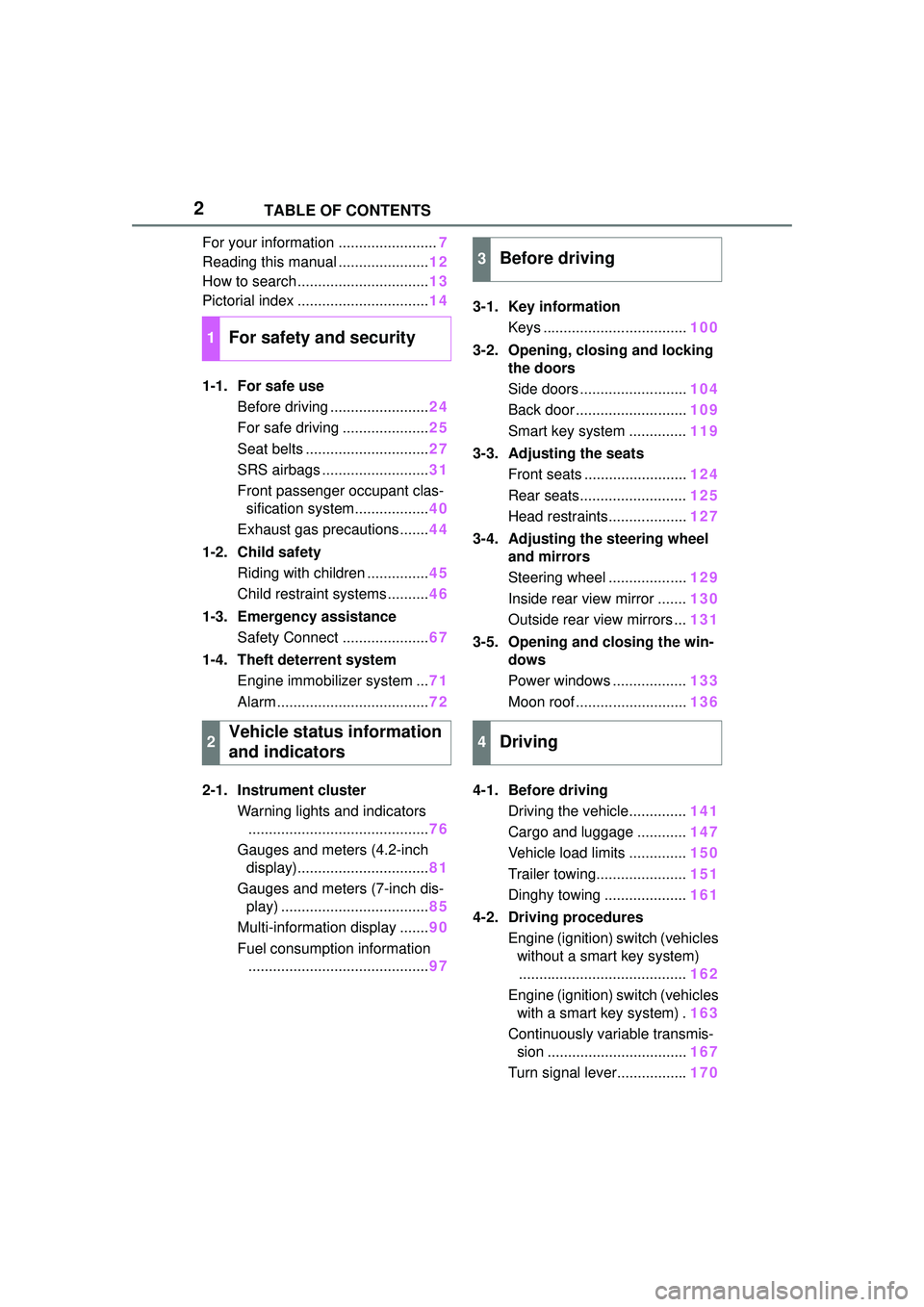
For your information ........................7
Reading this manual ...................... 12
How to search ................................ 13
Pictorial index ................................ 14
1-1. For safe use Before driving ........................ 24
For safe driving ..................... 25
Seat belts .............................. 27
SRS airbags .......................... 31
Front passenger occupant clas- sification system.................. 40
Exhaust gas precautions....... 44
1-2. Child safety Riding with children ............... 45
Child restraint systems .......... 46
1-3. Emergency assistance Safety Connect ..................... 67
1-4. Theft deterrent system Engine immobilizer system ... 71
Alarm ..................................... 72
2-1. Instrument cluster Warning lights and indicators............................................ 76
Gauges and meters (4.2-inch display)................................ 81
Gauges and meters (7-inch dis- play) .................................... 85
Multi-information display ....... 90
Fuel consumption information ............................................ 973-1. Key information
Keys ................................... 100
3-2. Opening, closing and locking
th e doors
Side doors .......................... 104
Back door ........................... 109
Smart key system .............. 119
3-3. Adjusting the seats Front seats ......................... 124
Rear seats.......................... 125
Head restraints................... 127
3-4. Adjust ing the steering wheel
and mirrors
Ste ering wheel ................... 129
Inside rear view mirror ....... 130
Outside rear view mirrors ... 131
3-5. Opening and closing the win- dows
Power windows .................. 133
Moon roof ........................... 136
4-1. Before driving Driving the vehicle.............. 141
Cargo and luggage ............ 147
Vehicle load limits .............. 150
Trailer towing...................... 151
Dinghy towing .................... 161
4-2. Driving procedures Engine (ignition) switch (vehicles without a smart key system)......................................... 162
Engine (ignition) switch (vehicles with a smart key system) . 163
Continuously variable transmis- sion .
................................. 167
Turn signal lever................. 170
1For safety and security
2Vehicle status information
and indicators
3Before driving
4Driving
Page 3 of 612
3TABLE OF CONTENTS
1
2
3
4
5
6
7
8
9
10
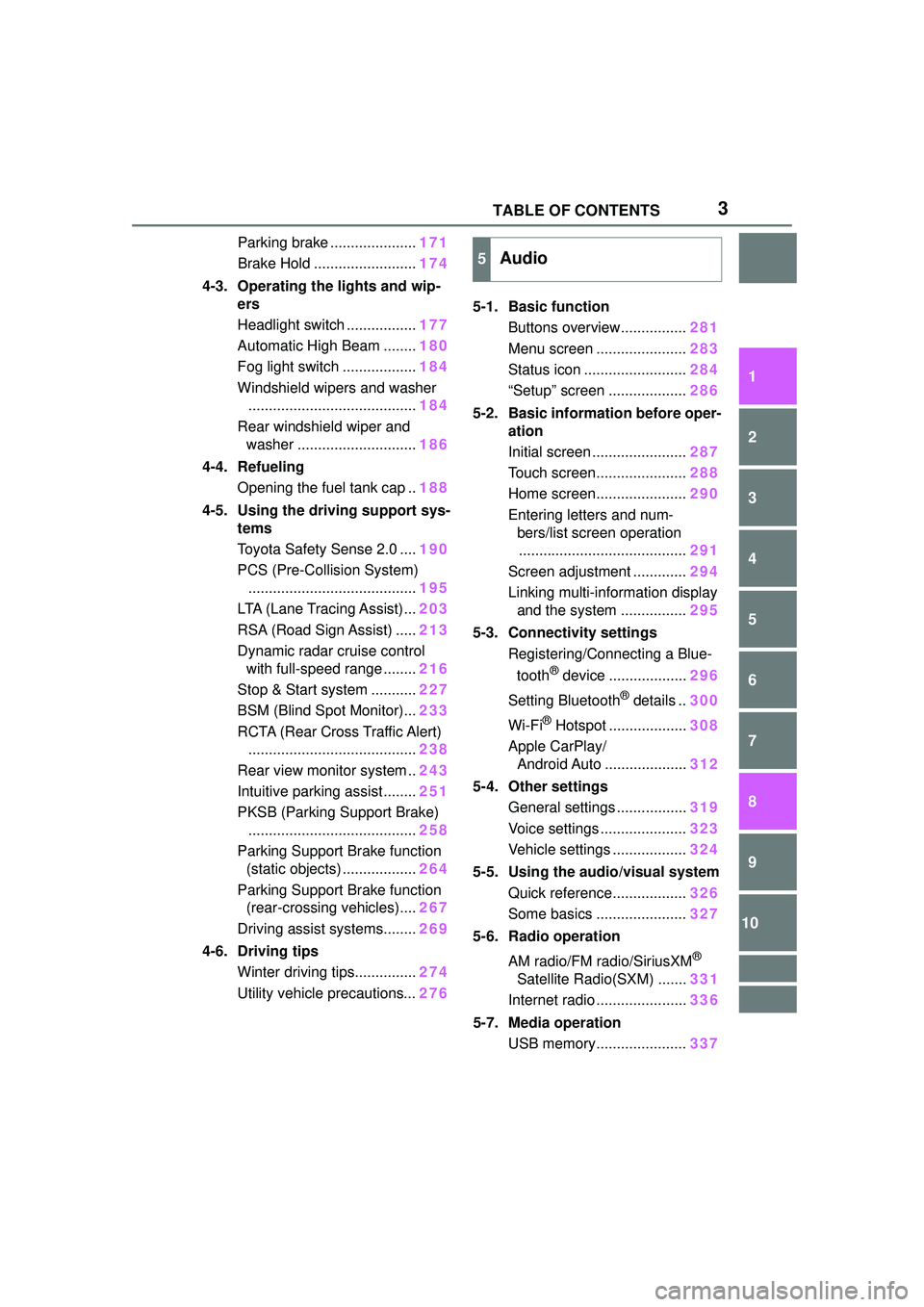
Parking brake .....................171
Brake Hold ......................... 174
4-3. Operating the lights and wip- ers
Headlight switch ................. 177
Automatic High Beam ........ 180
Fog light switch .................. 184
Windshield wipers and washer ......................................... 184
Rear windshield wiper and washer ............................. 186
4-4. Refueling Opening the fuel tank cap .. 188
4-5. Using the driving support sys- tems
Toyota Safety Sense 2.0 .... 190
PCS (Pre-Collision System) ......................................... 195
LTA (Lane Tracing Assist)... 203
RSA (Road Sign Assist) ..... 213
Dynamic radar cruise control with full-speed range ........ 216
Stop & Start system ........... 227
BSM (Blind Spot Monitor)... 233
RCTA (Rear Cross Traffic Alert) ......................................... 238
Rear view monitor system .. 243
Intuitive parking assist ........ 251
PKSB (Parking Support Brake) ......................................... 258
Parking Support Brake function (static objects) .................. 264
Parking Support Brake function (rear-crossing vehicles).... 267
Driving assist systems........ 269
4-6. Driving tips Winter driving tips............... 274
Utility vehicle precautions... 2765-1. Basic function
Buttons overview................ 281
Menu screen ...................... 283
Status icon ......................... 284
“Setup” screen ................... 286
5-2. Basic information before oper- ation
Initial screen ....................... 287
Touch screen...................... 288
Home screen...................... 290
Entering letters and num- bers/list screen operation......................................... 291
Screen adjustment ............. 294
Linking multi-information display and the system ................ 295
5-3. Connectivity settings Registering/Connecting a Blue-
tooth
® device ................... 296
Setting Bluetooth
® details .. 300
Wi-Fi
® Hotspot ................... 308
Apple CarPlay/ Android Auto .................... 312
5-4. Other settings General settings ................. 319
Voice settings ..................... 323
Vehicle settings .................. 324
5-5. Using the audio/visual system Quick reference.................. 326
Some basics ...................... 327
5-6. Radio operation
AM radio/FM radio/SiriusXM
®
Satellite Radio(SXM) ....... 331
Internet radio ...................... 336
5-7. Media operation USB memory...................... 337
5Audio
Page 4 of 612
4TABLE OF CONTENTS
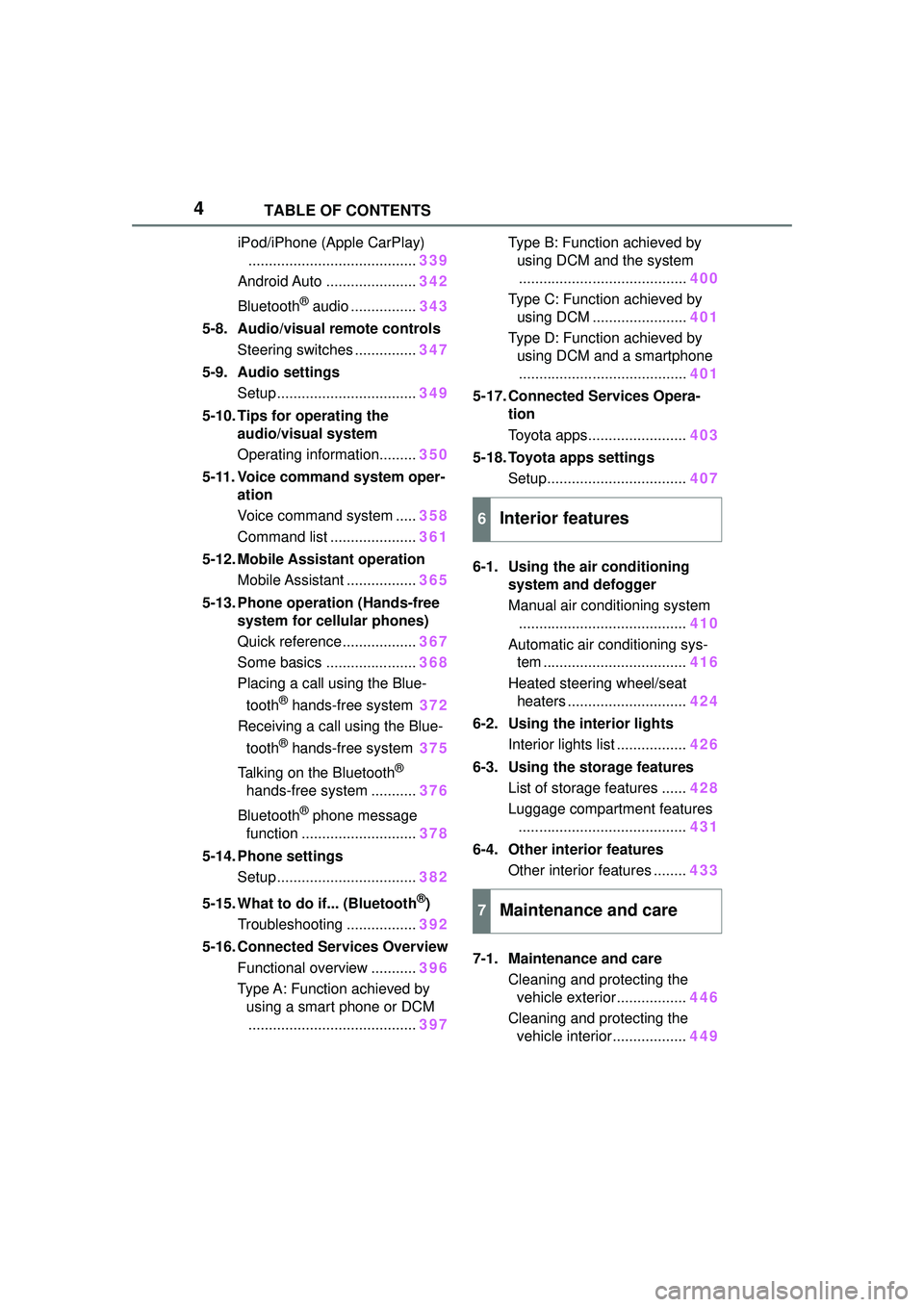
iPod/iPhone (Apple CarPlay)......................................... 339
Android Auto ...................... 342
Bluetooth
® audio ................ 343
5-8. Audio/visual remote controls Steering switches ............... 347
5-9. Audio settings Setup .................................. 349
5-10. Tips for operating the audio/visual system
Operating information......... 350
5-11. Voice command system oper- ation
Voice command system ..... 358
Command list ..................... 361
5-12. Mobile Assistant operation Mobile Assistant ................. 365
5-13. Phone operation (Hands-free system for cellular phones)
Quick reference .................. 367
Some basics ...................... 368
Placing a call using the Blue-
tooth
® hands-free system 372
Receiving a call using the Blue-
tooth
® hands-free system 375
Talking on the Bluetooth
®
hands-free system ........... 376
Bluetooth
® phone message
function ............................ 378
5-14. Phone settings Setup .................................. 382
5-15. What to do if... (Bluetooth
®)
Troubleshooting ................. 392
5-16. Connected Services Overview Functional overview ........... 396
Type A: Function achieved by using a smart phone or DCM......................................... 397Type B: Function achieved by
using DCM and the system......................................... 400
Type C: Function achieved by using DCM ....................... 401
Type D: Function achieved by using DCM and a smartphone......................................... 401
5-17. Connected Services Opera- tion
Toyota apps........................ 403
5-18. Toyota apps settings Setup.................................. 407
6-1. Using the air conditioning system and defogger
Manual air conditioning system......................................... 410
Automatic air conditioning sys- tem ................................... 416
Heated steering wheel/seat heaters ............................. 424
6-2. Using the interior lights Interior lights list ................. 426
6-3. Using the storage features List of storage features ...... 428
Luggage compartment features ......................................... 431
6-4. Other interior features Other interior features ........ 433
7-1. Maintenance and care Cleaning and protecting the vehicle exterior................. 446
Cleaning and protecting the vehicle interior.................. 449
6Interior features
7Maintenance and care
Page 15 of 612
15Pictorial index
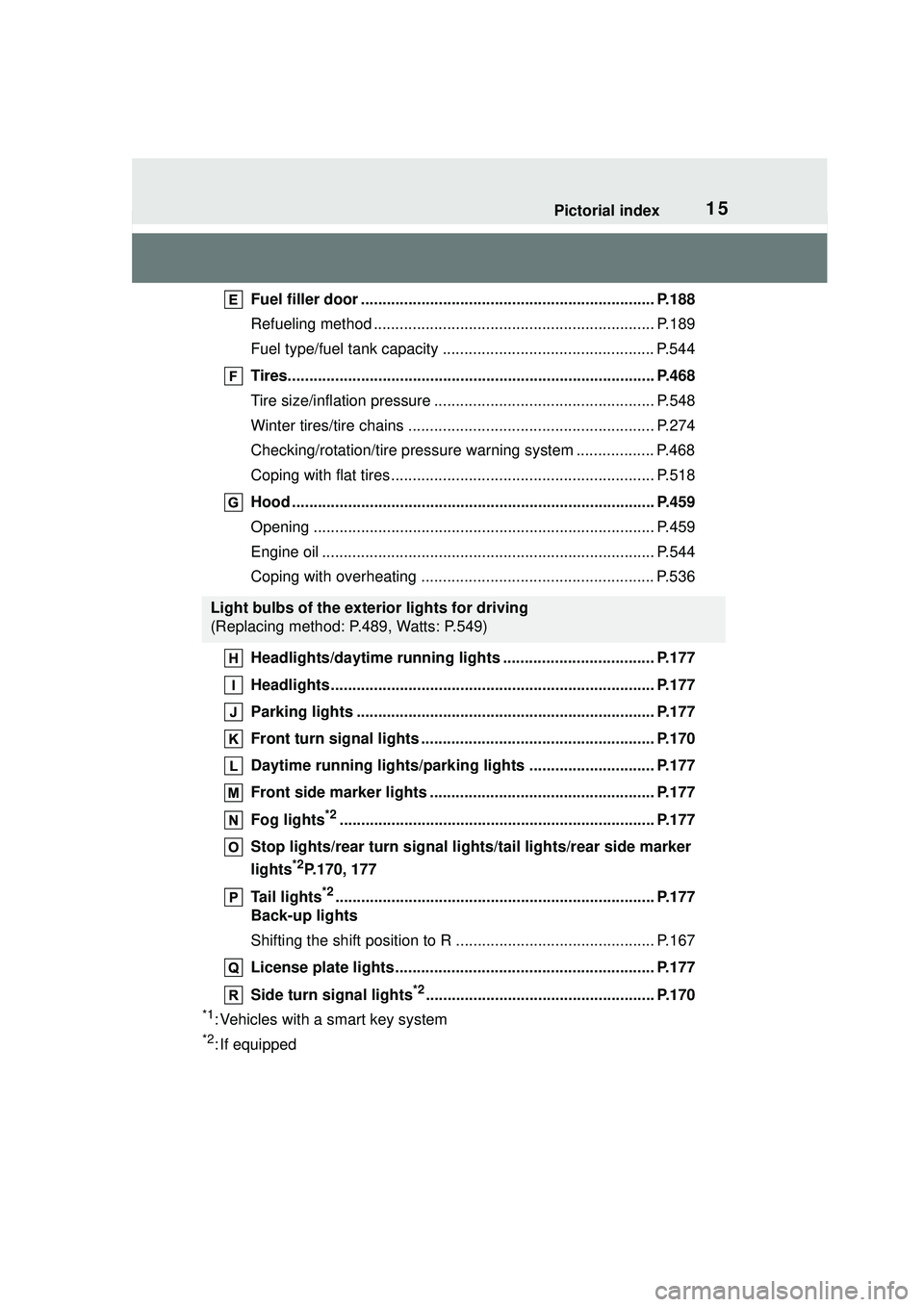
Fuel filler door .................................................................... P.188
Refueling method ................................................................. P.189
Fuel type/fuel tank capacity ................................................. P.544
Tires..................................................................................... P.468
Tire size/inflation pressure ................................................... P.548
Winter tires/tire chains ......................................................... P.274
Checking/rotation/tire pressure warning system .................. P.468
Coping with flat tires............................................................. P.518
Hood .................................................................................... P.459
Opening ............................................................................... P.459
Engine oil ............................................................................. P.544
Coping with overheating ...................................................... P.536
Headlights/daytime running lights ................................... P.177
Headlights........................................................................... P.177
Parking lights ..................................................................... P.177
Front turn signal lights ...................................................... P.170
Daytime running lights/parking lights ............................. P.177
Front side marker lights .................................................... P.177
Fog lights
*2......................................................................... P.177
Stop lights/rear turn signal ligh ts/tail lights/rear side marker
lights
*2P.170, 177
Tail lights
*2.......................................................................... P.177
Back-up lights
Shifting the shift position to R . ............................................. P.167
License plate lights............................................................ P.177
Side turn signal lights
*2..................................................... P.170
*1: Vehicles with a smart key system
*2: If equipped
Light bulbs of the exterior lights for driving
(Replacing method: P.489, Watts: P.549)
Page 16 of 612
16Pictorial index
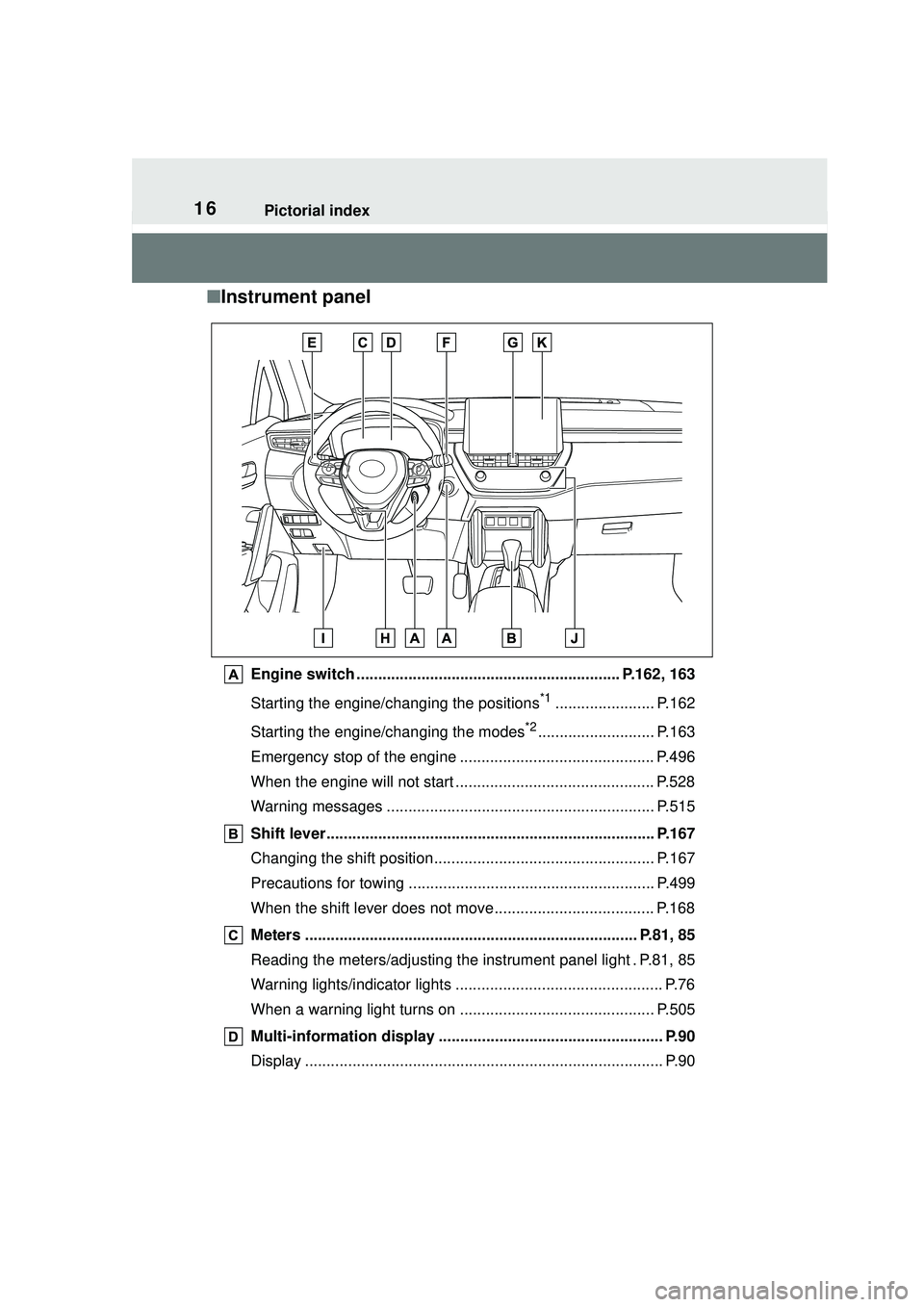
■Instrument panel
Engine switch ............................................................. P.162, 163
Starting the engine/changing the positions
*1....................... P.162
Starting the engine/changing the modes
*2........................... P.163
Emergency stop of the engine ............................................. P.496
When the engine will not start .............................................. P.528
Warning messages .............................................................. P.515
Shift lever............................................................................ P.167
Changing the shift position................................................... P.167
Precautions for towing . ........................................................ P.499
When the shift lever does not move..................................... P.168
Meters ............................................................................. P.81, 85
Reading the meters/adjusting the instrument panel light . P.81, 85
Warning lights/indicator lights ................................................ P.76
When a warning light turns on ............................................. P.505
Multi-information display ........... ......................................... P.90
Display ................................................................................... P.90
Page 17 of 612
17Pictorial index
When a warning message is displayed ................................ P.515
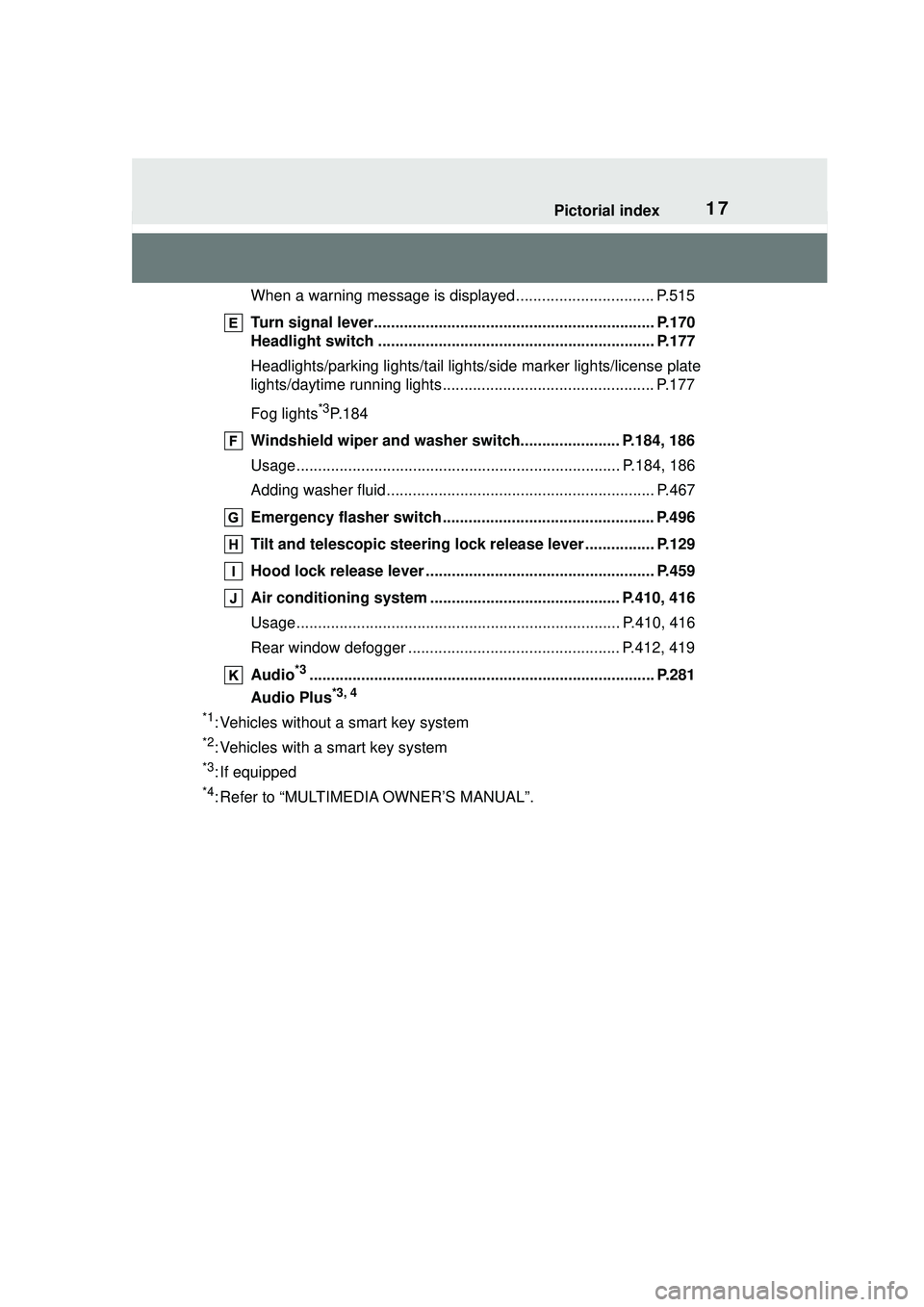
Turn signal lever................................................................. P.170
Headlight switch ................................................................ P.177
Headlights/parking lights/tail lights/side marker lights/license plate
lights/daytime running lights ................................................. P.177
Fog lights
*3P. 1 8 4
Windshield wiper and washer switch....................... P.184, 186
Usage........................................................................... P.184, 186
Adding washer fluid .............................................................. P.467
Emergency flasher switch ................................................. P.496
Tilt and telescopic steering lo ck release lever ................ P.129
Hood lock releas e lever .............................................. ....... P.459
Air conditioning system ................................. ........... P.410, 416
Usage........................................................................... P.410, 416
Rear window defogger ................................................. P.412, 419
Audio
*3................................................................................ P.281
Audio Plus
*3, 4
*1
: Vehicles without a smart key system
*2: Vehicles with a smart key system
*3: If equipped
*4: Refer to “MULTIMEDIA OWNER’S MANUAL”.
Page 21 of 612
21Pictorial index
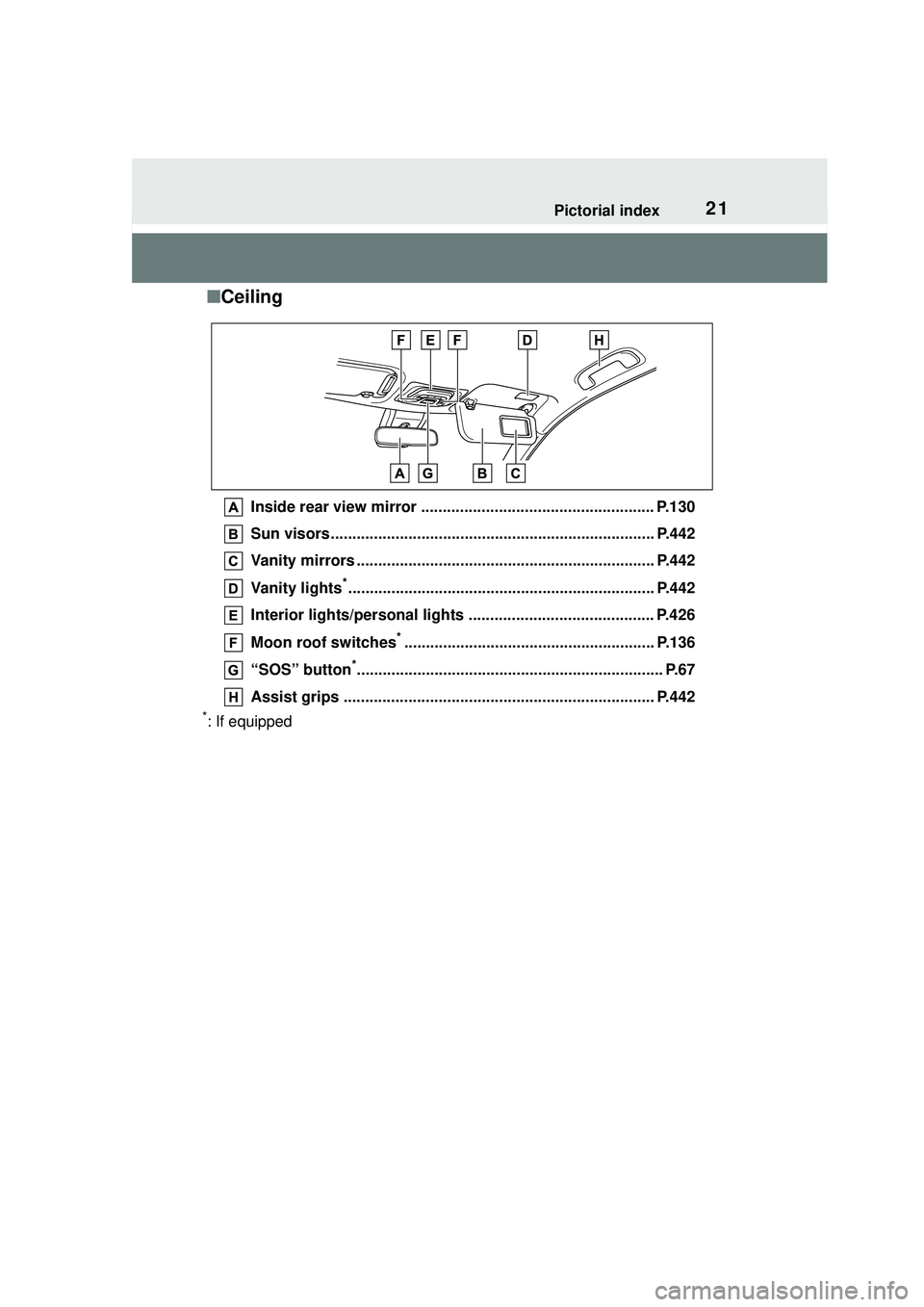
■Ceiling
Inside rear view mirror ...................................................... P.130
Sun visors........................................................................... P.442
Vanity mirrors ..................................................................... P.442
Vanity lights
*....................................................................... P.442
Interior lights/personal lights ........................................... P.426
Moon roof switches
*.......................................................... P.136
“SOS” button
*....................................................................... P.67
Assist grips ........................................................................ P.442
*: If equipped
Page 32 of 612
321-1. For safe use
SRS curtain shield airbags
• Can help protect primarily the head of occupants in the outer seats
• Can help prevent the occupants from being thrown from the vehicle in the event of vehicle rollover
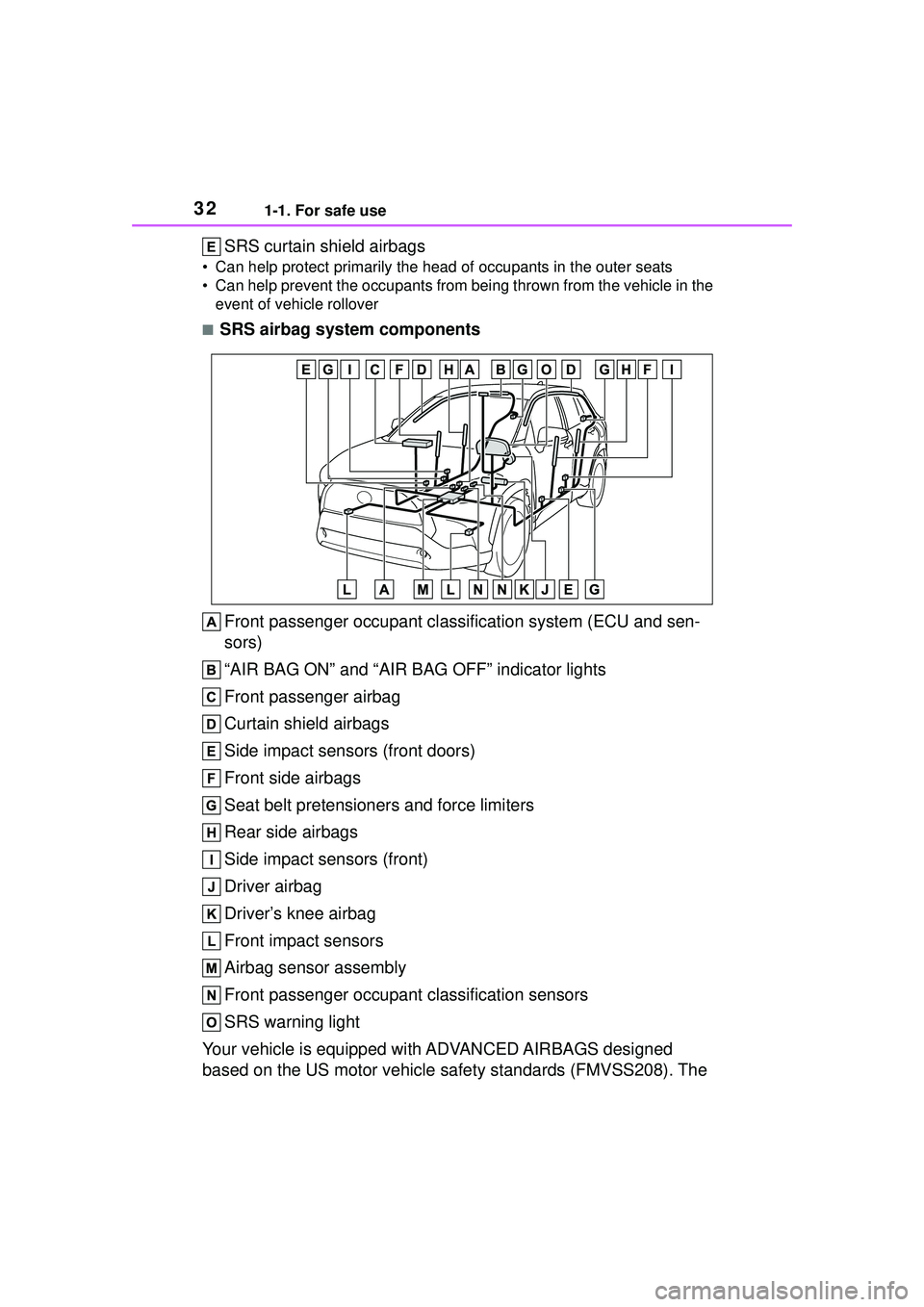
■SRS airbag system components
Front passenger occupant classification system (ECU and sen-
sors)
“AIR BAG ON” and “AIR BAG OFF” indicator lights
Front passenger airbag
Curtain shield airbags
Side impact sensors (front doors)
Front side airbags
Seat belt pretensioners and force limiters
Rear side airbags
Side impact sensors (front)
Driver airbag
Driver’s knee airbag
Front impact sensors
Airbag sensor assembly
Front passenger occupant classification sensors
SRS warning light
Your vehicle is equipped wi th ADVANCED AIRBAGS designed
based on the US motor vehicle safety standards (FMVSS208). The
Page 33 of 612
331-1. For safe use
1
For safety and security
airbag sensor assembly (ECU) controls airbag deployment based on
information obtained from the sensors etc. shown in the system
components diagram above. This information includes crash sever-
ity and occupant information. As the airbags deploy, a chemical
reaction in the inflators quickly fills the airbags with non-toxic gas to
help restrain the motion of the occupants.
■If the SRS airbags deploy
(inflate)
●Slight abrasions, burns, bruising
etc., may be sustained from SRS
airbags, due to the extremely high
speed deployment (inflation) by
hot gases.
●A loud noise and white powder will
be emitted.
●Parts of the airbag module (steer-
ing wheel hub, airbag cover and
inflator) as well as the front seats,
parts of the front and rear pillars,
and roof side rails, may be hot for
several minutes. The airbag itself
may also be hot.
●The windshield may crack.
●All of the doors will be unlocked.
( P.106)
●The brakes and st op lights will be
controlled automatically. ( P.270)
●The interior lights will turn on auto-
matically. ( P.427)
●The emergency flashers will turn
on automatically. ( P.496)
●Fuel supply to the engine will be
stopped. ( P.504)
●For Safety Connect subscribers, if
any of the following situations
occur, the system is designed to
send an emergency call to the
response center, notifying them of
the vehicle’s location (without
needing to push the “SOS” button)
and an agent will a ttempt to speak
with the occupants to ascertain
the level of emergency and assis-
tance required. If the occupants
are unable to communicate, the
agent automatically treats the call as an emergency and helps to dis-
patch the necessary emergency
services. (
P. 6 7 )
• An SRS airbag is deployed.
• A seat belt pretensioner is acti-
vated.
• The vehicle is involved in a severe
rear-end collision.
■SRS airbag deployment condi-
tions (SRS front airbags)
●The SRS front airbags will deploy
in the event of an impact that
exceeds the set threshold level
(the level of force corresponding
to an approximately 12 - 18 mph
[20 - 30 km/h] fr ontal collision with
a fixed wall that does not move or
deform).
However, this threshold velocity will
be considerably higher in the follow-
ing situations:
• If the vehicle strikes an object, such as a parked vehicle or sign
pole, which can move or deform
on impact
• If the vehicle is involved in an underride collision, such as a colli-
sion in which the front of the vehi-
cle “underrides”, or goes under,
the bed of a truck
●Depending on the type of collision,
it is possible that only the seat belt
pretensioners will activate.
●The SRS front airbags for the front
passenger will not activate if there
is no passenger sitting in the front
passenger seat. However, the
SRS front airbags for the front
passenger may deploy if luggage
is put in the seat, even if the seat
is unoccupied.
Page 42 of 612
421-1. For safe use
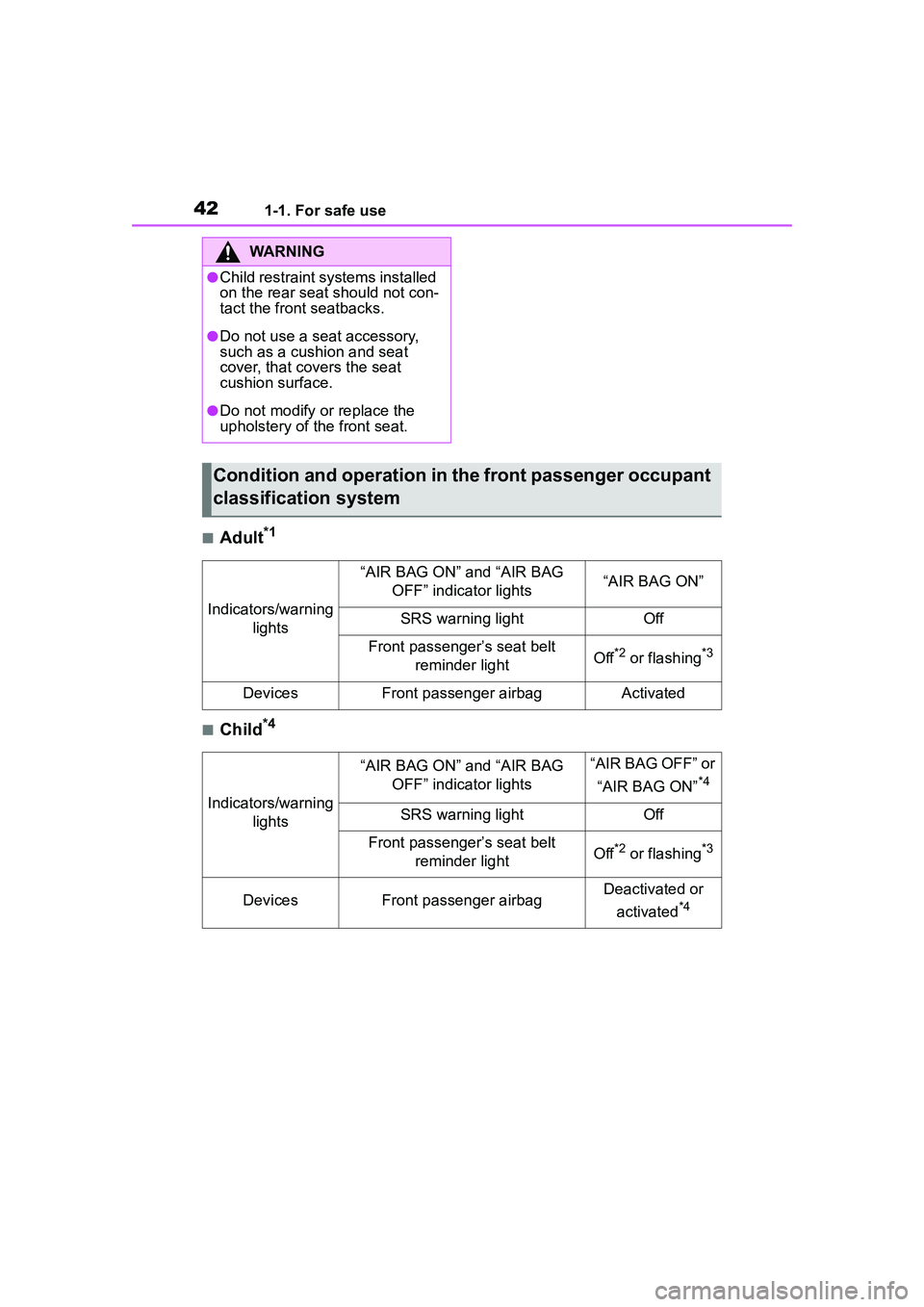
■Adult*1
■Child*4
WARNING
●Child restraint systems installed
on the rear seat should not con-
tact the front seatbacks.
●Do not use a seat accessory,
such as a cushion and seat
cover, that covers the seat
cushion surface.
●Do not modify or replace the
upholstery of the front seat.
Condition and operation in the front passenger occupant
classification system
Indicators/warning lights
“AIR BAG ON” and “AIR BAG OFF” indicator lights“AIR BAG ON”
SRS warning lightOff
Front passenger’s seat belt reminder lightOff*2 or flashing*3
DevicesFront passenger airbagActivated
Indicators/warning lights
“AIR BAG ON” and “AIR BAG OFF” indicator lights“AIR BAG OFF” or
“AIR BAG ON”
*4
SRS warning lightOff
Front passenger’s seat belt reminder lightOff*2 or flashing*3
DevicesFront passenger airbagDeactivated or
activated
*4