tires TOYOTA COROLLA HATCHBACK 2020 (in English) Service Manual
[x] Cancel search | Manufacturer: TOYOTA, Model Year: 2020, Model line: COROLLA HATCHBACK, Model: TOYOTA COROLLA HATCHBACK 2020Pages: 572, PDF Size: 13.8 MB
Page 497 of 572
4978-2. Steps to take in an emergency
COROLLA H/B_U
8
When trouble arises
WARNING
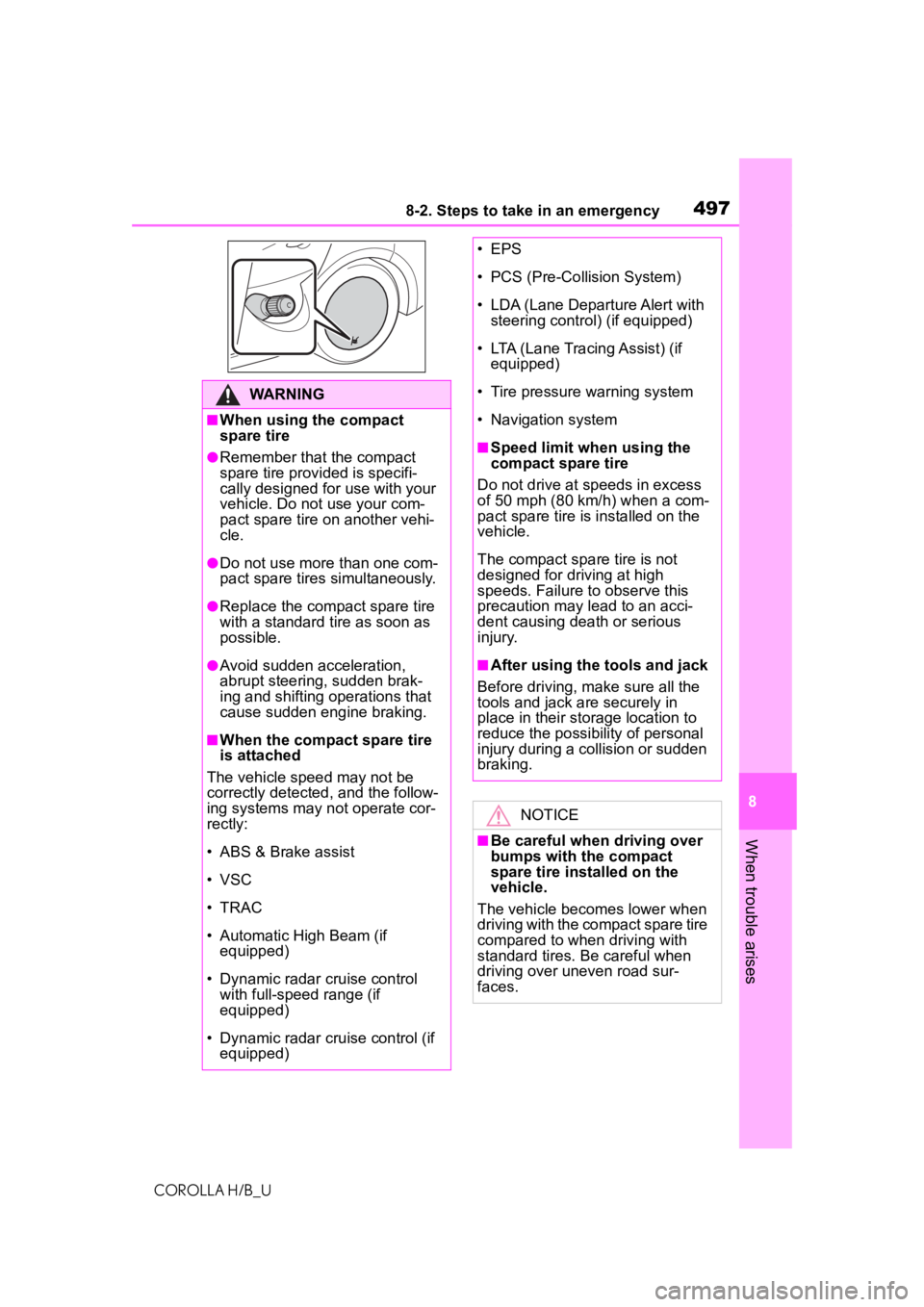
■When using the compact
spare tire
●Remember that the compact
spare tire provided is specifi-
cally designed for use with your
vehicle. Do not use your com-
pact spare tire on another vehi-
cle.
●Do not use more than one com-
pact spare tires simultaneously.
●Replace the compact spare tire
with a standard tire as soon as
possible.
●Avoid sudden acceleration,
abrupt steering, sudden brak-
ing and shifting operations that
cause sudden engine braking.
■When the compact spare tire
is attached
The vehicle speed may not be
correctly detecte d, and the follow-
ing systems may not operate cor-
rectly:
• ABS & Brake assist
• VSC
• TRAC
• Automatic High Beam (if
equipped)
• Dynamic radar cruise control with full-speed range (if
equipped)
• Dynamic radar cruise control (if equipped)
• EPS
• PCS (Pre-Collision System)
• LDA (Lane Departure Alert with steering control) (if equipped)
• LTA (Lane Tracing Assist) (if equipped)
• Tire pressure warning system
• Navigation system
■Speed limit when using the
compact spare tire
Do not drive at speeds in excess
of 50 mph (80 km /h) when a com-
pact spare tire is installed on the
vehicle.
The compact spare tire is not
designed for driving at high
speeds. Failure to observe this
precaution may lead to an acci-
dent causing death or serious
injury.
■After using the tools and jack
Before driving, ma ke sure all the
tools and jack are securely in
place in their storage location to
reduce the possibility of personal
injury during a collision or sudden
braking.
NOTICE
■Be careful when driving over
bumps with the compact
spare tire installed on the
vehicle.
The vehicle becomes lower when
driving with the compact spare tire
compared to when driving with
standard tires. Be careful when
driving over uneven road sur-
faces.
Page 498 of 572

4988-2. Steps to take in an emergency
COROLLA H/B_U
One of the following may be the
cause of the problem:
There may not be sufficient
fuel in the vehicle’s tank.
Refuel the vehicle.
The engine may be flooded.
Try to restart the engine again
following correct starting pro-
cedures. ( P.142)
There may be a malfunction
in the engine immobilizer sys-
tem. ( P.64)
One of the following may be the
cause of the problem:
The battery may be dis-
charged. ( P.502)
NOTICE
■Driving with tire chains and
the compact spare tire
Do not fit tire chains to the com-
pact spare tire. Tire chains may
damage the vehicle body and
adversely affect driving perfor-
mance.
■When replacing the tires
When removing or fitting the
wheels, tires or the tire pressure
warning valve and transmitter,
contact your Toyota dealer as the
tire pressure warning valve and
transmitter may be damaged if not
handled correctly.
If the engine will not
star t
If the engine will not start
even though correct starting
procedures are being fol-
lowed ( P.142), consider
each of the following points:
The engine will not start
even though the starter
motor operates normally.
The starter motor turns
over slowly, the interior
lights and headlights are
dim, or the horn does not
sound or sounds at a low
volume.
Page 508 of 572

5088-2. Steps to take in an emergency
COROLLA H/B_U
1Stop the engine. Set the
parking brake and shift the
shift lever to P (continuously
variable transmission) or N
(manual transmission).
2 Remove the mud, snow or
sand from around the front
wheels.
3 Place wood, stones or some
other material under the front
wheels to help provide trac-
tion.
4 Restart the engine.
5 Shift the shift lever to D or R
(continuously variable trans-
mission) or 1 or R (manual
transmission) and release
the parking brake. Then,
while exercising caution,
depress the accelerator
pedal.
■When it is difficult to free the
vehicle
Press the switch to turn off
TRAC.
If the vehicle becomes
stuck
Carry out the following pro-
cedures if the tires spin or
the vehicle becomes stuck
in mud, dirt or snow:
Recovering procedure
WARNING
■When attempting to free a
stuck vehicle
If you choose to push the vehicle
back and forth to free it, make
sure the surrounding area is clear
to avoid striking other vehicles,
objects or people. The vehicle
may also lunge forward or lunge
back suddenly as it becomes free.
Use extreme caution.
■When shifting the shift lever
(vehicles with a continuously
variable transmission)
Be careful not to shift the shift
lever with the accelerator pedal
depressed.
This may lead to unexpected
rapid acceleration of the vehicle
that may cause an accident
resulting in death o r serious injury.
NOTICE
■To avoid damaging the trans-
mission and other compo-
nents
●Avoid spinning the front wheels
and depressing the accelerator
pedal more than necessary.
●If the vehicle remains stuck
even after these procedures are
performed, the vehicle may
require towing to be freed.
Page 515 of 572

5159-1. Specifications
COROLLA H/B_U
9
Vehicle specifications
*1: Minimum pedal clearance when de pressed with a force of 67.4 lbf (300
N, 30.6 kgf) while the engine is running.
When performing the brake pedal i nspection, also be sure to check that
the brake system warning light is not illuminated when the engine is run-
ning. (If the brake system warning light is illuminate d, refer to P.468.)
*2: Make sure to confirm that the brake warning light (yellow) doe s not illumi-
nate. (If the brake warning light illuminates, refer to P.468.)
15-inch tires
16-inch tires
Parking brake indicator*2
When pulling th e parking brake switch for
1 to 2 seconds: comes on
When pushing the parking brake switch for
1 to 2 seconds: turns off
Fluid typeFMVSS No.116 DOT 3 or SAE J1703
Steering
Free playLess than 1.2 in. (30 mm)
Tires and wheels
Tire size195/65R15 91S
Tire inflation pressure
(Recommended cold tire
inflation pressure)
Front tire
38 psi (260 kPa, 2.6 kgf/cm
2 or bar)
Rear tire
36 psi (250 kPa, 2.5 kgf/cm
2 or bar)
Wheel size15 6 1/2J
Wheel nut torque76 ft•lbf (103 N•m, 10.5 kgf•m)
Tire size205/55R16 91H
Tire inflation pressure
(Recommended cold tire
inflation pressure)
Front tire
35 psi (240 kPa, 2.4 kgf/cm
2 or bar)
Rear tire
33 psi (230 kPa, 2.3 kgf/cm
2 or bar)
Page 516 of 572

5169-1. Specifications
COROLLA H/B_U
18-inch tires
Compact spare tire (if equipped)
Wheel size16 7J
Wheel nut torque76 ft•lbf (103 N•m, 10.5 kgf•m)
Tire size225/40R18 88V
Tire inflation pressure
(Recommended cold tire
inflation pressure)
Driving under nor mal conditions
Front tire
33 psi (230 kPa, 2.3 kgf/cm
2 or bar)
Rear tire
30 psi (210 kPa, 2.1 kgf/cm
2 or bar)
Driving at high speeds (above 100 mph [160
km/h]) (in countries wher e such speeds are per-
mitted by law)
Add 5 psi (30 kPa, 0.3 kgf/cm
2 or bar) to the front
tires and rear tires. Never exceed the maximum
cold tire inflation pressu re indicated on the tire
sidewall.
Wheel size18 8J
Wheel nut torque76 ft•lbf (103 N•m, 10.5 kgf•m)
Tire sizeT125/70D17 98M
Tire inflation pressure
(Recommended cold tire
inflation pressure)
60 psi (420 kPa, 4.2 kgf/cm2 or bar)
Wheel size17 4T
Wheel nut torque76 ft•lbf (103 N•m, 10.5 kgf•m)
Light bulbs
Light bulbsBulb No.WTy p e
ExteriorFront side marker lights—5A
License plate lights—5A
Page 520 of 572

5209-1. Specifications
COROLLA H/B_U
Full-size tireTire size ( P.522)
DOT and Tire Identification Number (TIN) ( P.522)
Uniform tire quality grading
For details, see “Uniform Tire Quality Grading” that follows.
Location of treadwear indicators ( P.436)
Tire ply composition and materials
Plies are layers of rubber-coat ed parallel cords. Cords are the strands
which form the pl ies in a tire.
Radial tires or bias-ply tires
A radial tire has “RADIAL” on th e sidewall. A tire not marked “RADIAL” is a
bias-ply tire.
TUBELESS or TUBE TYPE
A tubeless tire does not have a tube and air is directly put into the tire. A
tube type tire has a tube inside t he tire and the tube maintains the air pres-
sure.
Load limit at maximum cold tire inflation pressure (P.437)
Maximum cold tire inflation pressure ( P.515)
This means the pressure to w hich a tire may be inflated.
Summer tires or all season tires ( P.437)
Tire information
Typical tire symbols
Page 521 of 572

5219-1. Specifications
COROLLA H/B_U
9
Vehicle specifications
An all season tire has “M+S” on the sidewal l. A tire not marked “M+S” is a
summer tire.
Compact spare tire
“TEMPORARY USE ONLY”
A compact spare tire is identifi ed by the phrase “TEMPORARY USE ONLY”
molded on its sidewall. This tire is designed for temporary eme rgency use
only.
Tire size ( P.522)
DOT and Tire Identification Number (TIN) ( P.522)
Load limit at maximum cold tire inflation pressure (P.437)
Location of treadwear indicators ( P.436)
Maximum cold tire inflation pressure ( P.515)
This means the pressure to w hich a tire may be inflated.
Tire ply composition and materials
Plies are layers of rubber-coat ed parallel cords. Cords are the strands
which form the pl ies in a tire.
TUBELESS or TUBE TYPE
A tubeless tire does not have a tube and air is directly put into the tire. A
tube type tire has a tube inside t he tire and the tube maintains the air pres-
sure.
Radial tires or bias-ply tires
A radial tire has “RADIAL” on th e sidewall. A tire not marked “RADIAL” is a
bias-ply tire.
Page 523 of 572

5239-1. Specifications
COROLLA H/B_U
9
Vehicle specifications
Speed symbol (alphabet with
one letter)
■Tire dimensions Section width
Tire height
Wheel diameter
Bead
Sidewall
Shoulder
Tread
Belt
Inner liner
Reinforcing rubber
Carcass
Rim lines
Bead wires Chafer
This information has been pre-
pared in accordance with regu-
lations issued by the National
Highway Traffic Safety Adminis-
tration of the U.S. Department of
Transportation.
It provides the purchasers
and/or prospective purchasers
of Toyota vehicles with informa-
tion on uniform tire quality grad-
ing.
Your Toyota dealer will help answer
any questions you may have as you
read this information.
■DOT quality grades
All passenger vehicle tires must
conform to Federal Safety
Requirements in addition to
these grades. Quality grades
can be found where applicable
on the tire sidewall between
tread shoulder and maximum
section width.
For example: Treadwear 200 Trac-
tion AA Temperature A
■Treadwear
The treadwear grade is a com-
parative rating based on the
wear rate of the tire when tested
under controlled conditions on a
specified government test
course.
For example, a tire graded 150
Tire section names
Uniform Tire Quality
Grading
Page 524 of 572

5249-1. Specifications
COROLLA H/B_Uwould wear one and a half (1 - 1/2)
times as well on the government
course as a tire graded 100.
The relative perfo
rmance of tires
depends upon the actual conditions
of their use. Performance may differ
significantly from the norm due to
variations in driving habits, service
practices and differences in road
characteristics and climate.
■Traction AA, A, B, C
The traction grades, from high-
est to lowest, are AA, A, B and
C, and they represent the tire’s
ability to stop on wet pavement
as measured under controlled
conditions on specified govern-
ment test surfaces of asphalt
and concrete.
A tire marked C may have poor
traction performance.
Warning: The traction grade
assigned to this tire is based on
braking (straight ahead) traction
tests and does not include corner-
ing (turning) traction.
■Temperature A, B, C
The temperature grades are A (the highest), B, and C, repre-
senting the tire’s resistance to
the generation of heat and its
ability to dissipate heat when
tested under controlled condi-
tions on a specified indoor labo-
ratory test wheel.
Sustained high temperature can
cause the material
of the tire to
degenerate and reduce tire life, and
excessive temperature can lead to
sudden tire failure.
Grade C corresponds to a level of
performance which all passenger
car tires must meet under the Fed-
eral Motor Vehicle Safety Standard
No. 109.
Grades B and A represent higher
levels of performance on the labo-
ratory test wheel than the minimum
required by law.
Warning: The temperature grades
of a tire assume tha t it is properly
inflated and not overloaded.
Excessive speed, underinflation, or
excessive loading, either sepa-
rately or in combination, can cause
heat buildup and possible tire fail-
ure.
Glossary of tire terminology
Tire related termMeaning
Cold tire infl ation pressure
Tire pressure when the vehicle has been
parked for three hours or more, or has not
been driven more than 1 mile or 1.5 km
under that condition
Maximum inflation pressure
The maximum cold inf lated pressure to
which a tire may be inflated, shown on the
sidewall of the tire
Page 539 of 572
5399-3. Initialization
COROLLA H/B_U
9
Vehicle specifications
9-3.Initialization
Items to initialize
The following items must be initialized for normal system
operation after such cases as the battery being reconnected,
or maintenance being performed on the vehicle:
List of items to initialize
ItemWhen to initializeReference
Message indicat-
ing maintenance is
required
• After maintenance is performedP. 4 2 0
Tire pressure warn-
ing system
• When rotating the tires.
• When the tire inflation pressure is changed, such as when the
tire size is changed.
• When the tire inflation pressure is changed, such as when
changing traveling speed.
• When changing between two registered wheel sets
P. 4 4 2