inflation pressure TOYOTA COROLLA HATCHBACK 2022 (in English) User Guide
[x] Cancel search | Manufacturer: TOYOTA, Model Year: 2022, Model line: COROLLA HATCHBACK, Model: TOYOTA COROLLA HATCHBACK 2022Pages: 758, PDF Size: 155.26 MB
Page 483 of 758
481
7
7-3. Do-it-yourself maintenance
Maintenance and care
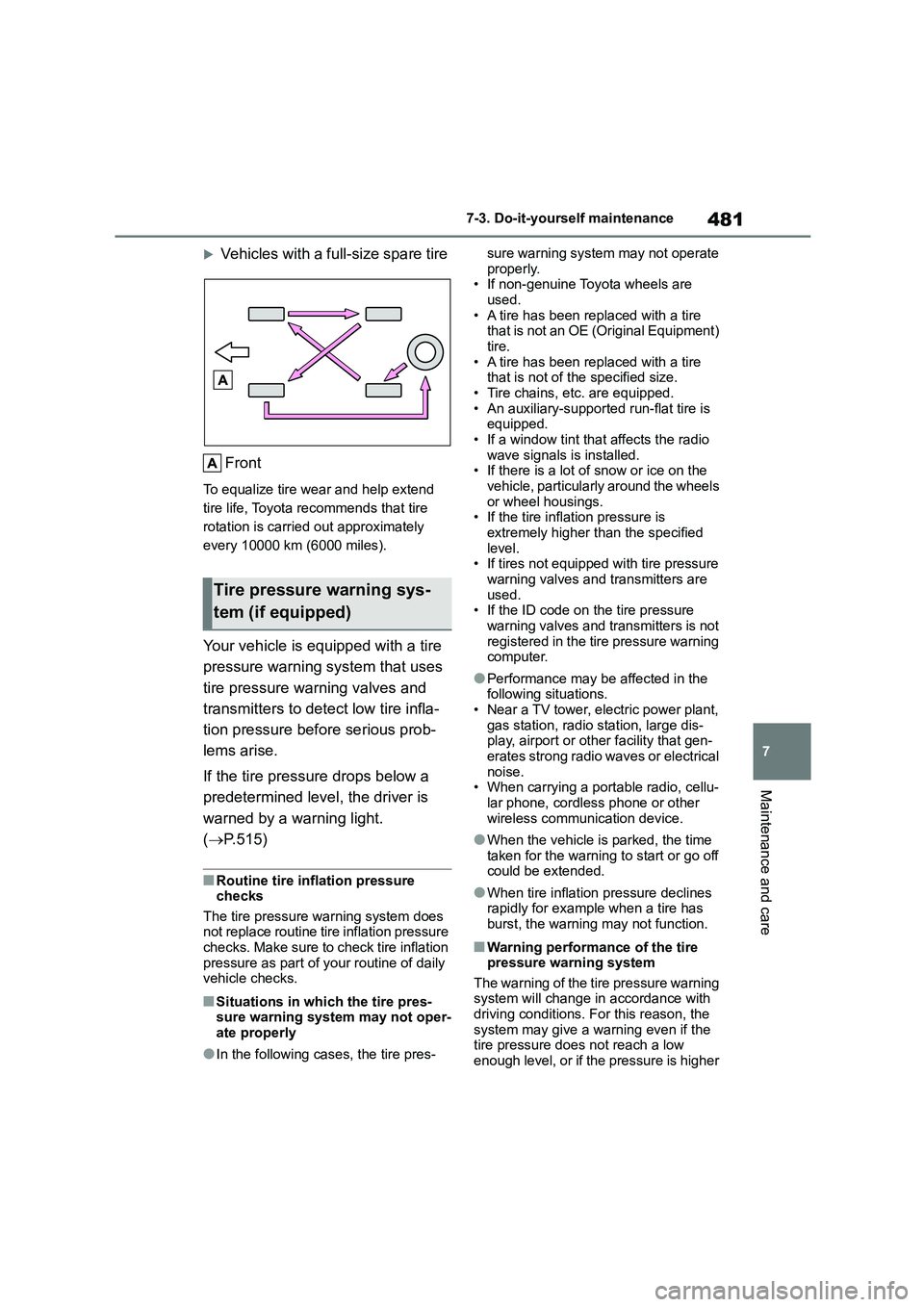
Vehicles with a full-size spare tire
Front
To equalize tire wear and help extend
tire life, Toyota recommends that tire
rotation is carried out approximately
every 10000 km (6000 miles).
Your vehicle is equipped with a tire
pressure warning system that uses
tire pressure warning valves and
transmitters to detect low tire infla-
tion pressure before serious prob-
lems arise.
If the tire pressure drops below a
predetermined level, the driver is
warned by a warning light.
( P.515)
■Routine tire inflation pressure
checks
The tire pressure warning system does not replace routine tire inflation pressure
checks. Make sure to check tire inflation
pressure as part of your routine of daily vehicle checks.
■Situations in which the tire pres-
sure warning system may not oper-
ate properly
●In the following cases, the tire pres-
sure warning system may not operate
properly. • If non-genuine Toyota wheels are
used.
• A tire has been replaced with a tire that is not an OE (Original Equipment)
tire.
• A tire has been replaced with a tire that is not of the specified size.
• Tire chains, etc. are equipped.
• An auxiliary-supported run-flat tire is equipped.
• If a window tint that affects the radio
wave signals is installed. • If there is a lot of snow or ice on the
vehicle, particularly around the wheels
or wheel housings. • If the tire inflation pressure is
extremely higher than the specified
level. • If tires not equipped with tire pressure
warning valves and transmitters are
used. • If the ID code on the tire pressure
warning valves and transmitters is not
registered in the tire pressure warning computer.
●Performance may be affected in the following situations.
• Near a TV tower, electric power plant,
gas station, radio station, large dis- play, airport or other facility that gen-
erates strong radio waves or electrical
noise. • When carrying a portable radio, cellu-
lar phone, cordless phone or other
wireless communication device.
●When the vehicle is parked, the time
taken for the warning to start or go off could be extended.
●When tire inflation pressure declines rapidly for example when a tire has
burst, the warning may not function.
■Warning performance of the tire
pressure warning system
The warning of the tire pressure warning system will change in accordance with
driving conditions. For this reason, the
system may give a warning even if the tire pressure does not reach a low
enough level, or if the pressure is higher
Tire pressure warning sys-
tem (if equipped)
Page 485 of 758
483
7
7-3. Do-it-yourself maintenance
Maintenance and care
■The tire pressure warning sys-
tem must be init ialized in the
following circumstances:
When rotating front and rear tires
which have different tire inflation
pressures.
When changing the tire size.
When the tire inflation pressure
is changed such as when chang-
ing traveling speed or load
weight.
When changing between two
registered wheel sets.
When the tire pressure warning
system is initialized , the current tire
inflation pressure is set as the
benchmark pressure.
■How to initialize the tire pres-
sure warning system
1 Park the vehicle in a safe place
and turn the engine switch off.
Initialization cannot be performed while the vehicle is moving.
2 Adjust the tire inflation pressure
to the specified co ld tire inflation
pressure level. ( P.573)
Make sure to adjust the tire pressure to
the specified cold tire inflation pressure level. The tire pre ssure warning system
will operate based on this pressure
level.
3 Turn the engine switch to ON.
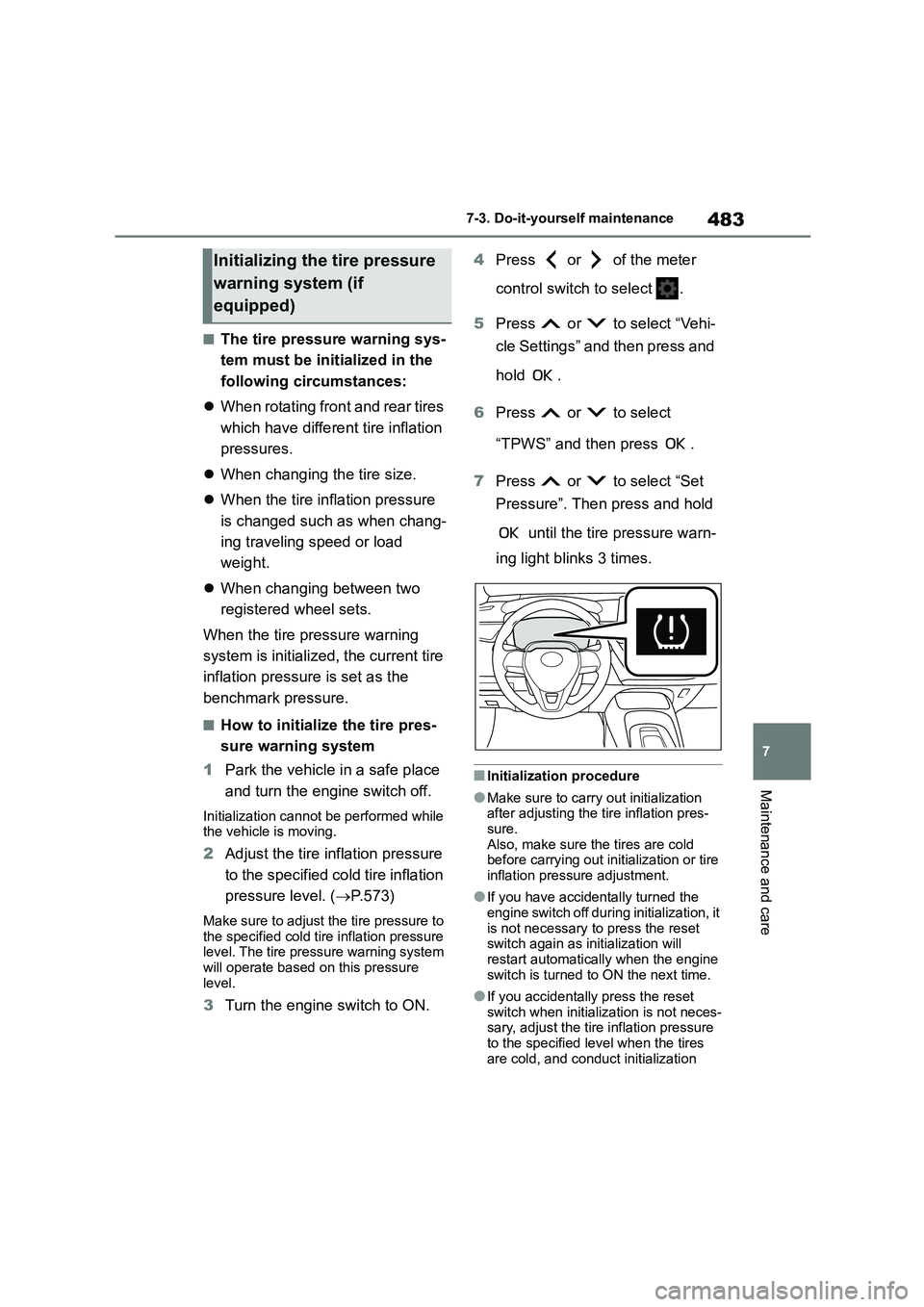
4 Press or of the meter
control switch to select .
5 Press or to select “Vehi-
cle Settings” and then press and
hold .
6 Press or to select
“TPWS” and then press .
7 Press or to select “Set
Pressure”. Then press and hold
until the tire pressure warn-
ing light blinks 3 times.
■Initialization procedure
●Make sure to carry out initialization after adjusting the tire inflation pres-
sure.
Also, make sure the tires are cold before carrying out initialization or tire
inflation pressure adjustment.
●If you have accidentally turned the
engine switch off during initialization, it
is not necessary to press the reset switch again as initialization will
restart automatically when the engine
switch is turned to ON the next time.
●If you accidentally press the reset
switch when initialization is not neces- sary, adjust the tire inflation pressure
to the specified level when the tires
are cold, and conduct initialization
Initializing the tire pressure
warning system (if
equipped)
Page 486 of 758
4847-3. Do-it-yourself maintenance
again.
■When initialization of the tire pres-
sure warning system has failed
Initialization can be completed in a few
minutes. However, in the following
cases, the settings have not been recorded and the system will not oper-
ate properly. If repeated attempts to
record tire inflation pressure settings are unsuccessful, have the vehicle
inspected by any authorized Toyota
retailer or Toyota authorized repairer, or any reliable repairer.
●When operating the tire pressure warning reset switch, the tire pressure
warning light does not blink 3 times.
●After driving for a certain period of
time since the initialization has been
completed, the wa rning light comes on after blinking for 1 minute.
The tire pressure warning valve
and transmitter is equipped with a
unique ID code. When replacing a
tire pressure warning valve and
transmitter, it is necessary to regis-
ter the ID code. Have the ID code
registered by any authorized Toyota
retailer or Toyota authorized
repairer, or any reliable repairer.
Your vehicle is equipped with tire
pressure warning system with the
function to have ID codes regis-
tered for a second wheel set, for
example a winter set, by any
authorized Toyota retailer or Toyota
authorized repairer, or any reliable
repairer.
After registration of a second wheel
set, either of these two wheel sets
can be selected for usage with the
tire pressure warning system.
■Operating conditions for the
function
This function will perform the
change of wheel set only if a sec-
ond wheel set has been regis-
tered. If no second wheel set has
been registered, no change will
be made when selecting this
function in the menu.
Only a change between both
registered wheel set is possible,
mixing between these wheel sets
is not supported.
■How to change between wheel
sets
1 Have the vehicle fitted with the
preferred wheel set.
2 Press or of the meter
control switch to select .
WA R N I N G
■When initializing the tire pres-
sure warning system
Do not initialize the tire pressure warning system withou t first adjusting
the tire inflation pressure to the speci-
fied level. Otherwise, the tire pressure warning light may not come on even if
the tire inflation pressure is low, or it
may come on when the tire inflation pressure is actually normal.
Registering ID codes (vehi-
cles with a tire pressure
warning system)
Selecting wheel set (vehi-
cles with a tire pressure
warning system)
Page 487 of 758
485
7
7-3. Do-it-yourself maintenance
Maintenance and care
3 Press or to select “Vehi-
cle Settings” and then press
.
4 Press or to select
“TPWS” and then press .
5 Press or to select
“Change Wheel”. Then press
and hold until the tire pres-
sure warning light blinks slowly
3 times.
6 Initialize the tire pressure warn-
ing system. ( P.483)
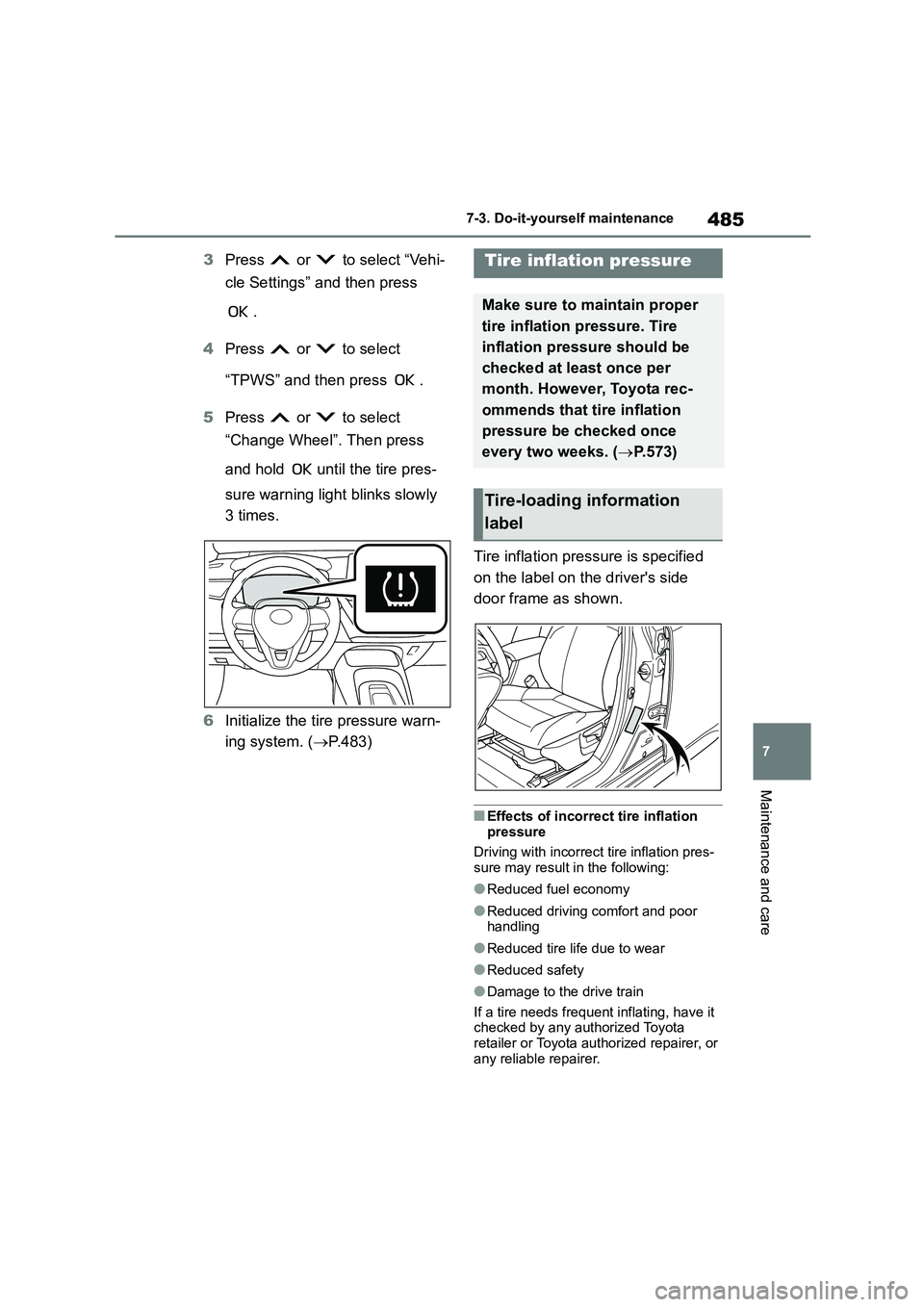
Tire inflation pressure is specified
on the label on the driver's side
door frame as shown.
■Effects of incorrect tire inflation
pressure
Driving with incorrect tire inflation pres- sure may result in the following:
●Reduced fuel economy
●Reduced driving comfort and poor
handling
●Reduced tire life due to wear
●Reduced safety
●Damage to the drive train
If a tire needs frequent inflating, have it checked by any authorized Toyota
retailer or Toyota authorized repairer, or
any reliable repairer.
Tire inflation pressure
Make sure to maintain proper
tire inflation pressure. Tire
inflation pressure should be
checked at least once per
month. However, Toyota rec-
ommends that tire inflation
pressure be checked once
every two weeks. ( P. 5 7 3 )
Tire-loading information
label
Page 488 of 758
4867-3. Do-it-yourself maintenance
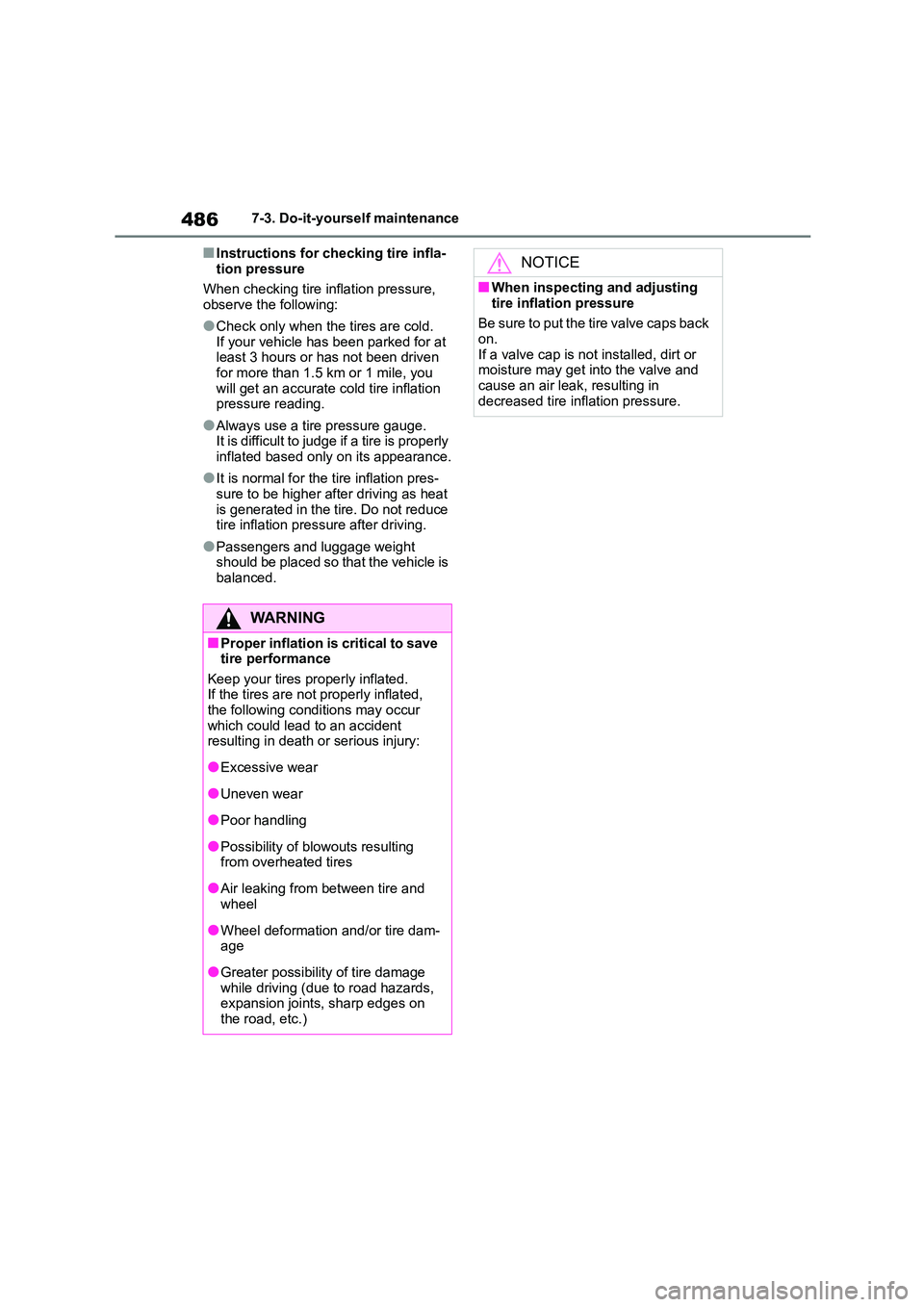
■Instructions for checking tire infla-
tion pressure
When checking tire inflation pressure,
observe the following:
●Check only when the tires are cold.
If your vehicle has been parked for at
least 3 hours or has not been driven for more than 1.5 km or 1 mile, you
will get an accurate cold tire inflation
pressure reading.
●Always use a tire pressure gauge.
It is difficult to judge if a tire is properly inflated based only on its appearance.
●It is normal for the tire inflation pres-sure to be higher after driving as heat
is generated in the tire. Do not reduce
tire inflation pressure after driving.
●Passengers and luggage weight
should be placed so that the vehicle is balanced.
WA R N I N G
■Proper inflation is critical to save
tire performance
Keep your tires properly inflated. If the tires are not properly inflated,
the following conditions may occur
which could lead to an accident resulting in death or serious injury:
●Excessive wear
●Uneven wear
●Poor handling
●Possibility of blowouts resulting from overheated tires
●Air leaking from between tire and wheel
●Wheel deformation and/or tire dam-age
●Greater possibility of tire damage while driving (due to road hazards,
expansion joints, sharp edges on
the road, etc.)
NOTICE
■When inspecting and adjusting
tire inflation pressure
Be sure to put the tire valve caps back on.
If a valve cap is not installed, dirt or
moisture may get into the valve and cause an air leak, resulting in
decreased tire inflation pressure.
Page 489 of 758
487
7
7-3. Do-it-yourself maintenance
Maintenance and care
When replacing wheels, care
should be taken to ensure that they
are equivalent to those removed in
load capacity, diameter, rim width
and inset*.
Replacement wheels are available
at any authorized Toyota retailer or
Toyota authorized repairer, or any
reliable repairer.
*: Conventionally referred to as offset.
Toyota does not recommend using
the following:
Wheels of different sizes or types
Used wheels
Bent wheels that have been
straightened
■When replacing wheels (vehicles
with a tire pressure warning sys- tem)
The wheels of your vehicle are equipped
with tire pressure warning valves and transmitters that allow the tire pressure
warning system to provide advance
warning in the event of a loss in tire inflation pressure. Whenever wheels are
replaced, the tire pressure warning
valves and transmitters must be installed. ( P.482)
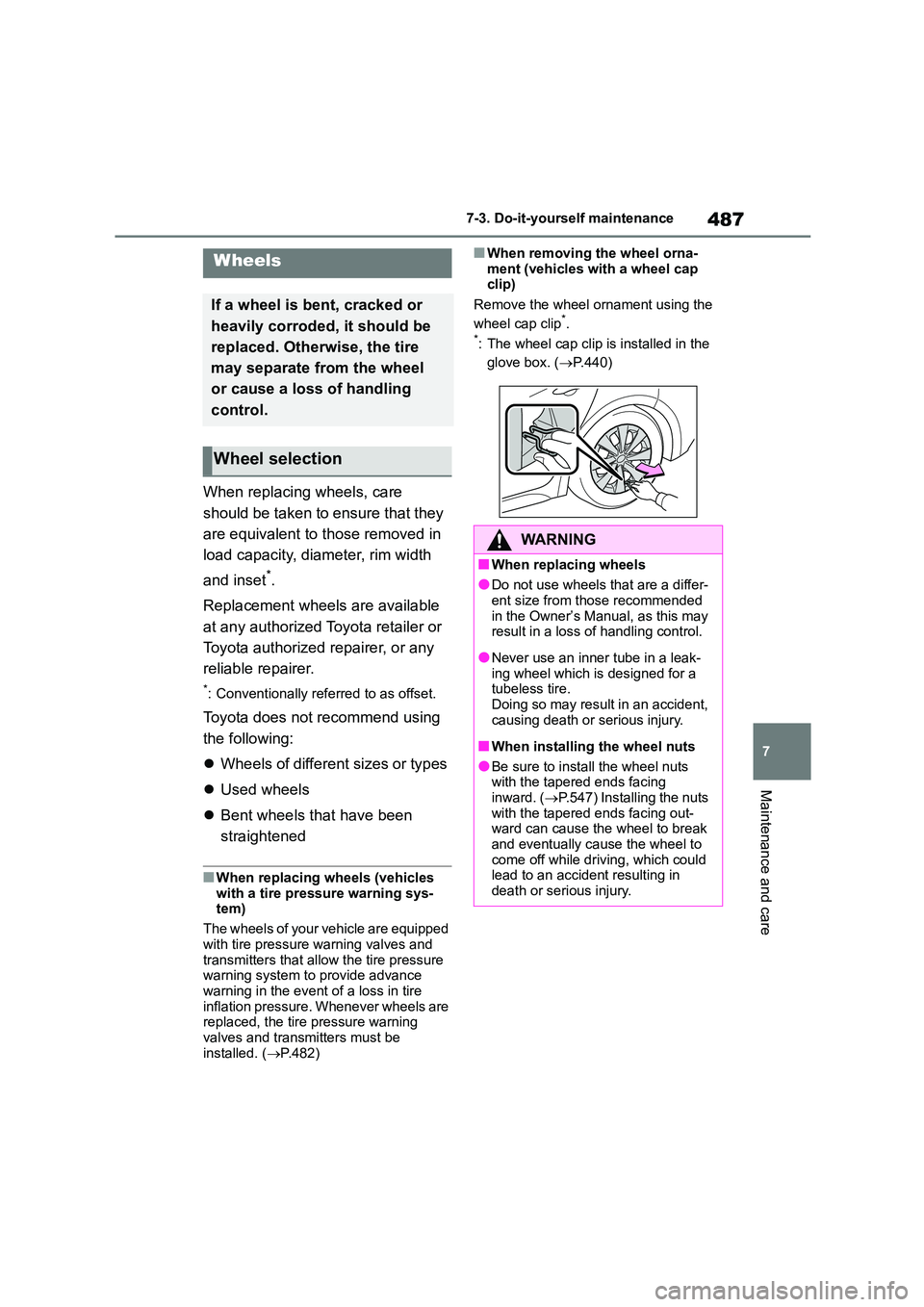
■When removing the wheel orna-
ment (vehicles with a wheel cap clip)
Remove the wheel ornament using the
wheel cap clip*.*: The wheel cap clip is installed in the
glove box. ( P.440)
Wheels
If a wheel is bent, cracked or
heavily corroded, it should be
replaced. Otherwise, the tire
may separate from the wheel
or cause a loss of handling
control.
Wheel selection
WA R N I N G
■When replacing wheels
●Do not use wheels that are a differ-
ent size from those recommended
in the Owner’s Manual, as this may result in a loss of handling control.
●Never use an inner tube in a leak-ing wheel which is designed for a
tubeless tire.
Doing so may result in an accident, causing death or serious injury.
■When installing the wheel nuts
●Be sure to install the wheel nuts
with the tapered ends facing
inward. ( P.547) Installing the nuts with the tapered ends facing out-
ward can cause the wheel to break
and eventually cause the wheel to come off while driving, which could
lead to an accident resulting in
death or serious injury.
Page 517 of 758
515
8
8-2. Steps to take in an emergency
When trouble arises
sounds intermittently for a certain period of time after the vehicle reaches a certain
speed.
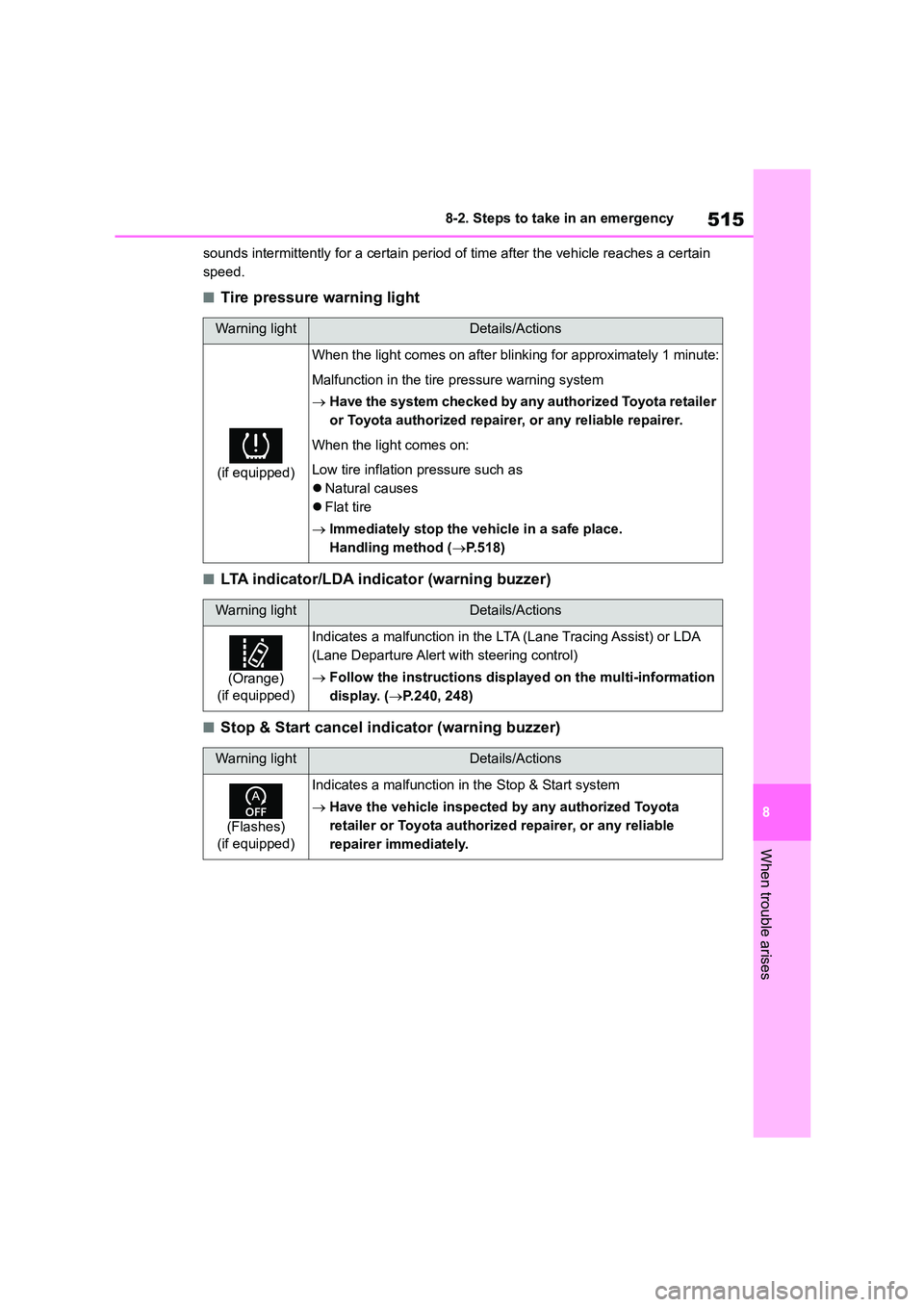
■Tire pressure warning light
■LTA indicator/LDA indicator (warning buzzer)
■Stop & Start cancel indicator (warning buzzer)
Warning lightDetails/Actions
(if equipped)
When the light comes on after blinking for approximately 1 minute:
Malfunction in the tire pressure warning system
Have the system checked by any authorized Toyota retailer
or Toyota authorized repairer, or any reliable repairer.
When the light comes on:
Low tire inflation pressure such as
Natural causes
Flat tire
Immediately stop the vehicle in a safe place.
Handling method ( P.518)
Warning lightDetails/Actions
(Orange)
(if equipped)
Indicates a malfunction in the LTA (Lane Tracing Assist) or LDA
(Lane Departure Alert with steering control)
Follow the instructions displayed on the multi-information
display. ( P.240, 248)
Warning lightDetails/Actions
(Flashes)
(if equipped)
Indicates a malfunction in the Stop & Start system
Have the vehicle inspected by any authorized Toyota
retailer or Toyota authorized repairer, or any reliable
repairer immediately.
Page 521 of 758
519
8
8-2. Steps to take in an emergency
When trouble arises
tion pressure of each tire and adjust
them to the specified level.
2 If the warning light does not turn off even after several minutes have
elapsed, check that the inflation
pressure of each tire is at the speci- fied level and perform initialization.
( P.483)
■The tire pressure warning light may
come on due to natural causes (vehicles with a tire pressure warn-
ing system)
The tire pressure warning light may come on due to natural causes such as
natural air leaks and tire inflation pres-
sure changes caused by temperature. In this case, adjusting the tire inflation
pressure will turn off the warning light
(after a few minutes).
■When a tire is replaced with a spare tire (vehicles with a tire pressure
warning system)
The spare tire is not equipped with a tire pressure warning valve and transmitter.
If a tire goes flat, the tire pressure warn-
ing light will not turn off even though the flat tire has been replaced with the spare
tire. Replace the spare tire with the
repaired tire and adjust the tire inflation pressure. The tire pr essure warning light
will go off after a few minutes.
■Conditions that the tire pressure
warning system may not function properly (vehicles with a tire pres-
sure warning system)
P.481
WA R N I N G
■If both the ABS and the brake
system warning lights remain on
Stop your vehicle in a safe place immediately and contact any author-
ized Toyota retailer or Toyota author-
ized repairer, or any reliable repairer. The vehicle will become extremely
unstable during br aking, and the ABS
system may fail, which could cause
an accident resulting in death or seri- ous injury.
■When the electric power steer-ing system warning light comes
on
When the light comes on yellow, the assist to the power steering is
restricted. When th e light comes on
red, the assist to the power steering is lost and handling operations of the
steering wheel become extremely
heavy. When steering wheel operations are
heavier than usual, grip the steering
wheel firmly and operate it using more force than usual.
■If the tire pressure warning light comes on (vehicles with a tire
pressure warning system)
Be sure to observe the following pre- cautions.
Failure to do so could cause a loss of
vehicle control and re sult in death or serious injury.
●Stop your vehicle in a safe place as soon as possible. Adjust the tire
inflation pressure immediately.
Page 522 of 758
5208-2. Steps to take in an emergency
■Warning messages
The warning messages explained below
may differ from the actual messages
according to operation conditions and vehicle specifications.
■Warning buzzer
A buzzer may sound when a message is
displayed. The buzzer may not be audible if the
vehicle is in a noisy location or if the
audio system volume is high.
■If “Engine Oil Level Low Add or Replace” is displayed
The engine oil level is low. Check the
WA R N I N G
●Vehicles with a compact spare tire
and full-size spare tire: If the tire
pressure warning light comes on even after tire inflation pressure
adjustment, it is probable that you
have a flat tire. Check the tires. If a tire is flat, change it with the spare
tire and have the flat tire repaired
by the nearest any authorized
Toyota retailer or Toyota authorized repairer, or any reliable repairer.
●Vehicles with emergency tire punc-ture repair kit: If the tire pressure
warning light comes on even after
tire inflation pressure adjustment, it is probable that you have a flat tire.
Check the tires. If a tire is flat, repair
the flat tire by using emergency tire puncture repair kit.
●Avoid abrupt maneuvering and braking.
If the vehicle tires deteriorate, you
could lose control of the steering wheel or the brakes.
■If a blowout or sudden air leak-age should occur (vehicles with
a tire pressure warning system)
The tire pressure warning system may not activate immediately.
NOTICE
■To ensure the tire pressure warn-
ing system operates properly
(vehicles with a tire pressure warning system)
Do not install tires with different speci-
fications or makers, as the tire pres- sure warning system may not operate
properly.
If a war ning message is
displayed
The multi-information display
shows warnings for system
malfunctions and incorrectly
performed operations, and
messages that indicate a need
for maintenance. When a mes-
sage is displayed, perform the
appropriate corrective action
for the message.
If a warning message is dis-
played again after the appro-
priate actions have been
performed, contact any author-
ized Toyota retailer or Toyota
authorized repairer, or any reli-
able repairer.
Additionally, if a warning light
comes on or flashes at the
same time that a warning mes-
sage is displayed, take the
appropriate corrective action
for the warning light. ( P.511)
Page 531 of 758
529
8
8-2. Steps to take in an emergency
When trouble arises
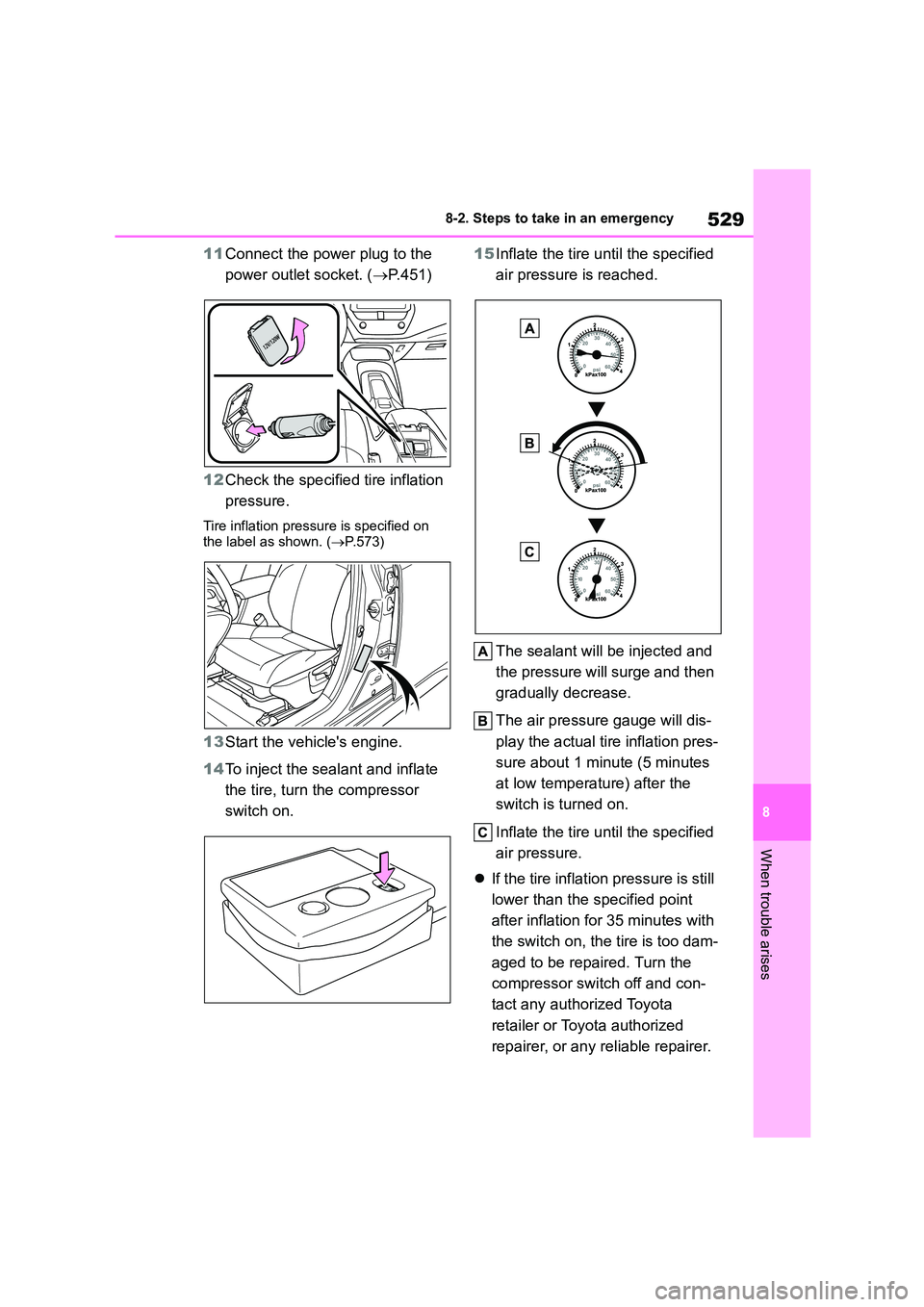
11 Connect the power plug to the
power outlet socket. ( P.451)
12 Check the specified tire inflation
pressure.
Tire inflation pressure is specified on the label as shown. ( P.573)
13Start the vehicle's engine.
14 To inject the sealant and inflate
the tire, turn the compressor
switch on.
15 Inflate the tire until the specified
air pressure is reached.
The sealant will be injected and
the pressure will surge and then
gradually decrease.
The air pressure gauge will dis-
play the actual tire inflation pres-
sure about 1 minute (5 minutes
at low temperature) after the
switch is turned on.
Inflate the tire until the specified
air pressure.
If the tire inflation pressure is still
lower than the specified point
after inflation for 35 minutes with
the switch on, the tire is too dam-
aged to be repaired. Turn the
compressor switch off and con-
tact any authorized Toyota
retailer or Toyota authorized
repairer, or any reliable repairer.