airbag off TOYOTA COROLLA HATCHBACK 2022 Owners Manual (in English)
[x] Cancel search | Manufacturer: TOYOTA, Model Year: 2022, Model line: COROLLA HATCHBACK, Model: TOYOTA COROLLA HATCHBACK 2022Pages: 758, PDF Size: 155.26 MB
Page 4 of 758
2TABLE OF CONTENTS
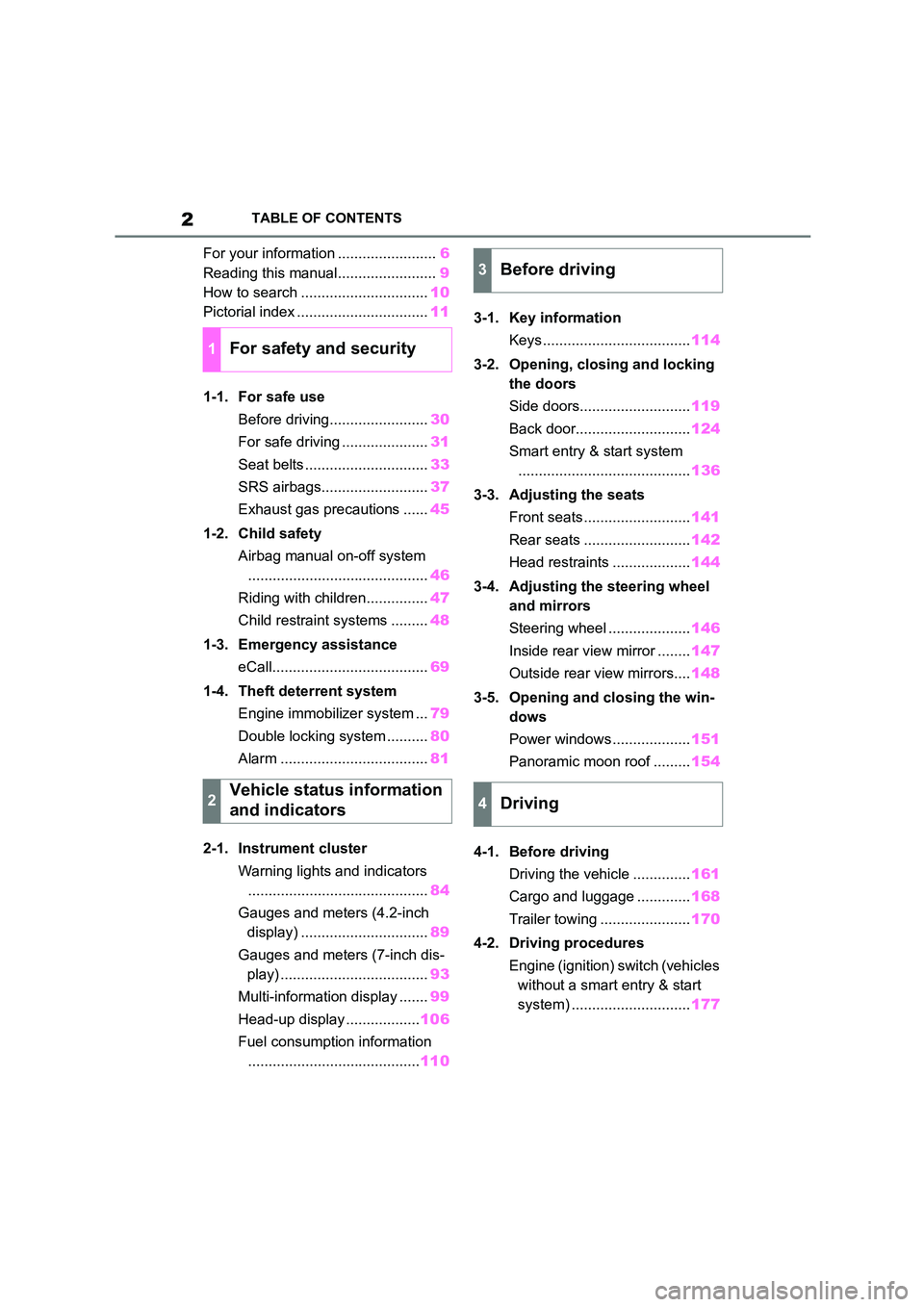
For your information ........................6
Reading this manual........................ 9
How to search ............................... 10
Pictorial index ................................ 11
1-1. For safe use
Before driving........................ 30
For safe driving ..................... 31
Seat belts .............................. 33
SRS airbags.......................... 37
Exhaust gas precautions ...... 45
1-2. Child safety
Airbag manual on-off system
............................................ 46
Riding with children............... 47
Child restraint systems ......... 48
1-3. Emergency assistance
eCall...................................... 69
1-4. Theft deterrent system
Engine immobilizer system ... 79
Double locking system .......... 80
Alarm .................................... 81
2-1. Instrument cluster
Warning lights and indicators
............................................ 84
Gauges and meters (4.2-inch
display) ............................... 89
Gauges and meters (7-inch dis-
play) .................................... 93
Multi-information display ....... 99
Head-up display .................. 106
Fuel consumption information
.......................................... 110
3-1. Key information
Keys .................................... 114
3-2. Opening, closing and locking
the doors
Side doors........................... 119
Back door............................ 124
Smart entry & start system
.......................................... 136
3-3. Adjusting the seats
Front seats .......................... 141
Rear seats .......................... 142
Head restraints ................... 144
3-4. Adjusting the steering wheel
and mirrors
Steering wheel .................... 146
Inside rear view mirror ........ 147
Outside rear view mirrors.... 148
3-5. Opening and closing the win-
dows
Power windows ................... 151
Panoramic moon roof ......... 154
4-1. Before driving
Driving the vehicle .............. 161
Cargo and luggage ............. 168
Trailer towing ...................... 170
4-2. Driving procedures
Engine (ignition) switch (vehicles
without a smart entry & start
system) ............................. 177
1For safety and security
2Vehicle status information
and indicators
3Before driving
4Driving
Page 9 of 758
7
RF-transmitters, is available on
request at any authorized Toyota
retailer or Toyota authorized
repairer, or any reliable repairer.
The vehicle is equipped with
sophisticated comp uters that will
record certain data, such as:
• Engine speed/Electric motor
speed (traction motor speed)
• Accelerator status
• Brake status
• Vehicle speed
• Operation status of the driving
assist systems
• Images from the cameras
Your vehicle is equipped with cameras.
Contact any authorized Toyota retailer
or Toyota authorized repairer, or any
reliable repairer for the location of
recording cameras.
The recorded data varies according
to the vehicle grade level, options
and destinations with which it is
equipped.
These computers do not record
conversations or sounds, and only
record images outside of the vehi-
cle in certain situations.
Data usage
Toyota may use the data recorded in
this computer to diagnose malfunc-
tions, conduct research and develop-
ment, and improve quality.
Toyota will not disclose the recorded
data to a third party except:
• With the consent of the vehicle owner
or with the consent of the lessee if
the vehicle is leased
• In response to an official request by
the police, a court of law or a govern-
ment agency
• For use by Toyota in a lawsuit
• For research purposes where the
data is not tied to a specific vehicle or
vehicle owner
Recorded image information can
be erased by any authorized
Toyota retailer or Toyota author-
ized repairer, or any reliable
repairer.
The image recording function can be
disabled. However, if the function is dis-
abled, data from when the system oper-
ates will not be available.
The SRS airbag and seat belt
pretensioner devices in your Toyota
contain explosive c hemicals. If the
vehicle is scrapped with the airbags
and seat belt pretensioners left as
they are, this may cause an acci-
dent such as fire. Be sure to have
the systems of the SRS airbag and
seat belt pretensioner removed and
disposed of by a qualified service
shop or by any authorized Toyota
retailer or Toyota authorized
repairer, or any reliable repairer
before you scrap your vehicle.
Vehicle data recording
Scrapping of your Toyota
Page 31 of 758
1
29
For safety and security
1
For safety and security
.1-1. For safe use
Before driving ..................... 30
For safe driving ................... 31
Seat belts............................ 33
SRS airbags ....................... 37
Exhaust gas precautions .... 45
1-2. Child safety
Airbag manual on-off system
......................................... 46
Riding with children ............ 47
Child restraint systems ....... 48
1-3. Emergency assistance
eCall ................................... 69
1-4. Theft deterrent system
Engine immobilizer system
......................................... 79
Double locking system ........ 80
Alarm .................................. 81
Page 40 of 758
381-1. For safe use
Can help protect primarily the head of occupants in the outer seats
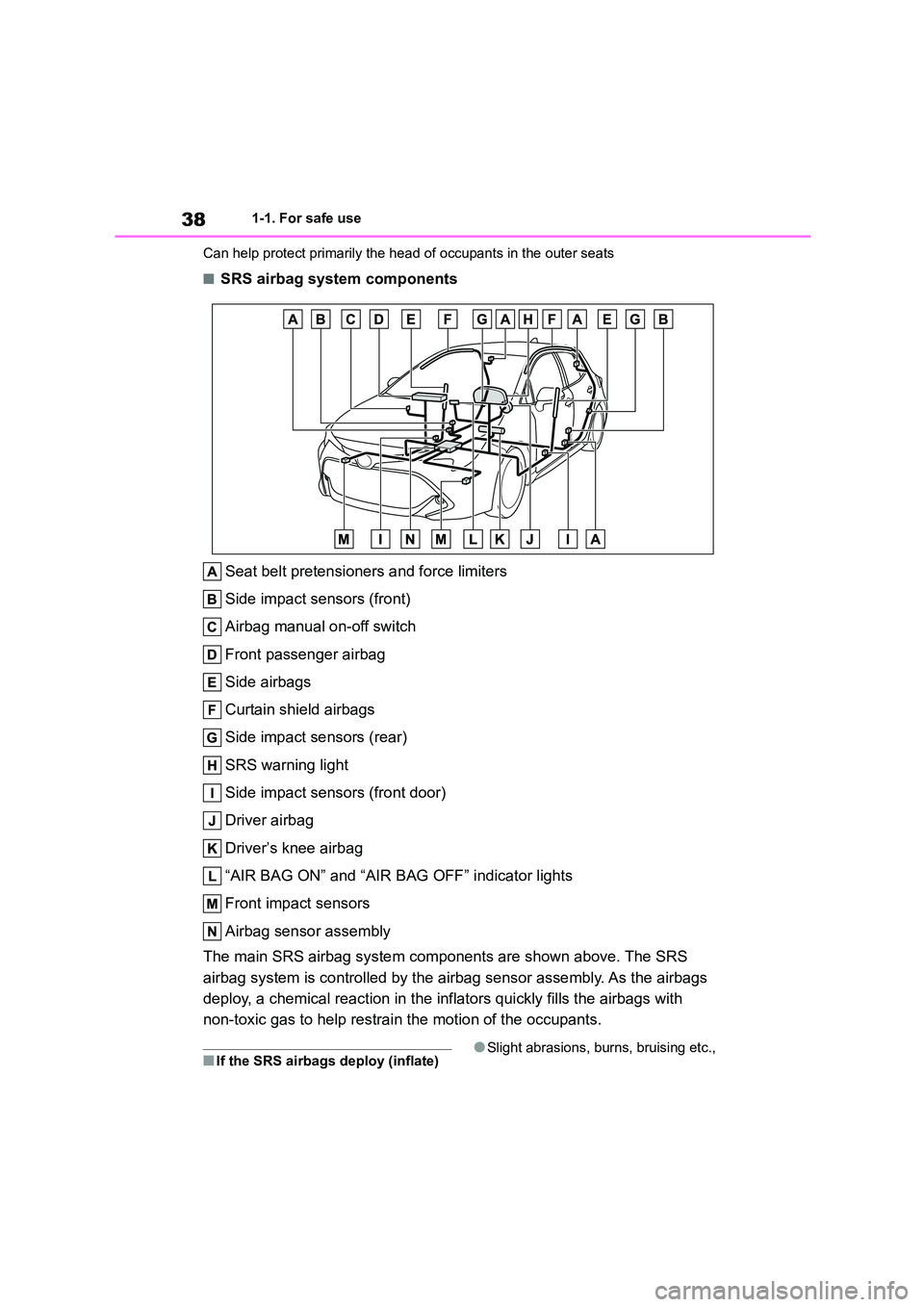
■SRS airbag system components
Seat belt pretensioners and force limiters
Side impact sensors (front)
Airbag manual on-off switch
Front passenger airbag
Side airbags
Curtain shield airbags
Side impact sensors (rear)
SRS warning light
Side impact sensors (front door)
Driver airbag
Driver’s knee airbag
“AIR BAG ON” and “AIR BAG OFF” indicator lights
Front impact sensors
Airbag sensor assembly
The main SRS airbag system components are shown above. The SRS
airbag system is controlled by the airbag sensor assembly. As the airbags
deploy, a chemical reaction in the inflators quickly fills the airbags with
non-toxic gas to help restrain the motion of the occupants.
■If the SRS airbags deploy (inflate)●Slight abrasions, burns, bruising etc.,
Page 46 of 758
441-1. For safe use
WA R N I N G
●Do not use seat accessories which
cover the parts where the SRS side
airbags inflate as they may interfere with inflation of the SRS airbags.
Such accessories may prevent the
side airbags from activating cor- rectly, disable the system or cause
the side airbags to inflate acciden-
tally, resulting in death or serious
injury.
●Do not strike or apply significant
levels of force to the area of the SRS airbag components or the
front doors.
Doing so can cause the SRS airbags to malfunction.
●Do not touch any of the component parts immediately after the SRS
airbags have deployed (inflated) as
they may be hot.
●If breathing becomes difficult after
the SRS airbags have deployed, open a door or window to allow
fresh air in, or leave the vehicle if it
is safe to do so. Wash off any resi- due as soon as possible to prevent
skin irritation.
●If the areas where the SRS airbags
are stored, such as the steering
wheel pad and front and rear pillar garnishes, are damaged or
cracked, have them replaced by
any authorized Toyota retailer or Toyota authorized repairer, or any
reliable repairer.
■Modification and disposal of SRS
airbag system components
Do not dispose of your vehicle or per- form any of the following modifica-
tions without consulting your Toyota
retailer or Toyota authorized repairer, or any reliable repairer. The SRS
airbags may malfunction or deploy
(inflate) accidentally, causing death or serious injury.
●Installation, remo val, disassembly and repair of the SRS airbags
●Repairs, modifications, removal or replacement of the steering wheel,
instrument panel, dashboard, seats
or seat upholstery, front, side and rear pillars, roof side rails, front
door panels, front door trims or front
door speakers
●Modifications to the front door panel
(such as making a hole in it)
●Repairs or modifications of the front
fender, front bumper, or side of the occupant compartment
●Installation of a grille guard (bull bars, kangaroo bar, etc.), snow
plows or winches
●Modifications to the vehicle’s sus-
pension system
●Installation of electronic devices
such as mobile two-way radios
(RF-transmitter) and CD players
Page 48 of 758
461-2. Child safety
1-2.Child safety
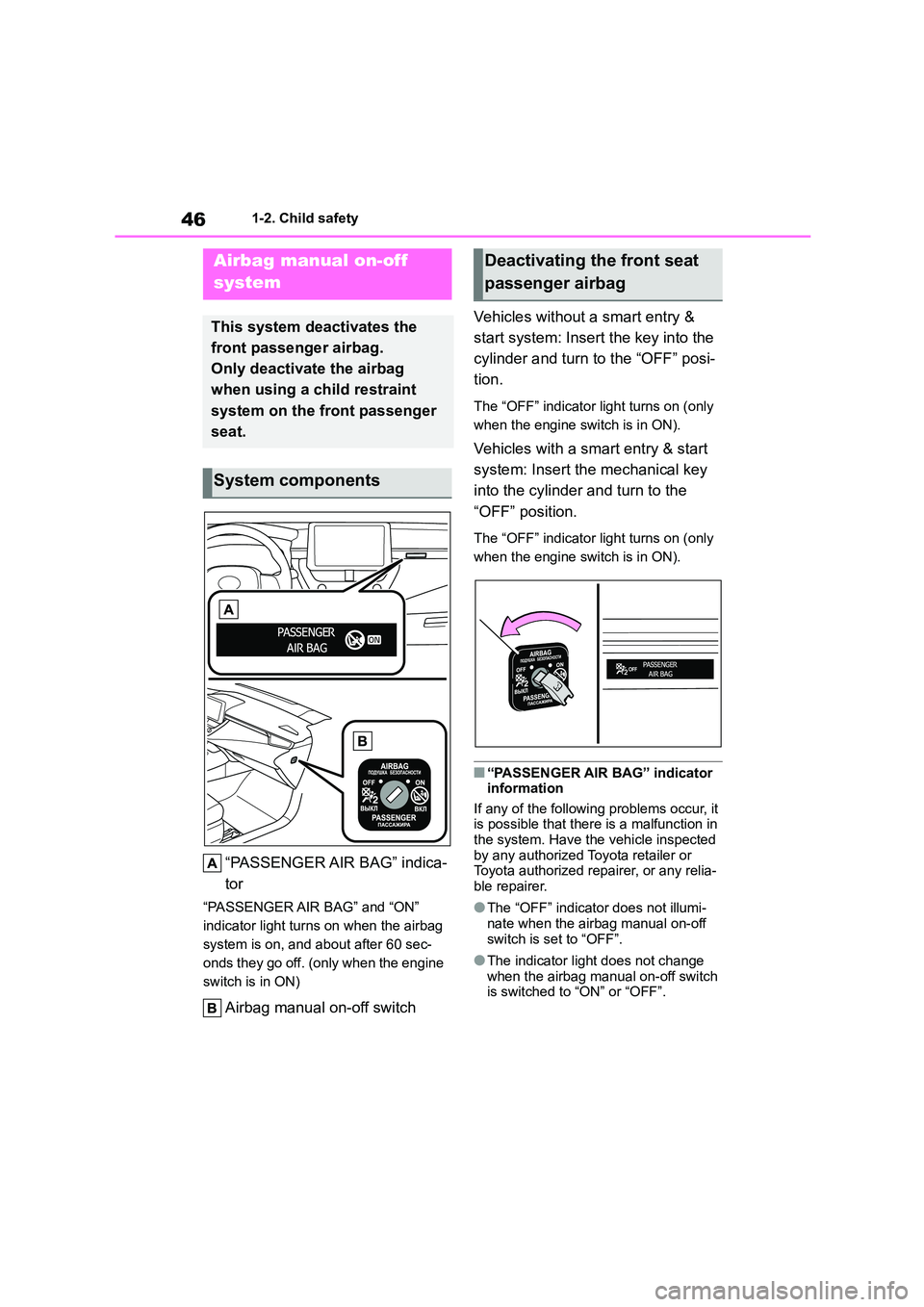
“PASSENGER AIR BAG” indica-
tor
“PASSENGER AIR BAG” and “ON”
indicator light turns on when the airbag
system is on, and about after 60 sec-
onds they go off. (only when the engine
switch is in ON)
Airbag manual on-off switch
Vehicles without a smart entry &
start system: Insert the key into the
cylinder and turn to the “OFF” posi-
tion.
The “OFF” indicator light turns on (only
when the engine switch is in ON).
Vehicles with a smart entry & start
system: Insert the mechanical key
into the cylinder and turn to the
“OFF” position.
The “OFF” indicator light turns on (only
when the engine switch is in ON).
■“PASSENGER AIR BAG” indicator information
If any of the following problems occur, it
is possible that there is a malfunction in the system. Have the vehicle inspected
by any authorized Toyota retailer or
Toyota authorized repairer, or any relia- ble repairer.
●The “OFF” indicator does not illumi-
nate when the airbag manual on-off switch is set to “OFF”.
●The indicator light does not change when the airbag manual on-off switch
is switched to “ON” or “OFF”.
Airbag manual on-off
system
This system deactivates the
front passenger airbag.
Only deactivate the airbag
when using a child restraint
system on the front passenger
seat.
System components
Deactivating the front seat
passenger airbag
Page 49 of 758
47
1
1-2. Child safety
For safety and security
WA R N I N G
■When installing a child restraint
system
For safety reasons, always install a child restraint system in a rear seat. In
the event that the rear seat cannot be
used, the front seat can be used as long as the airbag manual on-off sys-
tem is set to “OFF”.
If the airbag manual on-off system is
left on, the strong impact of the airbag deployment (inflation) may cause
serious injury or even death.
■When a child restraint system is
not installed on the front passen-
ger seat
Ensure that the airbag manual on-off
system is set to “ON”.
If it is left off, the airbag may not deploy in the event of an accident,
which may result in serious injury or
even death.
Riding with children
Observe the following precau-
tions when children are in the
vehicle.
Use a child restraint system
appropriate for the child, until
the child becomes large
enough to properly wear the
vehicle’s seat belt.
It is recommended that chil-
dren sit in the rear seats to
avoid accidental contact with
the shift lever, wiper switch,
etc.
Use the rear door child-protec-
tor lock or the window lock
switch to avoid children open-
ing the door while driving or
operating the power window
accidentally. ( P.123, 153)
Do not let small children oper-
ate equipment which may
catch or pinch body parts,
such as the power window,
hood, back door, seats, etc.
Page 52 of 758
501-2. Child safety
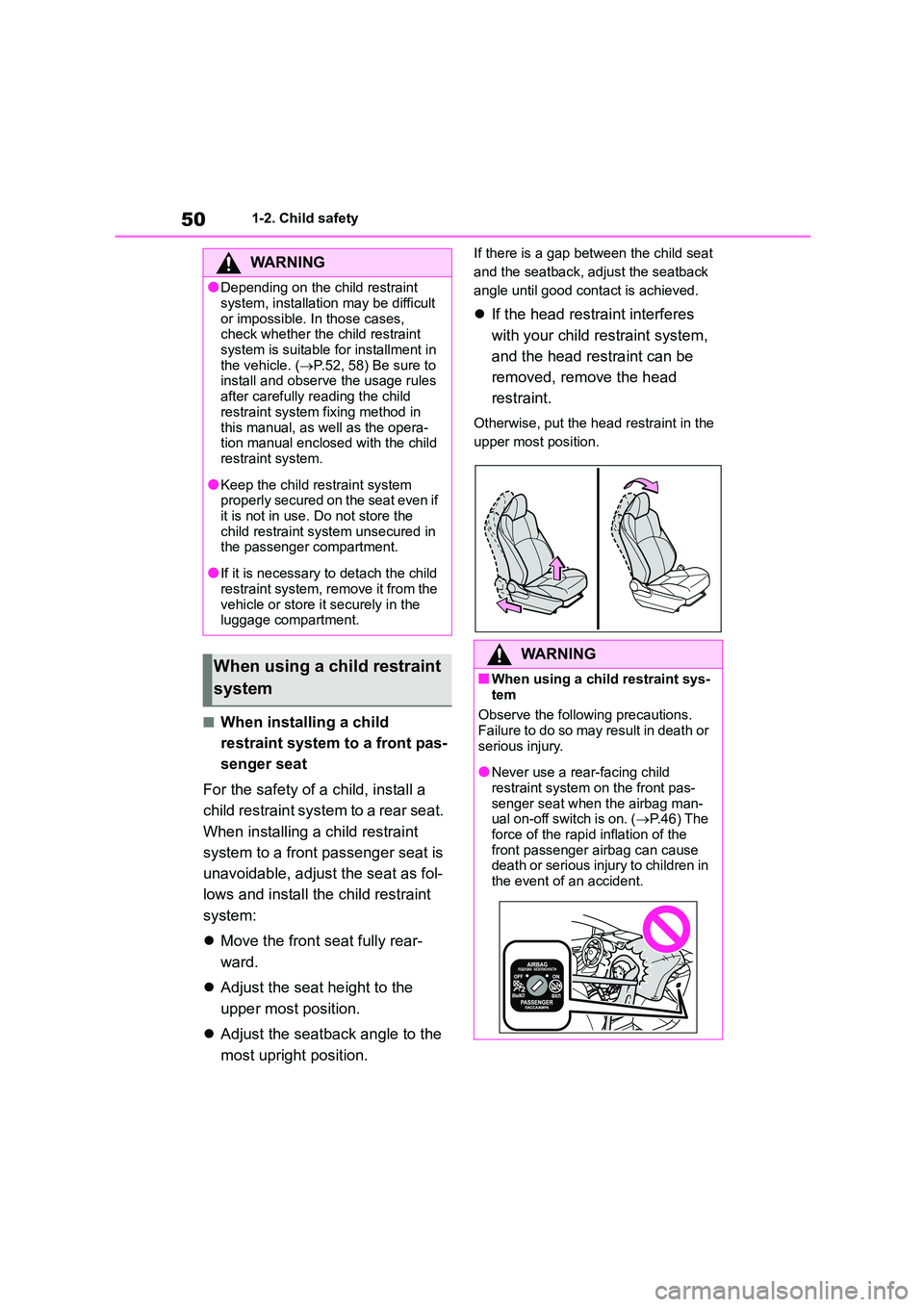
■When installing a child
restraint system to a front pas-
senger seat
For the safety of a child, install a
child restraint system to a rear seat.
When installing a child restraint
system to a front passenger seat is
unavoidable, adjust the seat as fol-
lows and install t he child restraint
system:
Move the front seat fully rear-
ward.
Adjust the seat height to the
upper most position.
Adjust the seatback angle to the
most upright position.
If there is a gap between the child seat
and the seatback, adjust the seatback
angle until good contact is achieved.
If the head restraint interferes
with your child restraint system,
and the head restraint can be
removed, remove the head
restraint.
Otherwise, put the head restraint in the
upper most position.
WA R N I N G
●Depending on the child restraint
system, installation may be difficult
or impossible. In those cases, check whether the child restraint
system is suitable for installment in
the vehicle. ( P.52, 58) Be sure to install and observe the usage rules
after carefully reading the child
restraint system fixing method in
this manual, as well as the opera- tion manual enclosed with the child
restraint system.
●Keep the child re straint system
properly secured on the seat even if
it is not in use. Do not store the child restraint system unsecured in
the passenger compartment.
●If it is necessary to detach the child
restraint system, remove it from the
vehicle or store it securely in the luggage compartment.
When using a child restraint
system
WA R N I N G
■When using a child restraint sys-
tem
Observe the following precautions. Failure to do so may result in death or
serious injury.
●Never use a rear-facing child
restraint system on the front pas-
senger seat when the airbag man- ual on-off switch is on. ( P.46) The
force of the rapid inflation of the
front passenger airbag can cause death or serious injury to children in
the event of an accident.
Page 54 of 758
521-2. Child safety
*: Guadeloupe, Martinique and F. Gui-
ana
■Child restraint system compat-
ibility for each seating posi-
tion
Compatibility of each seating posi-
tion with child restraint systems
( P.54) displays the type of child
restraint systems that can be used
and possible seating positions for
installation using symbols.
Also, the recommended child
restraint system that is suitable for
your child can be selected.
Otherwise, ch eck [Recommended
child restraint systems and Com-
patibility table] for recommended
WA R N I N G
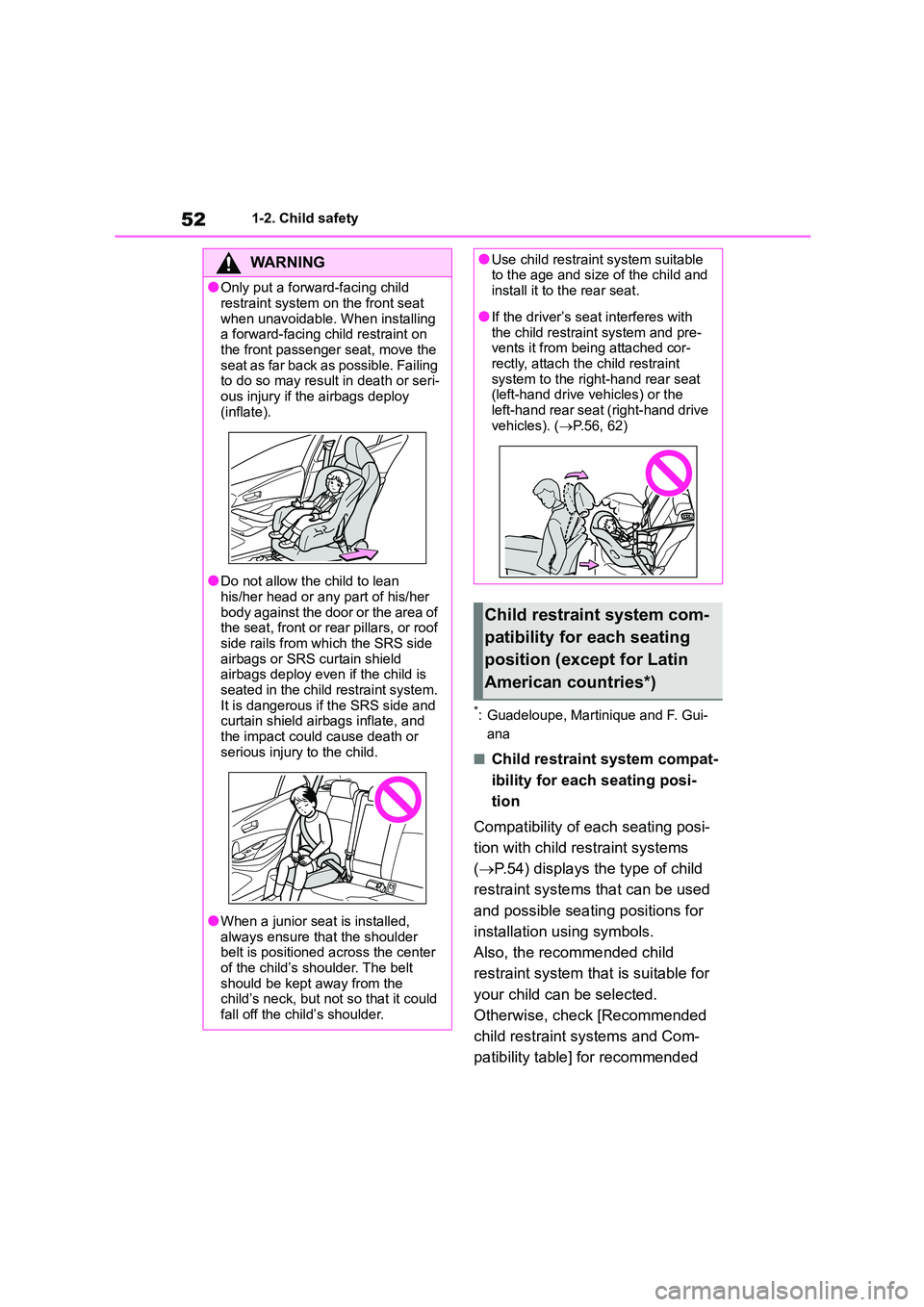
●Only put a forward-facing child
restraint system on the front seat
when unavoidable. When installing a forward-facing child restraint on
the front passenger seat, move the
seat as far back as possible. Failing to do so may result in death or seri-
ous injury if the airbags deploy
(inflate).
●Do not allow the child to lean
his/her head or any part of his/her
body against the door or the area of the seat, front or rear pillars, or roof
side rails from which the SRS side
airbags or SRS curtain shield airbags deploy even if the child is
seated in the child restraint system.
It is dangerous if the SRS side and curtain shield airbags inflate, and
the impact could cause death or
serious injury to the child.
●When a junior seat is installed,
always ensure that the shoulder belt is positioned across the center
of the child’s shoulder. The belt
should be kept away from the child’s neck, but not so that it could
fall off the child’s shoulder.
●Use child restrain t system suitable to the age and size of the child and
install it to the rear seat.
●If the driver’s seat interferes with
the child restraint system and pre-
vents it from being attached cor- rectly, attach th e child restraint
system to the right-hand rear seat
(left-hand drive vehicles) or the left-hand rear seat (right-hand drive
vehicles). ( P.56, 62)
Child restraint system com-
patibility for each seating
position (except for Latin
American countries*)
Page 56 of 758
541-2. Child safety
depending on the product.
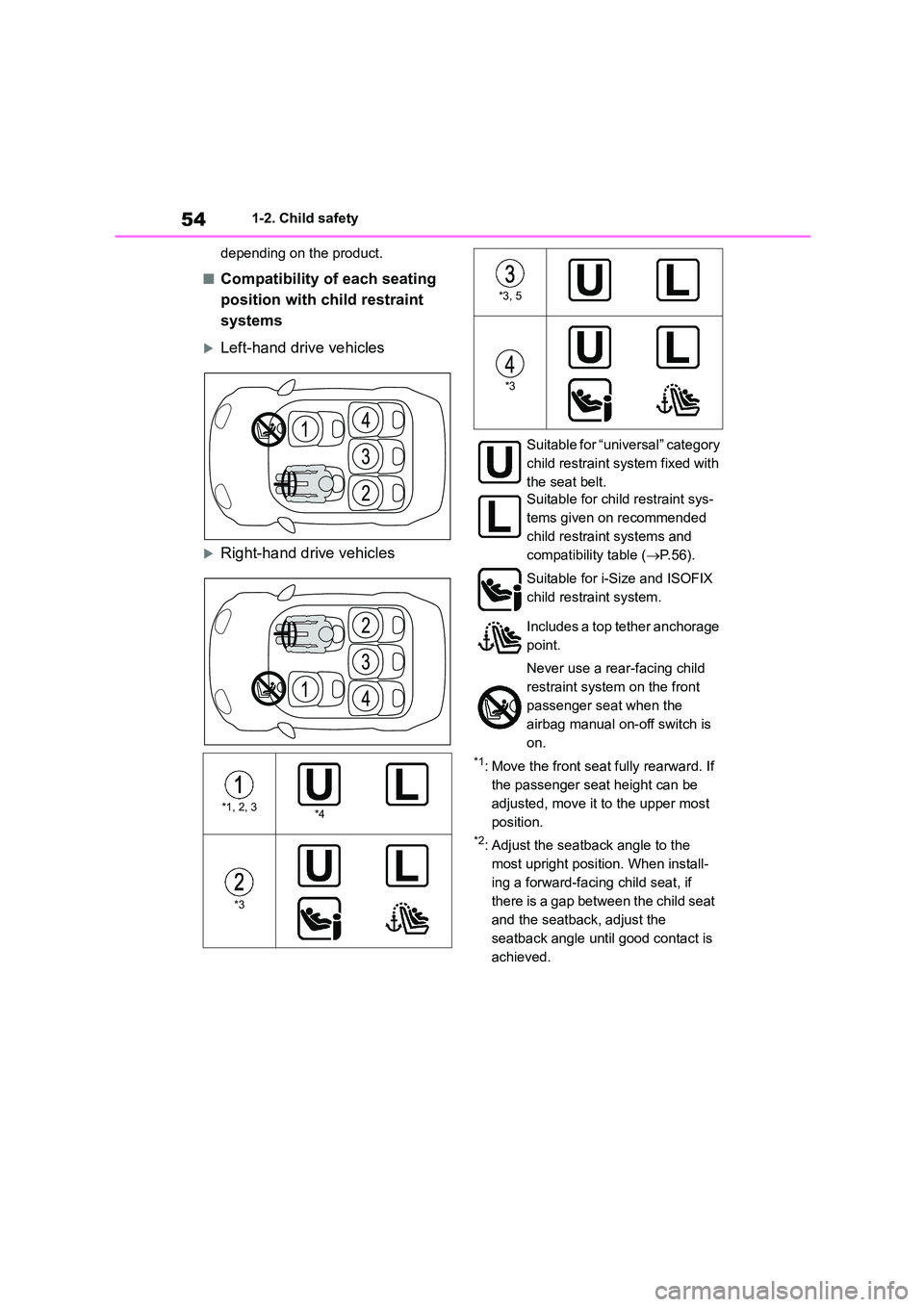
■Compatibility of each seating
position with child restraint
systems
Left-hand drive vehicles
Right-hand drive vehicles
*1: Move the front seat fully rearward. If
the passenger seat height can be
adjusted, move it to the upper most
position.
*2: Adjust the seatback angle to the
most upright position. When install-
ing a forward-facing child seat, if
there is a gap between the child seat
and the seatback, adjust the
seatback angle until good contact is
achieved.
*1, 2, 3*4
*3
*3, 5
*3
Suitable for “universal” category
child restraint system fixed with
the seat belt.
Suitable for child restraint sys-
tems given on recommended
child restraint systems and
compatibility table ( P. 5 6 ) .
Suitable for i-Size and ISOFIX
child restraint system.
Includes a top tether anchorage
point.
Never use a rear-facing child
restraint system on the front
passenger seat when the
airbag manual on-off switch is
on.