power steering TOYOTA COROLLA HATCHBACK 2022 Owners Manual (in English)
[x] Cancel search | Manufacturer: TOYOTA, Model Year: 2022, Model line: COROLLA HATCHBACK, Model: TOYOTA COROLLA HATCHBACK 2022Pages: 758, PDF Size: 155.26 MB
Page 4 of 758
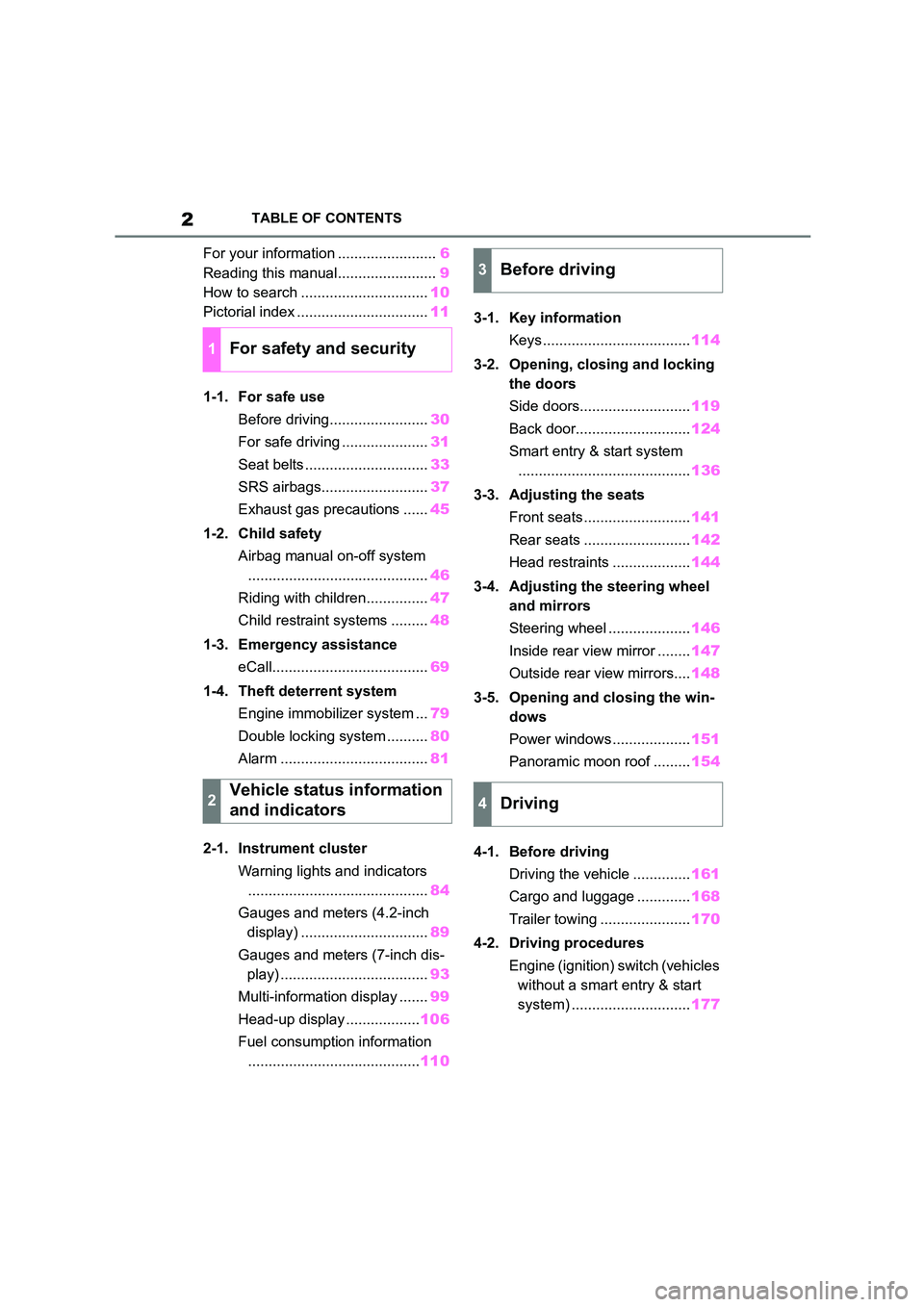
2TABLE OF CONTENTS
For your information ........................6
Reading this manual........................ 9
How to search ............................... 10
Pictorial index ................................ 11
1-1. For safe use
Before driving........................ 30
For safe driving ..................... 31
Seat belts .............................. 33
SRS airbags.......................... 37
Exhaust gas precautions ...... 45
1-2. Child safety
Airbag manual on-off system
............................................ 46
Riding with children............... 47
Child restraint systems ......... 48
1-3. Emergency assistance
eCall...................................... 69
1-4. Theft deterrent system
Engine immobilizer system ... 79
Double locking system .......... 80
Alarm .................................... 81
2-1. Instrument cluster
Warning lights and indicators
............................................ 84
Gauges and meters (4.2-inch
display) ............................... 89
Gauges and meters (7-inch dis-
play) .................................... 93
Multi-information display ....... 99
Head-up display .................. 106
Fuel consumption information
.......................................... 110
3-1. Key information
Keys .................................... 114
3-2. Opening, closing and locking
the doors
Side doors........................... 119
Back door............................ 124
Smart entry & start system
.......................................... 136
3-3. Adjusting the seats
Front seats .......................... 141
Rear seats .......................... 142
Head restraints ................... 144
3-4. Adjusting the steering wheel
and mirrors
Steering wheel .................... 146
Inside rear view mirror ........ 147
Outside rear view mirrors.... 148
3-5. Opening and closing the win-
dows
Power windows ................... 151
Panoramic moon roof ......... 154
4-1. Before driving
Driving the vehicle .............. 161
Cargo and luggage ............. 168
Trailer towing ...................... 170
4-2. Driving procedures
Engine (ignition) switch (vehicles
without a smart entry & start
system) ............................. 177
1For safety and security
2Vehicle status information
and indicators
3Before driving
4Driving
Page 19 of 758
17Pictorial index
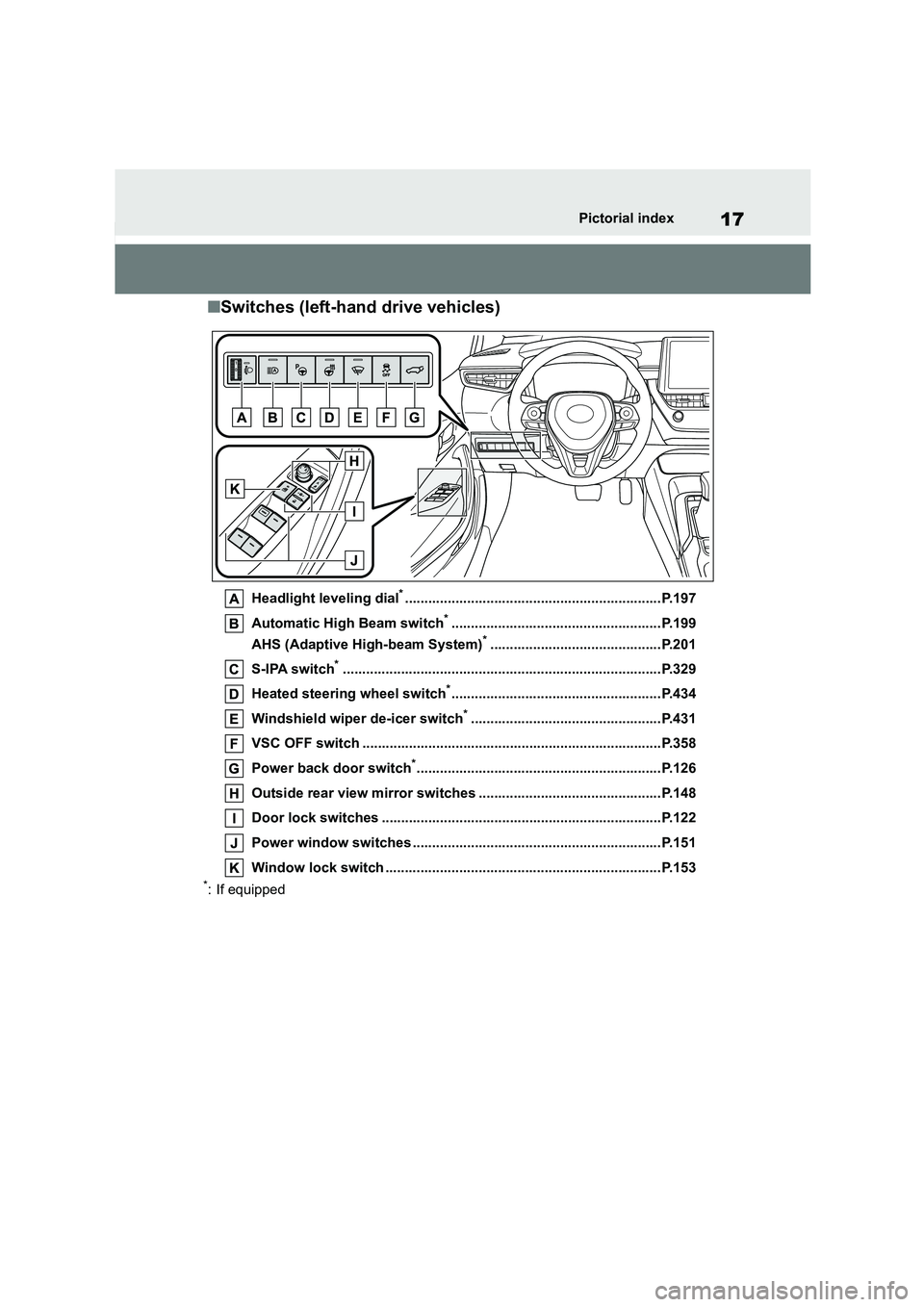
■Switches (left-hand drive vehicles)
Headlight leveling dial*..................................................................P.197
Automatic High Beam switch*......................................................P.199
AHS (Adaptive High-beam System)*............................................P.201
S-IPA switch*..................................................................................P.329
Heated steering wheel switch*......................................................P.434
Windshield wiper de-icer switch*.................................................P.431
VSC OFF switch .............................................................................P.358
Power back door switch*...............................................................P.126
Outside rear view mirror switches ...............................................P.148
Door lock switches ........................................................................P.122
Power window switches ................................................................P.151
Window lock switch .......................................................................P.153
*: If equipped
Page 26 of 758
24Pictorial index
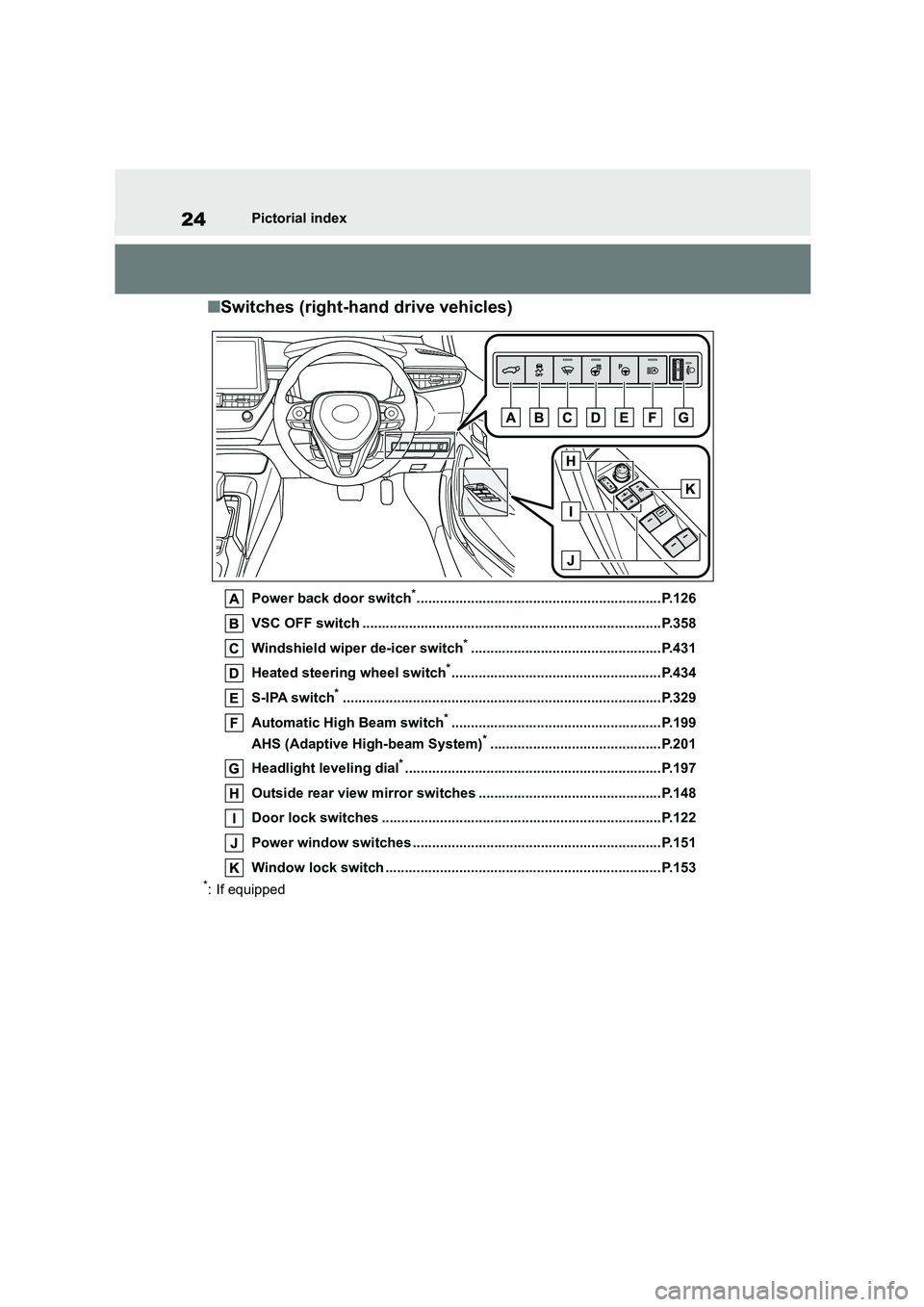
■Switches (right-hand drive vehicles)
Power back door switch*...............................................................P.126
VSC OFF switch .............................................................................P.358
Windshield wiper de-icer switch*.................................................P.431
Heated steering wheel switch*......................................................P.434
S-IPA switch*..................................................................................P.329
Automatic High Beam switch*......................................................P.199
AHS (Adaptive High-beam System)*............................................P.201
Headlight leveling dial*..................................................................P.197
Outside rear view mirror switches ...............................................P.148
Door lock switches ........................................................................P.122
Power window switches ................................................................P.151
Window lock switch .......................................................................P.153
*: If equipped
Page 88 of 758
862-1. Instrument cluster
*1: These lights come on when the
engine switch is turned to ON to indi-
cate that a system check is being
performed. They will turn off after the
engine is started, or after a few sec-
onds. There may be a malfunction in
a system if the lights do not come
on, or turn off. Have the vehicle
inspected by any authorized Toyota
retailer or Toyota authorized repairer,
or any reliable repairer.
*2: This light illuminates on the
multi-information display.
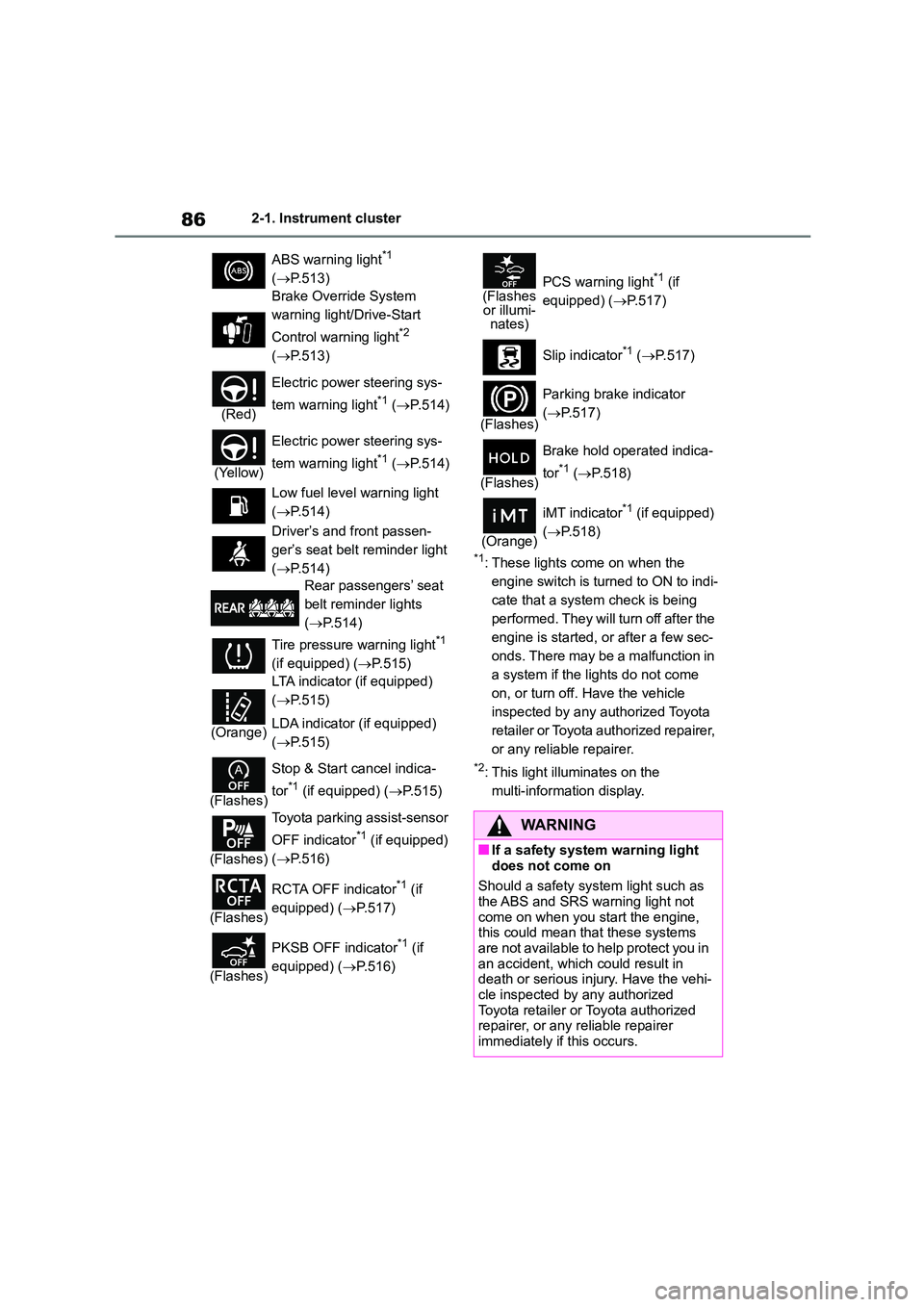
ABS warning light*1
( P.513)
Brake Override System
warning light/Drive-Start
Control warning light*2
( P.513)
(Red)
Electric power steering sys-
tem warning light*1 ( P.514)
(Yellow)
Electric power steering sys-
tem warning light*1 ( P.514)
Low fuel level warning light
( P.514)
Driver’s and front passen-
ger’s seat belt reminder light
( P.514)
Rear passengers’ seat
belt reminder lights
( P.514)
Tire pressure warning light*1
(if equipped) ( P.515)
(Orange)
LTA indicator (if equipped)
( P.515)
LDA indicator (if equipped)
( P.515)
(Flashes)
Stop & Start cancel indica-
tor*1 (if equipped) ( P.515)
(Flashes)
Toyota parking assist-sensor
OFF indicator*1 (if equipped)
( P.516)
(Flashes)
RCTA OFF indicator*1 (if
equipped) ( P.517)
(Flashes)
PKSB OFF indicator*1 (if
equipped) ( P.516)
(Flashes or illumi-nates)
PCS warning light*1 (if
equipped) ( P.517)
Slip indicator*1 ( P.517)
(Flashes)
Parking brake indicator
( P.517)
(Flashes)
Brake hold operated indica-
tor*1 ( P.518)
(Orange)
iMT indicator*1 (if equipped)
( P.518)
WA R N I N G
■If a safety system warning light
does not come on
Should a safety syst em light such as the ABS and SRS warning light not
come on when you start the engine,
this could mean that these systems are not available to help protect you in
an accident, which could result in
death or serious injury. Have the vehi-
cle inspected by any authorized Toyota retailer or Toyota authorized
repairer, or any reliable repairer
immediately if this occurs.
Page 115 of 758
3
113
3
Before driving
Before driving
.3-1. Key information
Keys.................................. 114
3-2. Opening, closing and locking
the doors
Side doors ........................ 119
Back door ......................... 124
Smart entry & start system
....................................... 136
3-3. Adjusting the seats
Front seats........................ 141
Rear seats ........................ 142
Head restraints ................. 144
3-4. Adjusting the steering wheel
and mirrors
Steering wheel .................. 146
Inside rear view mirror ...... 147
Outside rear view mirrors
....................................... 148
3-5. Opening and closing the win-
dows
Power windows................. 151
Panoramic moon roof ....... 154
Page 151 of 758
149
3
3-4. Adjusting the steering wheel and mirrors
Before driving
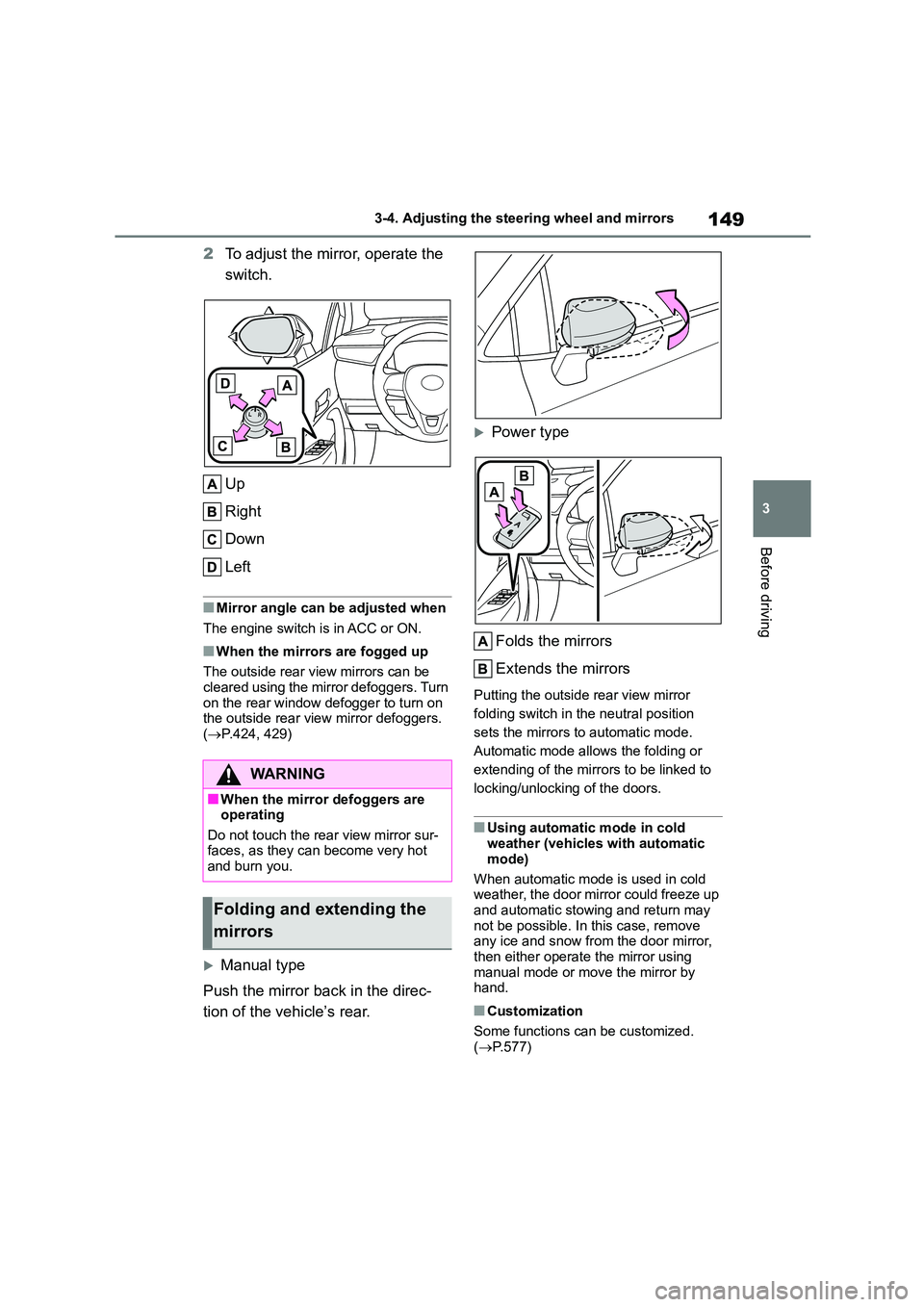
2 To adjust the mirror, operate the
switch.
Up
Right
Down
Left
■Mirror angle can be adjusted when
The engine switch is in ACC or ON.
■When the mirrors are fogged up
The outside rear view mirrors can be cleared using the mirror defoggers. Turn
on the rear window defogger to turn on
the outside rear view mirror defoggers. ( P.424, 429)
Manual type
Push the mirror back in the direc-
tion of the vehicle’s rear.
Power type
Folds the mirrors
Extends the mirrors
Putting the outside rear view mirror
folding switch in the neutral position
sets the mirrors to automatic mode.
Automatic mode allows the folding or
extending of the mirrors to be linked to
locking/unlocking of the doors.
■Using automatic mode in cold
weather (vehicles with automatic
mode)
When automatic mode is used in cold weather, the door mirror could freeze up
and automatic stowing and return may
not be possible. In this case, remove any ice and snow from the door mirror,
then either operate the mirror using
manual mode or move the mirror by hand.
■Customization
Some functions can be customized.
( P.577)
WA R N I N G
■When the mirror defoggers are
operating
Do not touch the rear view mirror sur- faces, as they can become very hot
and burn you.
Folding and extending the
mirrors
Page 166 of 758
1644-1. Before driving
WA R N I N G
• When backing up, you may twist
your body around, leading to a diffi-
culty in operating the pedals. Make sure to operate the pedals properly.
• Make sure to keep a correct driving posture even when moving the
vehicle only slightly. This allows you
to depress the brake and accelera-
tor pedals properly.
• Depress the brake pedal using your
right foot. Depressing the brake pedal using your left foot may delay
response in an emergency, result-
ing in an accident.
●Do not drive the vehicle over or
stop the vehicle near flammable materials.
The exhaust system and exhaust
gases can be extremely hot. These hot parts may cause a fire if there is
any flammable material nearby.
●During normal driving, do not turn
off the engine. Turning the engine
off while driving will not cause loss of steering or braking control, but
the power assist to these systems
will be lost. This will make it more difficult to steer and brake, so you
should pull over and stop the vehi-
cle as soon as it is safe to do so. However, in the event of an emer-
gency, such as if it becomes impos-
sible to stop the vehicle in the normal way: P. 5 0 2
●Use engine braking (downshift) to maintain a safe speed when driving
down a steep hill.
Using the brakes continuously may cause the brakes to overheat and
lose effectiveness. (P.182, 186)
●Do not adjust the positions of the
steering wheel, the seat, or the
inside or outside rear view mirrors while driving.
Doing so may result in a loss of
vehicle control.
●Always check that all passengers’ arms, heads or other parts of their
body are not outside the vehicle.
■When driving on slippery road
surfaces
●Sudden braking, acceleration and steering may cause tire slippage
and reduce your ability to control
the vehicle.
●Sudden acceleration, engine brak-
ing due to shifting, or changes in engine speed could cause the vehi-
cle to skid.
●After driving through a puddle,
lightly depress the brake pedal to
make sure that the brakes are func- tioning properly. Wet brake pads
may prevent the brakes from func-
tioning properly. If the brakes on only one side are wet and not func-
tioning properly, steering control
may be affected.
■When shifting the shift lever
●Vehicles with a Multidrive: Do not let the vehicle roll backward while a
forward driving position is selected,
or roll forward while the shift lever is in R.
Doing so may cause the engine to
stall or lead to poor brake and steering performance, resulting in
an accident or damage to the vehi-
cle.
●Vehicles with a Multidrive: Do not
shift the shift lever to P while the vehicle is moving.
Doing so can damage the transmis-
sion and may result in a loss of vehicle control.
●Do not shift the shift lever to R while
the vehicle is moving forward. Doing so can damage the transmis-
sion and may result in a loss of
vehicle control.
Page 169 of 758
167
4
4-1. Before driving
Driving
NOTICE
■When driving the vehicle (vehi-
cles with a Multidrive)
●Do not depress the accelerator and brake pedals at the same time dur-
ing driving, as this may restrain the
engine output.
●Do not use the accelerator pedal or
depress the accelerator and brake
pedals at the same time to hold the vehicle on a hill.
■When driving the vehicle (vehi-cles with a manual transmission)
●Do not depress the accelerator and
brake pedals at the same time dur- ing driving, as this may restrain the
engine output.
●Do not shift gears unless the clutch
pedal is fully depressed. After shift-
ing, do not release the clutch pedal abruptly. Doing so may damage the
clutch, transmission and gears.
●Observe the following precautions.
Failure to do so may cause exces-
sive premature wear or damage to the clutch, eventually making it diffi-
cult to accelerate and start off from
a stop. Have the vehicle inspected by any authorized Toyota retailer or
Toyota authorized repairer, or any
reliable repairer.
• Do not rest your foot on the clutch
pedal or depress it any time other
than when shifting. Doing so may cause clutch trouble.
• Do not use any gear other than the 1st gear when starting off and mov-
ing forward.
Doing so may damage the clutch.
• Do not use the clutch pedal to
adjust vehicle speed. Doing so may damage the clutch.
• When stopping the vehicle with the shift lever in a position other than N,
make sure to fully depress the
clutch pedal and stop the vehicle using the brakes.
●Do not shift the shift lever to R with-out the vehicle completely stopped.
Doing so may damage the clutch,
transmission and gears.
■When parking the vehicle (vehi-
cles with a Multidrive)
Always set the parking brake and shift
the shift lever to P. Failure to do so
may cause the vehicl e to move or the vehicle may accelerate suddenly if
the accelerator pedal is accidentally
depressed.
■Avoiding damage to vehicle parts
●Do not turn the steering wheel fully in either direction and hold it there
for an extended period of time.
Doing so may damage the power steering motor.
●When driving over bumps in the road, drive as slowly as possible to
avoid damaging the wheels, under-
side of the vehicle, etc.
●Make sure to idle the engine imme-
diately after high-load driving. Stop the engine only after the
turbocharger has cooled down.
Failure to do so may cause damage to the turbocharger.
■If you get a flat tire while driving
A flat or damaged tire may cause the
following situations. Hold the steering
wheel firmly and gradually depress the brake pedal to slow down the
vehicle.
●It may be difficult to control your vehicle.
●The vehicle will make abnormal sounds or vibrations.
●The vehicle will lean abnormally.
Page 182 of 758
1804-2. Driving procedures
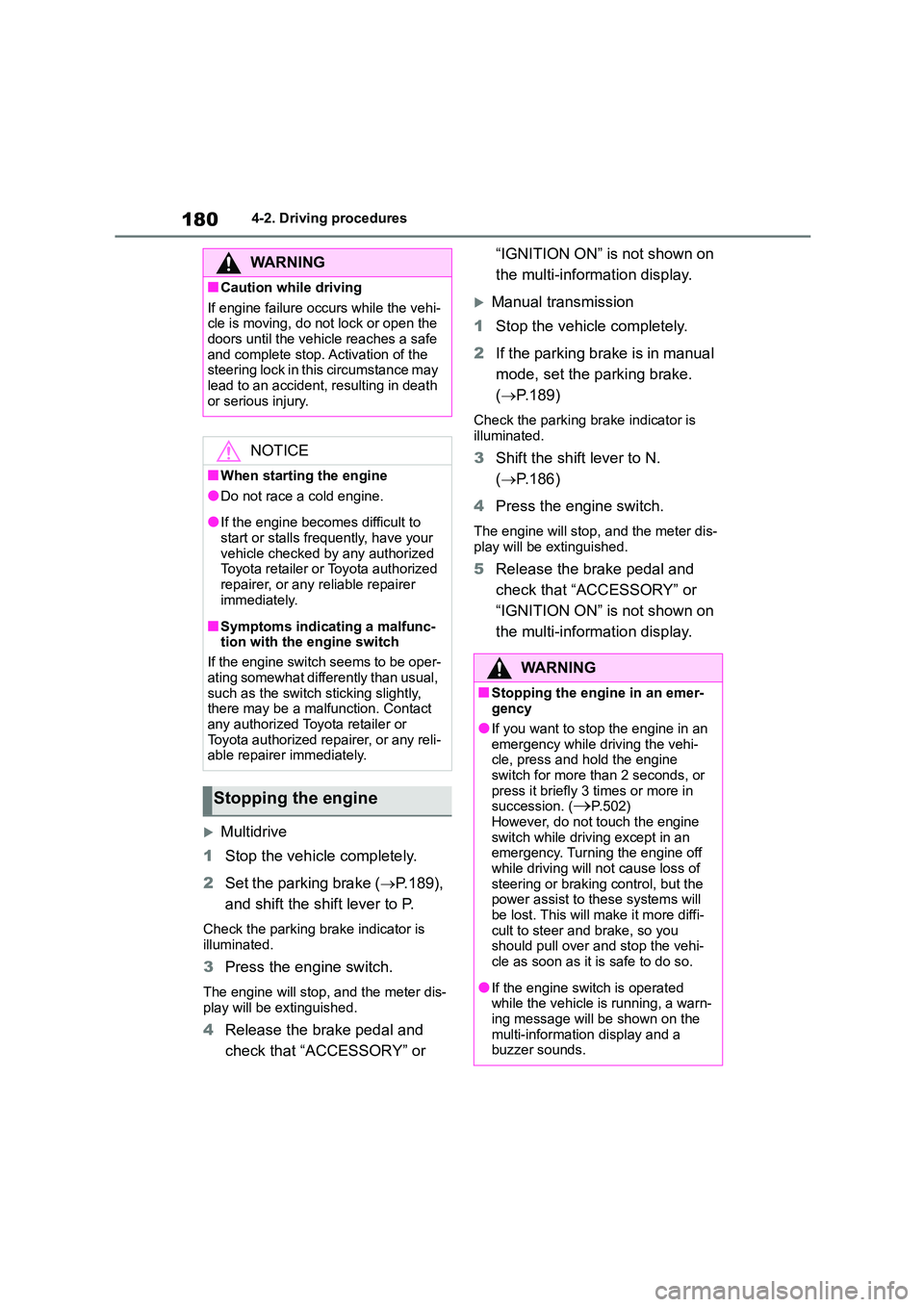
Multidrive
1 Stop the vehicle completely.
2 Set the parking brake (P.189),
and shift the shift lever to P.
Check the parking brake indicator is
illuminated.
3 Press the engine switch.
The engine will stop, and the meter dis-
play will be extinguished.
4 Release the brake pedal and
check that “ACCESSORY” or
“IGNITION ON” is not shown on
the multi-information display.
Manual transmission
1 Stop the vehicle completely.
2 If the parking brake is in manual
mode, set the parking brake.
( P.189)
Check the parking brake indicator is illuminated.
3 Shift the shift lever to N.
( P.186)
4 Press the engine switch.
The engine will stop, and the meter dis-
play will be extinguished.
5 Release the brake pedal and
check that “ACCESSORY” or
“IGNITION ON” is not shown on
the multi-information display.
WA R N I N G
■Caution while driving
If engine failure occurs while the vehi-
cle is moving, do not lock or open the doors until the vehicle reaches a safe
and complete stop. Activation of the
steering lock in this circumstance may lead to an accident, resulting in death
or serious injury.
NOTICE
■When starting the engine
●Do not race a cold engine.
●If the engine becomes difficult to
start or stalls frequently, have your vehicle checked by any authorized
Toyota retailer or Toyota authorized
repairer, or any reliable repairer immediately.
■Symptoms indicating a malfunc-tion with the engine switch
If the engine switch seems to be oper-
ating somewhat differently than usual,
such as the switch sticking slightly, there may be a malfunction. Contact
any authorized Toyota retailer or
Toyota authorized repairer, or any reli- able repairer immediately.
Stopping the engine
WA R N I N G
■Stopping the engine in an emer-gency
●If you want to stop the engine in an
emergency while driving the vehi- cle, press and hold the engine
switch for more than 2 seconds, or
press it briefly 3 times or more in succession. (P.502)
However, do not touch the engine
switch while driving except in an emergency. Turning the engine off
while driving will not cause loss of
steering or braking control, but the power assist to these systems will
be lost. This will make it more diffi-
cult to steer and brake, so you should pull over and stop the vehi-
cle as soon as it is safe to do so.
●If the engine switch is operated
while the vehicle is running, a warn-
ing message will be shown on the multi-information display and a
buzzer sounds.
Page 285 of 758
283
4
4-5. Using the driving support systems
Driving
• The windshield defogger is turned on.
• The steering wheel is operated. • Vehicles with a Multidrive: The shift
lever is shifted to M, N or R from D.
• Vehicles with a Multidrive: The shift lever is shifted from P.
• The driver’s seat belt is unfastened.
• The driver’s door is opened. • Vehicles with a Multidrive: The accel-
erator pedal is depressed.
• The Stop & Start cancel switch is pressed.
• The vehicle starts to roll on an incline.
• When the preceding vehicle starts off when your vehicle is stopped by oper-
ation of the dynamic radar cruise con-
trol with full-speed range. (if equipped) • The driving mode is changed from
NORMAL or ECO mode to another
mode.
●In the following situations, the engine
may restart automatically if the engine is stopped by the Stop & Start system.
(To enable stopping of the engine by
the Stop & Start system, drive the vehicle.)
• The brake pedal is pumped or
strongly depressed. • The air conditioni ng system is being
used.
• The battery is not sufficiently charged. • When a switch of the air conditioning
system is operated (windshield defog-
ger switch, etc.).
■Stop & Start system operation when the brake hold system is
operating
●If the engine is restarted automatically
by the Stop & Start system when the
brake hold system is operating, the brake hold system will continue to
apply the brakes.
●If the operation conditions of the brake hold system are no longer met
( P.192) while the engine is stopped
by the Stop & Start system, the brake hold system will stop operating.
At this time, the parking brake will be
applied automatically and the engine will
be restarted automatically.
■Stop & Start system operation dur-
ing a controlled stop by the dynamic radar cruise control with
full-speed range (if equipped)
If the engine is restarted automatically by the Stop & Start system during a con-
trolled stop by the dynamic radar cruise
control with full-sp eed range, the con- trolled stop will continue. (Resuming fol-
low-up cruising after a controlled stop:
P.255)
■Hood
●If the hood is opened while the engine
is stopped by the Stop & Start system, the engine will stall and will not be
able to be restarted by the automatic
engine start function. In this case, restart the engine using the normal
engine starting procedure. ( P.177,
178)
●Even if the hood is closed after the
engine is started with the hood open, the Stop & Start system will not oper-
ate. Close the hood, turn the engine
switch off, wait 30 seconds or more, and then start the engine.
■When to use the Stop & Start sys-
tem
●When stopping the vehicle for a
longer period of time, turn the engine
switch off and stop the engine com- pletely.
●When the system does not operate, is canceled, or is malfunctioning, warn-
ing messages and a warning buzzer
are used to inform the driver. ( P.285)
●If the engine switch is pressed when the engine is stopped by the Stop &
Start system, the engine will stall and
will not be able to be restarted by the
automatic engine start function. In this case, restart the engine using the nor-
mal engine starting procedure.
( P.177, 178)
●When the engine is restarted by the
Stop & Start system, the power outlet may be temporarily unusable, but this
is not a malfunction.