towing TOYOTA COROLLA HATCHBACK 2022 Owners Manual (in English)
[x] Cancel search | Manufacturer: TOYOTA, Model Year: 2022, Model line: COROLLA HATCHBACK, Model: TOYOTA COROLLA HATCHBACK 2022Pages: 758, PDF Size: 155.26 MB
Page 4 of 758
2TABLE OF CONTENTS
For your information ........................6
Reading this manual........................ 9
How to search ............................... 10
Pictorial index ................................ 11
1-1. For safe use
Before driving........................ 30
For safe driving ..................... 31
Seat belts .............................. 33
SRS airbags.......................... 37
Exhaust gas precautions ...... 45
1-2. Child safety
Airbag manual on-off system
............................................ 46
Riding with children............... 47
Child restraint systems ......... 48
1-3. Emergency assistance
eCall...................................... 69
1-4. Theft deterrent system
Engine immobilizer system ... 79
Double locking system .......... 80
Alarm .................................... 81
2-1. Instrument cluster
Warning lights and indicators
............................................ 84
Gauges and meters (4.2-inch
display) ............................... 89
Gauges and meters (7-inch dis-
play) .................................... 93
Multi-information display ....... 99
Head-up display .................. 106
Fuel consumption information
.......................................... 110
3-1. Key information
Keys .................................... 114
3-2. Opening, closing and locking
the doors
Side doors........................... 119
Back door............................ 124
Smart entry & start system
.......................................... 136
3-3. Adjusting the seats
Front seats .......................... 141
Rear seats .......................... 142
Head restraints ................... 144
3-4. Adjusting the steering wheel
and mirrors
Steering wheel .................... 146
Inside rear view mirror ........ 147
Outside rear view mirrors.... 148
3-5. Opening and closing the win-
dows
Power windows ................... 151
Panoramic moon roof ......... 154
4-1. Before driving
Driving the vehicle .............. 161
Cargo and luggage ............. 168
Trailer towing ...................... 170
4-2. Driving procedures
Engine (ignition) switch (vehicles
without a smart entry & start
system) ............................. 177
1For safety and security
2Vehicle status information
and indicators
3Before driving
4Driving
Page 17 of 758
15Pictorial index
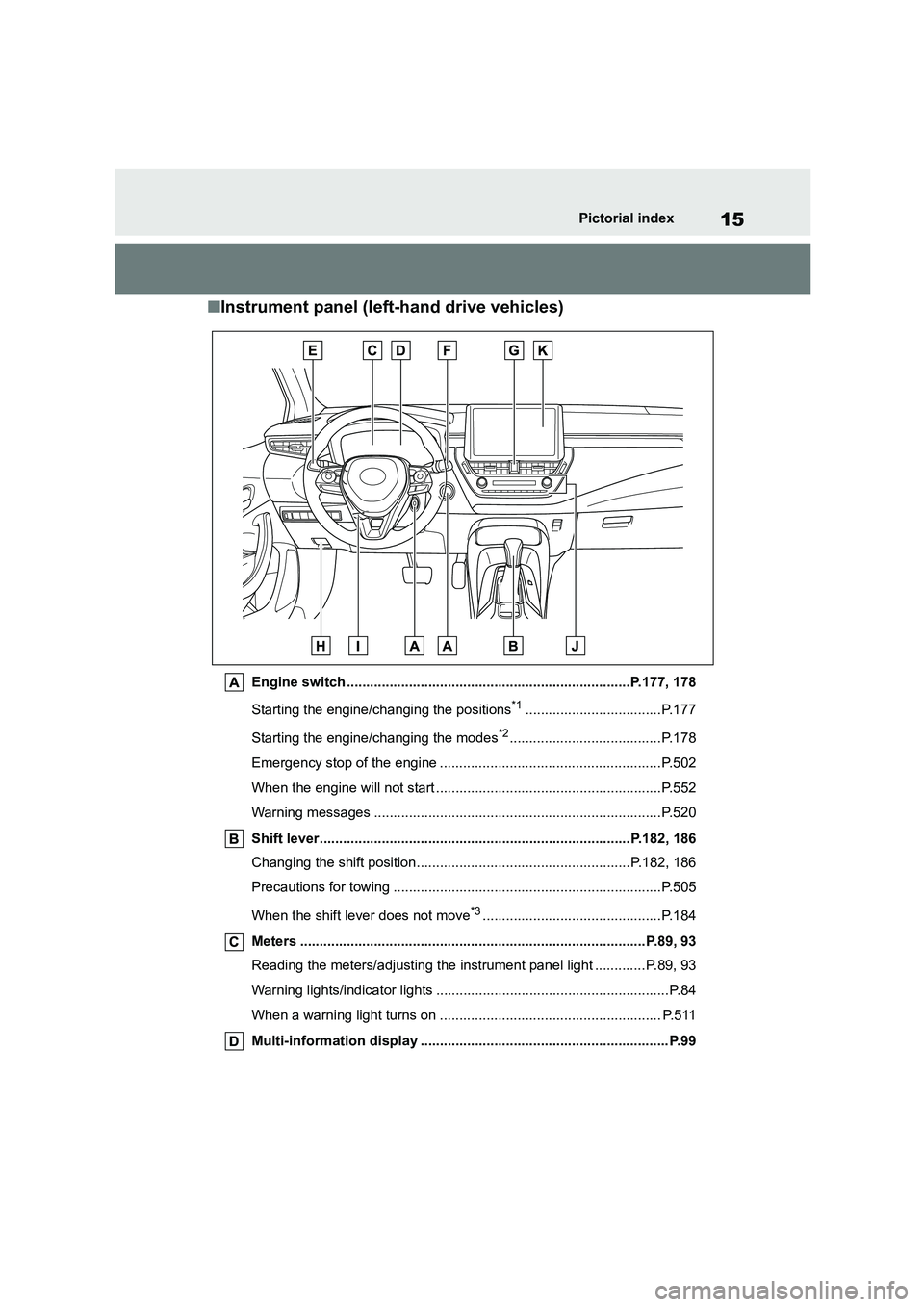
■Instrument panel (left-hand drive vehicles)
Engine switch .........................................................................P.177, 178
Starting the engine/changing the positions*1...................................P.177
Starting the engine/changing the modes*2.......................................P.178
Emergency stop of the engine .........................................................P.502
When the engine will not start ..........................................................P.552
Warning messages ..........................................................................P.520
Shift lever................................................................................P.182, 186
Changing the shift position.......................................................P.182, 186
Precautions for towing .....................................................................P.505
When the shift lever does not move*3..............................................P.184
Meters .........................................................................................P.89, 93
Reading the meters/adjusting the instrument panel light ............. P.89, 93
Warning lights/indicator lights ............................................................P.84
When a warning light turns on ......................................................... P.511
Multi-information display ................................................................P.99
Page 24 of 758
22Pictorial index
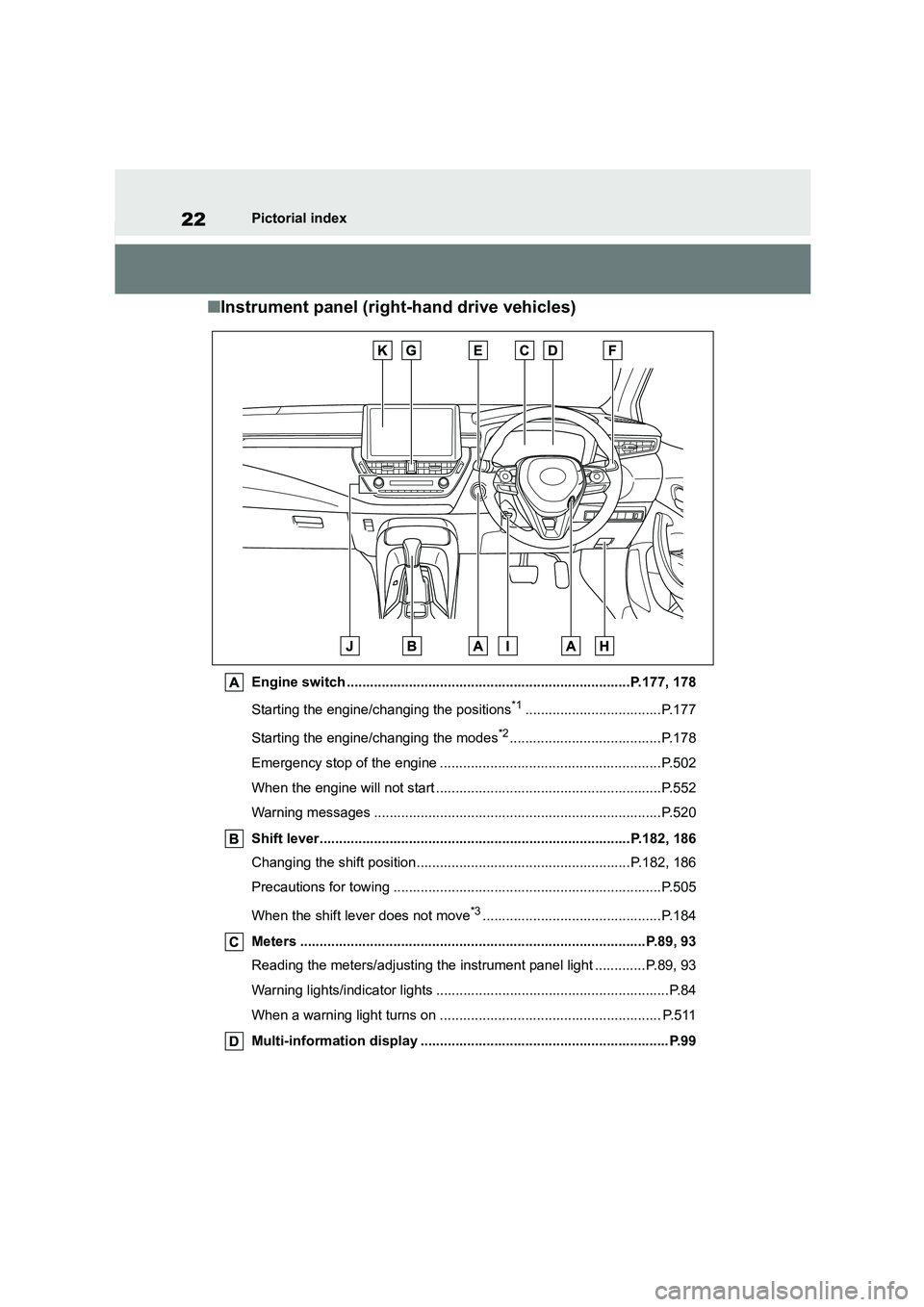
■Instrument panel (right-hand drive vehicles)
Engine switch .........................................................................P.177, 178
Starting the engine/changing the positions*1...................................P.177
Starting the engine/changing the modes*2.......................................P.178
Emergency stop of the engine .........................................................P.502
When the engine will not start ..........................................................P.552
Warning messages ..........................................................................P.520
Shift lever................................................................................P.182, 186
Changing the shift position.......................................................P.182, 186
Precautions for towing .....................................................................P.505
When the shift lever does not move*3..............................................P.184
Meters .........................................................................................P.89, 93
Reading the meters/adjusting the instrument panel light ............. P.89, 93
Warning lights/indicator lights ............................................................P.84
When a warning light turns on ......................................................... P.511
Multi-information display ................................................................P.99
Page 67 of 758
65
1
1-2. Child safety
For safety and security
1 If installing the child restraint
system to the front passenger
seat is unavoidable, refer to
P.50 for the front passenger seat
adjustment.
2 If the head restraint interferes
with your child restraint system,
and the head restraint can be
removed, remove the head
restraint.
Otherwise, put the head
restraint in the upper most posi-
tion. ( P.144)
3 Run the seat belt through the
child restraint system and insert
the plate into th e buckle. Make
sure that the belt is not twisted.
Securely fix the seat belt to the
child restraint s ystem in accord-
ance to the directions enclosed
with the child restraint system.
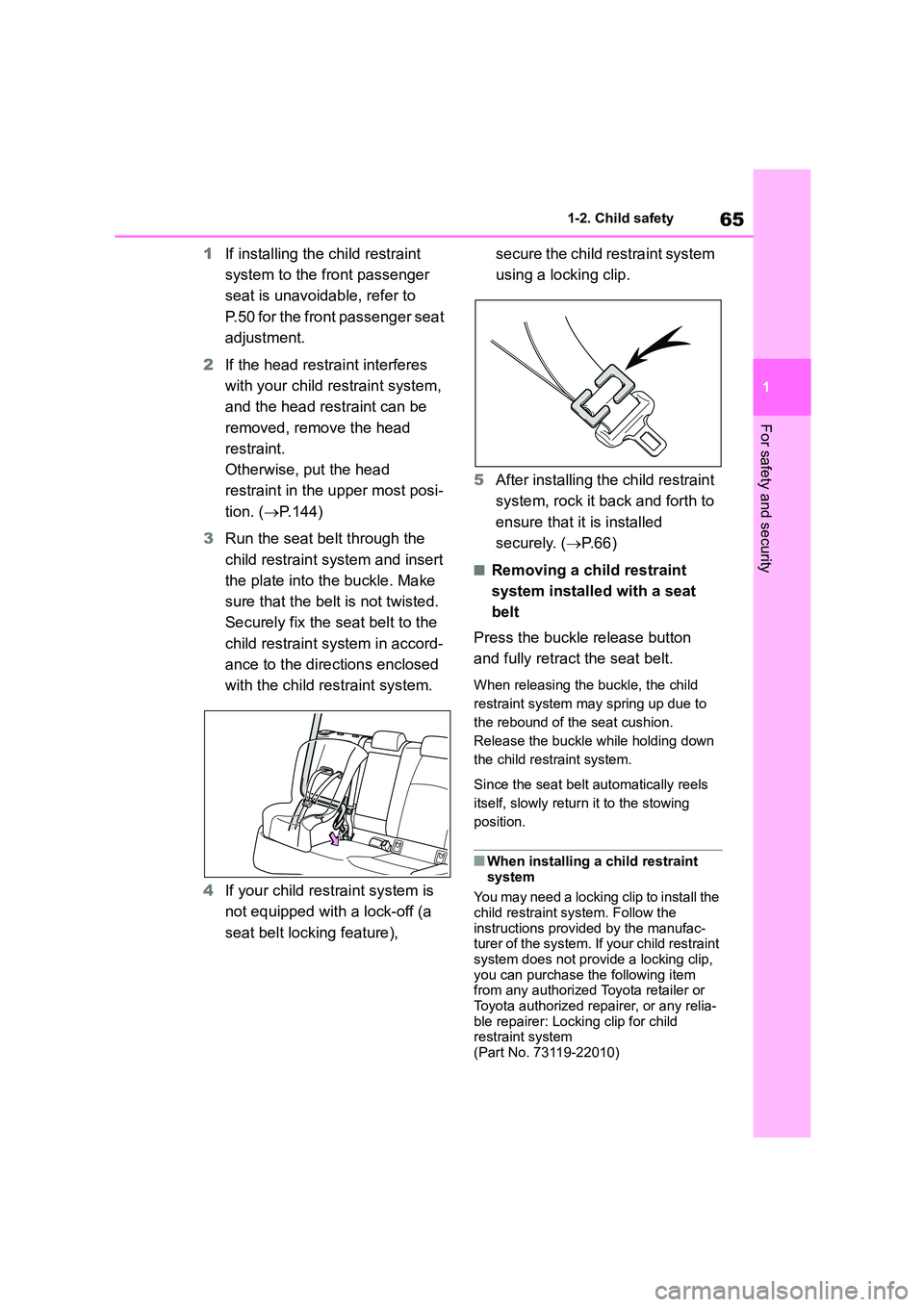
4 If your child restraint system is
not equipped with a lock-off (a
seat belt locking feature),
secure the child restraint system
using a locking clip.
5 After installing the child restraint
system, rock it back and forth to
ensure that it is installed
securely. ( P. 6 6 )
■Removing a child restraint
system installed with a seat
belt
Press the buckle release button
and fully retract the seat belt.
When releasing the buckle, the child
restraint system may spring up due to
the rebound of the seat cushion.
Release the buckle while holding down
the child restraint system.
Since the seat belt automatically reels
itself, slowly return it to the stowing
position.
■When installing a child restraint system
You may need a locking clip to install the
child restraint system. Follow the
instructions provided by the manufac- turer of the system. If your child restraint
system does not prov ide a locking clip,
you can purchase the following item from any authorized Toyota retailer or
Toyota authorized repairer, or any relia-
ble repairer: Locking clip for child restraint system
(Part No. 73119-22010)
Page 132 of 758
1303-2. Opening, closing and locking the doors
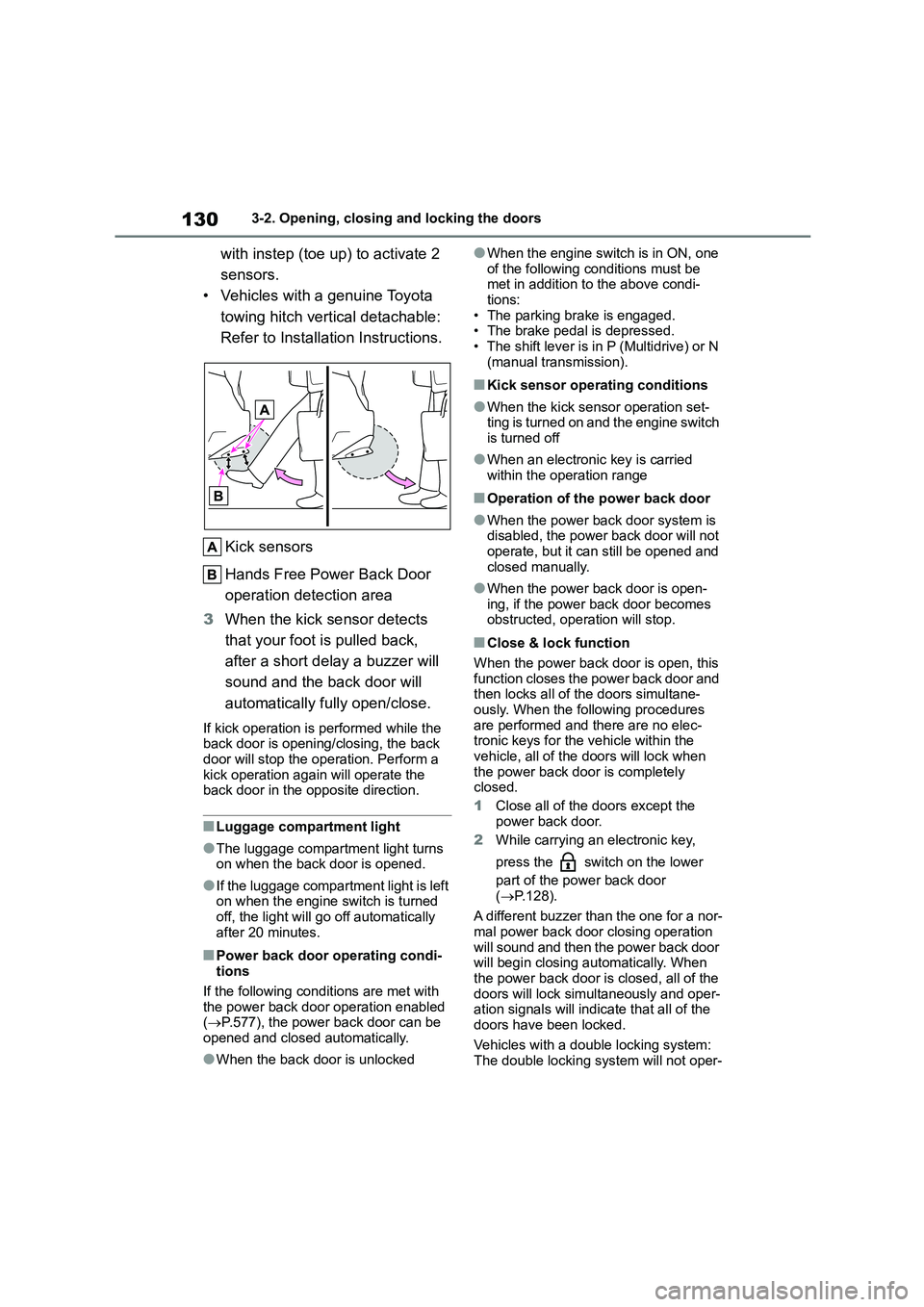
with instep (toe up) to activate 2
sensors.
• Vehicles with a genuine Toyota
towing hitch vertical detachable:
Refer to Installation Instructions.
Kick sensors
Hands Free Power Back Door
operation detection area
3 When the kick sensor detects
that your foot is pulled back,
after a short delay a buzzer will
sound and the back door will
automatically fully open/close.
If kick operation is performed while the
back door is opening/closing, the back door will stop the operation. Perform a
kick operation again will operate the
back door in the opposite direction.
■Luggage compartment light
●The luggage compartment light turns
on when the back door is opened.
●If the luggage compartment light is left
on when the engine switch is turned off, the light will go off automatically
after 20 minutes.
■Power back door operating condi-
tions
If the following conditions are met with
the power back door operation enabled
( P.577), the power back door can be opened and closed automatically.
●When the back door is unlocked
●When the engine switch is in ON, one
of the following conditions must be met in addition to the above condi-
tions:
• The parking brake is engaged. • The brake pedal is depressed.
• The shift lever is in P (Multidrive) or N
(manual transmission).
■Kick sensor operating conditions
●When the kick sensor operation set-
ting is turned on and the engine switch is turned off
●When an electronic key is carried within the operation range
■Operation of the power back door
●When the power back door system is disabled, the power back door will not
operate, but it can still be opened and
closed manually.
●When the power back door is open-
ing, if the power back door becomes obstructed, operation will stop.
■Close & lock function
When the power back door is open, this
function closes the power back door and then locks all of the doors simultane-
ously. When the following procedures
are performed and there are no elec- tronic keys for the vehicle within the
vehicle, all of the doors will lock when
the power back door is completely closed.
1 Close all of the doors except the
power back door.
2 While carrying an electronic key,
press the switch on the lower
part of the power back door
( P.128).
A different buzzer than the one for a nor-
mal power back door closing operation will sound and then the power back door
will begin closing automatically. When
the power back door is closed, all of the doors will lock simultaneously and oper-
ation signals will indicate that all of the
doors have been locked.
Vehicles with a double locking system:
The double locking syst em will not oper-
Page 151 of 758
149
3
3-4. Adjusting the steering wheel and mirrors
Before driving
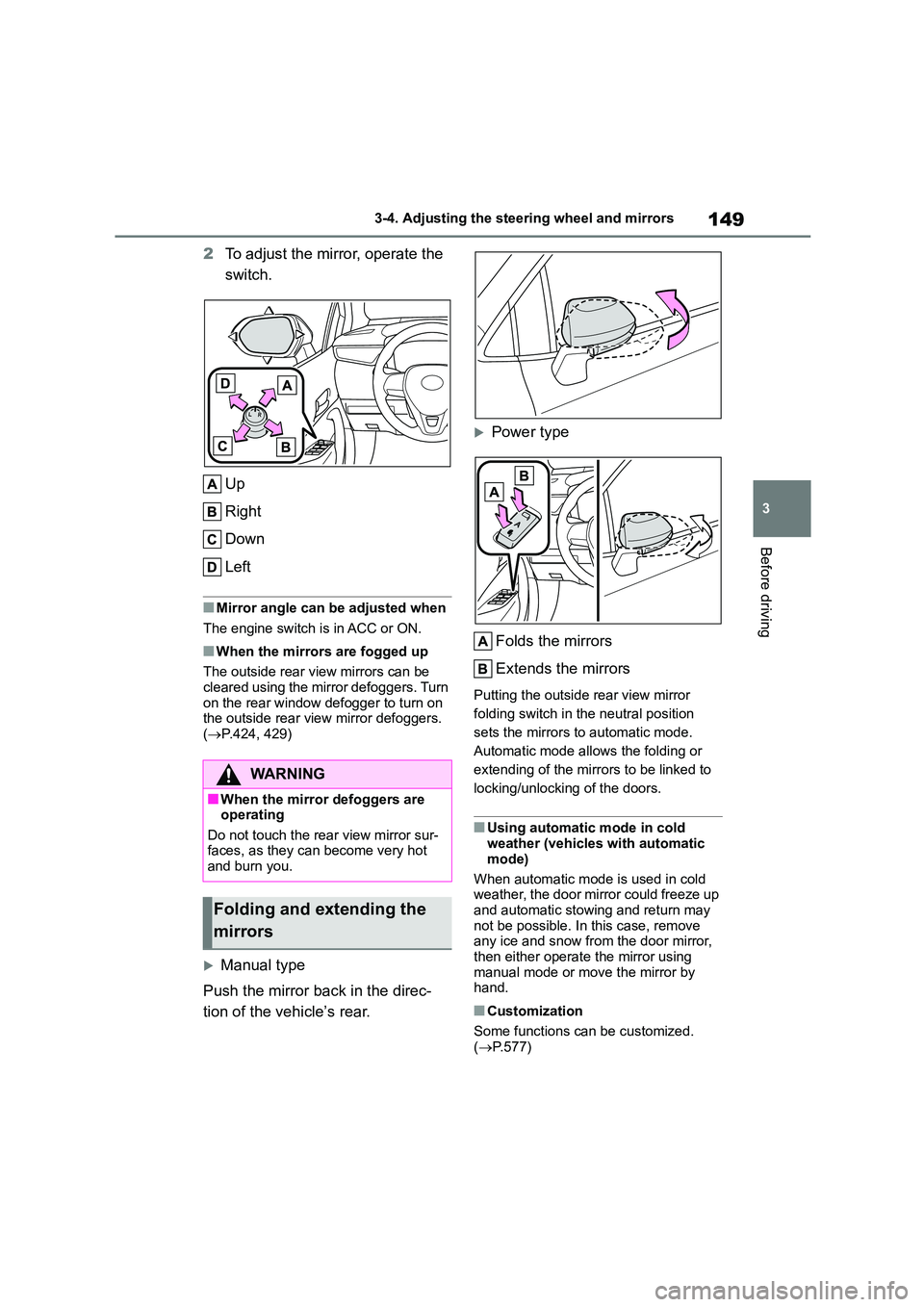
2 To adjust the mirror, operate the
switch.
Up
Right
Down
Left
■Mirror angle can be adjusted when
The engine switch is in ACC or ON.
■When the mirrors are fogged up
The outside rear view mirrors can be cleared using the mirror defoggers. Turn
on the rear window defogger to turn on
the outside rear view mirror defoggers. ( P.424, 429)
Manual type
Push the mirror back in the direc-
tion of the vehicle’s rear.
Power type
Folds the mirrors
Extends the mirrors
Putting the outside rear view mirror
folding switch in the neutral position
sets the mirrors to automatic mode.
Automatic mode allows the folding or
extending of the mirrors to be linked to
locking/unlocking of the doors.
■Using automatic mode in cold
weather (vehicles with automatic
mode)
When automatic mode is used in cold weather, the door mirror could freeze up
and automatic stowing and return may
not be possible. In this case, remove any ice and snow from the door mirror,
then either operate the mirror using
manual mode or move the mirror by hand.
■Customization
Some functions can be customized.
( P.577)
WA R N I N G
■When the mirror defoggers are
operating
Do not touch the rear view mirror sur- faces, as they can become very hot
and burn you.
Folding and extending the
mirrors
Page 161 of 758
4
159
4
Driving
Driving
.4-1. Before driving
Driving the vehicle ............ 161
Cargo and luggage ........... 168
Trailer towing .................... 170
4-2. Driving procedures
Engine (ignition) switch (vehi-
cles without a smart entry &
start system) ................... 177
Engine (ignition) switch (vehi-
cles with a smart entry & start
system) ........................... 178
Multidrive .......................... 182
Manual transmission ......... 186
Turn signal lever ............... 189
Parking brake ................... 189
Brake Hold ........................ 192
4-3. Operating the lights and wip-
ers
Headlight switch ............... 195
Automatic High Beam ....... 199
AHS (Adaptive High-beam
System) .......................... 201
Fog light switch ................. 205
Windshield wipers and washer
....................................... 206
Rear window wiper and washer
....................................... 209
4-4. Refueling
Opening the fuel tank cap
....................................... 211
4-5. Using the driving support
systems
Toyota Safety Sense......... 213
PCS (Pre-Collision System)
........................................ 224
LTA (Lane Tracing Assist)
........................................ 231
LDA (Lane Departure Alert with
steering control) .............. 241
Dynamic radar cruise control
with full-speed range ...... 249
Dynamic radar cruise control
........................................ 260
Cruise control.................... 271
Speed limiter ..................... 273
RSA (Road Sign Assist) .... 276
Stop & Start system .......... 280
BSM (Blind Spot Monitor)
........................................ 288
Toyota parking assist-sensor
........................................ 303
RCTA (Rear Crossing Traffic
Alert) function ................. 312
PKSB (Parking Support Brake)
........................................ 317
Parking Support Brake function
(static objects) ................ 324
Parking Support Brake function
(rear-crossing vehicles) .. 327
S-IPA (Simple Intelligent Park-
ing Assist System) .......... 329
Driving mode select switch
........................................ 355
Exhaust Gas Filter system
........................................ 356
Driving assist systems ...... 357
Page 165 of 758
163
4
4-1. Before driving
Driving
als are depressed at the same time,
the engine output may be restrained.
●A warning message is displayed on
the multi-information display while the system is operating.
■Restraining sudden start
(Drive-Start Control [vehicles with a
Multidrive])
●When the following unusual operation
is performed, the engine output may be restrained.
• When the shift lever is shifted from R
to D, D to R, N to R, P to D*, or P to R* (D includes M) with the accelerator
pedal depressed, a warning message
appears on the multi-information dis- play. If a warning message is shown
on the multi-information display, read
the message and follow the instruc- tion.
• When the accelerator pedal is
depressed too much while the vehicle is in reverse.*: Depending on the situation, the shift
position may not be changed.
●While Drive-Start Control is being acti- vated, your vehicle may have trouble
escaping from the mud or fresh snow.
In such case, deactivate TRC ( P.358) to cancel Drive-Start Control
so that the vehicle may become able
to escape from the mud or fresh snow.
■Breaking in your new Toyota
To extend the life of the vehicle, observ-
ing the following precautions is recom-
mended:
●For the first 300 km (186 miles):
Avoid sudden stops.
●For the first 800 km (500 miles):
Do not tow a trailer.
●For the first 1000 km (621 miles):
• Do not drive at extremely high speeds.
• Avoid sudden acceleration.
• Do not drive continuously in low gears.
• Do not drive at a constant speed for
extended periods.
■Operating your vehicle in a foreign
country
Comply with the relevant vehicle regis-
tration laws and confirm the availability
of the correct fuel. ( P.568)
■Idling time before engine stop
To prevent damage to the turbocharger,
allow the engine to idle immediately
after high-speed driving or hill climbing.
Driving conditionIdling time
Normal city driving or
high-speed driving (at the
highway speed limit or rec-
ommended speed)
Not nec-
essary
Steep hill driving, continu-
ous driving (race track driv-
ing, etc.) or towing a trailer
or another vehicle
Approxi-
mately 1
minute
WA R N I N G
Observe the following precautions.
Failure to do so may result in death or
serious injury.
■When starting the vehicle (vehi-
cles with a Multidrive)
Always keep your foot on the brake
pedal while stopped with the engine
running. This prevents the vehicle from creeping.
■When driving the vehicle
●Do not drive if you are unfamiliar
with the location of the brake and
accelerator pedals to avoid depressing the wrong pedal.
• Accidentally depressing the accel-
erator pedal instead of the brake pedal will result in sudden accelera-
tion that may lead to an accident.
Page 172 of 758
1704-1. Before driving
Check the allowable towing capac-
ity, GVM (Gross Vehicle Mass),
MPAC (Maximum Permissible Axle
Trailer towing
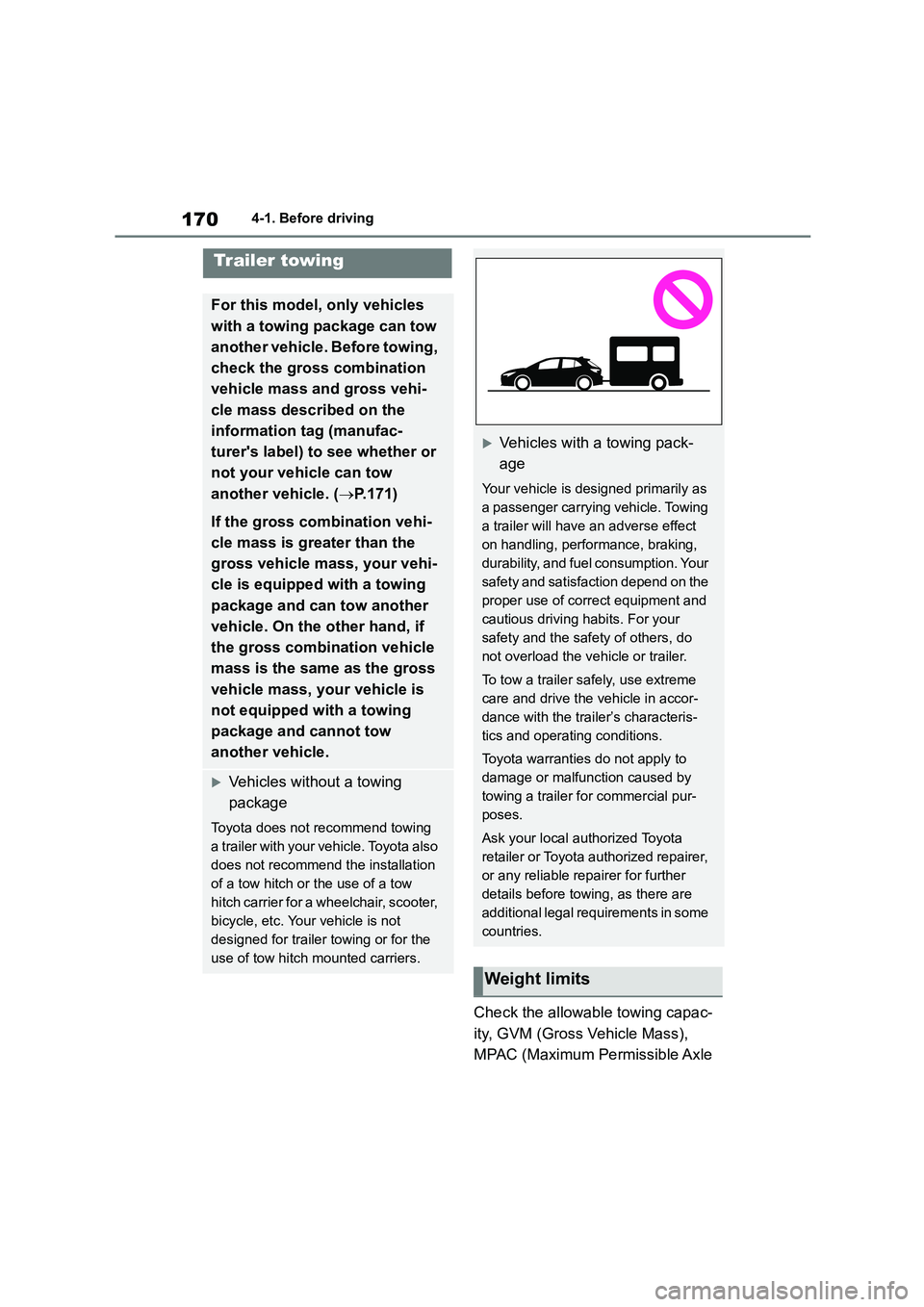
For this model, only vehicles
with a towing package can tow
another vehicle. Before towing,
check the gross combination
vehicle mass and gross vehi-
cle mass described on the
information tag (manufac-
turer's label) to see whether or
not your vehicle can tow
another vehicle. ( P.171)
If the gross combination vehi-
cle mass is greater than the
gross vehicle mass, your vehi-
cle is equipped with a towing
package and can tow another
vehicle. On the other hand, if
the gross combination vehicle
mass is the same as the gross
vehicle mass, your vehicle is
not equipped with a towing
package and cannot tow
another vehicle.
Vehicles without a towing
package
Toyota does not recommend towing
a trailer with your vehicle. Toyota also
does not recommend the installation
of a tow hitch or the use of a tow
hitch carrier for a wheelchair, scooter,
bicycle, etc. Your vehicle is not
designed for trailer towing or for the
use of tow hitch mounted carriers.
Vehicles with a towing pack-
age
Your vehicle is designed primarily as
a passenger carrying vehicle. Towing
a trailer will have an adverse effect
on handling, performance, braking,
durability, and fuel consumption. Your
safety and satisfaction depend on the
proper use of correct equipment and
cautious driving habits. For your
safety and the safety of others, do
not overload the vehicle or trailer.
To tow a trailer safely, use extreme
care and drive the vehicle in accor-
dance with the trailer’s characteris-
tics and operating conditions.
Toyota warranties do not apply to
damage or malfunction caused by
towing a trailer for commercial pur-
poses.
Ask your local authorized Toyota
retailer or Toyota authorized repairer,
or any reliable repairer for further
details before towing, as there are
additional legal requirements in some
countries.
Weight limits
Page 173 of 758
171
4
4-1. Before driving
Driving
Capacity), and permissible drawbar
load before towing. ( P.566)
Toyota recommends the use of the
Toyota hitch/bracket for your vehi-
cle. Other products of a suitable
nature and comparable quality may
also be used.
For vehicles where the towing
device blocks any of the lights or
license plate, the following shall be
observed:
Do not use towing devices that
cannot be easily removed or
repositioned.
Towing devices must be
removed or repositioned when
not in use.
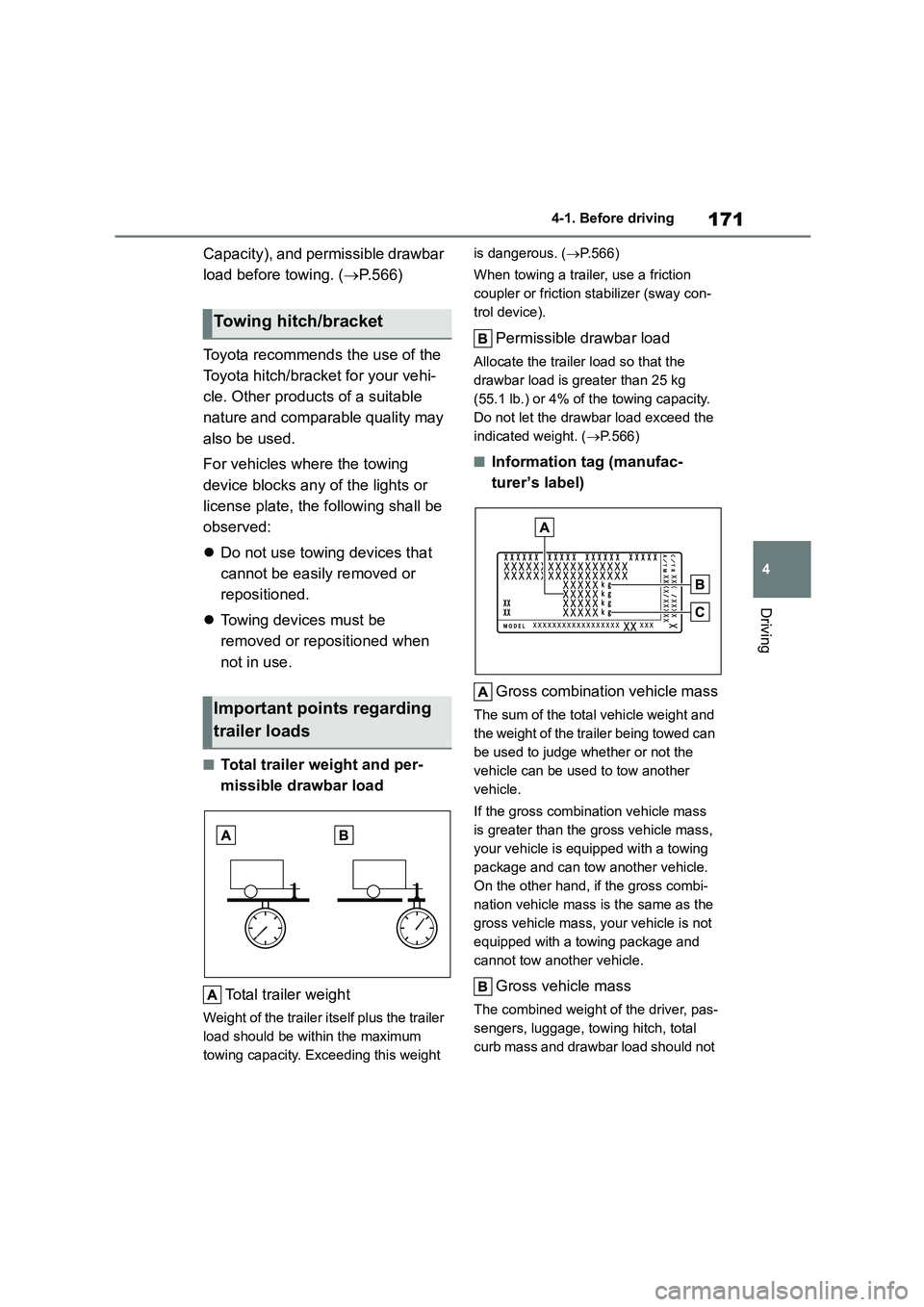
■Total trailer weight and per-
missible drawbar load
Total trailer weight
Weight of the trailer itself plus the trailer
load should be within the maximum
towing capacity. Exceeding this weight
is dangerous. ( P.566)
When towing a trailer, use a friction
coupler or friction stabilizer (sway con-
trol device).
Permissible drawbar load
Allocate the trailer load so that the
drawbar load is greater than 25 kg
(55.1 lb.) or 4% of the towing capacity.
Do not let the drawbar load exceed the
indicated weight. ( P.566)
■Information tag (manufac-
turer’s label)
Gross combination vehicle mass
The sum of the total vehicle weight and
the weight of the trailer being towed can
be used to judge whether or not the
vehicle can be used to tow another
vehicle.
If the gross combination vehicle mass
is greater than the gross vehicle mass,
your vehicle is equipped with a towing
package and can tow another vehicle.
On the other hand, if the gross combi-
nation vehicle mass is the same as the
gross vehicle mass, your vehicle is not
equipped with a towing package and
cannot tow another vehicle.
Gross vehicle mass
The combined weight of the driver, pas-
sengers, luggage, towing hitch, total
curb mass and drawbar load should not
Towing hitch/bracket
Important points regarding
trailer loads