engine TOYOTA COROLLA HYBRID 2023 Repair Manual
[x] Cancel search | Manufacturer: TOYOTA, Model Year: 2023, Model line: COROLLA HYBRID, Model: TOYOTA COROLLA HYBRID 2023Pages: 496, PDF Size: 10.13 MB
Page 414 of 496
4147-2. Steps to take in an emergency
If the engine coolant tempera-
ture gauge enters the red
zone or “Engine Coolant
Temp High Stop in a Safe
Place See Owner’s Manual”
is shown on the multi-informa-
tion display
1 Stop the vehicle in a safe
place and turn off the air con-
ditioning system, and then
stop the hybrid system.
2 If you see steam: Carefully lift
the hood after the steam sub- sides.
If you do not see steam:
Carefully lift the hood.
3 After the hybrid system has
cooled down sufficiently,
inspect the hoses and radia-
tor core (radiator) for any
leaks.
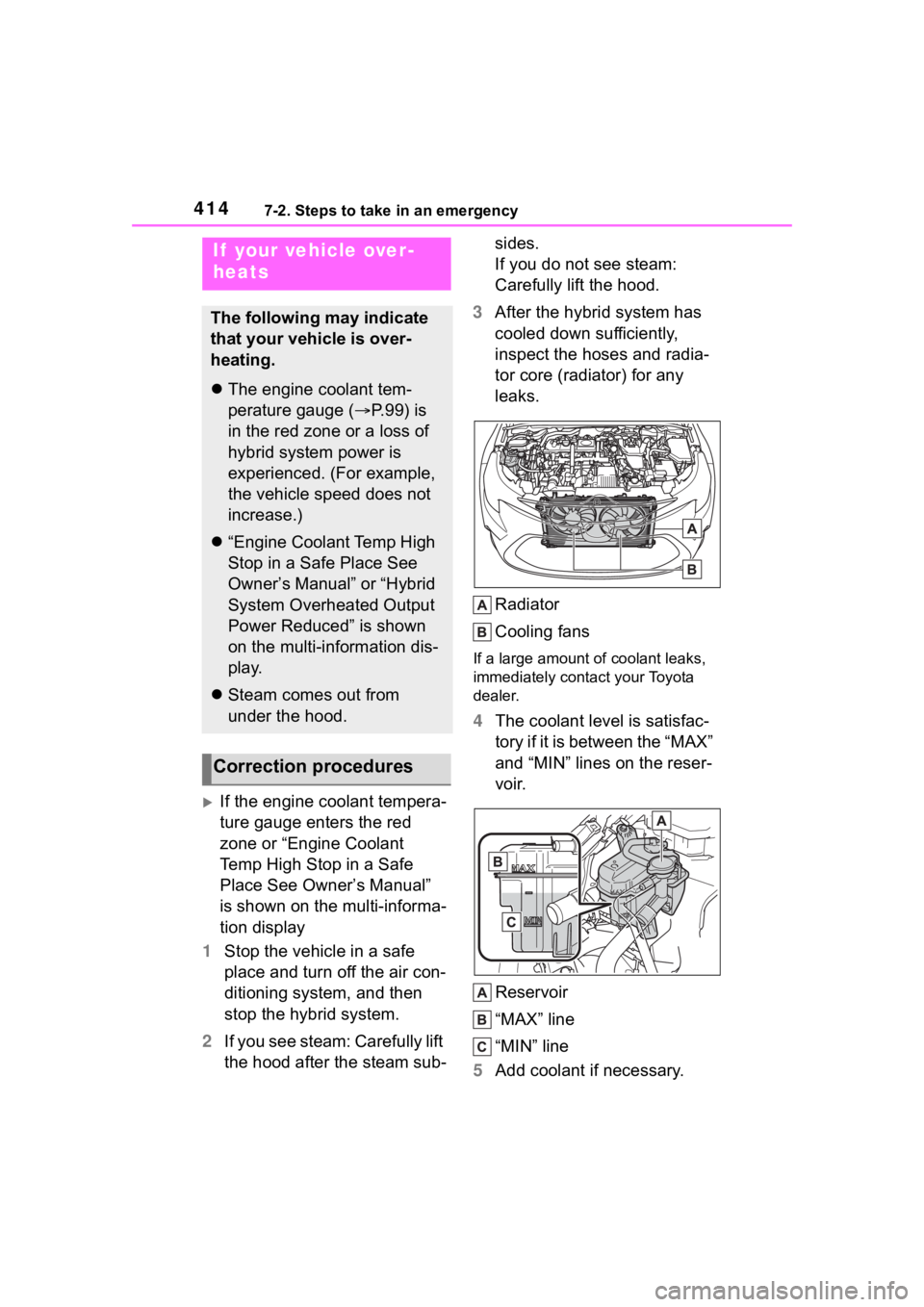
Radiator
Cooling fans
If a large amount of coolant leaks,
immediately contact your Toyota
dealer.
4The coolant level is satisfac-
tory if it is between the “MAX”
and “MIN” lines on the reser-
voir.
Reservoir
“MAX” line
“MIN” line
5 Add coolant if necessary.
If your vehicle over-
heats
The following may indicate
that your vehicle is over-
heating.
The engine coolant tem-
perature gauge ( P. 9 9 ) i s
in the red zone or a loss of
hybrid system power is
experienced. (For example,
the vehicle speed does not
increase.)
“Engine Coolant Temp High
Stop in a Safe Place See
Owner’s Manual” or “Hybrid
System Overheated Output
Power Reduced” is shown
on the multi-information dis-
play.
Steam comes out from
under the hood.
Correction procedures
Page 416 of 496
4167-2. Steps to take in an emergency
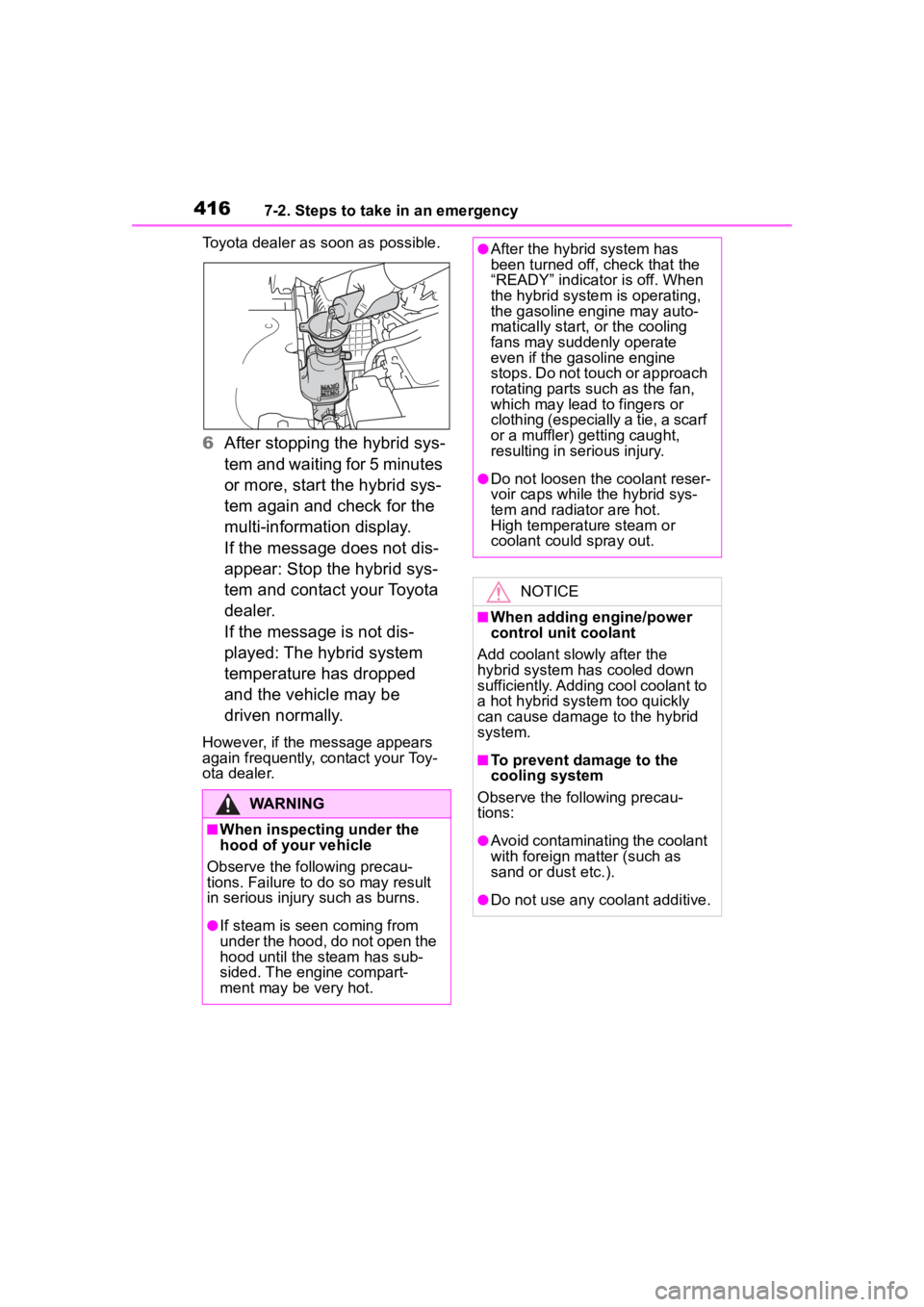
Toyota dealer as soon as possible.
6After stopping the hybrid sys-
tem and waiting for 5 minutes
or more, start the hybrid sys-
tem again and check for the
multi-information display.
If the message does not dis-
appear: Stop the hybrid sys-
tem and contact your Toyota
dealer.
If the message is not dis-
played: The hybrid system
temperature has dropped
and the vehicle may be
driven normally.
However, if the message appears
again frequently, contact your Toy-
ota dealer.
WARNING
■When inspecting under the
hood of your vehicle
Observe the following precau-
tions. Failure to do so may result
in serious injury such as burns.
●If steam is seen coming from
under the hood, do not open the
hood until the steam has sub-
sided. The engine compart-
ment may be very hot.
●After the hybrid system has
been turned off , check that the
“READY” indicator is off. When
the hybrid system is operating,
the gasoline engine may auto-
matically start, or the cooling
fans may suddenly operate
even if the gasoline engine
stops. Do not touch or approach
rotating parts such as the fan,
which may lead to fingers or
clothing (especially a tie, a scarf
or a muffler) getting caught,
resulting in serious injury.
●Do not loosen the coolant reser-
voir caps while the hybrid sys-
tem and radiator are hot.
High temperature steam or
coolant could spray out.
NOTICE
■When adding engine/power
control unit coolant
Add coolant slowly after the
hybrid system has cooled down
sufficiently. Adding cool coolant to
a hot hybrid system too quickly
can cause damage to the hybrid
system.
■To prevent damage to the
cooling system
Observe the following precau-
tions:
●Avoid contaminating the coolant
with foreign matter (such as
sand or dust etc.).
●Do not use any coolant additive.
Page 421 of 496
4218-1. Specifications
8
Vehicle specifications
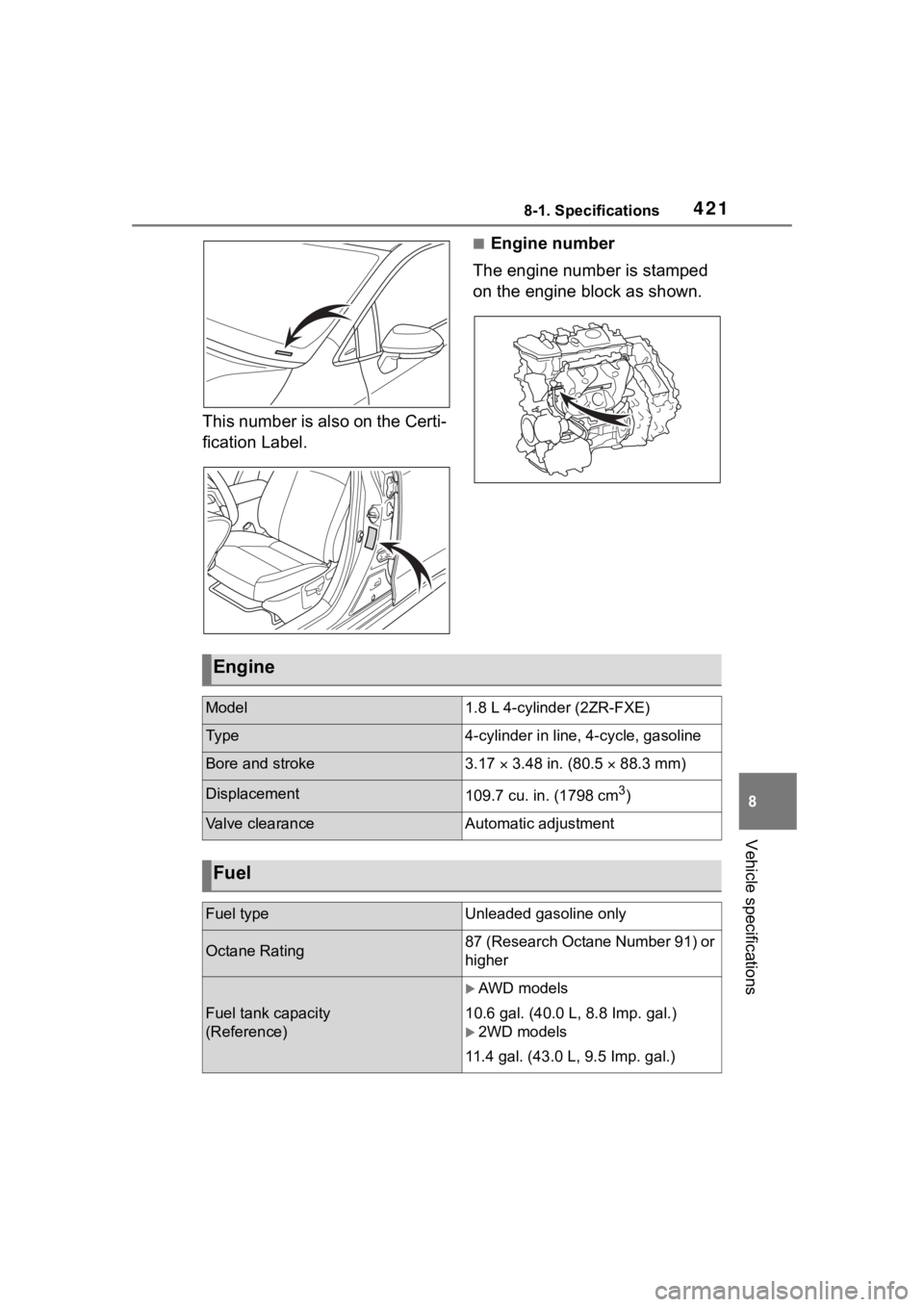
This number is also on the Certi-
fication Label.
■Engine number
The engine number is stamped
on the engine block as shown.
Engine
Model1.8 L 4-cylinder (2ZR-FXE)
Ty p e4-cylinder in line , 4-cycle, gasoline
Bore and stroke3.17 3.48 in. (80.5 88.3 mm)
Displacement109.7 cu. in. (1798 cm3)
Valve clearanceAutomatic adjustment
Fuel
Fuel typeUnleaded gasoline only
Octane Rating87 (Research Octane Number 91) or
higher
Fuel tank capacity
(Reference)
AWD models
10.6 gal. (40.0 L, 8.8 Imp. gal.)
2WD models
11.4 gal. (43.0 L , 9.5 Imp. gal.)
Page 422 of 496
![TOYOTA COROLLA HYBRID 2023 Repair Manual 4228-1. Specifications
Front (2WD models)
Rear (AWD models)
■Oil capacity (Drain and refill
[Reference
*])
*: The engine oil capacity is a refer-ence quantity to be used when
changing the en](/img/14/59253/w960_59253-421.png "TOYOTA COROLLA HYBRID 2023 Repair Manual 4228-1. Specifications
Front (2WD models)
Rear (AWD models)
■Oil capacity (Drain and refill
[Reference
*])
*: The engine oil capacity is a refer-ence quantity to be used when
changing the en")
4228-1. Specifications
Front (2WD models)
Rear (AWD models)
■Oil capacity (Drain and refill
[Reference
*])
*: The engine oil capacity is a refer-ence quantity to be used when
changing the engine oil. Warm up
the engine and turn off the hybrid
system, wait more than 5 min-
utes, and check the oil level on the dipstick.
■Engine oil selection
“Toyota Genuine Motor Oil” is
used in your Toyota vehicle. Use
Toyota approved “Toyota Genu-
ine Motor Oil” or equivalent to
satisfy the following grade and
viscosity.
Oil grade: ILSAC GF-6B multi-
grade engine oil
Recommended viscosity: SAE
0W-16
Electric motor (traction motor)
Ty p ePermanent magnet synchronous
motor
Maximum output70 kW
Maximum torque136.4 ft•lbf (185 N•m, 168.9 kgf•m)
Ty p ePermanent magnet synchronous
motor
Maximum output30 kW
Maximum torque62 ft•lbf (84 N•m, 8.6 kgf•m)
Hybrid battery (traction battery)
Ty p eLithium-ion battery
Vo l t a g e3.7 V/cell
Capacity4.08 Ah
Quantity56 cells
Nominal voltage207.2 V
Lubrication system
With filter4.4 qt. (4.2 L, 3.7 Imp.
qt.)
Without
filter4.1 qt. (3.9 L, 3.4 Imp.
qt.)
Page 423 of 496
4238-1. Specifications
8
Vehicle specifications
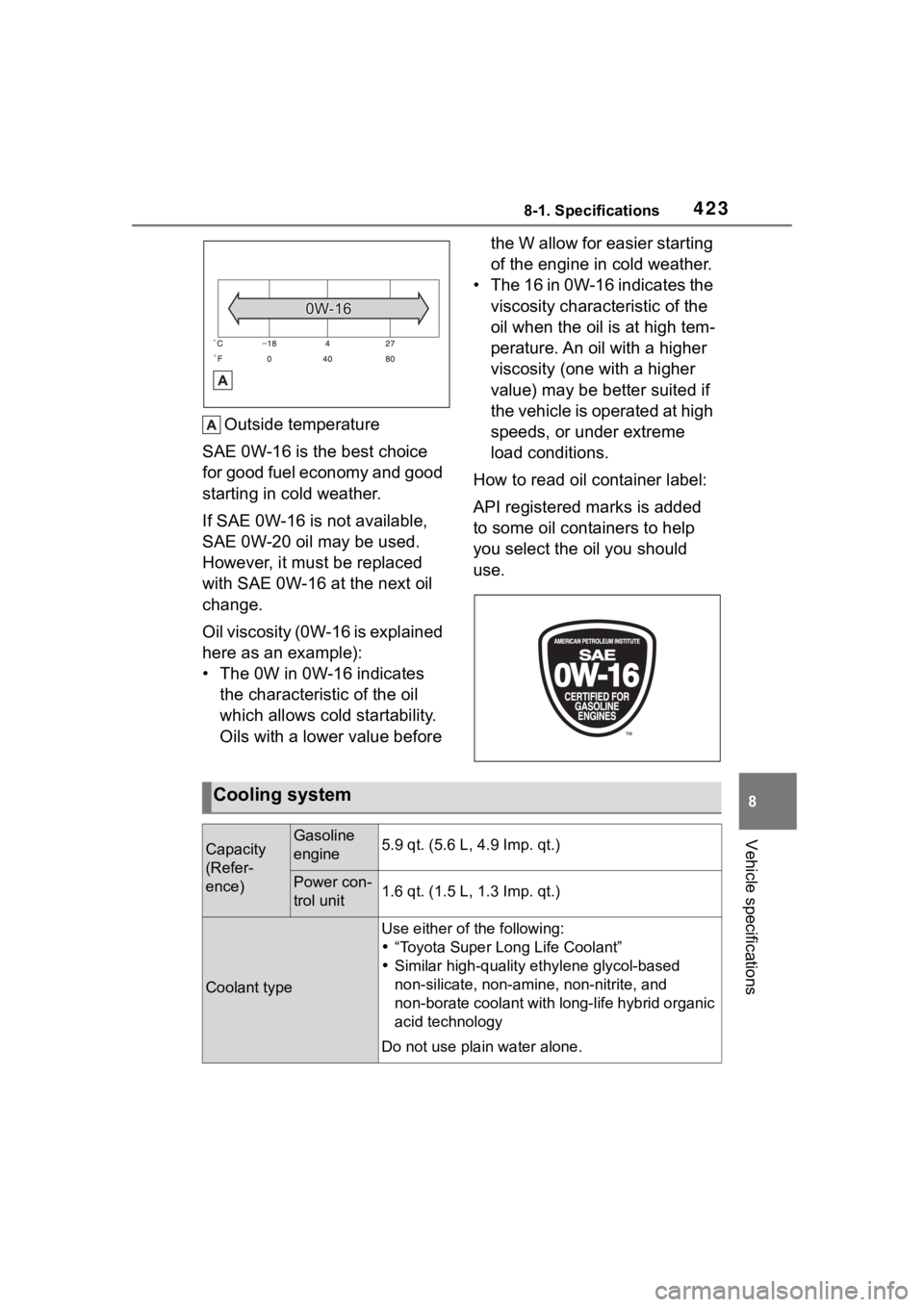
Outside temperature
SAE 0W-16 is the best choice
for good fuel economy and good
starting in cold weather.
If SAE 0W-16 is not available,
SAE 0W-20 oil may be used.
However, it must be replaced
with SAE 0W-16 at the next oil
change.
Oil viscosity (0W-16 is explained
here as an example):
• The 0W in 0W-16 indicates the characteristic of the oil
which allows cold startability.
Oils with a lower value before the W allow for easier starting
of the engine in cold weather.
• The 16 in 0W-16 indicates the viscosity characteristic of the
oil when the oil is at high tem-
perature. An oil with a higher
viscosity (one with a higher
value) may be better suited if
the vehicle is operated at high
speeds, or under extreme
load conditions.
How to read oil container label:
API registered marks is added
to some oil containers to help
you select the oil you should
use.
Cooling system
Capacity
(Refer-
ence)Gasoline
engine5.9 qt. (5.6 L, 4.9 Imp. qt.)
Power con-
trol unit1.6 qt. (1.5 L, 1.3 Imp. qt.)
Coolant type
Use either o f the following:
“Toyota Super Long Life Coolant”
Similar high-quality et hylene glycol-based
non-silicate, non -amine, non-nitrite, and
non-borate coolant with long-life hybrid organic
acid technology
Do not use pla in water alone.
Page 429 of 496
4298-1. Specifications
8
Vehicle specifications
■Gasoline quality
In very few cases, driveability prob-
lems may be caused by the brand of
gasoline you are using. If driveability
problems persist, try changing the
brand of gasoline. If this does not
correct the problem, consult your
Toyota dealer.
■Recommendation of the use of
gasoline containing detergent
additives
●Toyota recomme nds the use of
gasoline that contains detergent
additives to avoid the build-up of
engine deposits.
●All gasoline sold in the U.S.A. con-
tains minimum detergent additives
to clean and/or keep clean intake
systems, per EPA’s lowest addi-
tives concentration program.
●Toyota strongly recommends the
use of Top Tier Detergent Gaso-
line. For more information on Top
Tier Detergent Gasoline and a list
of marketers, please go to the offi-
cial website www.toptiergas.com.
■Recommendation of the use of
low emissions gasoline
Gasolines containing oxygenates
such as ethers and ethanol, as well
as reformulated gasolines, are avail-
able in some cities. These fuels are
typically acceptable for use, provid-
ing they meet other fuel require-
ments.
Toyota recommends these fuels,
since the formulations allow for
reduced vehicle emissions.
■Non-recommendation of the
use of blended gasoline
●Use only gasoline containing up to
15% ethanol.
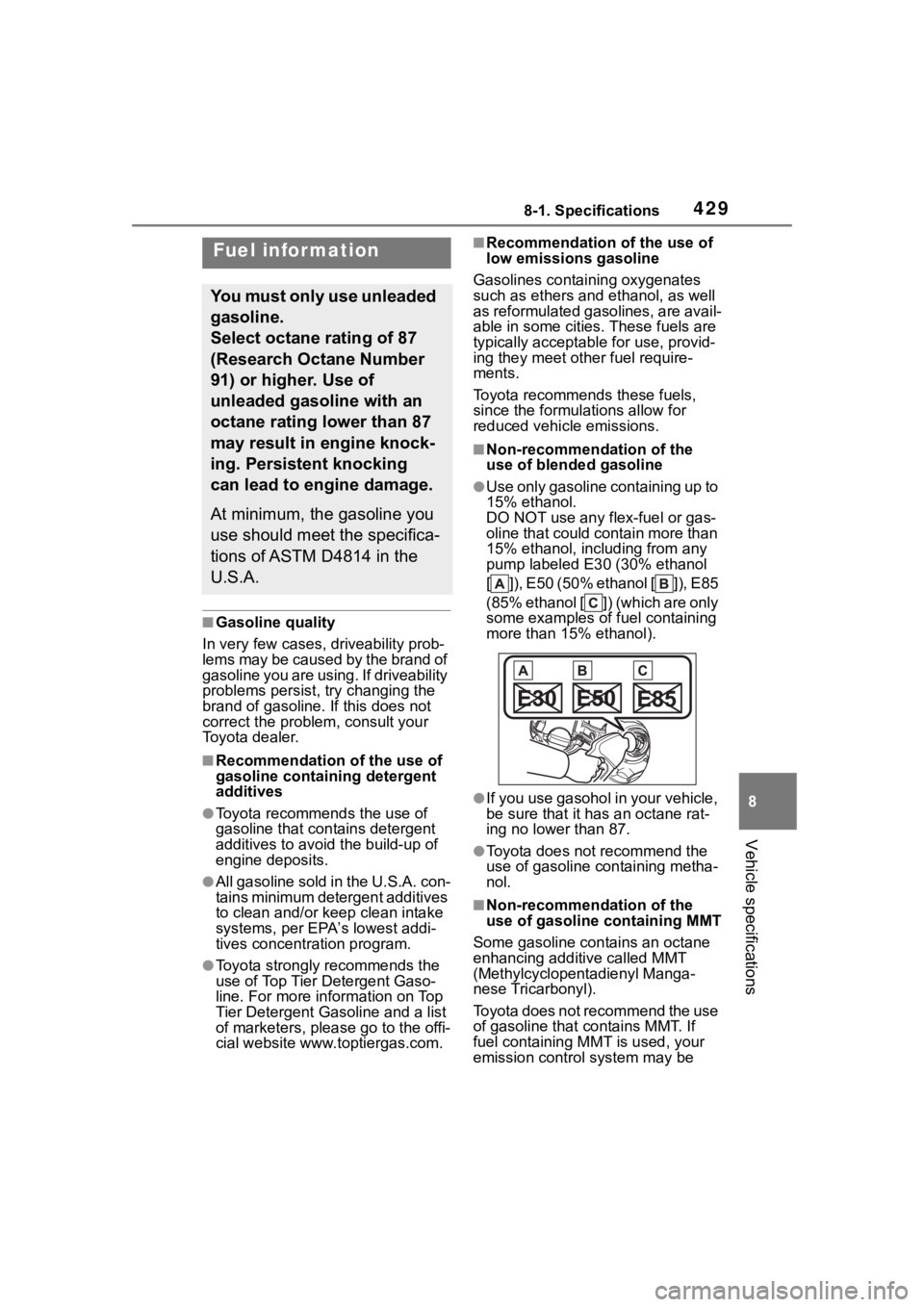
DO NOT use any flex-fuel or gas-
oline that could contain more than
15% ethanol, including from any
pump labeled E30 (30% ethanol
[ ]), E50 (50% ethanol [ ]), E85
(85% ethanol [ ]) (which are only
some examples of f uel containing
more than 15% ethanol).
●If you use gasohol in your vehicle,
be sure that it has an octane rat-
ing no lower than 87.
●Toyota does not recommend the
use of gasoline containing metha-
nol.
■Non-recommendation of the
use of gasoline containing MMT
Some gasoline contains an octane
enhancing additive called MMT
(Methylcyclopentadienyl Manga-
nese Tricarbonyl).
Toyota does not re commend the use
of gasoline that contains MMT. If
fuel containing MMT is used, your
emission control system may be
Fuel infor mation
You must only use unleaded
gasoline.
Select octane rating of 87
(Research Octane Number
91) or higher. Use of
unleaded gasoline with an
octane rating lower than 87
may result in engine knock-
ing. Persistent knocking
can lead to engine damage.
At minimum, the gasoline you
use should meet the specifica-
tions of ASTM D4814 in the
U.S.A.
Page 430 of 496
4308-1. Specifications
adversely affected.
The malfunction indicator lamp on
the instrument cluster may come on.
If this happens, contact your Toyota
dealer for service.
■If your engine knocks
●Consult your Toyota dealer.
●You may occasionally notice light
knocking for a short time while
accelerating or driving uphill. This
is normal and there is no need for
concern.
NOTICE
■Notice on fuel quality
●Do not use impro per fuels. If
improper fuels are used, the
engine will be damaged.
●Do not use leaded gasoline.
Leaded gasoline can cause
damage to your vehicle’s
three-way catalytic converters
causing the emission control
system to malfunction.
●Do not use gasohol other than
the type previously stated.
Other gasohol may cause fuel
system damage or vehicle per-
formance problems.
●Using unleaded gasoline with
an octane number or rating
lower than the l evel previously
stated will cause persistent
heavy knocking.
At worst, this will lead to engine
damage.
■Fuel-related poor driveability
If poor driveability (poor hot start-
ing, vaporization, engine knock-
ing, etc.) is encountered after
using a different type of fuel, dis-
continue the use of that type of
fuel.
■When refueling with gasohol
Take care not to spill gasohol. It
can damage your vehicle’s paint.
Page 436 of 496
4368-1. Specifications
Recommended inflation pres-
sureCold tire inflation pressure recommended
by a manufacturer
Accessory weight
The combined weight (in excess of those
standard items which may be replaced) of
automatic transmission, power steering,
power brakes, power windows, power
seats, radio and heater, to the extent that
these items are available as fac-
tory-installed equipment (whether installed
or not)
Curb weight
The weight of a motor vehicle with stan-
dard equipment, including the maximum
capacity of fuel, oil and coolant, and if so
equipped, air conditioning and additional
weight optional engine
Maximum loaded vehicle
weight
The sum of:
(a) Curb weight
(b) Accessory weight
(c) Vehicle capacity weight
(d) Production options weight
Normal occupant weight
150 lb. (68 kg) times the number of occu-
pants specified in the second column of
Table 1
* that follows
Occupant distribution
Distribution of occupan ts in a vehicle as
specified in the thi rd column of Table 1
*
below
Production options weight
The combined weight o f installed regular
production options weighing over 5 lb. (2.3
kg) in excess of the s tandard items which
they replace, not previously considered in
curb weight or accessory weight, including
heavy duty brakes, ride levelers, roof rack,
heavy duty battery, and special trim
Rim
A metal support for a tire or a tire and tube
assembly upon which the tire beads are
seated
Tire related termMeaning
Page 468 of 496

468Alphabetical Index
Brake assist ............................ 266
Break-in tips ........................... 160
Brightness control Instrument panel light control98, 101
Meter light control ................. 101
BSM (Blind Spot Monitor) ...... 249
C
Care Exterior ................................. 302
Interior .................................. 305
Seat belts ............................. 305
Wheels and wheel ornaments........................................... 302
Cargo capacity ....................... 168
Chains ..................................... 274
Child restraint system Fixed with a LATCH system ... 64
Fixed with a seat belt ............. 60
Front passenger occupant clas-sification system ................... 41
Points to remember ................ 48
Riding with children ................ 47
Types of child restraint system installation met hod ............... 50
Using an anchor bracket ........ 68
Child safety 12-volt battery precautions . 323, 413
Airbag precautions ................. 36
Child restraint system............. 50
Heated steering wheel and seat
heater precautions ............. 284
How your child should wear the seat belt................................ 28
Moon roof precau tions ......... 154
Power window lock switch.... 152
Power window precautions .. 151
Rear door child-protectors.... 132
Seat belt extender precautions ............................................. 28 Seat belt precautions..............47
Trunk precautions .................133
Child-protectors......................132
Cleaning Exterior .................................302
Interior ..................................305
Seat belts .............................305
Wheels and wheel ornaments...........................................302
Clock ......................96, 98, 99, 102
Coat hooks ..............................299
Condenser ............. ..................321
Console box ............................290
Cooling system .......................320 Engine overheating ..............414
Hybrid system overheating ...415
Cruise control .........................244
Cup holders.............................289
Current fuel consumption....104, 11 0
Curtain shield airbags ..............31
Customizable featu res ...........442
D
Daytime running light system189
Defogger
Outside rear view mirrors .....280
Rear window.........................280
Windshield ............................279
Differential Rear differential oil................424
Dimensions .............................420
Dinghy towing .........................169
Display Cruise control .......................245
Dynamic radar cruise control 239
Energy monitor ..................... 116
Multi-information display.....102,
109
RCTA ....................................254
Warning message.................382
Display change button .....97, 101
Page 469 of 496

469Alphabetical Index
Do-it-yourself maintenance ... 309
Door lockDoors.................................... 127
Key ....................................... 128
Smart key system................. 136
Wireless remote control ....... 124
Doors Automatic door locking and unlocking system................ 132
Door glasses ........................ 150
Door lock .............................. 127
Open door warning buzzer . 129, 131
Outside rear view mirrors ..... 148
Rear door child-protectors.... 132
Side doors ............................ 127
Drive distance ................. 107, 113
Drive information ........... 107, 113
Drive-Start Control (DSC) ...... 165
Driving Break-in tips ......................... 160
Correct driving posture ........... 25
Driving mode select switch... 264
Hybrid vehicle driving tips .... 271
Procedures ........................... 159
Winter drive tips ................... 273
Driving information display . 103, 11 0
Driving range .................. 104, 110
Driving support system informa- tion display ................... 107, 113
DSC (Drive-Start Control) ...... 165
Dynamic radar cruise control 236
E
ECO Accelerator Guidance . 104, 111
Eco score ........................ 104, 111
EDR (Event data recorder)......... 8
E-Four ...................................... 266
Elapsed time ................... 107, 113
Electric motor (traction motor)77 Electric Power Steering (EPS)
...............................................266Warning light.........................375
Electronic key .........................122 Battery-saving function .........137
If the electronic key does not operate properly .................408
Replacing the battery ...........350
Emergency Driving Stop System ...............................................247
Emergency flashers ...............362
Emergency tire puncture .......387
Emergency, in case of If a warning buzzer sounds ..372
If a warning light turns on .....372
If a warning message is dis-played .................................382
If the 12-volt battery is dis- charged ..............................410
If the electronic key does not operate properly .................408
If the hybrid sys tem will not start
...........................................406
If the vehicle is submerged or water on the road is rising ..364
If you have a flat tire .....387, 398
If you lose your keys.............407
If you think something is wrong ...........................................370
If your vehicle becomes stuck ...........................................417
If your vehicle has to be stopped in an emergency .................363
If your vehicle needs to be towed ...........................................366
If your vehicle ove rheats ......414
Energy monitor ....................... 116
Engine ACCESSORY mode . ............176
Compartment........................318
Engine switch ...............170, 172
Hood .....................................316