bulb TOYOTA COROLLA HYBRID 2023 Owners Manual
[x] Cancel search | Manufacturer: TOYOTA, Model Year: 2023, Model line: COROLLA HYBRID, Model: TOYOTA COROLLA HYBRID 2023Pages: 496, PDF Size: 10.13 MB
Page 1 of 496

1
2
3
4
5
6
7
8
9
9
COROLLA HV_U
Pictorial indexSearch by illustration
For safety
and securityMake sure to read through them
(Main topics: Child seat, theft deterrent system)
Vehicle status
information and
indicatorsReading driving-related information
(Main topics: Meters, multi-information display)
Before driving
Opening and closing the doors and windows,
adjustment before driving
(Main topics: Keys, doors, seats)
Driving
Operations and advice which are necessary for
driving
(Main topics: Starting hybrid system, refueling)
Interior featuresUsage of the interior features
(Main topics: Air conditioner, storage features)
Maintenance
and careCaring for your vehicle and maintenance
procedures
(Main topics: Interior and exterior, light bulbs)
When trouble
arisesWhat to do in case of malfunction and emergency
(Main topics: 12-volt battery discharge, flat tire)
Vehicle
specificationsVehicle specifications, customizable features
(Main topics: Fuel, oil, tire inflation pressure)
For ownersReporting safety defects for U.S. owners, and seat
belt and SRS airbag instructions for Canadian
owners
IndexSearch by symptom
Search alphabetically
Page 4 of 496
4TABLE OF CONTENTS
Air conditioning filter ...........346
Cleaning the hybrid battery (trac- tion battery) air intake vents......................................... 347
Wireless remote control/elec- tronic key battery.............. 350
Checking and replacing fuses ......................................... 354
Light bulbs .......................... 356
7-1. Essential information Emergency flashers ........... 362
If your vehicle has to be stopped in an emergency .............. 363
If the vehicle is submerged or water on the road is rising......................................... 364
7-2. Steps to take in an emergency If your vehicle needs to be towed......................................... 366
If you think something is wrong ......................................... 370
If a warning light turns on or a warning buzzer sounds .... 372
If a warning message is dis- played .............................. 382
If you have a flat tire (vehicles without spare tire) ............ 387
If you have a flat tire (vehicles with a spare tire) .............. 398
If the hybrid system will not start ......................................... 406
If you lose your keys .......... 407
If the electronic key does not operate properly ............... 408
If the 12-volt battery is dis- charged ............................ 410
If your vehicle overheats .... 414
If the vehicle becomes stuck ......................................... 4178-1. Specifications
Maintenance data (fuel, oil level, etc.) .................................. 420
Fuel information ................. 429
Tire information .................. 431
8-2. Customization Customizable features ....... 442
8-3. Initialization Items to initialize ................ 452
9-1. For owners Reporting safety defects for U.S. owners ............................. 454
Reporting safety defects for Canadian owners ............. 454
Seat belt instructions for Cana- dian owners (in French) ... 455
SRS airbag instructions for Canadian owners (in French)......................................... 456
What to do if... (Troubleshooting) ......................................... 464
Alphabetical Index.............. 467
7When trouble arises
8Vehicle specifications
9For owners
Index
Page 14 of 496
14Pictorial index
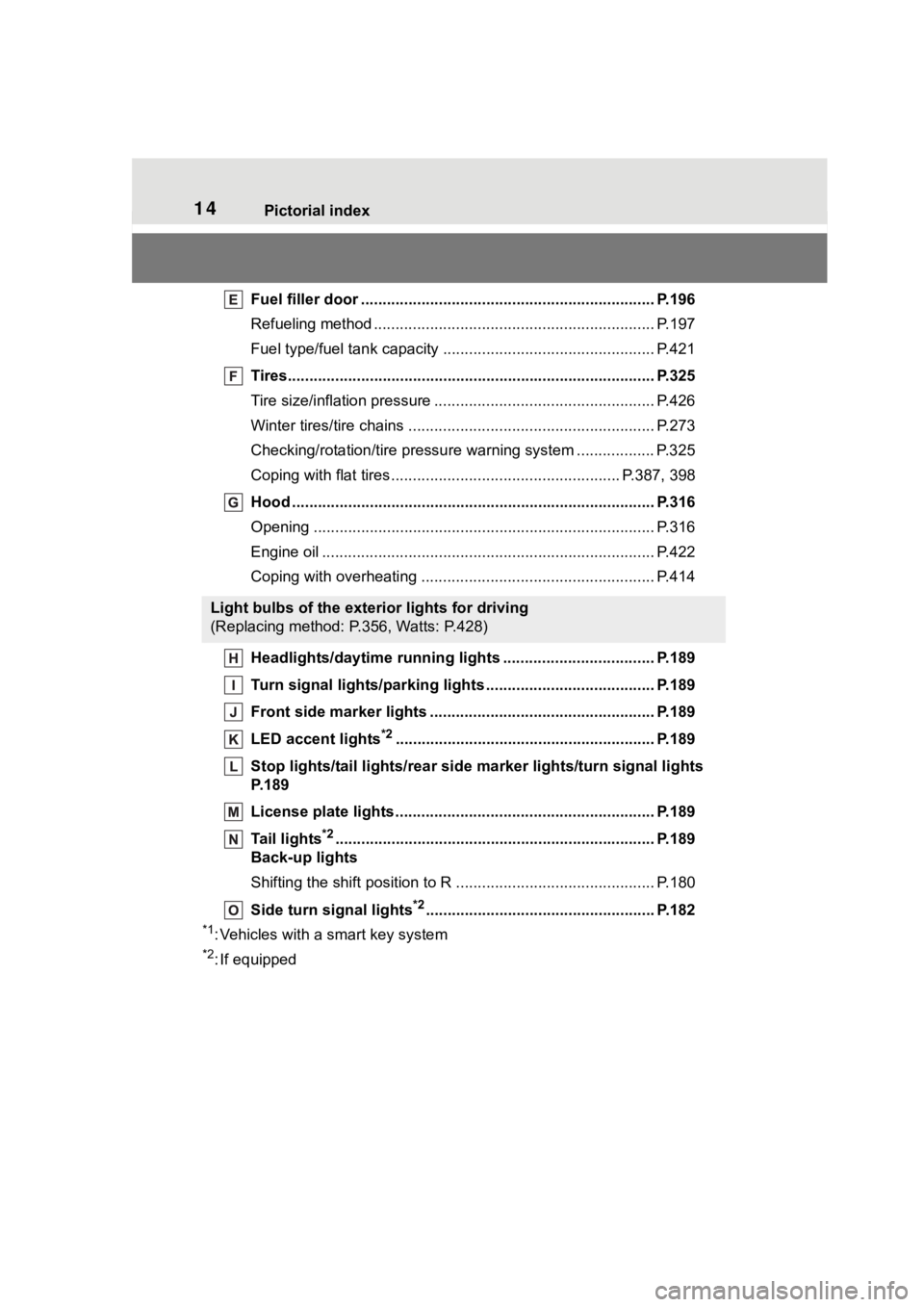
Fuel filler door .................................................................... P.196
Refueling method ............................................... .................. P.197
Fuel type/fuel tan k capacity ................................... .............. P.421
Tires.......................................................... ........................... P.325
Tire size/inflation pressure ................................... ................ P.426
Winter tires/tire chains ....................................... .................. P.273
Checking/rotation/tire pressur e warning system ..................P.325
Coping with flat tires......................................... ............ P.387, 398
Hood ........................................................... ......................... P.316
Opening ............................................................................... P.316
Engine oil ..................................................... ........................ P.422
Coping with overheating ...................................................... P.414
Headlights/daytime running lights .............................. ..... P.189
Turn signal lights/parking lights .............................. ......... P.189
Front side marker lights ....................................... ............. P.189
LED accent lights
*2............................................................ P.1 89
Stop lights/tail lights/rear side marker lights/turn signal lig hts
P. 1 8 9
License plate lights........................................... ................. P.189
Tail lights
*2............................................................... ........... P.189
Back-up lights
Shifting the shift position to R ............................... ............... P.180
Side turn signal lights
*2..................................................... P.182
*1: Vehicles with a smart key system
*2: If equipped
Light bulbs of the exterior lights for driving
(Replacing method: P.356, Watts: P.428)
Page 182 of 496
1824-2. Driving procedures
P.264
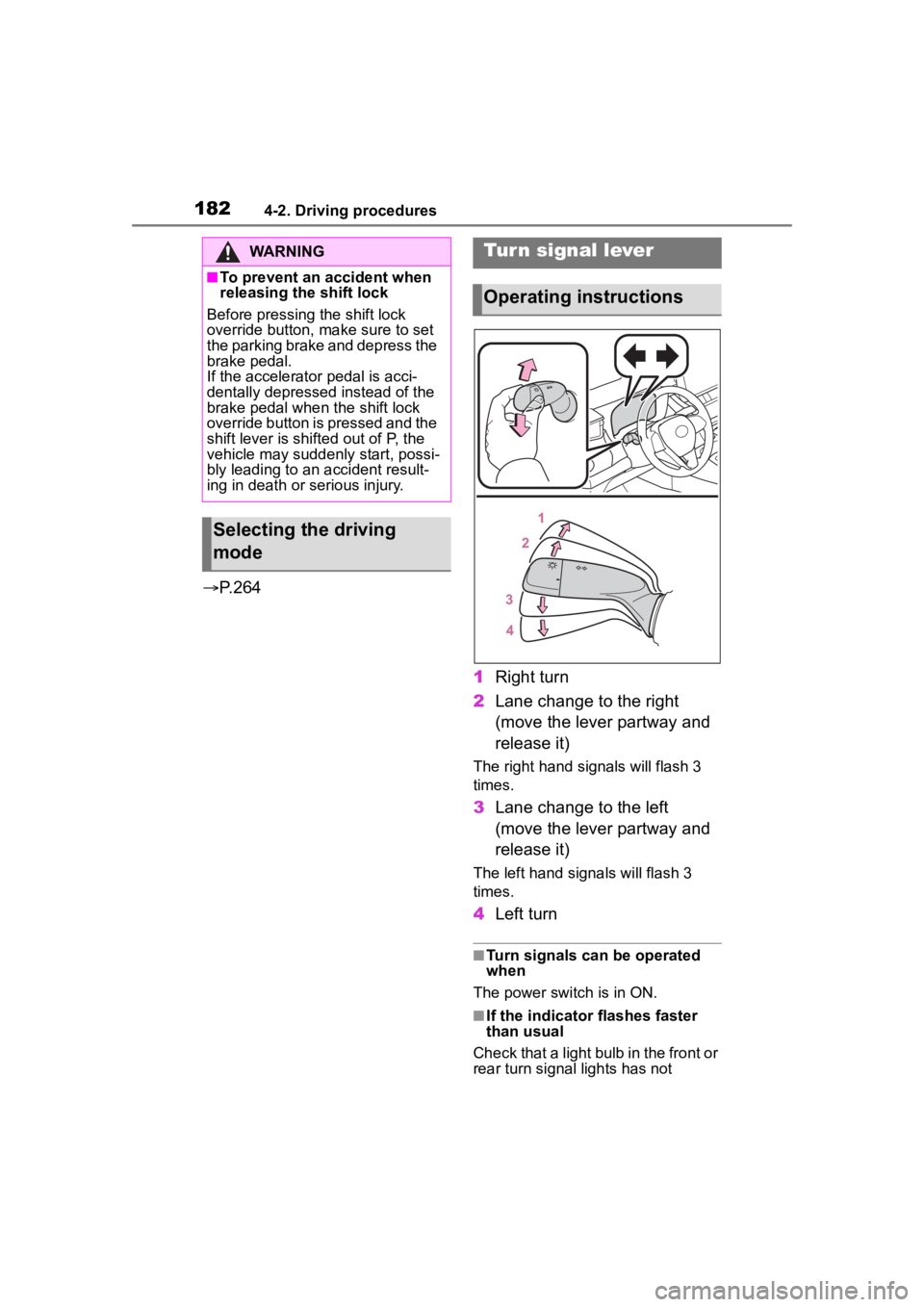
1Right turn
2 Lane change to the right
(move the lever partway and
release it)
The right hand s ignals will flash 3
times.
3 Lane change to the left
(move the lever partway and
release it)
The left hand signals will flash 3
times.
4Left turn
■Turn signals can be operated
when
The power switch is in ON.
■If the indicator flashes faster
than usual
Check that a light bulb in the front or
rear turn signal lights has not
WARNING
■To prevent an accident when
releasing the shift lock
Before pressing the shift lock
override button, make sure to set
the parking brake and depress the
brake pedal.
If the accelerator pedal is acci-
dentally depressed instead of the
brake pedal when the shift lock
override button is pressed and the
shift lever is shifted out of P, the
vehicle may suddenly start, possi-
bly leading to an accident result-
ing in death or serious injury.
Selecting the driving
mode
Tur n signal lever
Operating instructions
Page 301 of 496
301
6
6
Maintenance and care
Maintenance and care
.6-1. Maintenance and careCleaning and protecting the vehicle exterior .......... 302
Cleaning and protecting the vehicle interior ........... 305
6-2. Maintenance Maintenance requirements.................................. 308
General maintenance.. 310
Emission inspection and maintenance (I/M) pro-
grams ........................ 312
6-3. Do-it-yourself mainte- nance
Do-it-yourself service pre- cautions ..................... 314
Hood ........................... 316
Positioning a floor jack .................................. 317
Engine compartment ... 318
Tires ............................ 325
Tire inflation pressure.. 342
Wheels ......... ...............344
Air conditioning filter .... 346
Cleaning the hybrid battery (traction battery) air intake
vents.......................... 347
Wireless remote con- trol/electronic key battery.................................. 350
Checking and replacing fuses.......................... 354Light bulbs ...................
356
Page 315 of 496
3156-3. Do-it-yourself maintenance
6
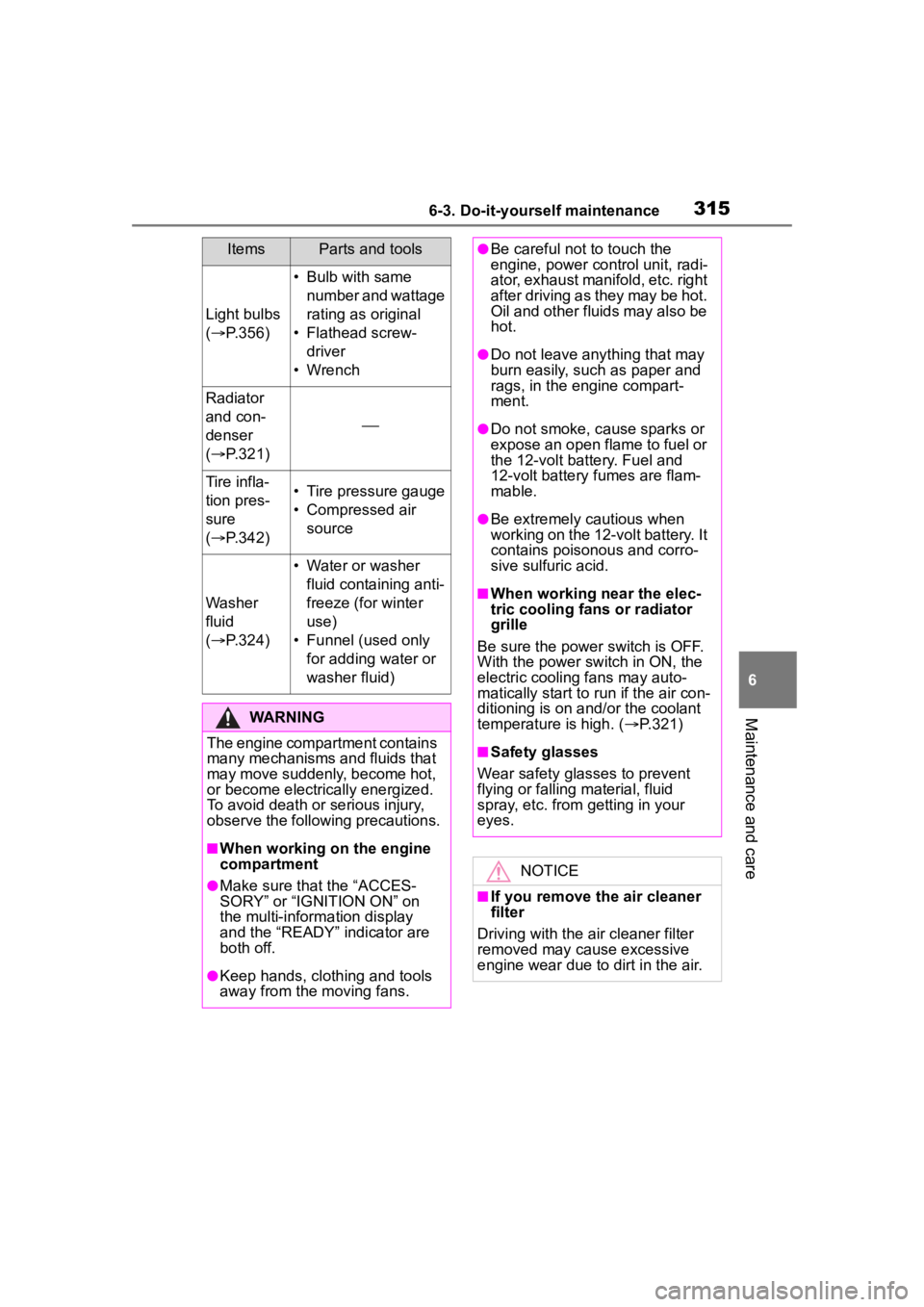
Maintenance and care
Light bulbs
( P.356)
• Bulb with same
number and wattage
rating as original
• Flathead screw- driver
• Wrench
Radiator
and con-
denser
( P.321)
Tire infla-
tion pres-
sure
( P.342)• Tire pressure gauge
• Compressed air
source
Washer
fluid
( P.324)
• Water or washer
fluid containing anti-
freeze (for winter
use)
• Funnel (used only for adding water or
washer fluid)
WARNING
The engine compartment contains
many mechanisms and fluids that
may move suddenly, become hot,
or become electrically energized.
To avoid death or serious injury,
observe the following precautions.
■When working on the engine
compartment
●Make sure that the “ACCES-
SORY” or “IGNITION ON” on
the multi-inform ation display
and the “READY” indicator are
both off.
●Keep hands, clothing and tools
away from the moving fans.
ItemsParts and tools●Be careful not to touch the
engine, power control unit, radi-
ator, exhaust manifold, etc. right
after driving as they may be hot.
Oil and other fluids may also be
hot.
●Do not leave anything that may
burn easily, such as paper and
rags, in the engine compart-
ment.
●Do not smoke, cause sparks or
expose an open flame to fuel or
the 12-volt battery. Fuel and
12-volt battery fumes are flam-
mable.
●Be extremely cautious when
working on the 12-volt battery. It
contains poisonous and corro-
sive sulfuric acid.
■When working near the elec-
tric cooling fans or radiator
grille
Be sure the power switch is OFF.
With the power switch in ON, the
electric cooling fans may auto-
matically start to r un if the air con-
ditioning is on an d/or the coolant
temperature is high. ( P.321)
■Safety glasses
Wear safety glasses to prevent
flying or falling material, fluid
spray, etc. from getting in your
eyes.
NOTICE
■If you remove the air cleaner
filter
Driving with the air cleaner filter
removed may cause excessive
engine wear due to dirt in the air.
Page 355 of 496
3556-3. Do-it-yourself maintenance
6
Maintenance and care
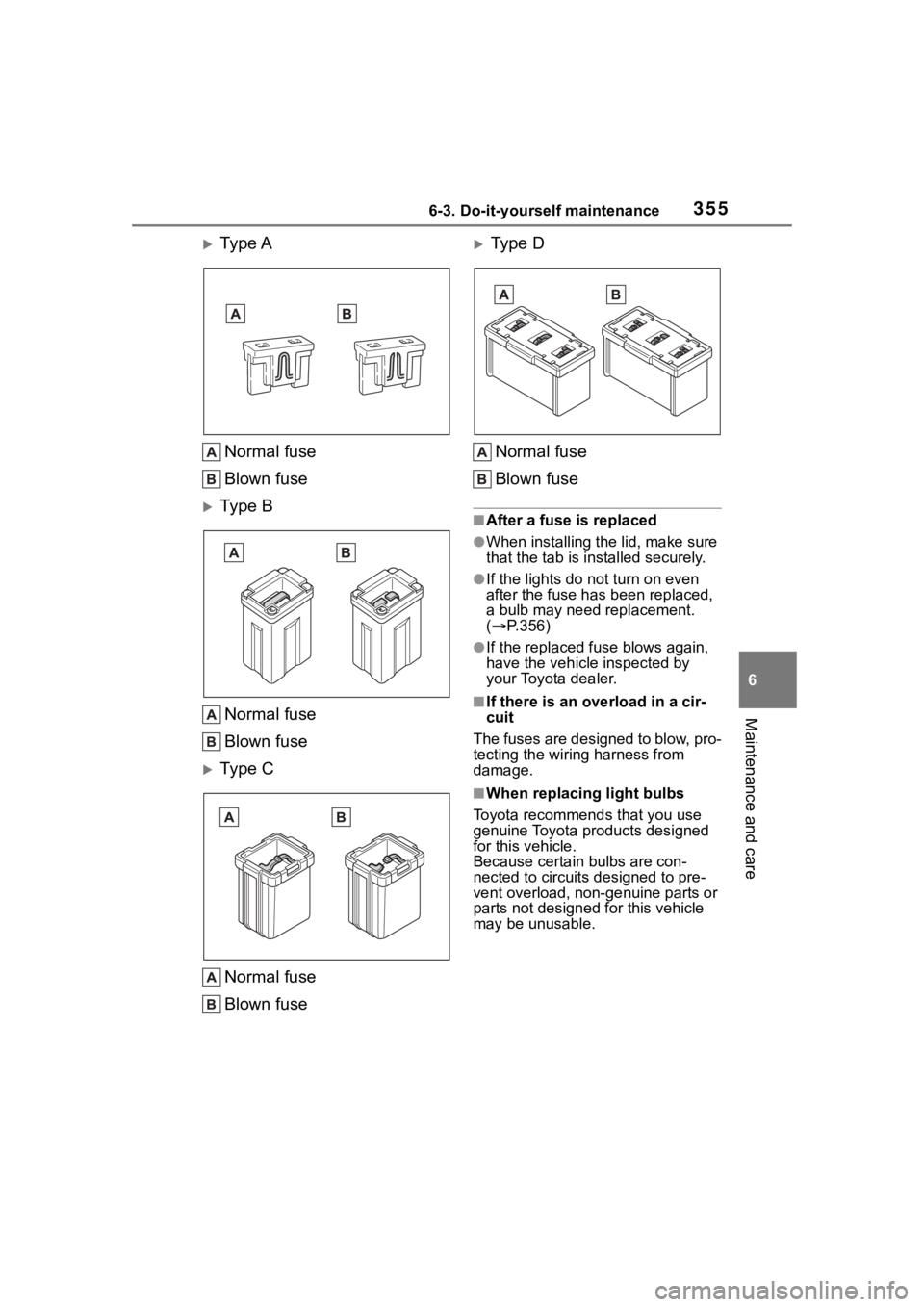
Ty p e ANormal fuse
Blown fuse
Ty p e B
Normal fuse
Blown fuse
Ty p e CNormal fuse
Blown fuse
Type DNormal fuse
Blown fuse
■After a fuse is replaced
●When installing the lid, make sure
that the tab is ins talled securely.
●If the lights do not turn on even
after the fuse has been replaced,
a bulb may need replacement.
( P.356)
●If the replaced fuse blows again,
have the vehicle inspected by
your Toyota dealer.
■If there is an ove rload in a cir-
cuit
The fuses are designed to blow, pro-
tecting the wiring harness from
damage.
■When replacing light bulbs
Toyota recommends that you use
genuine Toyota pr oducts designed
for this vehicle.
Because certain bulbs are con-
nected to circuits designed to pre-
vent overload, non-genuine parts or
parts not designed for this vehicle
may be unusable.
Page 356 of 496
3566-3. Do-it-yourself maintenance
Check the wattage of the light
bulb to be replaced. ( P.428)
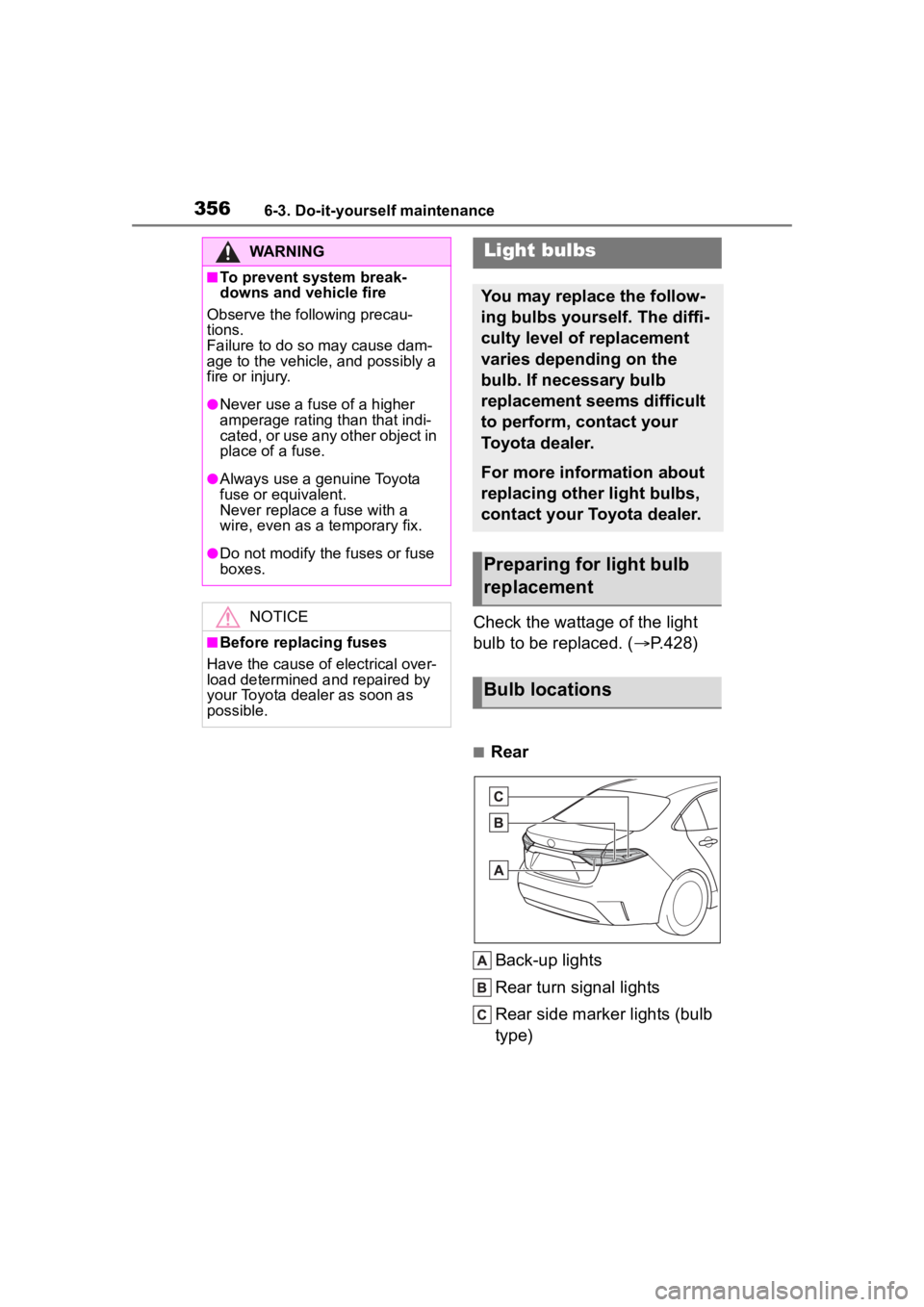
■Rear
Back-up lights
Rear turn signal lights
Rear side marker lights (bulb
type)
WARNING
■To prevent system break-
downs and vehicle fire
Observe the following precau-
tions.
Failure to do so may cause dam-
age to the vehicle, and possibly a
fire or injury.
●Never use a fuse of a higher
amperage rating than that indi-
cated, or use any other object in
place of a fuse.
●Always use a genuine Toyota
fuse or equivalent.
Never replace a fuse with a
wire, even as a temporary fix.
●Do not modify the fuses or fuse
boxes.
NOTICE
■Before replacing fuses
Have the cause of electrical over-
load determined and repaired by
your Toyota dealer as soon as
possible.
Light bulbs
You may replace the follow-
ing bulbs yourself. The diffi-
culty level of replacement
varies depending on the
bulb. If necessary bulb
replacement seems difficult
to perform, contact your
Toyota dealer.
For more information about
replacing other light bulbs,
contact your Toyota dealer.
Preparing for light bulb
replacement
Bulb locations
Page 357 of 496
3576-3. Do-it-yourself maintenance
6
Maintenance and care
■Bulbs that need to be
replaced by your Toyota
dealer
Headlights/daytime running
lights
Parking lights
Front turn signal lights
Front side marker lights
LED accent lights (if
equipped)
Side turn signal lights (if
equipped)
Tail lights
Stop lights
Rear side marker lights (LED
type)
High mounted stoplight
License plate lights
■LED light bulbs
The lights other than the rear turn
signal lights, rear side marker lights
(bulb type) and back-up lights con-
sist of a number of LEDs. If any of
the LEDs burn out, take your vehicle
to your Toyota dealer to have the
light replaced.
■Condensation build-up on the
inside of the lens
In certain situatio ns, such as when
driving in the rain or when washing
the vehicle, condensation may form
on the inner side of the headlight
lens and other li ghts. As each light
has a ventilation hole, moist air may
enter. If the ambient temperature is
low, condensation may form tempo-
rarily, but it will di ssipate as the
inside of the light i s warmed up. As
the condensation is due to a phe-
nomenon similar to windows fogging
in the rain, it doe s not indicate a malfunction.
Contact your Toyota dealer for more
information in t
he following situa-
tions:
●Large drops of water have built up
on the inside of the lens.
●Water has built up inside the
headlight.
■When replacing light bulbs
P.355
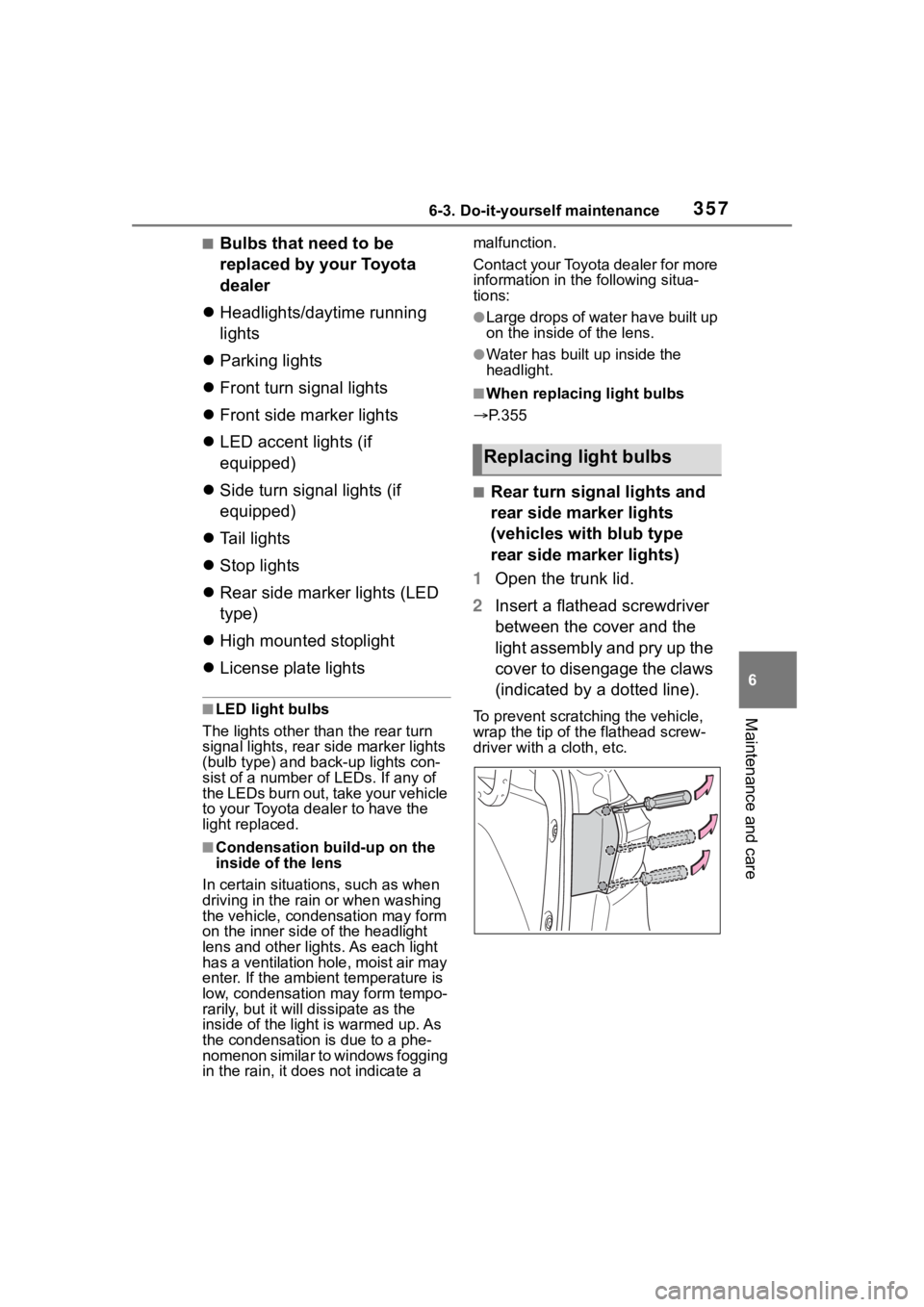
■Rear turn signal lights and
rear side marker lights
(vehicles with blub type
rear side marker lights)
1 Open the trunk lid.
2 Insert a flathead screwdriver
between the cover and the
light assembly and pry up the
cover to disengage the claws
(indicated by a dotted line).
To prevent scratching the vehicle,
wrap the tip of th e flathead screw-
driver with a cloth, etc.
Replacing light bulbs
Page 358 of 496
3586-3. Do-it-yourself maintenance
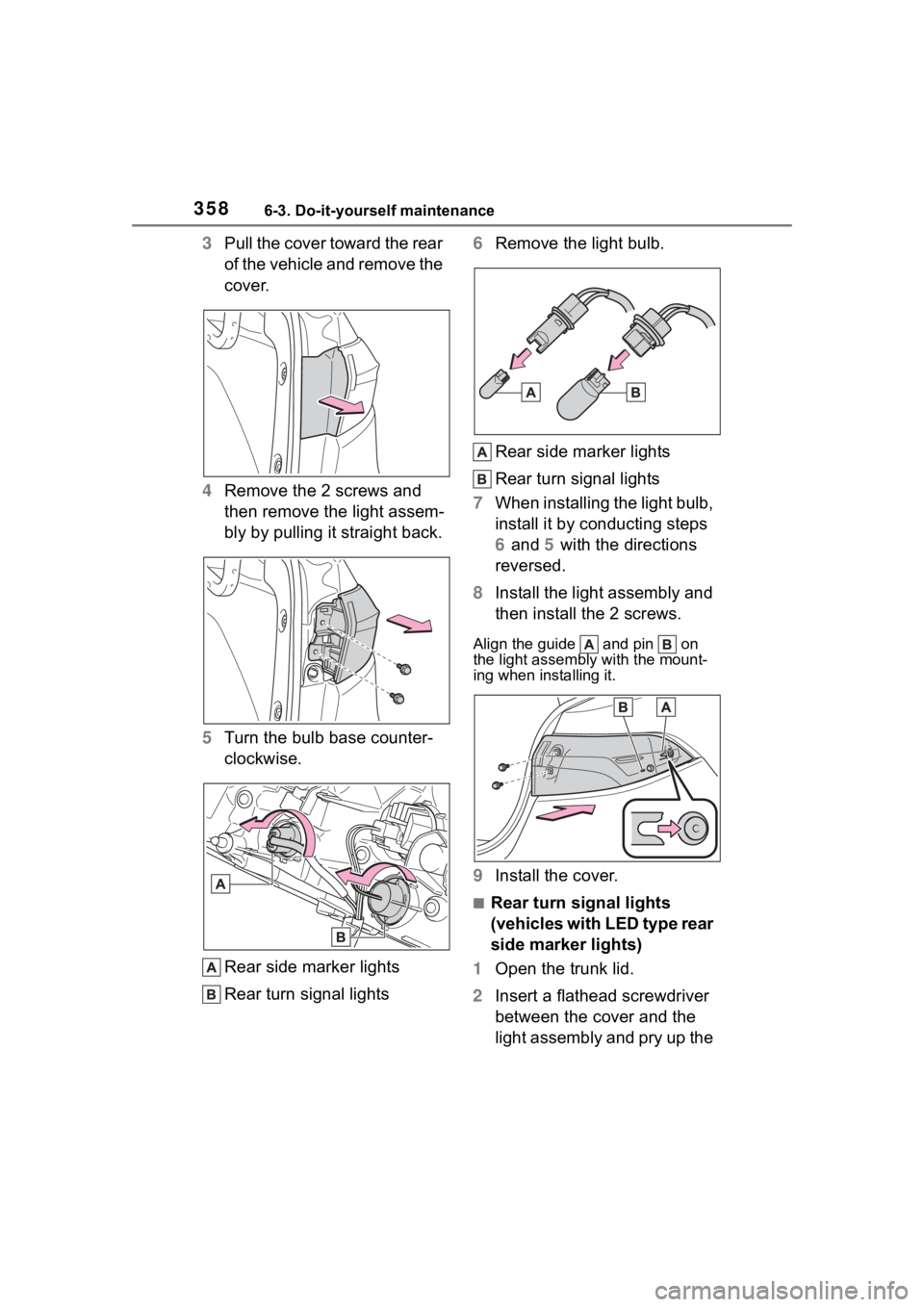
3Pull the cover toward the rear
of the vehicle and remove the
cover.
4 Remove the 2 screws and
then remove the light assem-
bly by pulling it straight back.
5 Turn the bulb base counter-
clockwise.
Rear side marker lights
Rear turn signal lights 6
Remove the light bulb.
Rear side marker lights
Rear turn signal lights
7 When installing the light bulb,
install it by conducting steps
6 and 5 with the directions
reversed.
8 Install the light assembly and
then install the 2 screws.
Align the guide and pin on
the light assembl y with the mount-
ing when installing it.
9 Install the cover.
■Rear turn signal lights
(vehicles with LED type rear
side marker lights)
1 Open the trunk lid.
2 Insert a flathead screwdriver
between the cover and the
light assembly and pry up the