tow TOYOTA FJ CRUISER 2010 1.G Owner's Guide
[x] Cancel search | Manufacturer: TOYOTA, Model Year: 2010, Model line: FJ CRUISER, Model: TOYOTA FJ CRUISER 2010 1.GPages: 439, PDF Size: 11.02 MB
Page 290 of 439

289
4
Maintenance and care
4-3. Do-it-yourself maintenance
Do-it-yourself ser vice precautions
If you perform maintenance yourself, be sure to follow the correct
procedures as given in these sections.
ItemsParts and tools
Battery condition (P. 303)•Warm water
• Baking soda
• Grease
• Conventional wrench
(for terminal clamp bolts)
Brake fluid level (P. 300)• FMVSS No.116 DOT 3 or SAE
J1703 brake fluid
• Rag or paper towel
Engine coolant level (P. 299)• “Toyota Super Long Life Coolant”
or similar high quality ethylene
glycol based non-silicate, non-
amine, non-nitrite and non-borate
coolant with long-life hybrid
organic acid technology.
U.S.A.:
“Toyota Super Long Life Coolant”
is pre-mixed with 50% coolant
and 50% deionized water.
Canada:
“Toyota Super Long Life Coolant”
is pre-mixed with 55% coolant
and 45% deionized water.
Engine oil levelP. 295)• Toyota Genuine Motor Oil or
equivalent
• Rag or paper towel
• Funnel (used only for adding oil)
Fuses (P. 324)• Fuse with same amperage rating
as original
Page 291 of 439
290 4-3. Do-it-yourself maintenance
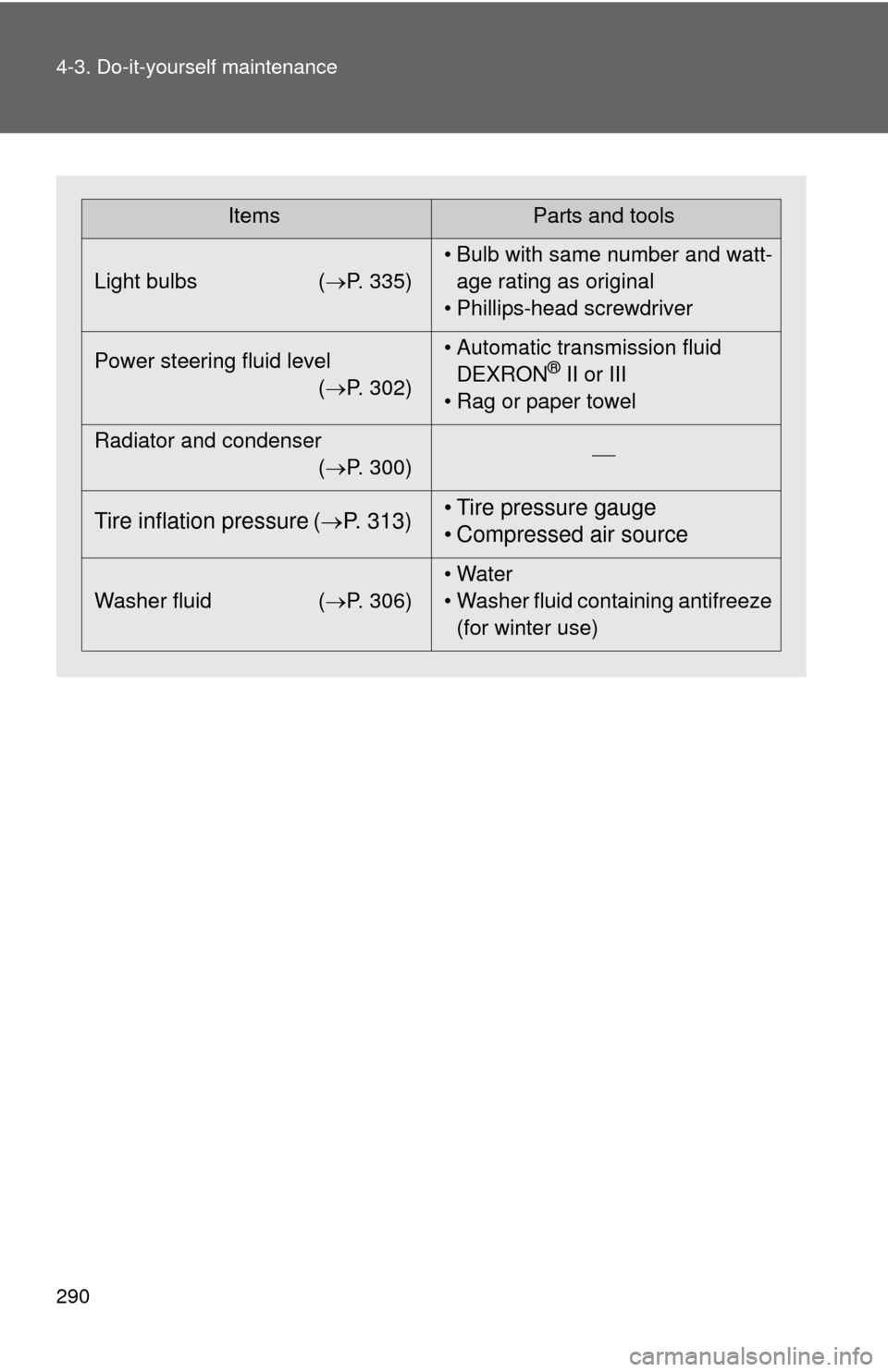
ItemsParts and tools
Light bulbs (P. 335)• Bulb with same number and watt-
age rating as original
• Phillips-head screwdriver
Power steering fluid level
(P. 302)• Automatic transmission fluid
DEXRON
® II or III
• Rag or paper towel
Radiator and condenser
(P. 300)
Tire inflation pressure (P. 313)• Tire pressure gauge
• Compressed air source
Washer fluid (P. 306)• Water
• Washer fluid containing antifreeze
(for winter use)
Page 302 of 439

301 4-3. Do-it-yourself maintenance
4
Maintenance and care
■Adding fluid
Make sure to check the fluid type and prepare the necessary items.
Turn the engine switch off.
Depress the brake pedal 20 times or more.
Remove the reservoir cap.
Add newly opened brake fluid up to the MAX line.
.
Fluid type FMVSS No.116 DOT 3 or SAE J1703 brake fluid
Items Rag or paper towel
■Brake fluid can absorb moisture from the air
Excess moisture in the fluid can cause a dangerous loss of braking effi-
ciency. Use only newly opened brake fluid.
CAUTION
■When filling the reservoir
Take care because brake fluid can harm your hands or eyes and damage
painted surfaces.
If fluid gets on your hands or in your eyes, flush the affected area with clean
water immediately.
If you still experience discomfort, see a doctor.
NOTICE
■If the fluid level is low or high
It is normal for the brake fluid level to go down slightly as the brake pads
wear or when the fluid level in the accumulator is high.
If the reservoir needs frequent refilling, it may indicate a serious problem.
■If you spill fluid
Be sure to wash it off with water to prevent damage to parts or paint.
Page 303 of 439
302 4-3. Do-it-yourself maintenance
Power steering fluid
■Fluid level
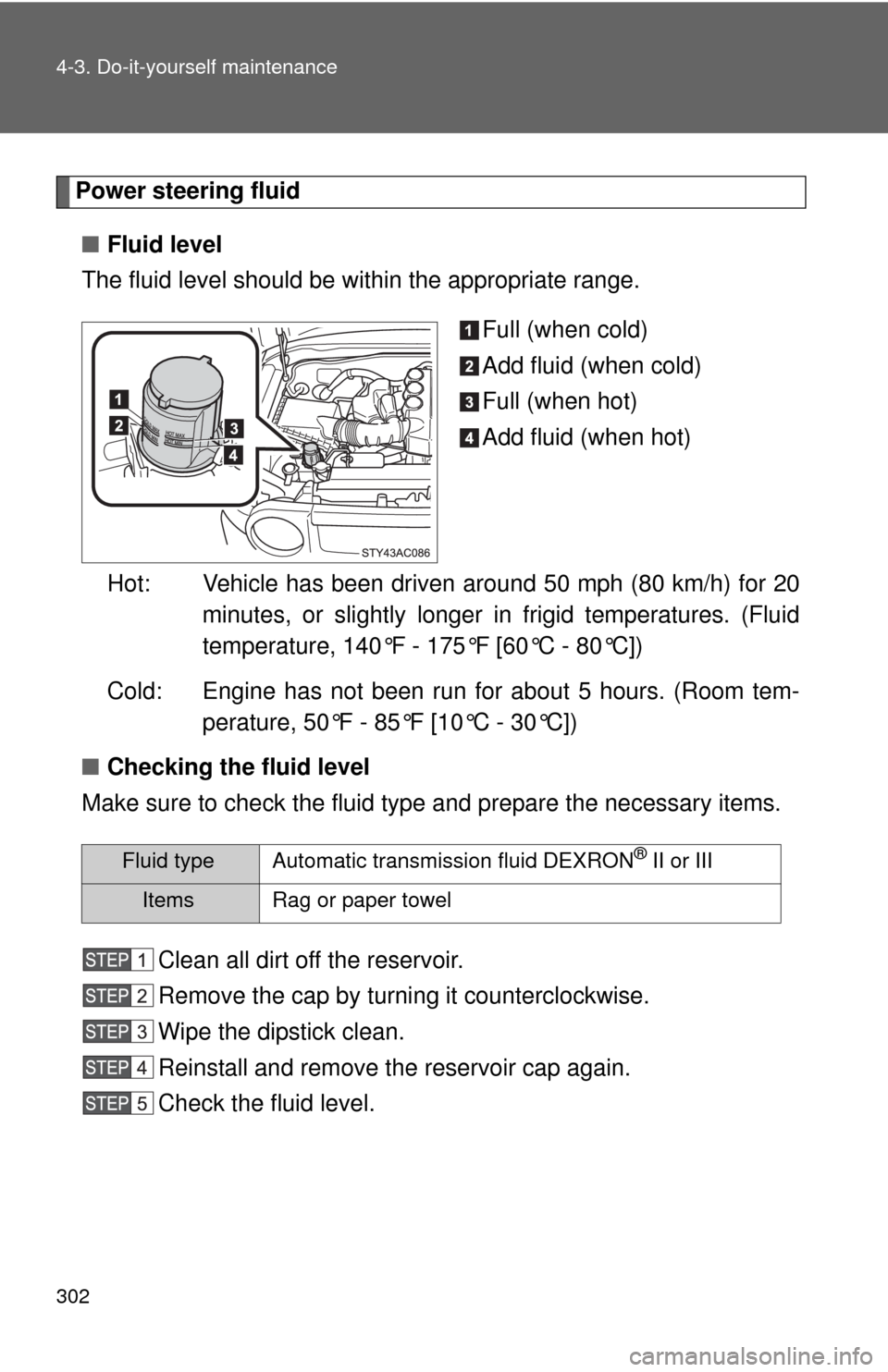
The fluid level should be within the appropriate range.
Full (when cold)
Add fluid (when cold)
Full (when hot)
Add fluid (when hot)
Hot: Vehicle has been driven around 50 mph (80 km/h) for 20
minutes, or slightly longer in frigid temperatures. (Fluid
temperature, 140°F - 175°F [60°C - 80°C])
Cold: Engine has not been run for about 5 hours. (Room tem-
perature, 50°F - 85°F [10°C - 30°C])
■Checking the fluid level
Make sure to check the fluid type and prepare the necessary items.
Clean all dirt off the reservoir.
Remove the cap by turning it counterclockwise.
Wipe the dipstick clean.
Reinstall and remove the reservoir cap again.
Check the fluid level.
Fluid type Automatic transmission fluid DEXRON® II or III
Items Rag or paper towel
Page 330 of 439
329 4-3. Do-it-yourself maintenance
4
Maintenance and care
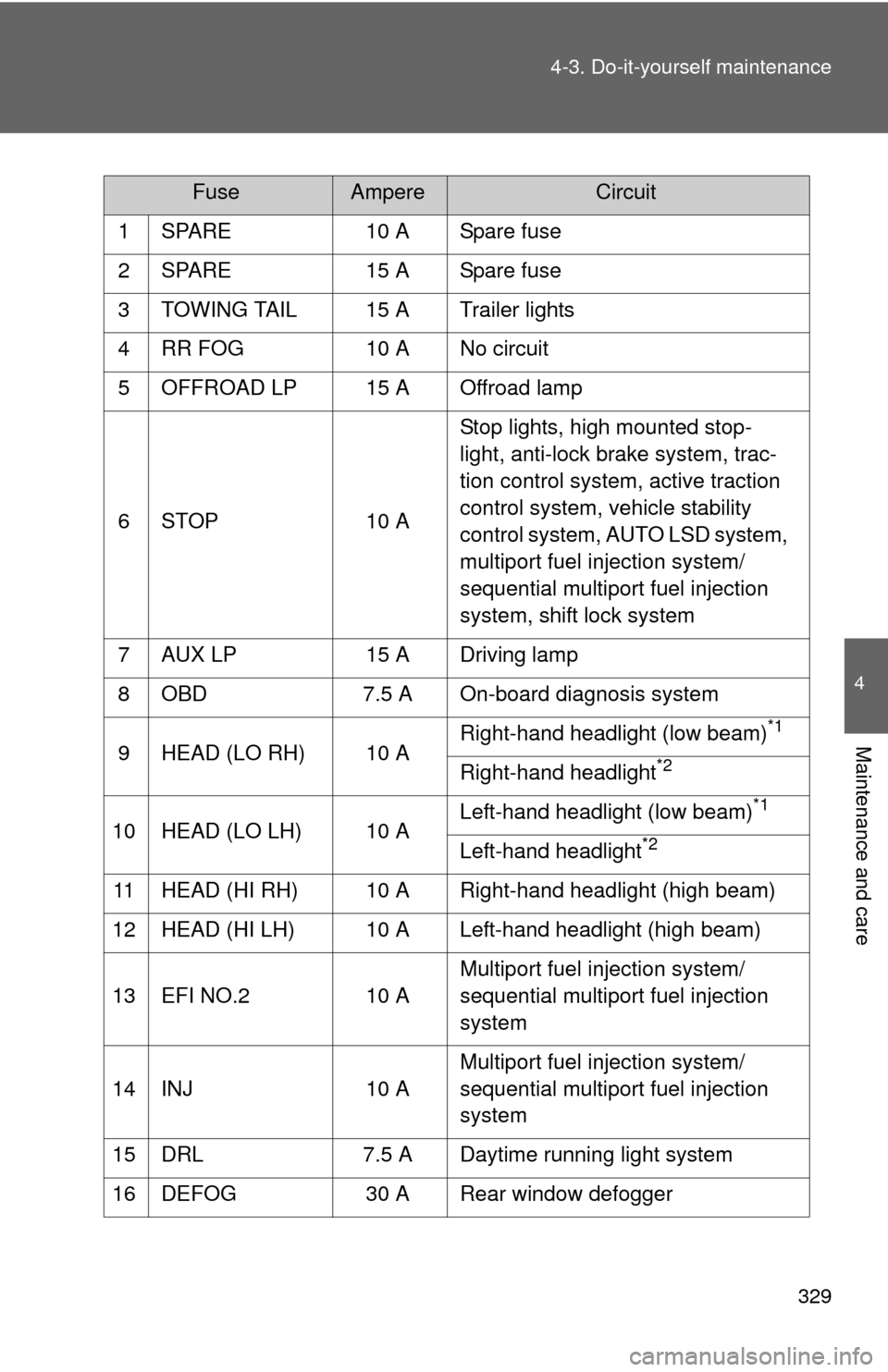
FuseAmpereCircuit
1 SPARE 10 A Spare fuse
2 SPARE 15 A Spare fuse
3 TOWING TAIL 15 A Trailer lights
4 RR FOG 10 A No circuit
5 OFFROAD LP 15 A Offroad lamp
6 STOP 10 AStop lights, high mounted stop-
light, anti-lock brake system, trac-
tion control system, active traction
control system, vehicle stability
control system, AUTO LSD system,
multiport fuel injection system/
sequential multiport fuel injection
system, shift lock system
7 AUX LP 15 A Driving lamp
8 OBD 7.5 A On-board diagnosis system
9 HEAD (LO RH) 10 ARight-hand headlight (low beam)
*1
Right-hand headlight*2
10 HEAD (LO LH) 10 ALeft-hand headlight (low beam)
*1
Left-hand headlight*2
11 HEAD (HI RH) 10 A Right-hand headlight (high beam)
12 HEAD (HI LH) 10 A Left-hand headlight (high beam)
13 EFI NO.2 10 AMultiport fuel injection system/
sequential multiport fuel injection
system
14 INJ 10 AMultiport fuel injection system/
sequential multiport fuel injection
system
15 DRL 7.5 A Daytime running light system
16 DEFOG 30 A Rear window defogger
Page 331 of 439
330 4-3. Do-it-yourself maintenance
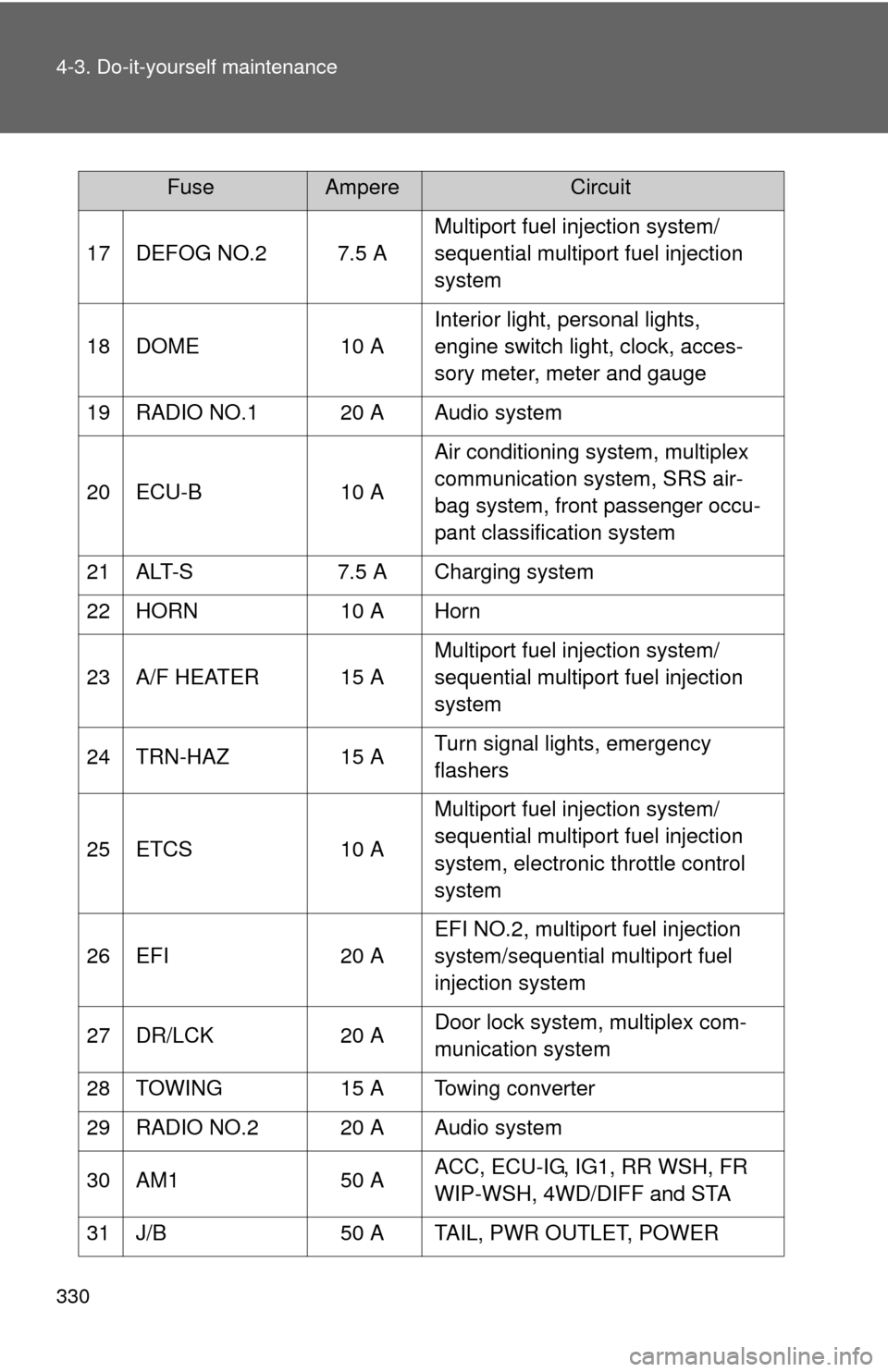
17 DEFOG NO.2 7.5 AMultiport fuel injection system/
sequential multiport fuel injection
system
18 DOME 10 AInterior light, personal lights,
engine switch light, clock, acces-
sory meter, meter and gauge
19 RADIO NO.1 20 A Audio system
20 ECU-B 10 AAir conditioning system, multiplex
communication system, SRS air-
bag system, front passenger occu-
pant classification system
21 ALT-S 7.5 A Charging system
22 HORN 10 A Horn
23 A/F HEATER 15 AMultiport fuel injection system/
sequential multiport fuel injection
system
24 TRN-HAZ 15 ATurn signal lights, emergency
flashers
25 ETCS 10 AMultiport fuel injection system/
sequential multiport fuel injection
system, electronic throttle control
system
26 EFI 20 AEFI NO.2, multiport fuel injection
system/sequential multiport fuel
injection system
27 DR/LCK 20 ADoor lock system, multiplex com-
munication system
28 TOWING 15 A Towing converter
29 RADIO NO.2 20 A Audio system
30 AM1 50 AACC, ECU-IG, IG1, RR WSH, FR
WIP-WSH, 4WD/DIFF and STA
31 J/B 50 A TAIL, PWR OUTLET, POWER
FuseAmpereCircuit
Page 332 of 439

331 4-3. Do-it-yourself maintenance
4
Maintenance and care
*1: Vehicles with daytime running light
*2: Vehicles without daytime running light32 ABS MTR 40 AAnti-lock brake system, vehicle sta-
bility control system, traction con-
trol system, active traction control
system, AUTO LSD system
33 AM2 30 AIGN and GAUGE, multiport fuel
injection system/sequential multi-
port fuel injection system, starting
system
34 ABS SOL 30 AAnti-lock brake system, vehicle sta-
bility control system, traction con-
trol system, active traction control
system, AUTO LSD system
35 ALT 120 AAM1, AC 115V, DEFOG, DEFOG
NO.2, STOP, OBD, J/B, TOWING
TAIL, AUX LP and OFFROAD LP
36 HEATER 60 A Air conditioning system
37 AC 115V 80 A Power outlet
FuseAmpereCircuit
Page 344 of 439

When trouble arises5
343
5-1. Essential information
Emergency flashers ......... 344
If your vehicle needs to
be towed ........................ 345
If you think something is
wrong ............................. 350
Fuel pump shut off
system ........................... 351
Event data recorder ......... 352
5-2. Steps to take in an
emergency
If a warning light turns on
or a warning buzzer
sounds... ........................ 354
If you have a flat tire......... 364
If the engine will not
start ................................ 376
If the shift lever cannot
be shifted from P............ 377
If you lose your keys ........ 378
If the vehicle battery is
discharged ..................... 379
If your vehicle
overheats ....................... 382
If the vehicle becomes
stuck .............................. 385
Page 346 of 439

5
When trouble arises
345
5-1. Essential information
If your vehicle needs to be towed
Before towing
The following may indicate a problem with your transmission. Contact
your Toyota dealer before towing.
●The engine is running, but the vehicle will not move.
●The vehicle makes an abnormal sound.
Emergency towing
If a tow truck is not available, in an emergency your vehicle may be
temporarily towed using a cable or chain secured to the emergency
towing eyelet. This should only attempted on hard, surfaced roads for
short distances at low speeds.
A driver must be in the vehicle to steer and operate the brakes. The
vehicle’s wheels, drive train, axles, steering and brakes must be in
good condition.
Towing eyelet
If towing is necessary, we recommend having your vehicle towed by
your Toyota dealer or a commercial towing service, using a lift-type
truck or a flat bed truck.
Use a safety chain system for all towing, and abide by all state/pro-
vincial and local laws.
The wheels and axle on the ground must be in good condition.
If they are damaged, use a towing dolly or flat bed truck.
Page 347 of 439

346 5-1. Essential information
■Emergency towing procedure
The engine switch must be in the ACC (engine off) or the ON
(engine running) position.
4WD models with an automatic transmission: Shift the front-wheel
drive control lever in H2.
4WD models with a manual transmission: Unlock the center differ-
ential.
Put the shift lever in N.
Release the parking brake.
CAUTION
■Caution while towing
●Use extreme caution when towing the vehicle.
Avoid sudden starts or erratic driving maneuvers which place excessive
stress on the emergency towing eyelet and the cables or chains.
●If the engine is not running, the power assist for the brakes and steering
will not function, making steering and braking more difficult.
NOTICE
■To prevent causing serious damage to the transmission
(vehicles with an automatic transmission)
Never tow this vehicle from the rear with the four wheels on the ground.
This may cause serious damage to the transmission.
■Emergency towing eyelet precautions
●Before emergency towing, check that the eyelet is not broken or damaged.
●Fasten the towing cable or chain securely to the eyelet.
●Do not jerk the eyelet. Apply steady and even force.
●To avoid damaging the eyelet, do not pull from the side or at a vertical
angle. Always pull straight ahead.