engine TOYOTA FJ CRUISER 2014 1.G User Guide
[x] Cancel search | Manufacturer: TOYOTA, Model Year: 2014, Model line: FJ CRUISER, Model: TOYOTA FJ CRUISER 2014 1.GPages: 572, PDF Size: 9.45 MB
Page 68 of 572
68 1-3. Adjustable components (seats, mirrors, steering wheel)
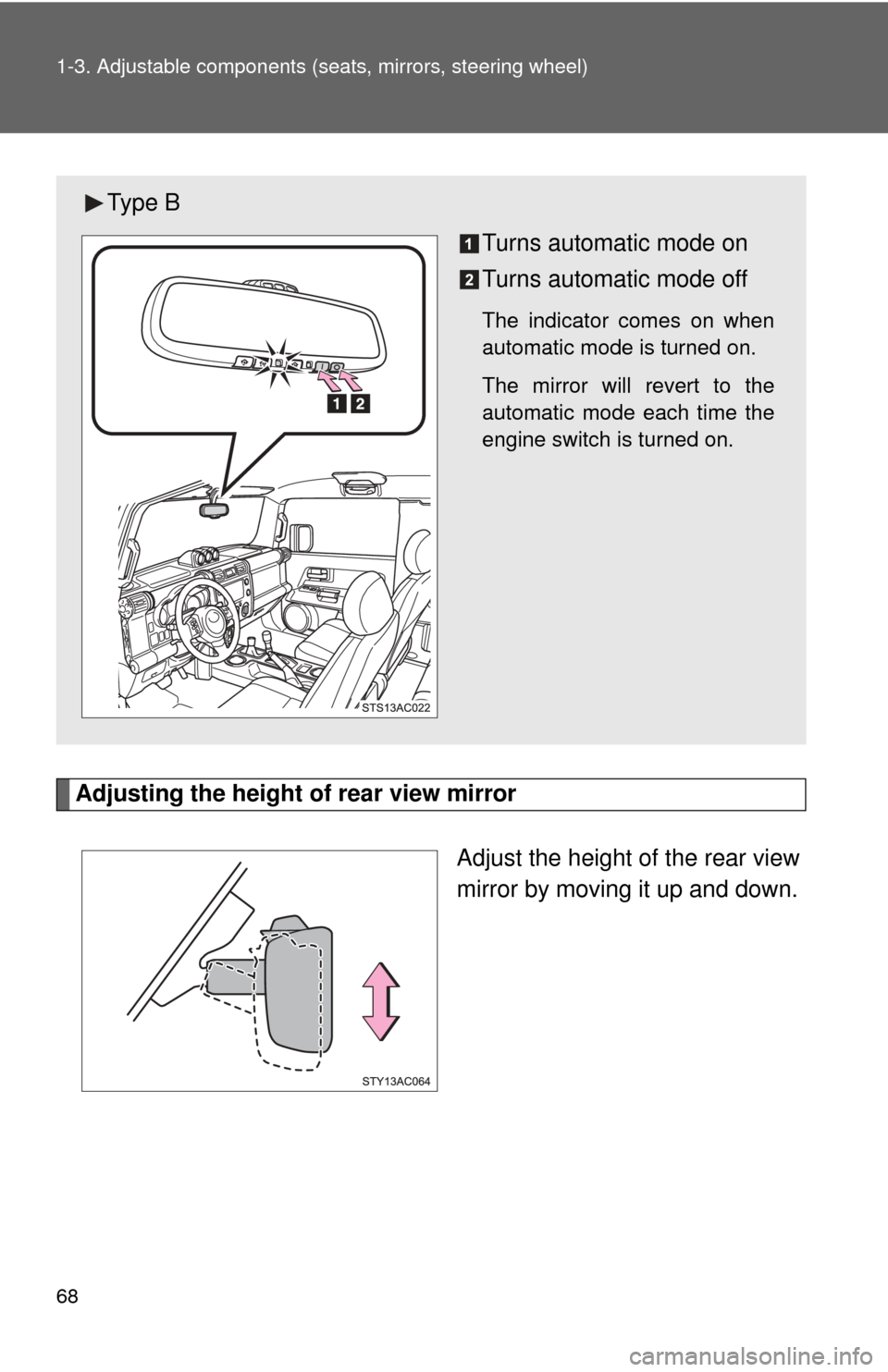
Adjusting the height of rear view mirror
Adjust the height of the rear view
mirror by moving it up and down.
Ty p e BTurns automatic mode on
Turns automatic mode off
The indicator comes on when
automatic mode is turned on.
The mirror will revert to the
automatic mode each time the
engine switch is turned on.
Page 72 of 572
72 1-3. Adjustable components (seats, mirrors, steering wheel)
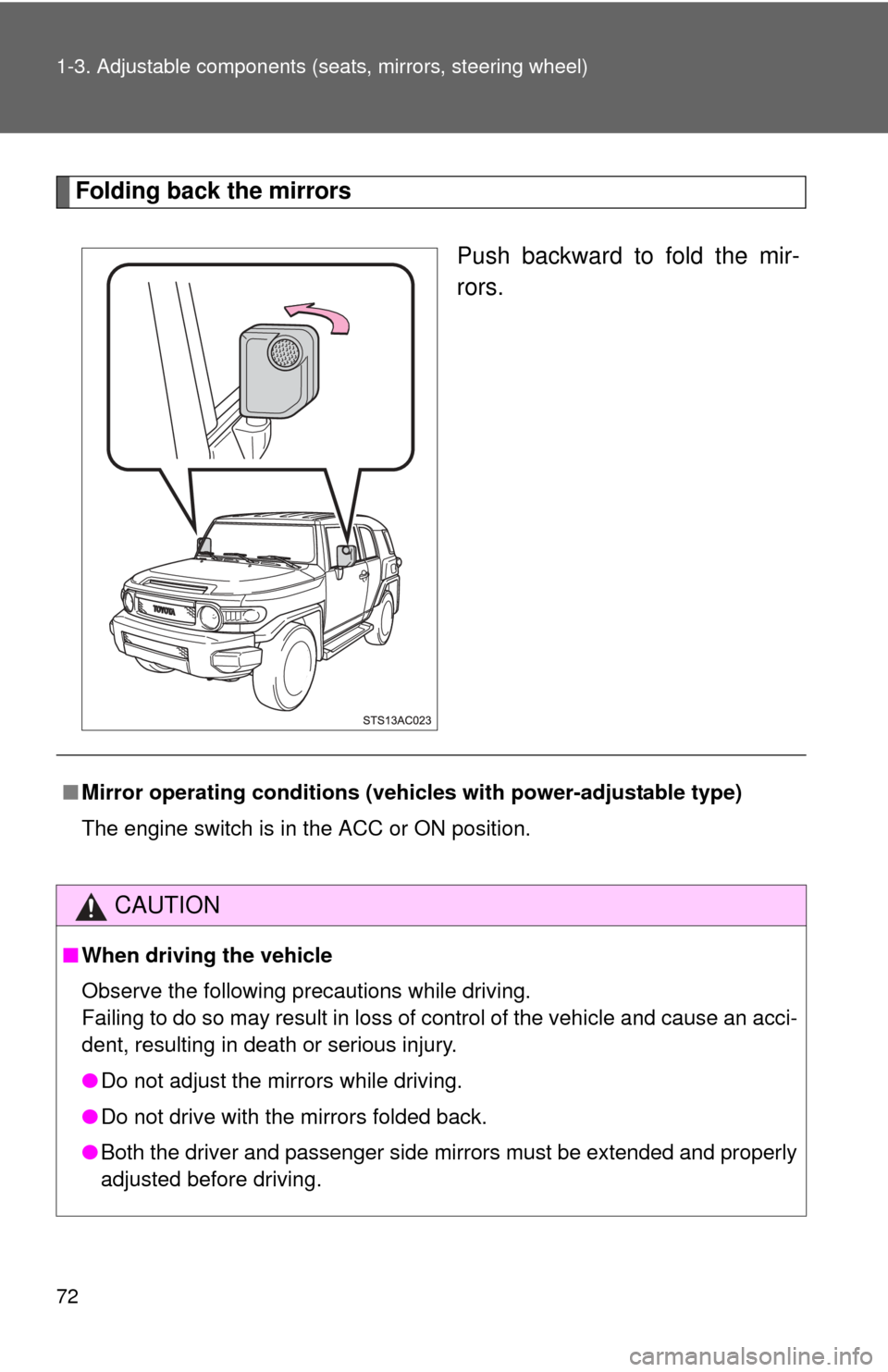
Folding back the mirrors
Push backward to fold the mir-
rors.
■Mirror operating conditions (vehic les with power-adjustable type)
The engine switch is in the ACC or ON position.
CAUTION
■ When driving the vehicle
Observe the following precautions while driving.
Failing to do so may result in loss of control of the vehicle and cause an acci-
dent, resulting in death or serious injury.
●Do not adjust the mirrors while driving.
● Do not drive with the mirrors folded back.
● Both the driver and passenger side mirrors must be extended and properly
adjusted before driving.
Page 75 of 572

75
1-4. Opening and closing the windows
1
Before driving
■
The power windows can be operated when
The engine switch is in the ON position.
■ Operating the power windows after turning the engine switch off
The power windows can be operated for approximately 45 seconds even
after the engine switch is turned off. They cannot, however, be operated
once either front door is opened.
CAUTION
■ Closing the windows
Observe the following precautions.
Failing to do so may result in death or serious injury.
●Check to make sure that all passengers do not have any part of their body
in a position where it could be caught when a window is being operated.
● Do not allow children to operate the power windows.
Closing a power window on someone can cause serious injury, and in
some instances, even death.
The driver is responsible for instructing children not to operate the power
windows.
Page 76 of 572
76
1-5. Refueling
Opening the fuel tank cap
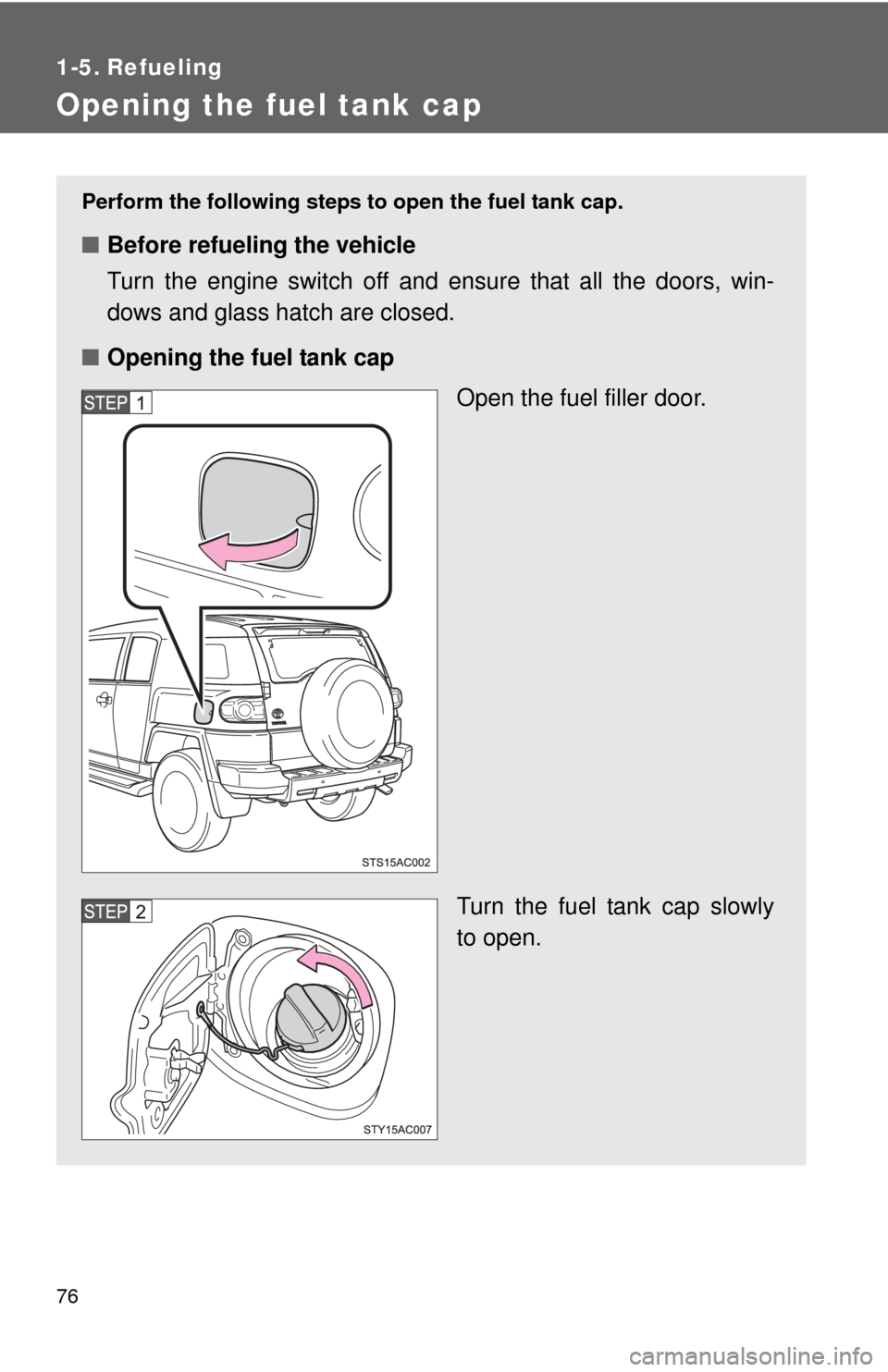
Perform the following steps to open the fuel tank cap.
■Before refueling the vehicle
Turn the engine switch off and ensure that all the doors, win-
dows and glass hatch are closed.
■ Opening the fuel tank cap
Open the fuel filler door.
Turn the fuel tank cap slowly
to open.
Page 78 of 572

78 1-5. Refueling
CAUTION
■Refueling the vehicle
●Do not inhale vaporized fuel.
Fuel contains substances that are harmful if inhaled.
● Do not smoke while refueling the vehicle.
Doing so may cause the fuel to ignite and cause a fire.
● Do not return to the vehicle or touch any person or object that is statically
charged.
This may cause static electricity to build up, resulting in a possible engine
hazard.
■ When replacing the fuel tank cap
Do not use anything but a genuine Toyota fuel tank cap designed for your
vehicle. Doing so may cause a fire or other incident which may result in
death or serious injury.
NOTICE
■Refueling
Do not spill fuel during refueling.
Doing so may damage the vehicle, such as causing the exhaust systems to
operate abnormally or damaging fuel s ystem components or the vehicle’s
painted surface.
■ To prevent damage to the fuel filler door
Do not apply excessive force.
Page 79 of 572
79
1
Before driving
1-6. Theft deterrent system
Engine immobilizer system
■System maintenance
The vehicle has a maintenance-free type engine immobilizer system.
■ Conditions that may cause the system to malfunction
● If the key is in contact with a metallic object
● If the key is in close proximity to or touching a key to the security system
(key with a built-in transponder chip) of another vehicle
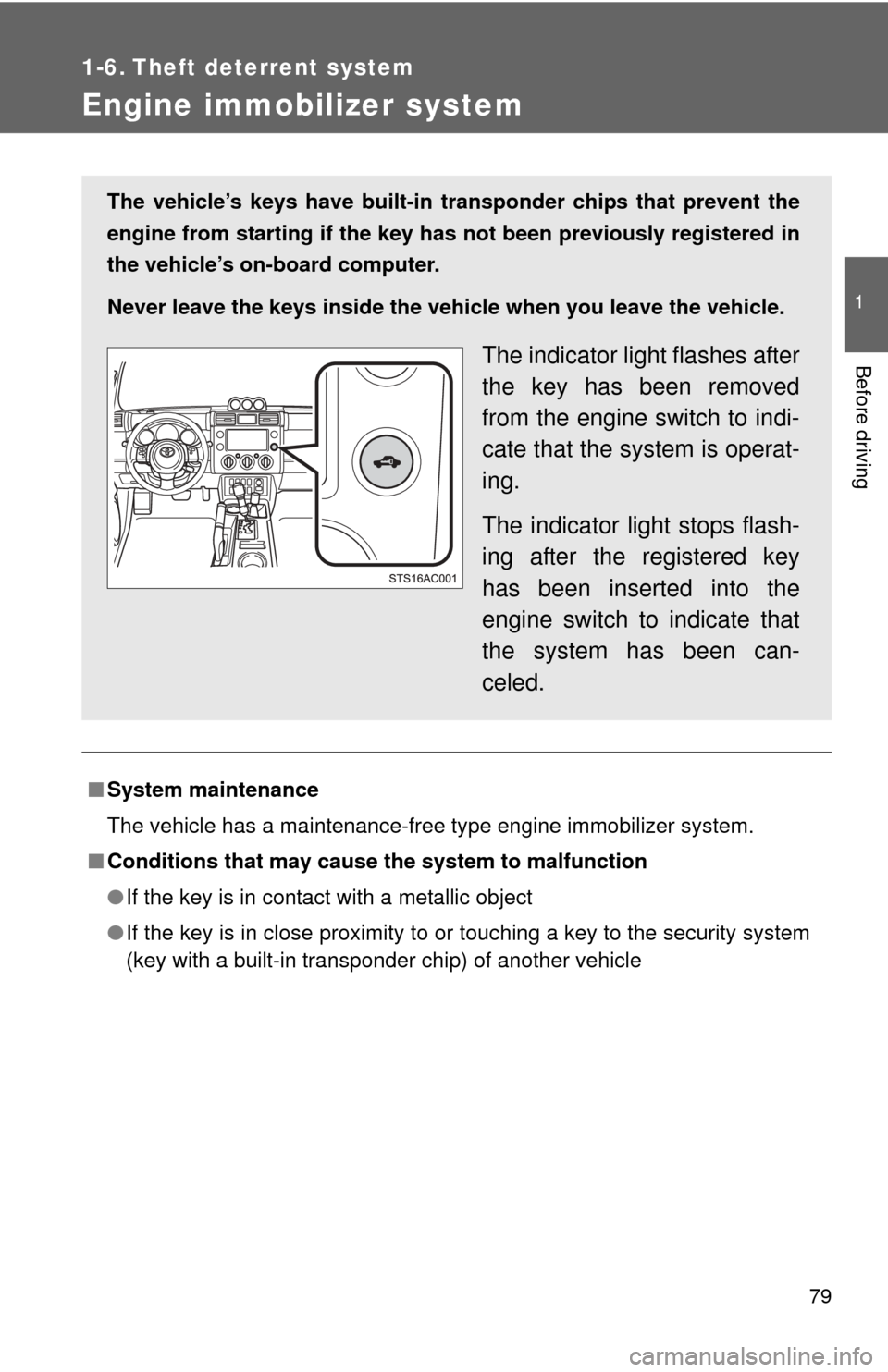
The vehicle’s keys have built-in tr ansponder chips that prevent the
engine from starting if the key has not been previously registered in
the vehicle’s on-board computer.
Never leave the keys inside the vehicle when you leave the vehicle.
The indicator light flashes after
the key has been removed
from the engine switch to indi-
cate that the system is operat-
ing.
The indicator light stops flash-
ing after the registered key
has been inserted into the
engine switch to indicate that
the system has been can-
celed.
Page 80 of 572

80 1-6. Theft deterrent system
■Certifications for the engine immobilizer system
For vehicles sold in the U.S.A.
FCC ID: MOZRI-20BTY
This device complies with part 15 of the FCC Rules. Operation is subject to
the following two conditions: (1) This device may not cause harmful interfer-
ence, and (2) this device must accept any interference received, including
interference that may cause undesired operation.
FCC WARNING:
Changes or modifications not expressly approved by the party responsible
for compliance could void the user’s authority to operate the equipment.
For vehicles sold in Canada
This device complies with Industry Canada licence-exempt RSS stan-
dard(s). Operation is subject to the following two conditions: (1) this device
may not cause interference, and (2) this device must accept any interfer-
ence, including interference that may cause undesired operation of the
device.
NOTICE
■ To ensure the system operates correctly
Do not modify or remove the system. If modified or removed, the proper
operation of the system cannot be guaranteed.
Page 95 of 572
95
1-7. Safety information
1
Before driving
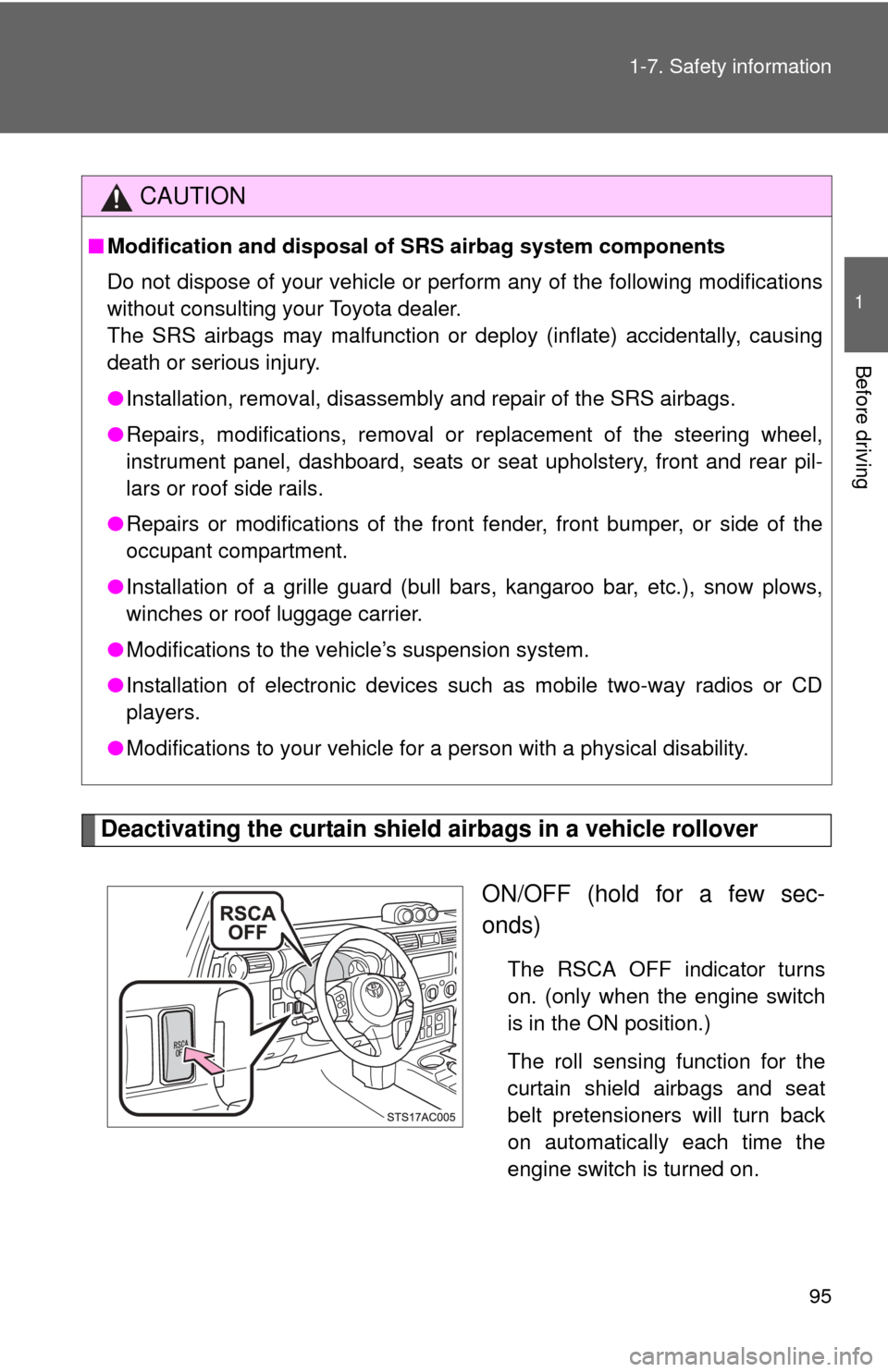
Deactivating the curtain shield airbags in a vehicle rollover
ON/OFF (hold for a few sec-
onds)
The RSCA OFF indicator turns
on. (only when the engine switch
is in the ON position.)
The roll sensing function for the
curtain shield airbags and seat
belt pretensioners will turn back
on automatically each time the
engine switch is turned on.
CAUTION
■Modification and disposal of SRS airbag system components
Do not dispose of your vehicle or per form any of the following modifications
without consulting your Toyota dealer.
The SRS airbags may malfunction or deploy (inflate) accidentally, causing
death or serious injury.
● Installation, removal, disassembly and repair of the SRS airbags.
● Repairs, modifications, removal or replacement of the steering wheel,
instrument panel, dashboard, seats or seat upholstery, front and rear pil-
lars or roof side rails.
● Repairs or modifications of the front fender, front bumper, or side of the
occupant compartment.
● Installation of a grille guard (bull bars, kangaroo bar, etc.), snow plows,
winches or roof luggage carrier.
● Modifications to the vehicle’s suspension system.
● Installation of electronic devices such as mobile two-way radios or CD
players.
● Modifications to your vehicle for a person with a physical disability.
Page 117 of 572
When driving2
117
2-1. Driving proceduresDriving the vehicle............ 118
Engine (ignition) switch .... 129
Automatic Transmission... 132
Manual Transmission ....... 134
Turn signal lever .............. 136
Parking brake ................... 137
Horn ................................. 139
2-2. Instrument cluster Gauges and meters ......... 140
Indicators and warning lights .............................. 143
Accessory meter .............. 146
2-3. Operating the lights and wipers
Headlight switch ............... 148
Windshield wipers and washer ........................... 151
Rear window wiper and washer ........................... 153
2-4. Using other driving systems Cruise control ................... 154
Intuitive parking assist...... 158
Rear view monitor system ........................... 163 Four-wheel drive system
(4WD models with a
manual transmission) ..... 176
Four-wheel drive system (4WD models with
an automatic
transmission) ................. 179
Active traction control system ........................... 182
AUTO LSD system (2WD models) ................ 185
Rear differential lock system ........................... 187
Clutch start cancel switch (vehicles with a
manual transmission) ..... 191
Crawl Control ................... 192
Driving assist systems ..... 196
2-5. Driving information Off-road precautions ........ 201
Cargo and luggage .......... 206
Vehicle load limits ............ 210
Winter driving tips ............ 211
Trailer towing ................... 214
Dinghy towing .................. 232
Page 118 of 572
118
2-1. Driving procedures
Driving the vehicle
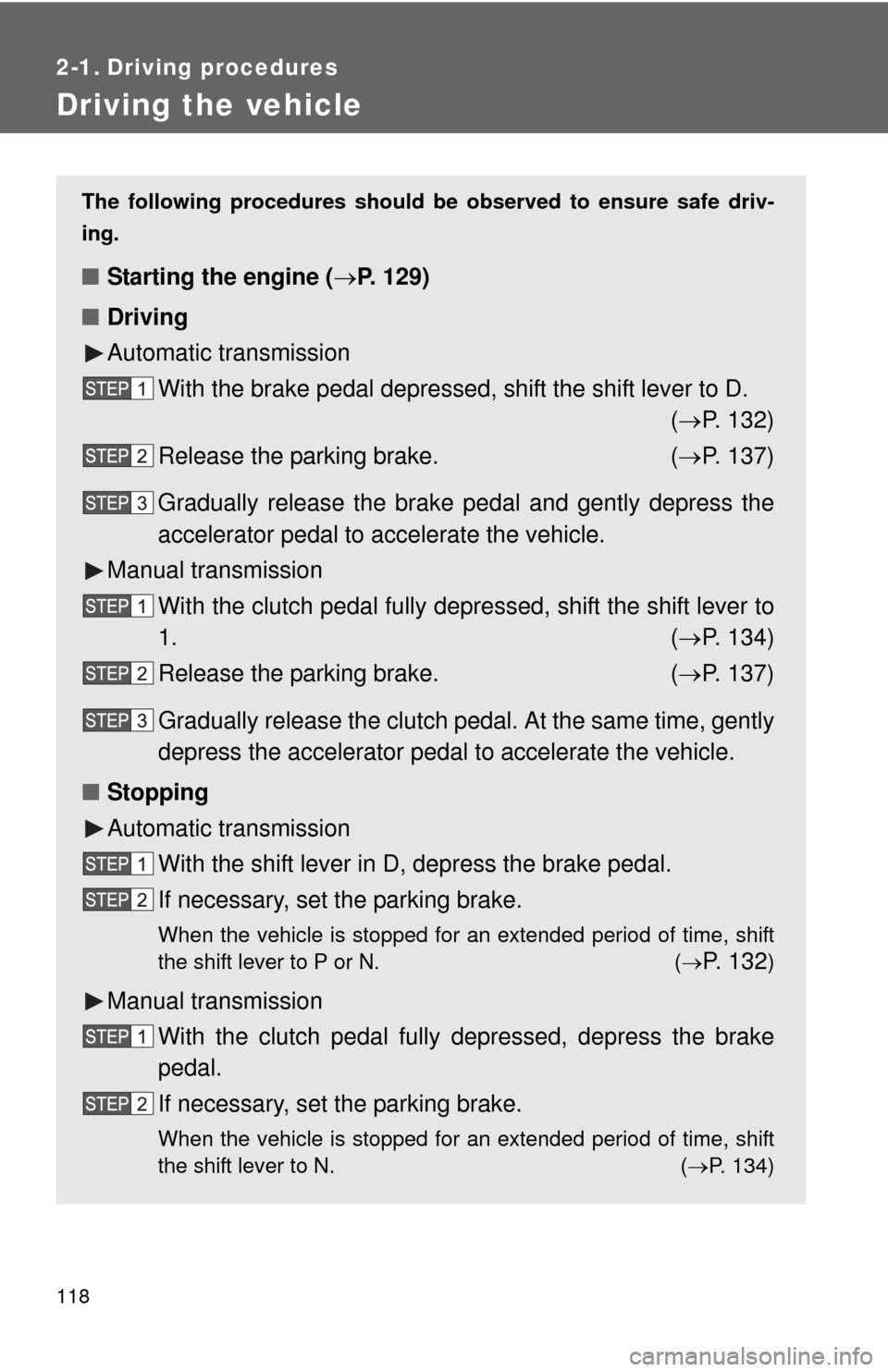
The following procedures should be observed to ensure safe driv-
ing.
■ Starting the engine ( P. 129)
■ Driving
Automatic transmission
With the brake pedal depressed, shift the shift lever to D. ( P. 132)
Release the parking brake. ( P. 137)
Gradually release the brake pedal and gently depress the
accelerator pedal to accelerate the vehicle.
Manual transmission With the clutch pedal fully depressed, shift the shift lever to
1. ( P. 134)
Release the parking brake. ( P. 137)
Gradually release the clutch pedal. At the same time, gently
depress the accelerator pedal to accelerate the vehicle.
■ Stopping
Automatic transmission
With the shift lever in D, depress the brake pedal.
If necessary, set the parking brake.
When the vehicle is stopped for an extended period of time, shift
the shift lever to P or N. (
P. 1 3 2)
Manual transmission
With the clutch pedal fully depressed, depress the brake
pedal.
If necessary, set the parking brake.
When the vehicle is stopped for an extended period of time, shift
the shift lever to N. ( P. 134)