maintenance TOYOTA FR-S 2013 Owners Manual (in English)
[x] Cancel search | Manufacturer: TOYOTA, Model Year: 2013, Model line: FR-S, Model: TOYOTA FR-S 2013Pages: 412, PDF Size: 5.3 MB
Page 1 of 412

TABLE OF CONTENTS
1
1Before drivingAdjusting and operating features such as door locks,
mirrors, and steering column.
2When drivingDriving, stopping and safe-driving information.
3Interior fea-
turesAir conditioning and audio systems, as well as other in-
terior features for a comfortable driving experience.
4Maintenance
and careCleaning and protecting your vehicle, performing do-it-
yourself maintenance, and maintenance information.
5When trouble
arisesWhat to do if the vehicle needs to be towed, gets a flat
tire, or is involved in an accident.
6Vehicle
specificationsDetailed vehicle information.
7For ownersReporting safety defects for US owners, and seat belt
and SRS airbag instructions for Canadian owners
IndexAlphabetical listing of information contained in this
manual.
Page 3 of 412

1
2
3
4
5
6
7
3
2-5. Driving informationCargo and luggage ............. 179
Vehicle load limits ............... 183
Winter driving tips ............... 184
Trailer towing ...................... 187
Dinghy towing (vehicles with an automatic
transmission) .................... 188
Dinghy towing (vehicles with a manual
transmission) .................... 189
3-1. Using the air conditioning system and defogger
Manual air conditioning system .............................. 192
Rear window and outside rear view mirror
defoggers .......................... 199
3-2. Using the audio system Using the AUX/USB port ..... 201
3-3. Using the interior lights Interior lights list .................. 202
• Interior light ....................... 203
3-4. Using the storage features List of storage features ....... 204
• Glove box.......................... 205
• Bottle holders .................... 206
• Cup holders/console tray .................................... 207 3-5. Other interior features
Sun visors........................... 209
Vanity mirrors ..................... 210
Clock .................................. 211
Outside temperature display .............................. 212
Power outlets...................... 213
Floor mat ............................ 215
4-1. Maintenance and care Cleaning and protecting the vehicle exterior ........... 220
Cleaning and protecting the vehicle interior ............ 224
4-2. Maintenance Maintenance requirements .................... 228
General maintenance ......... 230
Emission inspection and maintenance (I/M)
programs .......................... 233
3Interior features
4Maintenance and care
Page 4 of 412

TABLE OF CONTENTSIndex
4
4-3. Do-it-yourself maintenanceDo-it-yourself service precautions ...................... 234
Hood................................... 237
Positioning a floor jack ....... 239
Engine compartment .......... 241
Tires ................................... 254
Tire inflation pressure......... 261
Wheels ............................... 265
Air conditioning filter ........... 268
Wireless remote control key battery ....................... 270
Checking and replacing fuses ................................ 273
Light bulbs .......................... 281
5-1. Essential information Emergency flashers ........... 294
If your vehicle needs to be towed .......................... 295
If you think something is wrong ............................... 302
Fuel pump shut off system .............................. 303 5-2. Steps to take in an
emergency
If a warning light turns on or a warning buzzer
sounds... .......................... 304
If you have a flat tire ........... 314
If the engine will not start .... 325
If the shift lever cannot be shifted from P (vehicles
with an automatic
transmission) .................... 326
If you lose your keys ........... 327
If the battery is discharged ........................ 328
If your vehicle overheats..... 332
If the vehicle becomes stuck ................................. 335
If your vehicle has to be stopped in an
emergency........................ 337
6-1. Specifications Maintenance data (fuel, oil level, etc.) ........... 340
Fuel information .................. 352
Tire information................... 356
6-2. Customization Customizable features ........ 369
5When trouble arises
6Vehicle specifications
Page 59 of 412
59
1
Before driving
1-6. Theft deterrent system
Engine immobilizer system
■When the vehicle cannot be st arted with the registered key
Remove the key and try again.
■ System maintenance
The vehicle has a maintenance-free type engine immobilizer system.
■ Conditions that may cause the system to malfunction
● If the key is in contact with a metallic object
● If the key is in close proximity to or touching a key to the security system
(key with a built-in transponder chip) of another vehicle
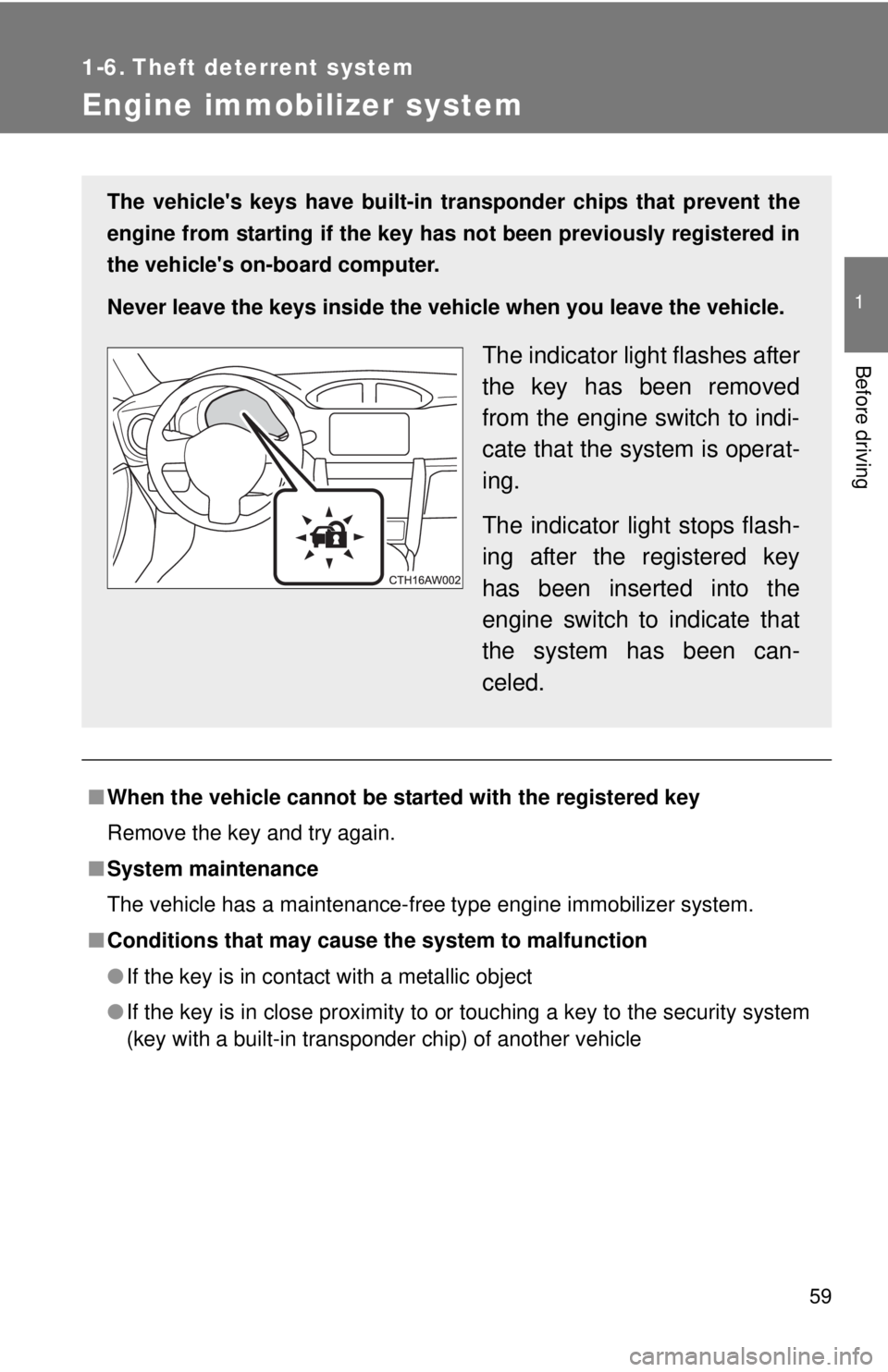
The vehicle's keys have built-in tr ansponder chips that prevent the
engine from starting if the key has not been previously registered in
the vehicle's on-board computer.
Never leave the keys inside the vehicle when you leave the vehicle.
The indicator light flashes after
the key has been removed
from the engine switch to indi-
cate that the system is operat-
ing.
The indicator light stops flash-
ing after the registered key
has been inserted into the
engine switch to indicate that
the system has been can-
celed.
Page 74 of 412

74 1-7. Safety information
Also, if luggage or electronic devices are placed on the front passenger’s
seat, this may adversely affect the ability of the system to determine deploy-
ment. This may prevent the front passenger’s frontal airbag ON and OFF
indicators from working properly. Check that the indicators work properly.
When the OFF indicator turns off and the ON indicator illuminates, the front
passenger’s frontal airbag may deploy during a collision. Remove luggage
and electronic devices from the front passenger’s seat.
NOTE
This device complies with Part 18 of the FCC Rules. This device may cause
interference. If this device causes interference, consult the nearest Scion
dealer. Also, for maintenance of the system, consult the nearest Scion
dealer.
■ Conditions in which front passenger’ s SRS frontal airbag is not acti-
vated
The front passenger’s SRS frontal airbag will not be activated when any of
the following conditions are met regarding the front passenger’s seat:
● The seat is empty.
● The seat is equipped with a rearward facing child restraint system and an
infant is restrained with it. (See WARNING that follows.)
● The seat is equipped with a forward facing child restraint system and a
small child is restrained with it. (See WARNING that follows.)
● The seat is equipped with a booster seat and a small child is in the
booster seat. (See WARNING that follows.)
● The seat is relieved of the occupant load for a time exceeding the prede-
termined monitoring time period.
● The seat is occupied by a child who has outgrown a child restraint sys-
tem (See WARNING that follows.) or by a small adult.
● The front passenger’s occupant detection system is malfunctioning.
When the front passenger’s seat is occupied by a child, observe the follow-
ing precautions. Failure to do so may increase the load on the front passen-
ger’s seat, activating the front passenger’s SRS frontal airbag even though
that seat is occupied by a child.
● Do not place any article on the seat other than the child occupant and a
child restraint system.
● Do not place more than one child on the seat.
Page 219 of 412
Maintenance and care4
219
4-1. Maintenance and careCleaning and protecting the vehicle exterior......... 220
Cleaning and protecting the vehicle interior.......... 224
4-2. Maintenance Maintenance requirements .................. 228
General maintenance....... 230
Emission inspection and maintenance (I/M)
programs........................ 233 4-3. Do-it-yourself
maintenance
Do-it-yourself service precautions .................... 234
Hood ................................ 237
Positioning a floor jack ..... 239
Engine compartment ........ 241
Tires ................................. 254
Tire inflation pressure ...... 261
Wheels ............................. 265
Air conditioning filter......... 268
Wireless remote control key battery ..................... 270
Checking and replacing fuses .............................. 273
Light bulbs........................ 281
Page 220 of 412
220
4-1. Maintenance and care
Cleaning and protecting the vehicle exterior
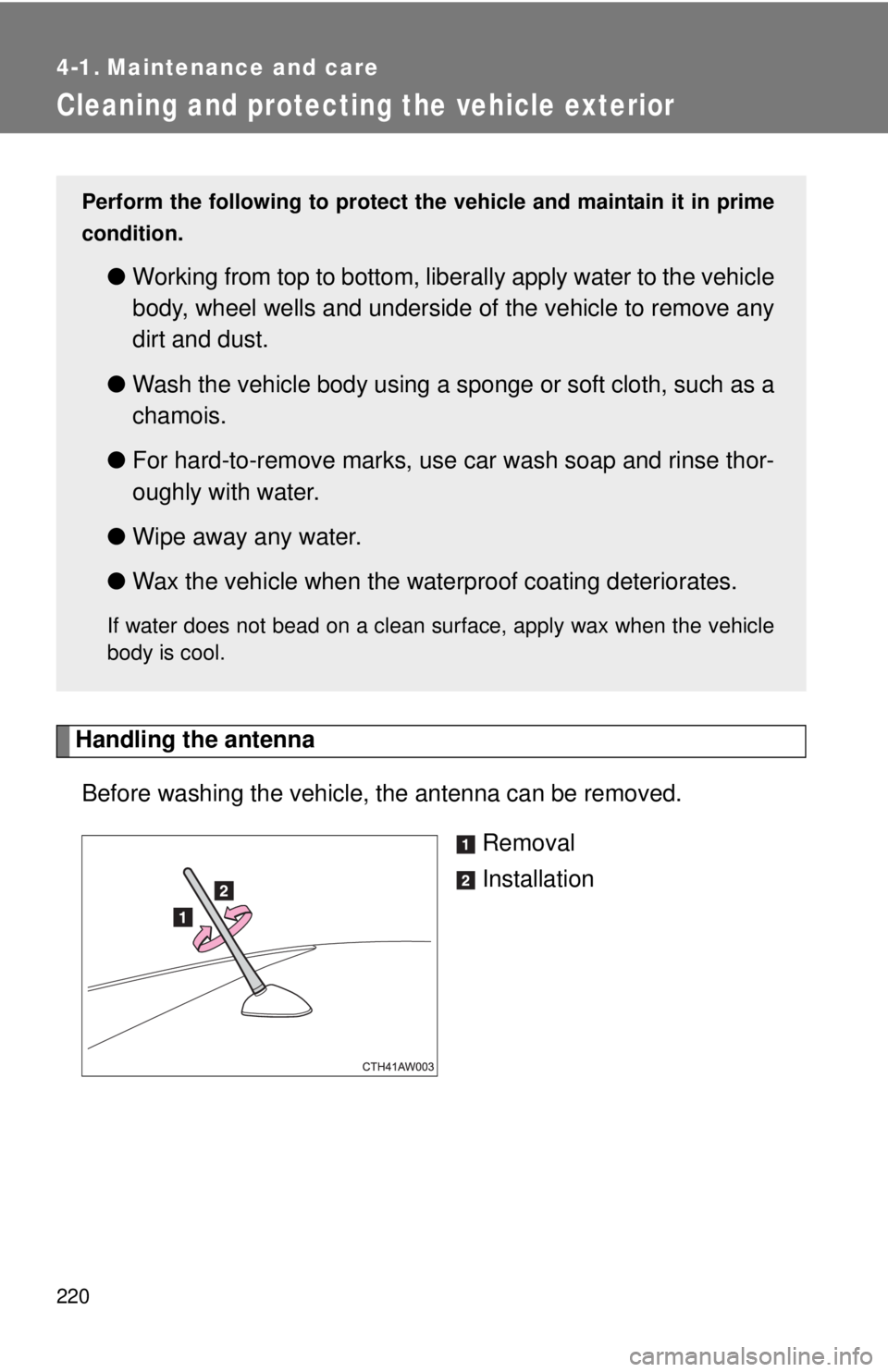
Handling the antennaBefore washing the vehicle, the antenna can be removed. Removal
Installation
Perform the following to protect the vehicle and maintain it in prime
condition.
● Working from top to bottom, liber ally apply water to the vehicle
body, wheel wells and underside of the vehicle to remove any
dirt and dust.
● Wash the vehicle body using a sponge or soft cloth, such as a
chamois.
● For hard-to-remove marks, use car wash soap and rinse thor-
oughly with water.
● Wipe away any water.
● Wax the vehicle when the waterproof coating deteriorates.
If water does not bead on a clean surface, apply wax when the vehicle
body is cool.
Page 221 of 412

221
4-1. Maintenance and care
4
Maintenance and care
■
Automatic car washes
●Fold the mirrors and remove the antenna before washing the vehicle.
Start washing from the front of the vehicle. Make sure to re-install the
antenna and extend the mirrors before driving.
● Brushes used in automatic car washes may scratch the vehicle surface
and harm your vehicle’s paint.
■ High pressure car washes
●Do not allow the nozzles of the car wash to come within close proximity
of the windows.
● Before car wash, check that the fuel filler door on your vehicle is closed
properly.
■ Aluminum wheels
●Remove any dirt immediately by using a neutral detergent. Do not use
hard brushes or abrasive cleaners. Do not use strong or harsh chemical
cleaners. Use the same mild detergent and wax as used on the paint.
● Do not use detergent on the wheels when they are hot, for example after
driving for long distance in the hot weather.
● Wash detergent from the wheels immediately after use.
■ Parts containing resin such as the bumper
Do not scrub with abrasive cleaners.
Page 222 of 412

222 4-1. Maintenance and care
CAUTION
■When washing the vehicle
Do not apply water to the inside of the engine compartment. Doing so may
cause the electrical components etc. to catch fire.
■ Precautions regarding the exhaust pipes
Exhaust gasses cause the exhaust pipes and rear bumper diffusers to
become quite hot.
When washing the vehicle, be careful not to touch the pipes and diffusers
until they have cooled sufficiently, as touching hot exhaust pipes and rear
bumper diffusers can cause burns.
NOTICE
■To prevent paint deterioration and corrosion on the body and compo-
nents (aluminum wheels etc.)
● Wash the vehicle immediately in the following cases:
• After driving near the sea coast
• After driving on salted roads
• If you see coal tar or tree sap on the paint surface
• If you see dead insects, insect droppings or bird droppings on the paint
• After driving in an area contaminated with soot, oily smoke, mine dust,
iron powder or chemical substances
• If the vehicle becomes heavily soiled in dust or mud
• If liquids such as benzene and gasoline are spilled on the paint surface
● If the paint is chipped or scratched, have it repaired immediately.
● To prevent the wheels from corroding, remove any dirt and store in a place
with low humidity when storing the wheels.
■ Protective film for side sill plates
Make sure to remove the protective film. Failure to do so may cause rust,
depending on conditions.
Page 223 of 412

223
4-1. Maintenance and care
4
Maintenance and care
NOTICE
■
Cleaning the exterior lights
●Wash carefully. Do not use organic substances or scrub with a hard brush.
This may damage the surfaces of the lights.
● Do not apply wax on the surfaces of the lights.
Wax may cause damage to the lenses.
■ Antenna installation and removal precautions
●Before driving, ensure that the antenna is installed.
● When the antenna is removed, such as before entering an automatic car
wash, make sure to store it in a suitable place so as not to lose it. Also,
before driving, make sure to reinstall the antenna in its original position.
■ To prevent damage to the windshield wiper arms
When lifting the wiper arms away from the windshield, pull the driver side
wiper arm upward first, and repeat for the passenger side. When returning
the wipers to their original position, do so from the passenger side first.
■ To prevent damage to the antenna
Remove the antenna in the following situations:
●When the antenna will touch the ceiling of a garage or other such places
● When a car cover is to be used to cover the vehicle
● When using an automatic car wash