check engine TOYOTA FR-S 2013 Owners Manual (in English)
[x] Cancel search | Manufacturer: TOYOTA, Model Year: 2013, Model line: FR-S, Model: TOYOTA FR-S 2013Pages: 448, PDF Size: 5.59 MB
Page 4 of 448

TABLE OF CONTENTSIndex
4
4-3. Do-it-yourself maintenance
Do-it-yourself service precautions ...................... 260
Hood................................... 263
Positioning a floor jack ....... 265
Engine compartment .......... 267
Tires ................................... 280
Tire inflation pressure......... 287
Wheels ............................... 291
Air conditioning filter ........... 294
Electronic key battery ......... 296
Checking and replacing fuses ................................ 298
Light bulbs .......................... 306
5-1. Essential information Emergency flashers ........... 318
If your vehicle needs to be towed .......................... 319
If you think something is wrong ............................ 326
Fuel pump shut off system .............................. 327 5-2. Steps to take in an
emergency
If a warning light turns on or a warning buzzer
sounds... .......................... 328
If you have a flat tire ........... 341
If the engine will not start .... 352
If the shift lever cannot be shifted from P ................... 355
If you lose your keys ........... 356
If the electronic key does not operate properly ......... 357
If the battery is discharged ........................ 361
If your vehicle overheats..... 365
If the vehicle becomes stuck ................................. 368
If your vehicle has to be stopped in an
emergency........................ 370
6-1. Specifications Maintenance data (fuel, oil level, etc.) ........... 372
Fuel information .................. 384
Tire information................... 388
6-2. Customization Customizable features ........ 401
5When trouble arises
6Vehicle specifications
Page 14 of 448

14
For your information
Main Owner’s Manual
Please note that this manual applies to all models and explains all equip-
ment, including options. Therefore, you may find some explanations for
equipment not installed on your vehicle.
All specifications provided in this manual are current at the time of printing.
However, because of the Scion policy of continual product improvement, we
reserve the right to make changes at any time without notice.
Depending on specifications, the vehicle shown in the illustration may differ
from your vehicle in terms of color and equipment.
Noise from under vehicle after turning off the engine
Approximately five hours after the engine is turned off, you may hear sound
coming from under the vehicle for several minutes. This is the sound of a fuel
evaporation leakage check and, it does not indicate a malfunction.
Accessories, spare parts and modification of your Scion
A wide variety of non-genuine spare parts and accessories for Scion vehicles
are currently available in the market. You should know that Scion does not
warrant these products and is not responsible for their performance, repair,
or replacement, or for any damage they may cause to, or adverse effect they
may have on, your Scion vehicle.
This vehicle should not be modified with non-genuine Scion products. Modifi-
cation with non-genuine Scion products could affect its performance, safety
or durability, and may even violate governmental regulations. In addition,
damage or performance problems resulting from the modification may not be
covered under warranty.
Page 31 of 448

31
1-2. Opening, closing and locking the doors and trunk
1
Before driving
■
Notes for the entry function
●Even when the electronic key is within the effective range (detection
areas), the system may not operate properly in the following cases:
• The electronic key is too close to the window or outside door handle,
near the ground, or in a high place when the doors are locked or
unlocked.
• The electronic key is near the ground or in a high place, or too close to the rear bumper center when the trunk is unlocked.
• The electronic key is on the instrument panel, rear shelf or floor, in the door pockets or glove box, auxiliary box when the engine is started or
“ENGINE START STOP” switch modes are changed.
● Do not leave the electronic key on top of the instrument panel or near the
door pockets when exiting the vehicle. Depending on the radio wave
reception conditions, it may be detected by the antenna outside the cabin
and the door will become lockable from the outside, possibly trapping the
electronic key inside the vehicle.
● As long as the electronic key is within the effective range, the doors may
be locked or unlocked by anyone.
● Even if the electronic key is not inside the vehicle, it may be possible to
start the engine if the electronic key is near the window.
● The doors may unlock if a large amount of water splashes on the door
handle, such as in the rain or in a car wash when the electronic key is
within the effective range. (The door will automatically be locked after
approximately 60 seconds if the doors are not opened and closed.)
● Gripping the door handle when wearing a glove may not unlock the door.
● If the wireless remote control is used to lock the doors when the elec-
tronic key is near the vehicle, there is a possibility that the door may not
be unlocked by the entry function. (Use the wireless remote control to
unlock the doors.)
● A sudden approach to the effective range or door handle may prevent the
doors from being unlocked. In this case, return the door handle to the
original position and check that the doors unlock before pulling the door
handle again.
Page 76 of 448
76 1-6. Theft deterrent system
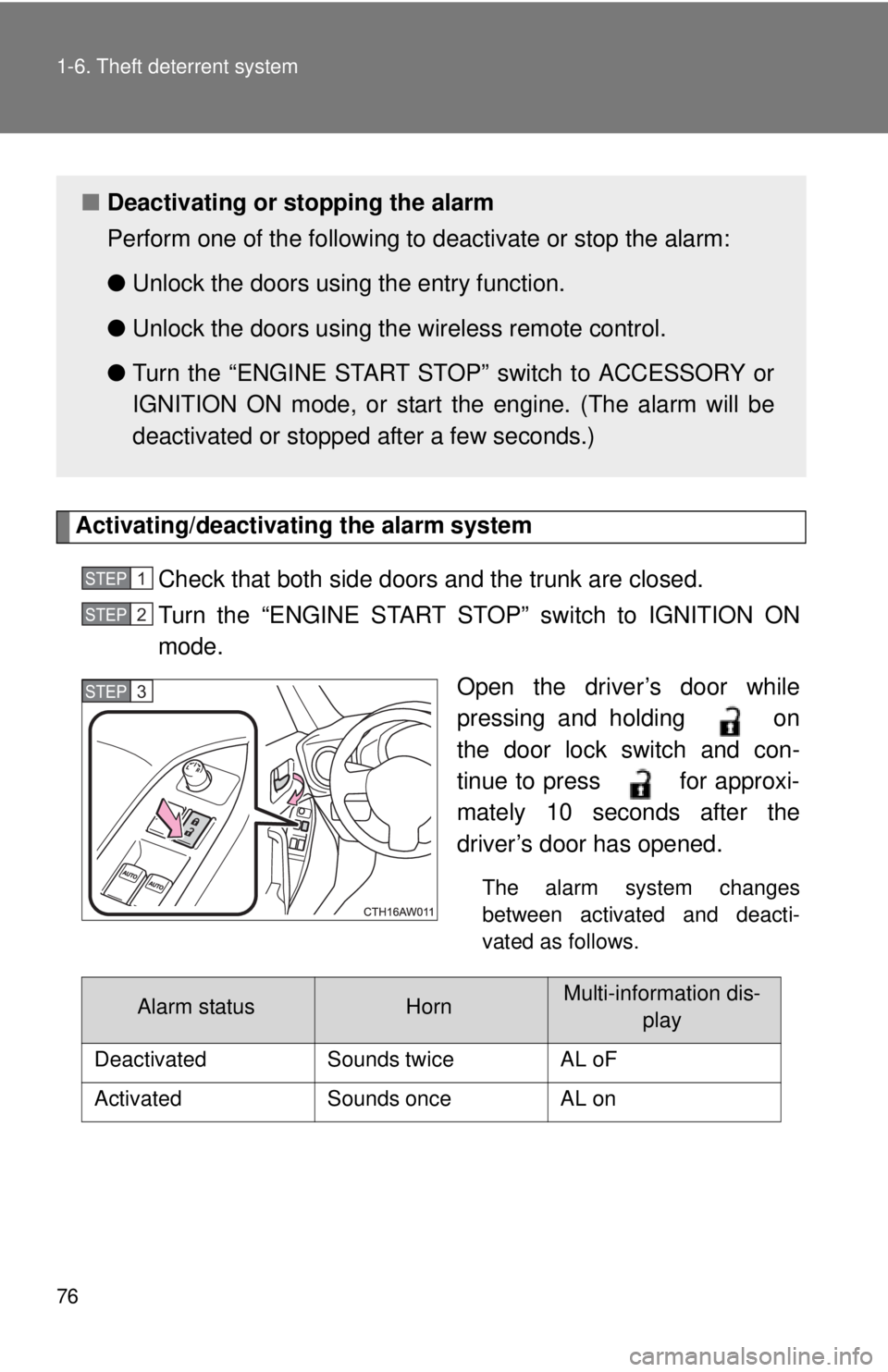
Activating/deactivating the alarm systemCheck that both side doors and the trunk are closed.
Turn the “ENGINE START STOP” switch to IGNITION ON
mode. Open the driver’s door while
pressing and holding on
the door lock switch and con-
tinue to press for approxi-
mately 10 seconds after the
driver’s door has opened.
The alarm system changes
between activated and deacti-
vated as follows.
■Deactivating or stopping the alarm
Perform one of the following to deactivate or stop the alarm:
● Unlock the doors usi ng the entry function.
● Unlock the doors using the wireless remote control.
● Turn the “ENGINE START STOP” switch to ACCESSORY or
IGNITION ON mode, or start the engine. (The alarm will be
deactivated or stopped after a few seconds.)
STEP 1
STEP 2
STEP 3
Alarm statusHornMulti-information dis- play
Deactivated Sounds twiceAL oF
Activated Sounds onceAL on
Page 95 of 448

95
1-7. Safety information
1
Before driving
■
If the passenger’s frontal airbag OFF indicator illuminates and the ON
indicator turns off even when the fr ont passenger’s seat is occupied by
an adult
This can be caused by the adult incorrectly sitting in the front passenger’s
seat. Turn the “ENGINE START STOP” switch off. Ask the front passenger
to set the seatback to the upright position, sit up straight in the center of the
seat cushion, correctly fasten the seat belt, position his/her legs out forward,
and adjust the seat to the rearmost position. Turn the “ENGINE START
STOP” switch to IGNITION ON mode. If the OFF indicator remains illumi-
nated while the ON indicator remains off, take the following actions.
● Turn the “ENGINE START STOP” switch off.
● Make sure that the front passenger does not use a blanket, seat cushion,
seat cover, seat heater or massager, etc.
● If wearing excessive layers of clothing, the front passenger should
remove any unnecessary items before sitting in the front passenger’s
seat, or should sit in a rear seat.
● Next, turn the “ENGINE START STOP” switch to IGNITION ON mode
and wait 6 seconds to allow the system to complete self-checking. Fol-
lowing the system check, both indicators turn off for 2 seconds. Now, the
ON indicator should illuminate while the OFF indicator remains off.
If the OFF indicator still remains illuminated while the ON indicator remains
off, ask the occupant to move to the rear seat and immediately contact your
Scion dealer for an inspection.
Page 116 of 448

116 1-7. Safety information
●Curtain shield airbag module (left-hand side)
● Satellite safing sensor (under the center of the rear seats)
● Seat belt pretensioner (driver’s side)
● Seat belt pretensioner (front passenger’s side)
● Seat belt buckle switch (front passenger’s side)
● Front passenger’s occupant cl assification system sensor
● Front passenger’s occupant detection control module
● Front passenger’s frontal airbag ON and OFF indicator
● All related wiring
CAUTION
■SRS warning light
If the warning light exhibits any of the following conditions, there may be a
malfunction in the seat belt pretensioners, SRS airbag system and/or front
passenger occupant classification system. Immediately take your vehicle to
your nearest Scion dealer to have the system checked. Unless checked and
properly repaired, the seat belt pretensioners, SRS airbag and/or front pas-
senger occupant classification system will not operate properly in the event
of a collision, which may increase the risk of death or serious injury.
●Flashing or flickering of the warning light
● No illumination of the warning light when the “ENGINE START STOP”
switch is first turned to IGNITION ON mode.
● Continuous illumination of the warning light
● Illumination of the warning light while driving
Page 118 of 448
118 1-7. Safety information
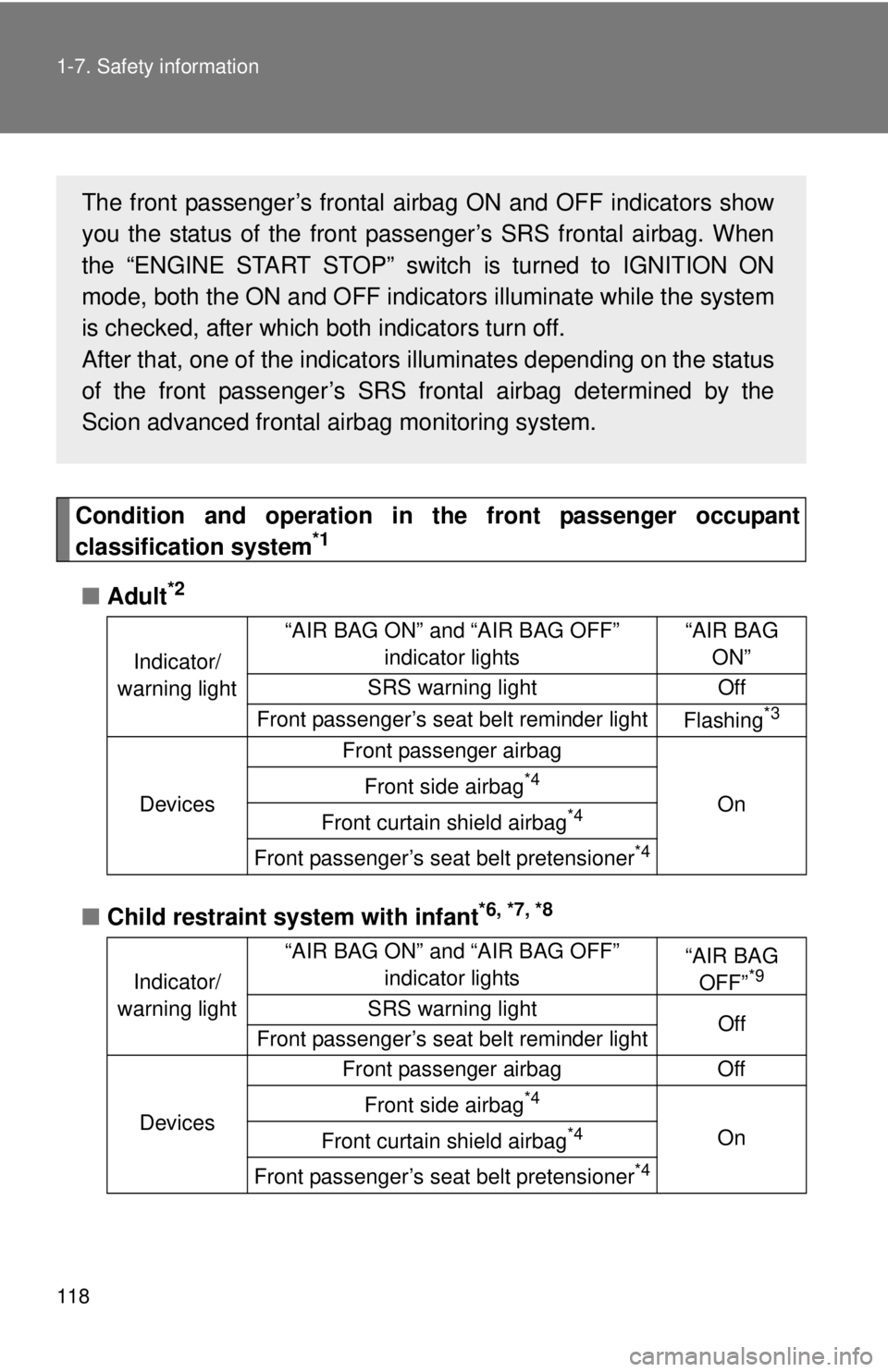
Condition and operation in the front passenger occupant
classification system*1
■Adult*2
■Child restraint system with infant*6, *7, *8
Indicator/
warning light “AIR BAG ON” and “AIR BAG OFF”
indicator lights “AIR BAG
ON”
SRS warning light Off
Front passenger’s seat belt reminder light Flashing
*3
DevicesFront passenger airbag
On
Front side airbag
*4
Front curtain shield airbag*4
Front passenger’s seat belt pretensioner*4
Indicator/
warning light “AIR BAG ON” and “AIR BAG OFF”
indicator lights “AIR BAG
OFF”*9
SRS warning light Off
Front passenger’s seat belt reminder light
Devices Front passenger airbag Off
Front side airbag
*4
On
Front curtain shield airbag*4
Front passenger’s seat belt pretensioner*4
The front passenger’s frontal airbag ON and OFF indicators show
you the status of the front passenger’s SRS frontal airbag. When
the “ENGINE START STOP” switch is turned to IGNITION ON
mode, both the ON and OFF indicators illuminate while the system
is checked, after which bot h indicators turn off.
After that, one of the indicators illuminates depending on the status
of the front passenger’s SRS fr ontal airbag determined by the
Scion advanced frontal airbag monitoring system.
Page 121 of 448

121
1-7. Safety information
1
Before driving
If the passenger’s frontal airbag OFF indi
cator illuminates and the ON indicator
turns off even when the front passenger’s seat is occupied by an adult
This can be caused by an adult in correctly sitting in the front passen-
ger’s seat. Perform the following.
Turn the “ENGINE START STOP” switch off.
Ask the front passenger to set the seatback to the upright
position, sit up straight in the center of the seat cushion, cor-
rectly wear the seat belt, posit ion his/her legs out forward, and
adjust the seat to the rearmost position.
Turn the “ENGINE START STOP” switch to IGNITION ON
mode.
Turn the OFF indicator remains illuminated while the ON indi-
cator remains off, perform the following.
• Turn the “ENGINE START STOP” switch off.
• Make sure that the front passenger is not using a blanket, seat cushion, seat cover or seat heater, etc.
• If wearing excessive layers of clothing, the front passenger should remove any unnecessary items before sitting in the
front passenger seat, or should sit in a rear seat.
Turn the “ENGINE START STOP” switch to IGNITION ON
mode. After the self-check is performed, the ON indicator
should illuminate while the OFF indicator remains off. If the
OFF indicator still remains illumi nated while the ON indicator
remains off, ask the occupant to move to the rear seat and
immediately contact your Scion dealer for an inspection.
STEP 1
STEP 2
STEP 3
STEP 4
STEP 5
Page 144 of 448

144 2-1. Driving procedures
CAUTION
■When starting the vehicle (vehicl es with an automatic transmission)
● Always keep your foot on the brake pedal while stopped with the engine
running. This prevents the vehicle from creeping.
● Firmly depress the brake pedal because engine speed may increase
immediately after starting the engine, when the air conditioning system is
operating, when turning the steering wheel, etc., thereby causing creeping
to become stronger. Apply the parking brake as necessary.
■ When driving the vehicle
●Do not drive if you are unfamiliar with the location of the brake and accel-
erator pedals to avoid depressing the wrong pedal.
• Accidentally depressing the accelerator pedal instead of the brake
pedal will result in sudden acceleration that may lead to an accident
that could result in death or serious injury.
• When backing up, you may twist your body around, leading to a diffi- culty in operating the pedals. Make sure to operate the pedals properly.
• Make sure to keep a correct driving posture even when moving the vehicle only slightly. This allows you to depress the brake and acceler-
ator pedals properly.
• Depress the brake pedal using your right foot. Depressing the brake pedal using your left foot may delay response in an emergency, result-
ing in an accident.
● Do not drive the vehicle over or stop the vehicle near flammable materials.
The exhaust system and exhaust gases can be extremely hot. These hot
parts may cause a fire if there is any flammable material nearby.
● On vehicles with an automatic transmission, do not let the vehicle roll
backward while the shift lever is in a driving position, or roll forward while
the shift lever is in R.
Doing so may cause the engine to stall or lead to poor brake and steering
performance, resulting in an accident or damage to the vehicle.
● If the smell of exhaust is noticed inside the vehicle, open the windows and
check that the trunk is closed. Large amounts of exhaust in the vehicle can
cause driver drowsiness and an accident, resulting in death or a serious
health hazard. Have the vehicle inspected by your Scion dealer immedi-
ately.
Page 146 of 448

146 2-1. Driving procedures
CAUTION
●Always check that all passengers' arms, heads or other parts of their body
are not outside the vehicle, as this may result in death or serious injury.
● Do not drive in excess of the speed limit. Even if the legal speed limit per-
mits it, do not drive over 85 mph (140 km/h) unless your vehicle has high-
speed capability tires. Driving over 85 mph (140 km/h) may result in tire
failure, loss of control and possible injury. Be sure to consult a tire dealer
to determine whether the tires on your vehicle are high-speed capability
tires or not before driving at such speeds.
■ When driving on slippery road surfaces
●Sudden braking, acceleration and steering may cause tire slippage and
reduce your ability to control the vehicle, resulting in an accident.
● Sudden acceleration, engine braking due to shift changing, or changes in
engine speed could cause the vehicle to skid, resulting in an accident.
● After driving through a puddle, lightly depress the brake pedal to make
sure that the brakes are functioning properly. Wet brake pads may prevent
the brakes from functioning properly. If the brakes on only one side are wet
and not functioning properly, steering control may be affected, resulting in
an accident.
■ When shifting the shift lever
●On vehicles with an automatic transmission, be careful not to shift the shift
lever with the accelerator pedal depressed. Shifting the shift lever to a
gear other than P or N may lead to unexpected rapid acceleration of the
vehicle that may cause an accident and result in death or serious injury.
● Do not place items in the shift lever's surrounding area. It may cause incor-
rect operation.
● If the shift boot is pulled out during cleaning, return it to its previous posi-
tion. If the shift boot is left pulled out, the shift lever may become difficult to
operate.