inflation pressure TOYOTA FR-S 2014 Owners Manual (in English)
[x] Cancel search | Manufacturer: TOYOTA, Model Year: 2014, Model line: FR-S, Model: TOYOTA FR-S 2014Pages: 452, PDF Size: 5.61 MB
Page 4 of 452

TABLE OF CONTENTSIndex
4
4-2. MaintenanceMaintenance requirements .................... 258
General maintenance ......... 260
Emission inspection and maintenance (I/M)
programs .......................... 263
4-3. Do-it-yourself maintenance
Do-it-yourself service precautions ...................... 264
Hood................................... 267
Positioning a floor jack ....... 269
Engine compartment .......... 271
Tires ................................... 284
Tire inflation pressure......... 291
Wheels ............................... 295
Air conditioning filter ........... 298
Electronic key battery ......... 300
Checking and replacing fuses ................................ 302
Light bulbs .......................... 310
5-1. Essential information Emergency flashers ........... 322
If your vehicle needs to be towed .......................... 323
If you think something is wrong ............................... 331
Fuel pump shut off system .............................. 332 5-2. Steps to take in an
emergency
If a warning light turns on or a warning buzzer
sounds... .......................... 333
If you have a flat tire ........... 346
If the engine will not start .................................. 357
If the shift lever cannot be shifted from P ................... 360
If you lose your keys ........... 361
If the electronic key does not operate properly ......... 362
If the battery is discharged ........................ 366
If your vehicle overheats..... 370
If the vehicle becomes stuck ................................. 373
If your vehicle has to be stopped in an
emergency........................ 375
6-1. Specifications Maintenance data (fuel, oil level, etc.) ........... 378
Fuel information .................. 390
Tire information................... 394
6-2. Customization Customizable features ........ 407
5When trouble arises
6Vehicle specifications
Page 7 of 452
7
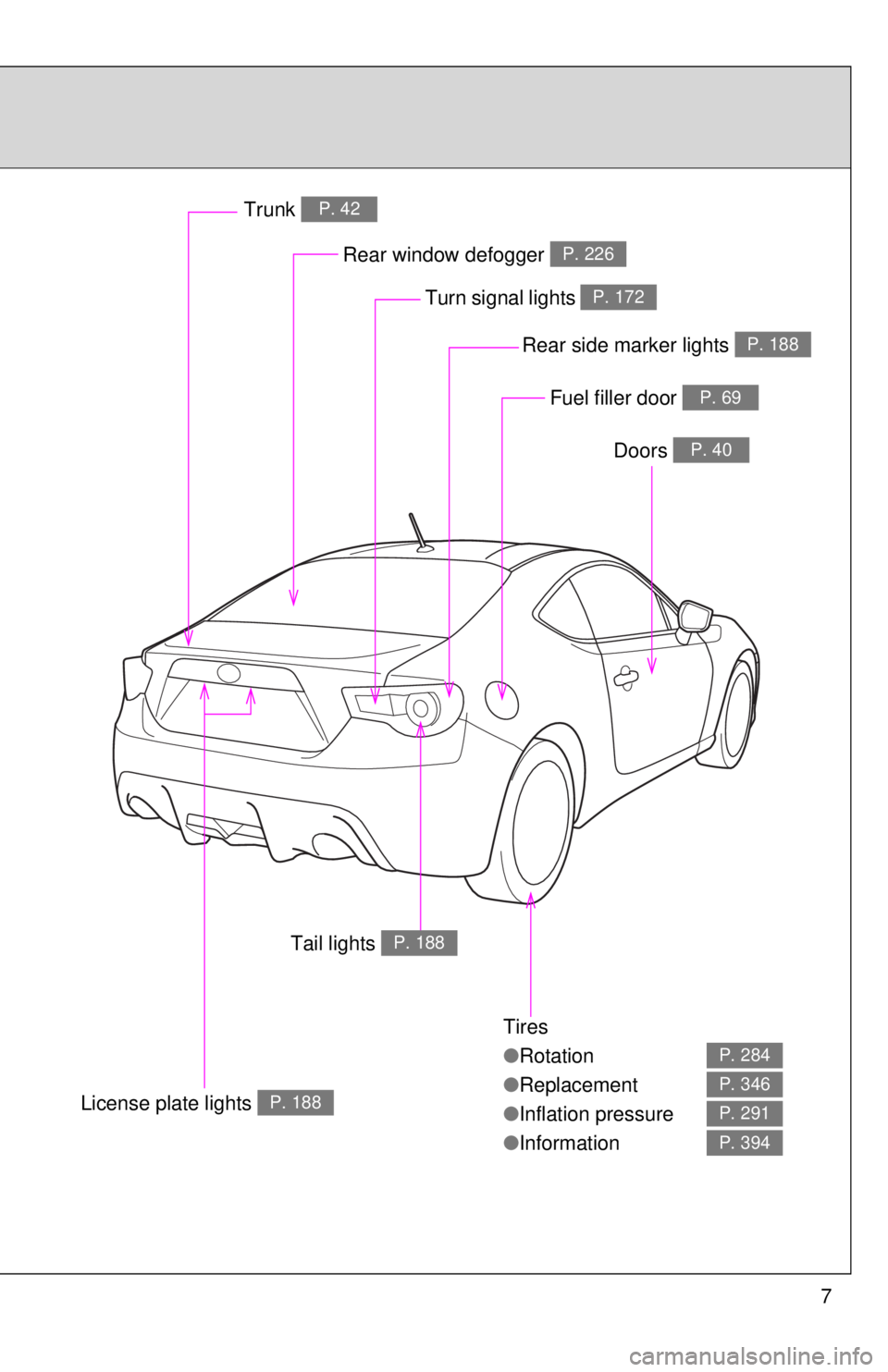
Tires
●Rotation
● Replacement
● Inflation pressure
● Information
P. 284
P. 346
P. 291
P. 394
Rear window defogger P. 226
Trunk P. 42
Doors P. 40
Fuel filler door P. 69
Turn signal lights P. 172
Rear side marker lights P. 188
License plate lights P. 188
Tail lights P. 188
Page 206 of 452

206 2-4. Using other driving systems
CAUTION
■When the TRAC/VSC syst ems are turned off
Be especially careful and drive at a speed appropriate to the road condi-
tions. As these are the systems to ensure vehicle stability and driving force,
do not turn the TRAC/VSC systems off unless necessary.
■ Replacing tires
Make sure that all tires are of the specified size, brand, tread pattern and
total load capacity. In addition, make sure that the tires are inflated to the
recommended tire inflation pressure level.
The ABS, TRAC and VSC systems will not function correctly if different tires
are installed on the vehicle.
Contact your Scion dealer for further information when replacing tires or
wheels.
■ Handling of tires and suspension
Using tires with any kind of problem or modifying the suspension will affect
the driving assist systems, and may cause a system to malfunction.
Page 247 of 452
Maintenance and care4
247
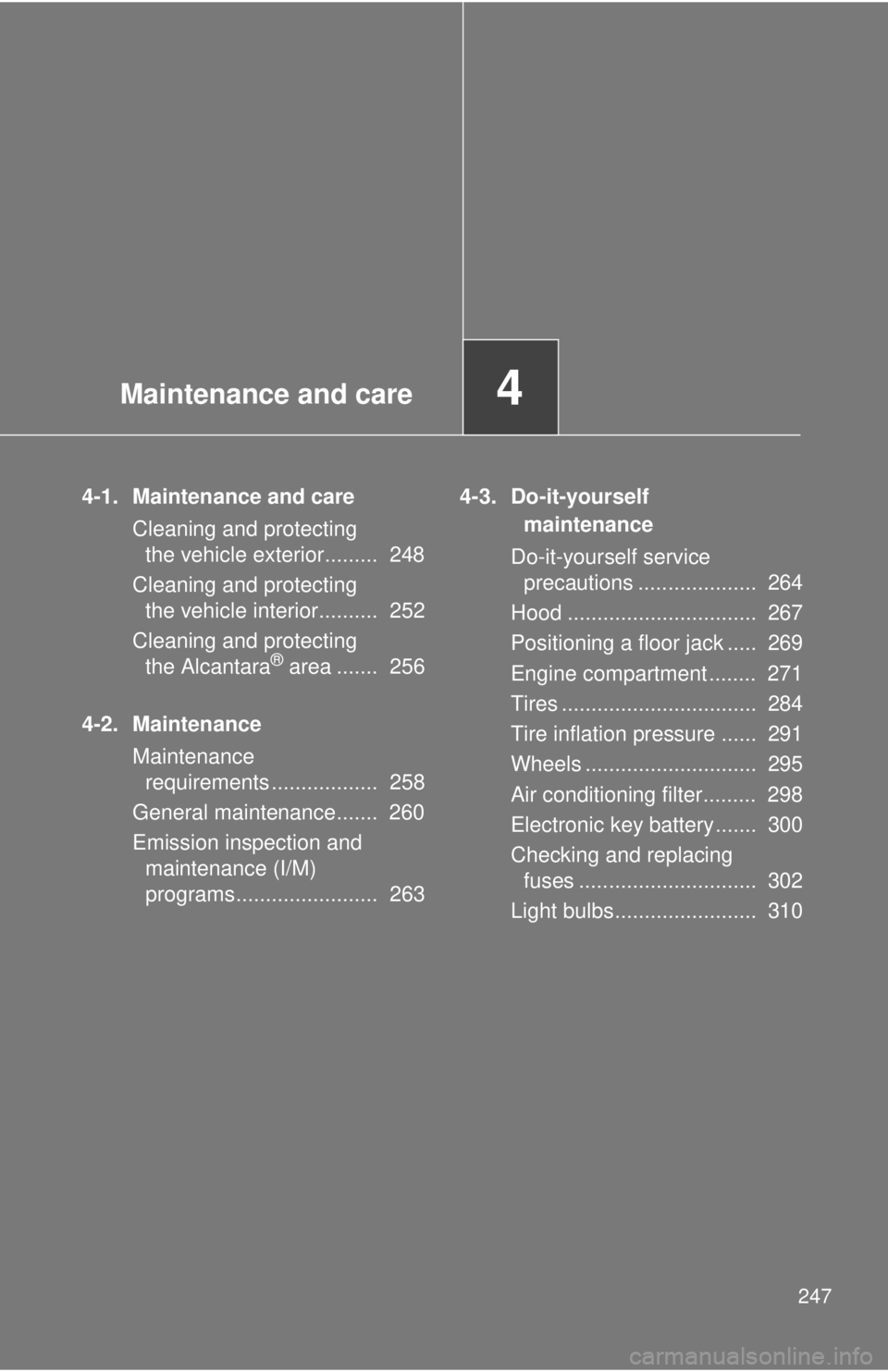
4-1. Maintenance and careCleaning and protecting the vehicle exterior......... 248
Cleaning and protecting the vehicle interior.......... 252
Cleaning and protecting the Alcantara
® area ....... 256
4-2. Maintenance Maintenance requirements .................. 258
General maintenance....... 260
Emission inspection and maintenance (I/M)
programs........................ 263 4-3. Do-it-yourself
maintenance
Do-it-yourself service precautions .................... 264
Hood ................................ 267
Positioning a floor jack ..... 269
Engine compartment ........ 271
Tires ................................. 284
Tire inflation pressure ...... 291
Wheels ............................. 295
Air conditioning filter......... 298
Electronic key battery....... 300
Checking and replacing fuses .............................. 302
Light bulbs........................ 310
Page 262 of 452
262 4-2. Maintenance
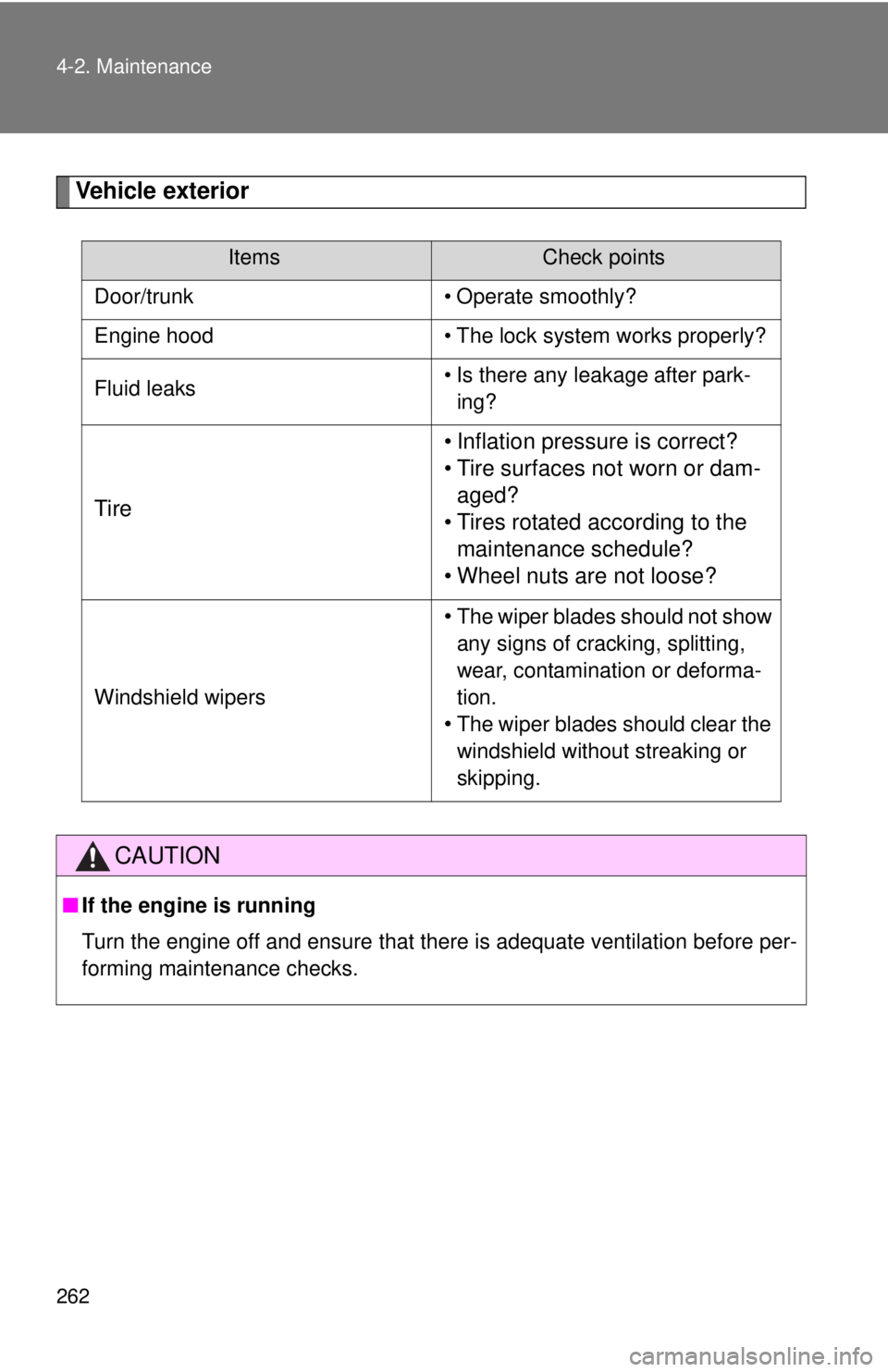
Vehicle exterior
ItemsCheck points
Door/trunk • Operate smoothly?
Engine hood • The lock system works properly?
Fluid leaks • Is there any leakage after park-
ing?
Tire • Inflation pressure is correct?
• Tire surfaces not worn or dam-
aged?
• Tires rotated according to the maintenance schedule?
• Wheel nuts are not loose?
Windshield wipers
•The wiper blades should not show
any signs of cracking, splitting,
wear, contamination or deforma-
tion.
•The wiper blades should clear the
windshield without streaking or
skipping.
CAUTION
■ If the engine is running
Turn the engine off and ensure that there is adequate ventilation before per-
forming maintenance checks.
Page 265 of 452
265
4-3. Do-it-yourself maintenance
4
Maintenance and care
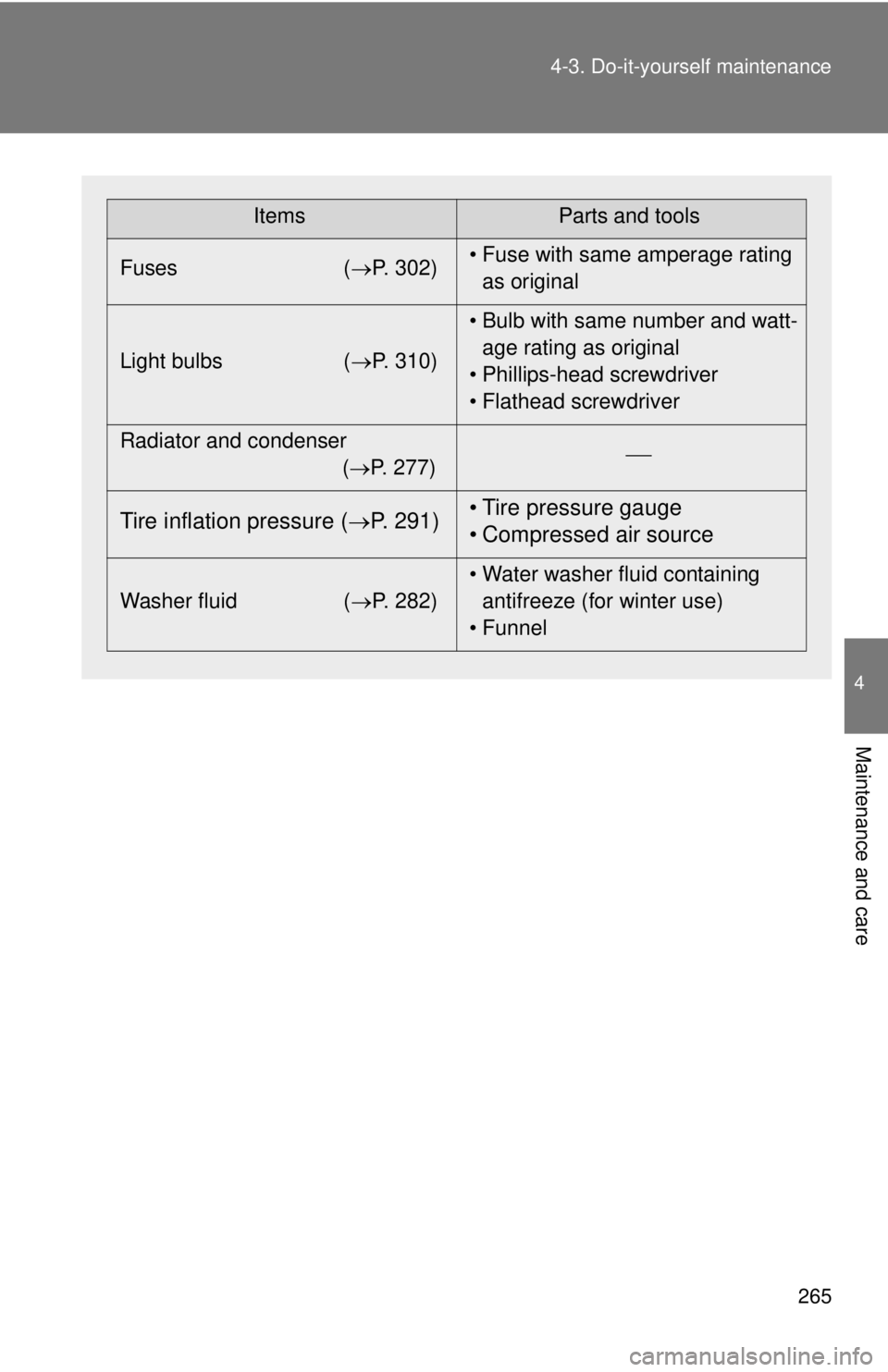
ItemsParts and tools
Fuses ( P. 302)• Fuse with same amperage rating
as original
Light bulbs ( P. 310)• Bulb with same number and watt-
age rating as original
• Phillips-head screwdriver
• Flathead screwdriver
Radiator and condenser (P. 277)
Tire inflation pressure ( P. 291) • Tire pressure gauge
• Compressed air source
Washer fluid
(P. 282) • Water washer fluid containing
antifreeze (for winter use)
• Funnel
Page 284 of 452
284
4-3. Do-it-yourself maintenance
Tires
Replace or rotate tires in accordance with maintenance sched-
ules and treadwear.
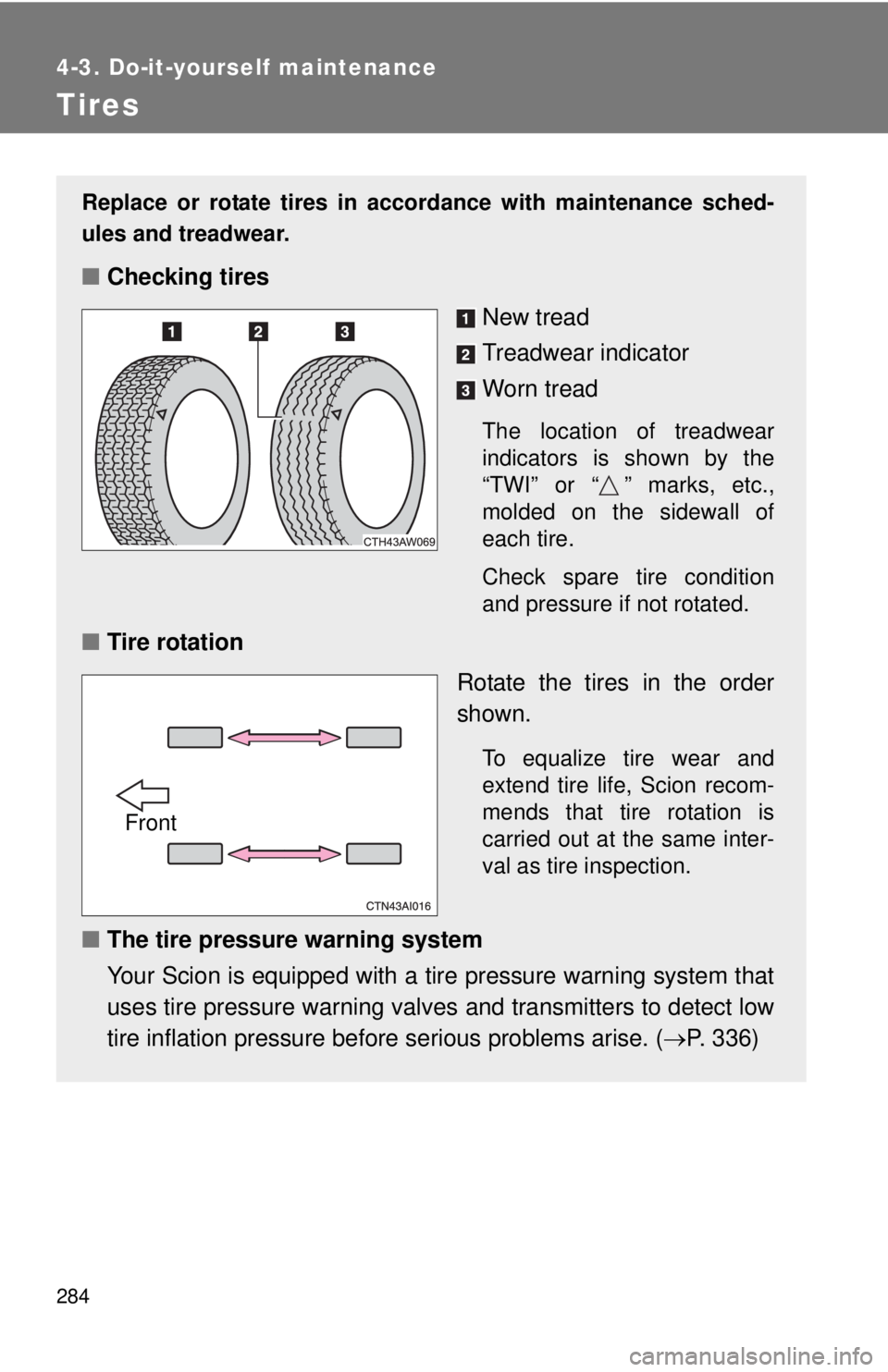
■Checking tires
New tread
Treadwear indicator
Worn tread
The location of treadwear
indicators is shown by the
“TWI” or “ ” marks, etc.,
molded on the sidewall of
each tire.
Check spare tire condition
and pressure if not rotated.
■Tire rotation
Rotate the tires in the order
shown.
To equalize tire wear and
extend tire life, Scion recom-
mends that tire rotation is
carried out at the same inter-
val as tire inspection.
■The tire pressure warning system
Your Scion is equipped with a tire pressure warning system that
uses tire pressure warning valves and transmitters to detect low
tire inflation pressure before serious problems arise. (P. 336)
Front
Page 287 of 452
287
4-3. Do-it-yourself maintenance
4
Maintenance and care
■Maximum load of tire
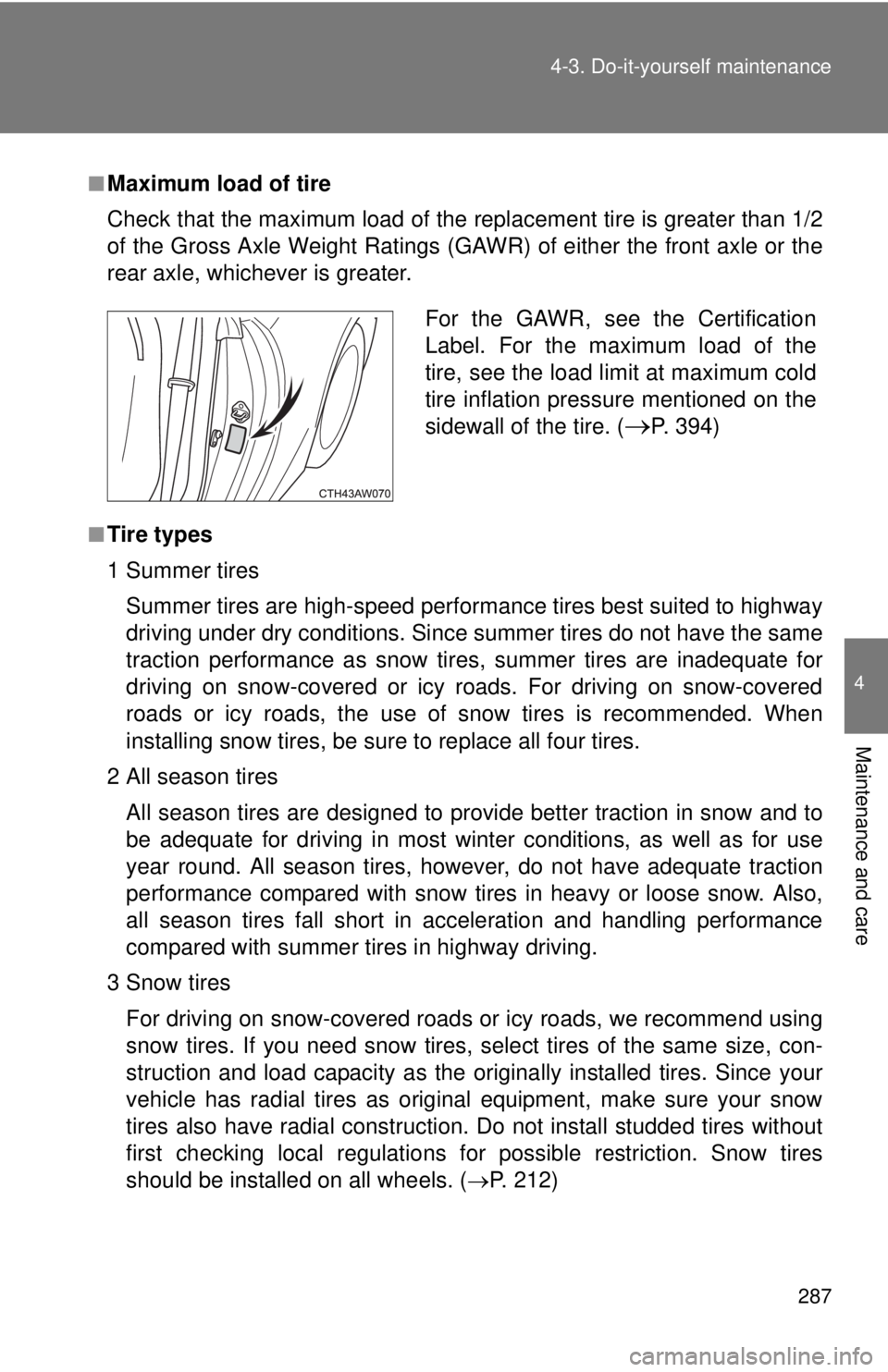
Check that the maximum load of the replacement tire is greater than 1/2
of the Gross Axle Weight Ratings (GAW
R) of either the front axle or the
rear axle, whichever is greater.
■Tire types
1 Summer tires
Summer tires are high-speed performance tires best suited to highway
driving under dry conditions. Since summer tires do not have the same
traction performance as snow tire s, summer tires are inadequate for
driving on snow-covered or icy roads. For driving on snow-covered
roads or icy roads, the use of snow tires is recommended. When
installing snow tires, be sure to replace all four tires.
2 All season tires
All season tires are designed to provide better traction in snow and to
be adequate for driving in most winter conditions, as well as for use
year round. All season tires, however, do not have adequate traction
performance compared with snow tires in heavy or loose snow. Also,
all season tires fall short in acceleration and handling performance
compared with summer tires in highway driving.
3Snow tires For driving on snow-covered roads or icy roads, we recommend using
snow tires. If you need snow tires, select tires of the same size, con-
struction and load capacity as the or iginally installed tires. Since your
vehicle has radial tires as original equipment, make sure your snow
tires also have radial construction. Do not install studded tires without
first checking local regulations for possible restriction. Snow tires
should be installed on all wheels. ( P. 212)
For the GAWR, see the Certification
Label. For the maximum load of the
tire, see the load limit at maximum cold
tire inflation pressure mentioned on the
sidewall of the tire. (
P. 394)
Page 288 of 452

288 4-3. Do-it-yourself maintenance
■Initializing the tire pressure warning system
Initialize the system with the tire infl ation pressure adjusted to the speci-
fied level.
■Routine tire inflation pressure checks
The tire pressure warning system doe s not replace routine tire inflation
pressure checks. Make sure to check tire inflation pressure as part of
your routine of daily vehicle checks.
■Tire pressure warning system certification
MODEL/FCC IDs:
Transmitter: PAXPMVC010
Receiver: HYQ23AAE
For vehicles sold in the U.S.A.
This device complies with part 15 of the FCC Rules. Operation is subject
to the following two conditions: (1) This device may not cause harmful
interference, and (2) this device must accept any interference received,
including interference that may cause undesired operation.
FCC WARNING:
Changes or modifications not expre ssly approved by the party responsi-
ble for compliance could void the user's authority to operate the equip-
ment.
For vehicles sold in Canada
NOTE:
This device complies with Industry Canada licence-exempt RSS stan-
dard(s). Operation is subject to the following two conditions: (1) this
device may not cause interference, an d (2) this device must accept any
interference, including interference that may cause undesired operation
of the device.
NOTE:
Le présent appareil est conforme aux CNR d’Industrie Canada applica-
bles aux appareils radio exempts de licence. L’exploitation est autorisée
aux deux conditions suivantes: (1) l’appareil ne doit pas produire de
brouillage, et (2) l’utilisateur de l’a ppareil doit accepter tout brouillage
radioélectrique subi, même si le brouillage est susceptible d’en compro-
mettre le fonctionnement.
Page 290 of 452

290 4-3. Do-it-yourself maintenance
NOTICE
■To avoid damage to the tire pressure warning valves and transmit-
ters
When a tire is repaired with liquid sealants, the tire pressure warning
valve and transmitter may not operate properly. If a liquid sealant is
used, contact your Scion dealer or other qualified service shop as soon
as possible. Make sure to replace the tire pressure warning valve and
transmitter when replacing the tire. ( P. 285)
■Driving on rough roads
Take particular care when driving on roads with loose surfaces or pot
holes.
These conditions may cause losses in tire inflation pressure, reducing
the cushioning ability of the tires. In addition, driving on rough roads may
cause damage to the tires themselves, as well as the vehicle’s wheels
and body.
■Low profile tires and wheels
Low profile tires may cause greater damage than usual to the tire wheel
when receiving impact from the road surface. Therefore pay attention to
the following:
●Be sure to use proper tire inflation pressure. If tires are under-inflated,
they may be damaged more severely.
●Avoid pot holes, uneven pavement, curbs and other road hazards.
Failure to do so may lead to severe tire and wheel damage.
■If tire inflation pressures become low while driving
Do not continue driving, or your tires and/or wheels may be ruined.