tow TOYOTA FR-S 2014 Owners Manual (in English)
[x] Cancel search | Manufacturer: TOYOTA, Model Year: 2014, Model line: FR-S, Model: TOYOTA FR-S 2014Pages: 452, PDF Size: 5.61 MB
Page 1 of 452
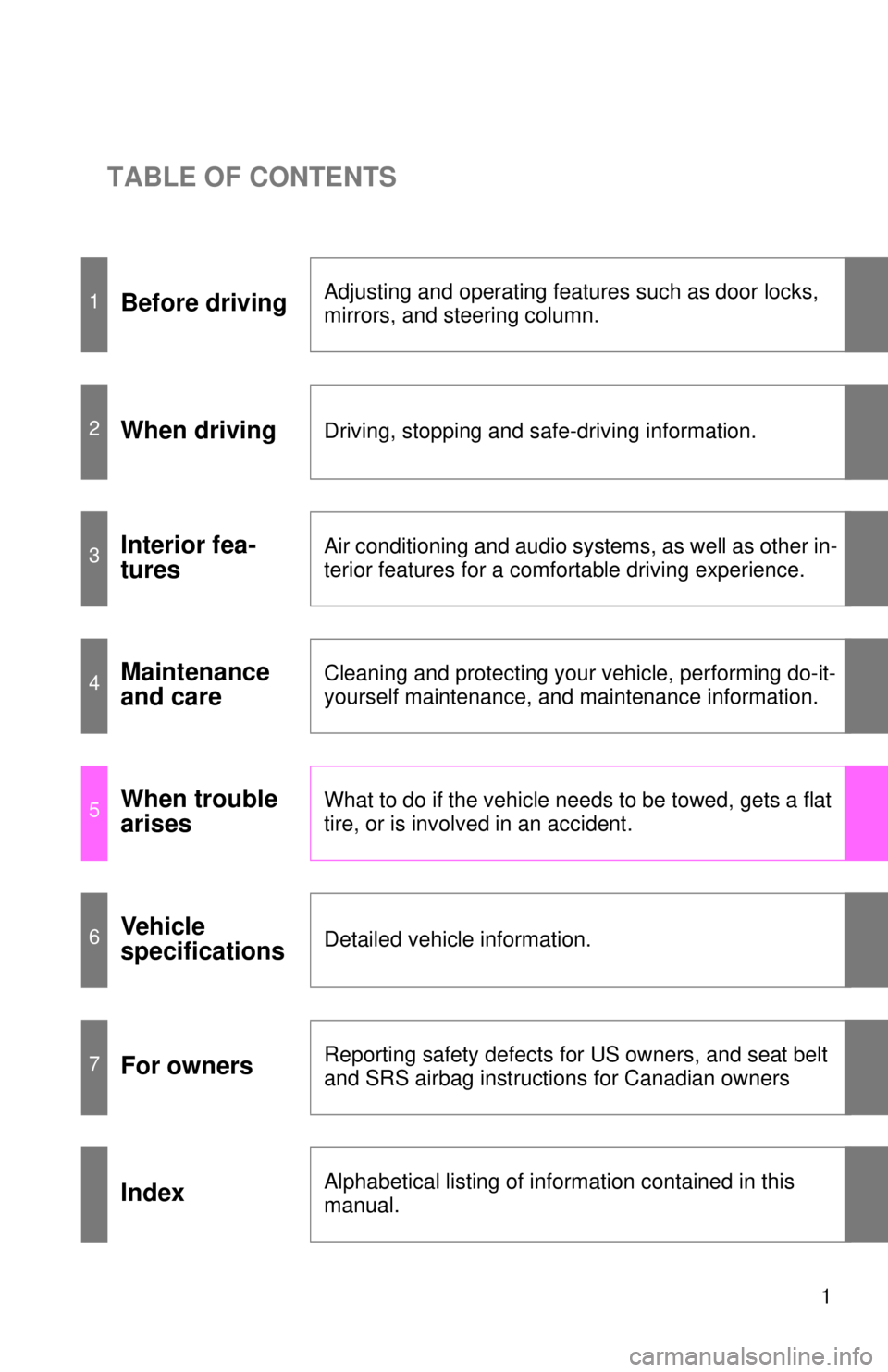
TABLE OF CONTENTS
1
1Before drivingAdjusting and operating features such as door locks,
mirrors, and steering column.
2When drivingDriving, stopping and safe-driving information.
3Interior fea-
turesAir conditioning and audio systems, as well as other in-
terior features for a comfortable driving experience.
4Maintenance
and careCleaning and protecting your vehicle, performing do-it-
yourself maintenance, and maintenance information.
5When trouble
arisesWhat to do if the vehicle needs to be towed, gets a flat
tire, or is involved in an accident.
6Vehicle
specificationsDetailed vehicle information.
7For ownersReporting safety defects for US owners, and seat belt
and SRS airbag instructions for Canadian owners
IndexAlphabetical listing of information contained in this
manual.
Page 3 of 452

1
2
3
4
5
6
7
3
2-3. Operating the lights and windshield wipers
Headlight switch .................. 188
Windshield wipers and washer .............................. 193
2-4. Using other driving systems
Cruise control ...................... 196
Driving assist systems ........ 201
2-5. Driving information Cargo and luggage ............. 207
Vehicle load limits ............... 211
Winter driving tips ............... 212
Trailer towing ...................... 215
Dinghy towing ..................... 216
3-1. Using the air conditioning system and defogger
Automatic air conditioning system .............................. 218
Rear window and outside rear view mirror
defoggers .......................... 226
3-2. Using the audio system Using the AUX/USB port ..... 228 3-3. Using the interior lights
Interior lights list ................. 229
• Interior light ...................... 230
3-4. Using the storage features List of storage features ....... 231
• Glove box ......................... 232
• Bottle holders ................... 233
• Cup holders/console tray ...................... 234
3-5. Other interior features Sun visors........................... 236
Vanity mirrors ..................... 237
Clock .................................. 238
Outside temperature display .............................. 239
Power outlets...................... 240
Seat heaters ....................... 242
Floor mat ............................ 244
4-1. Maintenance and care Cleaning and protecting the vehicle exterior ........... 248
Cleaning and protecting the vehicle interior ............ 252
Cleaning and protecting the Alcantara
® area.......... 256
3Interior features
4Maintenance and care
Page 4 of 452

TABLE OF CONTENTSIndex
4
4-2. MaintenanceMaintenance requirements .................... 258
General maintenance ......... 260
Emission inspection and maintenance (I/M)
programs .......................... 263
4-3. Do-it-yourself maintenance
Do-it-yourself service precautions ...................... 264
Hood................................... 267
Positioning a floor jack ....... 269
Engine compartment .......... 271
Tires ................................... 284
Tire inflation pressure......... 291
Wheels ............................... 295
Air conditioning filter ........... 298
Electronic key battery ......... 300
Checking and replacing fuses ................................ 302
Light bulbs .......................... 310
5-1. Essential information Emergency flashers ........... 322
If your vehicle needs to be towed .......................... 323
If you think something is wrong ............................... 331
Fuel pump shut off system .............................. 332 5-2. Steps to take in an
emergency
If a warning light turns on or a warning buzzer
sounds... .......................... 333
If you have a flat tire ........... 346
If the engine will not start .................................. 357
If the shift lever cannot be shifted from P ................... 360
If you lose your keys ........... 361
If the electronic key does not operate properly ......... 362
If the battery is discharged ........................ 366
If your vehicle overheats..... 370
If the vehicle becomes stuck ................................. 373
If your vehicle has to be stopped in an
emergency........................ 375
6-1. Specifications Maintenance data (fuel, oil level, etc.) ........... 378
Fuel information .................. 390
Tire information................... 394
6-2. Customization Customizable features ........ 407
5When trouble arises
6Vehicle specifications
Page 30 of 452

30 1-2. Opening, closing and locking the doors and trunk
■Conditions affecting operation
The smart key system uses weak radio waves. In the following situations,
the communication between the electronic key and the vehicle may be
affected, preventing the smart key system, wireless remote control and
engine immobilizer system from operating properly.
(Way of coping P. 362)
● When the electronic key battery is depleted
● Near a TV tower, electric power plant, gas station, radio station, large dis-
play, airport or other facility that generates strong radio waves or electri-
cal noise
● When the electronic key is in contact with, or is covered by the following
metallic objects
• Cards to which aluminum foil is attached
• Cigarette boxes that have aluminum foil inside
• Metallic wallets or bags
• Coins
• Hand warmers made of metal
• Media such as CDs and DVDs
● When other wireless keys (that emit radio waves) are being used nearby
● When carrying the electronic key together with the following devices that
emit radio waves
• A portable radio, cellular phone, cordless phone or other wireless com-
munication device
• Another vehicle's electronic key or a wireless key that emits radio waves
• Personal computers or personal digital assistants (PDAs)
• Digital audio players
• Portable game systems
● If window tint with a metallic content or metallic objects are attached to
the rear window
● When the electronic key is placed near a battery charger or electronic
devices
Page 89 of 452

89
1-7. Safety information
1
Before driving
Scion advanced frontal airbag system
Your vehicle is equipped with a Scion advanced frontal airbag system
that complies with the new advanc ed frontal airbag requirements in
the amended Federal Motor Vehicle Safety Standard (FMVSS) No.
208.
The Scion advanced frontal airbag system automatically determines
the deployment force of the driver’s SRS frontal airbag at the time of
deployment as well as whether or not to activate the front passen-
ger’s SRS frontal airbag and, if activa ted, the deployment force of the
SRS frontal airbag at the time of deployment.
Your vehicle has warning labels on the driver’s and front passenger’s
sun visors beginning with the phrase “EVEN WITH ADVANCED AIR
BAGS” and a tag attached to the glove box lid beginning with the
phrase “Even with Advanced Air Bags”. Make sure that you carefully
read the instructions on the warning labels and tag.
Always wear your seat belt. Th e Scion advanced frontal airbag sys-
tem is a supplemental restraint s ystem and must be used in combina-
tion with a seat belt. All occupants should wear a seat belt or be
seated in an appropriate child restraint system.
The driver’s SRS frontal airbag is stowed in the center portion of the
steering wheel. The front passenger’s SRS frontal airbag is stowed
near the top of the dashboard under an “SRS AIRBAG” mark.
In a moderate to severe frontal collision, the following components
deploy.
● SRS frontal airbag for driver
● SRS frontal airbag for front passenger
These components supplement the seat belts by reducing the impact
to the occupant’s head and chest.
Page 110 of 452

110 1-7. Safety information
CAUTION
■SRS airbag precautions
Observe the following precautions regarding the SRS airbags.
Failure to do so may cause death or serious injury.
●The driver and all passengers in the vehicle must wear their seat belts
properly.
The SRS airbags are supplemental devices to be used with the seat belts.
● The SRS driver airbag deploys with considerable force, and can cause
death or serious injury especially if the driver is very close to the airbag.
The National Highway Traffic Safety Administration (“NHTSA”) advises:
Since the risk zone for the driver’s airbag is the first 2 - 3 in. (50 - 75 mm)
of inflation, placing yourself 10 in. (250 mm) from your driver airbag pro-
vides you with a clear margin of safety. This distance is measured from the
center of the steering wheel to your breastbone. If you sit less than 10 in.
(250 mm) away now, you can change your driving position in several
ways:
• Move your seat to the rear as far as you can while still reaching the pedals comfortably.
• Slightly recline the back of the seat. Although vehicle designs vary, many drivers can achieve the 10 in. (250 mm) distance, even with the
driver seat all the way forward, simply by reclining the back of the seat
somewhat. If reclining the back of your seat makes it hard to see the
road, raise yourself by using a firm, non-slippery cushion, or raise the
seat if your vehicle has that feature.
• If your steering wheel is adjustable, tilt it downward. This points the air- bag toward your chest instead of your head and neck.
The seat should be adjusted as recommended by NHTSA above, while
still maintaining control of the foot pedals, steering wheel, and your view of
the instrument panel controls.
Page 112 of 452
112 1-7. Safety information
CAUTION
■SRS airbag precautions
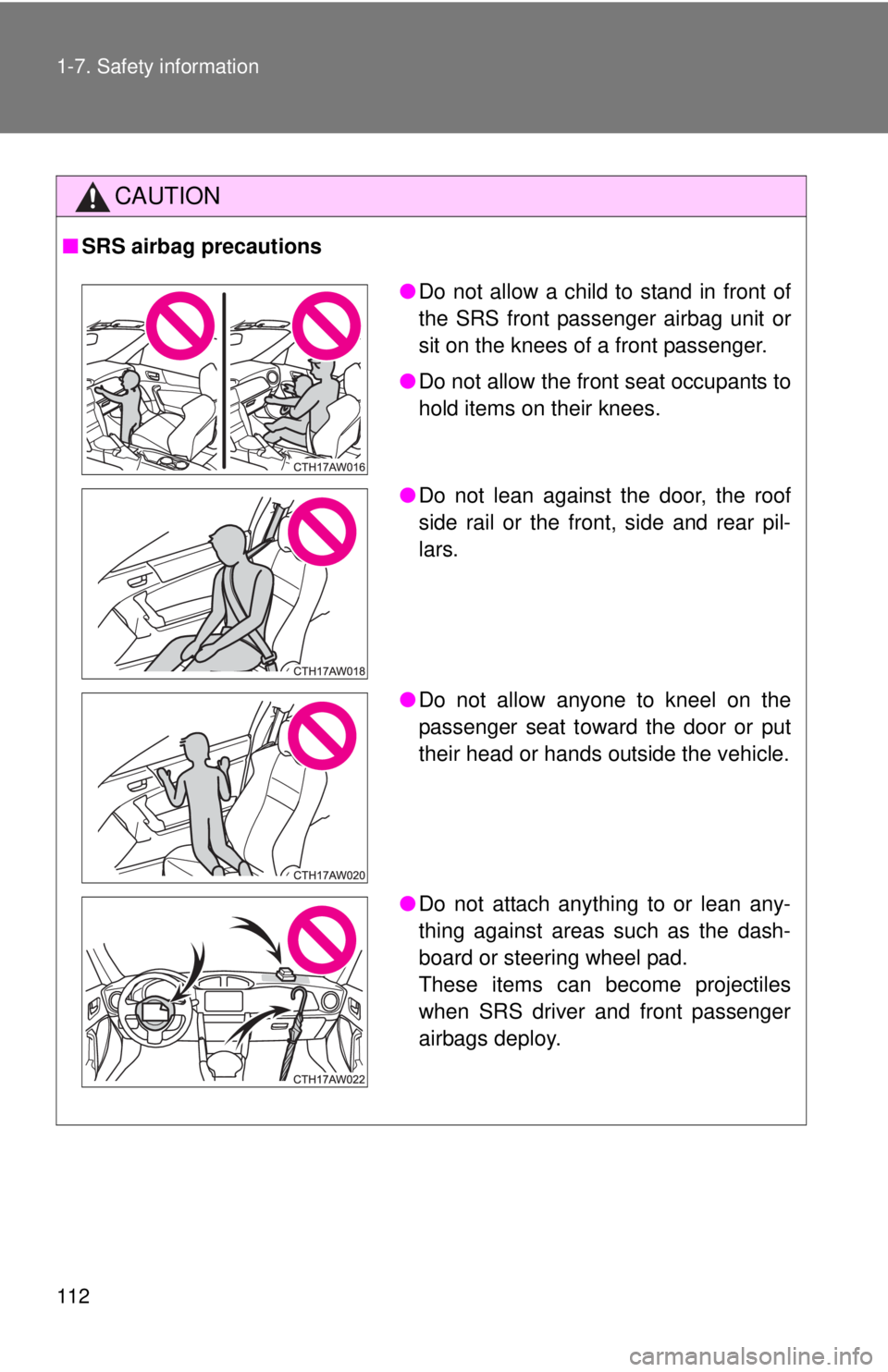
●Do not allow a child to stand in front of
the SRS front passenger airbag unit or
sit on the knees of a front passenger.
● Do not allow the front seat occupants to
hold items on their knees.
● Do not lean against the door, the roof
side rail or the front, side and rear pil-
lars.
● Do not allow anyone to kneel on the
passenger seat toward the door or put
their head or hands outside the vehicle.
● Do not attach anything to or lean any-
thing against areas such as the dash-
board or steering wheel pad.
These items can become projectiles
when SRS driver and front passenger
airbags deploy.
Page 139 of 452
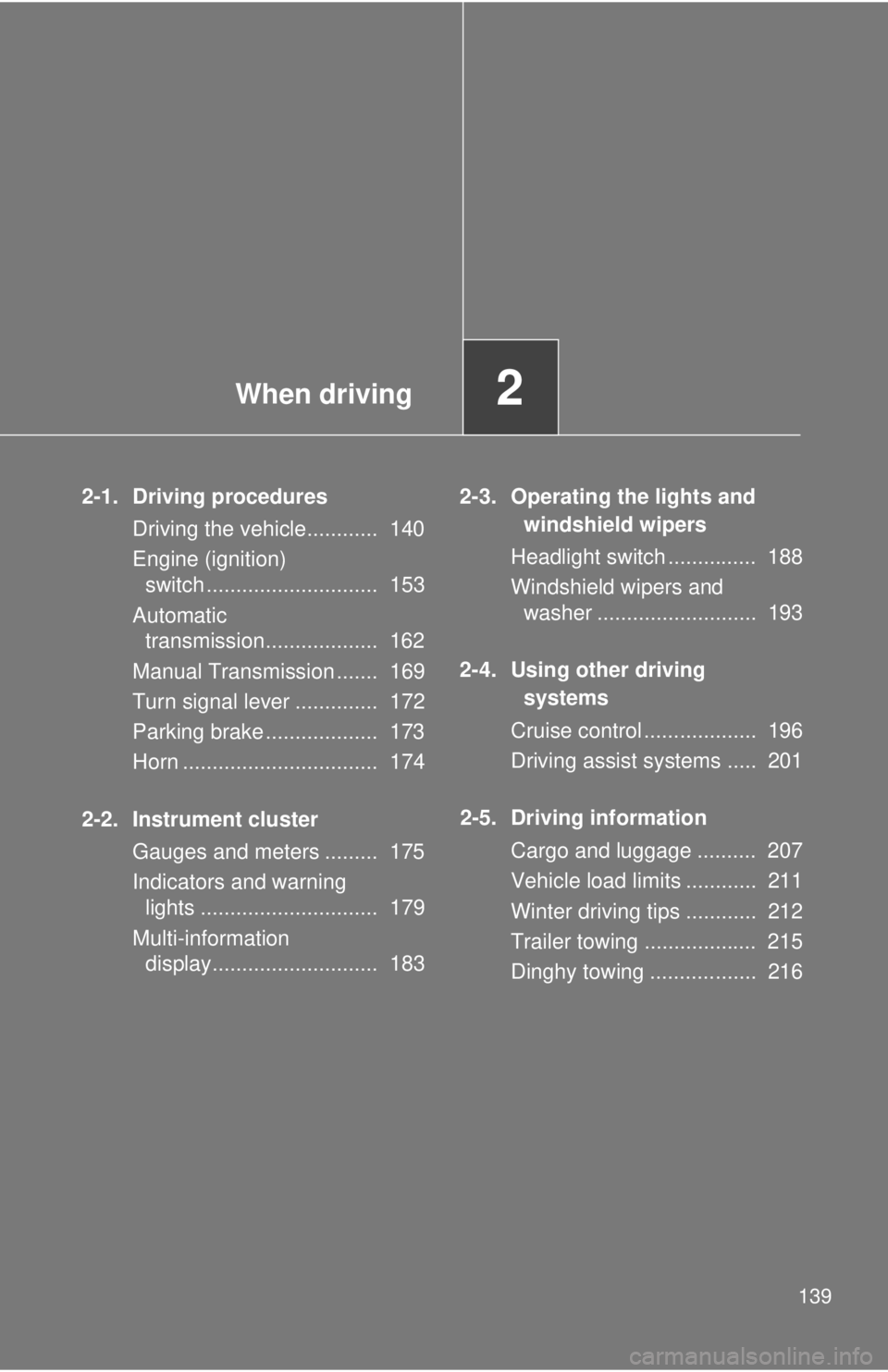
When driving2
139
2-1. Driving proceduresDriving the vehicle............ 140
Engine (ignition) switch ............................. 153
Automatic transmission................... 162
Manual Transmission ....... 169
Turn signal lever .............. 172
Parking brake ................... 173
Horn ................................. 174
2-2. Instrument cluster Gauges and meters ......... 175
Indicators and warning lights .............................. 179
Multi-information display............................ 183 2-3. Operating the lights and
windshield wipers
Headlight switch ............... 188
Windshield wipers and washer ........................... 193
2-4. Using other driving systems
Cruise control ................... 196
Driving assist systems ..... 201
2-5. Driving information Cargo and luggage .......... 207
Vehicle load limits ............ 211
Winter driving tips ............ 212
Trailer towing ................... 215
Dinghy towing .................. 216
Page 189 of 452
189
2-3. Operating the lights and windshield wipers
2
When driving
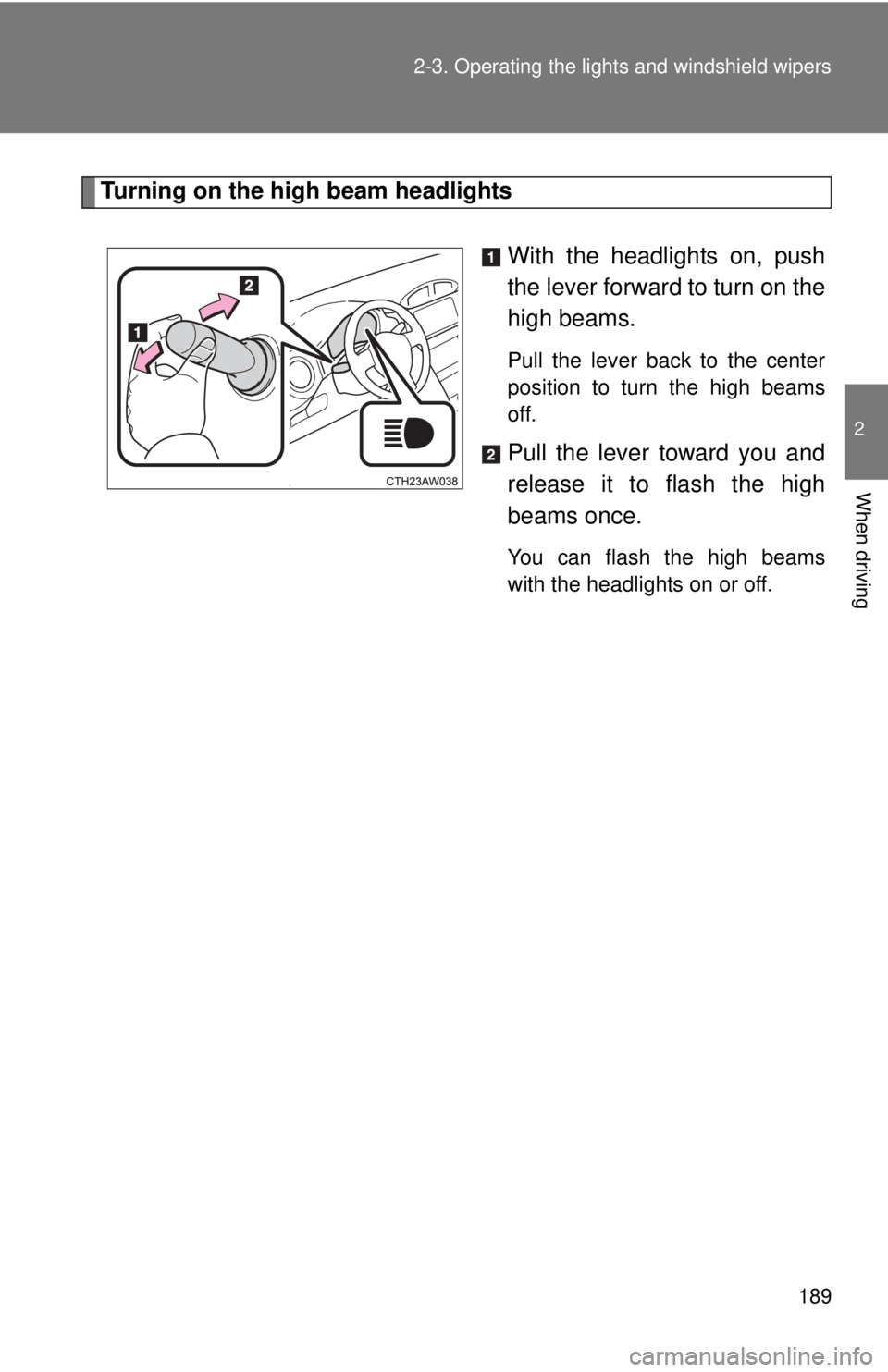
Turning on the high beam headlights
With the headlights on, push
the lever forward to turn on the
high beams.
Pull the lever back to the center
position to turn the high beams
off.
Pull the lever toward you and
release it to flash the high
beams once.
You can flash the high beams
with the headlights on or off.
Page 198 of 452
198 2-4. Using other driving systems
■Cruise control can be set when
Vehicles with an automatic transmission
●The shift lever is in D or M and the vehicle is in the 2
nd gear or higher.
● Vehicle speed is above approximately 25 mph (40 km/h).
Vehicles with a manual transmission
● The vehicle is in the 2
nd gear or higher.
● Vehicle speed is above approximately 25 mph (40 km/h).
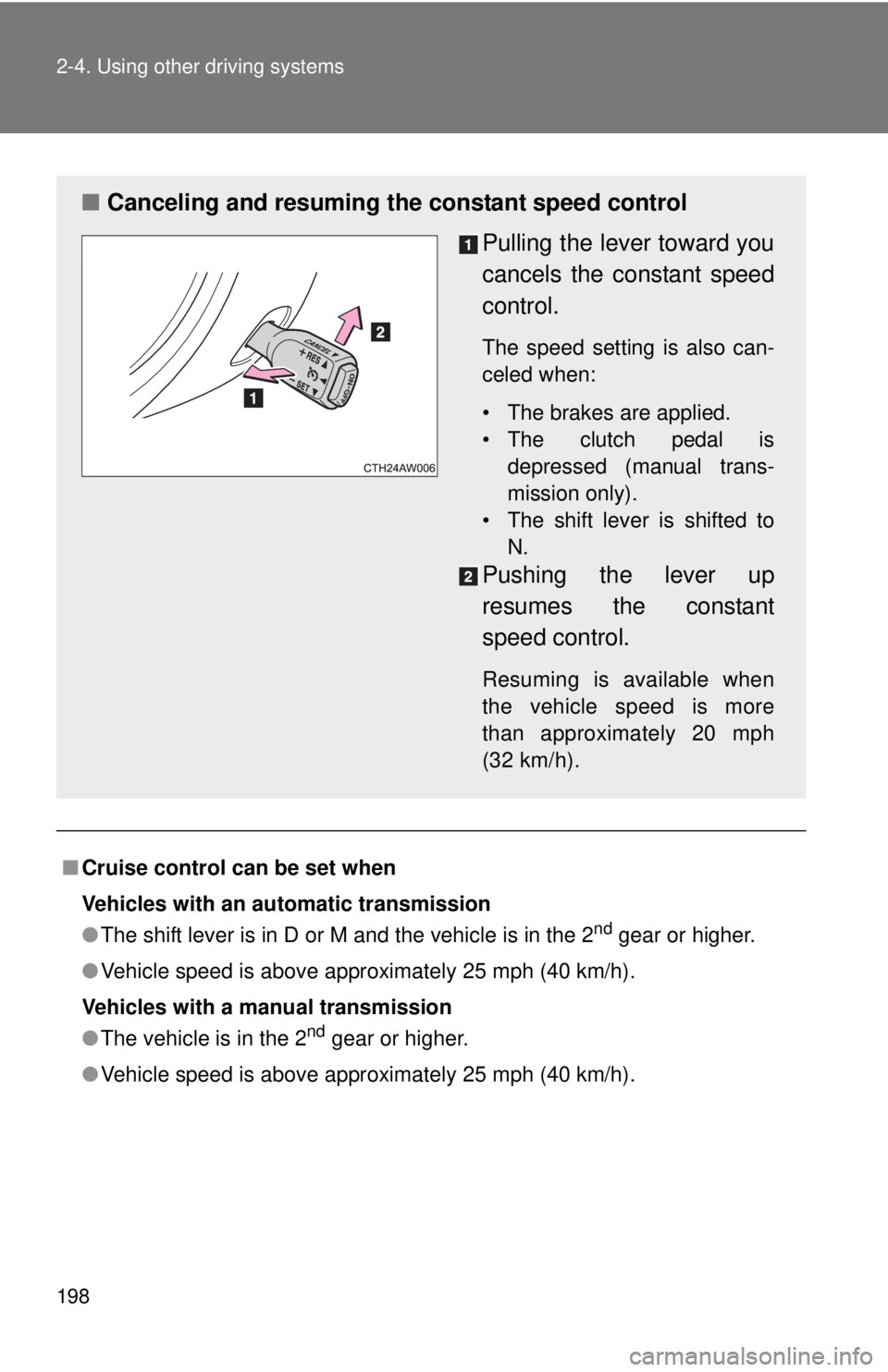
■ Canceling and resuming the constant speed control
Pulling the lever toward you
cancels the constant speed
control.
The speed setting is also can-
celed when:
• The brakes are applied.
• The clutch pedal isdepressed (manual trans-
mission only).
• The shift lever is shifted to N.
Pushing the lever up
resumes the constant
speed control.
Resuming is available when
the vehicle speed is more
than approximately 20 mph
(32 km/h).