parking brake TOYOTA GR YARIS 2022 Owner's Manual
[x] Cancel search | Manufacturer: TOYOTA, Model Year: 2022, Model line: GR YARIS, Model: TOYOTA GR YARIS 2022Pages: 470, PDF Size: 113.17 MB
Page 225 of 470
223
4
Owner's Manual_Europe_M52P63_en
4-5. Using the driving support systems
Driving
WARNING
●Unlike the parking brake, hill-start assist control is not intended to hold
the vehicle stationary for an extended period of time. Do not attempt to use hill-start assist con-
trol to hold the vehicle on an incline, as doing so may lead to an acci-dent.
■When the TRC/VSC is activated
The slip indicator light flashes. Always
drive carefully. Reckless driving may cause an accident. Exercise particular care when the indicator light flashes.
■When the TRC/VSC systems are turned off
Be especially careful and drive at a speed appropriate to the road condi-tions. As these are the systems to
help ensure vehicle stability and driv- ing force, do not turn the TRC/VSC systems off unless necessary.
■Expert mode precautions
●Do not use on public roads.
●Use only when the road conditions and safely of the surrounding area
can be ensured.
●Proper use of expert mode requires
a professional level of driving skill. When using expert mode, always check the road conditions and sur-
rounding area and drive more care- fully than usual.
■Replacing tires
Make sure that all tires are of the specified size, brand, tread pattern
and total load capacity. In addition, make sure that the tires are inflated to the recommended tire inflation pres-
sure level. The ABS, TRC and VSC systems will not function correctly if different tires
are installed on the vehicle. Contact any authorized Toyota retailer or Toyota authorized repairer, or any
reliable repairer for further information when replacing tires or wheels.
■Handling of tires and the suspen-sion
Using tires with any kind of problem
or modifying the suspension will affect the driving assist systems, and may cause a system to malfunction.
■Secondary Collision Brake (if equipped)
Do not rely solely upon the Secondary Collision Brake. This system is designed to help reduce the possibil-
ity of further damage due to a second- ary collision, however, that effect changes according to various condi-
tions. Overly relying on the system may result in death or serious injury.
■Active Torque Split AWD system
●The Active Torque Split AWD sys-tem is designed to ensure driving
stability on general roads and not for off-road driving such as for rally-ing. Do not subject the system to
extreme driving conditions.
●Drive carefully on slippery road sur-
faces.
Page 227 of 470
225
4
Owner's Manual_Europe_M52P63_en
4-6. Driving tips
Driving
the driving conditions:
Do not try to forcibly open a win-
dow or move a wiper that is fro-
zen. Pour warm water over the
frozen area to melt the ice. Wipe
away the water immediately to
prevent it from freezing.
To ensure proper operation of
the climate control system fan,
remove any snow that has accu-
mulated on the air inlet vents in
front of the windshield.
Check for and remove any
excess ice or snow that may
have accumulated on the exte-
rior lights, vehicle’s roof, chassis,
around the tires or on the brakes.
Remove any snow or mud from
the bottom of your shoes before
getting in the vehicle.
Accelerate the vehicle slowly, keep
a safe distance between you and
the vehicle ahead, and drive at a
reduced speed suitable to road
conditions.
Park the vehicle and shift the
shift lever to 1 or R without set-
ting the parking brake. The park-
ing brake may freeze up,
preventing it from being
released. If the vehicle is parked
without setting the parking brake,
make sure to block the wheels.
Failure to do so may be danger-
ous because it may cause the
vehicle to move unexpectedly,
possibly leading to an accident.
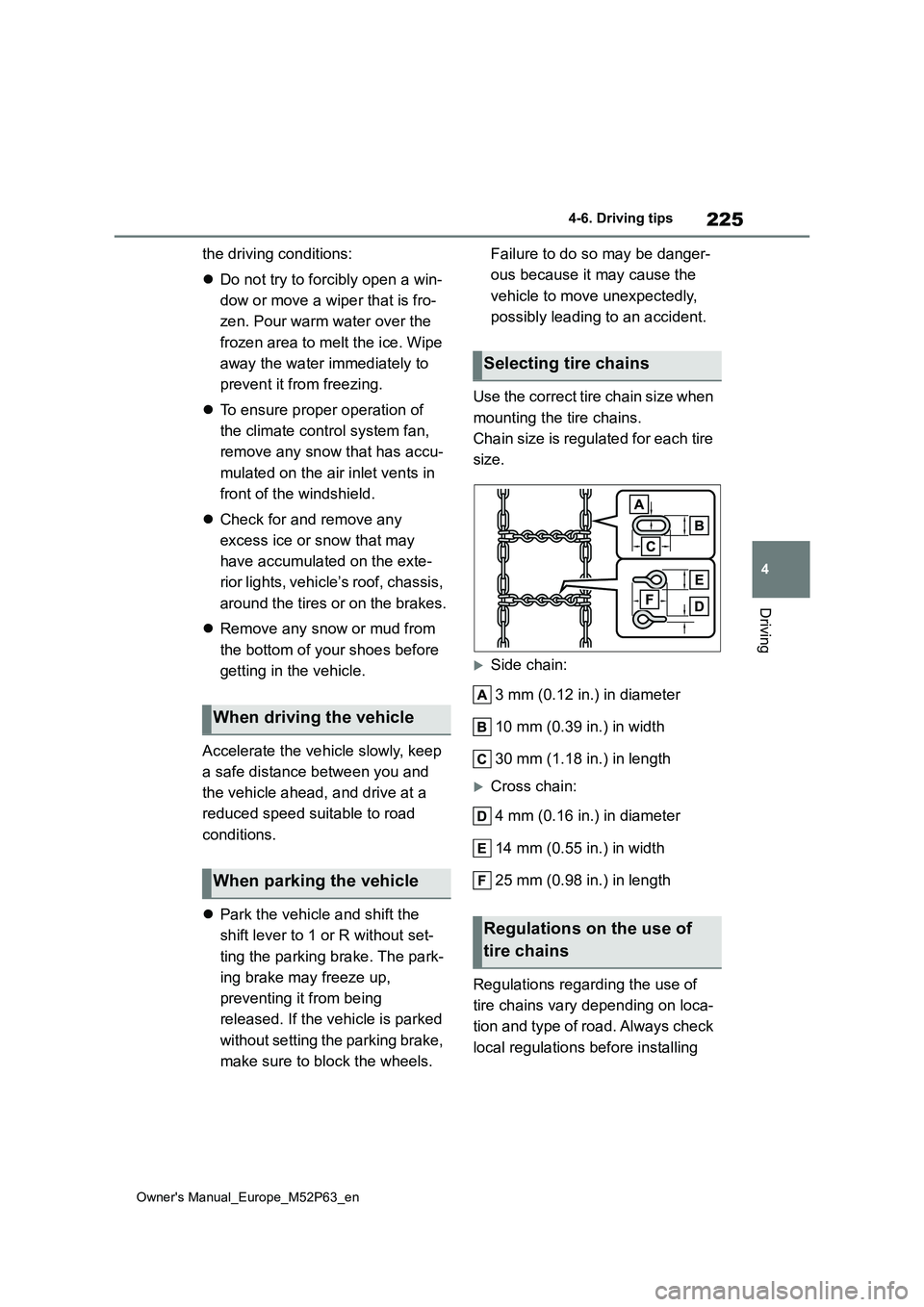
Use the correct tire chain size when
mounting the tire chains.
Chain size is regulated for each tire
size.
Side chain:
3 mm (0.12 in.) in diameter
10 mm (0.39 in.) in width
30 mm (1.18 in.) in length
Cross chain:
4 mm (0.16 in.) in diameter
14 mm (0.55 in.) in width
25 mm (0.98 in.) in length
Regulations regarding the use of
tire chains vary depending on loca-
tion and type of road. Always check
local regulations before installing
When driving the vehicle
When parking the vehicle
Selecting tire chains
Regulations on the use of
tire chains
Page 249 of 470
247
6
Owner's Manual_Europe_M52P63_en
6-1. Maintenance and care
Maintenance and care
late on the windows for a long period.
Clean the windows with a soft, damp cloth as soon as possible.• Do not use wax or glass cleaners that
contain abrasives when cleaning the windows.• Do not use any metallic objects to
remove condensation build up.
●When the water-repellent perfor-
mance has become insufficient, the coating can be repaired. Consult any authorized Toyota retailer or Toyota
authorized repairer, or any reliable repairer.
■Plated portions
If dirt cannot be removed, clean the
parts as follows:
●Use a soft cloth dampened with an
approximately 5% solution of neutral detergent and water to clean the dirt off.
●Wipe the surface with a dry, soft cloth to remove any remaining moisture.
●To remove oily deposits, use alcohol wet wipes or a similar product.
■Carbon film (if equipped)
●Do not attach a roof carrier on the car-bon-film. It may damage the film sur-
face.
●On l y u se lo w t em pe r a tu r e wat e r ; 50 ° C
(122°F) or less, for an automatic car wash and high pressure washer.
Do not use the high pressure washer to
the film edge to avoid coming off.
●Do not take heated water more than 90°C (194°F) directly. It may cause the film to come off easily.
●Only use a neutral detergent which is approved for car wash use and water.
●Do not wax or apply a coating to the film to keep film textured appearance.
●Dirt like bird droppings and oil should be cleaned off with a neutral detergent
immediately.
■Brake
●Painted brake calipers
• When using detergent, use neutral
detergent. Do not use hard brushes or abrasive cleaners, as they will dam-age the paint.
• Do not use detergent on the brake cal- ipers when they are hot.• Wash detergent off immediately after
use.
●Rust may form if the vehicle is parked
with wet brake pads or disc rotors, causing them to stick. Before parking the vehicle after it is washed, drive
slowly and apply the brakes several times to dry the parts.
WARNING
■When washing the vehicle
Do not apply water to the inside of the engine compartment. Doing so may cause the electrical components, etc.
to catch fire.
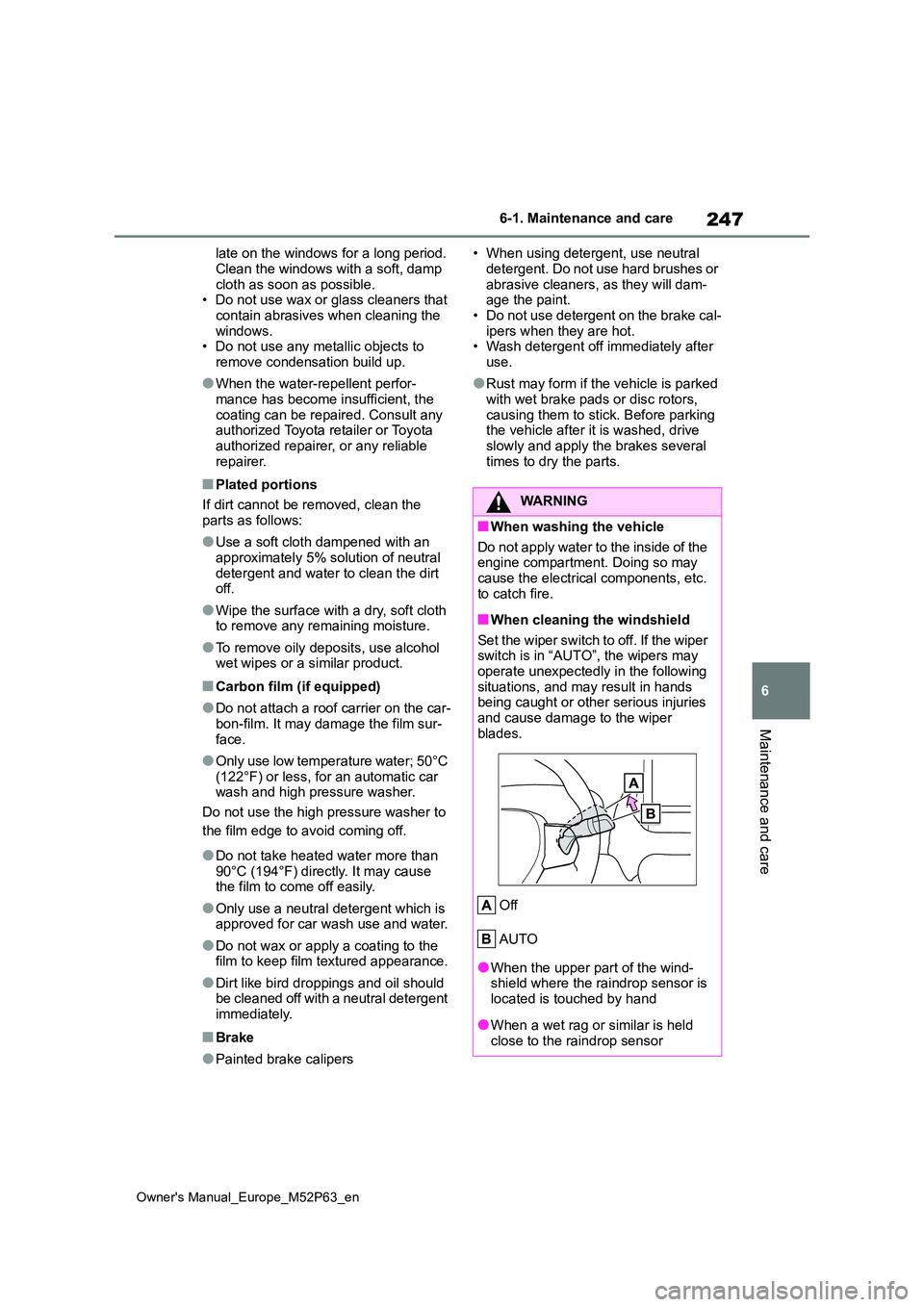
■When cleaning the windshield
Set the wiper switch to off. If the wiper switch is in “AUTO”, the wipers may operate unexpectedly in the following
situations, and may result in hands being caught or other serious injuries and cause damage to the wiper
blades.
Off
AUTO
●When the upper part of the wind- shield where the raindrop sensor is
located is touched by hand
●When a wet rag or similar is held
close to the raindrop sensor
Page 287 of 470
285
6
Owner's Manual_Europe_M52P63_en
6-4. Do-it-yourself maintenance
Maintenance and care
Stop the vehicle on a hard, flat
surface.
Set the parking brake.
Shift the shift lever to R.
Stop the engine.
Turn on the emergency flashers.
( P.304)
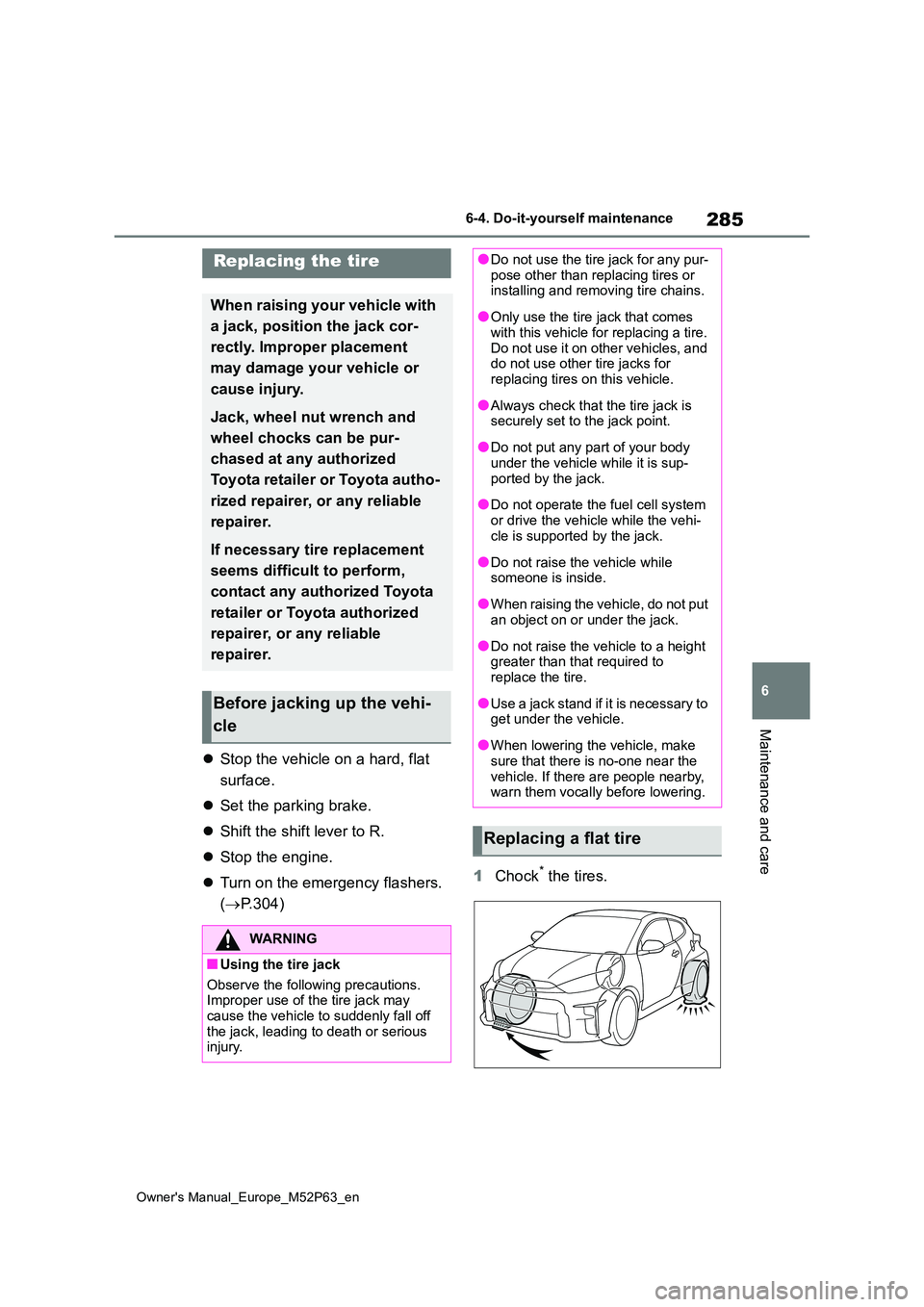
1 Chock* the tires.
Replacing the tire
When raising your vehicle with
a jack, position the jack cor-
rectly. Improper placement
may damage your vehicle or
cause injury.
Jack, wheel nut wrench and
wheel chocks can be pur-
chased at any authorized
Toyota retailer or Toyota autho-
rized repairer, or any reliable
repairer.
If necessary tire replacement
seems difficult to perform,
contact any authorized Toyota
retailer or Toyota authorized
repairer, or any reliable
repairer.
Before jacking up the vehi-
cle
WARNING
■Using the tire jack
Observe the following precautions. Improper use of the tire jack may cause the vehicle to suddenly fall off
the jack, leading to death or serious injury.
●Do not use the tire jack for any pur-pose other than replacing tires or installing and removing tire chains.
●Only use the tire jack that comes with this vehicle for replacing a tire.
Do not use it on other vehicles, and do not use other tire jacks for replacing tires on this vehicle.
●Always check that the tire jack is securely set to the jack point.
●Do not put any part of your body under the vehicle while it is sup-
ported by the jack.
●Do not operate the fuel cell system
or drive the vehicle while the vehi- cle is supported by the jack.
●Do not raise the vehicle while someone is inside.
●When raising the vehicle, do not put an object on or under the jack.
●Do not raise the vehicle to a height greater than that required to replace the tire.
●Use a jack stand if it is necessary to get under the vehicle.
●When lowering the vehicle, make sure that there is no-one near the
vehicle. If there are people nearby, warn them vocally before lowering.
Replacing a flat tire
Page 311 of 470
309
7
Owner's Manual_Europe_M52P63_en
7-2. Steps to take in an emergency
When trouble arises
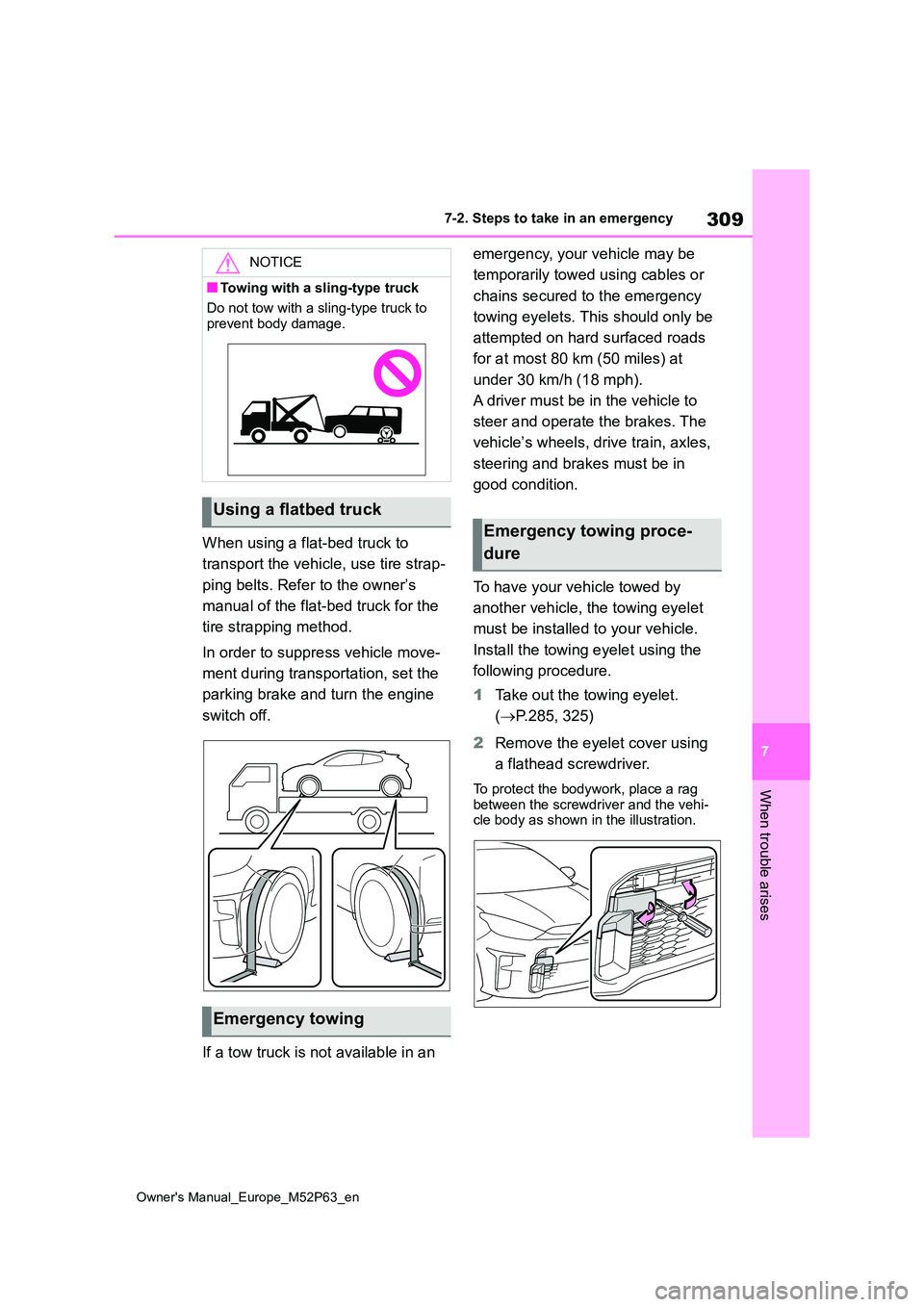
When using a flat-bed truck to
transport the vehicle, use tire strap-
ping belts. Refer to the owner’s
manual of the flat-bed truck for the
tire strapping method.
In order to suppress vehicle move-
ment during transportation, set the
parking brake and turn the engine
switch off.
If a tow truck is not available in an
emergency, your vehicle may be
temporarily towed using cables or
chains secured to the emergency
towing eyelets. This should only be
attempted on hard surfaced roads
for at most 80 km (50 miles) at
under 30 km/h (18 mph).
A driver must be in the vehicle to
steer and operate the brakes. The
vehicle’s wheels, drive train, axles,
steering and brakes must be in
good condition.
To have your vehicle towed by
another vehicle, the towing eyelet
must be installed to your vehicle.
Install the towing eyelet using the
following procedure.
1 Take out the towing eyelet.
( P.285, 325)
2 Remove the eyelet cover using
a flathead screwdriver.
To protect the bodywork, place a rag
between the screwdriver and the vehi- cle body as shown in the illustration.
NOTICE
■Towing with a sling-type truck
Do not tow with a sling-type truck to
prevent body damage.
Using a flatbed truck
Emergency towing
Emergency towing proce-
dure
Page 312 of 470

310
Owner's Manual_Europe_M52P63_en
7-2. Steps to take in an emergency
3Insert the towing eyelet into the
hole and tighten partially by
hand.
4 Tighten down the towing eyelet
securely using a wheel nut
wrench* or hard metal bar.
*: Wheel nut wrench is not installed in
this vehicle. You can purchase it from
any authorized Toyota retailer or
Toyota authorized repairer, or any
reliable repairer.
5 Securely attach cables or chains
to the towing eyelet.
Take care not to damage the vehicle body.
6 Enter the vehicle being towed
and start the engine.
If the engine does not start, turn the
engine switch to ON.
7 Shift the shift lever to N and
release the parking brake.
■While towing
If the engine is not running, the power
assist for the brakes and steering will not function, making steering and brak-ing more difficult.
Page 326 of 470
324
Owner's Manual_Europe_M52P63_en
7-2. Steps to take in an emergency
Stop the vehicle in a safe place
on a hard, flat surface.
Set the parking brake.
Shift the shift lever to N.
Stop the engine.
Turn on the emergency flashers.
( P.304)
Check the degree of the tire
damage.
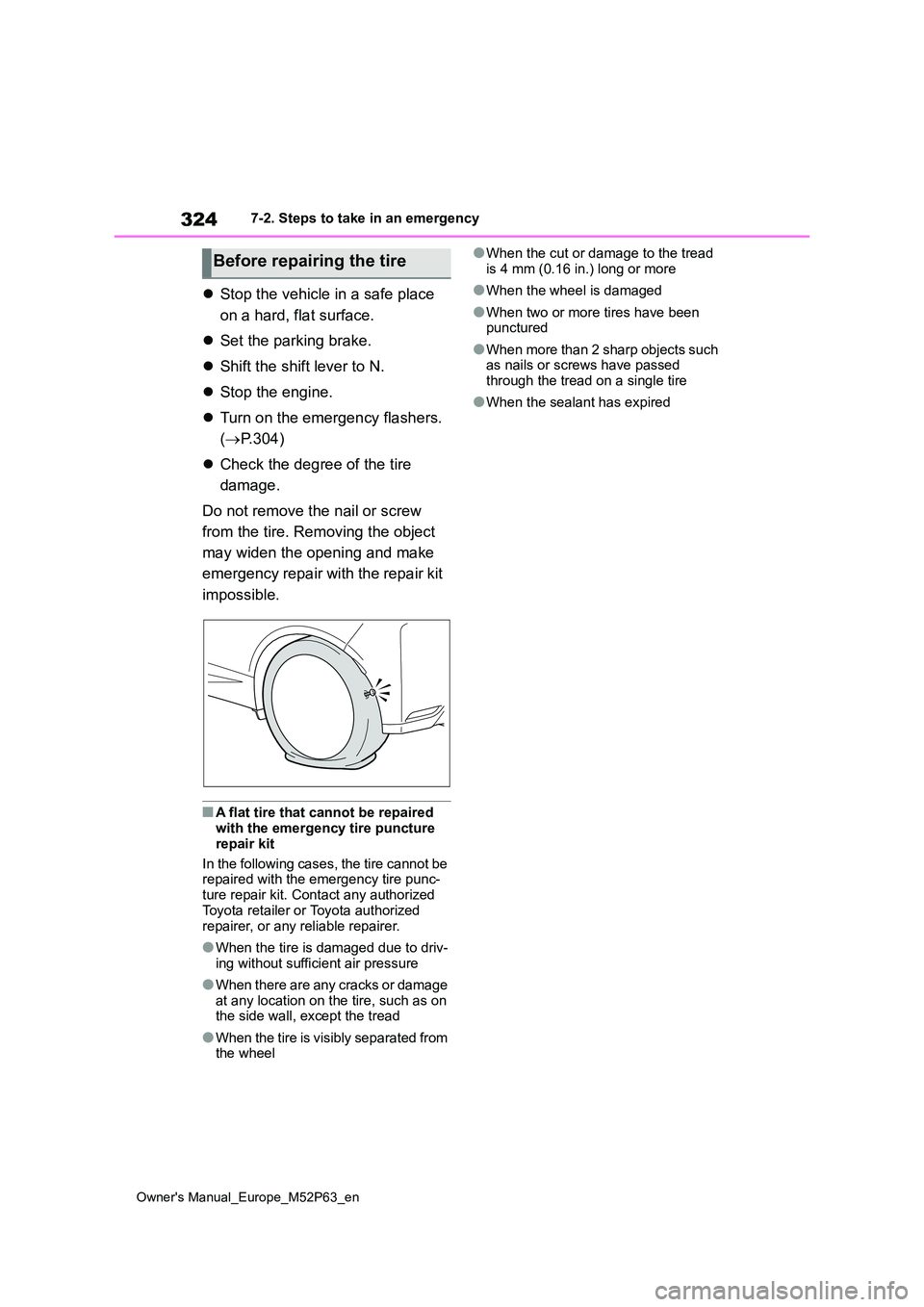
Do not remove the nail or screw
from the tire. Removing the object
may widen the opening and make
emergency repair with the repair kit
impossible.
■A flat tire that cannot be repaired with the emergency tire puncture
repair kit
In the following cases, the tire cannot be repaired with the emergency tire punc-
ture repair kit. Contact any authorized Toyota retailer or Toyota authorized
repairer, or any reliable repairer.
●When the tire is damaged due to driv-
ing without sufficient air pressure
●When there are any cracks or damage
at any location on the tire, such as on the side wall, except the tread
●When the tire is visibly separated from the wheel
●When the cut or damage to the tread
is 4 mm (0.16 in.) long or more
●When the wheel is damaged
●When two or more tires have been punctured
●When more than 2 sharp objects such as nails or screws have passed
through the tread on a single tire
●When the sealant has expired
Before repairing the tire
Page 338 of 470
336
Owner's Manual_Europe_M52P63_en
7-2. Steps to take in an emergency
interim measure to start the engine
if the engine switch is functioning
normally.
Do not use this starting procedure
except in case of emergency.
1 Set the parking brake.
2 Check that the shift lever is in N.
3 Turn the engine switch to ACC.
4 Press and hold the engine
switch for about 15 seconds
while depressing the clutch
pedal firmly.
Even if the engine can be started using
the above steps, the system may be
malfunctioning. Have the vehicle
inspected by any authorized Toyota
retailer or Toyota authorized repairer, or
any reliable repairer.
If you lose your keys
New genuine keys can be
made by any authorized Toyota
retailer or Toyota authorized
repairer, or any reliable
repairer using the other
mechanical key and the key
number stamped on your key
number plate.
Keep the plate in a safe place
such as your wallet, not in the
vehicle.
NOTICE
■When an electronic key is lost
If the electronic key remains lost, the
risk of vehicle theft increases signifi- cantly. Visit any authorized Toyota retailer or Toyota authorized repairer,
or any reliable repairer immediately with all remaining electronic keys that were provided with your vehicle.
Page 348 of 470
346
Owner's Manual_Europe_M52P63_en
7-2. Steps to take in an emergency
1Stop the engine. Set the parking
brake and shift the shift lever to
N.
2 Remove the mud, snow or sand
from around the front wheels.
3 Place wood, stones or some
other material under the front
wheels to help provide traction.
4 Restart the engine.
5 Shift the shift lever to 1 or R and
release the parking brake. Then,
while exercising caution,
depress the accelerator pedal.
■When it is difficult to free the vehi-
cle
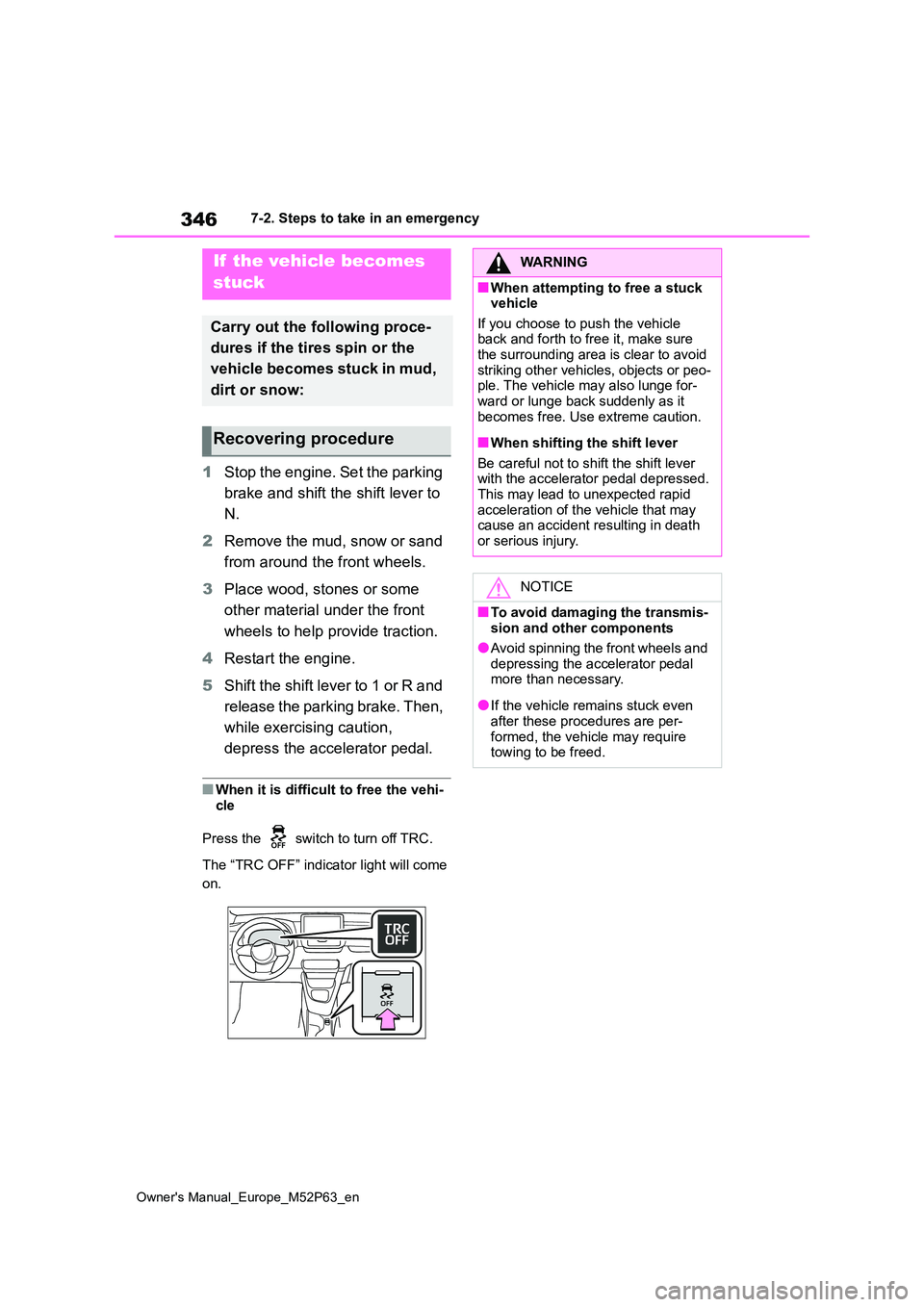
Press the switch to turn off TRC.
The “TRC OFF” indicator light will come
on.
If the vehicle becomes
stuck
Carry out the following proce-
dures if the tires spin or the
vehicle becomes stuck in mud,
dirt or snow:
Recovering procedure
WARNING
■When attempting to free a stuck vehicle
If you choose to push the vehicle back and forth to free it, make sure the surrounding area is clear to avoid
striking other vehicles, objects or peo- ple. The vehicle may also lunge for-ward or lunge back suddenly as it
becomes free. Use extreme caution.
■When shifting the shift lever
Be careful not to shift the shift lever with the accelerator pedal depressed.This may lead to unexpected rapid
acceleration of the vehicle that may cause an accident resulting in death or serious injury.
NOTICE
■To avoid damaging the transmis-sion and other components
●Avoid spinning the front wheels and depressing the accelerator pedal more than necessary.
●If the vehicle remains stuck even
after these procedures are per- formed, the vehicle may require towing to be freed.
Page 356 of 470
354
Owner's Manual_Europe_M52P63_en
8-1. Specifications
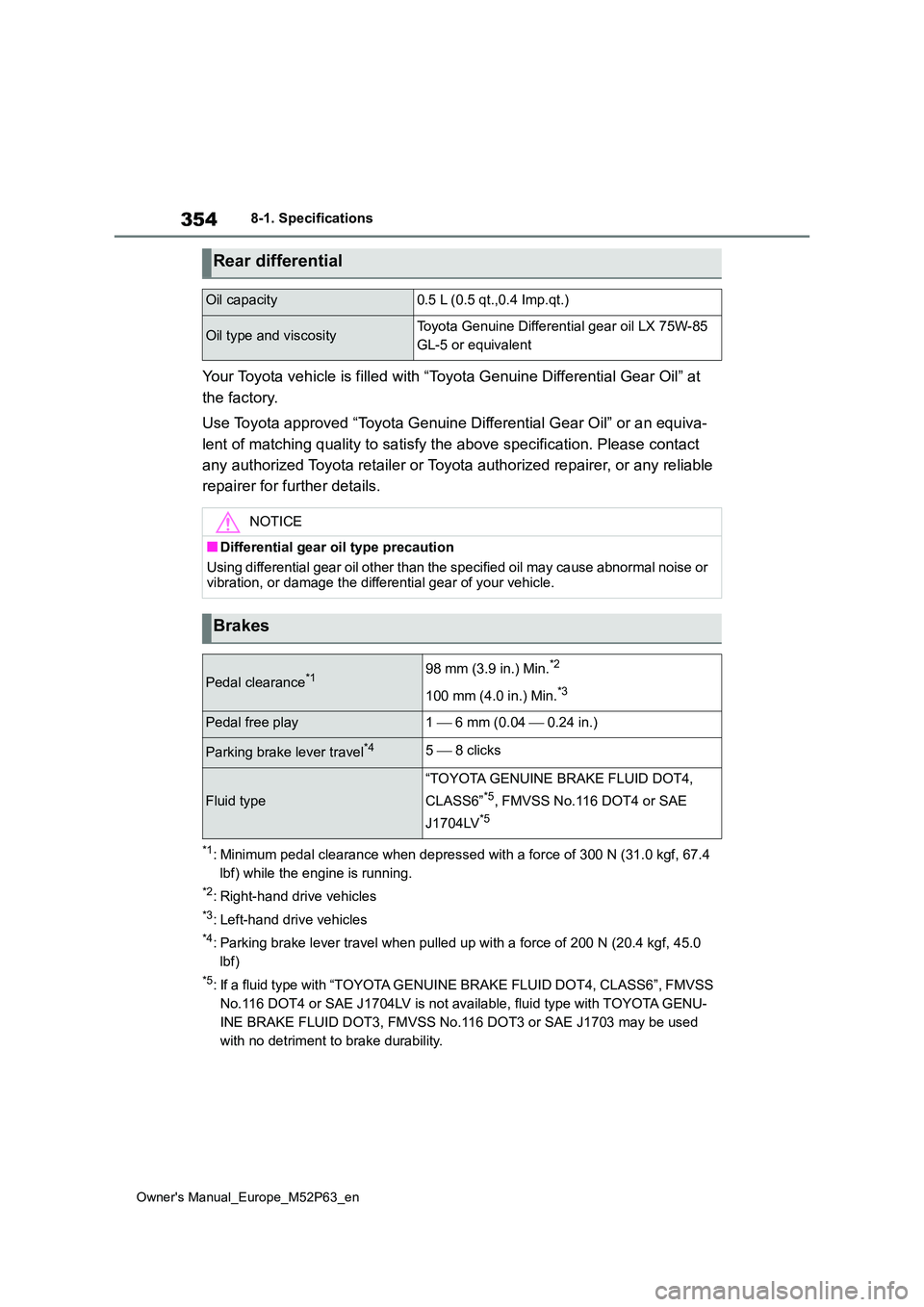
Your Toyota vehicle is filled with “Toyota Genuine Differential Gear Oil” at
the factory.
Use Toyota approved “Toyota Genuine Differential Gear Oil” or a n equiva-
lent of matching quality to satisfy the above specification. Pl ease contact
any authorized Toyota retailer or Toyota authorized repairer, o r any reliable
repairer for further details.
*1: Minimum pedal clearance when depressed with a force of 300 N ( 31.0 kgf, 67.4
lbf) while the engine is running.
*2: Right-hand drive vehicles
*3: Left-hand drive vehicles
*4: Parking brake lever travel when pulled up with a force of 200 N (20.4 kgf, 45.0
lbf)
*5: If a fluid type with “TOYOTA GENUINE BRAKE FLUID DOT4, CLASS6” , FMVSS
No.116 DOT4 or SAE J1704LV is not available, fluid type with TO YOTA GENU-
INE BRAKE FLUID DOT3, FMVSS No.116 DOT3 or SAE J1703 may be use d
with no detriment to brake durability.
Rear differential
Oil capacity0.5 L (0.5 qt.,0.4 Imp.qt.)
Oil type and viscosityToyota Genuine Differential gear oil LX 75W-85
GL-5 or equivalent
NOTICE
■Differential gear oil type precaution
Using differential gear oil other than the specified oil may ca use abnormal noise or vibration, or damage the differential gear of your vehicle.
Brakes
Pedal clearance*198 mm (3.9 in.) Min.*2
100 mm (4.0 in.) Min.*3
Pedal free play1 6 mm (0.04 0.24 in.)
Parking brake lever travel*45 8 clicks
Fluid type
“TOYOTA GENUINE BRAKE FLUID DOT4,
CLASS6”*5, FMVSS No.116 DOT4 or SAE
J1704LV*5