engine TOYOTA GR YARIS 2023 Owners Manual
[x] Cancel search | Manufacturer: TOYOTA, Model Year: 2023, Model line: GR YARIS, Model: TOYOTA GR YARIS 2023Pages: 470, PDF Size: 113.17 MB
Page 331 of 470
329
7
Owner's Manual_Europe_M52P63_en
7-2. Steps to take in an emergency
When trouble arises
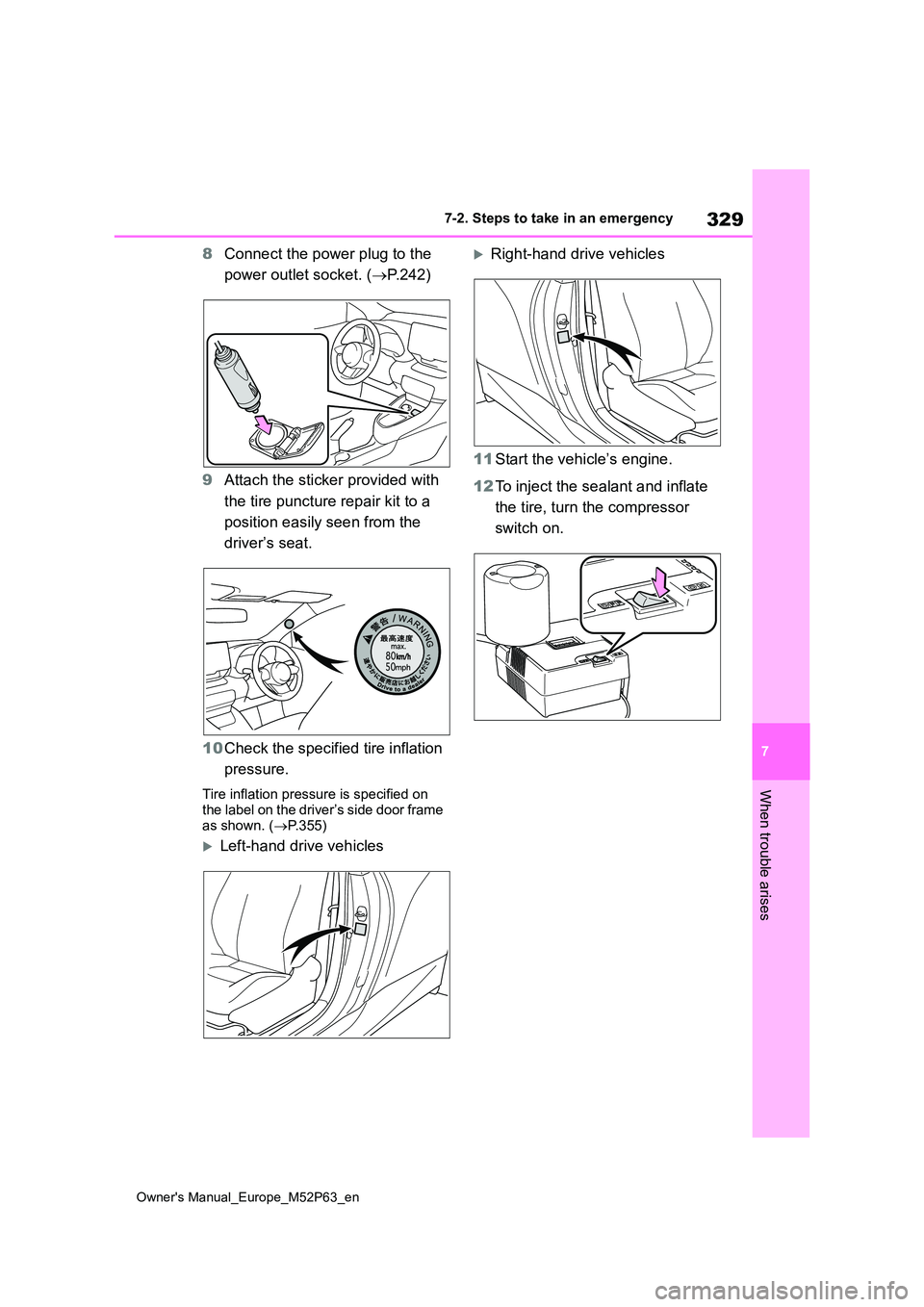
8Connect the power plug to the
power outlet socket. ( P.242)
9 Attach the sticker provided with
the tire puncture repair kit to a
position easily seen from the
driver’s seat.
10 Check the specified tire inflation
pressure.
Tire inflation pressure is specified on the label on the driver’s side door frame
as shown. ( P.355)
Left-hand drive vehicles
Right-hand drive vehicles
11 Start the vehicle’s engine.
12 To inject the sealant and inflate
the tire, turn the compressor
switch on.
Page 337 of 470
335
7
Owner's Manual_Europe_M52P63_en
7-2. Steps to take in an emergency
When trouble arises
One of the following may be the
cause of the problem:
There may not be sufficient fuel
in the vehicle’s tank. Refuel the
vehicle.
The engine may be flooded. Try
to restart the engine again fol-
lowing correct starting proce-
dures. ( P.134)
There may be a malfunction in
the engine immobilizer system.
( P. 7 0 )
One of the following may be the
cause of the problem:
The battery may be discharged.
( P.339)
The battery terminal connec-
tions may be loose or corroded.
( P.273)
The engine starting system may be
malfunctioning due to an electrical
problem such as electronic key bat-
tery depletion or a blown fuse.
However, an interim measure is
available to start the engine.
( P.335)
One of the following may be the
cause of the problem:
The battery may be discharged.
( P.339)
One or both of the battery termi-
nals may be disconnected.
( P.273)
There may be a malfunction in
the steering lock system.
Contact any authorized Toyota retailer
or Toyota authorized repairer, or any
reliable repairer if the problem cannot
be repaired, or if repair procedures are
unknown.
When the engine does not start, the
following steps can be used as an
If the engine will not
start
If the engine will not start even
though correct starting proce-
dures are being followed
( P.134), consider each of the
following points:
The engine will not start
even though the starter
motor operates normally.
The starter motor turns over
slowly, the interior lights
and headlights are dim, or
the horn does not sound or
sounds at a low volume.
The starter motor does not
turn over
The starter motor does not
turn over, the interior lights
and headlights do not turn
on, or the horn does not
sound.
Emergency start function
Page 338 of 470
336
Owner's Manual_Europe_M52P63_en
7-2. Steps to take in an emergency
interim measure to start the engine
if the engine switch is functioning
normally.
Do not use this starting procedure
except in case of emergency.
1 Set the parking brake.
2 Check that the shift lever is in N.
3 Turn the engine switch to ACC.
4 Press and hold the engine
switch for about 15 seconds
while depressing the clutch
pedal firmly.
Even if the engine can be started using
the above steps, the system may be
malfunctioning. Have the vehicle
inspected by any authorized Toyota
retailer or Toyota authorized repairer, or
any reliable repairer.
If you lose your keys
New genuine keys can be
made by any authorized Toyota
retailer or Toyota authorized
repairer, or any reliable
repairer using the other
mechanical key and the key
number stamped on your key
number plate.
Keep the plate in a safe place
such as your wallet, not in the
vehicle.
NOTICE
■When an electronic key is lost
If the electronic key remains lost, the
risk of vehicle theft increases signifi- cantly. Visit any authorized Toyota retailer or Toyota authorized repairer,
or any reliable repairer immediately with all remaining electronic keys that were provided with your vehicle.
Page 339 of 470
337
7
Owner's Manual_Europe_M52P63_en
7-2. Steps to take in an emergency
When trouble arises
■When the electronic key does not work properly
●Make sure that the smart entry & start system has not been deactivated in the customization setting. If it is off,
turn the function on. (Customizable features: P.359)
●Check if battery-saving mode is set. If it is set, cancel the function. ( P.108)
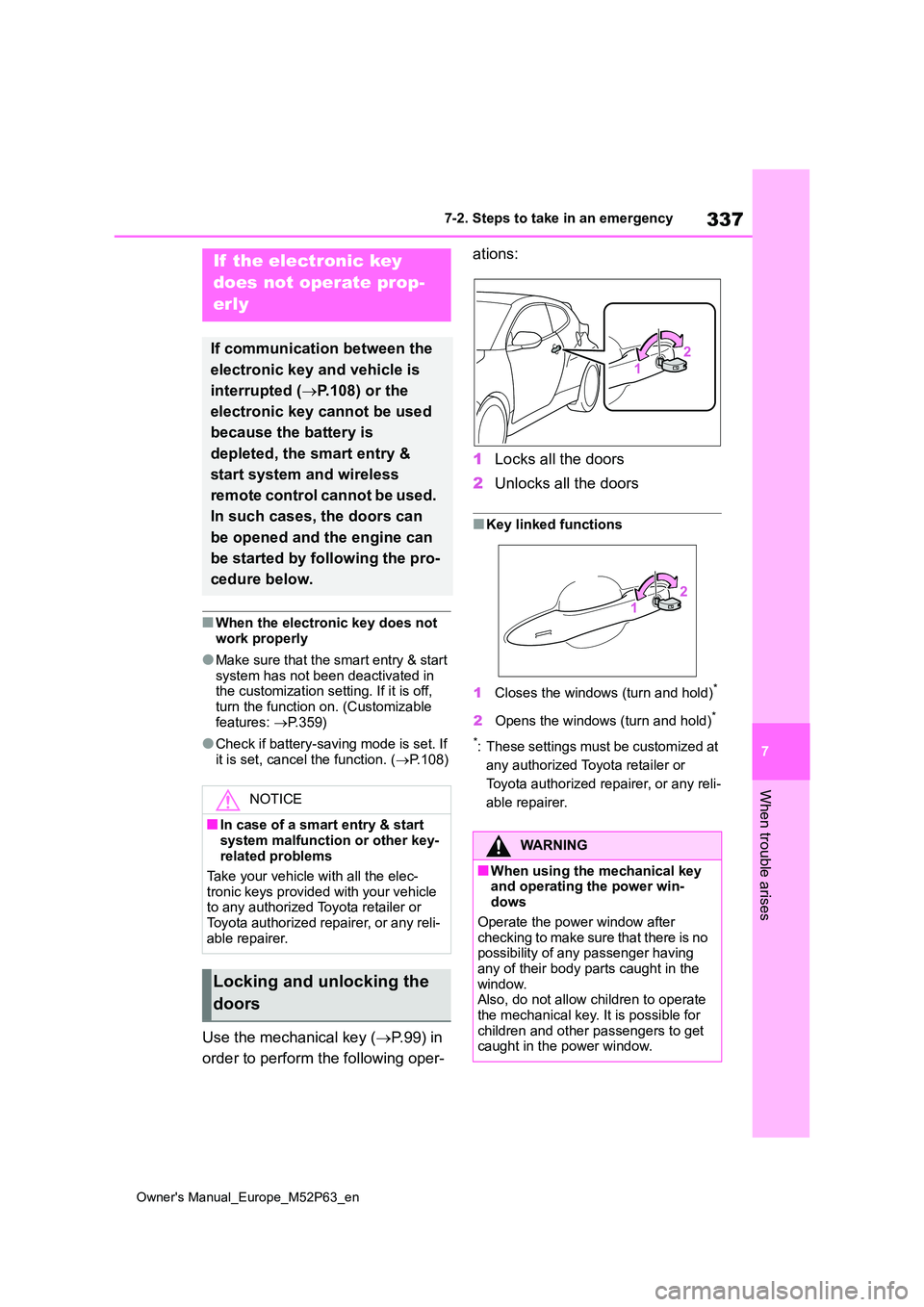
Use the mechanical key (P.99) in
order to perform the following oper-
ations:
1 Locks all the doors
2 Unlocks all the doors
■Key linked functions
1 Closes the windows (turn and hold)*
2Opens the windows (turn and hold)*
*: These settings must be customized at
any authorized Toyota retailer or
Toyota authorized repairer, or any reli-
able repairer.
If the electronic key
does not operate prop-
erly
If communication between the
electronic key and vehicle is
interrupted ( P.108) or the
electronic key cannot be used
because the battery is
depleted, the smart entry &
start system and wireless
remote control cannot be used.
In such cases, the doors can
be opened and the engine can
be started by following the pro-
cedure below.
NOTICE
■In case of a smart entry & start
system malfunction or other key- related problems
Take your vehicle with all the elec-
tronic keys provided with your vehicle to any authorized Toyota retailer or Toyota authorized repairer, or any reli-
able repairer.
Locking and unlocking the
doors
WARNING
■When using the mechanical key and operating the power win-dows
Operate the power window after checking to make sure that there is no possibility of any passenger having
any of their body parts caught in the window.Also, do not allow children to operate
the mechanical key. It is possible for children and other passengers to get caught in the power window.
Page 340 of 470
338
Owner's Manual_Europe_M52P63_en
7-2. Steps to take in an emergency
1Shift the shift lever to N and
depress the clutch pedal.
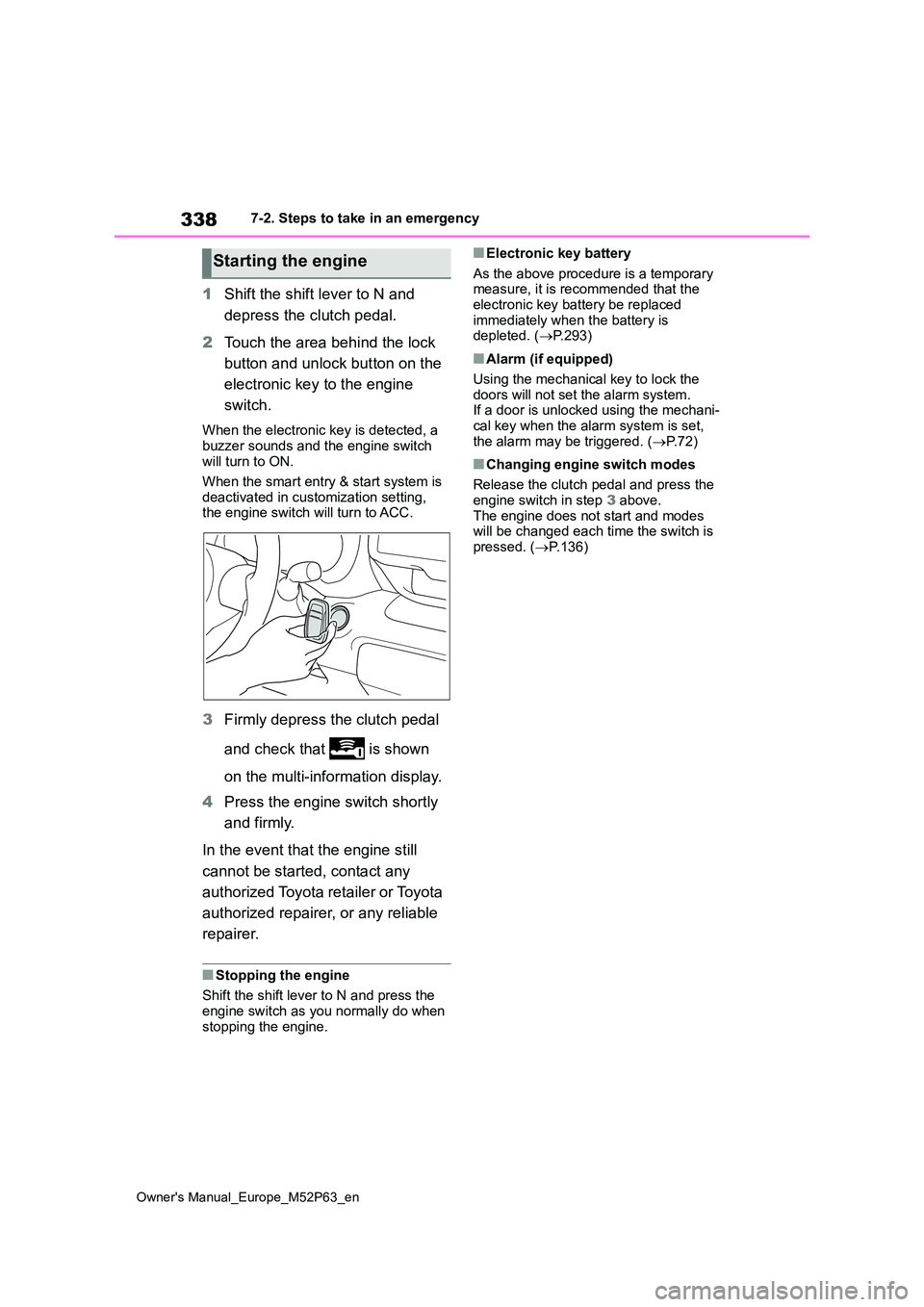
2 Touch the area behind the lock
button and unlock button on the
electronic key to the engine
switch.
When the electronic key is detected, a
buzzer sounds and the engine switch will turn to ON.
When the smart entry & start system is
deactivated in customization setting, the engine switch will turn to ACC.
3 Firmly depress the clutch pedal
and check that is shown
on the multi-information display.
4 Press the engine switch shortly
and firmly.
In the event that the engine still
cannot be started, contact any
authorized Toyota retailer or Toyota
authorized repairer, or any reliable
repairer.
■Stopping the engine
Shift the shift lever to N and press the engine switch as you normally do when
stopping the engine.
■Electronic key battery
As the above procedure is a temporary measure, it is recommended that the electronic key battery be replaced
immediately when the battery is depleted. ( P.293)
■Alarm (if equipped)
Using the mechanical key to lock the
doors will not set the alarm system. If a door is unlocked using the mechani-cal key when the alarm system is set,
the alarm may be triggered. ( P. 7 2 )
■Changing engine switch modes
Release the clutch pedal and press the engine switch in step 3 above.
The engine does not start and modes will be changed each time the switch is pressed. ( P.136)
Starting the engine
Page 341 of 470
339
7
Owner's Manual_Europe_M52P63_en
7-2. Steps to take in an emergency
When trouble arises
If you have a set of jumper (or
booster) cables and a second vehi-
cle with a 12-volt battery, you can
jump start your vehicle by following
the steps below.
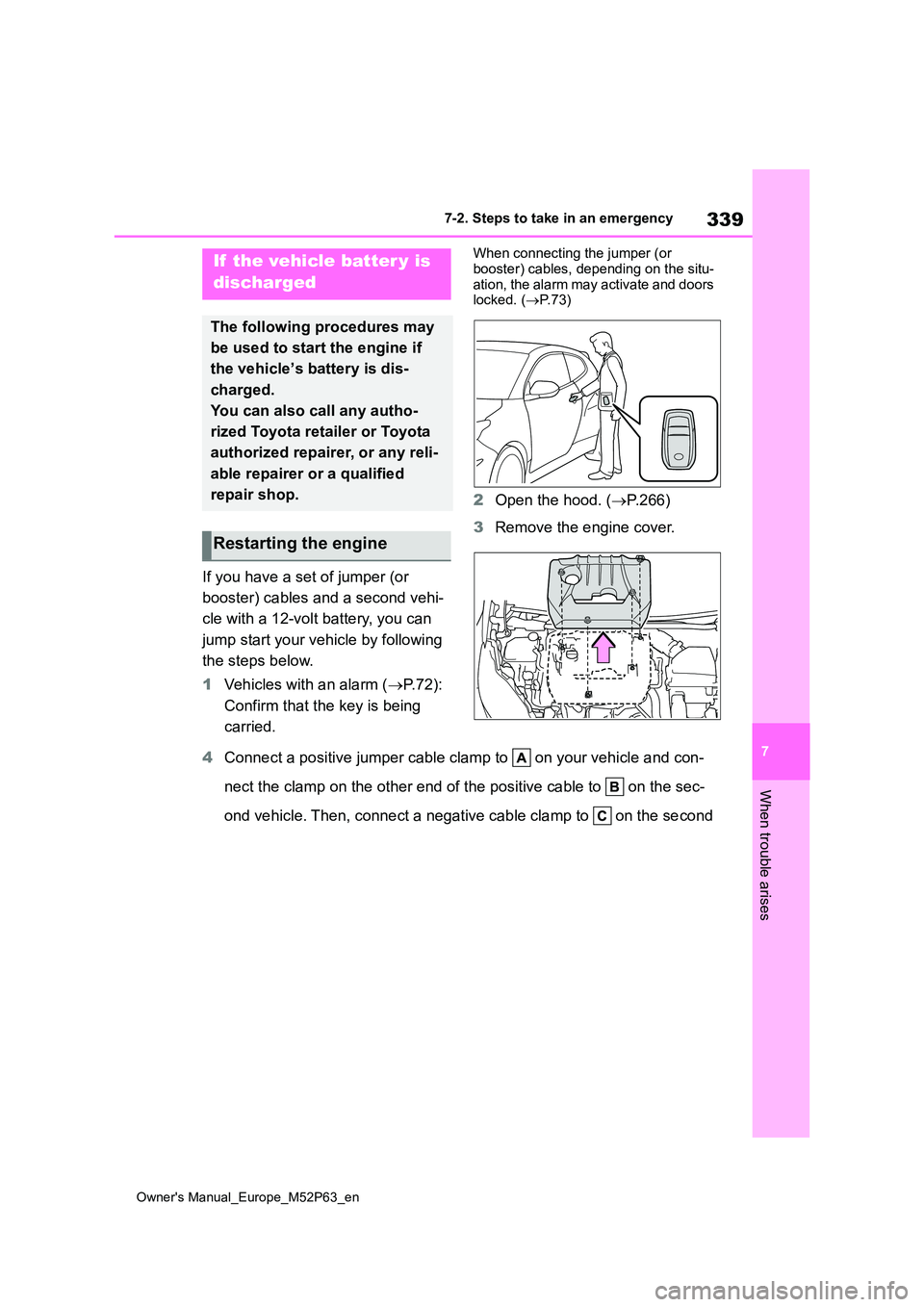
1 Vehicles with an alarm (P. 7 2 ) :
Confirm that the key is being
carried.
When connecting the jumper (or
booster) cables, depending on the situ- ation, the alarm may activate and doors locked. ( P. 7 3 )
2Open the hood. (P.266)
3 Remove the engine cover.
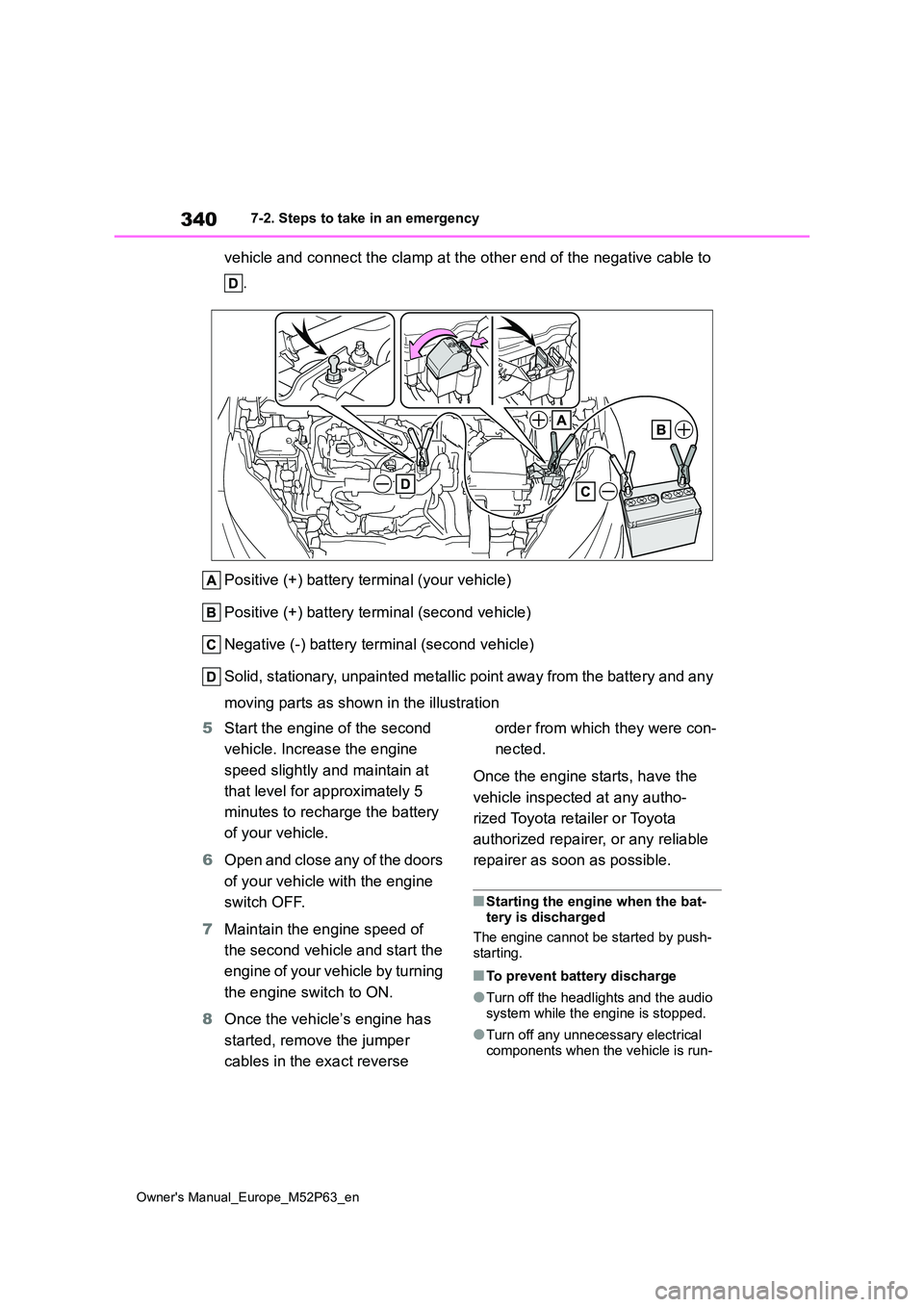
4 Connect a positive jumper cable clamp to on your vehicle and con-
nect the clamp on the other end of the positive cable to on th e sec-
ond vehicle. Then, connect a negative cable clamp to on the se cond
If the vehicle batter y is
discharged
The following procedures may
be used to start the engine if
the vehicle’s battery is dis-
charged.
You can also call any autho-
rized Toyota retailer or Toyota
authorized repairer, or any reli-
able repairer or a qualified
repair shop.
Restarting the engine
Page 342 of 470
340
Owner's Manual_Europe_M52P63_en
7-2. Steps to take in an emergency
vehicle and connect the clamp at the other end of the negative cable to
.
Positive (+) battery terminal (your vehicle)
Positive (+) battery terminal (second vehicle)
Negative (-) battery terminal (second vehicle)
Solid, stationary, unpainted metallic point away from the batte ry and any
moving parts as shown in the illustration
5 Start the engine of the second
vehicle. Increase the engine
speed slightly and maintain at
that level for approximately 5
minutes to recharge the battery
of your vehicle.
6 Open and close any of the doors
of your vehicle with the engine
switch OFF.
7 Maintain the engine speed of
the second vehicle and start the
engine of your vehicle by turning
the engine switch to ON.
8 Once the vehicle’s engine has
started, remove the jumper
cables in the exact reverse
order from which they were con-
nected.
Once the engine starts, have the
vehicle inspected at any autho-
rized Toyota retailer or Toyota
authorized repairer, or any reliable
repairer as soon as possible.
■Starting the engine when the bat- tery is discharged
The engine cannot be started by push-
starting.
■To prevent battery discharge
●Turn off the headlights and the audio
system while the engine is stopped.
●Turn off any unnecessary electrical
components when the vehicle is run-
Page 343 of 470
341
7
Owner's Manual_Europe_M52P63_en
7-2. Steps to take in an emergency
When trouble arises
ning at a low speed for an extended
period, such as in heavy traffic.
■When the battery is removed or dis- charged
●Information stored in the ECU is cleared. When the battery is depleted, have the vehicle inspected at any
authorized Toyota retailer or Toyota authorized repairer, or any reliable repairer.
●Some systems may require initializa-tion. ( P.367)
■When removing the battery termi-
nals
When the battery terminals are removed, the information stored in the
ECU is cleared. Before removing the battery terminals, contact any autho-rized Toyota retailer or Toyota autho-
rized repairer, or any reliable repairer.
■Charging the battery
The electricity stored in the battery will discharge gradually even when the vehi-
cle is not in use, due to natural dis- charge and the draining effects of certain electrical appliances. If the vehi-
cle is left for a long time, the battery may discharge, and the engine may be unable to start. (The battery recharges
automatically during driving.)
■When recharging or replacing the battery
●In some cases, it may not be possible to unlock the doors using the smart entry & start system when the battery
is discharged. Use the wireless remote control or the mechanical key to lock or unlock the doors.
●The engine may not start on the first attempt after the battery has
recharged but will start normally after the second attempt. This is not a mal-function.
●The engine switch mode is memo-rized by the vehicle. When the battery
is reconnected, the system will return to the mode it was in before the bat-tery was discharged. Before discon-
necting the battery, turn the engine
switch off. If you are unsure what mode the engine switch was in before the bat-
tery discharged, be especially careful when reconnecting the battery.
■When replacing the battery
●Use a genuine battery specifically designed for use with the Stop & Start system or a battery with equivalent
specifications to a genuine battery. If an unsupported battery is used, Stop & Start system functions may be
restricted to protect the battery. Also, battery performance may decrease and the engine may not be able to
restart. Contact any authorized Toyota retailer or Toyota authorized repairer, or any reliable repairer for details.
●Use a battery that conforms to Euro-pean regulations.
●Use a battery that the case size is same as the previous one, 20 hour
rate capacity (20HR) is equivalent or greater, and performance rating (CCA) is equivalent or greater. Check
the label on top of the battery for the battery size and specifications (ex. LN3, 65Ah, 600A).
• If the sizes differ, the battery cannot be properly secured.• If the 20 hour rate capacity is low,
even if the time period where the vehi- cle is not used is a short time, the bat-tery may discharge and the engine
may not be able to start.
●Use a ventilation type calcium battery
●After replacing, firmly attach the fol- lowing items to the exhaust hole of the
battery. • Use the exhaust hose that was attached to the battery before replac-
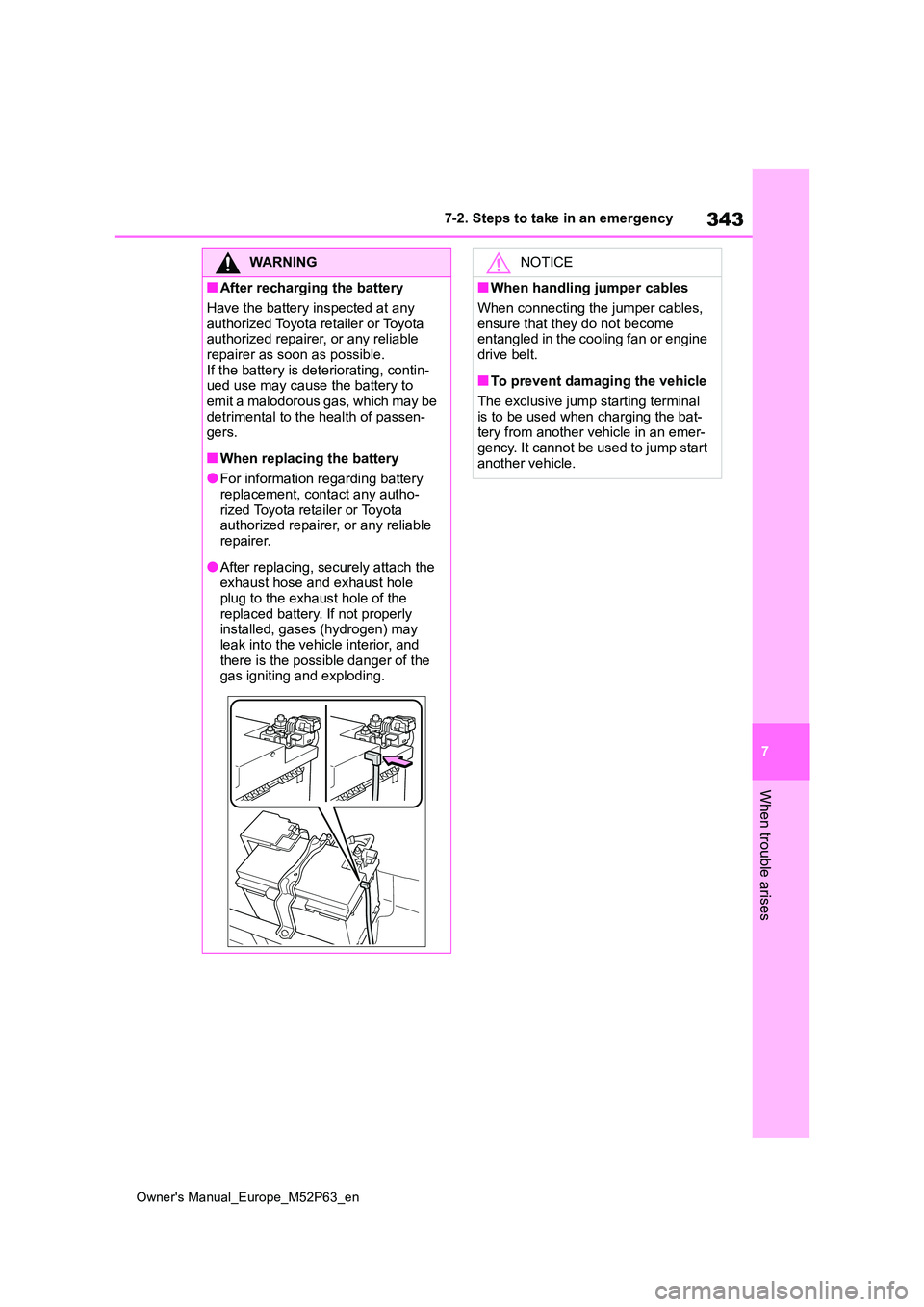
ing and confirm that it is firmly con- nected to the hole section of the vehicle.
• Use the exhaust hole plug included with the battery replaced or the one installed on the battery prior to the
replacement. (Depending on the bat- tery to be replaced, the exhaust hole
Page 345 of 470
343
7
Owner's Manual_Europe_M52P63_en
7-2. Steps to take in an emergency
When trouble arises
WARNING
■After recharging the battery
Have the battery inspected at any
authorized Toyota retailer or Toyota authorized repairer, or any reliable repairer as soon as possible.
If the battery is deteriorating, contin- ued use may cause the battery to emit a malodorous gas, which may be
detrimental to the health of passen- gers.
■When replacing the battery
●For information regarding battery replacement, contact any autho-
rized Toyota retailer or Toyota authorized repairer, or any reliable repairer.
●After replacing, securely attach the exhaust hose and exhaust hole
plug to the exhaust hole of the replaced battery. If not properly installed, gases (hydrogen) may
leak into the vehicle interior, and there is the possible danger of the gas igniting and exploding.
NOTICE
■When handling jumper cables
When connecting the jumper cables,
ensure that they do not become entangled in the cooling fan or engine drive belt.
■To prevent damaging the vehicle
The exclusive jump starting terminal
is to be used when charging the bat- tery from another vehicle in an emer-gency. It cannot be used to jump start
another vehicle.
Page 346 of 470
344
Owner's Manual_Europe_M52P63_en
7-2. Steps to take in an emergency
1Stop the vehicle in a safe place
and turn off the air conditioning
system, and then stop the
engine.
2 If you see steam: Carefully lift
the hood after the steam sub-
sides.
If you do not see steam: Care-
fully lift the hood.
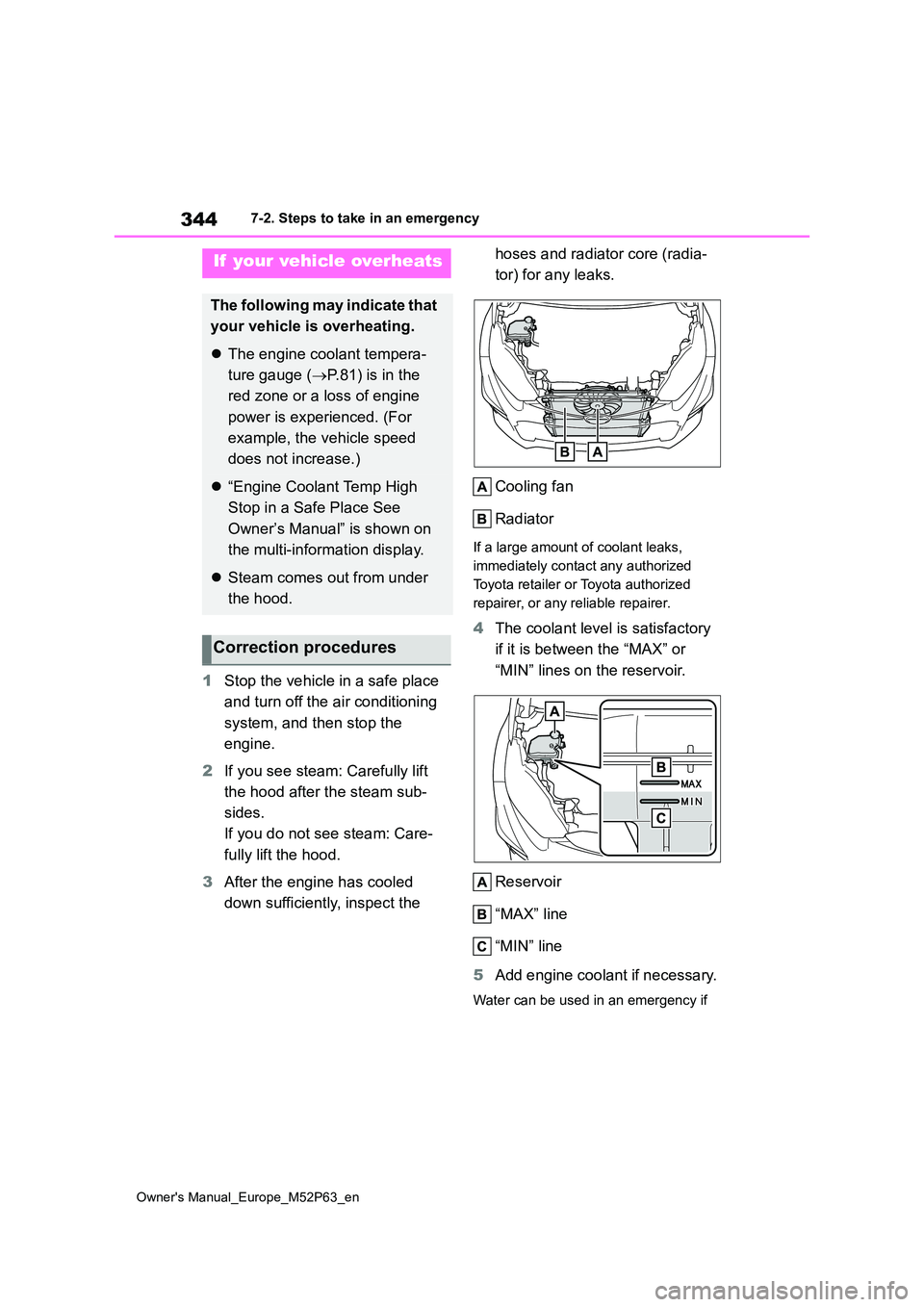
3 After the engine has cooled
down sufficiently, inspect the
hoses and radiator core (radia-
tor) for any leaks.
Cooling fan
Radiator
If a large amount of coolant leaks,
immediately contact any authorized
Toyota retailer or Toyota authorized
repairer, or any reliable repairer.
4 The coolant level is satisfactory
if it is between the “MAX” or
“MIN” lines on the reservoir.
Reservoir
“MAX” line
“MIN” line
5 Add engine coolant if necessary.
Water can be used in an emergency if
If your vehicle overheats
The following may indicate that
your vehicle is overheating.
The engine coolant tempera-
ture gauge ( P.81) is in the
red zone or a loss of engine
power is experienced. (For
example, the vehicle speed
does not increase.)
“Engine Coolant Temp High
Stop in a Safe Place See
Owner’s Manual” is shown on
the multi-information display.
Steam comes out from under
the hood.
Correction procedures