ECU TOYOTA GR YARIS 2023 User Guide
[x] Cancel search | Manufacturer: TOYOTA, Model Year: 2023, Model line: GR YARIS, Model: TOYOTA GR YARIS 2023Pages: 470, PDF Size: 113.17 MB
Page 43 of 470
41
1
Owner's Manual_Europe_M52P63_en
1-1. For safe use
For safety and security
WARNING
●If the areas where the SRS airbags are stored, such as the steering
wheel pad and front and rear pillar garnishes, are damaged or cracked, have them replaced by
any authorized Toyota dealer or repairer, or another duly qualified and equipped professional.
■Modification and disposal of SRS airbag system components
Do not dispose of your vehicle or per- form any of the following modifica-tions without consulting your Toyota
retailer or Toyota authorized repairer, or any reliable repairer. The SRS air-bags may malfunction or deploy
(inflate) accidentally, causing death or serious injury.
●Installation, removal, disassembly and repair of the SRS airbags
●Repairs, modifications, removal or replacement of the steering wheel, instrument panel, dashboard, seats
or seat upholstery, front, side and rear pillars, roof side rails, side door panels, side door trims or side door
speakers
●Modifications to the side door panel
(such as making a hole in it)
●Repairs or modifications of the front
fender, front bumper, or side of the occupant compartment
●Installation of a grille guard (bull bars, kangaroo bar, etc.), snow plows or winches
●Modifications to the vehicle’s sus-pension system
●Installation of electronic devices such as mobile two-way radios (RF-
transmitter) and CD players
Exhaust gas precautions
Harmful substance to the
human body is included in
exhaust gases if inhaled.
WARNING
Exhaust gases include harmful car-
bon monoxide (CO), which is color- less and odorless. Observe the following precautions.
Failure to do so may cause exhaust gases enter the vehicle and may lead to an accident caused by light-
headedness, or may lead to death or a serious health hazard.
■Important points while driving
●Keep the back door closed.
●If you smell exhaust gases in the vehicle even when the back door is closed, open the windows and have
the vehicle inspected at any autho- rized Toyota retailer or Toyota authorized repairer, or any reliable
repairer as soon as possible.
■When parking
●If the vehicle is in a poorly venti- lated area or a closed area, such as a garage, stop the engine.
●Do not leave the vehicle with the engine on for a long time.
If such a situation cannot be avoided, park the vehicle in an open space and ensure that
exhaust fumes do not enter the vehicle interior.
●Do not leave the engine running in an area with snow build-up, or where it is snowing. If snowbanks
build up around the vehicle while the engine is running, exhaust gases may collect and enter the
vehicle.
Page 45 of 470
43
1
Owner's Manual_Europe_M52P63_en
1-2. Child safety
For safety and security
1-2.Child sa fety
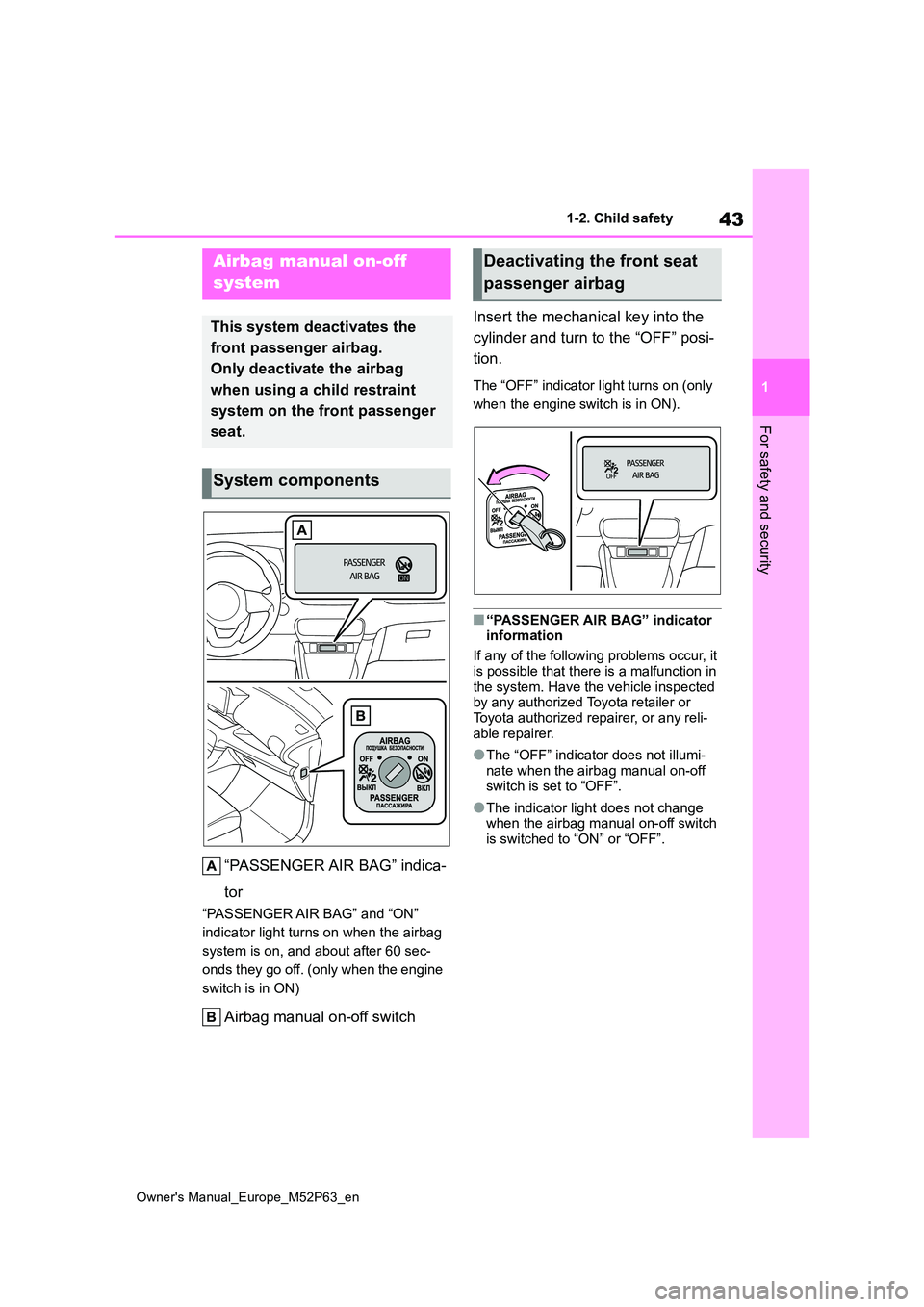
“PASSENGER AIR BAG” indica-
tor
“PASSENGER AIR BAG” and “ON”
indicator light turns on when the airbag
system is on, and about after 60 sec-
onds they go off. (only when the engine
switch is in ON)
Airbag manual on-off switch
Insert the mechanical key into the
cylinder and turn to the “OFF” posi-
tion.
The “OFF” indicator light turns on (only
when the engine switch is in ON).
■“PASSENGER AIR BAG” indicator information
If any of the following problems occur, it
is possible that there is a malfunction in the system. Have the vehicle inspected by any authorized Toyota retailer or
Toyota authorized repairer, or any reli- able repairer.
●The “OFF” indicator does not illumi-nate when the airbag manual on-off switch is set to “OFF”.
●The indicator light does not change when the airbag manual on-off switch
is switched to “ON” or “OFF”.
Airbag manual on-off
system
This system deactivates the
front passenger airbag.
Only deactivate the airbag
when using a child restraint
system on the front passenger
seat.
System components
Deactivating the front seat
passenger airbag
Page 47 of 470
45
1
Owner's Manual_Europe_M52P63_en
1-2. Child safety
For safety and security
Points to remember: P.45
When using a child restraint sys-
tem: P.46
Child restraint system compatibility
for each seating position: P.49
Child restraint system installation
method: P.54
• Fixed with a seat belt: P.55
• Fixed with an ISOFIX lower
anchorage: P.57
• Using a top tether anchorage:
P. 5 8
Prioritize and observe the warn-
ings, as well as the laws and reg-
ulations for child restraint
systems.
Use a child restraint system until
the child becomes large enough
to properly wear the vehicle’s
seat belt.
Choose a child restraint system
appropriate to the age and size
of the child.
Note that not all child restraint
systems can fit in all vehicles.
Before using or purchasing a
child restraint system, check the
compatibility of the child restraint
system with seat positions.
( P. 4 9 )
Child restraint systems
Before installing a child
restraint system in the vehicle,
there are precautions that need
to be observed, different types
of child restra int systems, as
well as installation methods,
etc., written in this manual.
Use a child restraint system
when riding with a small child
that cannot properly use a seat
belt. For the child’s safety,
install the child restraint sys-
tem to a rear seat. Be sure to
follow the installation method
that is in the operation manual
enclosed with the restraint sys-
tem.
The use of a Toyota genuine
child restraint system is rec-
ommended, as it is safer to
use in this vehicle. Toyota gen-
uine child restraint systems
are made specifically for
Toyota vehicles. They can be
purchased at a Toyota dealer.
Table of contents
Points to remember
WARNING
■When a child is riding
Observe the following precautions. Failure to do so may result in death or
serious injury.
Page 48 of 470
46
Owner's Manual_Europe_M52P63_en
1-2. Child safety
■When installing a child
restraint system to a front pas-
senger seat
For the safety of a child, install a
child restraint system to a rear seat.
When installing a child restraint
system to a front passenger seat is
unavoidable, adjust the seat as fol-
lows and install the child restraint
system:
Move the front seat fully rear-
ward.
Adjust the seatback angle to the
most upright position.
When installing a forward-facing child
seat, if there is a gap between the child
seat and the seatback, adjust the
seatback angle until good contact is
WARNING
●For effective protection in automo- bile accidents and sudden stops, a
child must be properly restrained, using a seat belt or child restraint system which is correctly installed.
For installation details, refer to the operation manual enclosed with the child restraint system. General
installation instruction is provided in this manual.
●Toyota strongly urges the use of a proper child restraint system that conforms to the weight and size of
the child, installed on the rear seat. According to accident statistics, the child is safer when properly
restrained in the rear seat than in the front seat.
●Holding a child in your or someone else’s arms is not a substitute for a child restraint system. In an acci-
dent, the child can be crushed against the windshield or between the holder and the interior of the
vehicle.
■Handling the child restraint sys-
tem
If the child restraint system is not properly fixed in place, the child or
other passengers may be seriously injured or even killed in the event of sudden braking, sudden swerving, or
an accident.
●If the vehicle were to receive a
strong impact from an accident, etc., it is possible that the child restraint system has damage that is
not readily visible. In such cases, do not reuse the restraint system.
●Depending on the child restraint system, installation may be difficult or impossible. In those cases,
check whether the child restraint system is suitable for installment in the vehicle. ( P.49) Be sure to
install and observe the usage rules after carefully reading the child restraint system fixing method in
this manual, as well as the opera- tion manual enclosed with the child restraint system.
●Keep the child restraint system properly secured on the seat even if
it is not in use. Do not store the child restraint system unsecured in the passenger compartment.
●If it is necessary to detach the child restraint system, remove it from the
vehicle or store it securely in the luggage compartment.
When using a child restraint
system
Page 49 of 470
47
1
Owner's Manual_Europe_M52P63_en
1-2. Child safety
For safety and security
achieved.
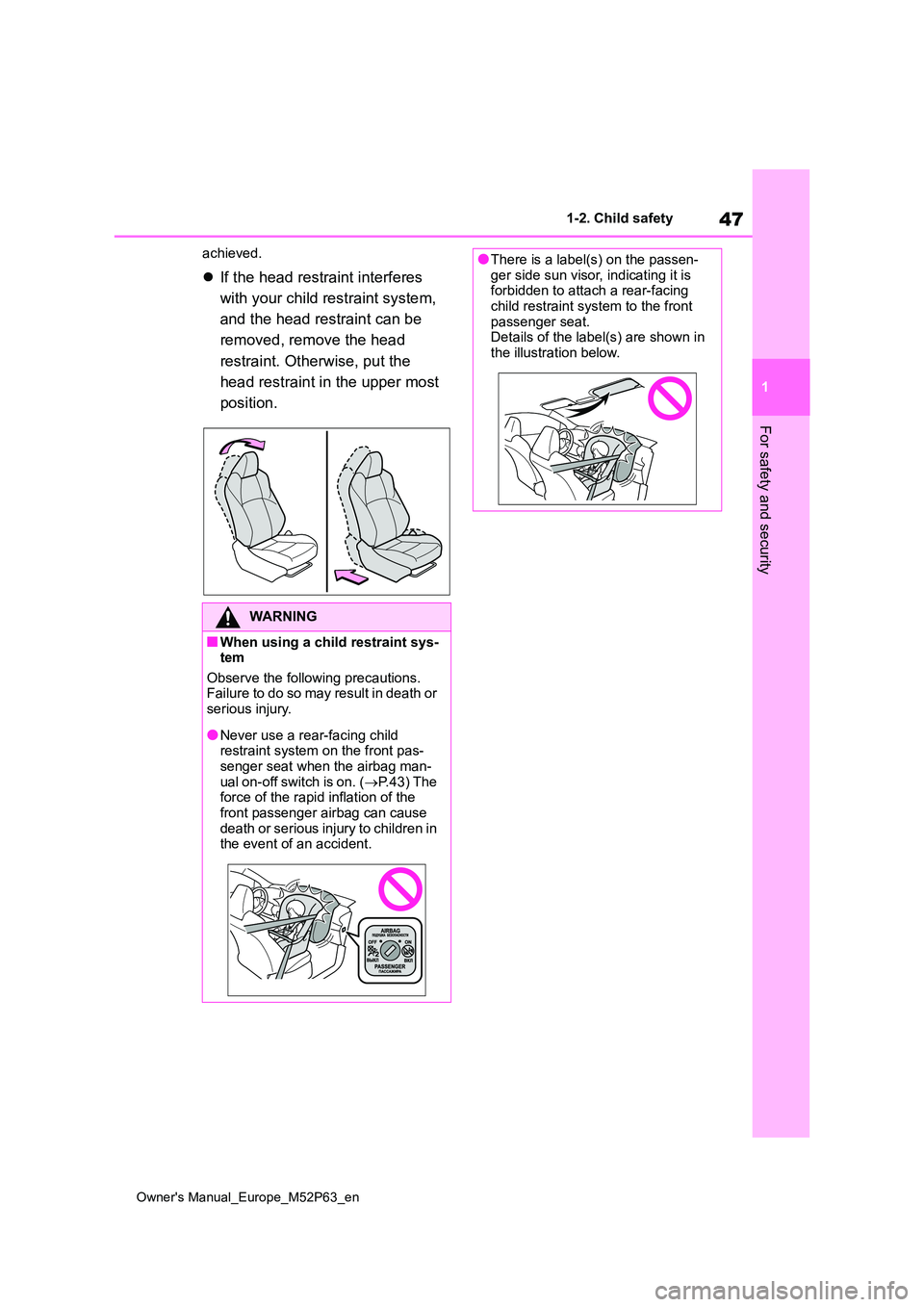
If the head restraint interferes
with your child restraint system,
and the head restraint can be
removed, remove the head
restraint. Otherwise, put the
head restraint in the upper most
position.
WARNING
■When using a child restraint sys- tem
Observe the following precautions. Failure to do so may result in death or serious injury.
●Never use a rear-facing child restraint system on the front pas-
senger seat when the airbag man- ual on-off switch is on. ( P.43) The force of the rapid inflation of the
front passenger airbag can cause death or serious injury to children in the event of an accident.
●There is a label(s) on the passen-ger side sun visor, indicating it is forbidden to attach a rear-facing
child restraint system to the front passenger seat.Details of the label(s) are shown in
the illustration below.
Page 51 of 470
49
1
Owner's Manual_Europe_M52P63_en
1-2. Child safety
For safety and security
■Child restraint system compat-
ibility for each seating posi-
tion
Compatibility of each seating posi-
tion with child restraint systems
( P.50) displays the type of child
restraint systems that can be used
and possible seating positions for
installation using symbols.
Also, the recommended child
restraint system that is suitable for
your child can be selected.
Otherwise, check [Recommended
child restraint systems information]
for recommended child restraint
systems. ( P. 5 4 )
Check the selected child restraint
system together with the following
[Before confirming the compatibility
of each seating position with child
restraint systems].
■Before confirming the compat-
ibility of each seating position
with child restraint systems
1 Checking the child restraint sys-
tem standards.
Use a child restraint system that
conforms to UN (ECE) R44*1.
The following approval mark is
displayed on child restraint sys-
tems which are conformed.
Check for an approval mark
attached to the child restraint
system.
Example of the displayed regulation
number
UN (ECE) R44 approval mark*2
The weight range of the child who is applicable for an UN (ECE) R44
approval mark is indicated.
2 Checking the category of the
child restraint system.
WARNING
●Use child restraint system suitable to the age and size of the child and
install it to the rear seat.
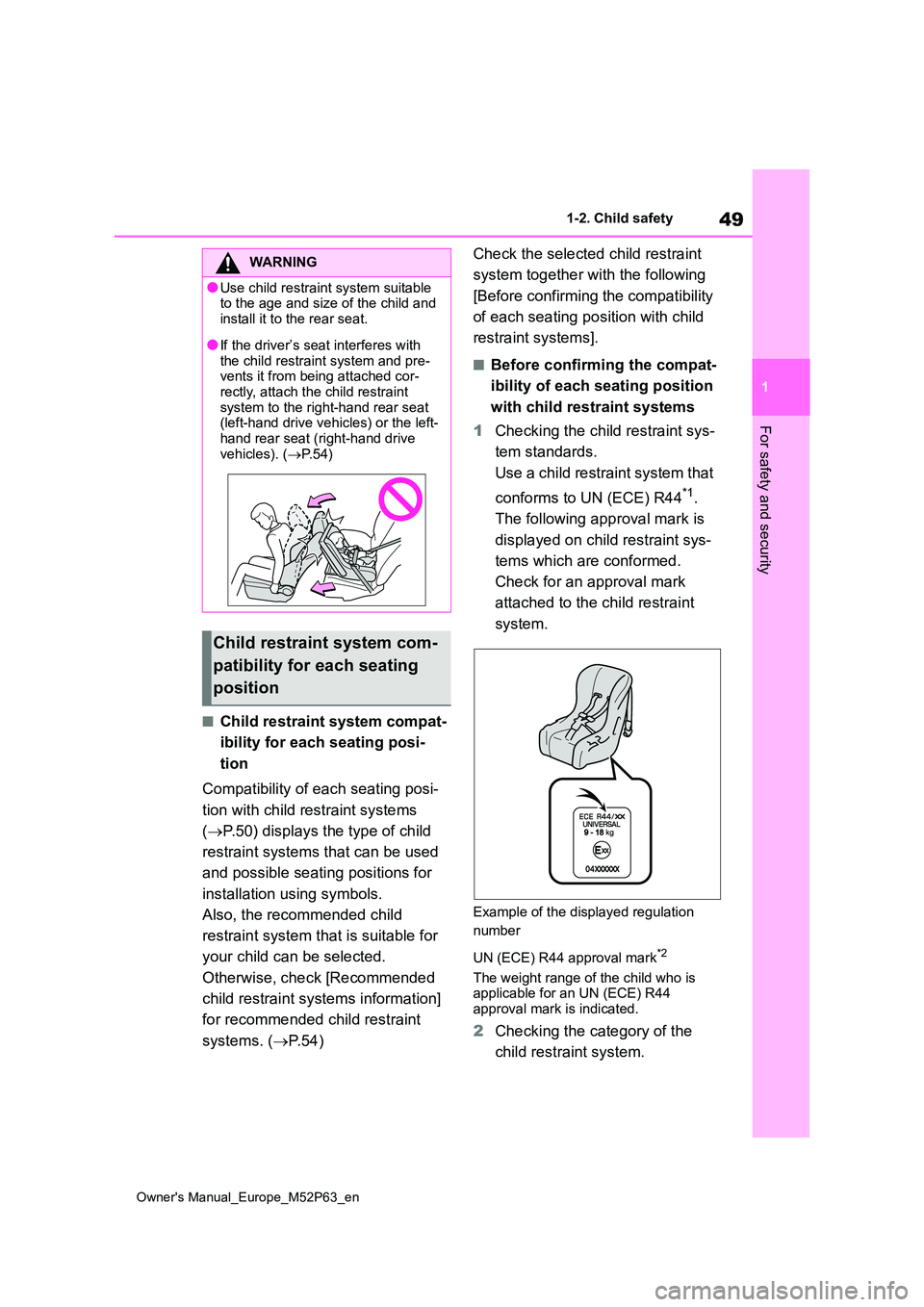
●If the driver’s seat interferes with
the child restraint system and pre- vents it from being attached cor-rectly, attach the child restraint
system to the right-hand rear seat (left-hand drive vehicles) or the left-hand rear seat (right-hand drive
vehicles). ( P. 5 4 )
Child restraint system com-
patibility for each seating
position
Page 53 of 470
51
1
Owner's Manual_Europe_M52P63_en
1-2. Child safety
For safety and security
*1: Move the front seat fully rearward. If
the passenger seat height can be
adjusted, move it to the upper most
position.
*2: Adjust the seatback angle to the
most upright position. When install-
ing a forward-facing child seat, if
there is a gap between the child seat
and the seatback, adjust the
seatback angle until good contact is
achieved.
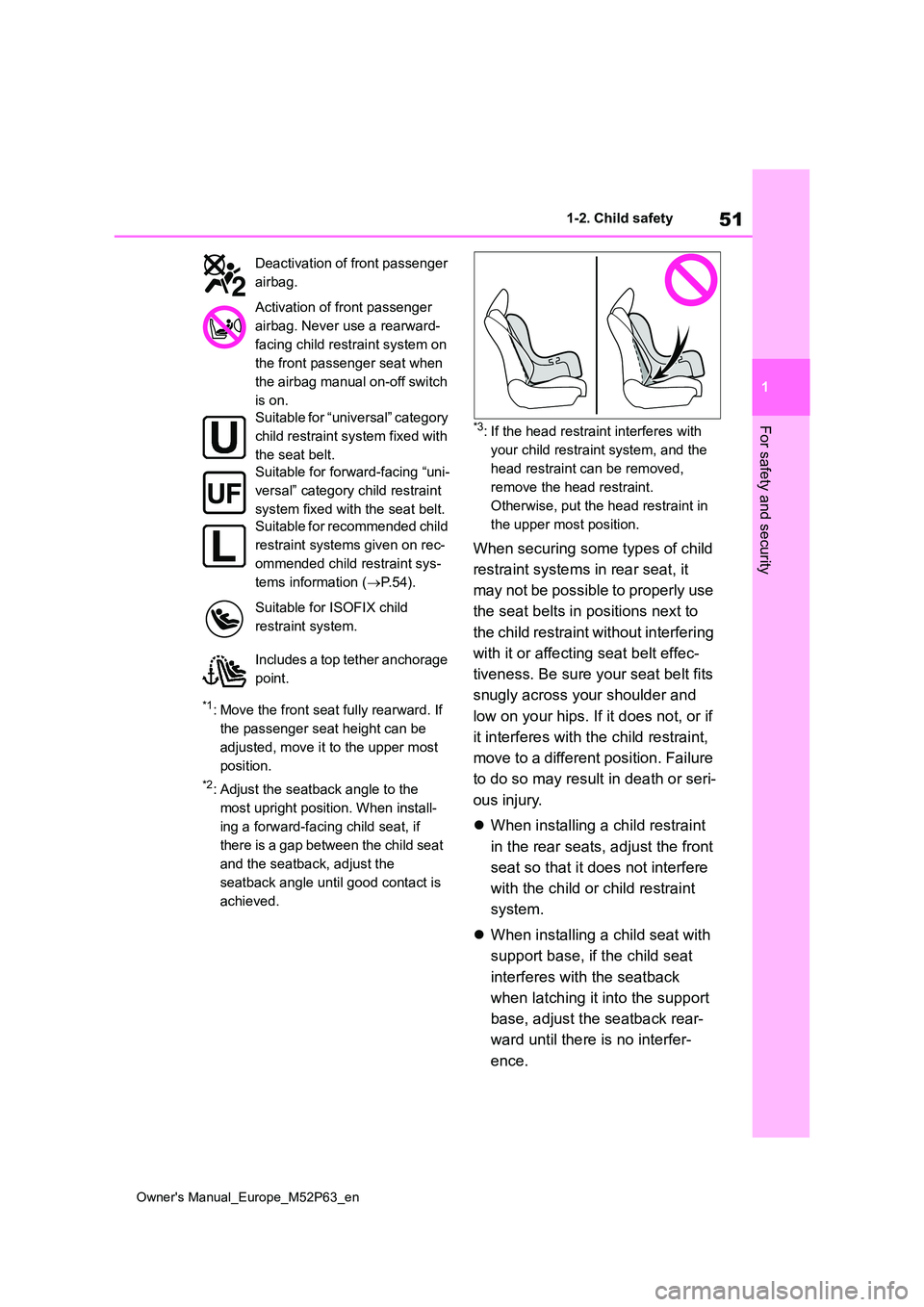
*3: If the head restraint interferes with
your child restraint system, and the
head restraint can be removed,
remove the head restraint.
Otherwise, put the head restraint in
the upper most position.
When securing some types of child
restraint systems in rear seat, it
may not be possible to properly use
the seat belts in positions next to
the child restraint without interfering
with it or affecting seat belt effec-
tiveness. Be sure your seat belt fits
snugly across your shoulder and
low on your hips. If it does not, or if
it interferes with the child restraint,
move to a different position. Failure
to do so may result in death or seri-
ous injury.
When installing a child restraint
in the rear seats, adjust the front
seat so that it does not interfere
with the child or child restraint
system.
When installing a child seat with
support base, if the child seat
interferes with the seatback
when latching it into the support
base, adjust the seatback rear-
ward until there is no interfer-
ence.
Deactivation of front passenger
airbag.
Activation of front passenger
airbag. Never use a rearward-
facing child restraint system on
the front passenger seat when
the airbag manual on-off switch
is on.
Suitable for “universal” category
child restraint system fixed with
the seat belt.
Suitable for forward-facing “uni-
versal” category child restraint
system fixed with the seat belt.
Suitable for recommended child
restraint systems given on rec-
ommended child restraint sys-
tems information ( P. 5 4 ) .
Suitable for ISOFIX child
restraint system.
Includes a top tether anchorage
point.
Page 55 of 470
53
1
Owner's Manual_Europe_M52P63_en
1-2. Child safety
For safety and security
Toyota suggests the users to use and seating positions.
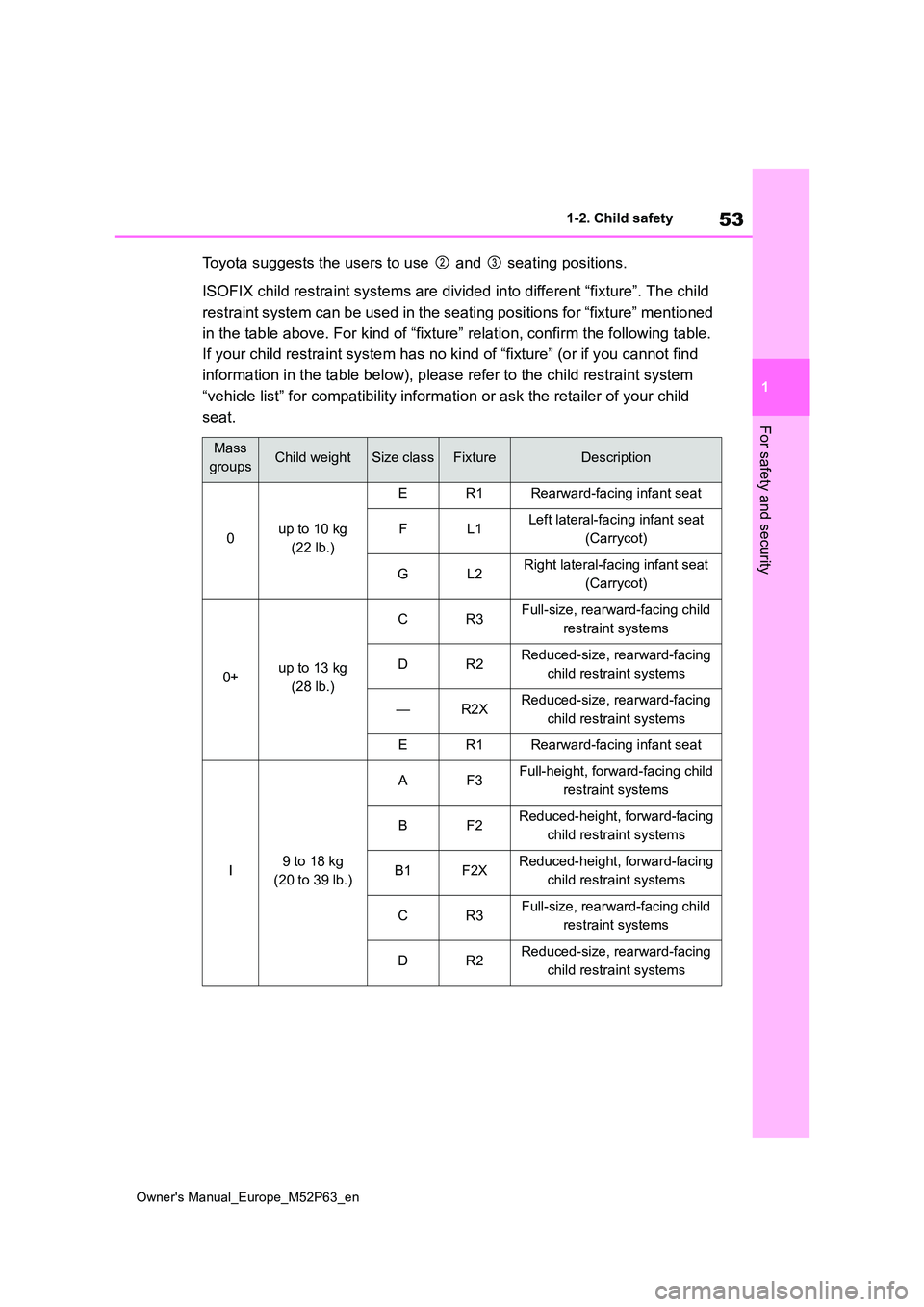
ISOFIX child restraint systems are divided into different “fixt ure”. The child
restraint system can be used in the seating positions for “fixt ure” mentioned
in the table above. For kind of “ fixture” relation, confirm the following table.
If your child restraint system ha s no kind of “fixture” (or if you cannot find
information in the table below), please refer to the child rest raint system
“vehicle list” for compatibility information or ask the retaile r of your child
seat.
Mass
groupsChild weightSize classFixtureDescription
0up to 10 kg
(22 lb.)
ER1Rearward-facing infant seat
FL1Left lateral-facing infant seat
(Carrycot)
GL2Right lateral-facing infant seat
(Carrycot)
0+up to 13 kg
(28 lb.)
CR3Full-size, rearward-facing child
restraint systems
DR2Reduced-size, rearward-facing
child restraint systems
—R2XReduced-size, rearward-facing
child restraint systems
ER1Rearward-facing infant seat
I9 to 18 kg
(20 to 39 lb.)
AF3Full-height, forward-facing child
restraint systems
BF2Reduced-height, forward-facing
child restraint systems
B1F2XReduced-height, forward-facing
child restraint systems
CR3Full-size, rearward-facing child
restraint systems
DR2Reduced-size, rearward-facing
child restraint systems
Page 57 of 470
55
1
Owner's Manual_Europe_M52P63_en
1-2. Child safety
For safety and security
■Installing child restraint sys-
tem using a seat belt
Install the child restraint system in
accordance to the operation man-
ual enclosed with the child restraint
system.
If the child restraint system on hand
is not within the “universal” cate-
gory (or the necessary information
is not in the table), refer to the
“Vehicle List” provided by the child
restraint system maker for various
possible installation positions, or
check the compatibility after asking
the retailer of the child seat.
( P.49, 50)
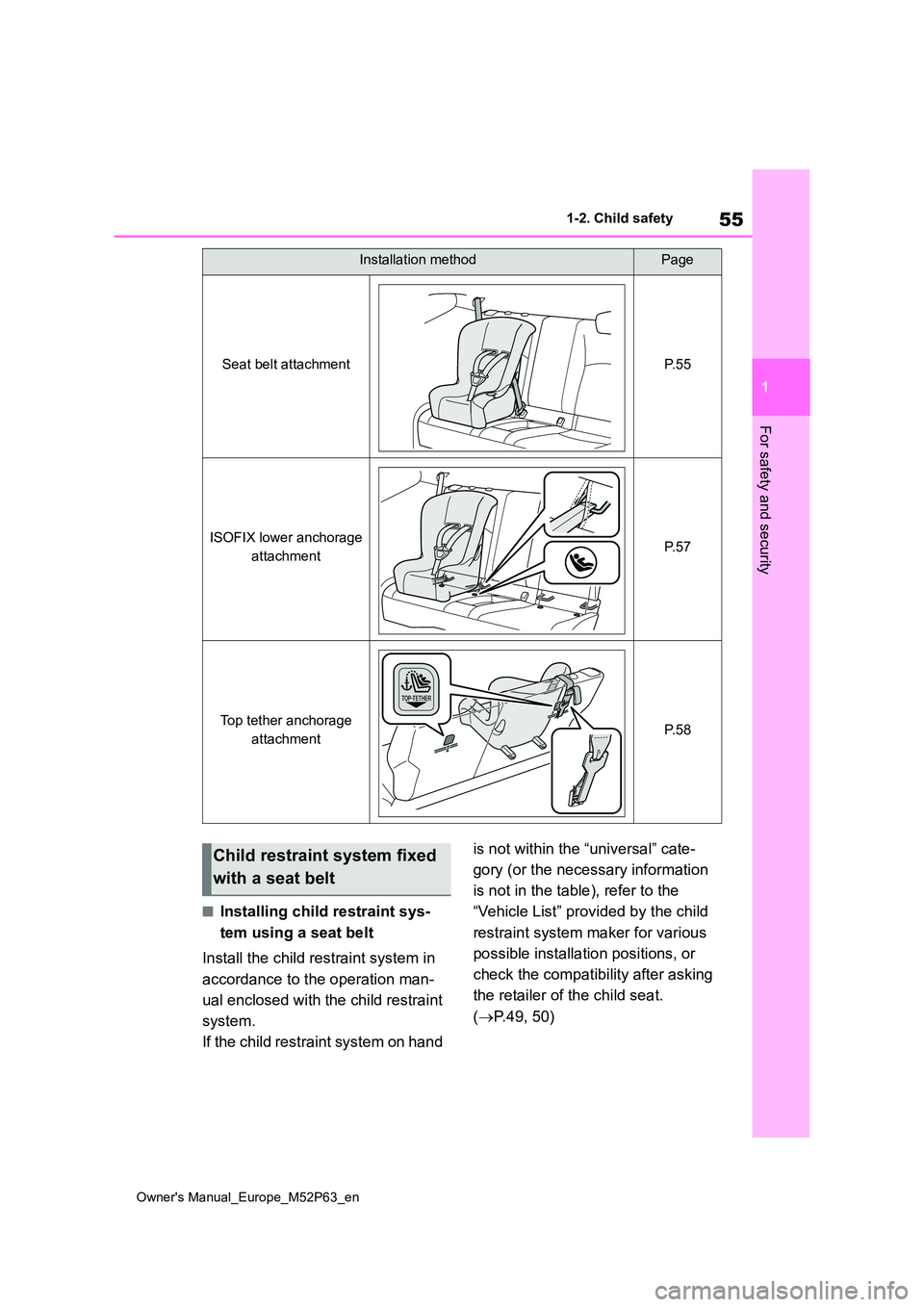
Installation methodPage
Seat belt attachmentP. 5 5
ISOFIX lower anchorage
attachmentP. 5 7
Top tether anchorage
attachmentP. 5 8
Child restraint system fixed
with a seat belt
Page 58 of 470
56
Owner's Manual_Europe_M52P63_en
1-2. Child safety
1If installing the child restraint
system to the front passenger
seat is unavoidable, refer to
P.46 for the front passenger seat
adjustment.
2 If the head restraint interferes
with your child restraint system,
and the head restraint can be
removed, remove the head
restraint. Otherwise, put the
head restraint in the upper most
position. ( P. 1 1 6 )
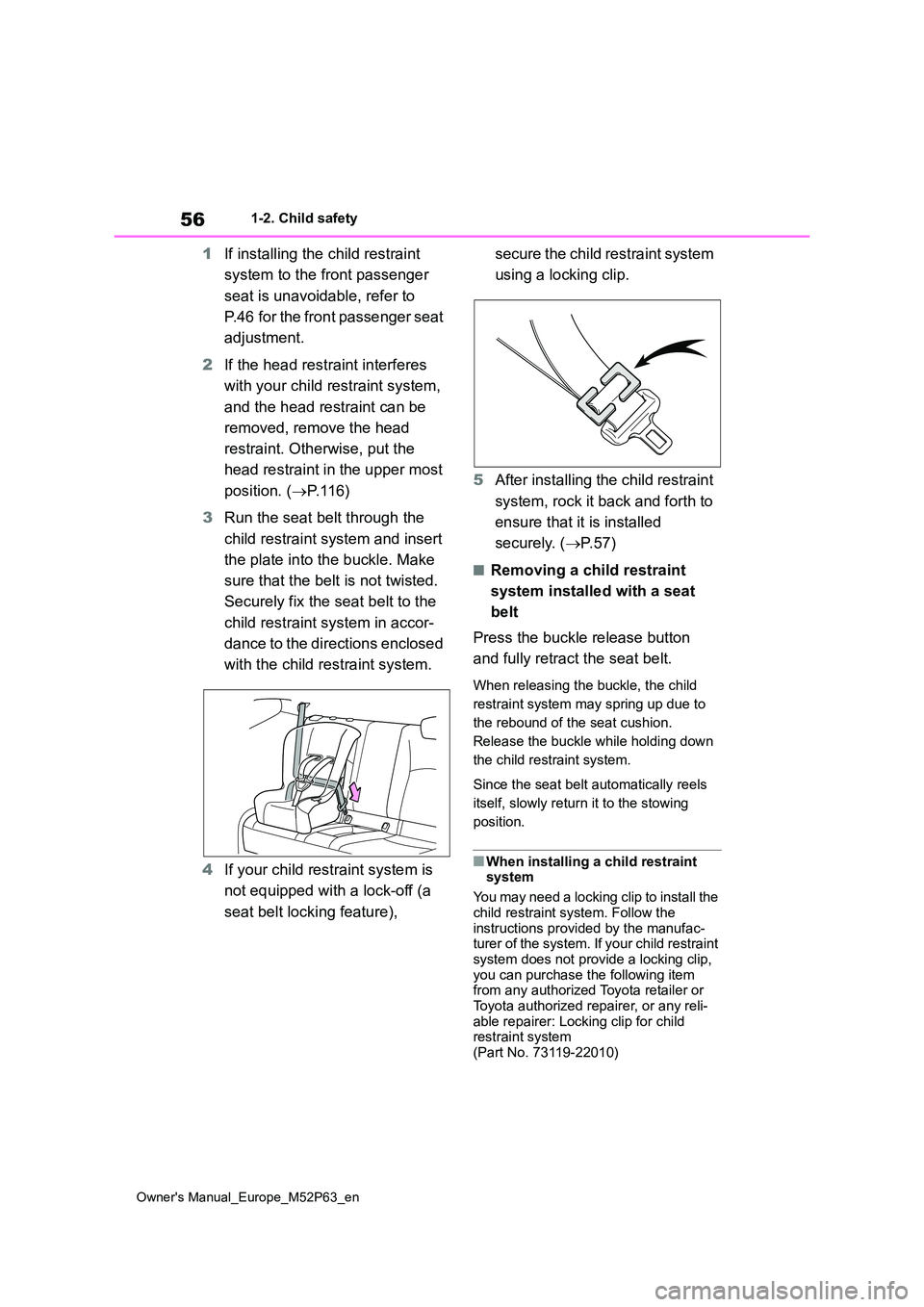
3 Run the seat belt through the
child restraint system and insert
the plate into the buckle. Make
sure that the belt is not twisted.
Securely fix the seat belt to the
child restraint system in accor-
dance to the directions enclosed
with the child restraint system.
4 If your child restraint system is
not equipped with a lock-off (a
seat belt locking feature),
s e c u r e t h e c h i l d r e s t r a i n t s y s t e m
using a locking clip.
5 After installing the child restraint
system, rock it back and forth to
ensure that it is installed
securely. ( P. 5 7 )
■Removing a child restraint
system installed with a seat
belt
Press the buckle release button
and fully retract the seat belt.
When releasing the buckle, the child
restraint system may spring up due to
the rebound of the seat cushion.
Release the buckle while holding down
the child restraint system.
Since the seat belt automatically reels
itself, slowly return it to the stowing
position.
■When installing a child restraint system
You may need a locking clip to install the
child restraint system. Follow the instructions provided by the manufac-turer of the system. If your child restraint
system does not provide a locking clip, you can purchase the following item from any authorized Toyota retailer or
Toyota authorized repairer, or any reli- able repairer: Locking clip for child restraint system
(Part No. 73119-22010)