warning TOYOTA GR86 2022 Owners Manual (in English)
[x] Cancel search | Manufacturer: TOYOTA, Model Year: 2022, Model line: GR86, Model: TOYOTA GR86 2022Pages: 582, PDF Size: 86.38 MB
Page 344 of 582
3427-2. Steps to take in an emergency
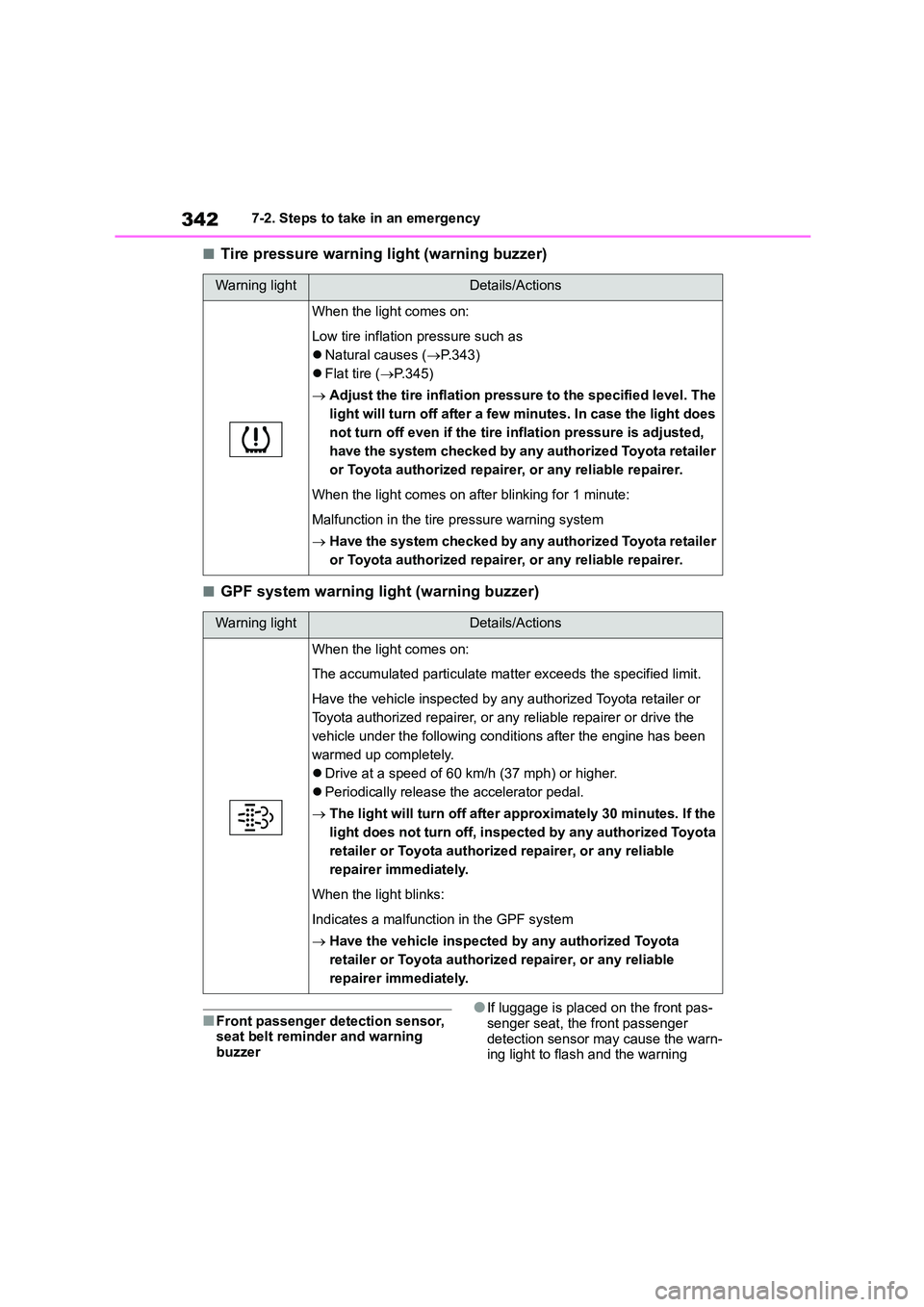
■Tire pressure warning light (warning buzzer)
■GPF system warning light (warning buzzer)
■Front passenger detection sensor,
seat belt reminder and warning buzzer
●If luggage is placed on the front pas-
senger seat, the front passenger
detection sensor may cause the warn- ing light to flash and the warning
Warning lightDetails/Actions
When the light comes on:
Low tire inflation pressure such as
Natural causes (P.343)
Flat tire (P.345)
Adjust the tire inflation pressure to the specified level. The
light will turn off after a few minutes. In case the light does
not turn off even if the tire inflation pressure is adjusted,
have the system checked by any authorized Toyota retailer
or Toyota authorized repairer, or any reliable repairer.
When the light comes on after blinking for 1 minute:
Malfunction in the tire pressure warning system
Have the system checked by any authorized Toyota retailer
or Toyota authorized repairer, or any reliable repairer.
Warning lightDetails/Actions
When the light comes on:
The accumulated particulate matter exceeds the specified limit.
Have the vehicle inspected by any authorized Toyota retailer or
Toyota authorized repairer, or any reliable repairer or drive the
vehicle under the following conditions after the engine has been
warmed up completely.
Drive at a speed of 60 km/h (37 mph) or higher.
Periodically release the accelerator pedal.
The light will turn off after approximately 30 minutes. If the
light does not turn off, inspected by any authorized Toyota
retailer or Toyota authorized repairer, or any reliable
repairer immediately.
When the light blinks:
Indicates a malfunction in the GPF system
Have the vehicle inspected by any authorized Toyota
retailer or Toyota authorized repairer, or any reliable
repairer immediately.
Page 345 of 582
343
7
7-2. Steps to take in an emergency
When trouble arises
buzzer to sound even if a passenger
is not sitting in the seat.
●If a cushion is placed on the seat, the
sensor may not detect a passenger, and the warning light may not operate
properly.
■If the malfunction indicator lamp
comes on while driving
The malfunction indicator lamp will
come on if the fuel tank becomes com-
pletely empty. If the fuel tank is empty, refuel the vehicle immediately. The mal-
function indicator lamp will go off after
several trips.
If the malfunction indicator lamp does
not go off, contact any authorized Toyota
retailer or Toyota authorized repairer, or any reliable repairer as soon as possi-
ble.
■Electric power steering system
warning light (warning buzzer)
When the battery charge becomes
insufficient or the voltage temporarily
drops, the electric power steering sys- tem warning light may come on and the
warning buzzer may sound.
■When the tire pressure warning
light comes on
Check the tire inflation pressure and
adjust to the appropriate level. Pushing
the tire pressure wa rning reset switch will not turn off the tire pressure warning
light.
■The tire pressure warning light may
come on due to natural causes
The tire pressure warning light may
come on due to natural causes such as
natural air leaks and tire inflation pres- sure changes caused by temperature. In
this case, adjusting the tire inflation
pressure will turn off the warning light
(after a few minutes).
■Conditions that the tire pressure warning system may not function
properly
P.304
■If the tire pressure warning light
frequently comes on after blinking for 1 minute
If the tire pressure warning light fre-
quently comes on after blinking for 1 minute when the engine switch is turned
to ON, have it checked by any author-
ized Toyota retailer or Toyota authorized repairer, or any reliable repairer.
■Warning buzzer
In some cases, the buzzer may not be
heard due to being in a noisy location or audio sound.
WA R N I N G
■If both the ABS and the brake
system warning lights remain on
Stop your vehicle in a safe place immediately and contact any author-
ized Toyota retailer or Toyota author-
ized repairer, or any reliable repairer. The vehicle will become extremely
unstable during br aking, and the ABS
system may fail, which could cause an accident resulting in death or seri-
ous injury.
■When the electric power steer-
ing system warning light comes
on
The steering wheel may become
extremely heavy.
When steering wheel operations are heavier than usual, grip the steering
wheel firmly and operate it using more
force than usual.
■If the tire pressure warning light
comes on
Be sure to observe the following pre-
cautions. Failure to do so could cause
a loss of vehicle control and result in death or serious injury.
●Stop your vehicle in a safe place as soon as possible. Adjust the tire
inflation pressure immediately.
Page 346 of 582
3447-2. Steps to take in an emergency
■Warning messages
The warning messages explained below
may differ from the actual messages
according to operation conditions and vehicle specifications.
■Warning buzzer
In some cases, the buzzer may not be
heard due to being in a noisy location or audio sound.
WA R N I N G
●If the tire pressure warning light
comes on even after tire inflation
pressure adjustment, it is probable that you have a flat tire. Check the
tires. If a tire is flat, repair the flat
tire by using emergency tire punc- ture repair kit.
●Avoid abrupt maneuvering and
braking. If the vehicle tires deterio- rate, you could lose control of the
steering wheel or the brakes.
■If a blowout or sudden air leak-
age should occur
The tire pressure warning system may not activate immediately.
NOTICE
■To ensure the tire pressure warn-
ing system operates properly
Do not install tires with different speci-
fications or makers, as the tire pres-
sure warning system may not operate
properly.
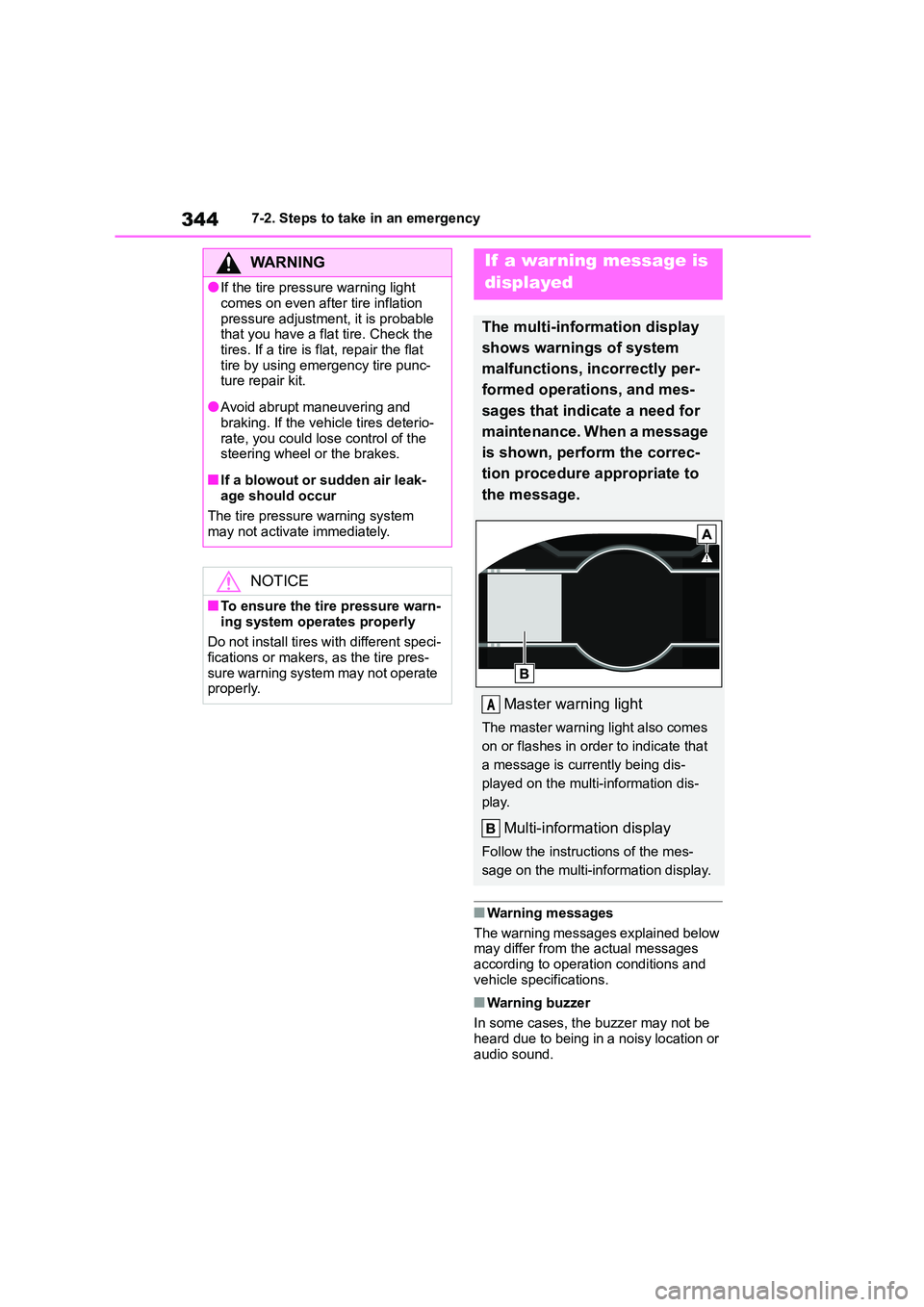
If a war ning message is
displayed
The multi-information display
shows warnings of system
malfunctions, incorrectly per-
formed operations, and mes-
sages that indicate a need for
maintenance. When a message
is shown, perform the correc-
tion procedure appropriate to
the message.
Master warning light
The master warning light also comes
on or flashes in order to indicate that
a message is currently being dis-
played on the multi-information dis-
play.
Multi-information display
Follow the instructions of the mes-
sage on the multi-information display.
A
Page 354 of 582
3527-2. Steps to take in an emergency
over in a safe place and recon-
nect the compressor.
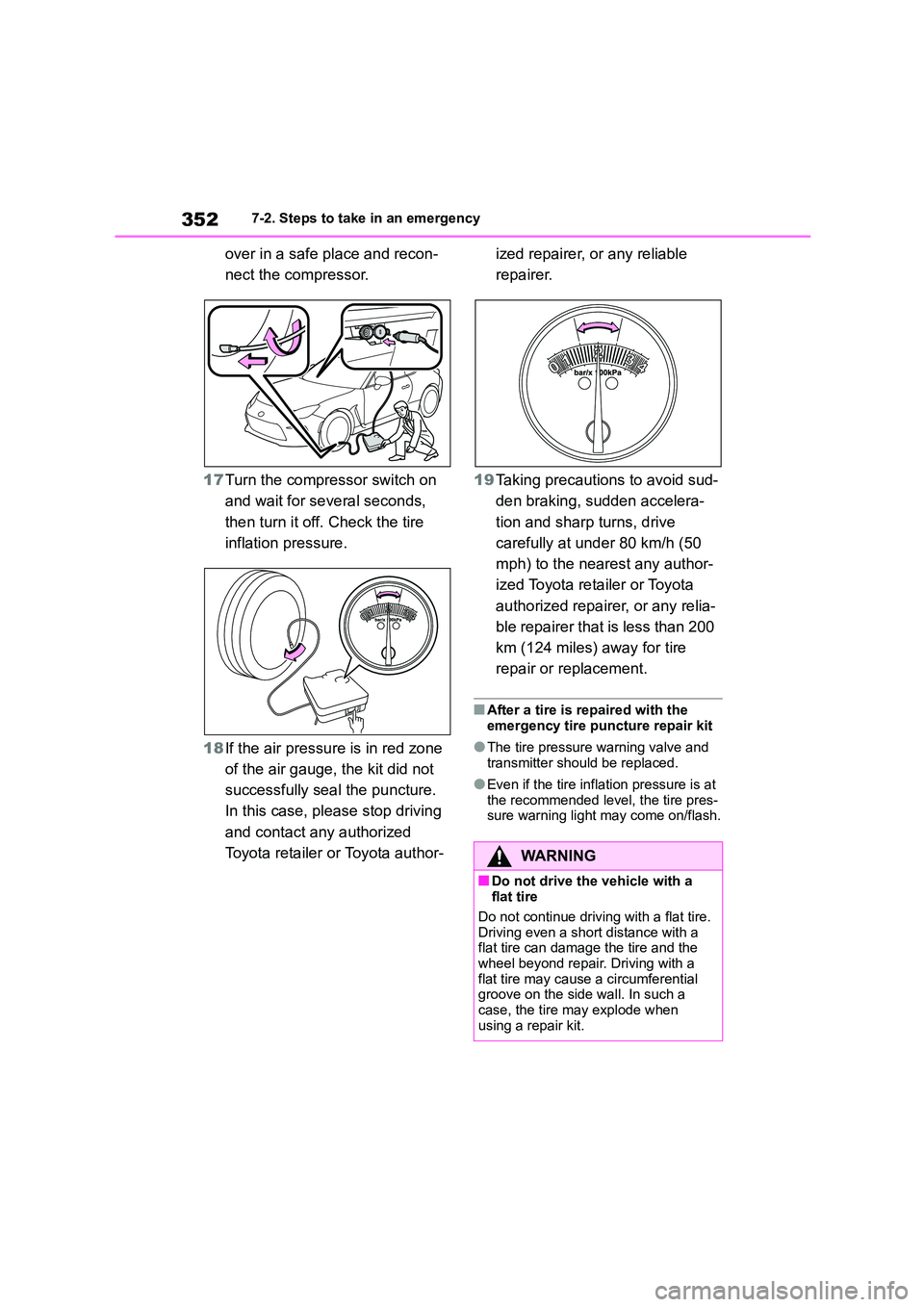
17 Turn the compressor switch on
and wait for several seconds,
then turn it off. Check the tire
inflation pressure.
18 If the air pressure is in red zone
of the air gauge, the kit did not
successfully seal the puncture.
In this case, please stop driving
and contact any authorized
Toyota retailer or Toyota author-
ized repairer, or any reliable
repairer.
19 Taking precautions to avoid sud-
den braking, sudden accelera-
tion and sharp turns, drive
carefully at under 80 km/h (50
mph) to the nearest any author-
ized Toyota reta iler or Toyota
authorized repairer, or any relia-
ble repairer that is less than 200
km (124 miles) away for tire
repair or replacement.
■After a tire is repaired with the emergency tire puncture repair kit
●The tire pressure warning valve and transmitter should be replaced.
●Even if the tire inflation pressure is at the recommended level, the tire pres-
sure warning light may come on/flash.
WA R N I N G
■Do not drive the vehicle with a
flat tire
Do not continue driving with a flat tire.
Driving even a short distance with a
flat tire can damage the tire and the wheel beyond repair. Driving with a
flat tire may cause a circumferential
groove on the side wall. In such a case, the tire may explode when
using a repair kit.
Page 355 of 582
353
7
7-2. Steps to take in an emergency
When trouble arises
WA R N I N G
■When fixing the flat tire
●Stop your vehicle in a safe and flat
area.
●Do not touch the wheels or the area
around the brakes immediately after the vehicle has been driven.
After the vehicle has been driven,
the wheels and the area around the
brakes may be extremely hot. Touching these areas with hands,
feet or other body parts may result
in burns.
●Connect the valve and hose
securely with the tire installed on the vehicle.
●If the hose is not properly con-nected to the valve, air leakage
may occur or sealant may be
sprayed out.
●If the hose comes off the valve
while inflating the tire, there is a risk that the hose will move abruptly due
to air pressure.
●After inflation of the tire has com-
pleted, the sealant may splatter
when the hose is disconnected or some air is let out of the tire.
●Follow the operation procedure to repair the tire. If the procedure is
not followed, the sealant may spray
out.
●Keep back from the tire while it is
being repaired, as there is a chance of it bursting while the repair opera-
tion is being performed. If you
notice any cracks or deformation of the tire, turn off the compressor
switch and stop the repair operation
immediately.
●The kit may overheat if operated for
a long period of time. Do not oper- ate the compressor continuously for
more than 10 minutes.
●Parts of the kit become hot during operation. Be careful handling the
kit during and after operation. Do
not touch the metal part around the connecting area between the bottle
and compressor. It will be extremely
hot.
●Do not attach the vehicle speed
warning sticker to an area other than the one indicated. If the sticker
is attached to an area where an
SRS airbag is located, such as the pad of the steering wheel, it may
prevent the SRS airbag from oper-
ating properly.
■Driving to spread the liquid seal-
ant evenly
Observe the following precautions to
reduce the risk of accidents.
Failing to do so may result in a loss of vehicle control and cause death or
serious injury.
●Drive the vehicle carefully at a low
speed. Be especially careful when
turning and cornering.
●If the vehicle does not drive straight
or you feel a pull through the steer- ing wheel, stop the vehicle and
check the tire. The tire may have
separated from the wheel.
NOTICE
■When performing an emergency repair
●Perform the emergency repair with-
out removing the nail or screw that has punctured the tread of the tire.
If the object that has punctured the
tire is removed, repair by the emer- gency tire puncture repair kit may
not be possible.
●The kit is not waterproof. Make sure
that the kit is not exposed to water,
such as when it is being used in the rain.
Page 356 of 582
3547-2. Steps to take in an emergency
NOTICE
●Do not put the kit directly onto dusty
ground such as sand at the side of
the road. If the kit vacuums up dust etc., a malfunction may occur.
●Make sure to stand the kit with the bottle vertical. The kit cannot work
properly if it is laid on its side.
■Handling the emergency tire puncture repair kit
●The compressor power source
should be 12 V DC suitable for vehicle use. Do not connect the
compressor to any other source.
●If gasoline splatters on the kit, the
kit may deteriorate. Take care not to
allow gasoline to contact it.
●Store the emergency tire puncture
repair kit in the trunk. The kit may be thrown around during sudden
braking and so forth, damaging the
kit.
Place the repair kit in a storage to pre-
vent it from being exposed to dirt or
water.
●Store the kit in its assigned place
out of reach of children.
●Do not disassemble or modify the
kit. Do not subject parts such as the air pressure indica tor to impacts.
This may cause a malfunction.
■To avoid damage to the tire pres- sure warning valves and trans-
mitters
When a tire is repaired with liquid sealants, the tire pressure warning
valve and transmitter may not operate
properly. If a liquid sealant is used, contact any authorized Toyota retailer
or Toyota authorized repairer, or any
reliable repairer or other qualified ser- vice shop as soon as possible. After
use of liquid sealant, make sure to
replace the tire pressure warning valve and transmitter when repairing
or replacing the tire. (P.304)
Page 380 of 582
3788-2. Customization
authorized repairer, or any reliable repairer
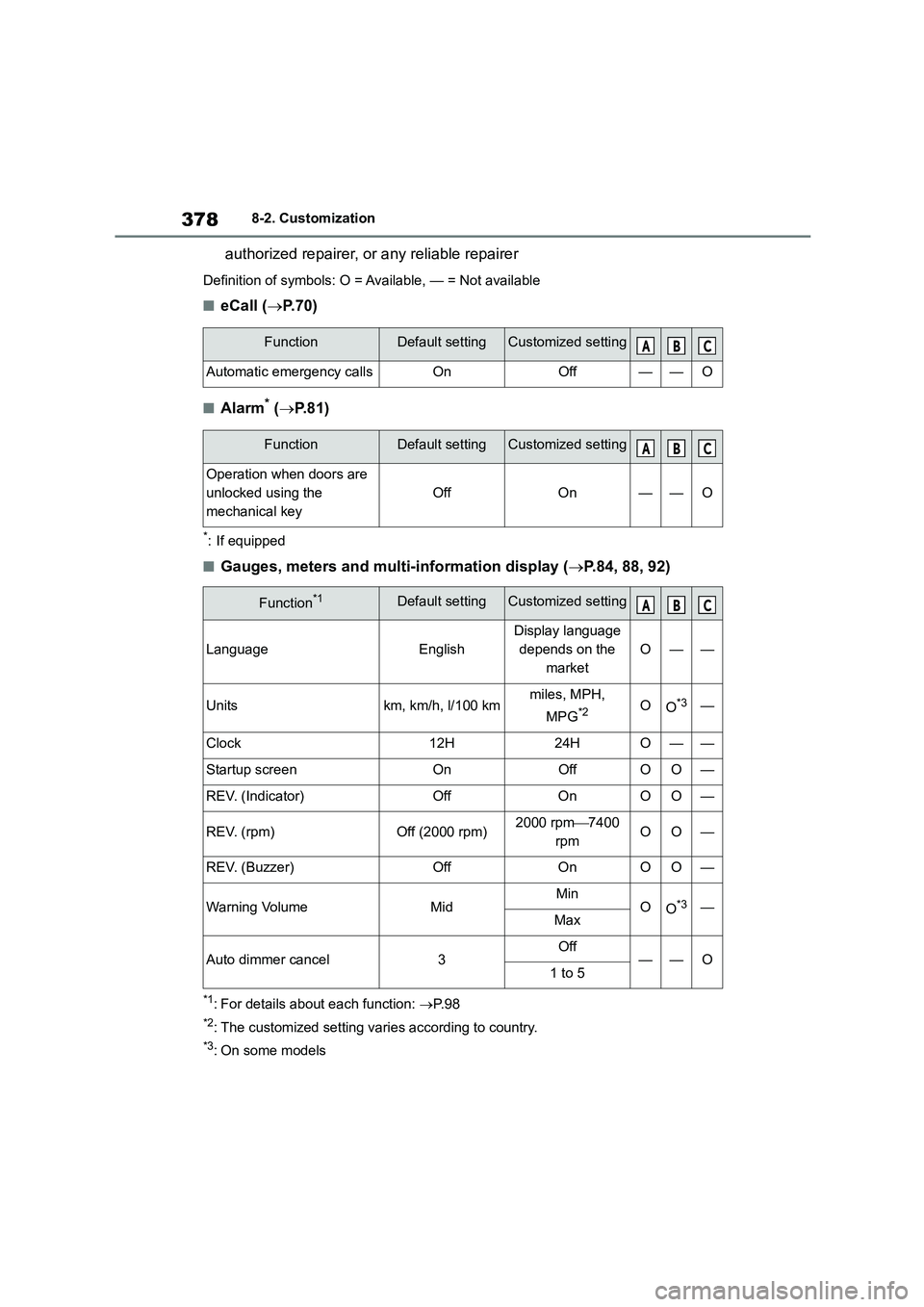
Definition of symbols: O = Available, — = Not available
■eCall (P. 7 0 )
■Alarm* (P.81)
*: If equipped
■Gauges, meters and multi-information display (P.84, 88, 92)
*1: For details about each function: P. 9 8
*2: The customized setting varies according to country.
*3: On some models
FunctionDefault settingCustomized setting
Automatic emergency callsOnOff——O
ABC
FunctionDefault settingCustomized setting
Operation when doors are
unlocked using the
mechanical key
OffOn——O
Function*1Default settingCustomized setting
LanguageEnglish
Display language
depends on the
market
O——
Unitskm, km/h, l/100 kmmiles, MPH,
MPG*2OO*3—
Clock12H24HO——
Startup screenOnOffOO—
REV. (Indicator)OffOnOO—
REV. (rpm)Off (2000 rpm)2000 rpm 7400
rpmOO—
REV. (Buzzer)OffOnOO—
Warning VolumeMidMinOO*3—Max
Auto dimmer cancel3Off——O1 to 5
ABC
ABC
Page 381 of 582
379
8
8-2. Customization
Vehicle specifications
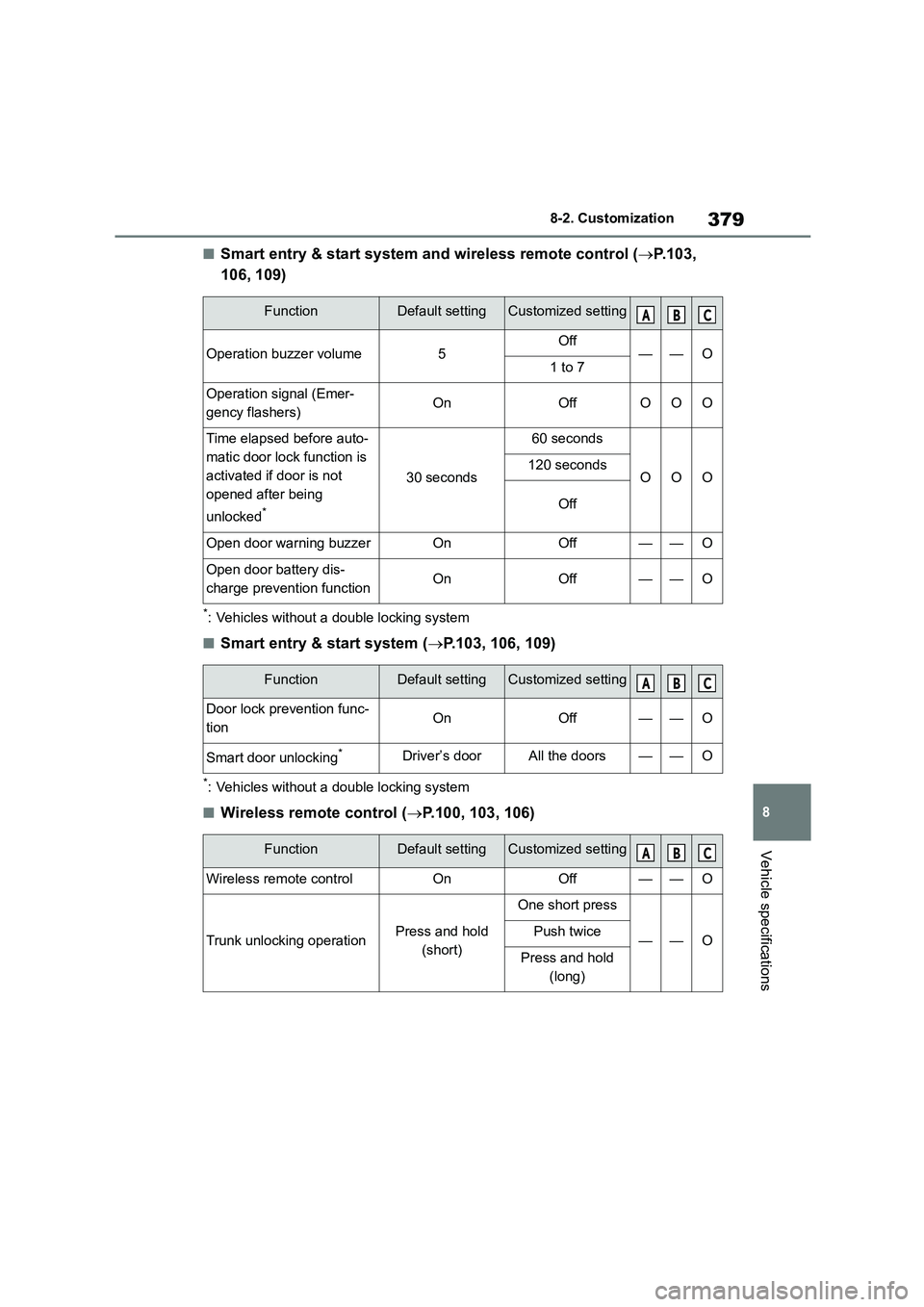
■Smart entry & start system and wireless remote control ( P.103,
106, 109)
*: Vehicles without a double locking system
■Smart entry & start system (P.103, 106, 109)
*: Vehicles without a double locking system
■Wireless remote control (P.100, 103, 106)
FunctionDefault settingCustomized setting
Operation buzzer volume5Off——O1 to 7
Operation signal (Emer-
gency flashers)OnOffOOO
Time elapsed before auto-
matic door lock function is
activated if door is not
opened after being
unlocked*
30 seconds
60 seconds
OOO120 seconds
Off
Open door warning buzzerOnOff——O
Open door battery dis-
charge prevention functionOnOff——O
ABC
FunctionDefault settingCustomized setting
Door lock prevention func-
tionOnOff——O
Smart door unlocking*Driver’s doorAll the doors——O
ABC
FunctionDefault settingCustomized setting
Wireless remote controlOnOff——O
Trunk unlocking operationPress and hold
(short)
One short press
——OPush twice
Press and hold
(long)
ABC
Page 384 of 582
3828-2. Customization
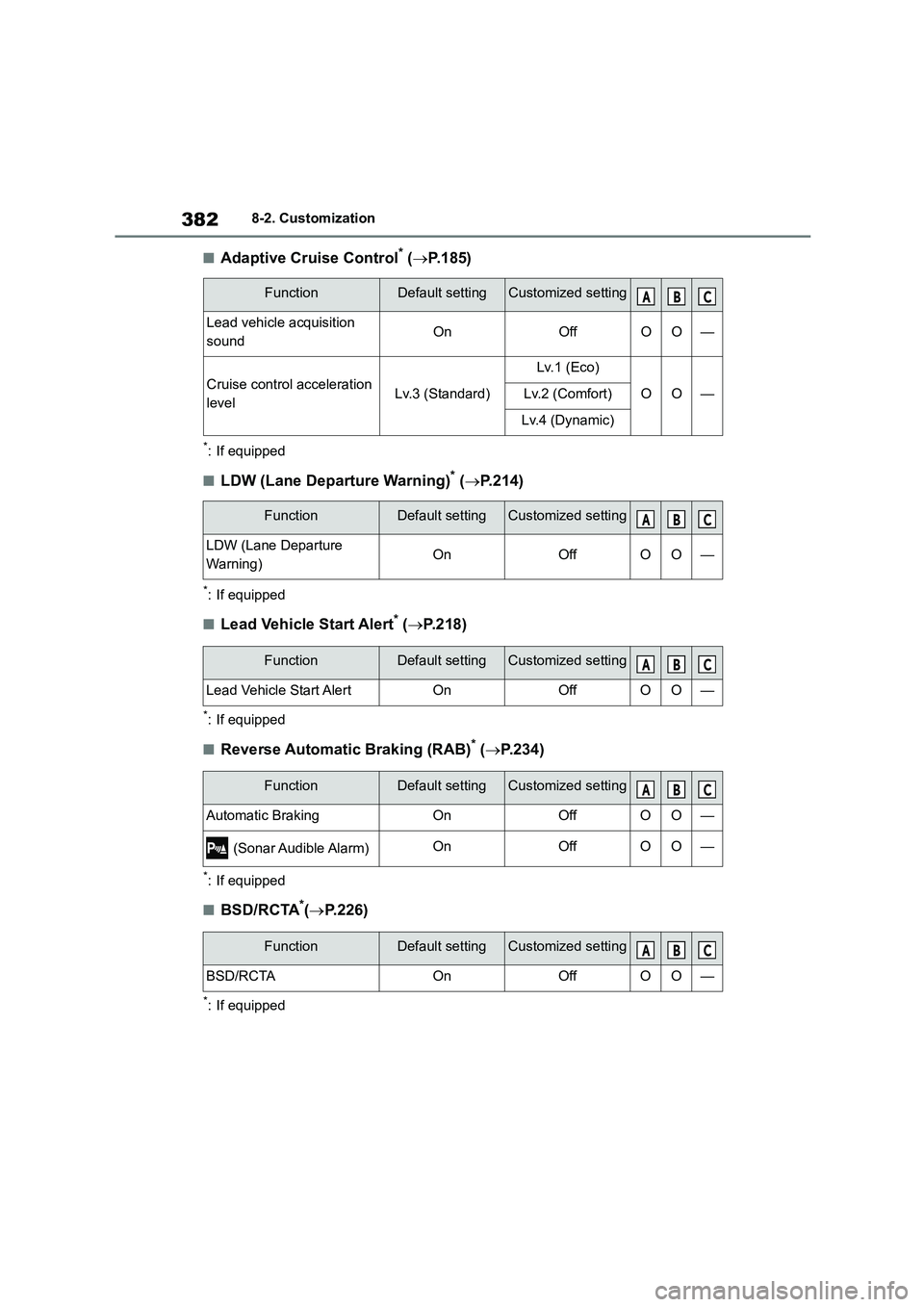
■Adaptive Cruise Control* (P. 1 8 5 )
*: If equipped
■LDW (Lane Departure Warning)* (P.214)
*: If equipped
■Lead Vehicle Start Alert* (P.218)
*: If equipped
■Reverse Automatic Braking (RAB)* (P.234)
*: If equipped
■BSD/RCTA*(P.226)
*: If equipped
FunctionDefault settingCustomized setting
Lead vehicle acquisition
soundOnOffOO—
Cruise control acceleration
levelLv.3 (Standard)
Lv.1 (Eco)
OO—Lv.2 (Comfort)
Lv.4 (Dynamic)
FunctionDefault settingCustomized setting
LDW (Lane Departure
Warning)OnOffOO—
ABC
ABC
FunctionDefault settingCustomized setting
Lead Vehicle Start AlertOnOffOO—
ABC
FunctionDefault settingCustomized setting
Automatic BrakingOnOffOO—
(Sonar Audible Alarm)OnOffOO—
ABC
FunctionDefault settingCustomized setting
BSD/RCTAOnOffOO—
ABC
Page 385 of 582
383
8
8-2. Customization
Vehicle specifications
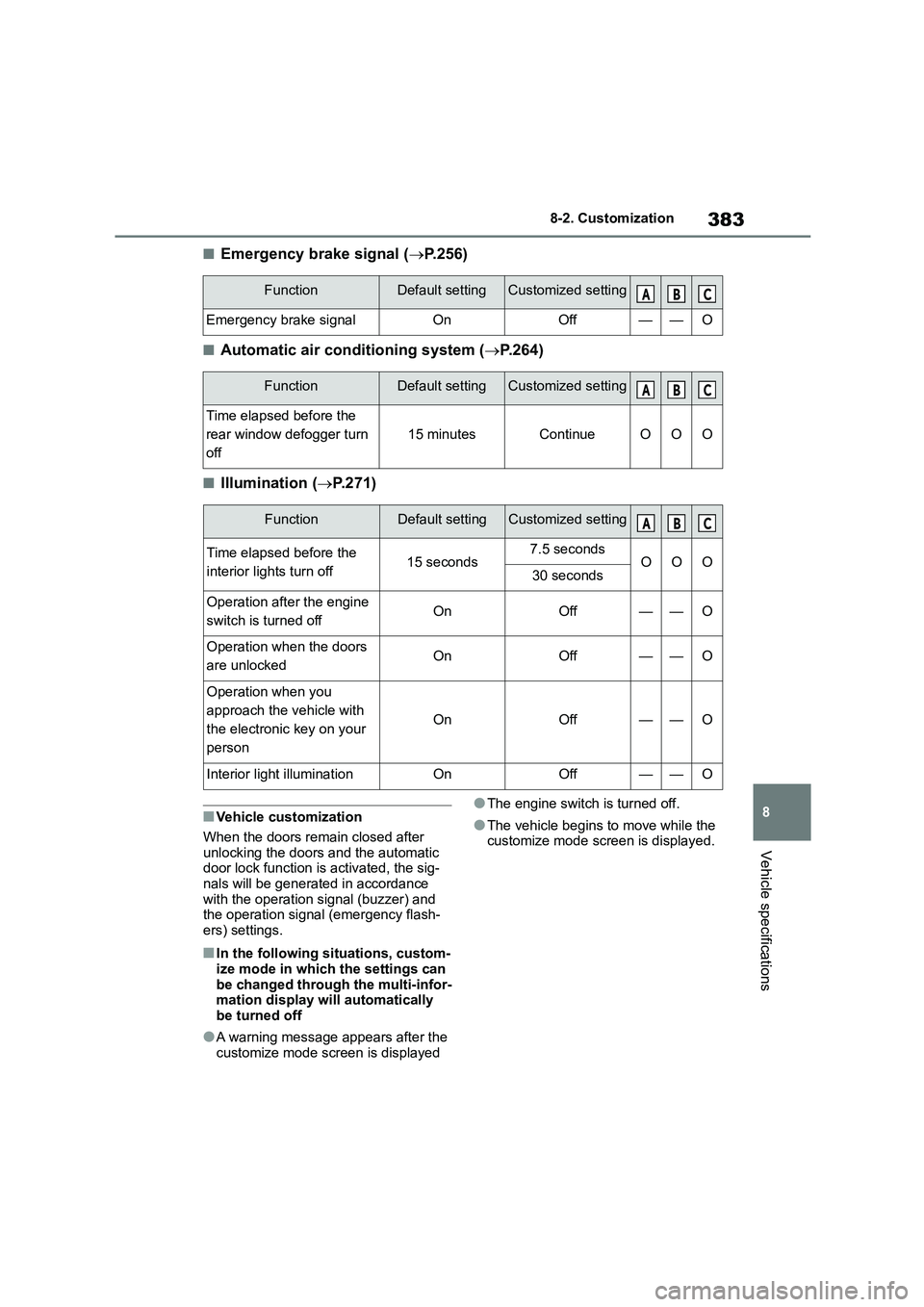
■Emergency brake signal ( P. 2 5 6 )
■Automatic air conditioning system (P.264)
■Illumination (P.271)
■Vehicle customization
When the doors remain closed after
unlocking the doors and the automatic door lock function is activated, the sig-
nals will be generated in accordance
with the operation signal (buzzer) and the operation signal (emergency flash-
ers) settings.
■In the following situations, custom-
ize mode in which the settings can
be changed through the multi-infor- mation display will automatically
be turned off
●A warning message appears after the
customize mode screen is displayed
●The engine switch is turned off.
●The vehicle begins to move while the
customize mode screen is displayed.
FunctionDefault settingCustomized setting
Emergency brake signalOnOff——O
ABC
FunctionDefault settingCustomized setting
Time elapsed before the
rear window defogger turn
off
15 minutesContinueOOO
ABC
FunctionDefault settingCustomized setting
Time elapsed before the
interior lights turn off15 seconds7.5 secondsOOO30 seconds
Operation after the engine
switch is turned offOnOff——O
Operation when the doors
are unlockedOnOff——O
Operation when you
approach the vehicle with
the electronic key on your
person
OnOff——O
Interior light illuminationOnOff——O
ABC