ECO mode TOYOTA GT86 2012 User Guide
[x] Cancel search | Manufacturer: TOYOTA, Model Year: 2012, Model line: GT86, Model: TOYOTA GT86 2012Pages: 448, PDF Size: 13.47 MB
Page 171 of 448
171 2-1. Driving procedures
2
When driving
FT86_EE
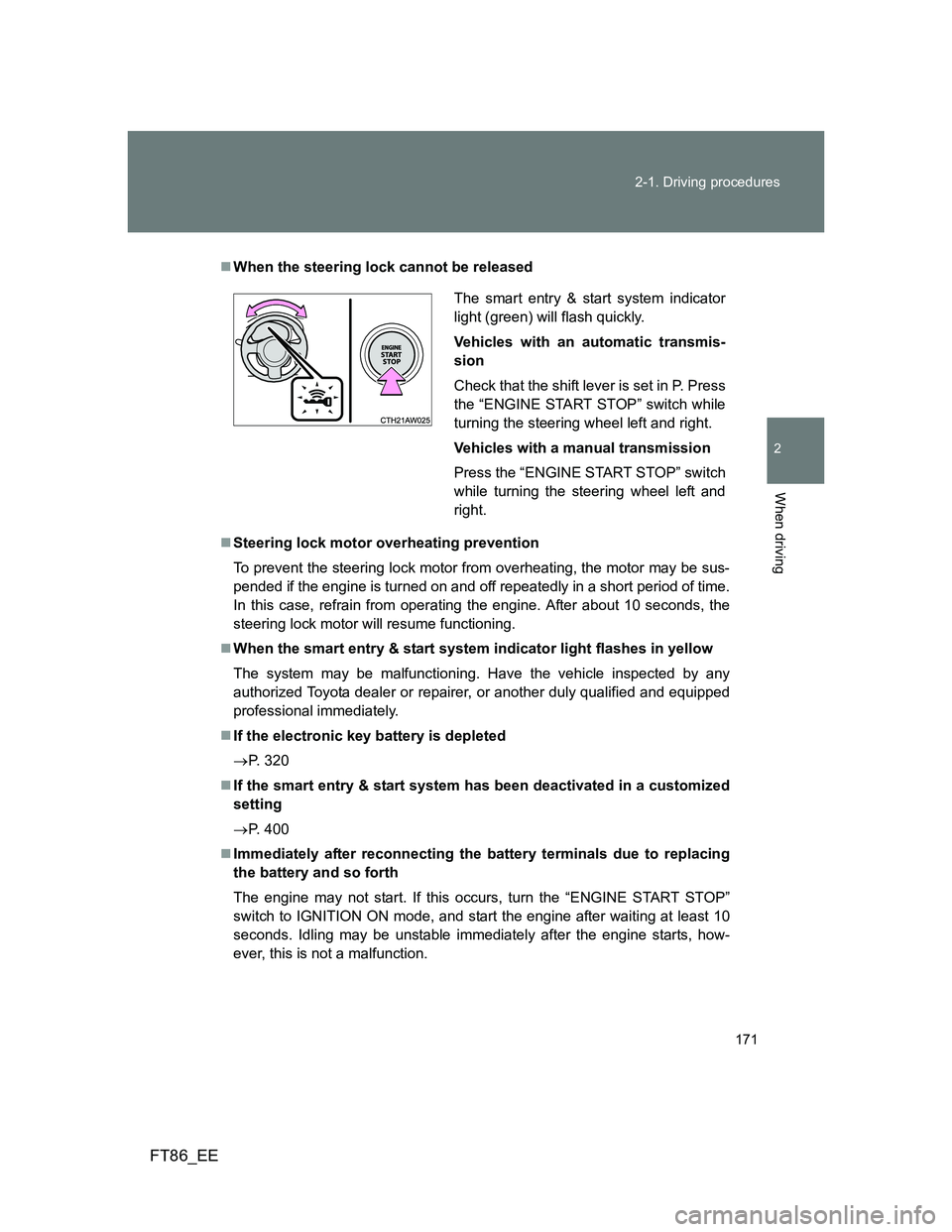
When the steering lock cannot be released
Steering lock motor overheating prevention
To prevent the steering lock motor from overheating, the motor may be sus-
pended if the engine is turned on and off repeatedly in a short period of time.
In this case, refrain from operating the engine. After about 10 seconds, the
steering lock motor will resume functioning.
When the smart entry & start system indicator light flashes in yellow
The system may be malfunctioning. Have the vehicle inspected by any
authorized Toyota dealer or repairer, or another duly qualified and equipped
professional immediately.
If the electronic key battery is depleted
P. 320
If the smart entry & start system has been deactivated in a customized
setting
P. 400
Immediately after reconnecting the battery terminals due to replacing
the battery and so forth
The engine may not start. If this occurs, turn the “ENGINE START STOP”
switch to IGNITION ON mode, and start the engine after waiting at least 10
seconds. Idling may be unstable immediately after the engine starts, how-
ever, this is not a malfunction.
The smart entry & start system indicator
light (green) will flash quickly.
Vehicles with an automatic transmis-
sion
Check that the shift lever is set in P. Press
the “ENGINE START STOP” switch while
turning the steering wheel left and right.
Vehicles with a manual transmission
Press the “ENGINE START STOP” switch
while turning the steering wheel left and
right.
Page 173 of 448
173 2-1. Driving procedures
2
When driving
FT86_EE
NOTICE
To prevent battery discharge
Do not leave the “ENGINE START STOP” switch in ACCESSORY or IGNI-
TION ON mode for long periods of time without the engine running.
If the smart entry & start system indicator light (green) is illuminated, the
“ENGINE START STOP” switch is not off. When exiting the vehicle,
always check that the “ENGINE START STOP” switch is off.
Vehicles with an automatic transmission: Do not stop the engine when the
shift lever is in a position other than P. If the engine is stopped in another
shift lever position, the “ENGINE START STOP” switch will not be turned
off but instead be turned to ACCESSORY mode. If the vehicle is left in
ACCESSORY mode, battery discharge may occur.
When starting the engine
Do not race a cold engine.
If the engine becomes difficult to start or stalls frequently, have your vehi-
cle checked by authorized Toyota dealer or repairer, or another duly quali-
fied and equipped professional immediately.
Symptoms indicating a malfunction with the “ENGINE START STOP”
switch
If the “ENGINE START STOP” switch seems to be operating somewhat dif-
ferently than usual, such as the switch sticking slightly, there may be a mal-
function. Contact any authorized Toyota dealer or repairer, or another duly
qualified and equipped professional immediately.
Page 178 of 448
178 2-1. Driving procedures
FT86_EE
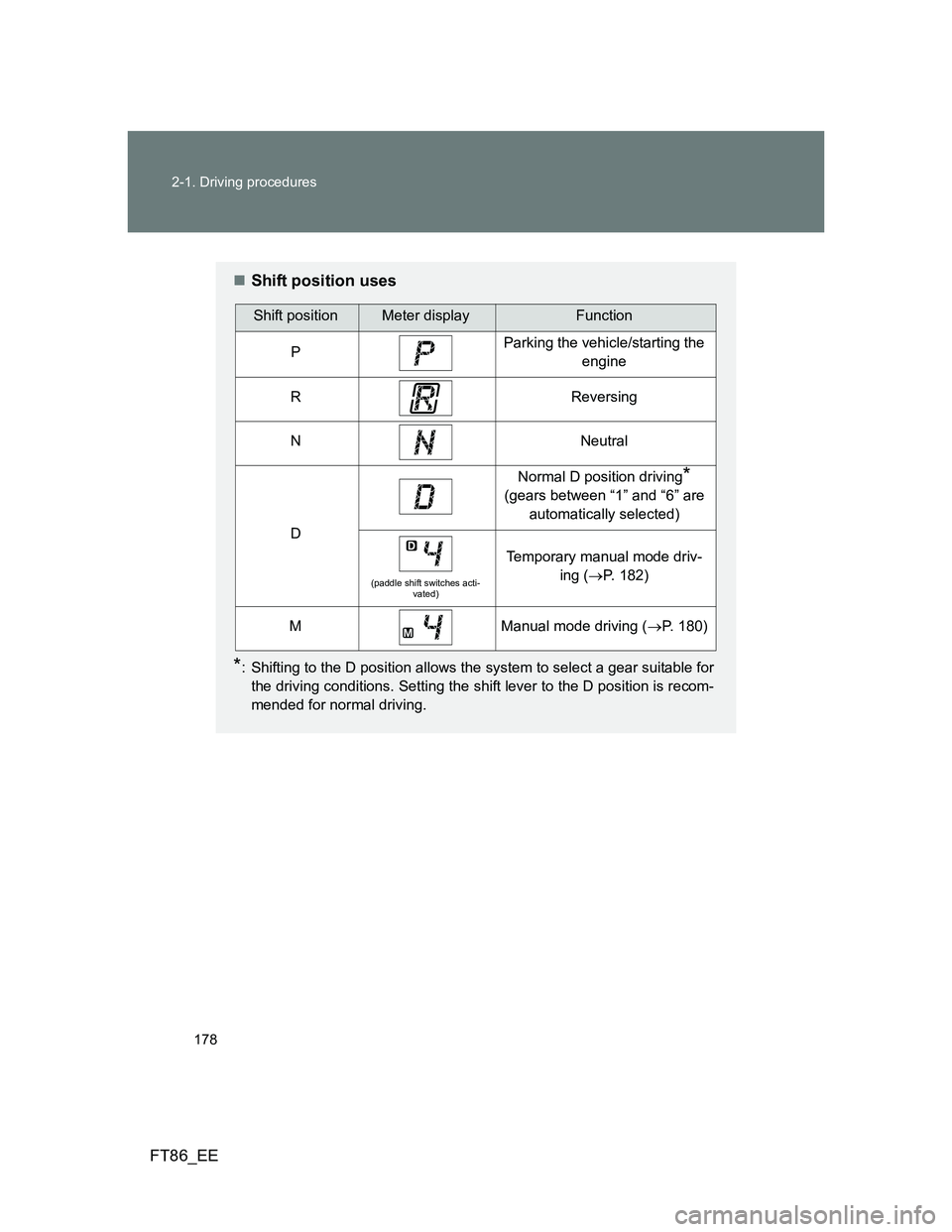
Shift position uses
*: Shifting to the D position allows the system to select a gear suitable for
the driving conditions. Setting the shift lever to the D position is recom-
mended for normal driving.
Shift positionMeter displayFunction
PParking the vehicle/starting the
engine
RReversing
NNeutral
D
Normal D position driving*
(gears between “1” and “6” are
automatically selected)
(paddle shift switches acti-
vated)
Temporary manual mode driv-
ing (P. 182)
MManual mode driving (P. 1 8 0 )
Page 197 of 448
197 2-2. Instrument cluster
2
When driving
FT86_EE
*1:Vehicles without a smart entry & start system
These lights turn on when the engine switch is turned to the “ON”
position to indicate that a system check is being performed. They
will turn off after the engine is started, or after a few seconds. There
may be a malfunction in a system if a light does not come on, or if
the lights do not turn off. Have the vehicle inspected by any autho-
rized Toyota dealer or repairer, or another duly qualified and
equipped professional for details.
Vehicles with a smart entry & start system
These lights turn on when the “ENGINE START STOP” switch is
turned to IGNITION ON mode to indicate that a system check is
being performed. They will turn off after the engine is started, or
after a few seconds. There may be a malfunction in a system if a
light does not come on, or if the lights do not turn off. Have the vehi-
cle inspected by any authorized Toyota dealer or repairer, or
another duly qualified and equipped professional for details.
*2: The light flashes to indicate that the system is operating.
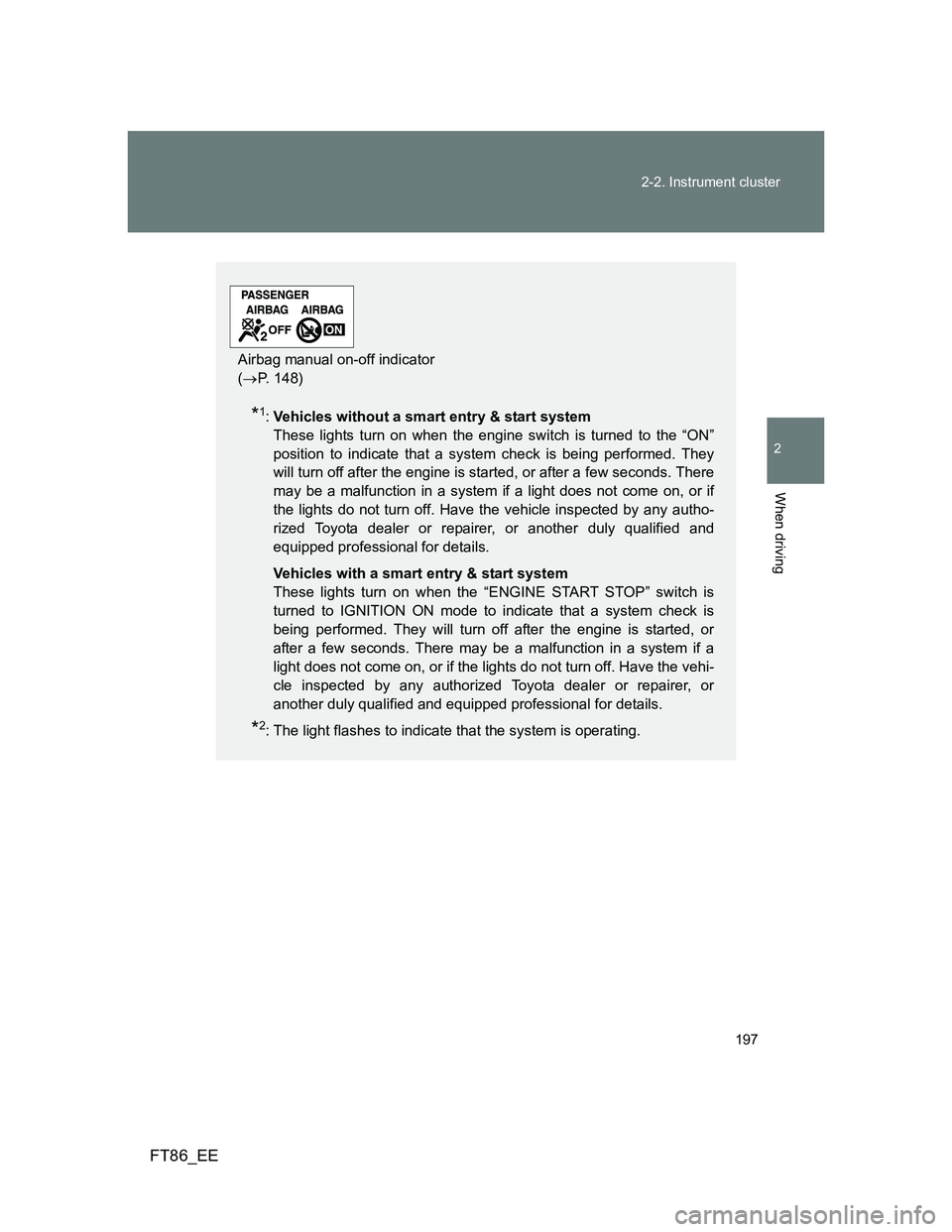
Airbag manual on-off indicator
(P. 148)
Page 198 of 448
198 2-2. Instrument cluster
FT86_EE
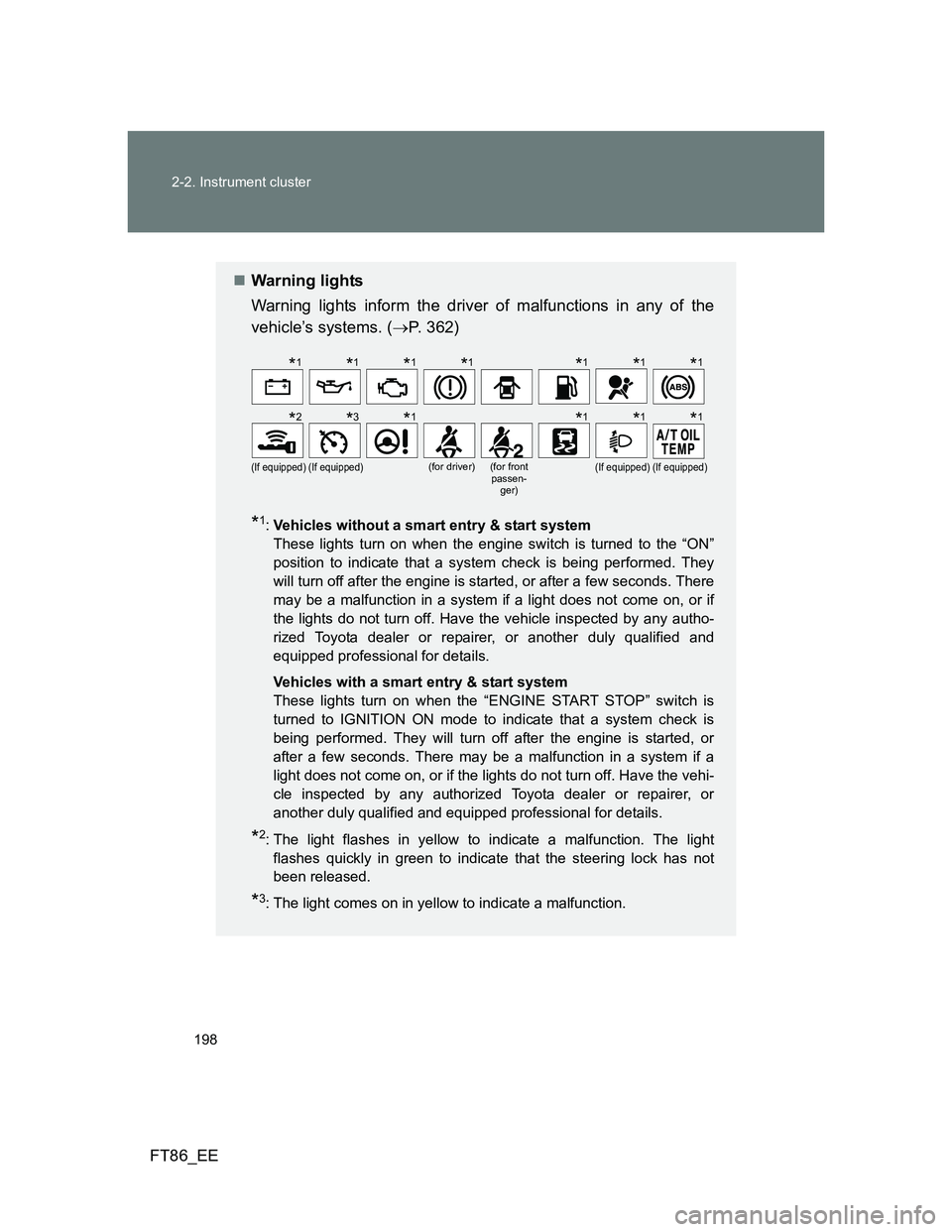
Warning lights
Warning lights inform the driver of malfunctions in any of the
vehicle’s systems. (P. 362)
*1:Vehicles without a smart entry & start system
These lights turn on when the engine switch is turned to the “ON”
position to indicate that a system check is being performed. They
will turn off after the engine is started, or after a few seconds. There
may be a malfunction in a system if a light does not come on, or if
the lights do not turn off. Have the vehicle inspected by any autho-
rized Toyota dealer or repairer, or another duly qualified and
equipped professional for details.
Vehicles with a smart entry & start system
These lights turn on when the “ENGINE START STOP” switch is
turned to IGNITION ON mode to indicate that a system check is
being performed. They will turn off after the engine is started, or
after a few seconds. There may be a malfunction in a system if a
light does not come on, or if the lights do not turn off. Have the vehi-
cle inspected by any authorized Toyota dealer or repairer, or
another duly qualified and equipped professional for details.
*2: The light flashes in yellow to indicate a malfunction. The light
flashes quickly in green to indicate that the steering lock has not
been released.
*3: The light comes on in yellow to indicate a malfunction.
(If equipped)(If equipped)(for driver)(for front
passen-
ger)(If equipped)(If equipped)
*1*1*1*1*1*1*1
*2*3*1*1*1*1
Page 211 of 448
211 2-3. Operating the lights and windshield wipers
2
When driving
FT86_EE
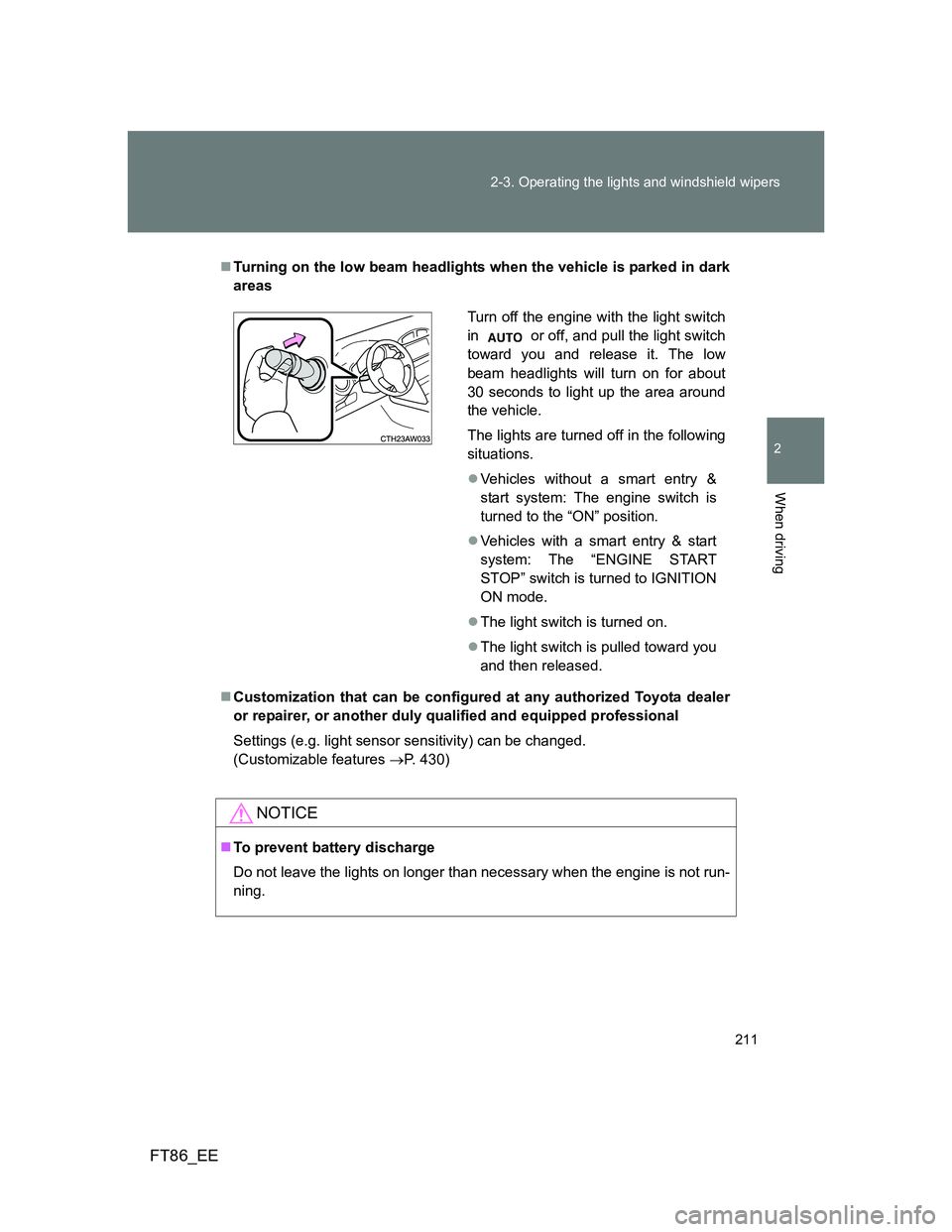
Turning on the low beam headlights when the vehicle is parked in dark
areas
Customization that can be configured at any authorized Toyota dealer
or repairer, or another duly qualified and equipped professional
Settings (e.g. light sensor sensitivity) can be changed.
(Customizable features P. 430)
NOTICE
To prevent battery discharge
Do not leave the lights on longer than necessary when the engine is not run-
ning.
Turn off the engine with the light switch
in or off, and pull the light switch
toward you and release it. The low
beam headlights will turn on for about
30 seconds to light up the area around
the vehicle.
The lights are turned off in the following
situations.
Vehicles without a smart entry &
start system: The engine switch is
turned to the “ON” position.
Vehicles with a smart entry & start
system: The “ENGINE START
STOP” switch is turned to IGNITION
ON mode.
The light switch is turned on.
The light switch is pulled toward you
and then released.
Page 215 of 448
215 2-3. Operating the lights and windshield wipers
2
When driving
FT86_EE
The windshield wipers and washer can be operated when
Vehicles without a smart entry & start system
The engine switch is in the “ON” position.
Vehicles with a smart entry & start system
The “ENGINE START STOP” switch is in IGNITION ON mode.
If no windshield washer fluid sprays
Check that the washer nozzles are not blocked if there is washer fluid in the
windshield washer fluid reservoir.
CAUTION
Caution regarding the use of washer fluid
When it is cold, do not use the washer fluid until the windshield becomes
warm. The fluid may freeze on the windshield and cause low visibility. This
may lead to an accident, resulting in death or serious injury.
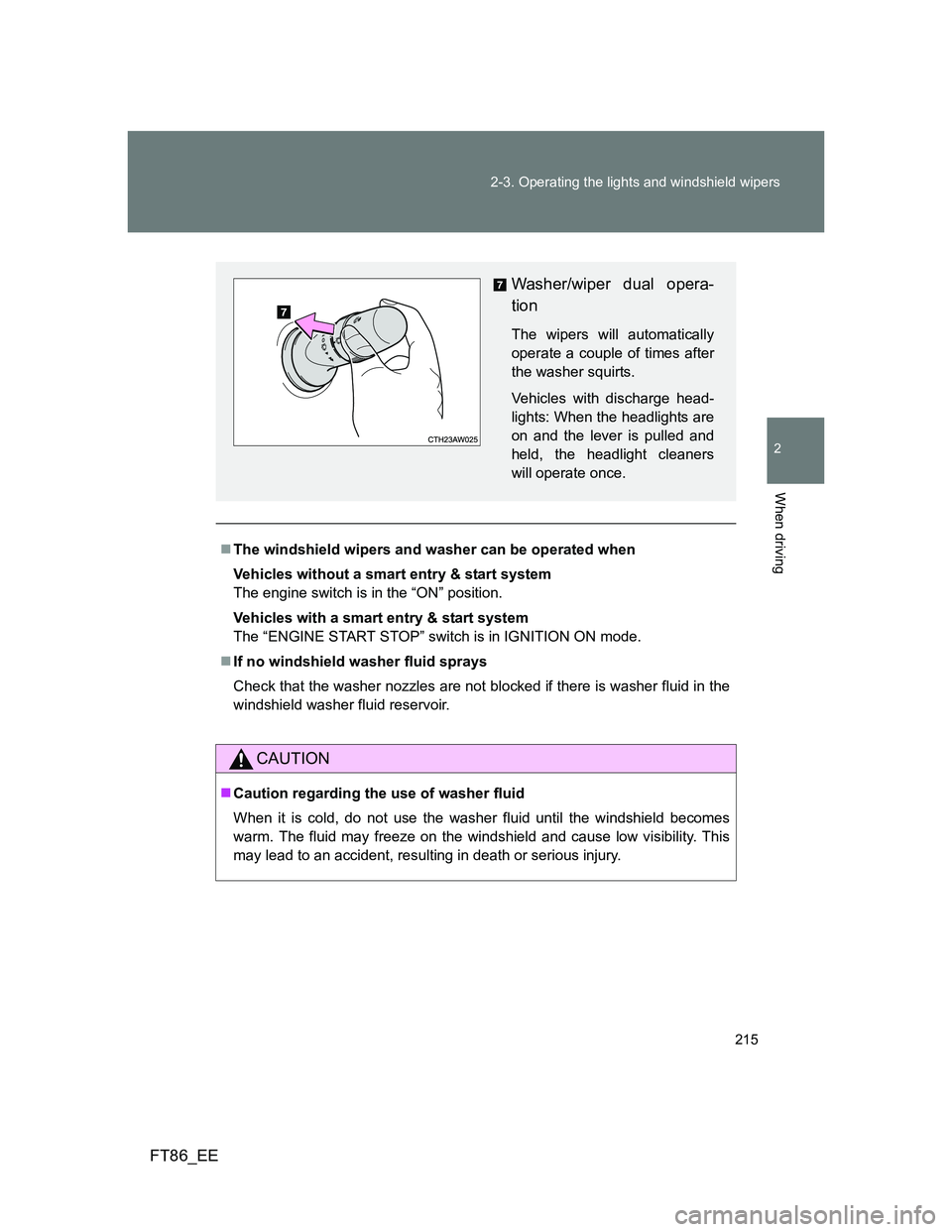
Washer/wiper dual opera-
tion
The wipers will automatically
operate a couple of times after
the washer squirts.
Vehicles with discharge head-
lights: When the headlights are
on and the lever is pulled and
held, the headlight cleaners
will operate once.
Page 242 of 448
242 3-1. Using the air conditioning system and defogger
FT86_EE
Fogging up of the windows
Vehicles with the button: The windows will easily fog up when the
humidity in the vehicle is high. Turning
on will dehumidify the air
from the outlets and defog the windshield effectively.
Vehicles with the button: If you turn
off, the windows may
fog up more easily.
The windows may fog up if the recirculated air mode is used.
Outside/recirculated air mode
When driving on dusty roads such as tunnels or in heavy traffic, set the
outside/recirculated air mode button to the recirculated air mode. This is
recommended to prevent outside air from entering the vehicle interior.
Vehicles with the button: During cooling operation, setting the
recirculated air mode will also cool the vehicle interior effectively.
When the outside temperature falls to nearly 0°C (32°F) (vehicles with
the button)
The dehumidification function may not operate even when is
pressed.
Page 243 of 448
243 3-1. Using the air conditioning system and defogger
3
Interior features
FT86_EE
Air conditioning odors
During use, various odors from inside and outside the vehicle may enter
into and accumulate in the air conditioning system. This may then cause
odor to be emitted from the vents.
To reduce potential odors from occurring:
It is recommended that the air conditioning system be set to outside air
mode prior to turning the vehicle off.
Air conditioning filter
P. 318
CAUTION
To prevent the windshield from fogging up
Do not set the air outlet selection dial to during cool air operation in
extremely humid weather. The difference between the temperature of the
outside air and that of the windshield can cause the outer surface of the
windshield to fog up, blocking your vision.
NOTICE
To prevent battery discharge
Do not leave the air conditioning system on longer than necessary when the
engine is stopped.
Page 251 of 448
251 3-1. Using the air conditioning system and defogger
3
Interior features
FT86_EE
Air conditioning odors
During use, various odors from inside and outside the vehicle may enter
into and accumulate in the air conditioning system. This may then cause
odor to be emitted from the vents.
To reduce potential odors from occurring:
• It is recommended that the air conditioning system be set to outside air
mode prior to turning the vehicle off.
• The start timing of the blower may be delayed for a short period of time
immediately after the air conditioning system is started in automatic
mode.
Air conditioning filter
P. 318
CAUTION
To prevent the windshield from fogging up
Do not use during cool air operation in extremely humid weather. The
difference between the temperature of the outside air and that of the wind-
shield can cause the outer surface of the windshield to fog up, blocking your
vision.
NOTICE
To prevent battery discharge
Do not leave the air conditioning system on longer than necessary when the
engine is stopped.