wheel TOYOTA GT86 2012 Owner's Manual
[x] Cancel search | Manufacturer: TOYOTA, Model Year: 2012, Model line: GT86, Model: TOYOTA GT86 2012Pages: 448, PDF Size: 13.47 MB
Page 75 of 448
75
1
1-3. Adjustable components (seats, mirrors, steering wheel)
Before driving
FT86_EE
Outside rear view mirrors
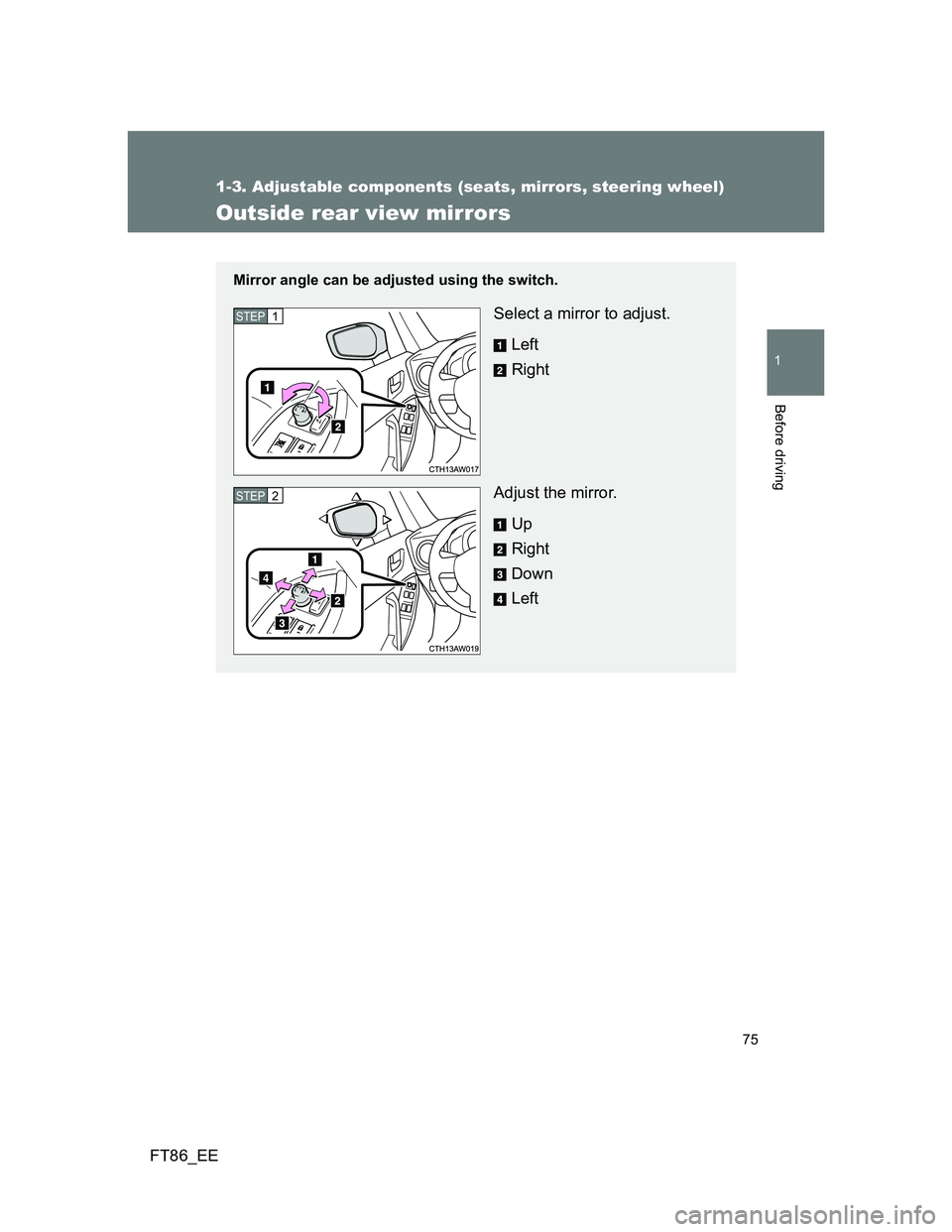
Mirror angle can be adjusted using the switch.
Select a mirror to adjust.
Left
Right
Adjust the mirror.
Up
Right
Down
LeftSTEP 1
STEP 2
Page 76 of 448
76 1-3. Adjustable components (seats, mirrors, steering wheel)
FT86_EE
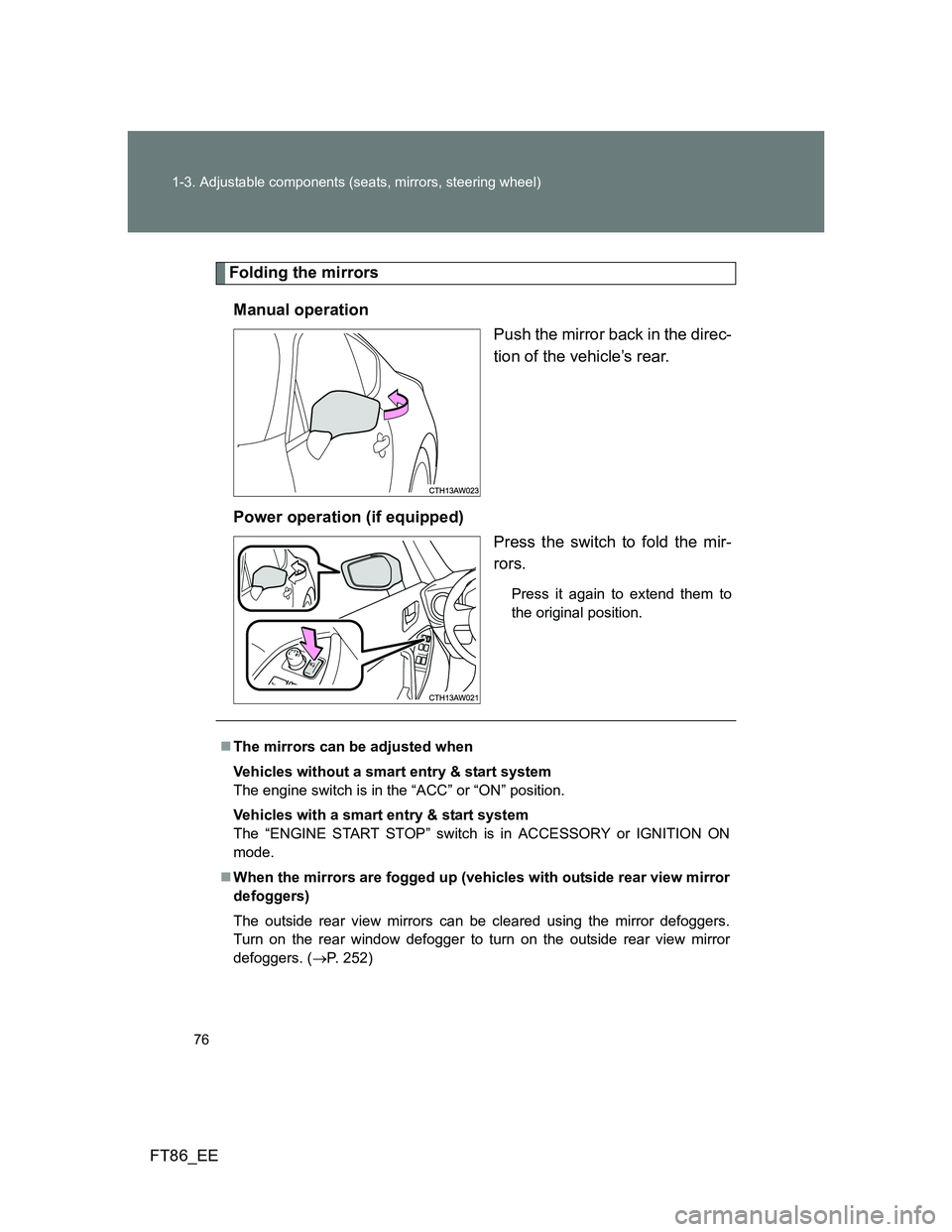
Folding the mirrors
Manual operation
Push the mirror back in the direc-
tion of the vehicle’s rear.
Power operation (if equipped)
Press the switch to fold the mir-
rors.
Press it again to extend them to
the original position.
The mirrors can be adjusted when
Vehicles without a smart entry & start system
The engine switch is in the “ACC” or “ON” position.
Vehicles with a smart entry & start system
The “ENGINE START STOP” switch is in ACCESSORY or IGNITION ON
mode.
When the mirrors are fogged up (vehicles with outside rear view mirror
defoggers)
The outside rear view mirrors can be cleared using the mirror defoggers.
Turn on the rear window defogger to turn on the outside rear view mirror
defoggers. (P. 252)
Page 77 of 448
77 1-3. Adjustable components (seats, mirrors, steering wheel)
1
Before driving
FT86_EE
CAUTION
When driving the vehicle
Observe the following precautions while driving.
Failure to do so may result in loss of control of the vehicle and cause an
accident, resulting in death or serious injury.
Do not adjust the mirrors while driving.
Do not drive with the mirrors folded.
Both the driver and passenger side mirrors must be extended and properly
adjusted before driving.
When a mirror is moving
To avoid personal injury and mirror malfunction, be careful not to get your
hand caught by the moving mirror.
When the mirror defoggers are operating (vehicles with outside rear
view mirror defoggers)
Do not touch the rear view mirror surfaces, as they can become very hot and
burn you.
Page 94 of 448
94
FT86_EE
1-7. Safety information
Correct driving posture
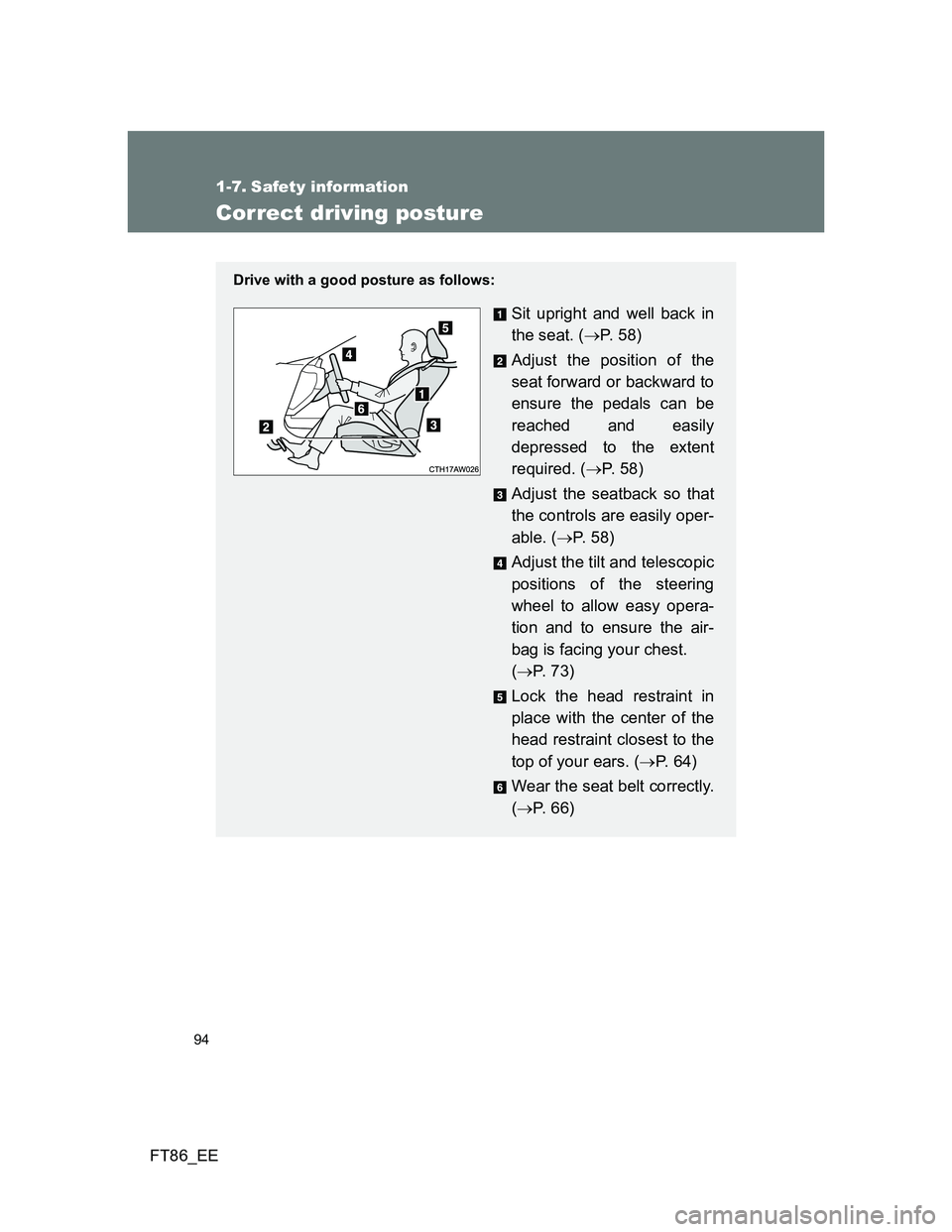
Drive with a good posture as follows:
Sit upright and well back in
the seat. (P. 5 8 )
Adjust the position of the
seat forward or backward to
ensure the pedals can be
reached and easily
depressed to the extent
required. (P. 58)
Adjust the seatback so that
the controls are easily oper-
able. (P. 58)
Adjust the tilt and telescopic
positions of the steering
wheel to allow easy opera-
tion and to ensure the air-
bag is facing your chest.
(P. 73)
Lock the head restraint in
place with the center of the
head restraint closest to the
top of your ears. (P. 64)
Wear the seat belt correctly.
(P. 66)
Page 98 of 448
98 1-7. Safety information
FT86_EE
CAUTION
SRS airbag
To obtain maximum protection in the event of an accident, the driver and
all passengers in the vehicle should always wear seat belts when the vehi-
cle is moving. The SRS airbag is designed only to be a supplement to the
primary protection provided by the seat belt. It does not eliminate the need
to fasten seat belts. In combination with the seat belts, it offers the best
combined protection in case of a serious accident.
Not wearing a seat belt increases the chance of severe injury or death in a
crash even when the vehicle has the SRS airbag.
For instructions and precautions concerning the seat belt system, refer to
“Seat belts”. (P. 66)
Do not sit or lean unnecessarily close to the SRS airbag. Because the
SRS airbag deploys with considerable speed - faster than the blink of an
eye - and force to protect in high speed collisions, the force of an airbag
can injure an occupant whose body is too close to SRS airbag.
It is also important to wear your seat belt to help avoid injuries that can
result when the SRS airbag contacts an occupant not in proper position
such as one thrown forward during pre-accident braking.
Even when properly positioned, there remains a possibility that an occu-
pant may suffer minor injury such as abrasions and bruises to the face or
arms because of the SRS airbag deployment force.
The SRS airbags deploy with considerable speed and force. Occupants
who are out of proper position when the SRS airbag deploys could suffer
very serious injuries. Because the SRS airbag needs enough space for
deployment, the driver should always sit upright and well back in the seat
as far from the steering wheel as practical while still maintaining full vehi-
cle control and the front passenger should move the seat as far back as
possible and sit upright and well back in the seat.
Do not place any objects over or near the SRS airbag cover or between
you and the SRS airbag. If the SRS airbag deploys, those objects could
interfere with its proper operation and could be propelled inside the vehicle
and cause injury.
Page 101 of 448
101 1-7. Safety information
1
Before driving
FT86_EE
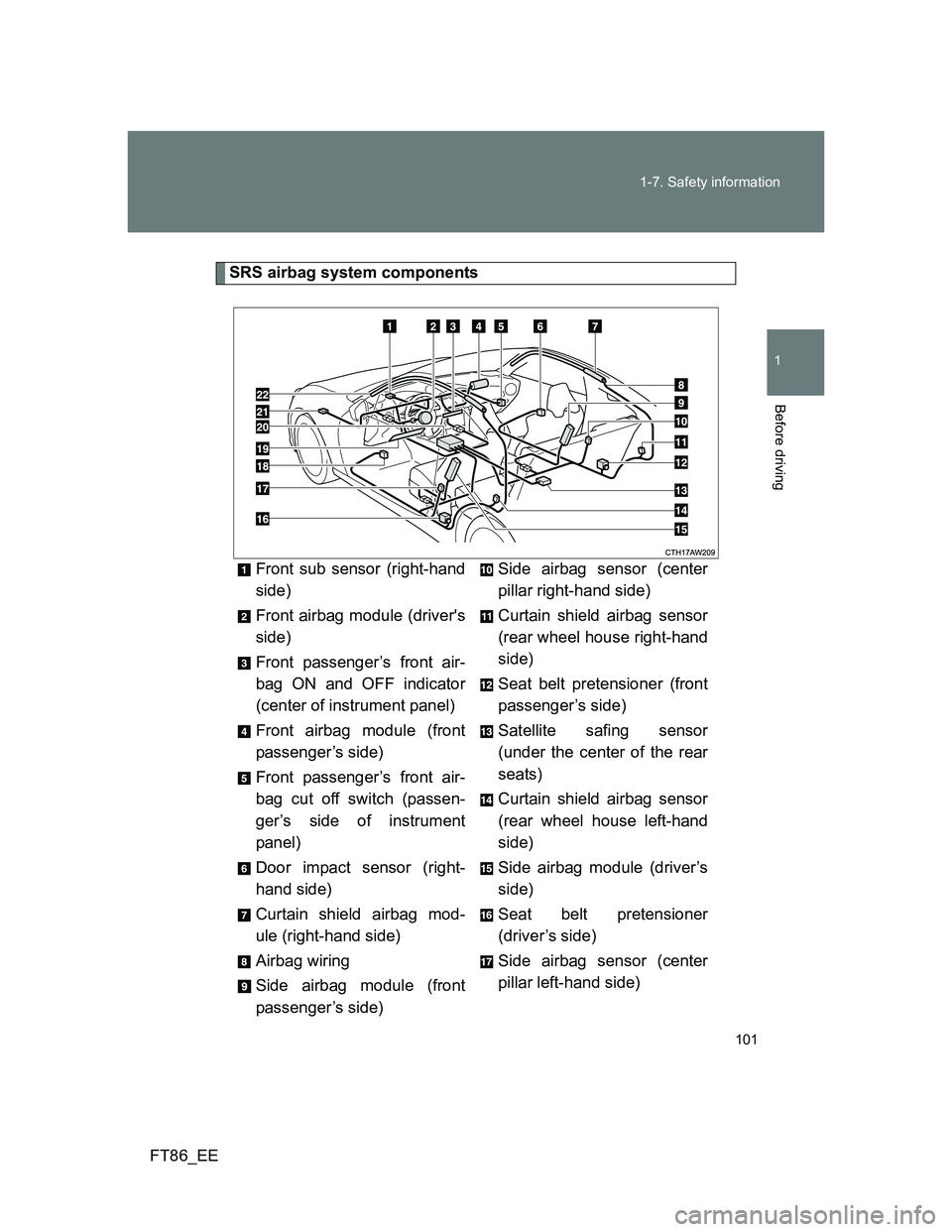
SRS airbag system components
Front sub sensor (right-hand
side)
Front airbag module (driver's
side)
Front passenger’s front air-
bag ON and OFF indicator
(center of instrument panel)
Front airbag module (front
passenger’s side)
Front passenger’s front air-
bag cut off switch (passen-
ger’s side of instrument
panel)
Door impact sensor (right-
hand side)
Curtain shield airbag mod-
ule (right-hand side)
Airbag wiring
Side airbag module (front
passenger’s side)Side airbag sensor (center
pillar right-hand side)
Curtain shield airbag sensor
(rear wheel house right-hand
side)
Seat belt pretensioner (front
passenger’s side)
Satellite safing sensor
(under the center of the rear
seats)
Curtain shield airbag sensor
(rear wheel house left-hand
side)
Side airbag module (driver’s
side)
Seat belt pretensioner
(driver’s side)
Side airbag sensor (center
pillar left-hand side)
Page 103 of 448
103 1-7. Safety information
1
Before driving
FT86_EE
SRS front airbag
The driver’s SRS front airbag is stowed in the center portion of the steering
wheel. The driver’s knee airbag is stowed under the steering column. The
passenger’s SRS front airbag is stowed near the top of the dashboard under
an “SRS AIRBAG” mark.
In a moderate to severe front collision, the following components deploy.
SRS front airbag for driver
SRS front airbag for front passenger
Knee airbag for driver
These components supplement the seat belts by reducing the impact to the
occupant’s head, chest and knees.
If the SRS airbags deploy (inflate)
Bruising and slight abrasions may result from contact with a deploying
(inflating) SRS airbag.
A loud noise and white powder will be emitted.
Parts of the airbag module (steering wheel hub, airbag cover and inflator)
as well as the front seats, parts of the front and rear pillars, and roof side
rails, may be hot for several minutes. The airbag itself may also be hot.
The windshield may crack.
Front-seat passenger airbag manual cut off switch
The passenger-side front airbag can be deactivated by the cut off switch
located in the instrumental panel side. When the cut off switch is turned to
the deactivation mode the passenger-side front airbag becomes deacti-
vated. When the cutoff switch is turned to the activation mode the passen-
ger-side front airbag becomes active to deploy. While the passenger-side
front airbag is active the A/B ON indicator is illuminated.
Page 110 of 448
110 1-7. Safety information
FT86_EE
CAUTION
A warning label
SRS front airbag precaution
Do not touch the SRS airbag system components around the steering wheel
and dashboard with bare hands right after deployment. Doing so can cause
burns because the components can be very hot as a result of deployment.
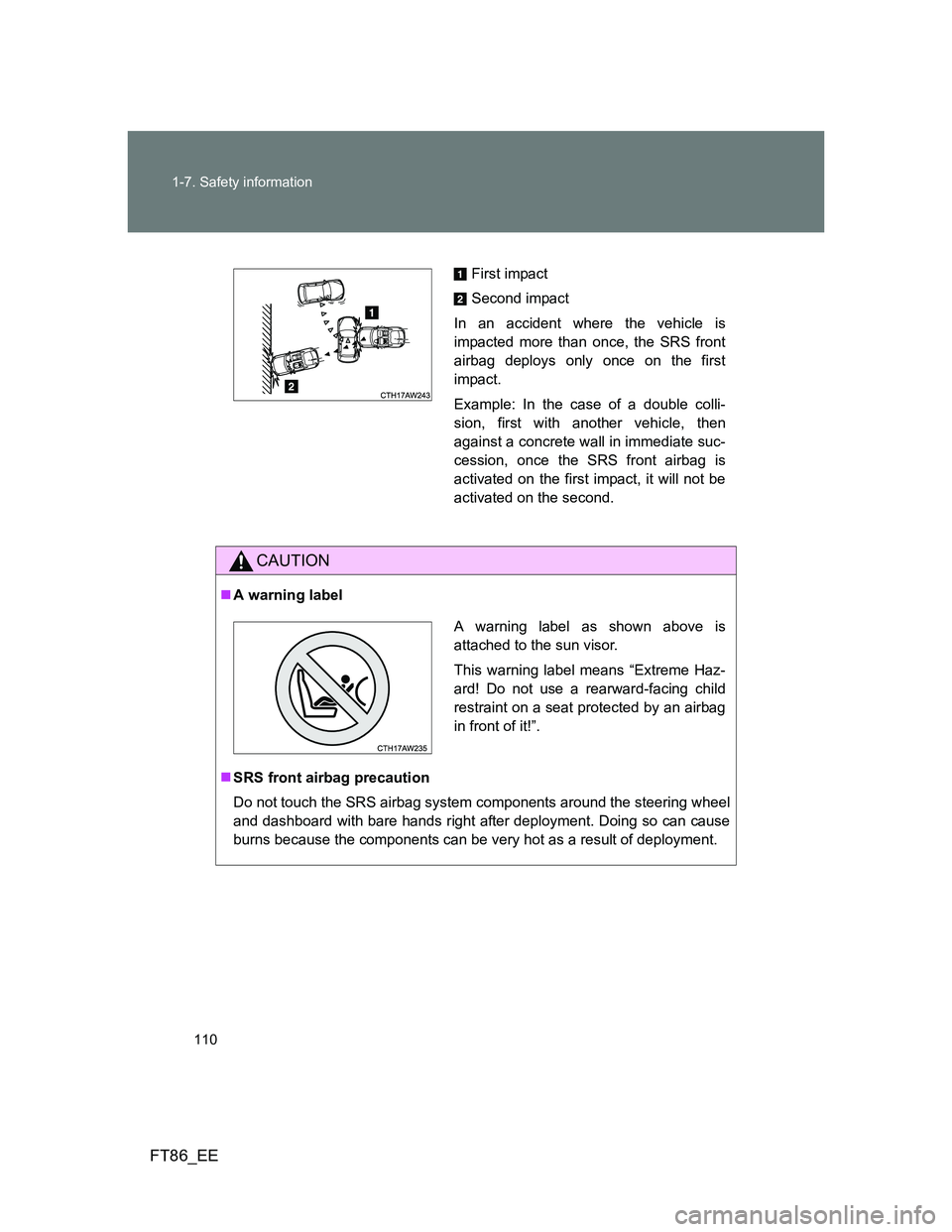
First impact
Second impact
In an accident where the vehicle is
impacted more than once, the SRS front
airbag deploys only once on the first
impact.
Example: In the case of a double colli-
sion, first with another vehicle, then
against a concrete wall in immediate suc-
cession, once the SRS front airbag is
activated on the first impact, it will not be
activated on the second.
A warning label as shown above is
attached to the sun visor.
This warning label means “Extreme Haz-
ard! Do not use a rearward-facing child
restraint on a seat protected by an airbag
in front of it!”.
Page 112 of 448
112 1-7. Safety information
FT86_EE
The driver’s and front passenger’s SRS side airbags and SRS curtain shield
airbags deploy independently of each other since each has its own impact
sensor. Therefore, they may not both deploy in the same accident. Also, the
SRS side airbag and SRS curtain shield airbag deploy independently of the
driver’s and front passenger’s SRS front airbags in the steering wheel and
instrument panel.
An impact sensor, which senses impact force, is located in each of the left
and right center pillars, doors and rear wheel houses. Another impact sen-
sor, which also senses impact force, is located under the rear center seat.
If one of the center pillar impact sensors and the impact sensor that is
located under the rear center seat together sense an impact force above a
predetermined level in a side collision, the control module causes both the
SRS side airbag and SRS curtain shield airbag on the impacted side to
inflate regardless of whether the rear wheel house impact sensor on the
same side senses an impact.
If one of the rear wheel house impact sensors and the impact sensor that is
located under the rear center seat together sense an impact force above a
predetermined level in a side collision, the control module causes only the
SRS curtain shield airbag on the impacted side to inflate.
After the deployment, the SRS side airbag immediately starts to deflate. The
time required from detection of an impact to deflation of an SRS side airbag
after deployment is shorter than the blink of an eye. The SRS curtain shield
airbag remains inflated for a while following deployment then slowly deflates.
The SRS side airbag and SRS curtain shield airbag deploy even when no
one occupies the seat on the side on which an impact is applied.
Page 116 of 448
116 1-7. Safety information
FT86_EE
When to contact any authorized Toyota dealer or repairer, or another
duly qualified and equipped professional
In the following cases, the vehicle will require inspection and/or repair. Con-
tact any authorized Toyota dealer or repairer, or another duly qualified and
equipped professional as soon as possible.
Any of the SRS airbags have been inflated.
The front of the vehicle is damaged or
deformed, or was involved in an acci-
dent that was not severe enough to
cause the SRS airbags to inflate.
A portion of a door is damaged or
deformed, or the vehicle was involved
in an accident that was not severe
enough to cause the SRS side airbags
and curtain shield airbags to inflate.
The pad section of the steering wheel,
dashboard or lower portion of the
instrument panel is scratched, cracked,
or otherwise damaged.
The surface of the seats with the side
airbag is scratched, cracked, or other-
wise damaged.