wheel TOYOTA GT86 2012 Owner's Guide
[x] Cancel search | Manufacturer: TOYOTA, Model Year: 2012, Model line: GT86, Model: TOYOTA GT86 2012Pages: 448, PDF Size: 13.47 MB
Page 117 of 448
117 1-7. Safety information
1
Before driving
FT86_EE
CAUTION
If the SRS airbags deploy
Do not touch the SRS side airbag system components around the front seat
seatback with bare hands right after deployment. Doing so can cause burns
because the components can be very hot as a result of deployment.
After deployment, do not touch any part of the SRS curtain shield airbag sys-
tem (from the front pillar to the part of the roof side over the rear seat). Doing
so can cause burns because the components can be very hot as a result of
deployment.
SRS airbag precautions
Observe the following precautions regarding the airbags.
Failure to do so may cause death or serious injury.
The driver and all passengers in the vehicle must wear their seat belts
properly.
The SRS airbags are supplemental devices to be used with the seat belts.
The SRS driver airbag deploys with considerable force, and can cause
death or serious injury especially if the driver is very close to the airbag.
Since the risk zone for driver airbag is the first 50 - 75 mm (2 - 3 in.) of
inflation, placing yourself 250 mm (10 in.) from your driver airbag provides
you with a clear margin of safety. This distance is measured from the cen-
ter of the steering wheel to your breastbone. If you sit less than 250 mm
(10 in.) away now, you can change your driving position in several ways:
• Move your seat to the rear as far as you can while still reaching the
pedals comfortably.
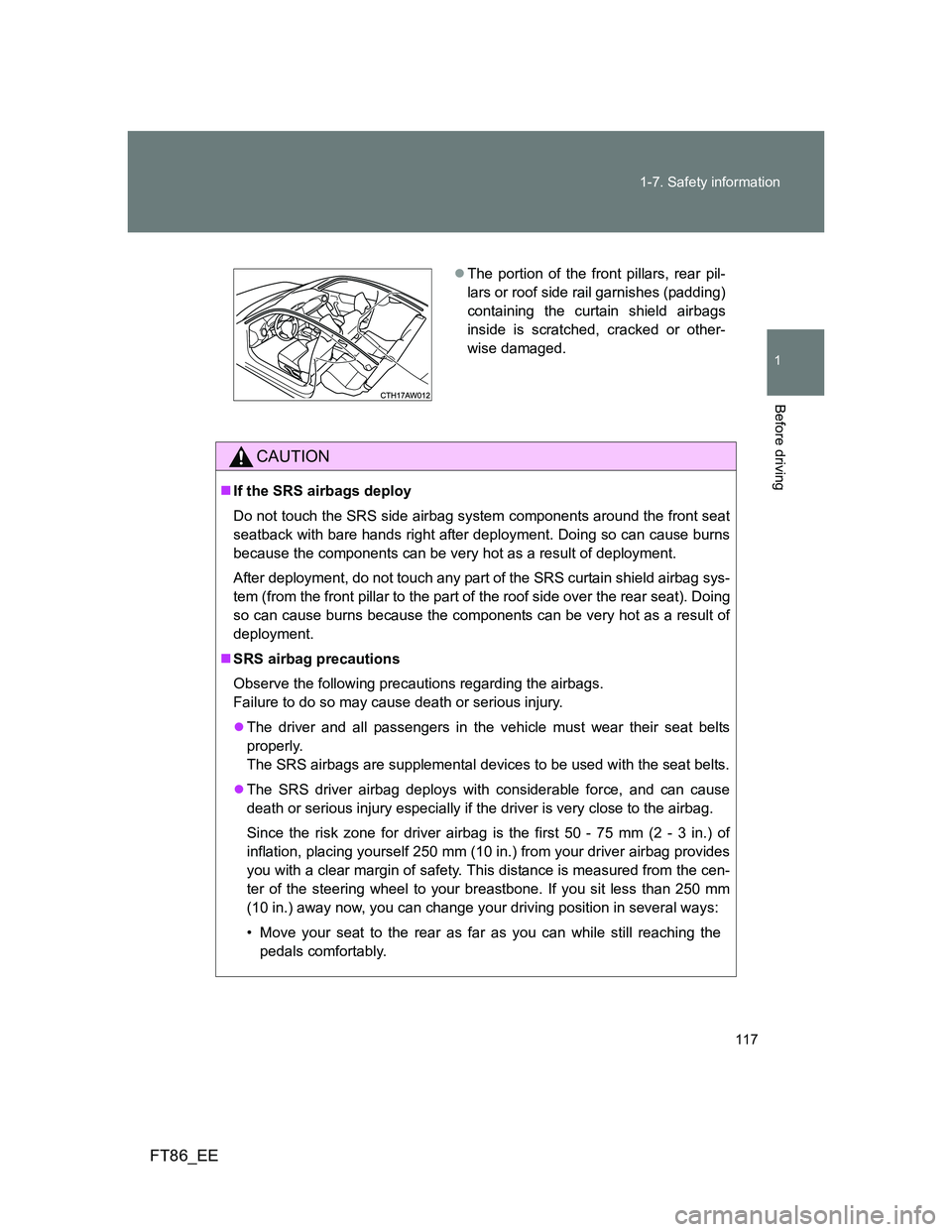
The portion of the front pillars, rear pil-
lars or roof side rail garnishes (padding)
containing the curtain shield airbags
inside is scratched, cracked or other-
wise damaged.
Page 118 of 448
118 1-7. Safety information
FT86_EE
CAUTION
SRS airbag precautions
• Slightly recline the back of the seat. Although vehicle designs vary,
many drivers can achieve the 250 mm (10 in.) distance, even with the
driver seat all the way forward, simply by reclining the back of the seat
somewhat. If reclining the back of your seat makes it hard to see the
road, raise yourself by using a firm, non-slippery cushion, or raise the
seat if your vehicle has that feature.
• If your steering wheel is adjustable, tilt it downward. This points the air-
bag toward your chest instead of your head and neck.
The seat should be adjusted as recommended above, while still maintain-
ing control of the foot pedals, steering wheel, and your view of the instru-
ment panel controls.
The SRS front passenger airbag also deploys with considerable force, and
can cause death or serious injury especially if the front passenger is very
close to the airbag. The front passenger seat should be as far from the air-
bag as possible with the seatback adjusted, so the front passenger sits
upright.
Improperly seated and/or restrained infants and children can be killed or
seriously injured by a deploying airbag. An infant or child who is too small
to use a seat belt should be properly secured using a child restraint sys-
tem. Toyota strongly recommends that all infants and children be placed in
the rear seats of the vehicle and properly restrained. The rear seats are
safer for infants and children than the front passenger seat. (P. 125)
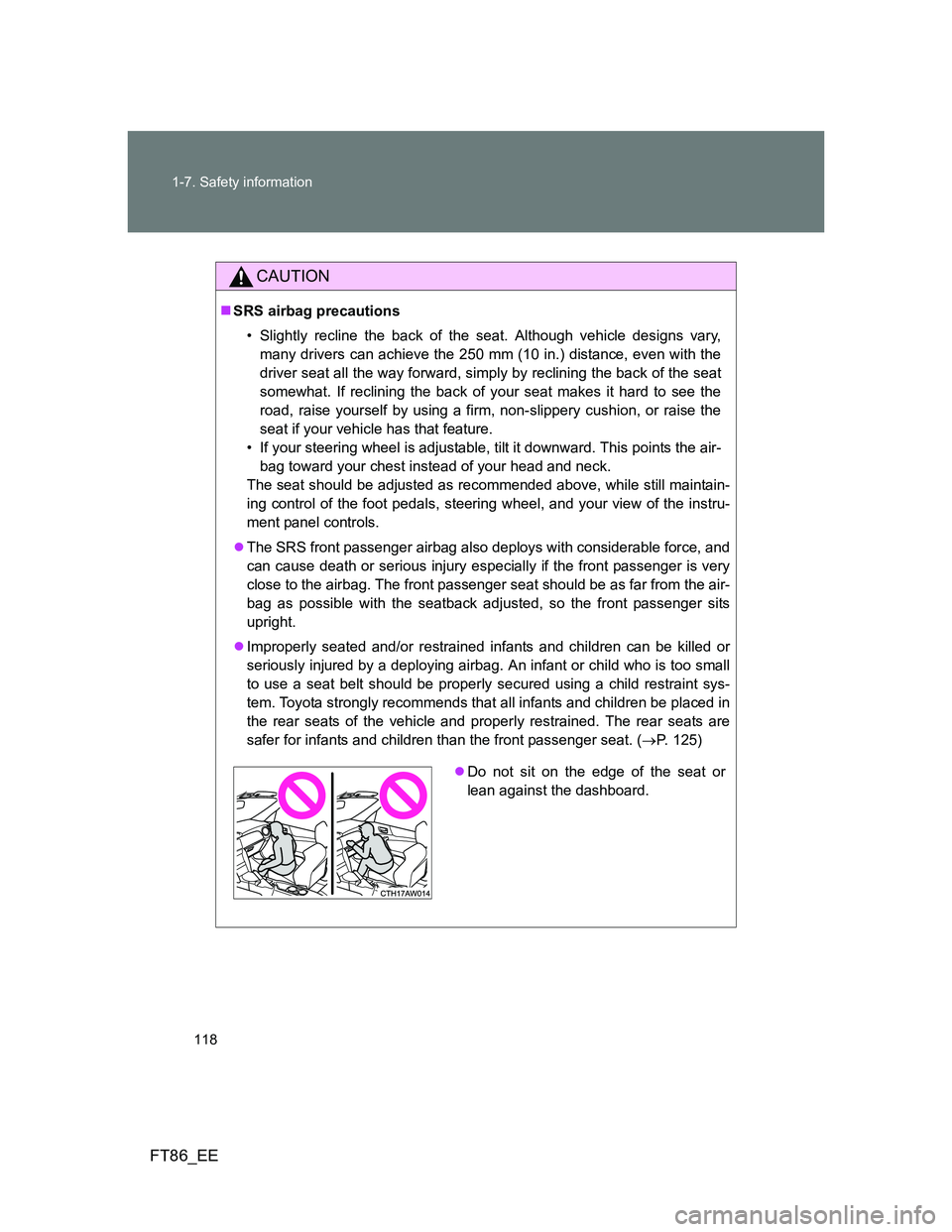
Do not sit on the edge of the seat or
lean against the dashboard.
Page 119 of 448
119 1-7. Safety information
1
Before driving
FT86_EE
CAUTION
SRS airbag precautions
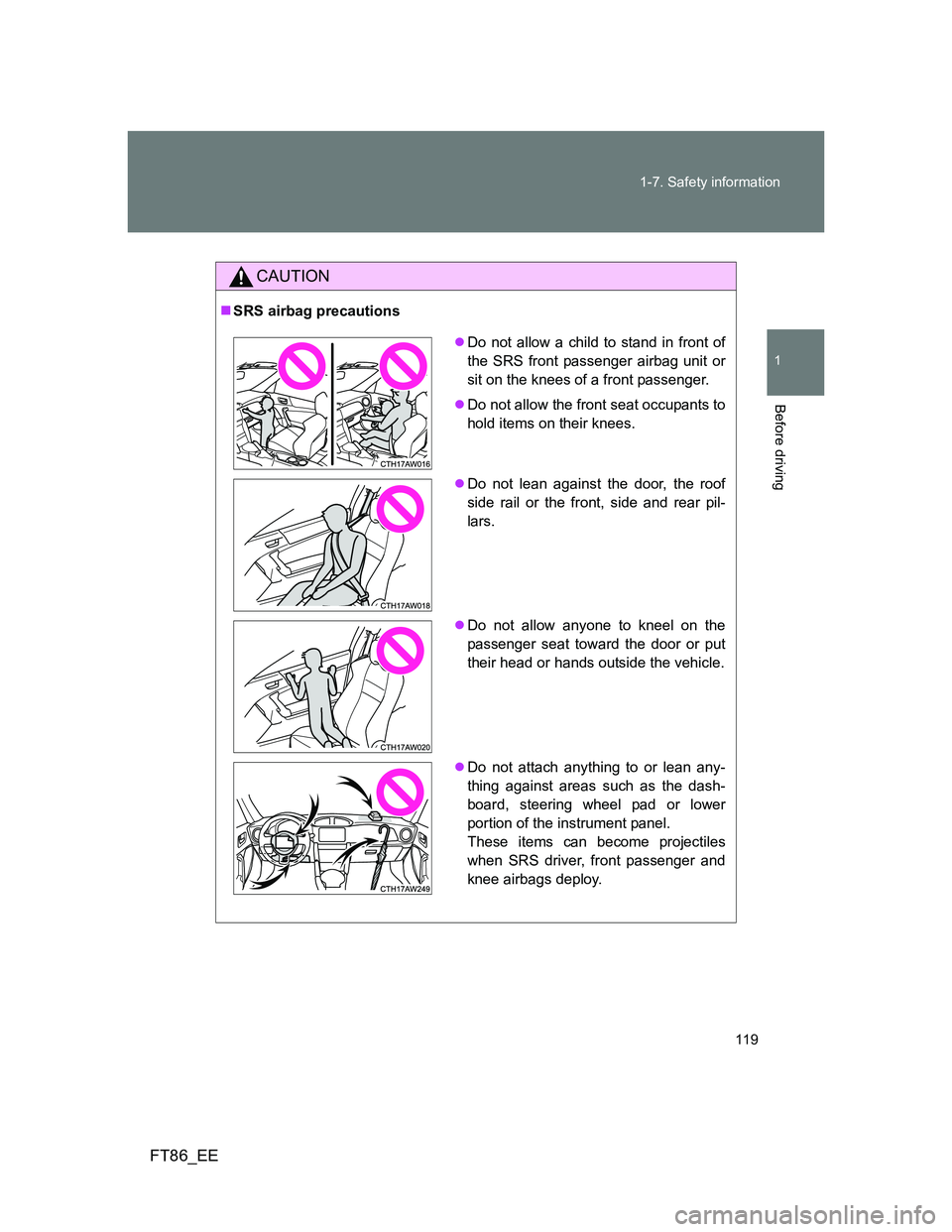
Do not allow a child to stand in front of
the SRS front passenger airbag unit or
sit on the knees of a front passenger.
Do not allow the front seat occupants to
hold items on their knees.
Do not lean against the door, the roof
side rail or the front, side and rear pil-
lars.
Do not allow anyone to kneel on the
passenger seat toward the door or put
their head or hands outside the vehicle.
Do not attach anything to or lean any-
thing against areas such as the dash-
board, steering wheel pad or lower
portion of the instrument panel.
These items can become projectiles
when SRS driver, front passenger and
knee airbags deploy.
Page 121 of 448
121 1-7. Safety information
1
Before driving
FT86_EE
CAUTION
SRS airbag precautions
If the areas where the SRS airbags are stored, such as the steering wheel
pad and front and rear pillar garnishes, are damaged or cracked, have
them replaced by any authorized Toyota dealer or repairer, or another duly
qualified and equipped professional.
The SRS side airbag and SRS curtain shield airbag are designed only to
be a supplement to the primary protection provided by the seat belt. They
do not do away with the need to fasten seat belts. It is also important to
wear your seat belt to help avoid injuries that can result when an occupant
is not seated in a proper upright position.
Modification and disposal of SRS airbag system components
Do not dispose of your vehicle or perform any of the following modifications
without consulting any authorized Toyota dealer or repairer, or another duly
qualified and equipped professional.
The SRS airbags may malfunction or deploy (inflate) accidentally, causing
death or serious injury.
Installation, removal, disassembly and repair of the SRS airbags.
Repairs, modifications, removal or replacement of the steering wheel,
instrument panel, dashboard, seats or seat upholstery, front, side and rear
pillars or roof side rails.
Repairs or modifications of the front fender, front bumper, or side of the
occupant compartment.
Installation of snow plows, winches, etc. to the front grille (bull bars, kan-
garoo bar etc.).
Modifications to the vehicle's suspension system.
Installation of electronic devices such as mobile two-way radios and CD
players.
Installation of electronic devices such as an RF-transmitter and CD play-
ers.
Modifications to your vehicle for a person with a physical disability.
Page 123 of 448
123 1-7. Safety information
1
Before driving
FT86_EESide airbag sensor
• Center pillar right-hand side
• Center pillar left-hand side
Side airbag module
• Driver’s side
• Front passenger’s side
Curtain shield airbag sensor
• Rear wheel house right-hand side
• Rear wheel house left-hand side
Curtain shield airbag module
• Right-hand side
• Left-hand side
Satellite safing sensor (under the center of the rear seats)
Seat belt pretensioner
• Driver’s side
• Front passenger’s side
All related wiring
Door impact sensor
• Right-hand side
• Left-hand side
Front passenger’s front airbag cut off switch (passenger's side of
instrument panel)
Front passenger’s front airbag ON and OFF indicator
Page 153 of 448
153 2-1. Driving procedures
2
When driving
FT86_EE
Parking the vehicle
Vehicles with an automatic transmission
With the shift lever in D, depress the brake pedal.
Shift the shift lever to P. (P. 177)
Set the parking brake. (P. 188)
Vehicles without a smart entry & start system:
Turn the engine switch to the “LOCK” position to stop the
engine.
Vehicles with a smart entry & start system:
Press the “ENGINE START STOP” switch to stop the
engine.
Lock the door, making sure that you have the key on your
person.
If parking on a hill, block the wheels as needed.
Vehicles with a manual transmission
While depressing the clutch pedal, depress the brake
pedal.
Shift the shift lever to N. (P. 184)
Set the parking brake. (P. 188)
Vehicles without a smart entry & start system:
Turn the engine switch to the “LOCK” position to stop the
engine.
Vehicles with a smart entry & start system:
Press the “ENGINE START STOP” switch to stop the
engine.
Lock the door, making sure that you have the key on your
person.
If parking on a hill, shift the shift lever to 1 or R and block the
wheels as needed.
STEP 1
STEP 2
STEP 3
STEP 4
STEP 5
STEP 1
STEP 2
STEP 3
STEP 4
STEP 5
Page 156 of 448
156 2-1. Driving procedures
FT86_EE
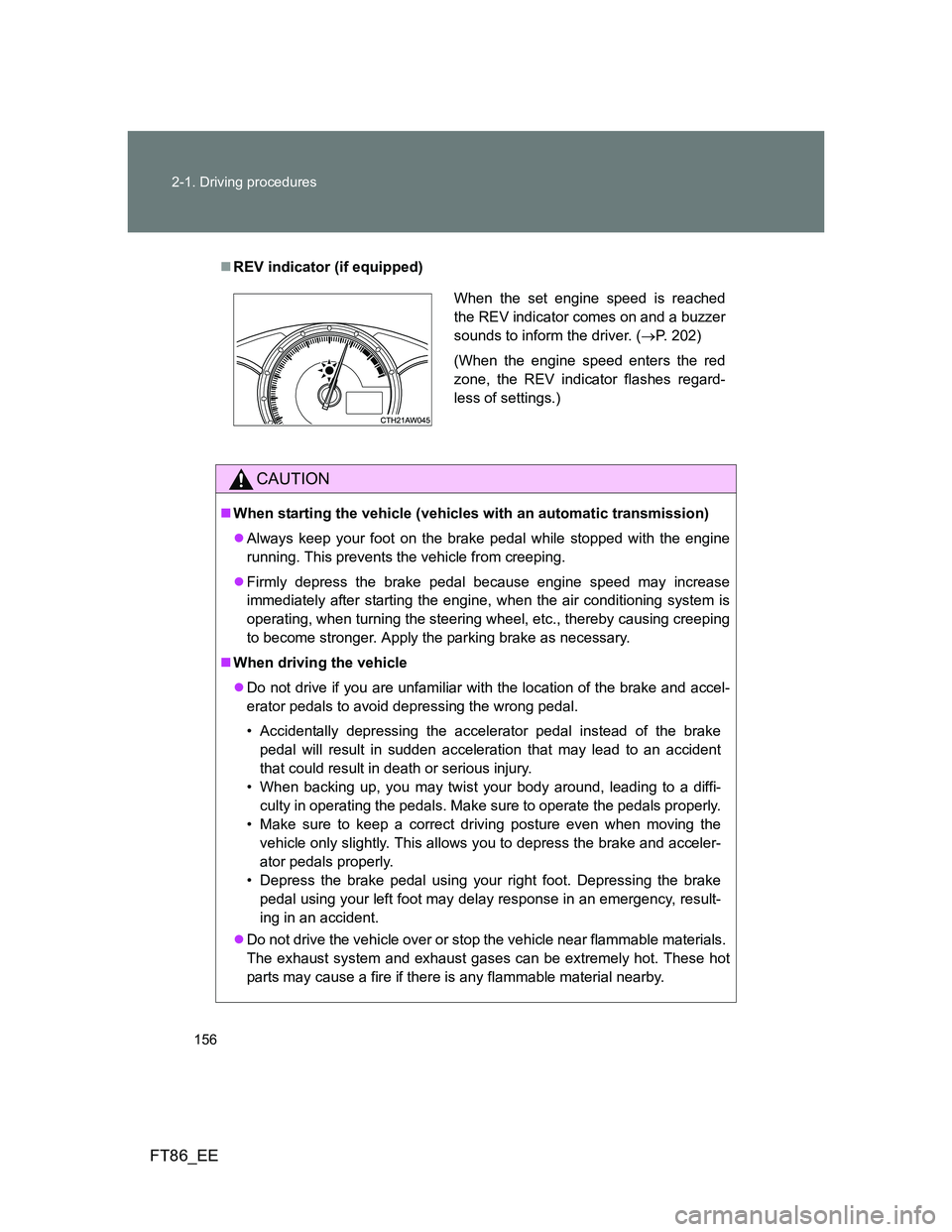
REV indicator (if equipped)
CAUTION
When starting the vehicle (vehicles with an automatic transmission)
Always keep your foot on the brake pedal while stopped with the engine
running. This prevents the vehicle from creeping.
Firmly depress the brake pedal because engine speed may increase
immediately after starting the engine, when the air conditioning system is
operating, when turning the steering wheel, etc., thereby causing creeping
to become stronger. Apply the parking brake as necessary.
When driving the vehicle
Do not drive if you are unfamiliar with the location of the brake and accel-
erator pedals to avoid depressing the wrong pedal.
• Accidentally depressing the accelerator pedal instead of the brake
pedal will result in sudden acceleration that may lead to an accident
that could result in death or serious injury.
• When backing up, you may twist your body around, leading to a diffi-
culty in operating the pedals. Make sure to operate the pedals properly.
• Make sure to keep a correct driving posture even when moving the
vehicle only slightly. This allows you to depress the brake and acceler-
ator pedals properly.
• Depress the brake pedal using your right foot. Depressing the brake
pedal using your left foot may delay response in an emergency, result-
ing in an accident.
Do not drive the vehicle over or stop the vehicle near flammable materials.
The exhaust system and exhaust gases can be extremely hot. These hot
parts may cause a fire if there is any flammable material nearby.
When the set engine speed is reached
the REV indicator comes on and a buzzer
sounds to inform the driver. (P. 202)
(When the engine speed enters the red
zone, the REV indicator flashes regard-
less of settings.)
Page 158 of 448
158 2-1. Driving procedures
FT86_EE
CAUTION
Use engine braking (downshift) to maintain a safe speed when driving
down a steep hill.
Using the brakes continuously may cause the brakes to overheat and lose
effectiveness. (P. 178, 184)
Do not adjust the position of the steering wheel, the seat, or the inside or
outside rear view mirrors while driving.
Doing so may result in a loss of vehicle control that can cause accidents,
resulting in death or serious injury.
Always check that all passengers' arms, heads or other parts of their body
are not outside the vehicle, as this may result in death or serious injury.
When driving on slippery road surfaces
Sudden braking, acceleration and steering may cause tire slippage and
reduce your ability to control the vehicle, resulting in an accident.
Sudden acceleration, engine braking due to shift changing, or changes in
engine speed could cause the vehicle to skid, resulting in an accident.
After driving through a puddle, lightly depress the brake pedal to make
sure that the brakes are functioning properly. Wet brake pads may prevent
the brakes from functioning properly. If the brakes on only one side are wet
and not functioning properly, steering control may be affected, resulting in
an accident.
When shifting the shift lever
On vehicles with an automatic transmission, be careful not to shift the shift
lever with the accelerator pedal depressed. Shifting the shift lever to a
gear other than P or N may lead to unexpected rapid acceleration of the
vehicle that may cause an accident and result in death or serious injury.
Do not place items in the shift lever's surrounding area. It may cause incor-
rect operation.
If the shift boot is pulled out during cleaning, return it to its previous posi-
tion. If the shift boot is left pulled out, the shift lever may become difficult to
operate.
Page 164 of 448
164 2-1. Driving procedures
FT86_EE
NOTICE
Avoiding damage to vehicle parts
Do not turn the steering wheel fully in either direction and hold it there for
an extended period of time.
Doing so may damage the power steering motor.
When driving over bumps in the road, drive as slowly as possible to avoid
damaging the wheels, underside of the vehicle, etc.
On vehicles with an automatic transmission, do not race the engine for
more than 5 seconds in any position except the N or P position when the
brake is applied or when chocks are used in the wheels. This may cause
the transmission fluid to overheat.
If you get a flat tire while driving
A flat or damaged tire may cause the following situations. Hold the steering
wheel firmly and gradually depress the brake pedal to slow down the vehicle.
It may be difficult to control your vehicle.
The vehicle will make abnormal sounds or vibrations.
The vehicle will lean abnormally.
Information on what to do in case of a flat tire (P. 371, 379)
When encountering flooded roads
Do not drive on a road that has flooded after heavy rain etc. Doing so may
cause the following serious damage to the vehicle:
Engine stalling
Short in electrical components
Engine damage caused by water immersion
In the event that you drive on a flooded road and the vehicle is flooded, be
sure to have any authorized Toyota dealer or repairer, or another duly quali-
fied and equipped professional check the following:
Brake function
Changes in quantity and quality of oil and fluid used for the engine, trans-
mission, differential, etc.
Lubricant condition for the propeller shaft, bearings and suspension joints
(where possible) and the function of all joints, bearings, etc.
Page 170 of 448
170 2-1. Driving procedures
FT86_EE
Operation of the “ENGINE START STOP” switch
When operating the “ENGINE START STOP” switch, one short, firm press is
enough. If the switch is pressed improperly, the engine may not start or the
“ENGINE START STOP” switch mode may not change. It is not necessary to
press and hold the switch.
Electronic key battery depletion
P. 4 2
Conditions affecting operation
P. 3 8
Note for the entry function
P. 3 9
If the engine does not start
The engine immobilizer system may not have been deactivated. (P. 85)
Contact any authorized Toyota dealer or repairer, or another duly qualified
and equipped professional.
Steering lock
After turning the “ENGINE START STOP” switch off and opening and closing
the doors, the steering wheel will be locked due to the steering lock function.
Operating the “ENGINE START STOP” switch again automatically cancels
the steering lock.
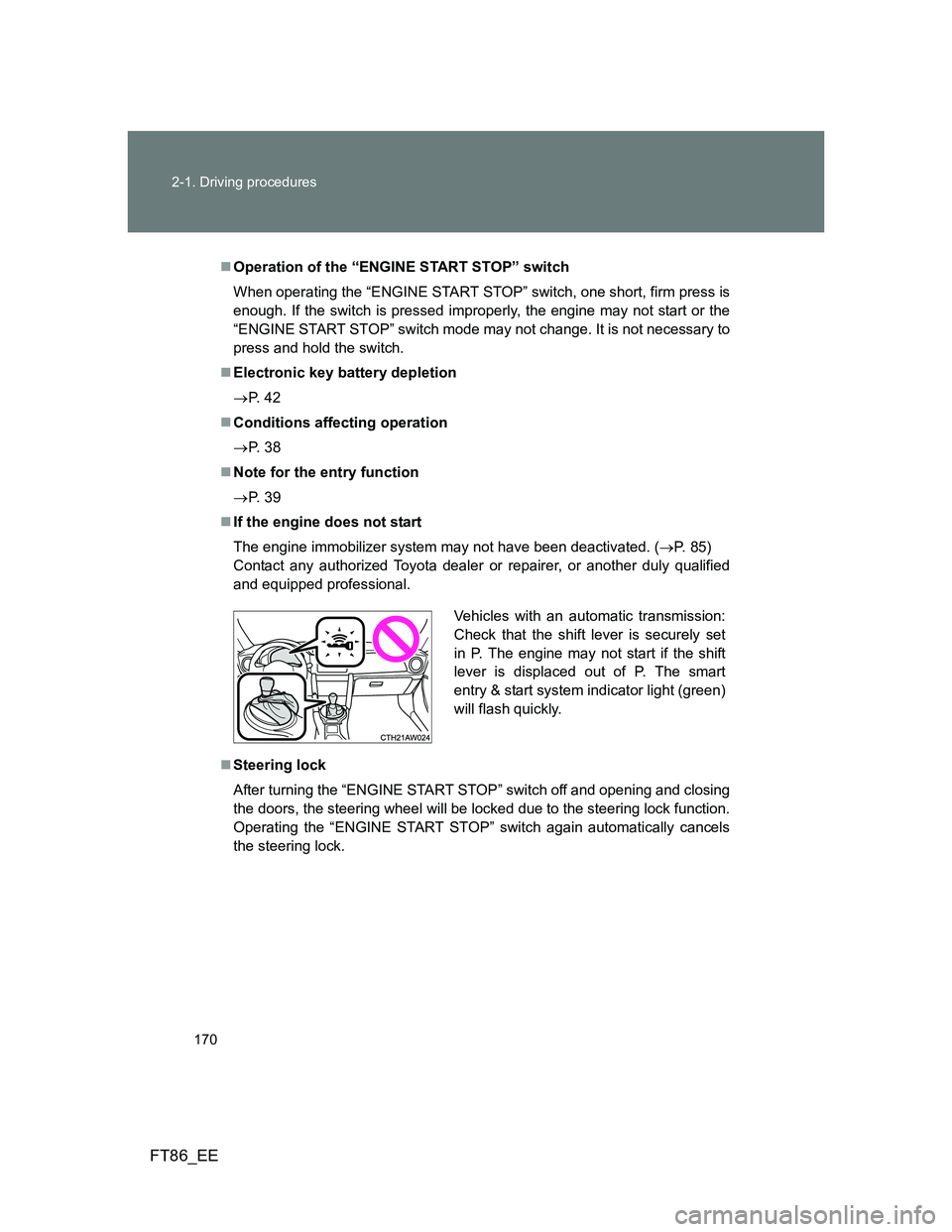
Vehicles with an automatic transmission:
Check that the shift lever is securely set
in P. The engine may not start if the shift
lever is displaced out of P. The smart
entry & start system indicator light (green)
will flash quickly.