trunk TOYOTA GT86 2012 Owner's Guide
[x] Cancel search | Manufacturer: TOYOTA, Model Year: 2012, Model line: GT86, Model: TOYOTA GT86 2012Pages: 448, PDF Size: 13.47 MB
Page 55 of 448
55 1-2. Opening, closing and locking the doors and trunk
1
Before driving
FT86_EE
CAUTION
Caution while driving
Keep the trunk lid closed while driving.
If the trunk lid is left open, it may hit near-by objects while driving or lug-
gage in the trunk may be unexpectedly thrown out, causing an accident.
In addition, exhaust gases may enter the vehicle, causing death or a seri-
ous health hazard. Make sure to close the trunk lid before driving.
Before driving the vehicle, make sure that the trunk lid is fully closed. If the
trunk lid is not fully closed, it may open unexpectedly while driving, caus-
ing an accident.
Never let anyone sit in the trunk. In the event of sudden braking or a colli-
sion, they are susceptible to death or serious injury.
When children are in the vehicle
Observe the following precautions.
Failure to do so may result in death or serious injury.
Do not allow children to enter the trunk.
If a child is accidentally locked in the trunk, they could overheat or suffo-
cate.
Do not allow a child to open or close the trunk lid.
Doing so may cause the trunk lid to operate unexpectedly, or cause the
child’s hands, head, or neck to be caught by the closing trunk lid.
Page 56 of 448
56 1-2. Opening, closing and locking the doors and trunk
FT86_EE
CAUTION
Using the trunk
Observe the following precautions.
Failure to do so may cause parts of the body to be caught, resulting in seri-
ous injury.
Remove any heavy loads, such as snow and ice, from the trunk lid before
opening it. Failure to do so may cause the trunk lid to fall closed again
after it is opened.
When opening or closing the trunk lid, thoroughly check to make sure the
surrounding area is safe.
If anyone is in the vicinity, make sure they are safe and let them know that
the trunk is about to open or close.
Use caution when opening or closing the trunk lid in windy weather as it
may move abruptly in strong wind.
Do not attach any accessories other than genuine Toyota parts to the trunk
lid. Such additional weight on the trunk lid may cause the lid to fall closed
again after it is opened.
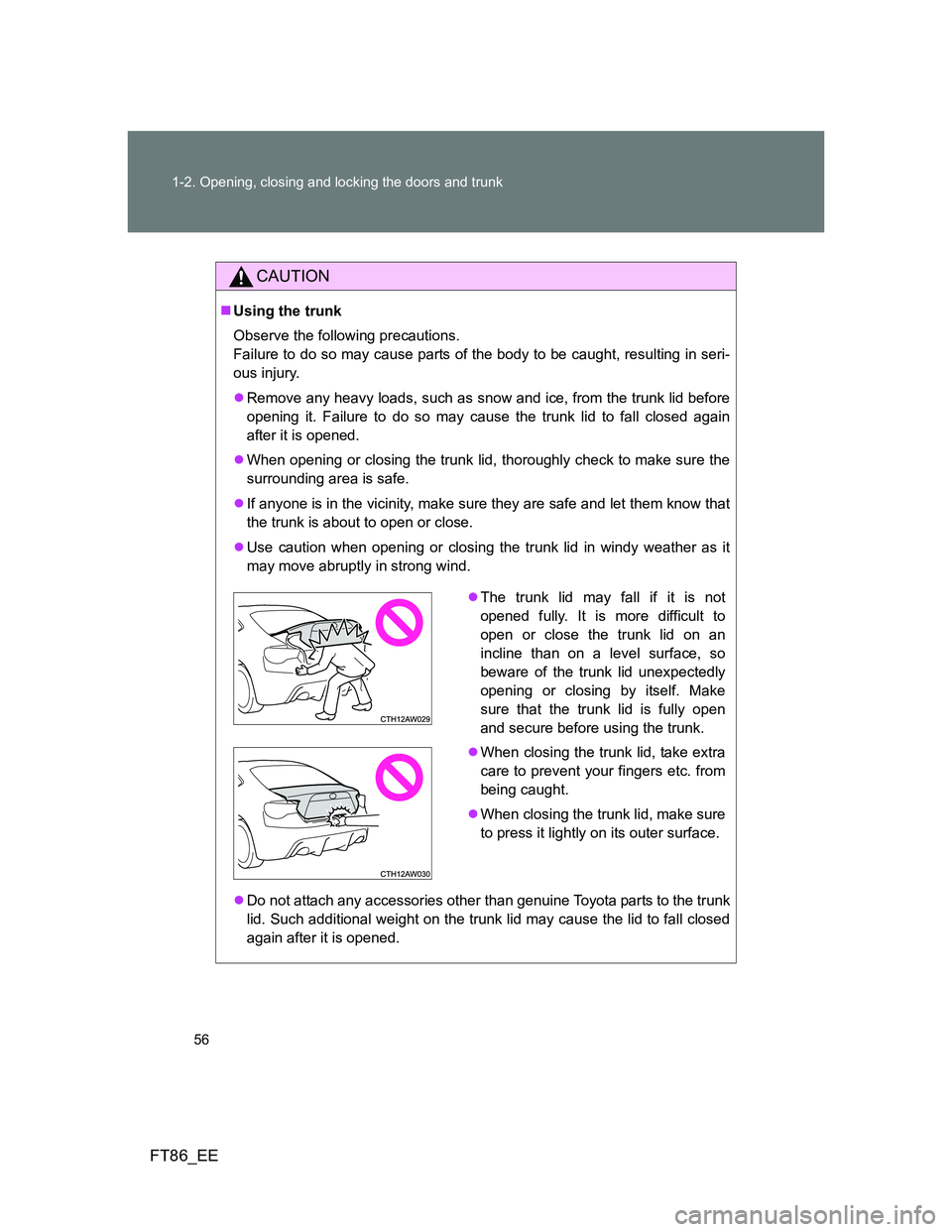
The trunk lid may fall if it is not
opened fully. It is more difficult to
open or close the trunk lid on an
incline than on a level surface, so
beware of the trunk lid unexpectedly
opening or closing by itself. Make
sure that the trunk lid is fully open
and secure before using the trunk.
When closing the trunk lid, take extra
care to prevent your fingers etc. from
being caught.
When closing the trunk lid, make sure
to press it lightly on its outer surface.
Page 57 of 448
57 1-2. Opening, closing and locking the doors and trunk
1
Before driving
FT86_EE
NOTICE
Trunk damper stays
The trunk lid is equipped with damper stays that hold the trunk lid in place.
Observe the following precautions.
Failure to do so may cause damage to trunk damper stays, resulting in a
malfunction.
Do not attach any foreign objects such as stickers, plastic sheets and
adhesives to damper stay rods.
Do not touch damper stay rods with gloves or other fabric items.
Do not attach any accessories other than genuine Toyota parts to the trunk
lid.
Do not apply lateral force to damper stays or place your hand on it.
Page 62 of 448
62
1-3. Adjustable components (seats, mirrors, steering wheel)
FT86_EE
Rear seats
Seat dust cover
Always remove the seat dust cover that may be attached at the time of pur-
chase before using the seat.
CAUTION
When folding the rear seatbacks down
Observe the following precautions. Failure to do so may result in death or
serious injury.
Do not fold the seatbacks down while driving.
Stop the vehicle on level ground, set the parking brake and shift the shift
lever to P (automatic transmission) or N (manual transmission).
Do not allow anyone to sit on a folded seatback or in the trunk while driv-
ing.
Do not allow children to enter the trunk.
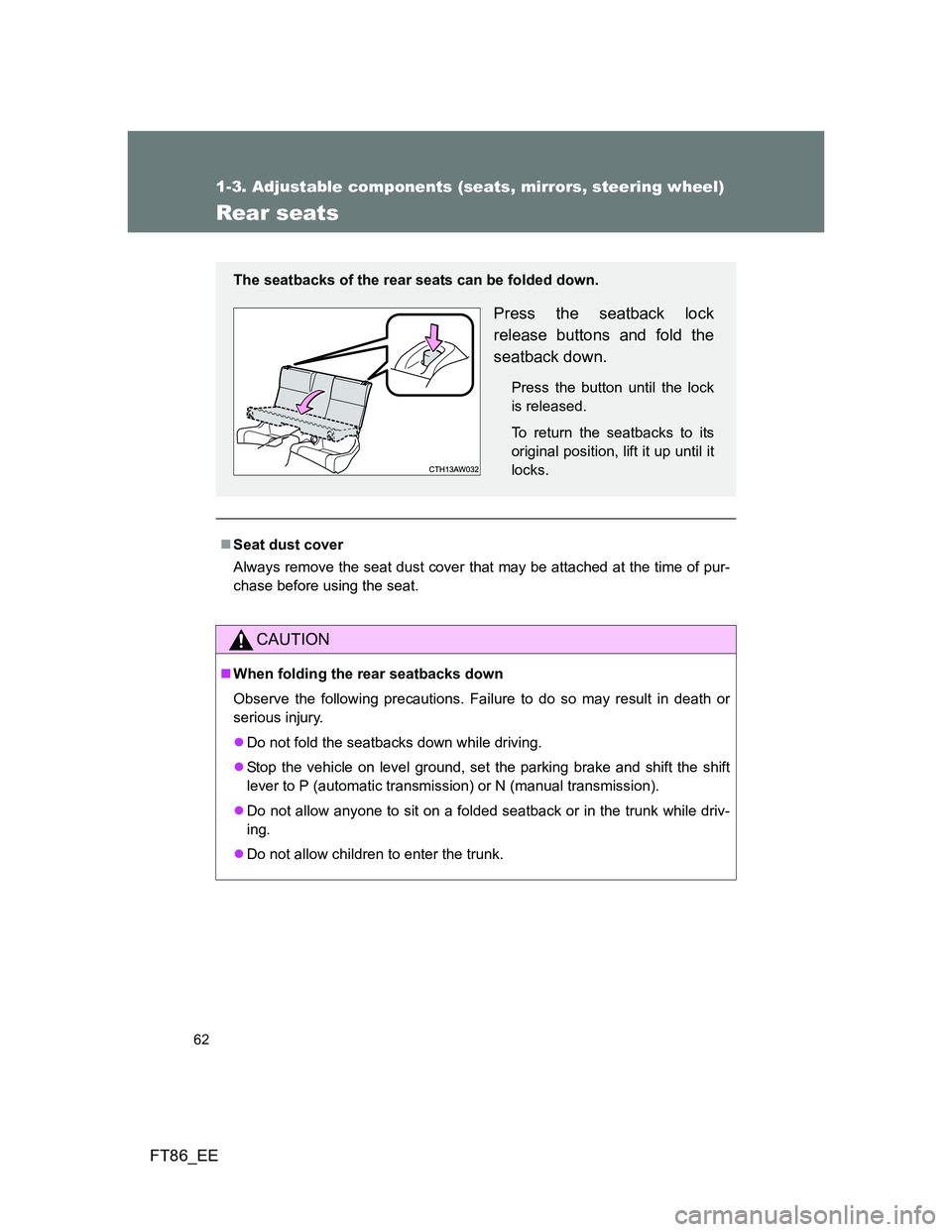
The seatbacks of the rear seats can be folded down.
Press the seatback lock
release buttons and fold the
seatback down.
Press the button until the lock
is released.
To return the seatbacks to its
original position, lift it up until it
locks.
Page 132 of 448
132 1-7. Safety information
FT86_EE
CAUTION
Child restraint precautions
Never use a rear-facing child restraint system on the front passenger seat
when the airbag manual on-off switch is on. (P. 148)
In the event of an accident, the force of the rapid inflation of the front pas-
senger airbag can cause death or serious injury to the child.
A forward-facing child restraint system should be allowed to be installed
on the front passenger seat only when it is unavoidable. Always move the
seat as far back as possible, because the front passenger airbag could
inflate with considerable speed and force. Otherwise, the child may be
killed or seriously injured.
Do not allow the child to lean his/her head or any part of his/her body
against the door or the area of the seat, front and rear pillars or roof side
rails from which the SRS side airbags or SRS curtain shield airbags deploy
even if the child is seated in the child restraint system. It is dangerous if
the SRS side airbags and curtain shield airbags inflate, and the impact
could cause death or serious injury to the child.
Make sure you have complied with all installation instructions provided by
the child restraint manufacturer and that the system is properly secured. If
it is not secured properly, it may cause death or serious injury to the child
in the event of a sudden stop, sudden swerve or an accident.
When children are in the vehicle
Do not allow children to play with the seat belt. If the seat belt becomes
twisted around a child’s neck, it may lead to choking or other serious injuries
that could result in death.
If this occurs and the buckle cannot be unfastened, scissors should be used
to cut the belt.
When the child restraint system is not in use
Keep the child restraint system properly secured on the seat even if it is
not in use. Do not store the restraint unsecured in the passenger compart-
ment.
If it is necessary to detach the child restraint system, remove it from the
vehicle or store it securely in the trunk. This will prevent it from injuring
passengers in the event of a sudden stop, sudden swerve or an accident.
Page 157 of 448
157 2-1. Driving procedures
2
When driving
FT86_EE
CAUTION
On vehicles with an automatic transmission, do not let the vehicle roll
backward while the shift lever is in a driving position, or roll forward while
the shift lever is in R.
Doing so may cause the engine to stall or lead to poor brake and steering
performance, resulting in an accident or damage to the vehicle.
If the smell of exhaust is noticed inside the vehicle, open the windows and
check that the trunk is closed. Large amounts of exhaust in the vehicle can
cause driver drowsiness and an accident, resulting in death or a serious
health hazard. Have the vehicle inspected by any authorized Toyota dealer
or repairer, or another duly qualified and equipped professional immedi-
ately.
On vehicles with a manual transmission, do not shift the shift lever to R
while the vehicle is moving forward.
Doing so can damage the transmission and may result in a loss of vehicle
control.
Do not shift the shift lever to D (vehicles with an automatic transmission) or
1 (vehicles with a manual transmission) while the vehicle is moving back-
ward.
Doing so can damage the transmission and may result in a loss of vehicle
control.
On vehicles with a manual transmission, do not release the clutch pedal
too quickly. Doing so may propel the vehicle forward, possibly causing an
accident.
Moving the shift lever to N while the vehicle is moving will disengage the
engine from the transmission. Engine braking is not available when N is
selected.
During normal driving, do not turn off the engine. Turning the engine off
while driving will not cause loss of steering or braking control, but the
power assist to these systems will be lost. This will make it more difficult to
steer and brake, so you should pull over and stop the vehicle as soon as it
is safe to do so.
However, in the event of an emergency, such as if it becomes impossible
to stop the vehicle in the normal way: P. 413
Page 227 of 448
227
2
When driving
FT86_EE
2-5. Driving information
Cargo and luggage
CAUTION
Things that must not be carried in the trunk
The following things may cause a fire if loaded in the trunk:
Receptacles containing gasoline
Aerosol cans
Take notice of the following information about storage precautions,
cargo capacity and load:
Stow cargo and luggage in the trunk whenever possible.
Be sure all items are secured in place.
To maintain vehicle balance while driving, position luggage
evenly within the luggage compartment.
For better fuel economy, do not carry unnecessary weight.
Page 228 of 448
228 2-5. Driving information
FT86_EE
CAUTION
Storage precautions
Observe the following precautions.
Failure to do so may result in death or serious injury.
Stow cargo and luggage in the trunk whenever possible.
To prevent cargo and luggage from sliding forward during braking, do
not stack anything in the enlarged trunk. Keep cargo and luggage low,
as close to the floor as possible.
When you fold down the rear seats, long items should not be placed
directly behind the front seats.
Never allow anyone to ride in the enlarged trunk. It is not designed for
passengers. They should ride in their seats with their seat belts prop-
erly fastened. Otherwise, they are much more likely to suffer death or
serious bodily injury, in the event of sudden braking, sudden swerving
or an accident.
Do not place cargo or luggage in or on the following locations as the
item may get under the clutch, brake or accelerator pedal and prevent
the pedals from being depressed properly, block the driver’s vision, or
hit the driver or passengers, causing an accident:
• At the feet of the driver
• On the front passenger or rear seats (when stacking items)
• On the package tray
• On the instrument panel
• On the dashboard
Secure all items in the occupant compartment, as they may shift and
injure someone during sudden braking, sudden swerving or an acci-
dent.
Load and distribution
Do not overload your vehicle.
Do not apply loads unevenly.
Improper loading may cause deterioration of steering or braking control
which may cause death or serious injury.
Page 235 of 448
3Interior features
235
FT86_EE
3-1. Using the air conditioning
system and defogger
Manual air conditioning
system ............................ 236
Automatic air conditioning
system ............................ 244
Rear window and
outside rear view
mirror defoggers ............. 252
3-2. Using the audio system
Using the AUX/USB
port ................................. 254
3-3. Using the interior lights
Interior lights list................ 255
• Interior light ..................... 256
3-4. Using the storage
features
List of storage features ..... 257
• Glove box ....................... 258
• Bottle holders ................. 259
• Cup holders/
console tray .................... 2603-5. Other interior features
Sun visors ......................... 262
Vanity mirrors.................... 263
Clock ................................. 264
Outside temperature
display ............................ 265
Ashtray.............................. 266
Power outlets .................... 267
Seat heaters ..................... 269
Floor mat........................... 271
Trunk features................... 274
Page 274 of 448
274
3-5. Other interior features
FT86_EE
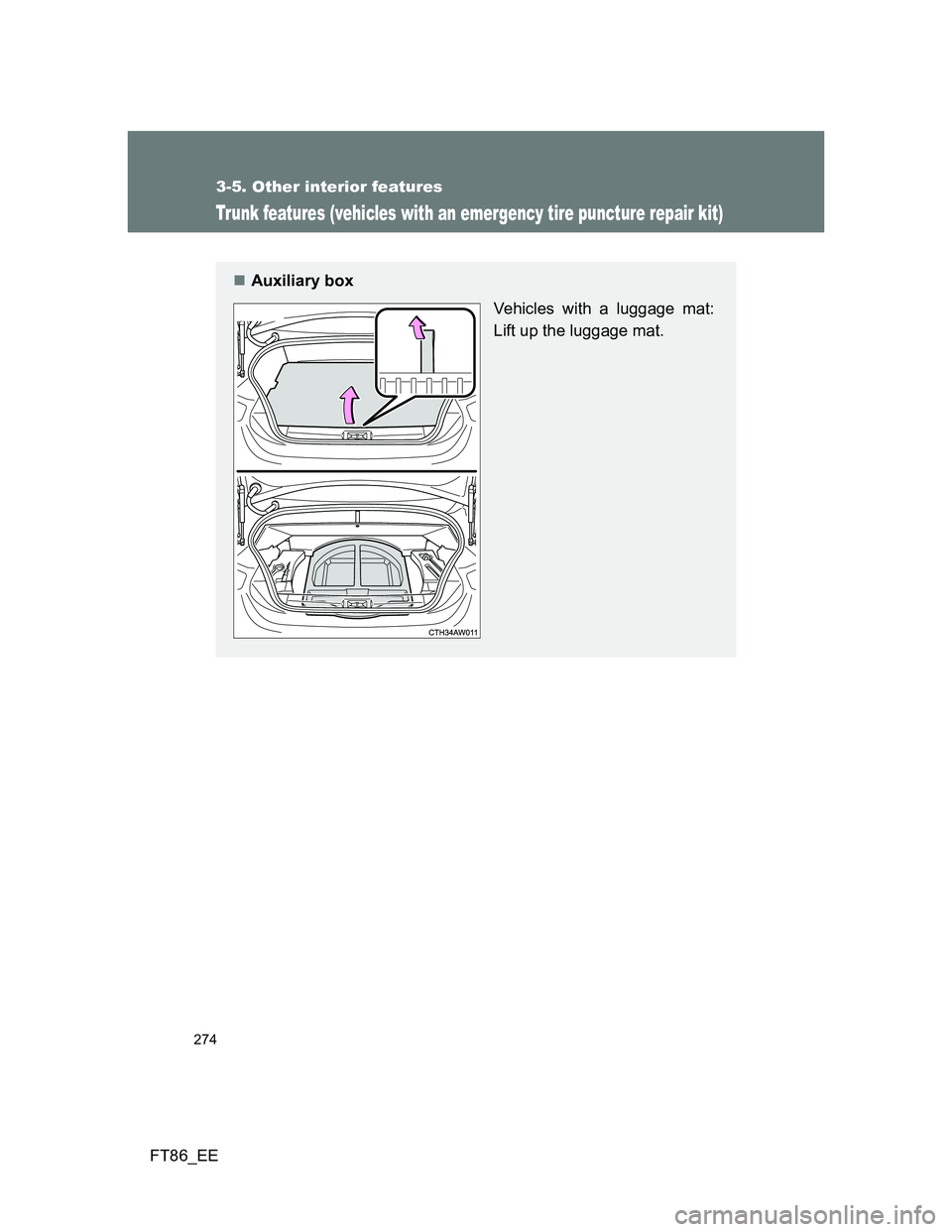
Trunk features (vehicles with an emergency tire puncture repair kit)
Auxiliary box
Vehicles with a luggage mat:
Lift up the luggage mat.