manual transmission TOYOTA GT86 2014 (in English) Owner's Manual
[x] Cancel search | Manufacturer: TOYOTA, Model Year: 2014, Model line: GT86, Model: TOYOTA GT86 2014Pages: 452, PDF Size: 14.38 MB
Page 214 of 452
214 2-3. Operating the lights and windshield wipers
FT86_EE
Daytime running light system
Vehicles with halogen headlights
Vehicles with an automatic transmission: To make your vehicle more visible
to other drivers, the daytime running lights turn on automatically whenever
the engine is started, the shift lever is shifted out of P and the parking brake
is released. Daytime running lights are not designed for use at night.
Vehicles with a manual transmission: To make your vehicle more visible to
other drivers, the daytime running lights turn on automatically whenever the
engine is started and the parking brake is released. Daytime running lights
are not designed for use at night.
Vehicles with discharge headlights
Vehicles with an automatic transmission: To make your vehicle more visible
to other drivers, the front position lights turn on automatically whenever the
engine is started, the shift lever is shifted out of P and the parking brake is
released. Daytime running lights are not designed for use at night.
Vehicles with a manual transmission: To make your vehicle more visible to
other drivers, the front position lights turn on automatically whenever the
engine is started and the parking brake is released. Daytime running lights
are not designed for use at night.
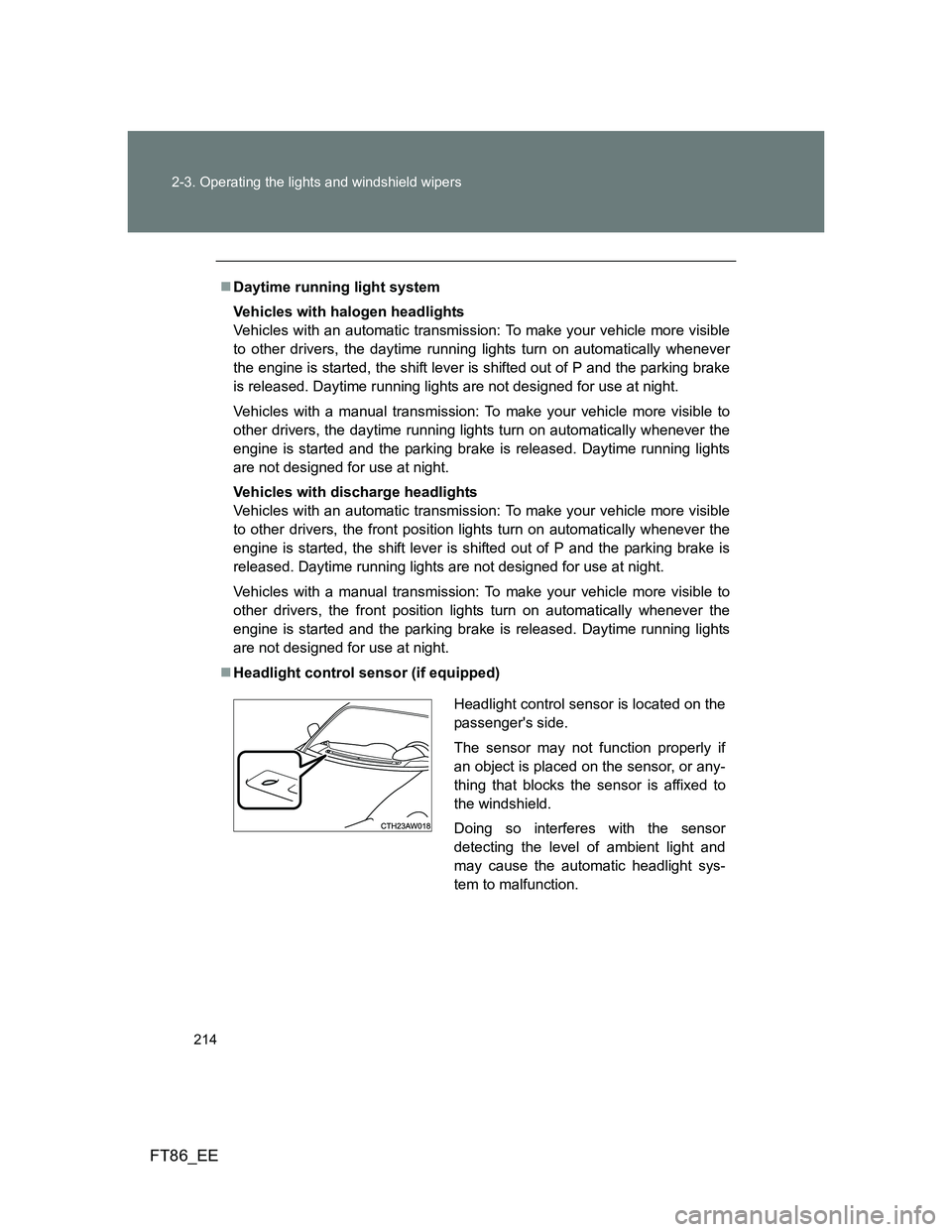
Headlight control sensor (if equipped)
Headlight control sensor is located on the
passenger's side.
The sensor may not function properly if
an object is placed on the sensor, or any-
thing that blocks the sensor is affixed to
the windshield.
Doing so interferes with the sensor
detecting the level of ambient light and
may cause the automatic headlight sys-
tem to malfunction.
Page 225 of 452
225 2-4. Using other driving systems
2
When driving
FT86_EE
Cruise control can be set when
Vehicles with an automatic transmission
The shift lever is in D or M and the vehicle is in the 2
nd gear or higher.
Vehicle speed is above approximately 40 km/h (25 mph).
Vehicles with a manual transmission
The vehicle is in the 2
nd gear or higher.
Vehicle speed is above approximately 40 km/h (25 mph).
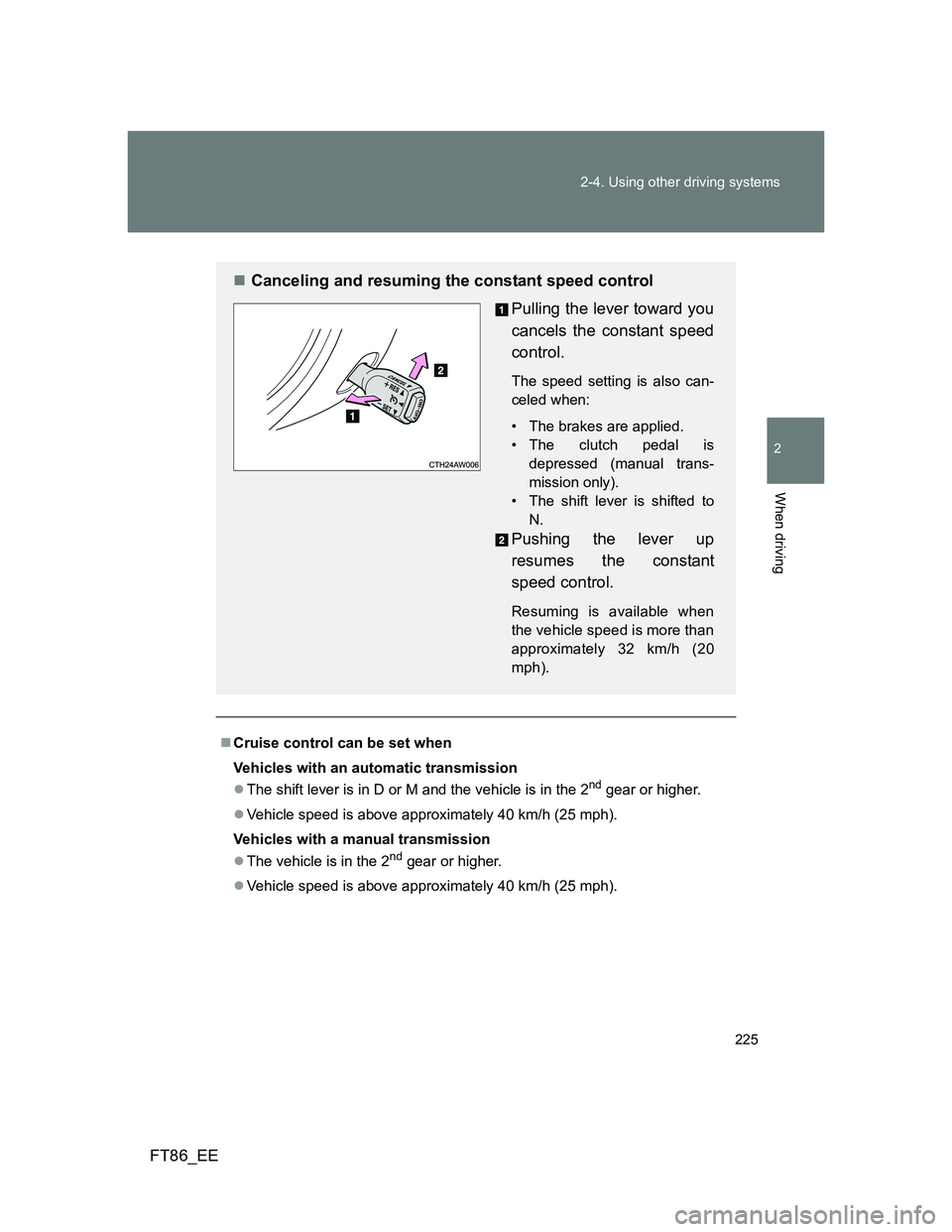
Canceling and resuming the constant speed control
Pulling the lever toward you
cancels the constant speed
control.
The speed setting is also can-
celed when:
• The brakes are applied.
• The clutch pedal is
depressed (manual trans-
mission only).
• The shift lever is shifted to
N.
Pushing the lever up
resumes the constant
speed control.
Resuming is available when
the vehicle speed is more than
approximately 32 km/h (20
mph).
Page 237 of 452
237 2-5. Driving information
2
When driving
FT86_EE
If a door is opened and closed when its side window is frozen,
the window safety device will operate and the side window
open/close function linked to door operation may not operate
correctly. If this occurs, perform the following after the ice has
melted.
Open the side window until it is approximately halfway
open.
Fully close the window by pulling the switch up to the one-
touch closing position and continue holding the switch for 1
second or more after the window fully closes.
The window position is reset and the safety device operations will
be released.
When driving the vehicle
Accelerate the vehicle slowly, keep a safe distance between you
and the vehicle ahead, and drive at a reduced speed suitable to
road conditions.
When parking the vehicle (in the winter time or in the cold
latitudes)
Park the vehicle and move the shift lever to P (automatic trans-
mission) or 1 or R (manual transmission) without setting the
parking brake. The parking brake may freeze up, preventing it
from being released. If necessary, block the wheels to prevent
inadvertent sliding or creeping.
STEP 1
STEP 2
Page 278 of 452
278 3-5. Other interior features
FT86_EE
CAUTION
Observe the following precautions.
Failure to do so may cause the driver's floor mat to slip, possibly interfering
with the pedals while driving. An unexpectedly high speed may result or it may
become difficult to stop the vehicle, leading to a serious accident, resulting in
death or serious injury.
When installing a floor mat
Do not use floor mats designed for other models or different model year
vehicles, even if they are Toyota Genuine floor mats.
Driver’s seat floor mat: Only use floor mats designed for the driver's seat.
Front: Always install the floor mat securely using the retaining hooks (clips)
provided.
Do not use two or more floor mats on top of each other.
Do not place the floor mat bottom-side up or upside-down.
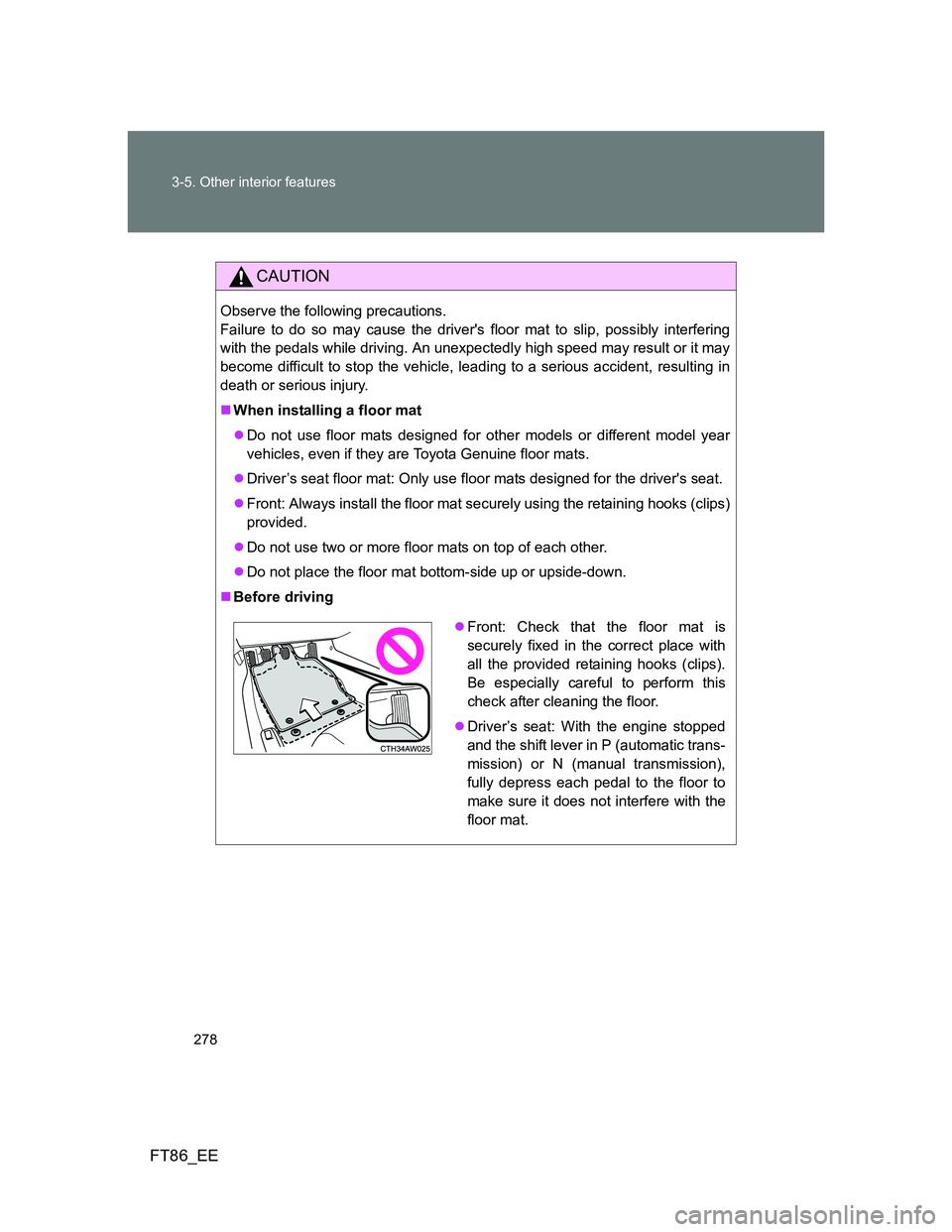
Before driving
Front: Check that the floor mat is
securely fixed in the correct place with
all the provided retaining hooks (clips).
Be especially careful to perform this
check after cleaning the floor.
Driver’s seat: With the engine stopped
and the shift lever in P (automatic trans-
mission) or N (manual transmission),
fully depress each pedal to the floor to
make sure it does not interfere with the
floor mat.
Page 303 of 452
303 4-3. Do-it-yourself maintenance
4
Maintenance and care
FT86_EE
CAUTION
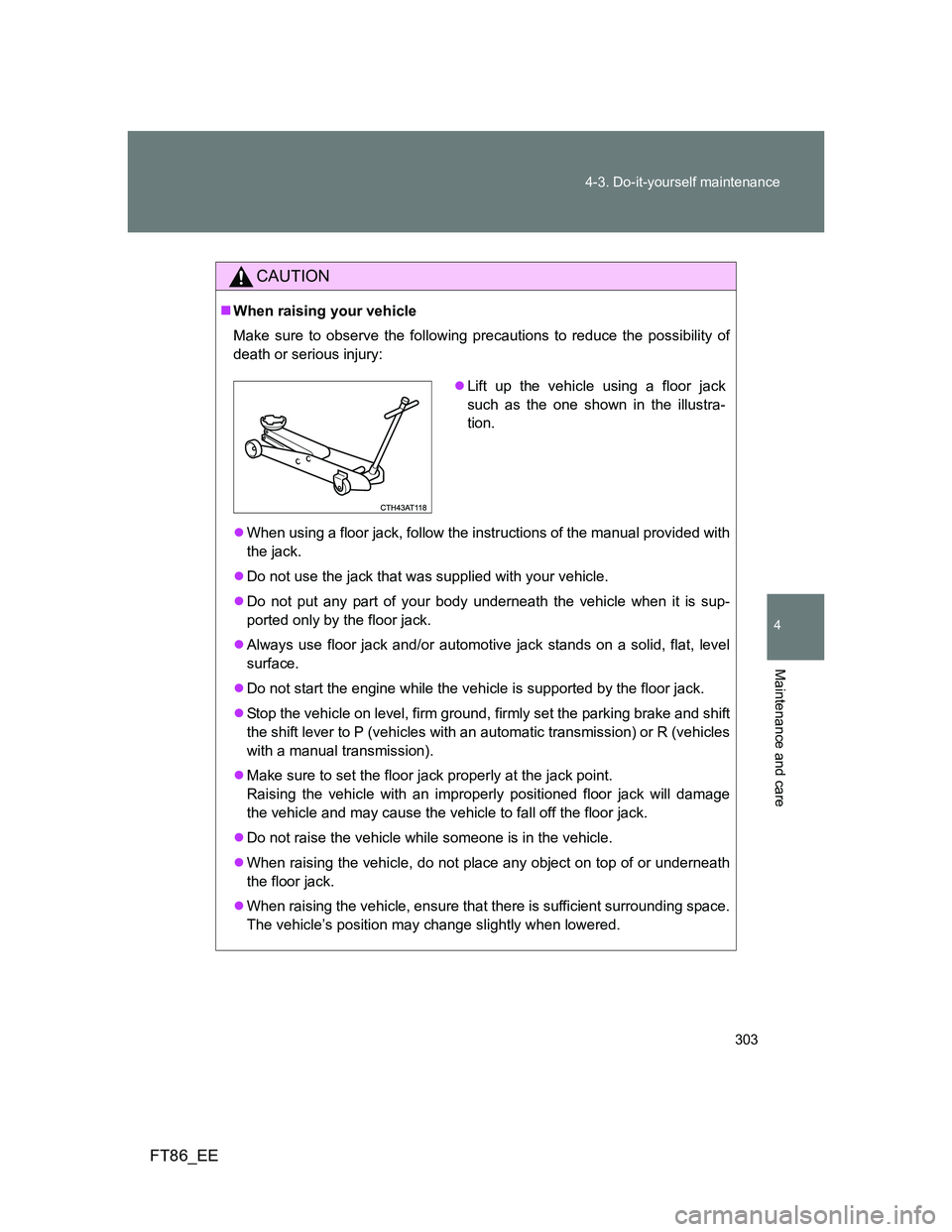
When raising your vehicle
Make sure to observe the following precautions to reduce the possibility of
death or serious injury:
When using a floor jack, follow the instructions of the manual provided with
the jack.
Do not use the jack that was supplied with your vehicle.
Do not put any part of your body underneath the vehicle when it is sup-
ported only by the floor jack.
Always use floor jack and/or automotive jack stands on a solid, flat, level
surface.
Do not start the engine while the vehicle is supported by the floor jack.
Stop the vehicle on level, firm ground, firmly set the parking brake and shift
the shift lever to P (vehicles with an automatic transmission) or R (vehicles
with a manual transmission).
Make sure to set the floor jack properly at the jack point.
Raising the vehicle with an improperly positioned floor jack will damage
the vehicle and may cause the vehicle to fall off the floor jack.
Do not raise the vehicle while someone is in the vehicle.
When raising the vehicle, do not place any object on top of or underneath
the floor jack.
When raising the vehicle, ensure that there is sufficient surrounding space.
The vehicle’s position may change slightly when lowered.
Lift up the vehicle using a floor jack
such as the one shown in the illustra-
tion.
Page 374 of 452
374 5-2. Steps to take in an emergency
FT86_EE
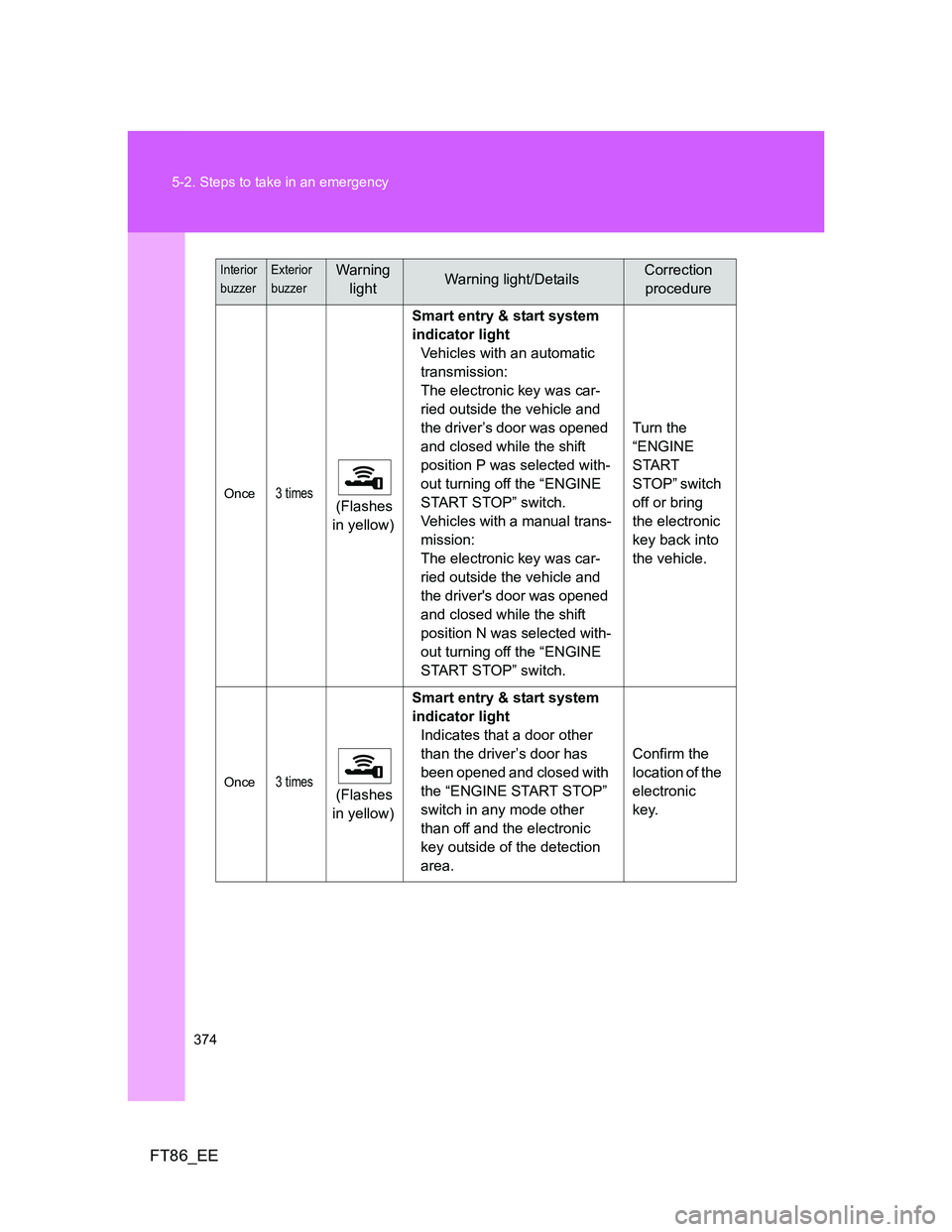
Once3 times (Flashes
in yellow)Smart entry & start system
indicator light
Vehicles with an automatic
transmission:
The electronic key was car-
ried outside the vehicle and
the driver’s door was opened
and closed while the shift
position P was selected with-
out turning off the “ENGINE
START STOP” switch.
Vehicles with a manual trans-
mission:
The electronic key was car-
ried outside the vehicle and
the driver's door was opened
and closed while the shift
position N was selected with-
out turning off the “ENGINE
START STOP” switch.Turn the
“ENGINE
START
STOP” switch
off or bring
the electronic
key back into
the vehicle.
Once3 times (Flashes
in yellow)Smart entry & start system
indicator light
Indicates that a door other
than the driver’s door has
been opened and closed with
the “ENGINE START STOP”
switch in any mode other
than off and the electronic
key outside of the detection
area.Confirm the
location of the
electronic
key.
Interior
buzzerExterior
buzzerWarning
lightWarning light/DetailsCorrection
procedure
Page 376 of 452
376 5-2. Steps to take in an emergency
FT86_EE
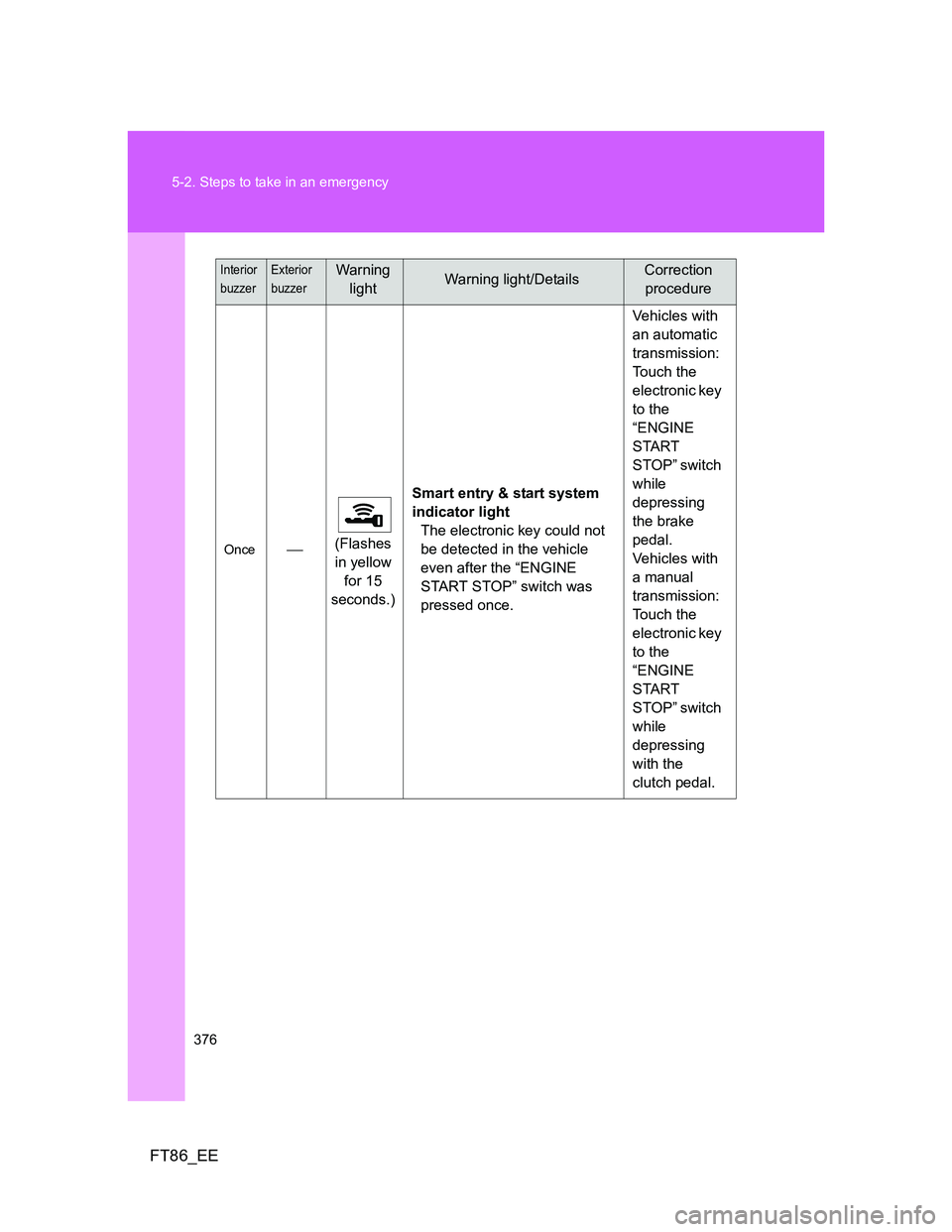
Once(Flashes
in yellow
for 15
seconds.)Smart entry & start system
indicator light
The electronic key could not
be detected in the vehicle
even after the “ENGINE
START STOP” switch was
pressed once.Vehicles with
an automatic
transmission:
Touch the
electronic key
to the
“ENGINE
START
STOP” switch
while
depressing
the brake
pedal.
Vehicles with
a manual
transmission:
Touch the
electronic key
to the
“ENGINE
START
STOP” switch
while
depressing
with the
clutch pedal.
Interior
buzzerExterior
buzzerWarning
lightWarning light/DetailsCorrection
procedure
Page 377 of 452
5
377
5-2. Steps to take in an emergency
When trouble arises
FT86_EE
If you have a flat tire (vehicles with a spare tire)
Remove the flat tire and replace it with the spare provided.
Before jacking up the vehicle
Stop the vehicle on a hard, flat surface.
Set the parking brake.
Shift the shift lever to P (vehicles with an automatic transmis-
sion) or R (vehicles with a manual transmission).
Stop the engine.
Turn on the emergency flashers.
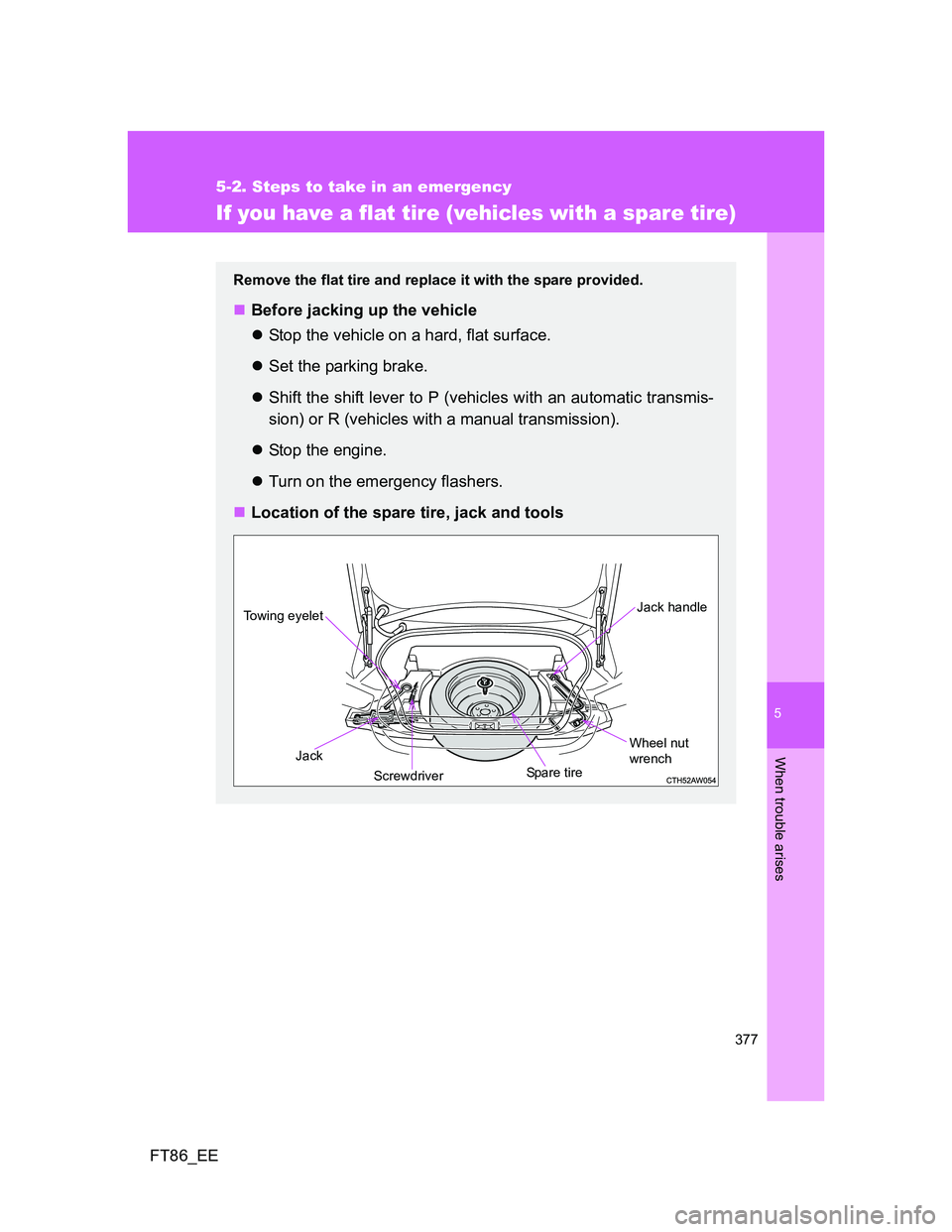
Location of the spare tire, jack and tools
Jack handle
Spare tire Towing eyelet
Screwdriver JackWheel nut
wrench
Page 385 of 452
5
385
5-2. Steps to take in an emergency
When trouble arises
FT86_EE
If you have a flat tire (vehicles with an emergency tire puncture repair kit)
A puncture caused by a nail or screw passing through the tire tread
can be repaired temporarily using the emergency tire puncture repair
kit. (The kit contains a bottle of sealant. The sealant can be used only
once to temporarily repair one tire without removing the nail or
screw from the tire.) Depending on the damage, this kit cannot be
used to repair the tire. (P. 388)
After temporarily repairing the tire with the kit, have the tire repaired
or replaced by any authorized Toyota dealer or repairer, or another
duly qualified and equipped professional. Repairs conducted using
the emergency tire puncture repair kit are only a temporary measure.
Have the tire repaired and replaced as soon as possible.
Before repairing the tire
Stop the vehicle in a safe place on a hard, flat surface.
Set the parking brake.
Shift the shift lever to P (vehicles with an automatic transmis-
sion) or N (vehicles with a manual transmission).
Stop the engine.
Turn on the emergency flashers.
Page 402 of 452
402 5-2. Steps to take in an emergency
FT86_EEVehicles with a manual transmission
Set the parking brake.
Put the shift lever in N.
Turn the “ENGINE START STOP” switch to ACCESSORY
mode.
Push and hold the “ENGINE START STOP” switch for about
15 seconds while depressing the brake pedal and clutch
pedal firmly.
Even if the engine can be started using the above steps, the system
may be malfunctioning. Have the vehicle checked by any authorized
Toyota dealer or repairer, or another duly qualified and equipped pro-
fessional.
STEP 1
STEP 2
STEP 3
STEP 4