light TOYOTA GT86 2015 (in English) User Guide
[x] Cancel search | Manufacturer: TOYOTA, Model Year: 2015, Model line: GT86, Model: TOYOTA GT86 2015Pages: 464, PDF Size: 10.65 MB
Page 37 of 464
37 1-2. Opening, closing and locking the doors and trunk
1
Before driving
Operation signals
The emergency flashers flash to indicate that the doors have been locked/
unlocked. (Locked: once; Unlocked: twice)
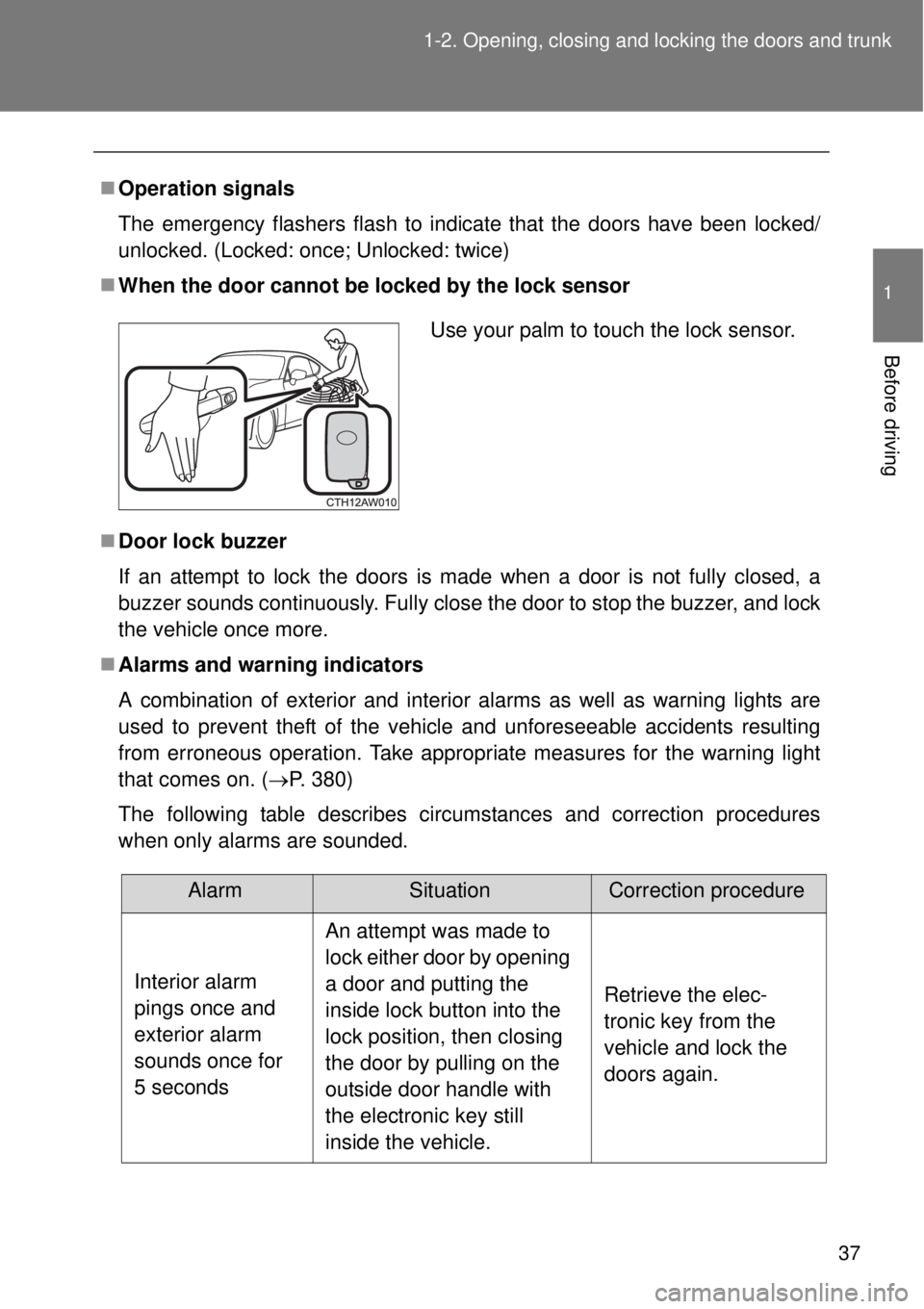
When the door cannot be locked by the lock sensor
Door lock buzzer
If an attempt to lock the doors is made when a door is not fully closed, a
buzzer sounds continuously. Fully close the door to stop the buzzer, and lock
the vehicle once more.
Alarms and warning indicators
A combination of exterior and interior alarms as well as warning lights are
used to prevent theft of the vehicle and unforeseeable accidents resulting
from erroneous operation. Take appropriate measures for the warning light
that comes on. (P. 380)
The following table describes circumstances and correction procedures
when only alarms are sounded.
Use your palm to touch the lock sensor.
AlarmSituationCorrection procedure
Interior alarm
pings once and
exterior alarm
sounds once for
5 secondsAn attempt was made to
lock either door by opening
a door and putting the
inside lock button into the
lock position, then closing
the door by pulling on the
outside door handle with
the electronic key still
inside the vehicle.Retrieve the elec-
tronic key from the
vehicle and lock the
doors again.
Page 42 of 464

42 1-2. Opening, closing and locking the doors and trunk
Notes for locking the doors
Touching the door lock sensor while wearing gloves may delay or prevent
lock operation. Remove the gloves and touch the lock sensor again.
Vehicles without a double locking system: When the lock operation is
performed using the lock sensor, recognition signals will be shown up to
two consecutive times. After this, no recognition signals will be given.
If the door handle becomes wet when washing the vehicle while the elec-
tronic key is within the effective range, the door may lock and unlock
repeatedly. In this case, place the electronic key in a location 2 m (6 ft.) or
more away from the vehicle (take care to ensure that the key is not sto-
len), and continue to wash the vehicle.
If the electronic key is inside the vehicle and a door handle becomes wet
during a car wash, a buzzer will sound outside the vehicle. To turn off the
alarm, lock all the doors.
The lock sensor may not work properly if it comes into contact with ice,
snow, mud, etc. Clean the lock sensor and attempt to operate it again.
Notes for the unlocking function
A sudden approach to the effective range or door handle may prevent the
doors from being unlocked. In this case, return the door handle to the
original position and check that the doors unlock before pulling the door
handle again.
Gripping the door handle when wearing a glove may not unlock the door.
Remove the gloves and touch the sensor on the back of the handle
again.
If the door handle becomes wet when washing the vehicle while the elec-
tronic key is within the effective range, the door may lock and unlock
repeatedly. In this case, place the electronic key in a location 2 m (6 ft.) or
more away from the vehicle (take care to ensure that the key is not sto-
len), and continue to wash the vehicle.
If there is another electronic key in the detection area, it may take slightly
longer to unlock the doors after the door handle is gripped.
Page 57 of 464

57 1-2. Opening, closing and locking the doors and trunk
1
Before driving
Window open/close function linked to door operation
In order to make opening and closing the doors easier, completely closed
windows are linked to door operations. Therefore, when a door is opened, its
window opens slightly. When a door is closed, its window closes completely.
However, if the battery has discharged or is disconnected, this function will
not operate. (P. 422)
If a wrong key is used (vehicles with a double locking system)
The key cylinder rotates freely to isolate inside mechanism.
If the smart entry & start system has been deactivated in a customized
setting (vehicles with a smart entry & start system)
Use the wireless remote control or mechanical key. (P. 51, 414)
CAUTION
To prevent an accident
Observe the following precautions while driving the vehicle.
Failure to do so may result in a door opening and an occupant falling out,
resulting in death or serious injury.
Always use a seat belt.
Ensure that both side doors are properly closed.
Do not pull the inside handle of the doors while driving.
The doors may be opened and the passengers are thrown out of the vehi-
cle and it may result in serious injury or death.
Page 59 of 464

59 1-2. Opening, closing and locking the doors and trunk
1
Before driving
Trunk light
The trunk light turns on when the trunk is opened.
Function to prevent the trunk being locked with the electronic key
inside (vehicles with a smart entry & start system)
When all doors are being locked, closing the trunk lid with the electronic
key left inside the trunk will sound an alarm.
In this case, the trunk lid can be opened using the entry function.
Even when the spare electronic key is put in the trunk with all the doors
locked, the key confinement prevention function can be activated so the
trunk can be opened. In order to prevent theft, take all electronic keys
with you when leaving the vehicle.
Even when the electronic key is put in the trunk with all the doors are
locked, the key may not be detected depending on the places and the
surrounding radio wave conditions. In this case, the key confinement pre-
vention function cannot be activated, causing the doors to lock when the
trunk is closed. Make sure to check where the key is before closing the
trunk.
The key confinement prevention function cannot be activated if any one
of the doors is unlocked. In this case, open the trunk using the trunk
opener.
Using the mechanical key (vehicles with a smart entry & start system
but without the double locking system)
The trunk can be also opened using the mechanical key. (P. 414)
Page 61 of 464
61 1-2. Opening, closing and locking the doors and trunk
1
Before driving
CAUTION
Using the trunk
Observe the following precautions.
Failure to do so may cause parts of the body to be caught, resulting in seri-
ous injury.
Remove any heavy loads, such as snow and ice, from the trunk lid before
opening it. Failure to do so may cause the trunk lid to suddenly shut again
after it is opened.
When opening or closing the trunk lid, thoroughly check to make sure the
surrounding area is safe.
If anyone is in the vicinity, make sure they are safe and let them know that
the trunk is about to open or close.
Use caution when opening or closing the trunk lid in windy weather as it
may move abruptly in strong wind.
Do not attach any accessories other than genuine Toyota parts to the trunk
lid. Such additional weight on the trunk lid may cause the lid to suddenly
shut again after it is opened.
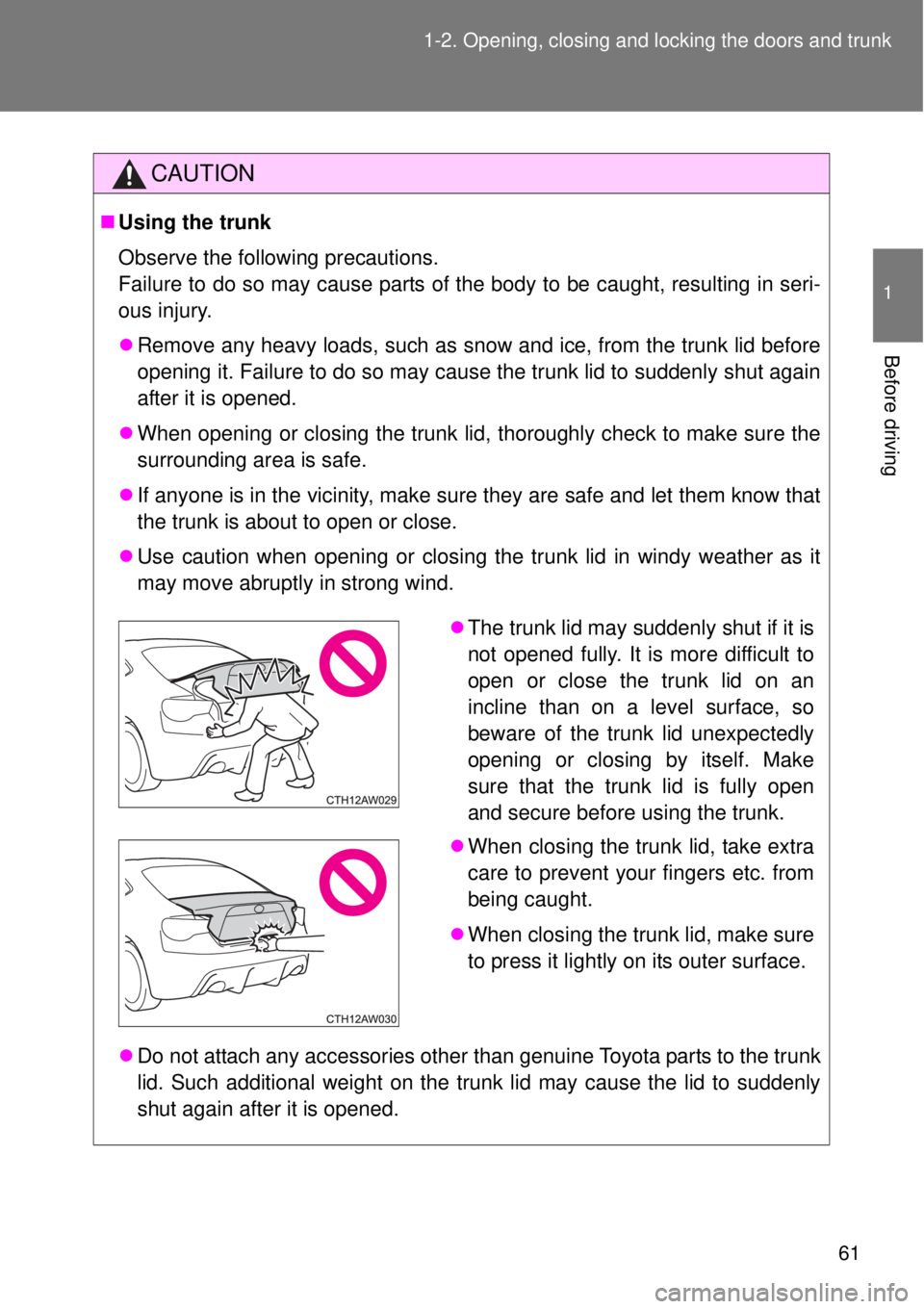
The trunk lid may suddenly shut if it is
not opened fully. It is more difficult to
open or close the trunk lid on an
incline than on a level surface, so
beware of the trunk lid unexpectedly
opening or closing by itself. Make
sure that the trunk lid is fully open
and secure before using the trunk.
When closing the trunk lid, take extra
care to prevent your fingers etc. from
being caught.
When closing the trunk lid, make sure
to press it lightly on its outer surface.
Page 68 of 464
68 1-3. Adjustable components (seats, mirrors, steering wheel)
CAUTION
After returning the rear seatback to the upright position
Observe the following precautions. Failure to do so may result in death or
serious injury.
Check that the seat belts are not twisted or caught in the seatback.
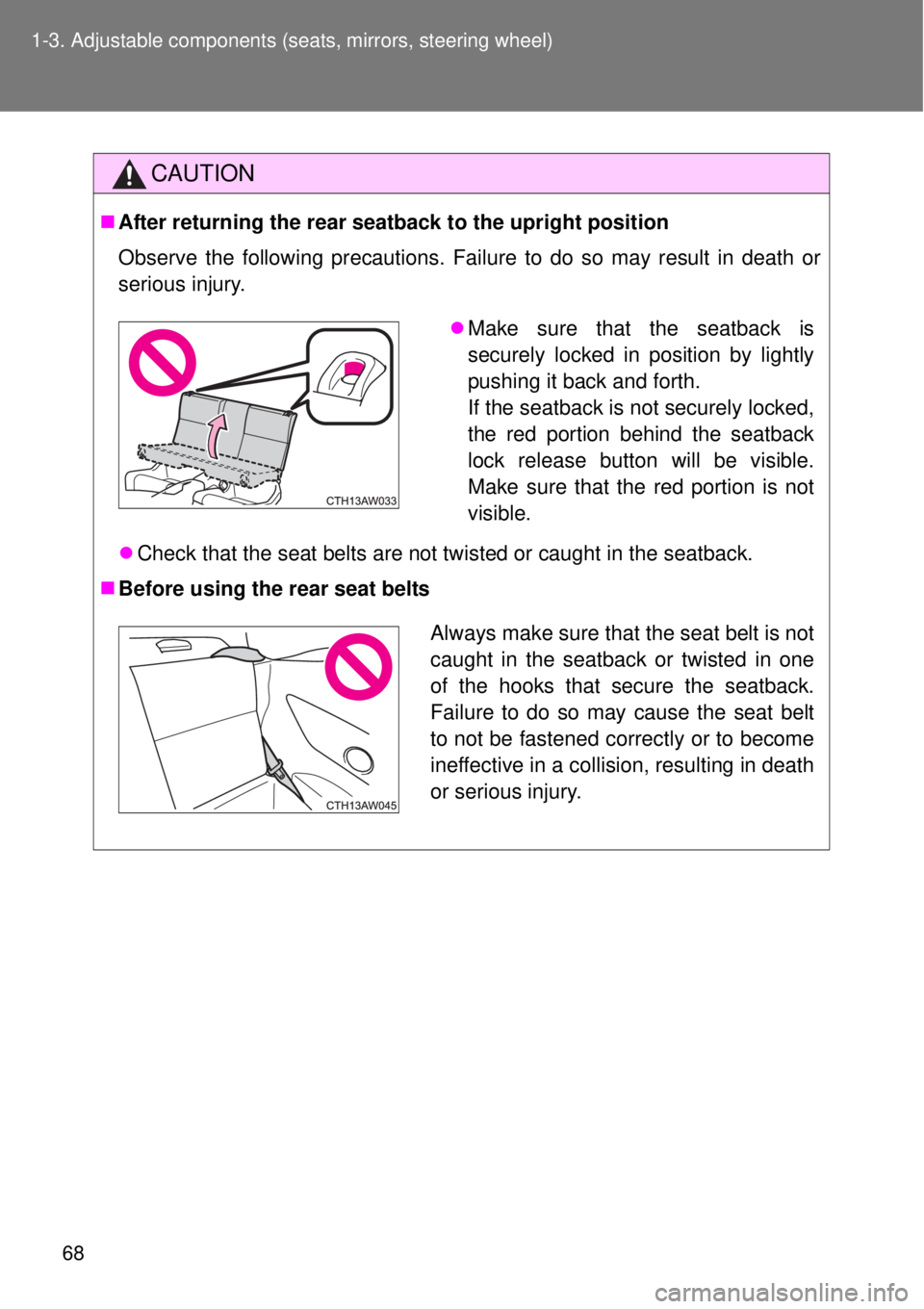
Before using the rear seat belts
Make sure that the seatback is
securely locked in position by lightly
pushing it back and forth.
If the seatback is not securely locked,
the red portion behind the seatback
lock release button will be visible.
Make sure that the red portion is not
visible.
Always make sure that the seat belt is not
caught in the seatback or twisted in one
of the hooks that secure the seatback.
Failure to do so may cause the seat belt
to not be fastened correctly or to become
ineffective in a collision, resulting in death
or serious injury.
Page 76 of 464

76 1-3. Adjustable components (seats, mirrors, steering wheel)
CAUTION
Seat belt pretensioners
If the pretensioner has activated, the SRS warning light will come on. In
that case, the seat belt cannot be used again and must be replaced at any
authorized Toyota dealer or repairer, or another duly qualified and
equipped professional.
To obtain maximum protection, the occupants should sit in an upright posi-
tion with their seat belts properly fastened.
Do not modify, remove or strike the front seat belt retractor assemblies or
surrounding area. This could result in accidental activation of the seat belt
pretensioners or could make the system inoperative, possibly resulting in
serious injury. Seat belt pretensioners have no user-serviceable parts. For
required servicing of front seat belt retractors equipped with seat belt pre-
tensioners, see any authorized Toyota dealer or repairer, or another duly
qualified and equipped professional.
When discarding front seat belt retractor assemblies or scrapping the
entire vehicle due to collision damage or for other reasons, consult any
authorized Toyota dealer or repairer, or another duly qualified and
equipped professional.
Seat belt damage and wear
Do not damage the seat belts by allowing the belt, plate, or buckle to be
jammed in the door.
Inspect the seat belt system periodically. Check for cuts, fraying, and loose
parts. Do not use a damaged seat belt until it is replaced. Damaged seat
belts cannot protect an occupant from death or serious injury.
Ensure that the belt and plate are locked and the belt is not twisted.
If the seat belt does not function correctly, immediately contact any autho-
rized Toyota dealer or repairer, or another duly qualified and equipped pro-
fessional.
Replace the seat assembly, including the belts, if your vehicle has been
involved in a serious accident, even if there's no obvious damage.
Page 79 of 464
79
1
1-3. Adjustable components (seats, mirrors, steering wheel)
Before driving
Anti-glare inside rear view mirror
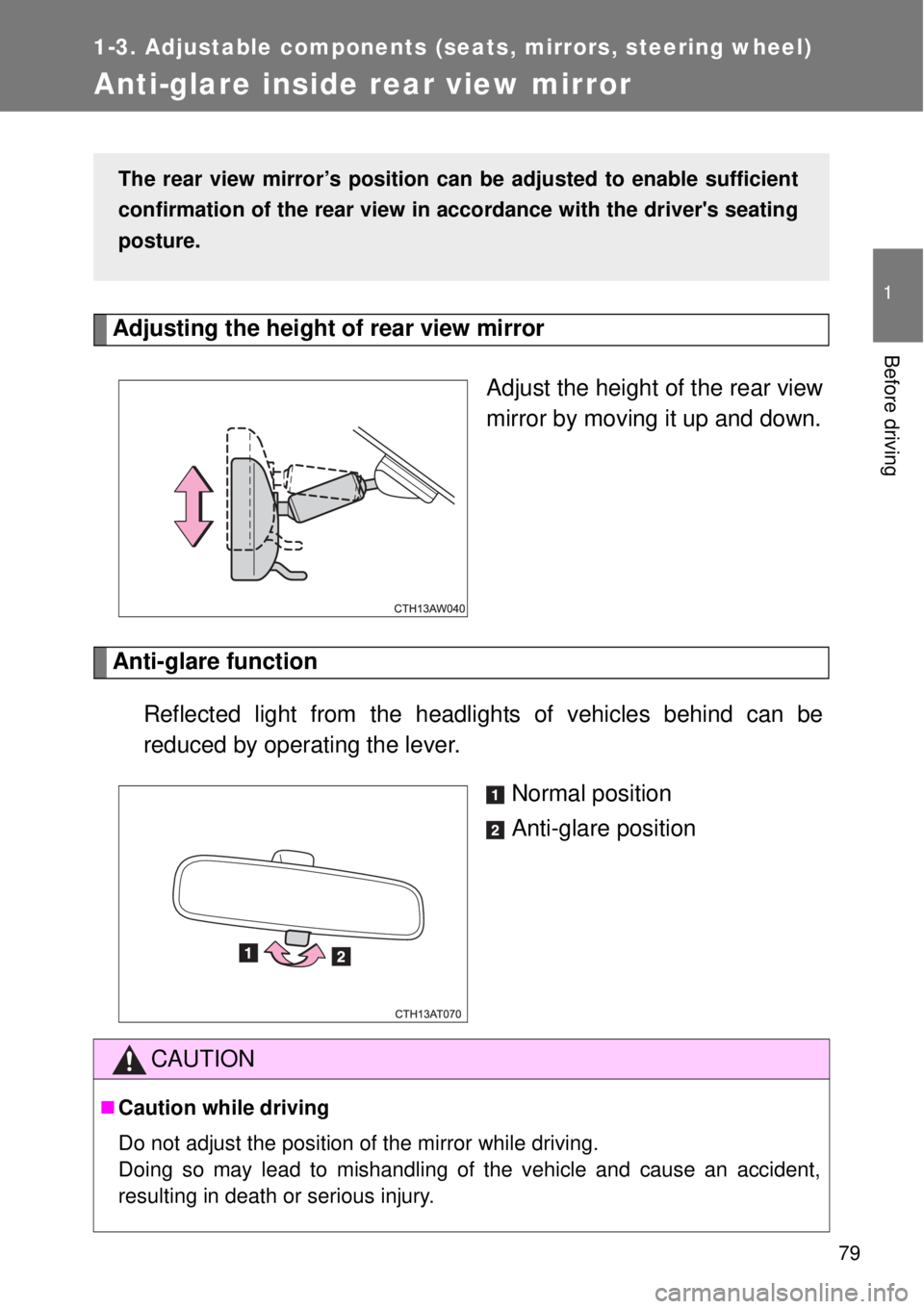
Adjusting the height of rear view mirror
Adjust the height of the rear view
mirror by moving it up and down.
Anti-glare function
Reflected light from the headlights of vehicles behind can be
reduced by operating the lever.
Normal position
Anti-glare position
The rear view mirror’s position can be adjusted to enable sufficient
confirmation of the rear view in accordance with the driver's seating
posture.
CAUTION
Caution while driving
Do not adjust the position of the mirror while driving.
Doing so may lead to mishandling of the vehicle and cause an accident,
resulting in death or serious injury.
Page 84 of 464

84 1-4. Opening and closing the windows
The power windows can be operated when
Vehicles without a smart entry & start system
The engine switch is in the “ON” position.
Vehicles with a smart entry & start system
The “ENGINE START STOP” switch is in IGNITION ON mode.
Operating the power windows after turning the engine off
Vehicles without a smart entry & start system
The power windows can be operated for approximately 45 seconds even
after the engine switch is turned to the “ACC” or “LOCK” position. They can-
not, however, be operated once either door is opened.
Vehicles with a smart entry & start system
The power windows can be operated for approximately 45 seconds even
after the “ENGINE START STOP” switch is turned to ACCESSORY mode or
turned off. They cannot, however, be operated once either door is opened.
Jam protection function
If an object becomes caught between the window and the body, window
travel is stopped and the window is opened slightly.
Page 85 of 464

85 1-4. Opening and closing the windows
1
Before driving
When the power window does not close normally
If the jam protection function is operating abnormally and a window cannot
be closed, close all the doors and perform the following operations using the
power window switch on the relevant door.
Vehicles without a smart entry & start system: After stopping the
vehicle, the engine switch is turned to the “ON” position.
Vehicles with a smart entry & start system: After stopping the vehi-
cle, the “ENGINE START STOP” switch is turned to IGNITION ON
mode.
Hold the power window switch in the one-touch closing position two
consecutive times.
Hold the power window switch in the one-touch closing position
once again and continue holding for 1 second or more after the win-
dow closes completely.
If you push the power window switch to the opening position while the win-
dow is moving, start again from the beginning. If the window continues to
close but then re-open slightly even after performing the above procedure
correctly, have the vehicle inspected by any authorized Toyota dealer or
repairer, or another duly qualified and equipped professional.
STEP 1
STEP 2
STEP 3