stop start TOYOTA GT86 2015 (in English) Manual Online
[x] Cancel search | Manufacturer: TOYOTA, Model Year: 2015, Model line: GT86, Model: TOYOTA GT86 2015Pages: 464, PDF Size: 10.65 MB
Page 416 of 464
416 5-2. Steps to take in an emergency
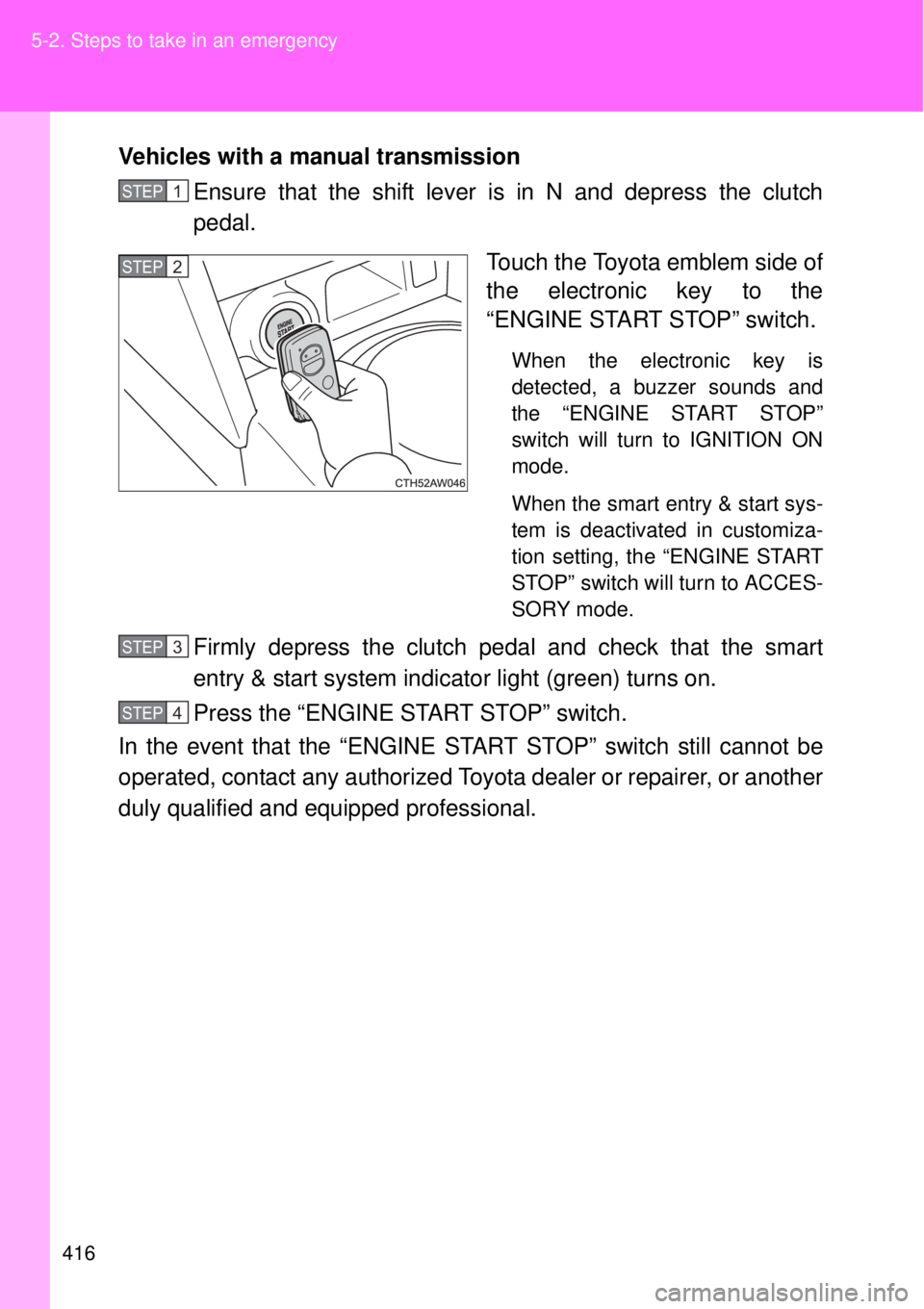
Vehicles with a manual transmission
Ensure that the shift lever is in N and depress the clutch
pedal.
Touch the Toyota emblem side of
the electronic key to the
“ENGINE START STOP” switch.
When the electronic key is
detected, a buzzer sounds and
the “ENGINE START STOP”
switch will turn to IGNITION ON
mode.
When the smart entry & start sys-
tem is deactivated in customiza-
tion setting, the “ENGINE START
STOP” switch will turn to ACCES-
SORY mode.
Firmly depress the clutch pedal and check that the smart
entry & start system indicator light (green) turns on.
Press the “ENGINE START STOP” switch.
In the event that the “ENGINE START STOP” switch still cannot be
operated, contact any authorized Toyota dealer or repairer, or another
duly qualified and equipped professional.
STEP 1
STEP 2
STEP 3
STEP 4
Page 417 of 464
5
417 5-2. Steps to take in an emergency
When trouble arises
Stopping the engine
Vehicles with an automatic transmission: Shift the shift lever to P and press
the “ENGINE START STOP” switch as you normally do when stopping the
engine.
Vehicles with a manual transmission: Shift the shift lever to N and press the
“ENGINE START STOP” switch as you normally do when stopping the
engine.
Replacing the key battery
As the above procedure is a temporary measure, it is recommended that the
electronic key battery be replaced immediately when the battery depletes.
(P. 331)
Changing “ENGINE START STOP” switch modes
Vehicles with an automatic transmission
Release the brake pedal and press the “ENGINE START STOP” switch in
above.The engine does not start and modes will be changed each
time the switch is pressed. (P. 172)
Vehicles with a manual transmission
Release the clutch pedal and press the “ENGINE START STOP” switch in
above.The engine does not start and modes will be changed each
time the switch is pressed. (P. 172)
If the doors cannot be locked or unlocked by the smart entry & start
system
Lock and unlock the doors by the mechanical key or wireless remote control.
STEP 3
STEP 3
Page 419 of 464
5
419 5-2. Steps to take in an emergency
When trouble arises
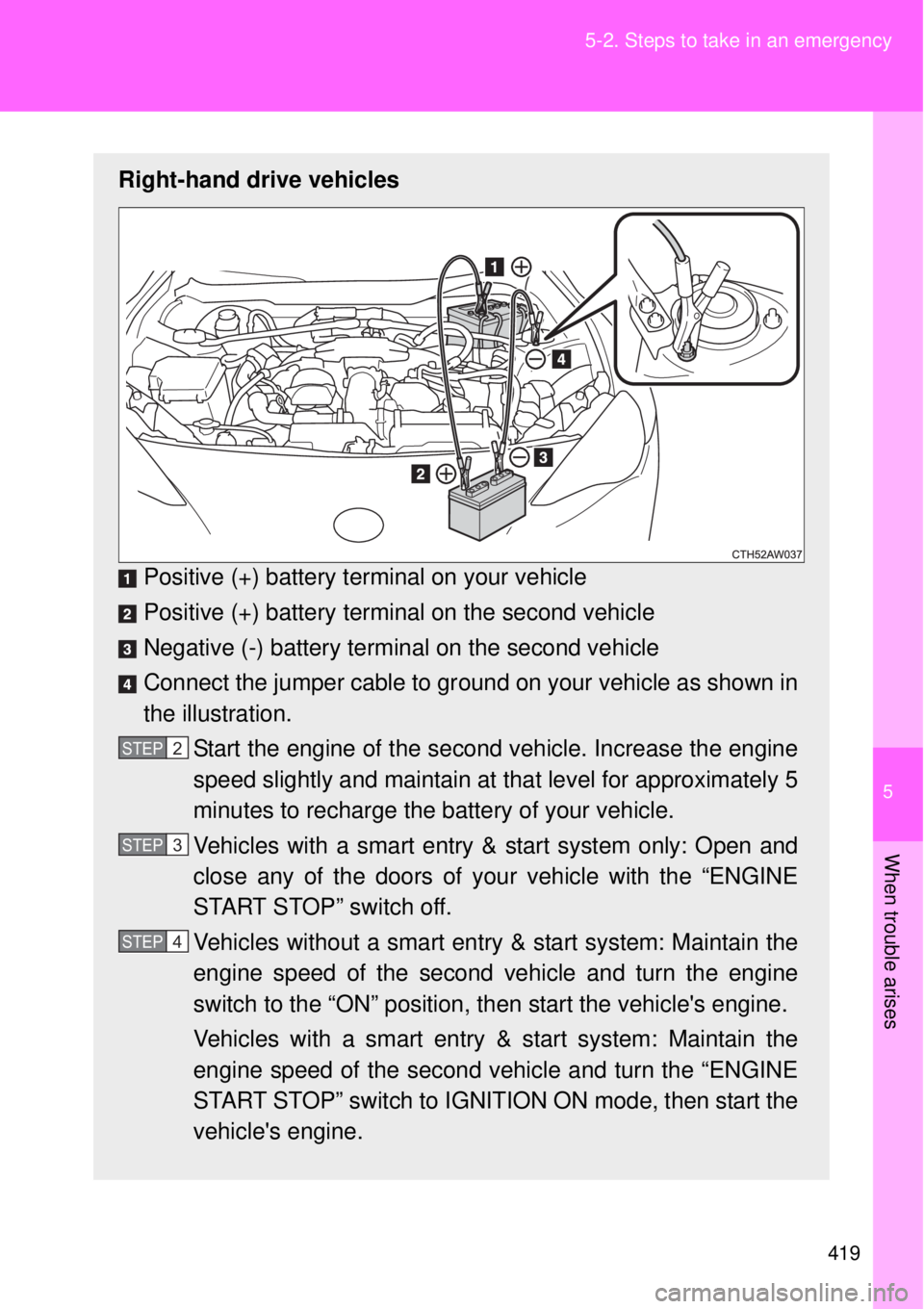
Right-hand drive vehicles
Positive (+) battery terminal on your vehicle
Positive (+) battery terminal on the second vehicle
Negative (-) battery terminal on the second vehicle
Connect the jumper cable to ground on your vehicle as shown in
the illustration.
Start the engine of the second vehicle. Increase the engine
speed slightly and maintain at that level for approximately 5
minutes to recharge the battery of your vehicle.
Vehicles with a smart entry & start system only: Open and
close any of the doors of your vehicle with the “ENGINE
START STOP” switch off.
Vehicles without a smart entry & start system: Maintain the
engine speed of the second vehicle and turn the engine
switch to the “ON” position, then start the vehicle's engine.
Vehicles with a smart entry & start system: Maintain the
engine speed of the second vehicle and turn the “ENGINE
START STOP” switch to IGNITION ON mode, then start the
vehicle's engine.
STEP 2
STEP 3
STEP 4
Page 421 of 464
5
421 5-2. Steps to take in an emergency
When trouble arises
The “ENGINE START STOP” switch mode is memorized by the vehicle.
When the battery is reconnected, the system will return to the mode it
was in before the battery was discharged. Before disconnecting the bat-
tery, turn the “ENGINE START STOP” switch off.
If you are unsure what mode the “ENGINE START STOP” switch was in
before the battery discharged, be especially careful when reconnecting
the battery.
CAUTION
Avoiding battery fires or explosions
Observe the following precautions to prevent accidentally igniting the flam-
mable gas that may be emitted from the battery.
Make sure the jumper cable is connected to the correct terminal and that it
is not unintentionally in contact with any part other than the intended termi-
nal.
Do not allow the jumper cables to come into contact with the “+” and “-” ter-
minals.
Do not allow open flame or use matches, cigarette lighters or smoke near
the battery.
Battery precautions
The battery contains poisonous and corrosive acidic electrolyte, while
related parts contain lead and lead compounds. Observe the following pre-
cautions when handling the battery.
When working with the battery, always wear safety glasses and take care
not to allow any battery fluids (acid) to come into contact with skin, clothing
or the vehicle body.
Do not lean over the battery.
In the event that battery fluid comes into contact with the skin or eyes,
immediately wash the affected area with water and seek medical attention.
Place a wet sponge or cloth over the affected area until medical attention
can be received.
Always wash your hands after handling the battery support, terminals, and
other battery-related parts.
Do not allow children near the battery.
Page 423 of 464
5
423
5-2. Steps to take in an emergency
When trouble arises
If your vehicle overheats
If your engine overheats:
Stop the vehicle in a safe place and turn off the air condi-
tioning system.
Check to see if steam is coming out from under the hood.
If you see steam:
Stop the engine. Carefully lift the hood after the steam sub-
sides and then restart the engine.
If you do not see steam:
Leave the engine running and carefully lift the hood.
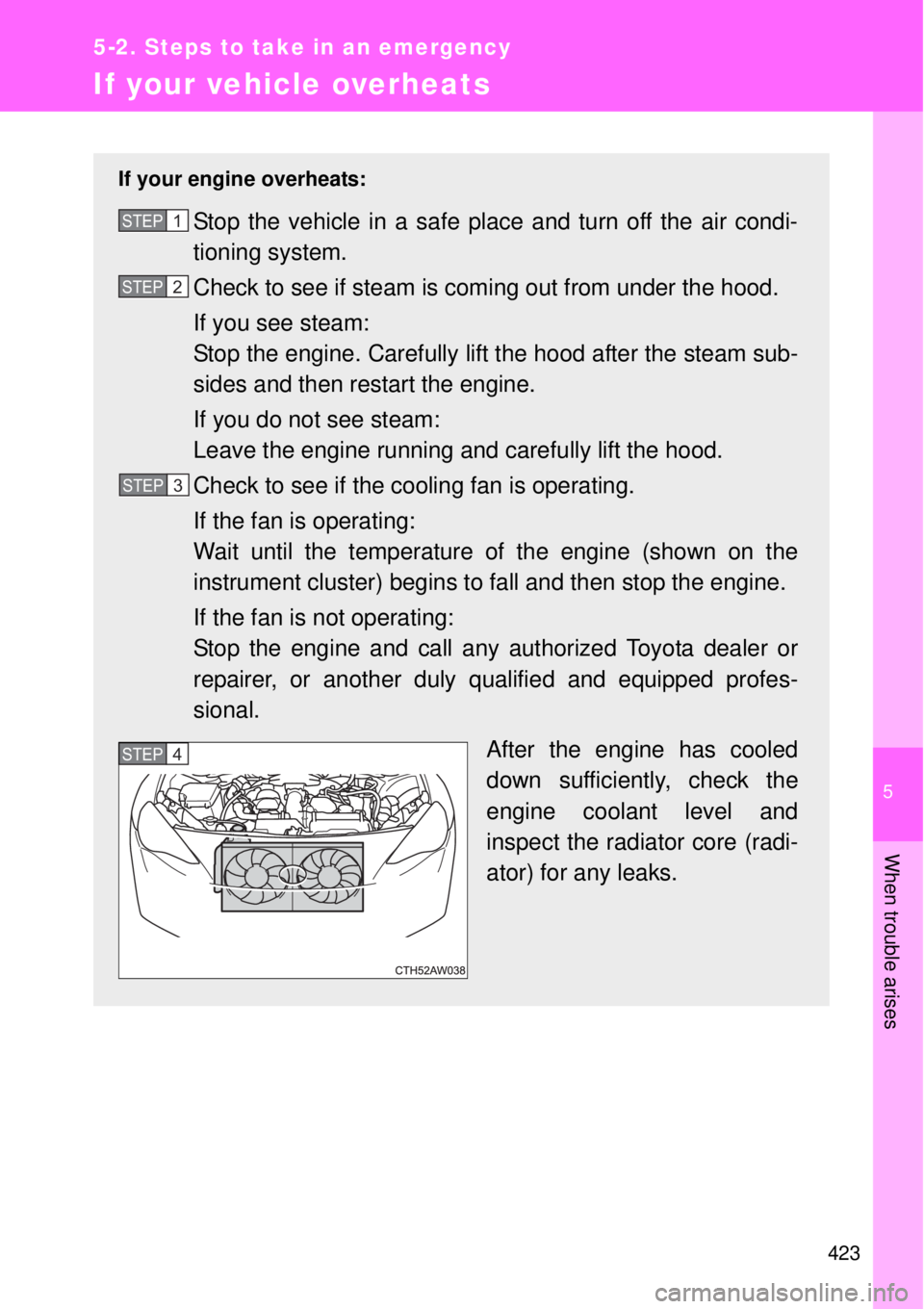
Check to see if the cooling fan is operating.
If the fan is operating:
Wait until the temperature of the engine (shown on the
instrument cluster) begins to fall and then stop the engine.
If the fan is not operating:
Stop the engine and call any authorized Toyota dealer or
repairer, or another duly qualified and equipped profes-
sional.
After the engine has cooled
down sufficiently, check the
engine coolant level and
inspect the radiator core (radi-
ator) for any leaks.STEP 1
STEP 2
STEP 3
STEP 4
Page 426 of 464
426
5-2. Steps to take in an emergency
If the vehicle becomes stuck
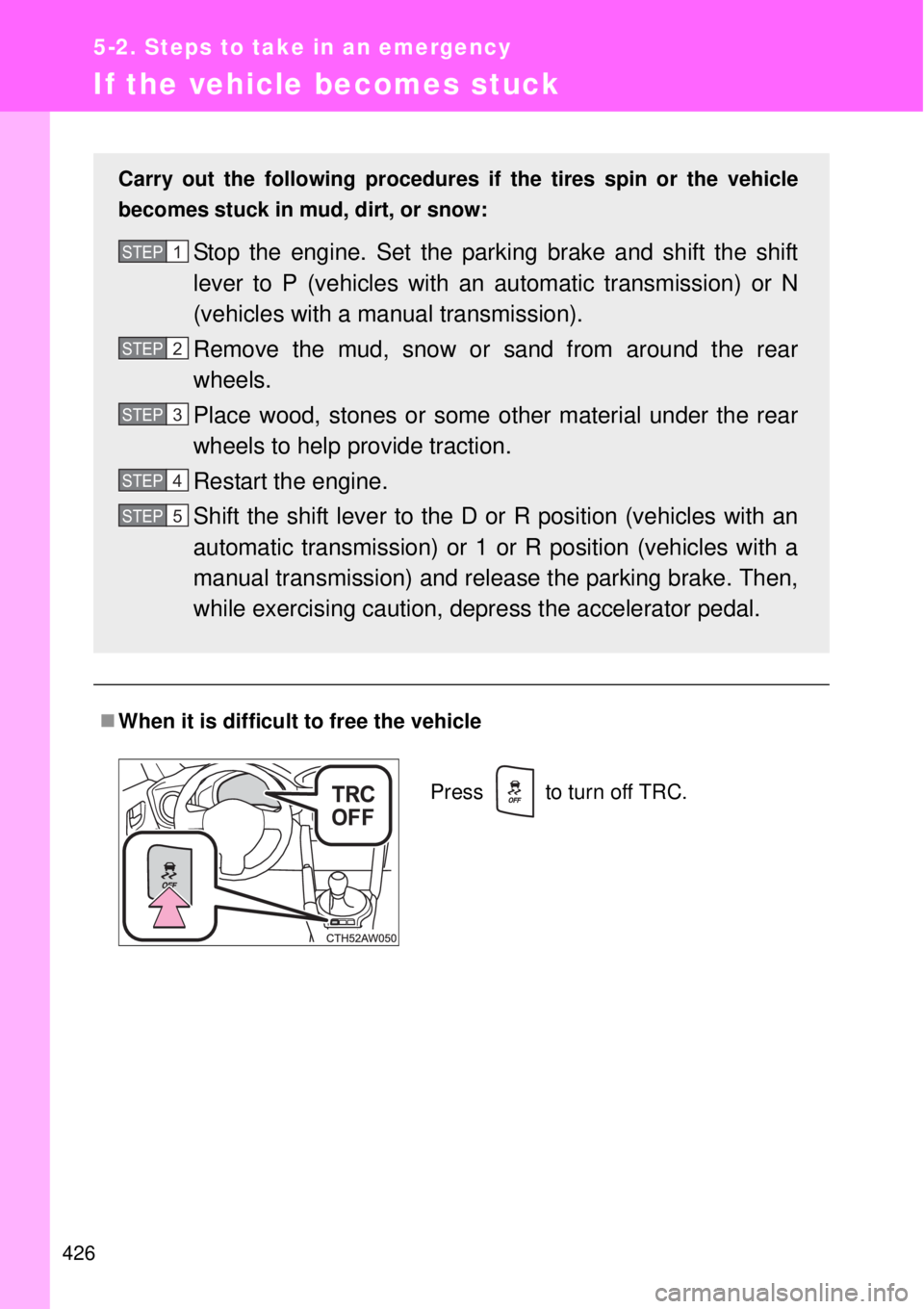
When it is difficult to free the vehicle
Carry out the following procedures if the tires spin or the vehicle
becomes stuck in mud, dirt, or snow:
Stop the engine. Set the parking brake and shift the shift
lever to P (vehicles with an automatic transmission) or N
(vehicles with a manual transmission).
Remove the mud, snow or sand from around the rear
wheels.
Place wood, stones or some other material under the rear
wheels to help provide traction.
Restart the engine.
Shift the shift lever to the D or R position (vehicles with an
automatic transmission) or 1 or R position (vehicles with a
manual transmission) and release the parking brake. Then,
while exercising caution, depress the accelerator pedal.STEP 1
STEP 2
STEP 3
STEP 4
STEP 5
Press to turn off TRC.
Page 428 of 464
428
5-2. Steps to take in an emergency
If your vehicle has to be stopped in an emergency
Only in an emergency, such as if it becomes impossible to stop the
vehicle in the normal way, stop the vehicle using the following pro-
cedure:
Steadily step on the brake pedal with both feet and firmly
depress it.
Do not pump the brake pedal repeatedly as this will increase the
effort required to slow the vehicle.
Shift the shift lever to N.
If the shift lever is shifted to N
After slowing down, stop the vehicle in a safe place by the
road.
Stop the engine.
If the shift lever cannot be shifted to N
Keep depressing the brake pedal with both feet to reduce
vehicle speed as much as possible.
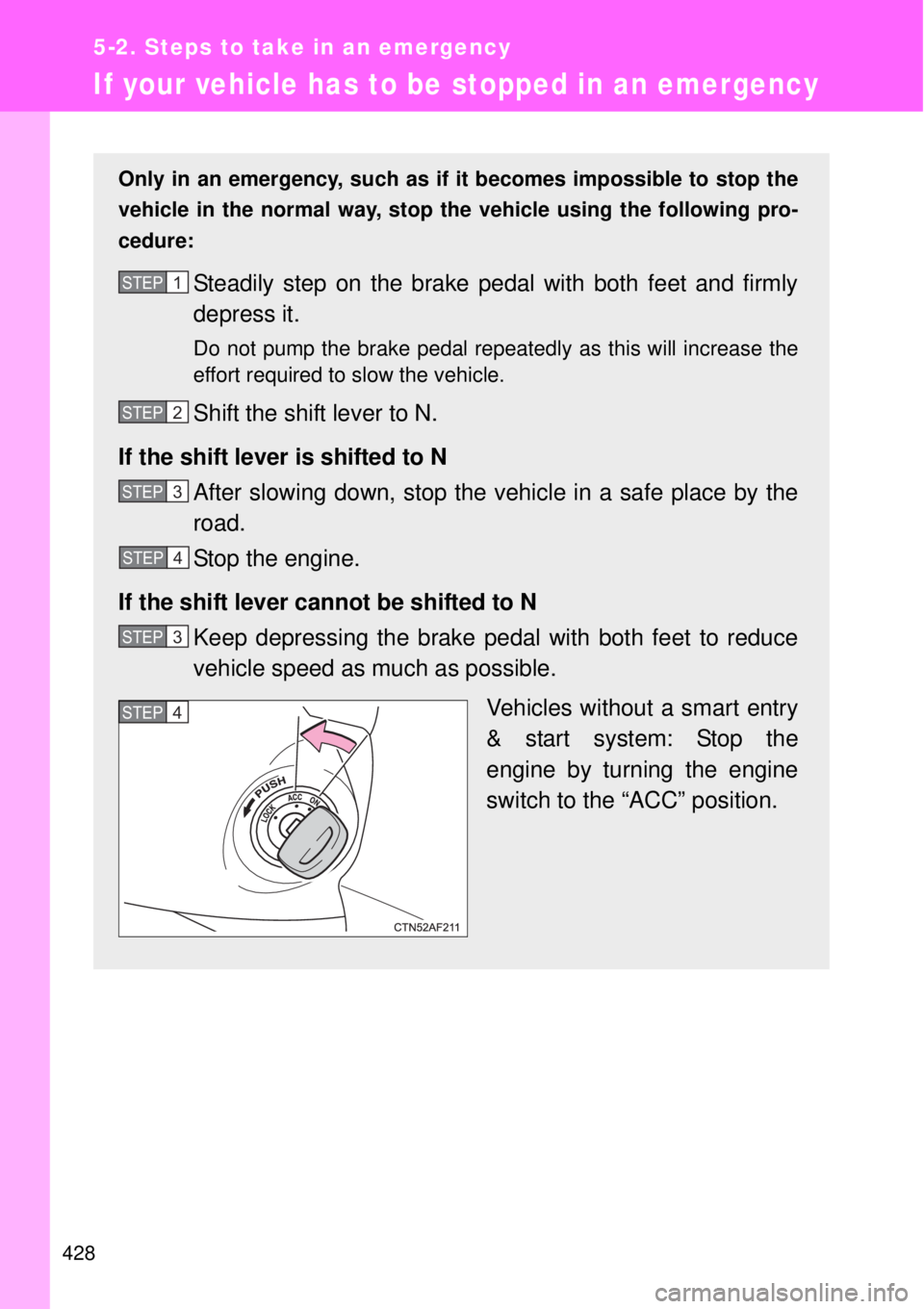
Vehicles without a smart entry
& start system: Stop the
engine by turning the engine
switch to the “ACC” position.
STEP 1
STEP 2
STEP 3
STEP 4
STEP 3
STEP 4
Page 429 of 464
5
429 5-2. Steps to take in an emergency
When trouble arises
CAUTION
If the engine has to be turned off while driving
Power assist for the brakes and steering wheel will be lost, making the
brake pedal harder to depress and the steering wheel heavier to turn.
Decelerate as much as possible before turning off the engine.
Vehicles without a smart entry & start system: Never attempt to remove
the key, as doing so will lock the steering wheel.
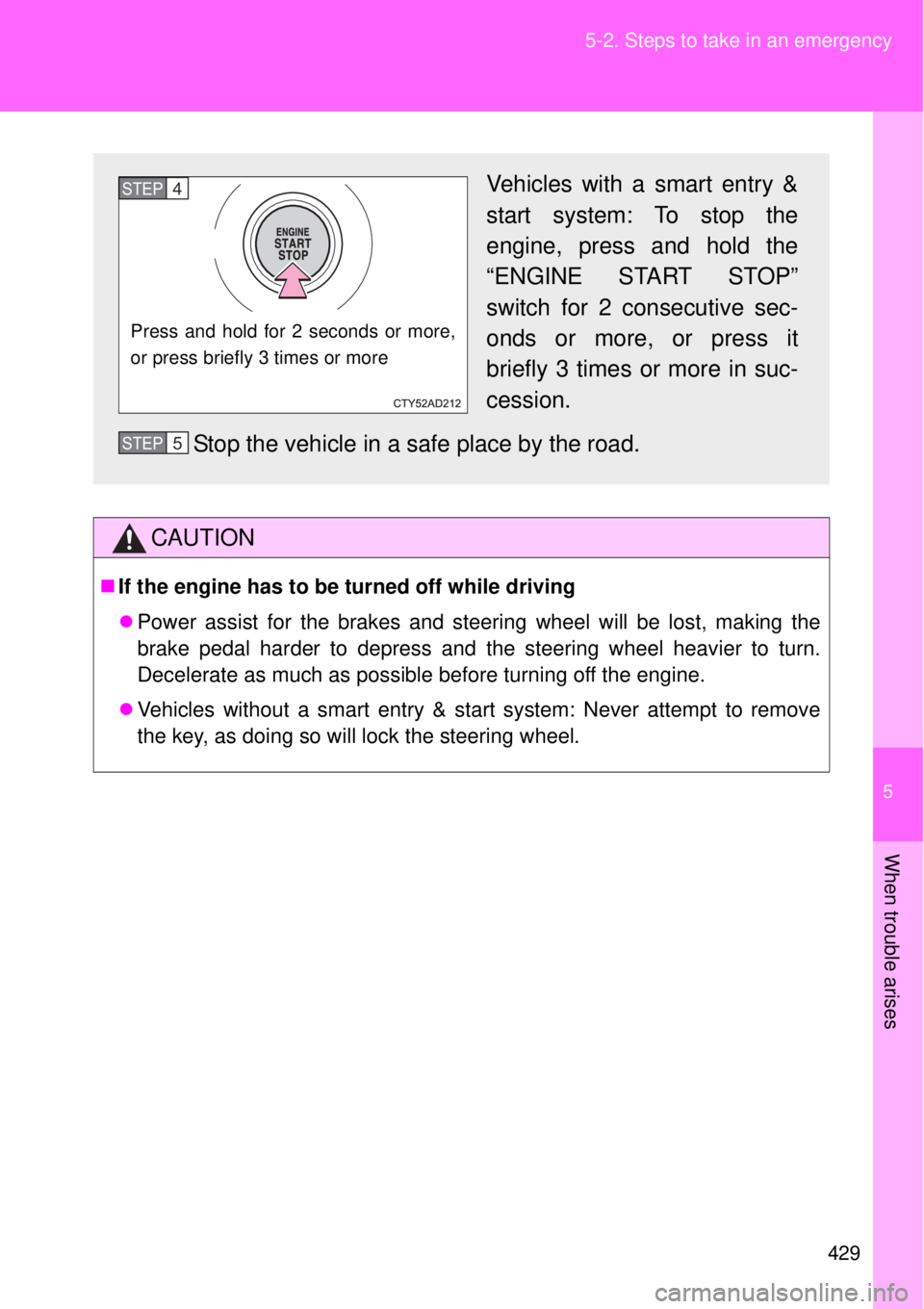
Vehicles with a smart entry &
start system: To stop the
engine, press and hold the
“ENGINE START STOP”
switch for 2 consecutive sec-
onds or more, or press it
briefly 3 times or more in suc-
cession.
Stop the vehicle in a safe place by the road.
Press and hold for 2 seconds or more,
or press briefly 3 times or more
STEP 4
STEP 5
Page 454 of 464

454 Alphabetical index
Electric power steering ........... 225
Electronic key
If the electronic key does
not operate properly ........... 414
Emergency flashers
Switch ................................... 362
Emergency, in case of
If the electronic key does
not operate properly ........... 414
If the engine will not start ...... 409
If the shift lever cannot
be shifted from P ................ 412
If the vehicle has a
discharged battery .............. 418
If the warning buzzer
sounds ................................ 372
If the warning light
turns on............................... 372
If you have a flat tire ..... 384, 393
If you lose your keys ............. 413
If you think something is
wrong .................................. 370
If your vehicle becomes
stuck ................................... 426
If your vehicle has to be
stopped in an
emergency .......................... 428
If your vehicle needs to
be towed ............................. 363
If your vehicle overheats ....... 423Engine
Compartment ........................ 301
Engine switch................ 169, 178
Hood ..................................... 297
How to start the
engine......................... 169, 178
Identification number ............ 433
If the engine will not start ...... 409
Ignition switch ............... 169, 178
Overheating .......................... 423
Engine coolant
Capacity ................................ 439
Checking ............................... 305
Engine coolant temperature
gauge...................................... 194
Engine immobilizer system ...... 91
Engine oil
Capacity ................................ 436
Checking ............................... 302
Preparing and checking
before winter....................... 233
Engine switch .................. 169, 178
Engine switch light .................. 259
EPS ........................................... 225
Event data recorder ................... 24E