emergency towing TOYOTA GT86 2015 Owners Manual (in English)
[x] Cancel search | Manufacturer: TOYOTA, Model Year: 2015, Model line: GT86, Model: TOYOTA GT86 2015Pages: 464, PDF Size: 10.65 MB
Page 224 of 464

224 2-4. Using other driving systems
CAUTION
To avoid operating the cruise control by mistake
Switch the cruise control off using the “ON-OFF” button when not in use.
Situations unsuitable for cruise control
Do not use cruise control in any of the following situations.
Doing so may result in loss of control and could cause an accident resulting
in death or serious injury.
In heavy traffic
On roads with sharp bends
On winding roads
On slippery roads, such as those covered with rain, ice or snow
On steep hills
Vehicle speed may exceed the set speed when driving down a steep hill.
During emergency towing
Page 363 of 464
5
363
5-1. Essential information
When trouble arises
If your vehicle needs to be towed
Before towing
The following may indicate a problem with your transmission. Contact
any authorized Toyota dealer or repairer, or another duly qualified
and equipped professional before towing.
The engine is running, but the vehicle will not move.
The vehicle makes an abnormal sound.
Emergency towing
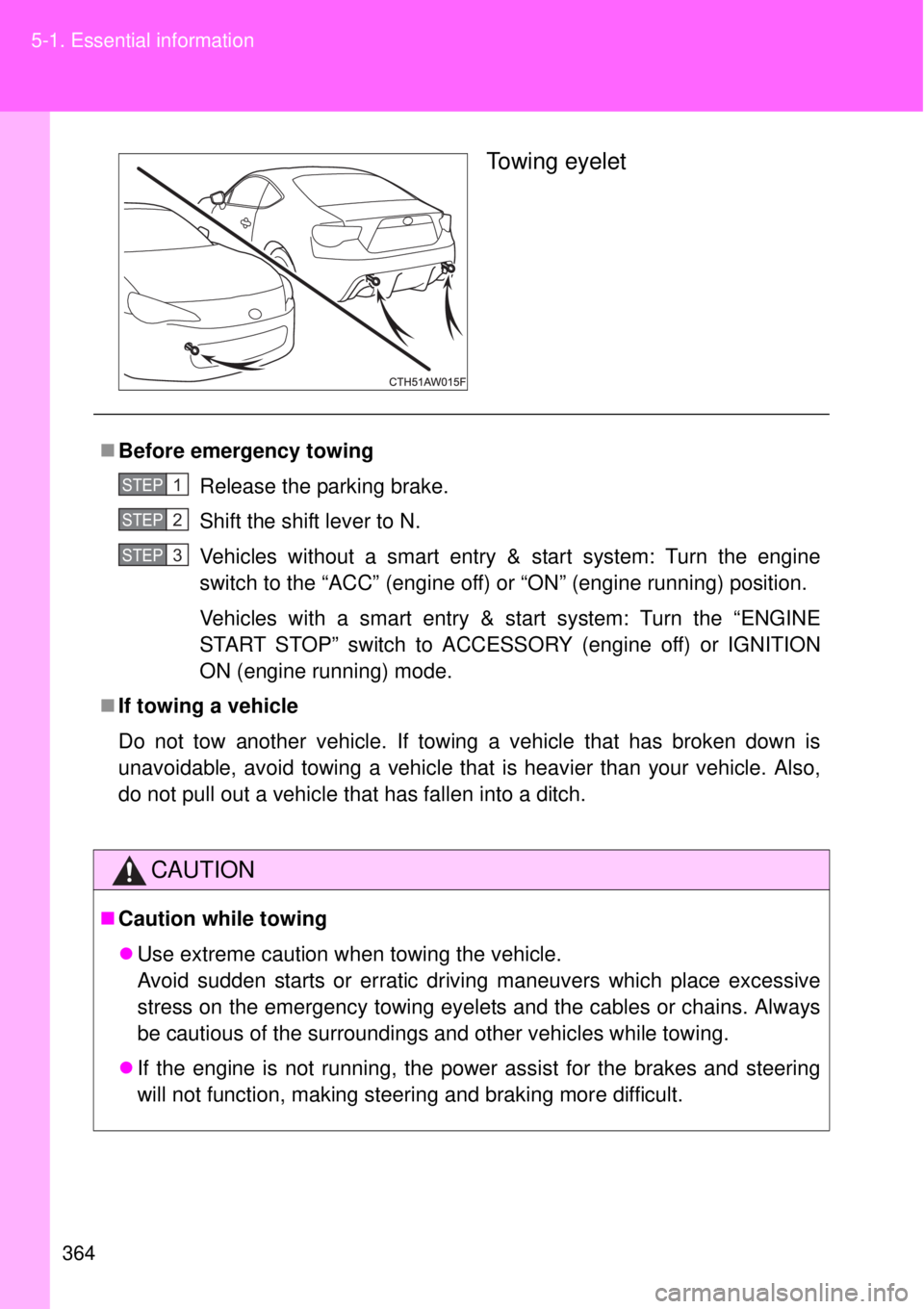
If a tow truck is not available in an emergency, your vehicle may be
temporarily towed using a cable or chain secured to the emergency
towing eyelet. This should only be attempted on hard surfaced roads
for short distances at low speeds.
A driver must be in the vehicle to steer and operate the brakes. The
vehicle’s wheels, drive train, axles, steering and brakes must be in
good condition.
For vehicles with an automatic transmission, only the front towing
eyelet may be used.
If towing is necessary, we recommend having your vehicle towed by
any authorized Toyota dealer or repairer, or another duly qualified
and equipped professional or a commercial towing service, using a
lift-type truck or a flat bed truck.
Use a safety chain system for all towing, and abide by all state/pro-
vincial and local laws.
If towing from the rear, the vehicle's front wheels and axles must be
in good condition. (P. 368)
If they are damaged, use a towing dolly or flat bed truck.
Page 364 of 464
364 5-1. Essential information
Towing eyelet
Before emergency towing
Release the parking brake.
Shift the shift lever to N.
Vehicles without a smart entry & start system: Turn the engine
switch to the “ACC” (engine off) or “ON” (engine running) position.
Vehicles with a smart entry & start system: Turn the “ENGINE
START STOP” switch to ACCESSORY (engine off) or IGNITION
ON (engine running) mode.
If towing a vehicle
Do not tow another vehicle. If towing a vehicle that has broken down is
unavoidable, avoid towing a vehicle that is heavier than your vehicle. Also,
do not pull out a vehicle that has fallen into a ditch.
CAUTION
Caution while towing
Use extreme caution when towing the vehicle.
Avoid sudden starts or erratic driving maneuvers which place excessive
stress on the emergency towing eyelets and the cables or chains. Always
be cautious of the surroundings and other vehicles while towing.
If the engine is not running, the power assist for the brakes and steering
will not function, making steering and braking more difficult.
STEP 1
STEP 2
STEP 3
Page 365 of 464
5
365 5-1. Essential information
When trouble arises
Installing towing eyelet
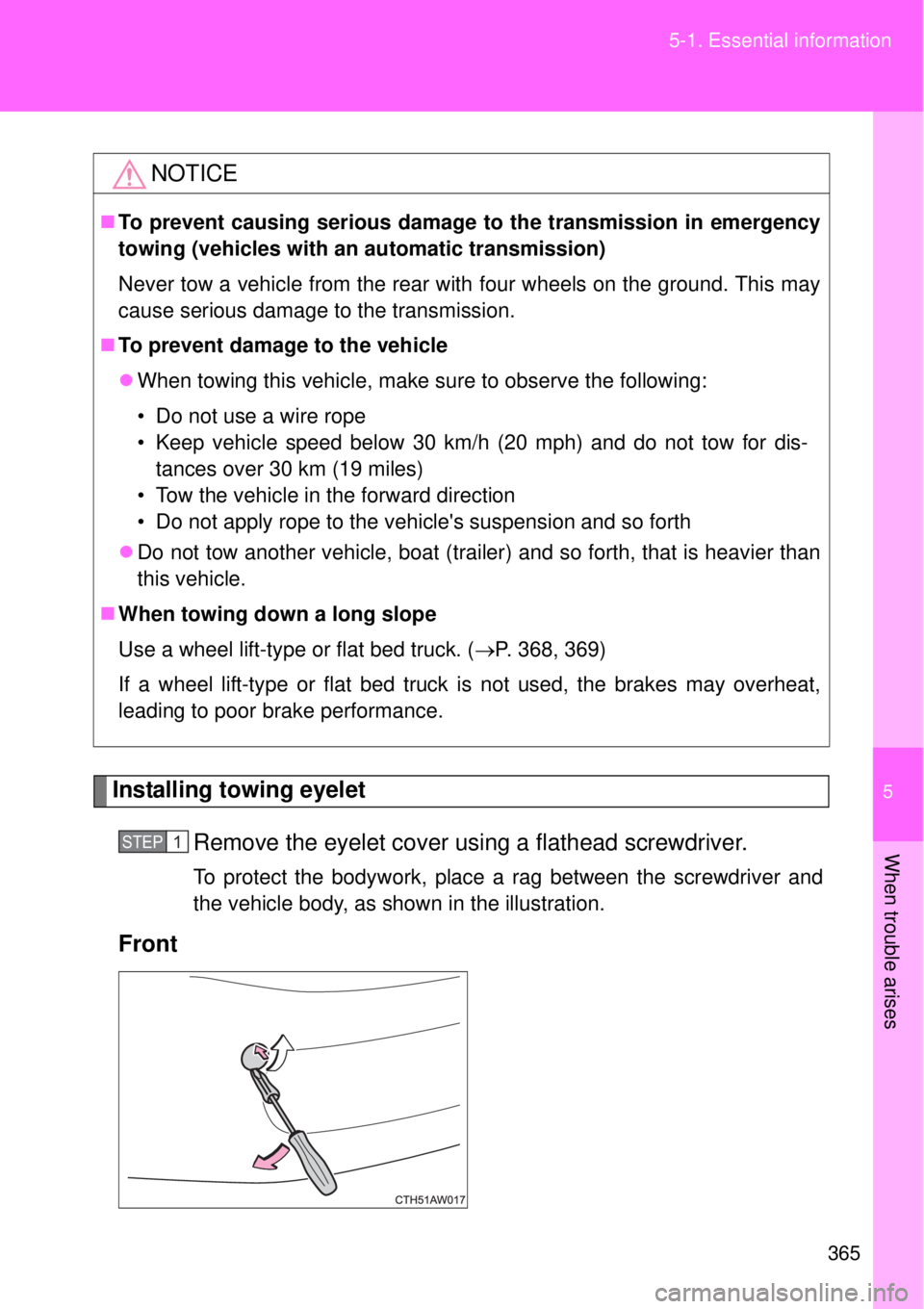
Remove the eyelet cover using a flathead screwdriver.
To protect the bodywork, place a rag between the screwdriver and
the vehicle body, as shown in the illustration.
Front
NOTICE
To prevent causing serious damage to the transmission in emergency
towing (vehicles with an automatic transmission)
Never tow a vehicle from the rear with four wheels on the ground. This may
cause serious damage to the transmission.
To prevent damage to the vehicle
When towing this vehicle, make sure to observe the following:
• Do not use a wire rope
• Keep vehicle speed below 30 km/h (20 mph) and do not tow for dis-
tances over 30 km (19 miles)
• Tow the vehicle in the forward direction
• Do not apply rope to the vehicle's suspension and so forth
Do not tow another vehicle, boat (trailer) and so forth, that is heavier than
this vehicle.
When towing down a long slope
Use a wheel lift-type or flat bed truck. (P. 368, 369)
If a wheel lift-type or flat bed truck is not used, the brakes may overheat,
leading to poor brake performance.
STEP 1
Page 367 of 464
5
367 5-1. Essential information
When trouble arises
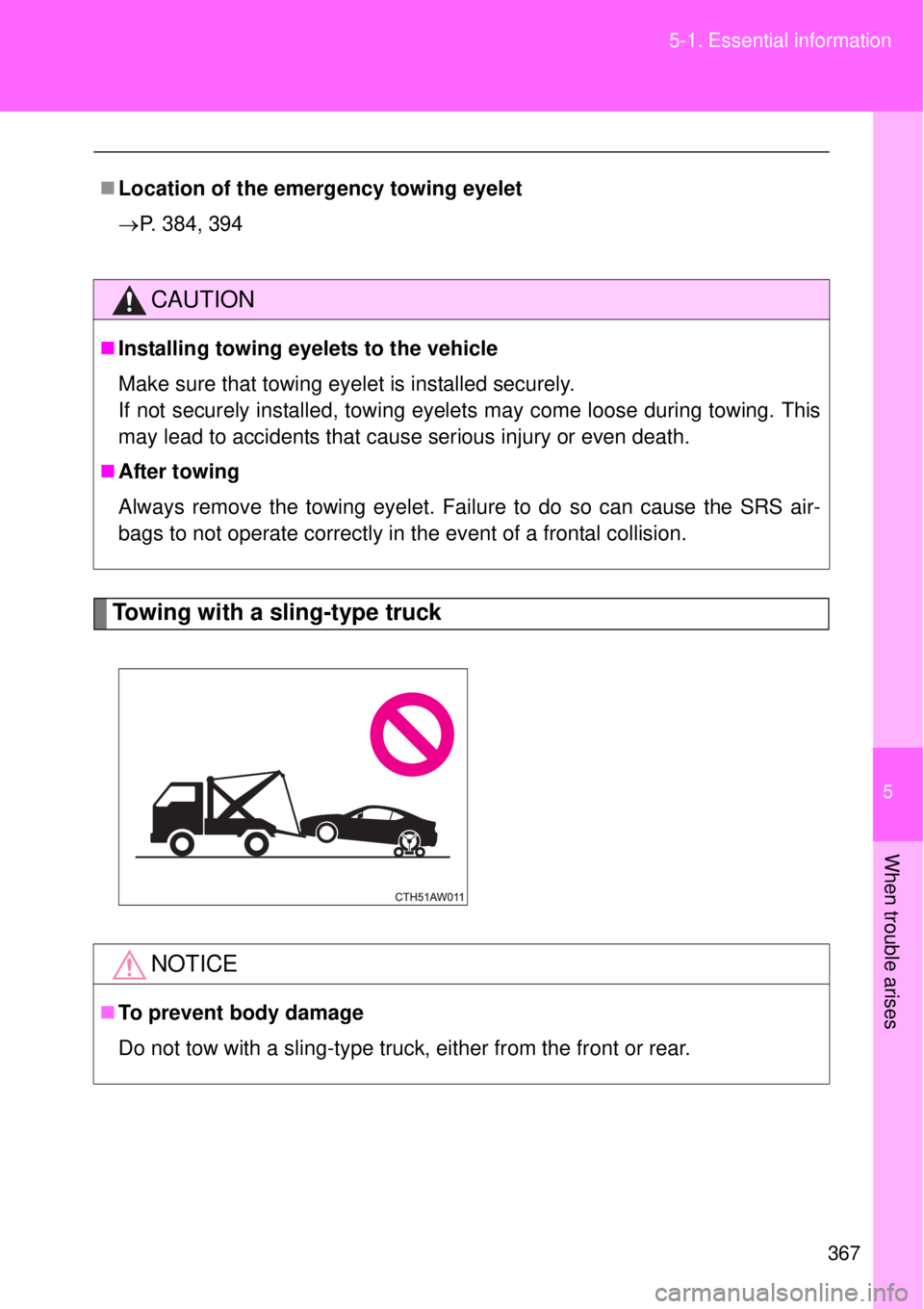
Towing with a sling-type truck
Location of the emergency towing eyelet
P. 384, 394
CAUTION
Installing towing eyelets to the vehicle
Make sure that towing eyelet is installed securely.
If not securely installed, towing eyelets may come loose during towing. This
may lead to accidents that cause serious injury or even death.
After towing
Always remove the towing eyelet. Failure to do so can cause the SRS air-
bags to not operate correctly in the event of a frontal collision.
NOTICE
To prevent body damage
Do not tow with a sling-type truck, either from the front or rear.
Page 384 of 464
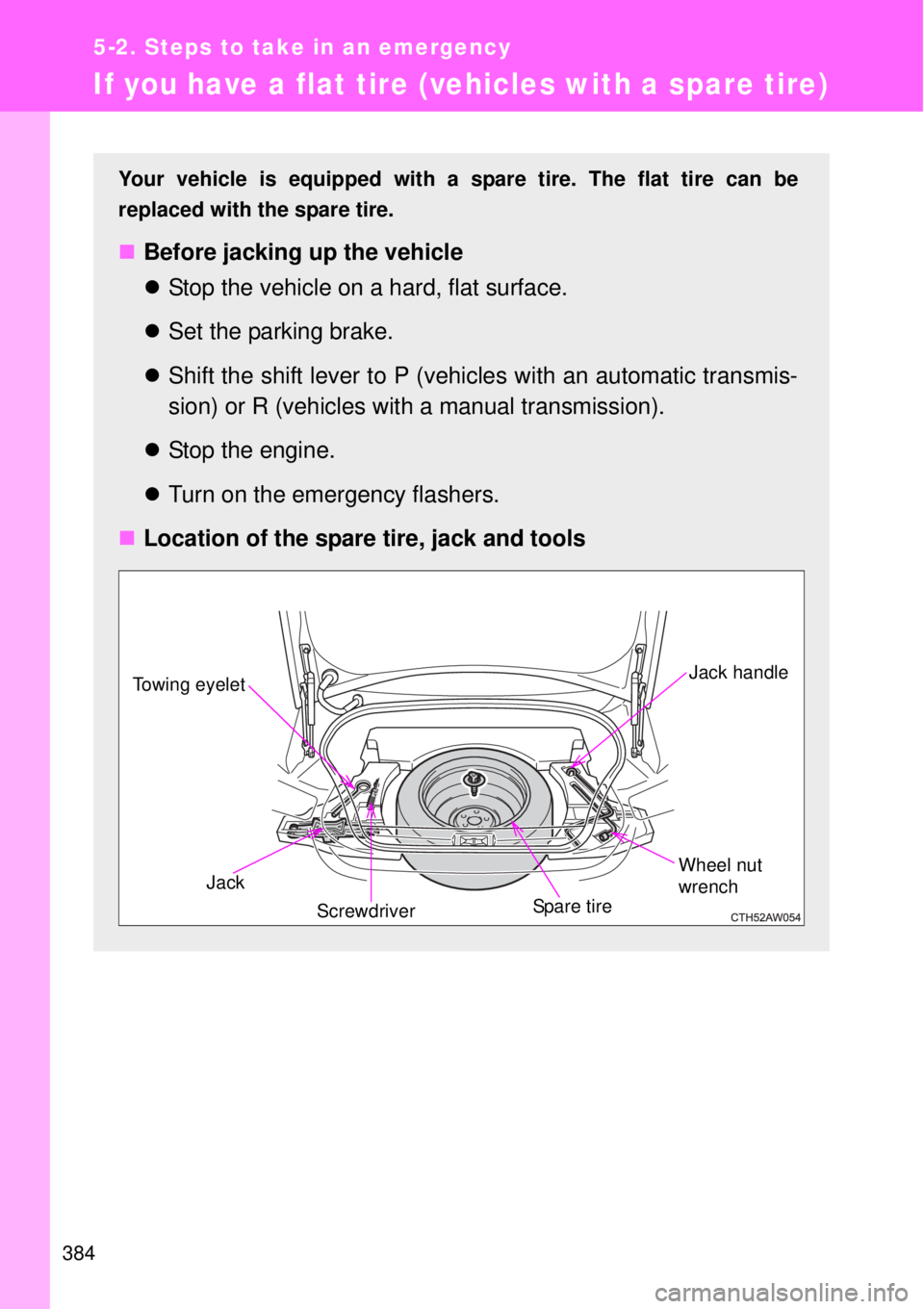
384
5-2. Steps to take in an emergency
If you have a flat tire (vehicles with a spare tire)
Your vehicle is equipped with a spare tire. The flat tire can be
replaced with the spare tire.
Before jacking up the vehicle
Stop the vehicle on a hard, flat surface.
Set the parking brake.
Shift the shift lever to P (vehicles with an automatic transmis-
sion) or R (vehicles with a manual transmission).
Stop the engine.
Turn on the emergency flashers.
Location of the spare tire, jack and tools
Jack handle
Spare tire Towing eyelet
Screwdriver JackWheel nut
wrench
Page 392 of 464

392 5-2. Steps to take in an emergency
NOTICE
Do not drive the vehicle with a flat tire.
Do not continue driving with a flat tire.
Driving even a short distance with a flat tire can damage the tire and the
wheel beyond repair.
Stowing the jack
When stowing the jack in the jack holder, make sure that the part that the
jack handle attaches to is pointing towards the inside of the trunk. Failure to
do so may damage the vehicle body.
When replacing the tires
When removing or fitting the wheels, tires or the tire pressure warning valve
and transmitter, contact any authorized Toyota dealer or repairer, or another
duly qualified and equipped professional as the tire pressure warning valve
and transmitter may be damaged if not handled correctly.
To avoid damage to the tire pressure warning valves and transmitters
When a tire is repaired with liquid sealants, the tire pressure warning valve
and transmitter may not operate properly. If a liquid sealant is used, contact
any authorized Toyota dealer or repairer, or another duly qualified and
equipped professional or other qualified service shop as soon as possible.
Make sure to replace the tire pressure warning valve and transmitter when
replacing the tire. (P. 315)
Page 394 of 464
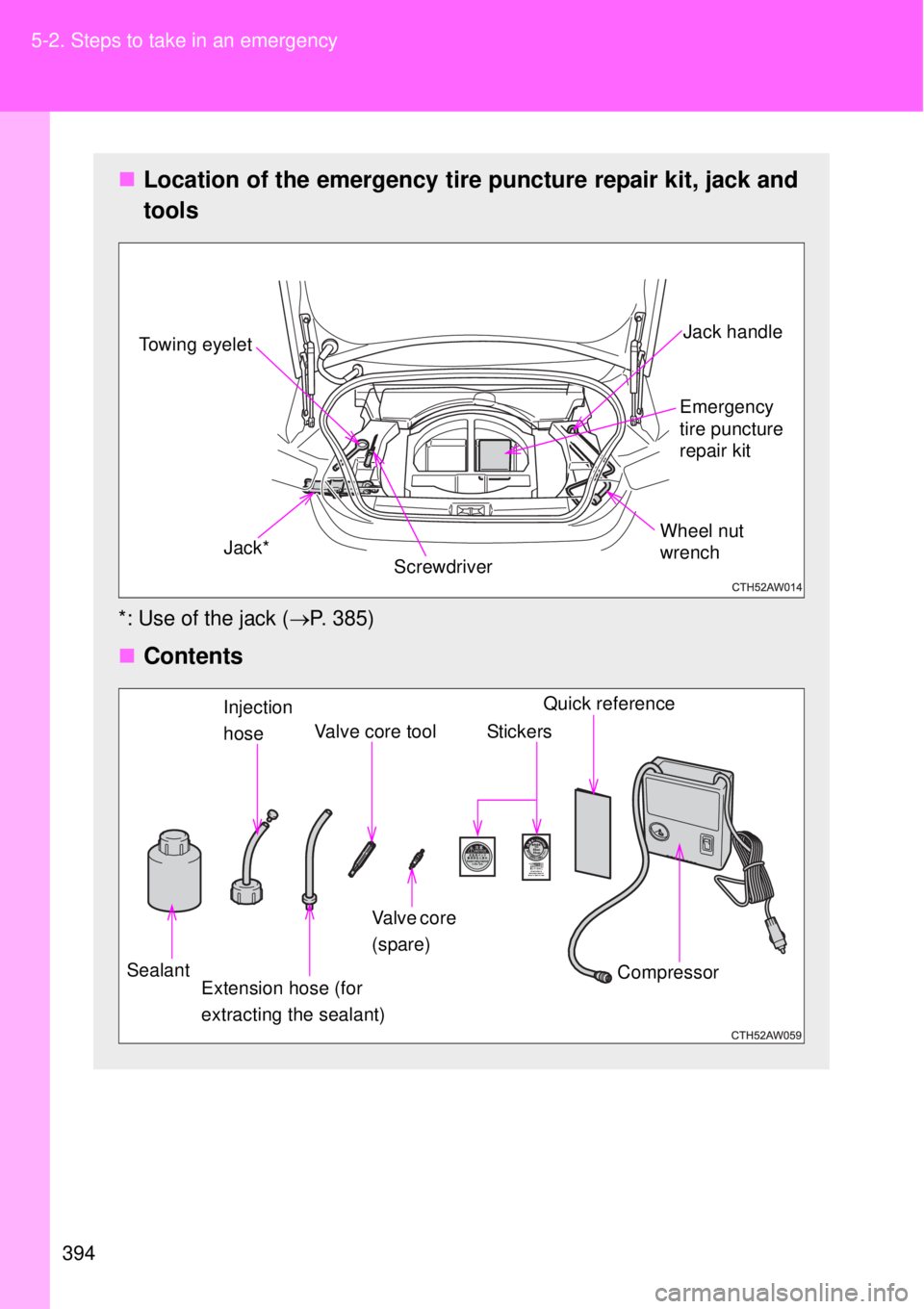
394 5-2. Steps to take in an emergency
Location of the emergency tire puncture repair kit, jack and
tools
*: Use of the jack (P. 385)
Contents
ScrewdriverEmergency
tire puncture
repair kitJack handle
Towing eyelet
Jack*Wheel nut
wrench
SealantInjection
hoseValve core tool
Va l v e c o r e
(spare)
Compressor Stickers
Extension hose (for
extracting the sealant)
Quick reference
Page 427 of 464

5
427 5-2. Steps to take in an emergency
When trouble arises
CAUTION
When attempting to free a stuck vehicle
If you choose to push the vehicle back and forth to free it, make sure the sur-
rounding area is clear to avoid striking other vehicles, objects or people. The
vehicle may also lunge forward or lunge back suddenly as it becomes free.
Use extreme caution.
When shifting the shift lever
For vehicles with an automatic transmission, be careful not to shift the shift
lever with the accelerator pedal depressed.
This may lead to unexpected rapid acceleration of the vehicle that may
cause an accident resulting in death or serious injury.
NOTICE
To avoid damage to the transmission and other components
Avoid spinning the rear wheels and depressing the accelerator pedal more
than necessary.
If the vehicle remains stuck even after these procedures are performed,
the vehicle may require towing to be freed.
Page 459 of 464

459 Alphabetical index
Sun visors ................................ 266
Switch
Airbag manual on/off ............. 151
Driving mode selector
switch.................................. 183
Emergency flasher switch ..... 362
Engine switch ................ 169, 178
Fog light switch ..................... 215
Hazard light switch ................ 362
Ignition switch ............... 169, 178
Light switches ....................... 208
“ODO/TRIP” switch ............... 196
Power door lock switch ........... 56
Power window switch .............. 83
Transmission shift
switches ...................... 184, 186
Window lock switch ................. 83
Wiper and washer switch ...... 217Tachometer
Tachometer........................... 194
Tail lights
Switch ................................... 208
Theft deterrent system
Double locking system .......... 100
Engine immobilizer system ..... 91
Tire inflation pressure ............. 443
Tires
Chains................................... 233
Checking ............................... 314
Emergency tire puncture
repair kit.............................. 393
If you have a flat tire ..... 384, 393
Inflation pressure .................. 323
Replacing .............................. 384
Rotating tires......................... 314
Size ....................................... 443
Snow tires ............................. 233
Spare tire .............................. 384
Tire pressure warning
system ........................ 314, 375
Tools ................................. 384, 393
Towing
Emergency towing ................ 363
Traction control ....................... 225
Transmission shift
switches ......................... 184, 186
TRC ........................................... 225
Trip meter ................................. 194
Trunk
Opener .................................... 58
Trunk light
Wattage ................................ 444
Turn signal lights
Replacing light bulbs............. 343
Switch ................................... 191
Wattage ................................ 444T