ron TOYOTA GT86 2017 1.G User Guide
[x] Cancel search | Manufacturer: TOYOTA, Model Year: 2017, Model line: GT86, Model: TOYOTA GT86 2017 1.GPages: 428, PDF Size: 7.83 MB
Page 36 of 428
36 1-3. Adjustable components (seats, mirrors, steering wheel)
Getting in and out of the rear seats
To get in and out of the rear seats, use the seatback angle adjust-
ment lever or seatback fold strap.
■ Before getting in or out of the rear seats
Release the seat belt from the seat belt guide. ( →P. 4 3 )
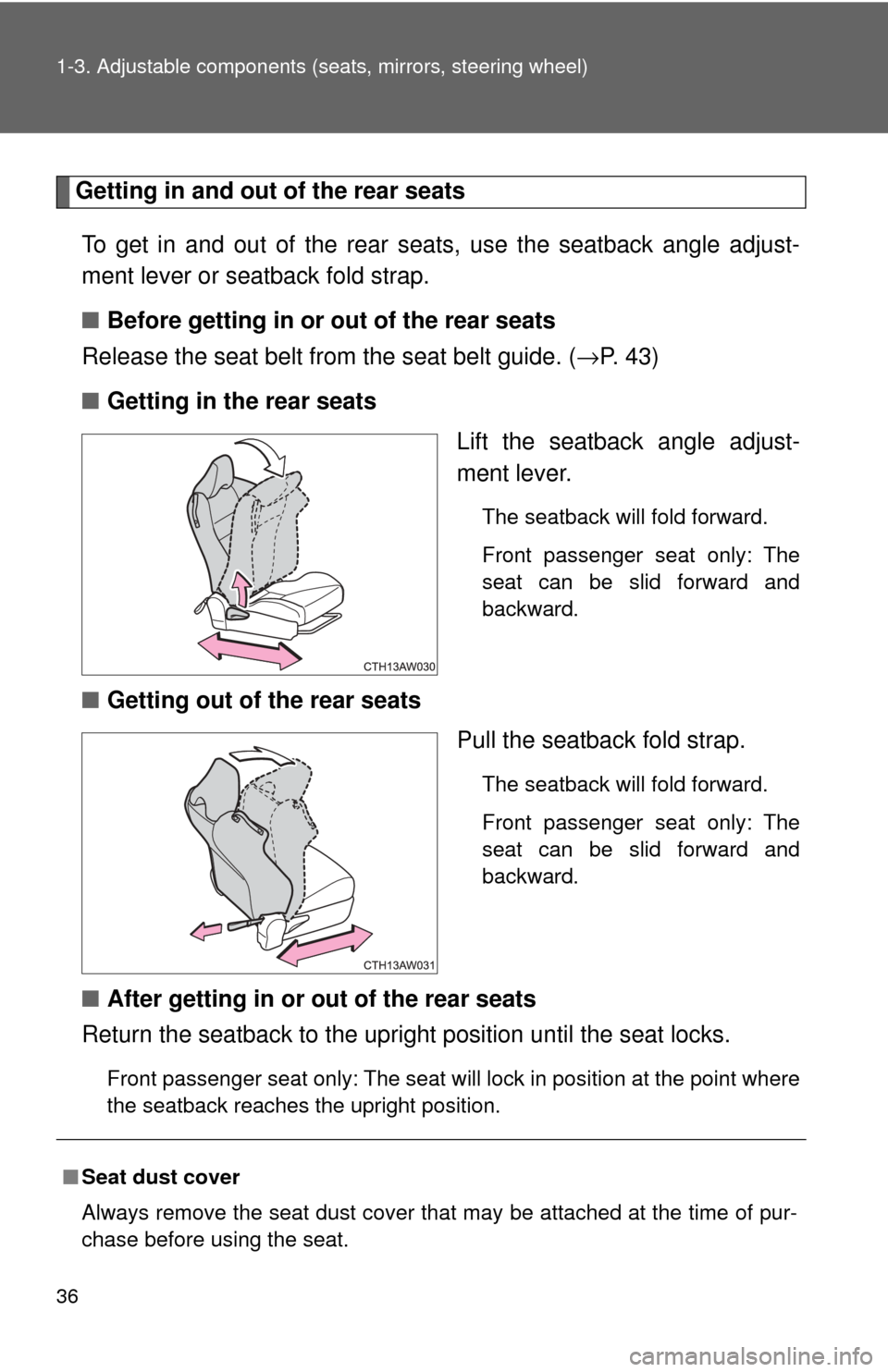
■ Getting in the rear seats
Lift the seatback angle adjust-
ment lever.
The seatback will fold forward.
Front passenger seat only: The
seat can be slid forward and
backward.
■Getting out of the rear seats
Pull the seatback fold strap.
The seatback will fold forward.
Front passenger seat only: The
seat can be slid forward and
backward.
■After getting in or out of the rear seats
Return the seatback to the upri ght position until the seat locks.
Front passenger seat only: The seat will lock in position at the point where
the seatback reaches the upright position.
■Seat dust cover
Always remove the seat dust cover that may be attached at the time of pur-
chase before using the seat.
Page 37 of 428
37
1-3. Adjustable components (s
eats, mirrors, steering wheel)
1
Before driving
WARNING
■Seat adjustment
●To reduce the risk of sliding under the lap belt during a collision, do not
recline the seat more than necessary.
If the seat is too reclined, the lap belt may slide past the hips and apply
restraint forces directly to the abdomen, or your neck may contact the
shoulder belt, increasing the risk of death or serious injury in the event of
an accident.
Adjustments should not be made while driving as the seat may unexpect-
edly move and cause the driver to lose control of the vehicle.
● After adjusting the seat, make sure that the seat is locked in position.
● Take care not to hit passengers with the seat.
When sliding the seat rearward, make sure not to squash the legs of the
rear passengers.
● When returning the seatback upright, perform seatback angle adjustment
while holding down the seatback.
● Do not pull on or use the seat belt guide to adjust or fold the front seat.
● Do not put your hands under the seat or near the moving parts to avoid
injury. Fingers or hands may become jammed in the seat mechanism.
■ When driving the vehicle
Never operate the seatback angle adjustment lever or seatback fold strap.
Doing so could cause an accident resulting in death or serious injury.
■ Getting in and out of the rear seats
● When getting in or out of the rear seats, make sure not to get your hands,
legs, etc. squashed in the movable or connecting parts.
● When getting in or out of the rear seats, make sure not to trip on the seat
rails.
● After getting in or out of the rear seats, always make sure the front seat is
locked in position.
■ When operating the front seat from the rear seat
Make sure that no passenger is seated in the front seat.
Page 40 of 428
40
1-3. Adjustable components (seats, mirrors, steering wheel)
Head restraints
■Removing the head restraints
■ Installing the head restraints
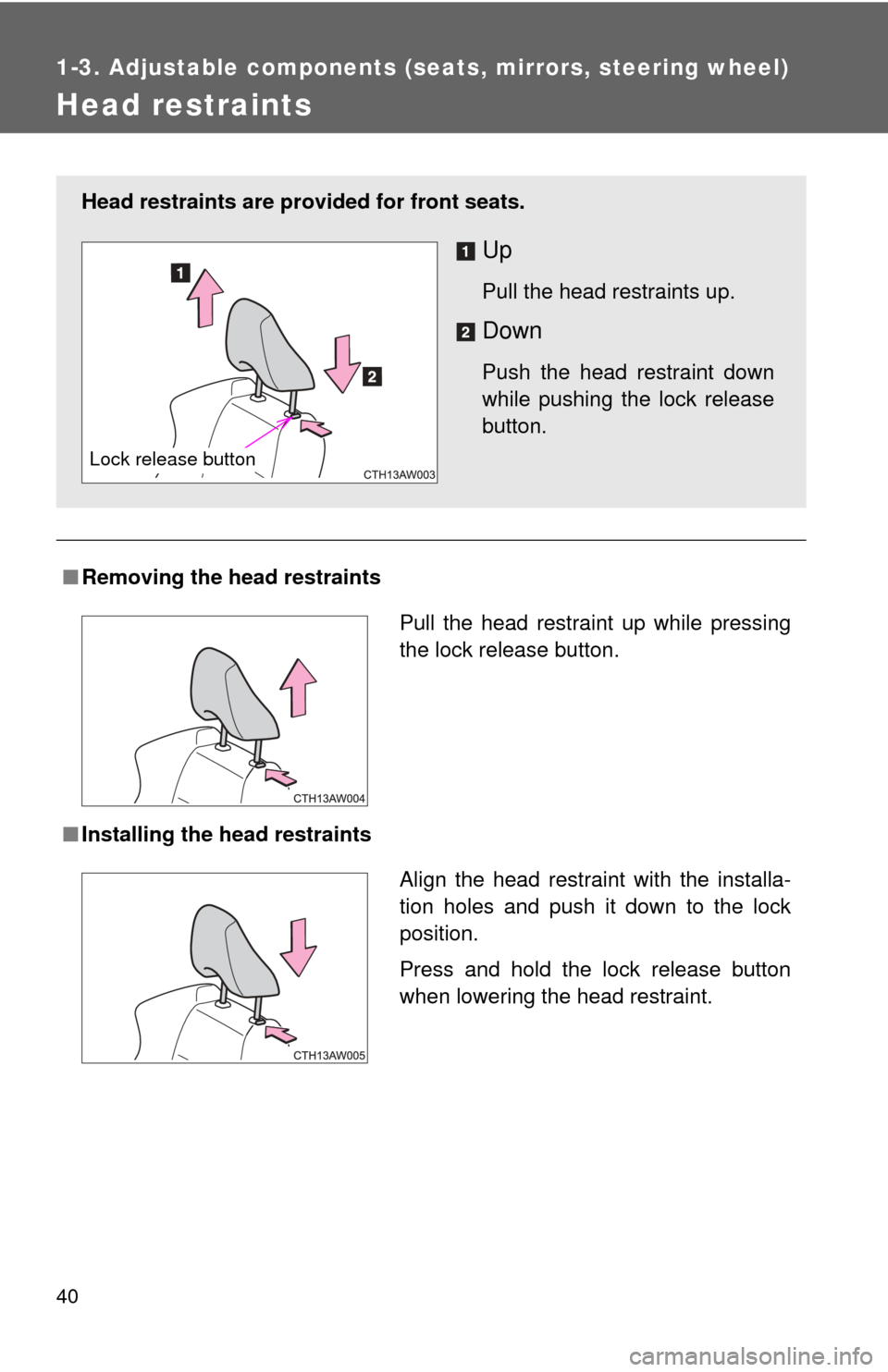
Head restraints are pr ovided for front seats.
Up
Pull the head restraints up.
Down
Push the head restraint down
while pushing the lock release
button.
Lock release button
Pull the head restraint up while pressing
the lock release button.
Align the head restraint with the installa-
tion holes and push it down to the lock
position.
Press and hold the lock release button
when lowering the head restraint.
Page 43 of 428
43
1-3. Adjustable components (s
eats, mirrors, steering wheel)
1
Before driving
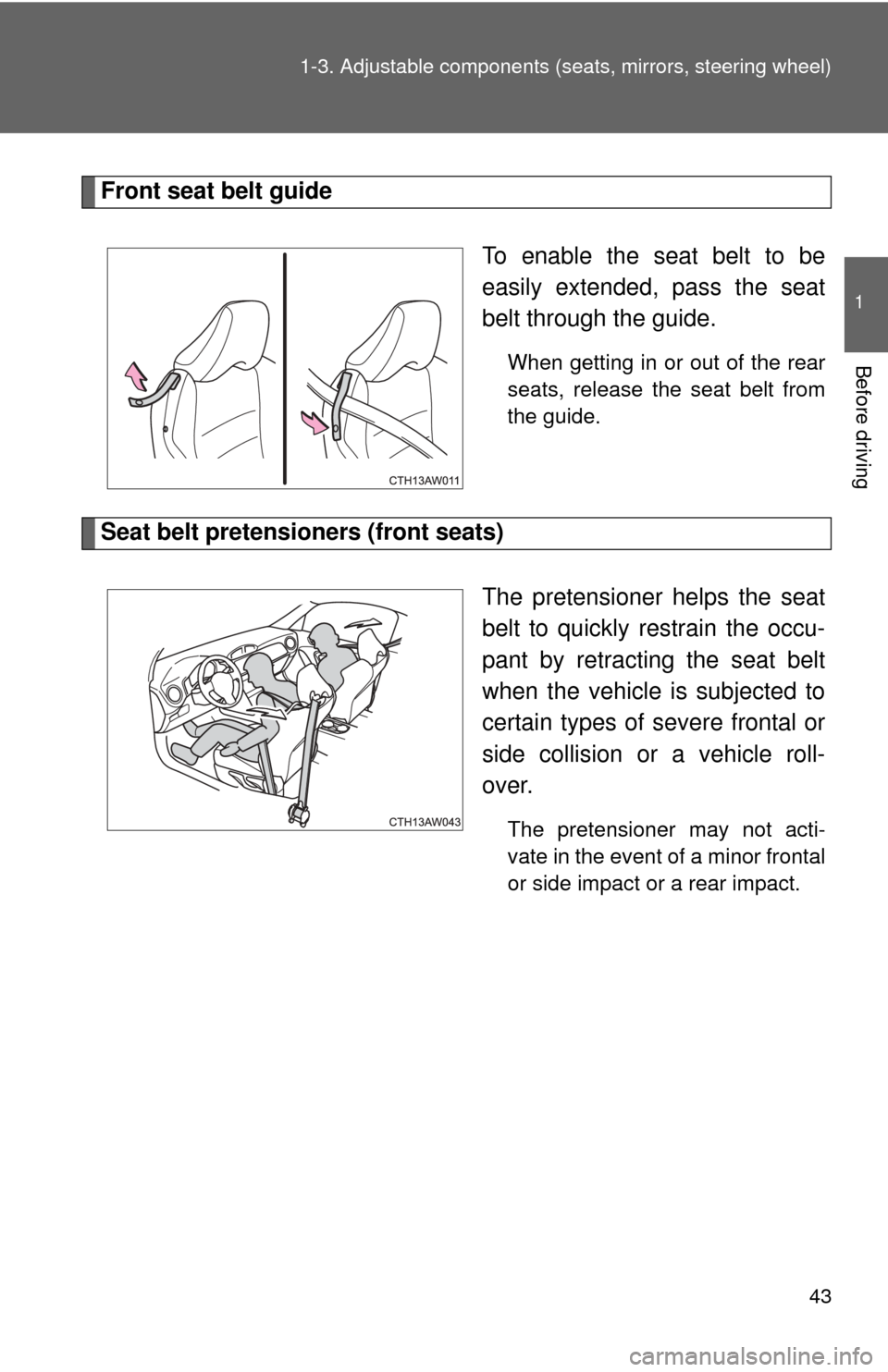
Front seat belt guide
To enable the seat belt to be
easily extended, pass the seat
belt through the guide.
When getting in or out of the rear
seats, release the seat belt from
the guide.
Seat belt pretensioners (front seats)The pretensioner helps the seat
belt to quickly restrain the occu-
pant by retracting the seat belt
when the vehicle is subjected to
certain types of severe frontal or
side collision or a vehicle roll-
over.
The pretensioner may not acti-
vate in the event of a minor frontal
or side impact or a rear impact.
Page 44 of 428
44 1-3. Adjustable components (seats, mirrors, steering wheel)
■Emergency locking retractor (ELR)
The retractor will lock the belt during a sudden stop or on impact. It may also
lock if you lean forward too quickly. A slow, easy motion will allow the belt to
extend so that you can move around fully.
■ Automatic locking retractor (ALR)
When a passenger's shoulder belt is completely extended and then
retracted even slightly, the belt is locked in that position and cannot be
extended. This feature is used to hold the child restraint system (CRS) firmly.
To free the belt again, fully retract the belt and then pull the belt out once
more. ( →P. 116)
■ Child seat belt usage
The seat belts of your vehicle are principally designed for persons of adult
size.
●Use a child restraint system appropriate for the child, until the child
becomes large enough to properly w ear the vehicle's seat belt.
( → P. 11 2 )
● When the child becomes large enough to properly wear the vehicle's seat
belt, follow the instructions on P. 42 regarding seat belt usage.
■ Seat belt pretensioners
●Seatbelt pretensioners are not designed to activate in a rear impact or
minor frontal or side impact.
● The following four components operate simultaneously when the vehicle
is involved in a rollover accident.
• Seat belt pretensioner for driver
• Seat belt pretensioner for front passenger
• SRS curtain shield airbag for driver’s seat side
• SRS curtain shield airbag for front passenger’s seat side
Page 45 of 428
45
1-3. Adjustable components (s
eats, mirrors, steering wheel)
1
Before driving
●The following four components operate simultaneously when the vehicle
is subjected to a severe frontal collision.
• Seat belt pretensioner for driver
• Seat belt pretensioner for front passenger
• SRS front airbag for driver
• SRS front airbag for front passenger*
*: This does not operate while the occupant classification system deter- mines to deactivate the airbag operation. For details, refer to “Front pas-
senger’s SRS frontal airbag” ( →P. 74)
● The following two components operate simultaneously when the vehicle
is subjected to a severe collision on the driver’s seat side of the vehicle.
• Seat belt pretensioner for driver
• Side airbag for driver
● The following two components operate simultaneously when the vehicle
is subjected to a severe collision on the front passenger’s seat side of the
vehicle.
• Seat belt pretensioner for front passenger
• Side airbag for front passenger
● Pretensioners are designed to function on a one-time-only basis. In the
event that a pretensioner is activated, both the driver’s and front passen-
ger’s seat belt retractor assemblies must be replaced only by Toyota
dealer. When replacing seat belt retractor assemblies for the front seat-
ing positions, use only genuine Toyota parts equipped with a force limiter.
● If either front seat belt does not retract or cannot be pulled out due to a
malfunction or activation of the pretensioner, contact your Toyota dealer
as soon as possible.
● If the front seat belt retractor assembly or surrounding area has been
damaged, contact your Toyota dealer as soon as possible.
● When you sell your vehicle, we urge you to explain to the buyer that it
has seat belt pretensioners by alerting the buyer to the contents of this
section.
■ Replacing the belt after the pr etensioner has been activated
If the vehicle is involved in multiple collisions, the pretensioner will activate
for the first collision, but will not activate for the second or subsequent colli-
sions.
Page 58 of 428
58 1-5. Refueling
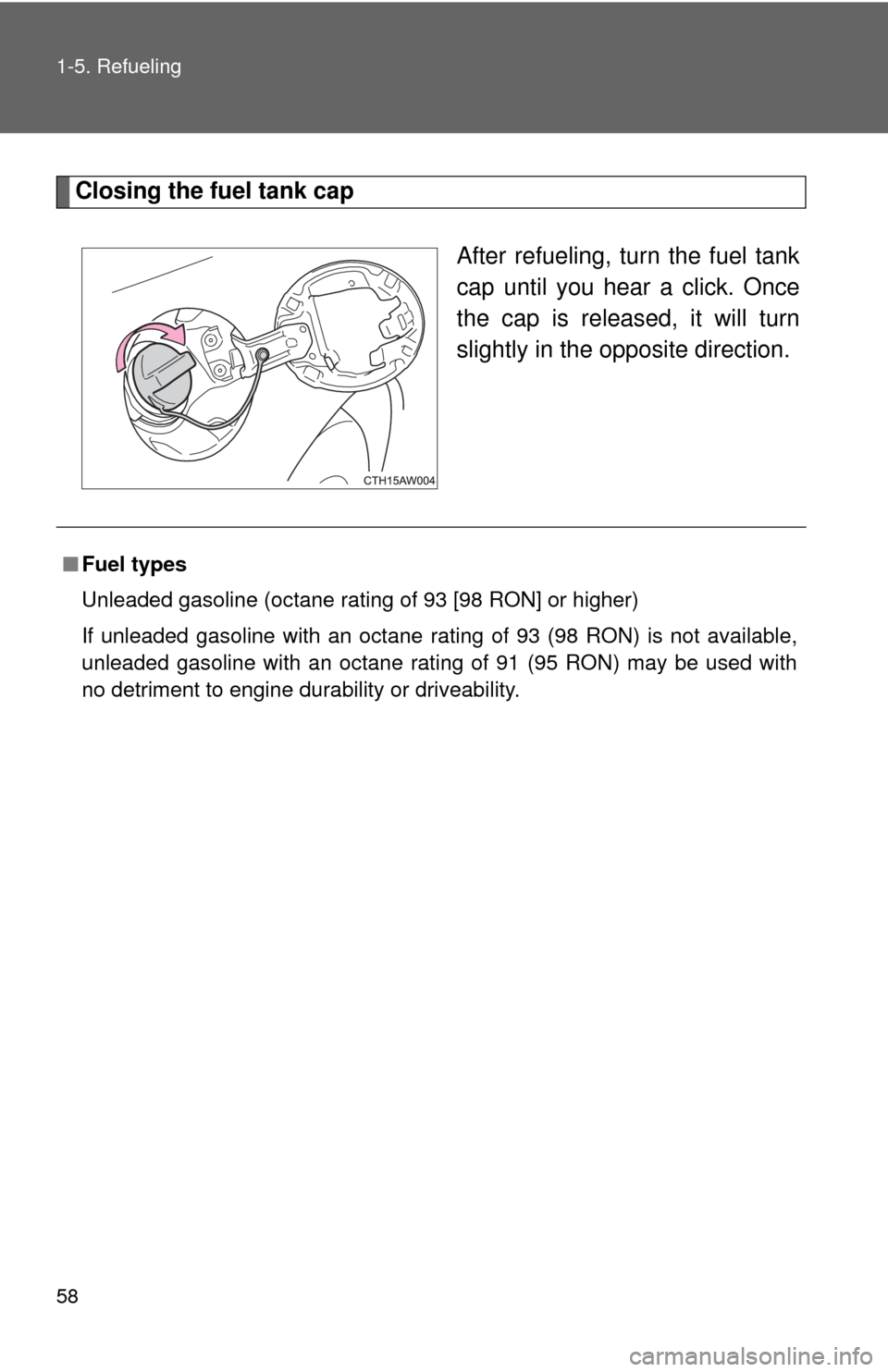
Closing the fuel tank capAfter refueling, turn the fuel tank
cap until you hear a click. Once
the cap is released, it will turn
slightly in the opposite direction.
■Fuel types
Unleaded gasoline (octane rating of 93 [98 RON] or higher)
If unleaded gasoline with an octane rating of 93 (98 RON) is not available,
unleaded gasoline with an octane rating of 91 (95 RON) may be used with
no detriment to engine durability or driveability.
Page 65 of 428
65
1-7. Safety information
1
Before driving
WARNING
■
While driving
●Do not adjust the position of the driver's seat.
Doing so could cause the driver to lose control of the vehicle.
● Do not place a cushion between the driver or passenger and the seatback.
A cushion may prevent correct posture from being achieved, and reduce
the effectiveness of the seat belt and head restraint, increasing the risk of
death or serious injury to the driver or passenger.
● Do not place anything under the front seats.
Objects placed under the front seats may become jammed in the seat
tracks and stop the seat from locking in place. This may lead to an acci-
dent resulting in serious injury or death. The adjustment mechanism may
also be damaged.
■ Adjusting the seat position
●Take care when adjusting the seat position to ensure that other passen-
gers are not injured by the moving seat.
● Do not put your hands under the seat or near the moving parts to avoid
injury.
Fingers or hands may become jammed in the seat mechanism.
Page 66 of 428
66
1-7. Safety information
SRS airbag (Supplemental Restraint System airbag)
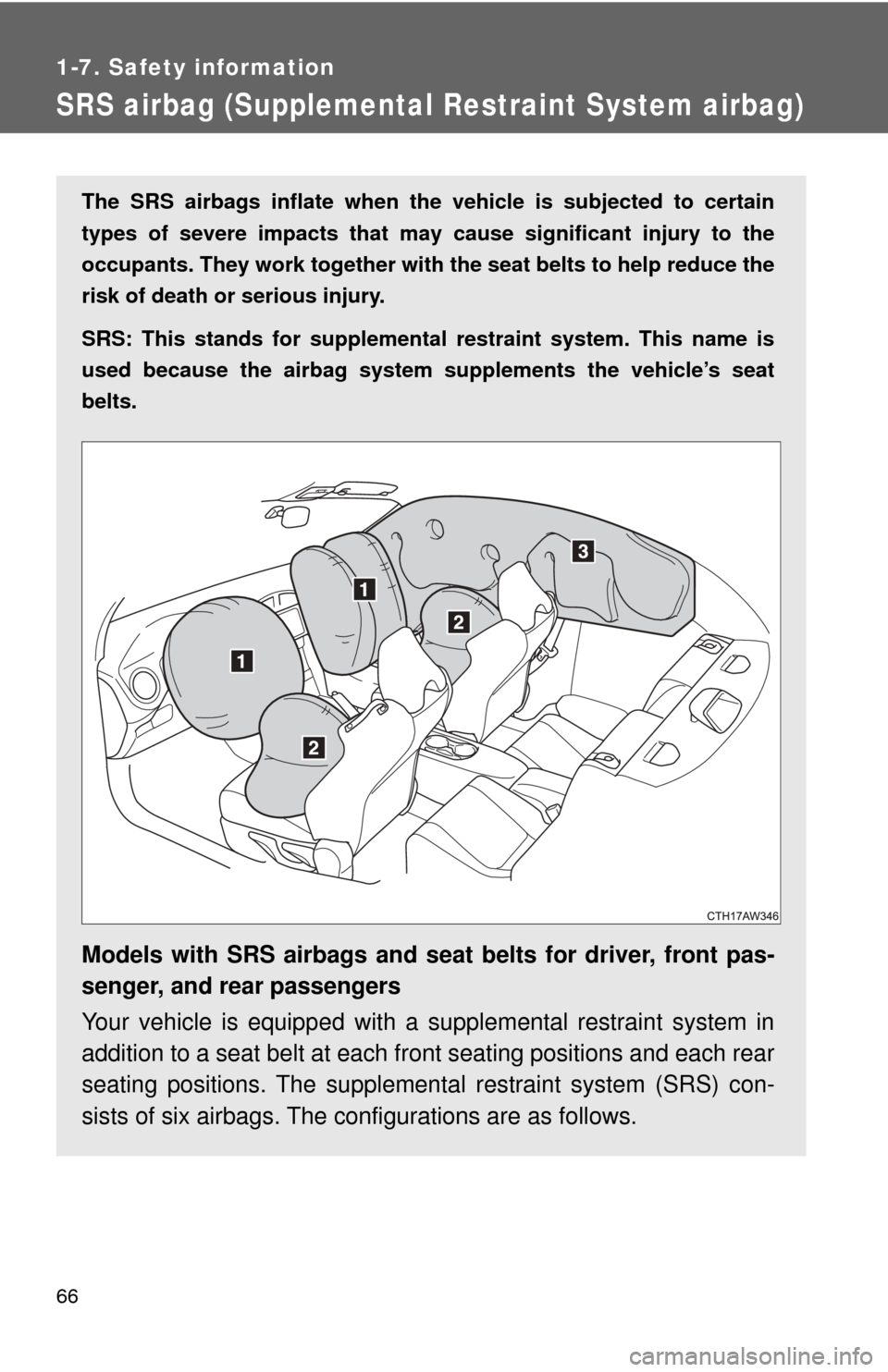
The SRS airbags inflate when the vehicle is subjected to certain
types of severe impacts that may cause significant injury to the
occupants. They work together with the seat belts to help reduce the
risk of death or serious injury.
SRS: This stands for supplement al restraint system. This name is
used because the airbag system supplements the vehicle’s seat
belts.
Models with SRS airbags and se at belts for driver, front pas-
senger, and rear passengers
Your vehicle is equipped with a s upplemental restraint system in
addition to a seat belt at each fr ont seating positions and each rear
seating positions. The supplementa l restraint system (SRS) con-
sists of six airbags. The c onfigurations are as follows.
Page 67 of 428
67
1-7. Safety information
1
Before driving
■
When you sell your vehicle
When you sell your vehicle, we urge you to explain to the buyer that it is
equipped with SRS airbags by alerting the buyer to the applicable section in
this Owner’s Manual.
Driver’s and front passenger’s frontal airbags
Driver’s and front passenger’s side airbags
Curtain shield airbags (for driver, front passenger, and rear pas-
sengers)
These SRS airbags are designed only as a supplement to the pri-
mary protection provid ed by the seat belt.
The system also controls front s eat belt pretensioners. For opera-
tion instructions and precautions concerning the seat belt preten-
sioner, refer to “Seat belt pretensioners”. (
→P. 43)