Diff TOYOTA GT86 2017 1.G Owner's Guide
[x] Cancel search | Manufacturer: TOYOTA, Model Year: 2017, Model line: GT86, Model: TOYOTA GT86 2017 1.GPages: 428, PDF Size: 7.83 MB
Page 325 of 428
5
When trouble arises
325
5-2. Steps to take in an emergency
WARNING
■Maintenance of the tires
Each tire, including the spare (if provided), should be checked monthly
when cold and inflated to the inflation pressure recommended by the
vehicle manufacturer on the vehicle
placard or tire inflation pressure
label (tire and load information label). (If your vehicle has tires of a differ-
ent size than the size indicated on the vehicle placard or tire inflation
pressure label [tire and load information label], you should determine the
proper tire inflation pr essure for those tires.)
As an added safety feature, your vehicle has been equipped with a tire
pressure monitoring system (TPMS-ti re pressure warning system) that
illuminates a low tire pressure telltal e (tire pressure warning light) when
one or more of your tires is sign ificantly under-inflated. Accordingly,
when the low tire pressu re telltale (tire pressure warning light) illumi-
nates, you should stop and check your tires as soon as possible, and
inflate them to the proper pressure. Driving on a significantly under-
inflated tire causes the tire to overheat and can lead to tire failure.
Under-inflation also reduces fuel effi ciency and tire tread life, and may
affect the vehicle's handling and stopping ability.
Please note that the TPMS (tire pressure warning system) is not a sub-
stitute for proper ti re maintenance, an d it is the driver's responsibility to
maintain correct tire pressure, even if under-inflation has not reached the
level to trigger illumination of the TP MS low tire pressure telltale (tire
pressure warning light).
Your vehicle has also been equipped with a TPMS (tire pressure warning
system) malfunction indicator to indi cate when the system is not operat-
ing properly. The TPMS (tire pressure warning system) malfunction indi-
cator is combined with the low tire pressure telltale (tire pressure
warning light). When the system detects a malfunctio n, the telltale will
flash for approximately one minute an d then remain continuously illumi-
nated. This sequence will continue upon subsequent vehicle start-ups as
long as the malfunction exists. When the malfunction indicator is illumi-
nated, the system may not be able to detect or signal low tire pressure
as intended.
Page 326 of 428

326 5-2. Steps to take in an emergency
WARNING
TPMS (tire pressure warning system) malfunctions may occur for a vari-
ety of reasons, including the installation of replacement or alternate tires
or wheels on the vehicle that preven t the TPMS (tire pressure warning
system) from functioning properly. Always check the TPMS (tire pres-
sure warning system) malfunction telltale after replacing one or more
tires or wheels on your vehicle to ensure that the replacement or alter-
nate tires and wheels allow the TPMS (tire pressure warning system) to
continue to function properly.
NOTICE
■To ensure the tire pressure warning system operates properly
Do not install tires with different specifications or makers, as the tire
pressure warning system may not operate properly.
Page 346 of 428
346 5-2. Steps to take in an emergency
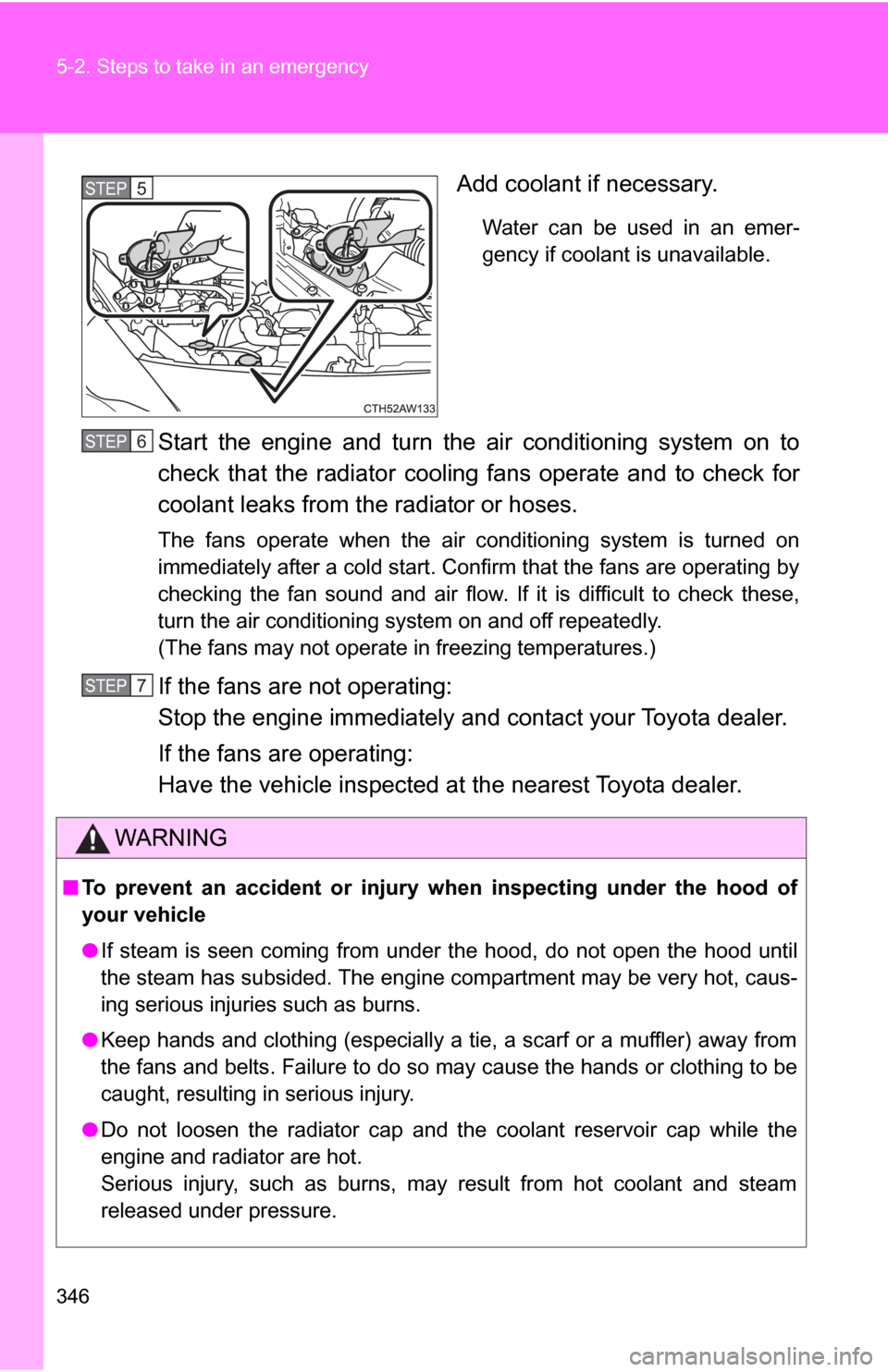
Add coolant if necessary.
Water can be used in an emer-
gency if coolant is unavailable.
Start the engine and turn the air conditioning system on to
check that the radiator cooling fans operate and to check for
coolant leaks from the radiator or hoses.
The fans operate when the air conditioning system is turned on
immediately after a cold start. Confirm that the fans are operating by
checking the fan sound and air flow. If it is difficult to check these,
turn the air conditioning system on and off repeatedly.
(The fans may not operate in freezing temperatures.)
If the fans are not operating:
Stop the engine immediately and contact your Toyota dealer.
If the fans are operating:
Have the vehicle inspected at the nearest Toyota dealer.
STEP 5
WARNING
■To prevent an accident or injury when inspecting under the hood of
your vehicle
● If steam is seen coming from under the hood, do not open the hood until
the steam has subsided. The engine compartment may be very hot, caus-
ing serious injuries such as burns.
● Keep hands and clothing (especially a tie, a scarf or a muffler) away from
the fans and belts. Failure to do so may cause the hands or clothing to be
caught, resulting in serious injury.
● Do not loosen the radiator cap and the coolant reservoir cap while the
engine and radiator are hot.
Serious injury, such as burns, may result from hot coolant and steam
released under pressure.
STEP 6
STEP 7
Page 348 of 428
348
5-2. Steps to take in an emergency
If the vehicle becomes stuck
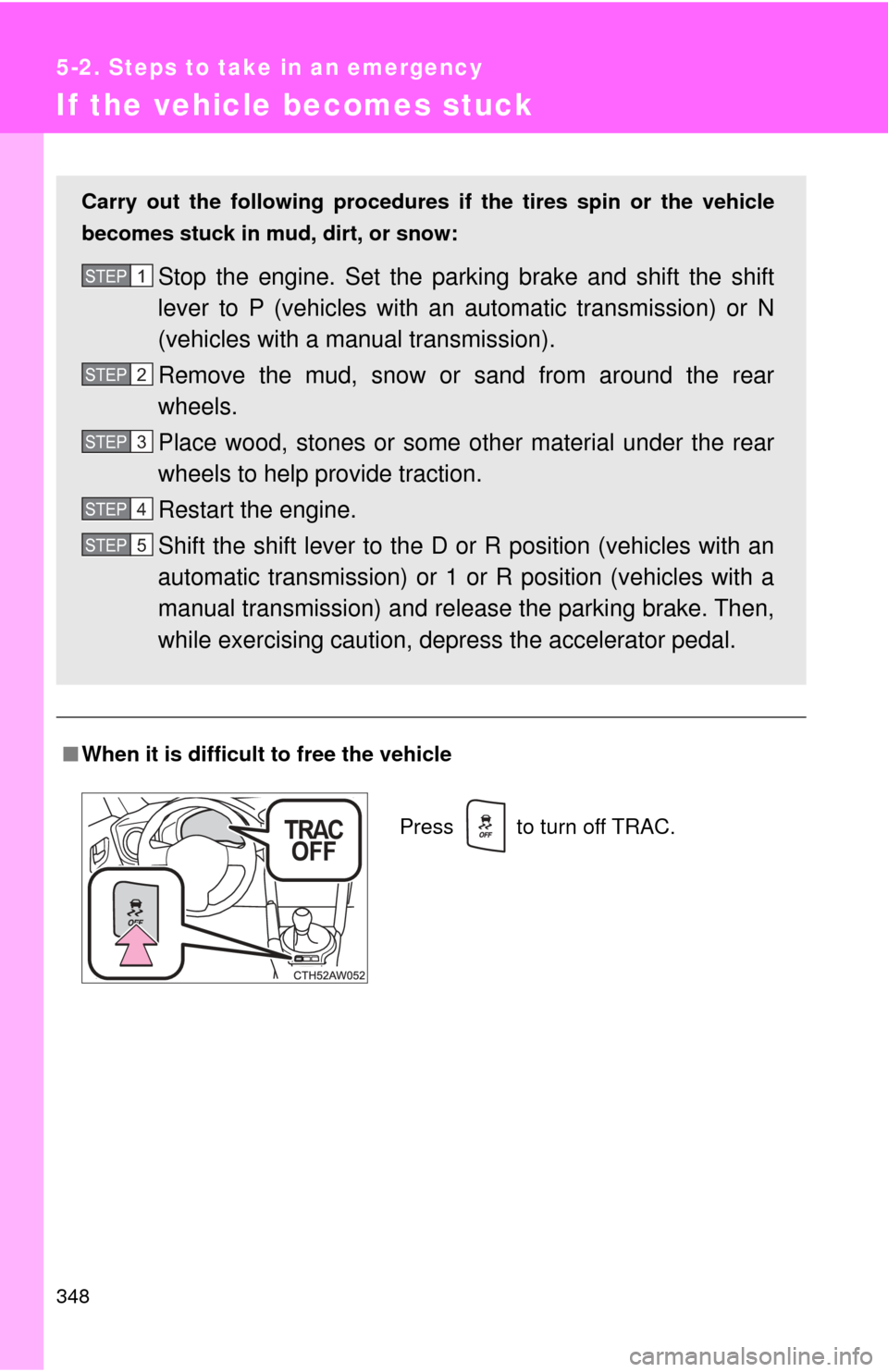
■When it is difficult to free the vehicle
Carry out the following procedures if the tires spin or the vehicle
becomes stuck in mud, dirt, or snow:
Stop the engine. Set the park ing brake and shift the shift
lever to P (vehicles with an automatic transmission) or N
(vehicles with a manual transmission).
Remove the mud, snow or sand from around the rear
wheels.
Place wood, stones or some other material under the rear
wheels to help provide traction.
Restart the engine.
Shift the shift lever to the D or R position (vehicles with an
automatic transmission) or 1 or R position (vehicles with a
manual transmission) and release the parking brake. Then,
while exercising caution, depress the accelerator pedal.STEP 1
STEP 2
STEP 3
STEP 4
STEP 5
Press to turn off TRAC.
Page 361 of 428
361
6-1. Specifications
6
Vehicle specifications
Electrical system
Differential
*: Your Toyota vehicle is filled with “Toyota Genuine Differential Gear Oil” at the
factory. Use Toyota approved “Toyota Genuine Differential Gear Oil” or an
equivalent of matching quality to satisfy the above specification. Please con-
tact your Toyota dealer for further details.
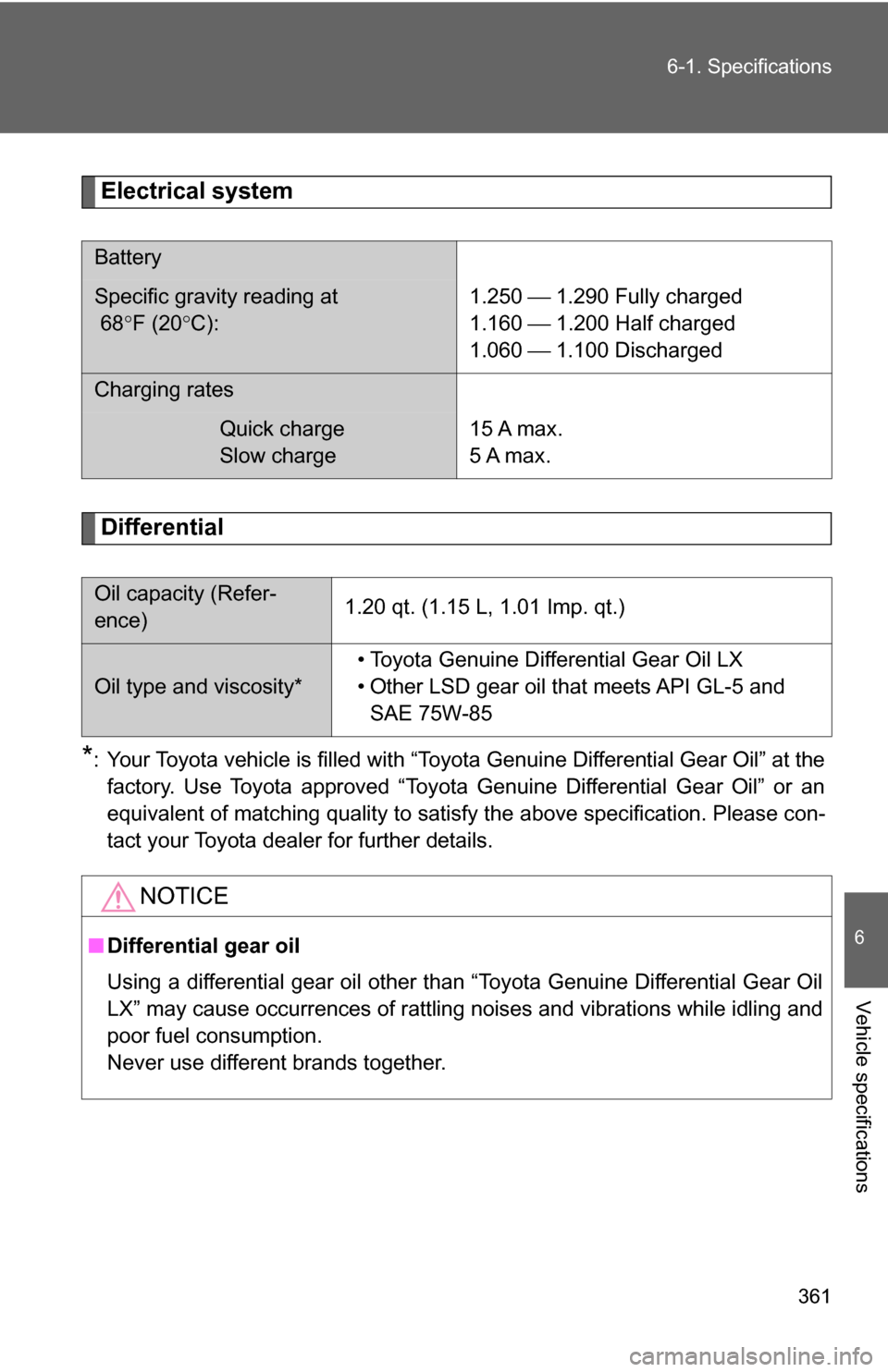
Battery
Specific gravity reading at
68 °F (20 °C): 1.250
⎯ 1.290 Fully charged
1.160 ⎯ 1.200 Half charged
1.060 ⎯ 1.100 Discharged
Charging rates
Quick charge
Slow charge 15 A max.
5 A max.
Oil capacity (Refer-
ence)
1.20 qt. (1.15 L, 1.01 Imp. qt.)
Oil type and viscosity* • Toyota Genuine Differential Gear Oil LX
• Other LSD gear oil that meets API GL-5 and
SAE 75W-85
NOTICE
■ Differential gear oil
Using a differential gear oil other than “Toyota Genuine Differential Gear Oil
LX” may cause occurrences of rattling noises and vibrations while idling and
poor fuel consumption.
Never use different brands together.
Page 362 of 428
362 6-1. Specifications
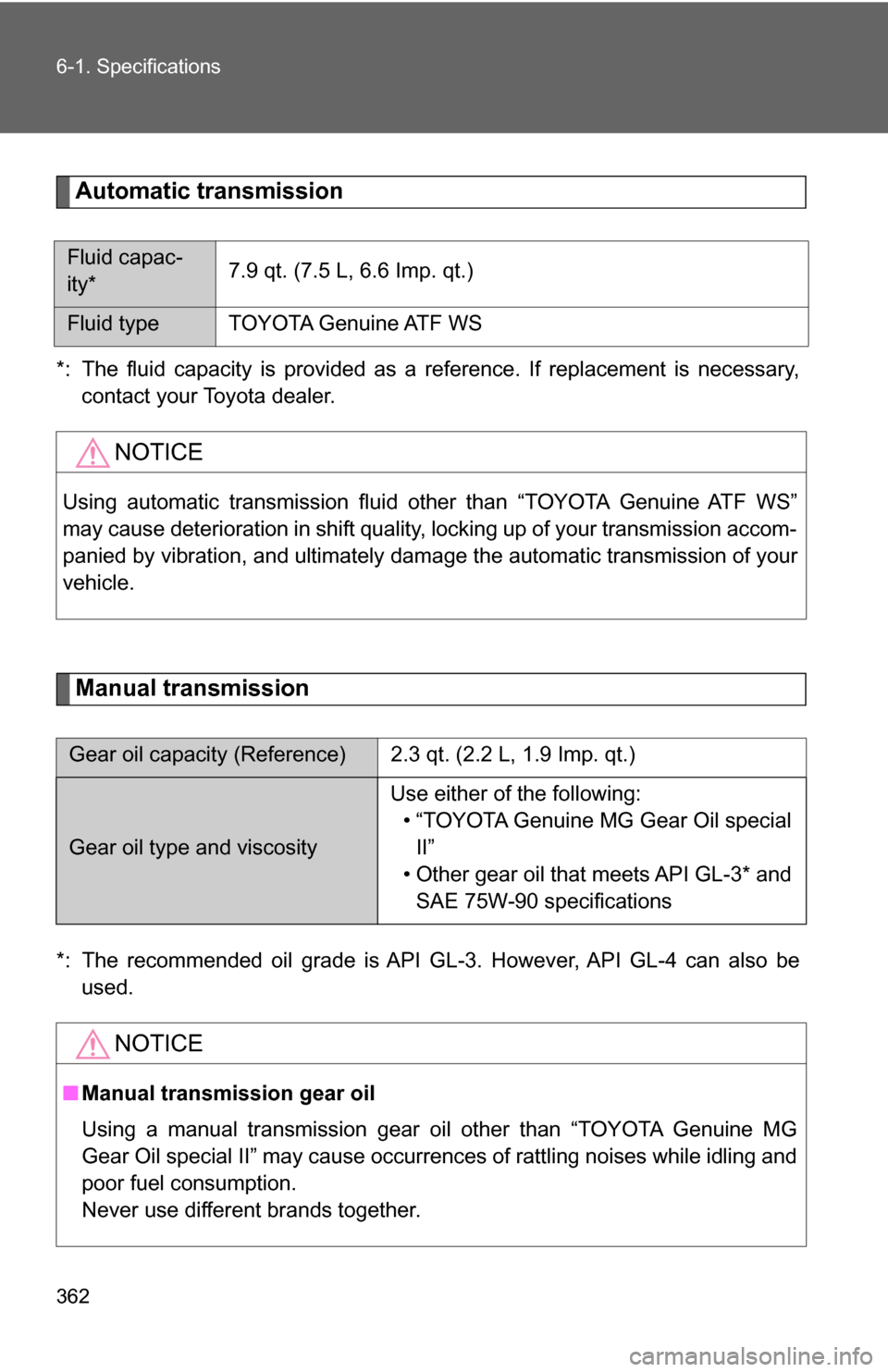
Automatic transmission
*: The fluid capacity is provided as a reference. If replacement is necessary,contact your Toyota dealer.
Manual transmission
*: The recommended oil grade is API GL-3. However, API GL-4 can also beused.
Fluid capac-
ity* 7.9 qt. (7.5 L, 6.6 Imp. qt.)
Fluid type TOYOTA Genuine ATF WS
NOTICE
Using automatic transmission fluid other than “TOYOTA Genuine ATF WS”
may cause deterioration in shift quality, locking up of your transmission accom-
panied by vibration, and ultimately damage the automatic transmission of your
vehicle.
Gear oil capacity (Reference) 2.3 qt. (2.2 L, 1.9 Imp. qt.)
Gear oil type and viscosity Use either of the following:
• “TOYOTA Genuine MG Gear Oil special II”
• Other gear oil that meets API GL-3* and SAE 75W-90 specifications
NOTICE
■ Manual transmission gear oil
Using a manual transmission gear oil other than “TOYOTA Genuine MG
Gear Oil special II” may cause occurrences of rattling noises while idling and
poor fuel consumption.
Never use different brands together.
Page 367 of 428

367
6-1. Specifications
6
Vehicle specifications
■
Gasoline quality
In very few cases, driveability problems may be caused by the brand of gas-
oline you are using. If driveability problems persist, try changing the brand of
gasoline. If this does not correct the problem, consult your Toyota dealer.
■ Fuel octane rating
This octane rating is the average of the Research Octane and Motor Octane
numbers and is commonly referred to as the Anti Knock Index.
Using a gasoline with a lower octane rating can cause persistent and heavy
knocking, which can damage the engine. Do not be concerned if your vehi-
cle sometimes knocks lightly when you drive up a hill or when you acceler-
ate. Contact your Toyota dealer if you use a fuel with the specified octane
rating and your vehicle knocks heavily or persistently.
■ Gasoline for California-certified LEV
If your vehicle was certified to California’s low emission vehicle (LEV) stan-
dards as indicated on the underhood tune-up label, it is designed to optimize
engine and emission performance with gasoline that meets the clean burn-
ing low-sulfur California gasoline specifications. If you live in any other state
than California, your vehicle will operate on gasoline meeting Federal speci-
fications. Gasoline sold outside California is permitted to have higher sulfur
levels, which may affect the performance of your vehicle’s catalytic converter
and may produce a sulfur exhaust odor or smell. Toyota recommends that
you try a different brand of unleaded gasoline having lower sulfur to deter-
mine if the problem is fuel related before returning your vehicle to an autho-
rized dealer for service.
Page 369 of 428

369
6-1. Specifications
6
Vehicle specifications
■
Toyota does not recommend gasoline containing MMT
Some gasoline contains octane enhancing additive called MMT (Methylcy-
clopentadienyl Manganese Tricarbonyl).
Toyota DOES NOT recommend the use of gasoline that contains MMT. If
fuel containing MMT is used, your emission control system may be
adversely affected.
The malfunction indicator lamp on the instrument cluster may come on. If
this happens, contact your Toyota dealer for service.
NOTICE
■Notice on fuel quality
●Do not use improper fuels. If improper fuels are used the engine will be
damaged.
● Do not use leaded gasoline.
Leaded gasoline can cause damage to your vehicle’s three-way catalytic
converters causing the emission control system to malfunction.
● Do not use gasohol other than the type previously stated.
Other gasohol may cause fuel system damage or vehicle performance
problems.
● Using unleaded gasoline with an octane number or rating lower than the
level previously stated may cause persistent heavy knocking.
At worst, this may lead to engine damage and will void the vehicle war-
ranty.
■ Fuel-related poor driveability
If after using a different type of fuel, poor driveability is encountered (poor
hot starting, vaporization, engine knocking, etc.), discontinue the use of that
type of fuel.
■ When refueling with gasohol
Take care not to spill gasohol. It can damage your vehicle's paint.
Page 375 of 428

375
6-1. Specifications
6
Vehicle specifications
■
Treadwear
The treadwear grade is a comparative rating based on the wear
rate of the tire when tested under controlled conditions on a speci-
fied government test course.
For example, a tire graded 150 would wear one and a half (1 - 1/2)
times as well on the government course as a tire graded 100.
The relative performance of tires depends upon the actual conditions
of their use. Performance may diff er significantly from the norm due
to variations in driving habits, service practices and differences in
road characteristics and climate.
■ Traction AA, A, B, C
The traction grades, from highest to lowest, are AA, A, B and C,
and they represent t he tire’s ability to stop on wet pavement as
measured under controlled cond itions on specified government
test surfaces of asphalt and concrete.
A tire marked C may have poor traction performance.
Warning: The traction grade assigned to this tire is based on braking
(straight ahead) traction tests and does not include cornering (turn-
ing) traction.
■ Temperature A, B, C
The temperature grades are A (the highest), B, and C, represent-
ing the tire’s resistance to the generation of heat and its ability to
dissipate heat when tested under controlled conditions on a speci-
fied indoor laboratory test wheel.
Sustained high temperature can c ause the material of the tire to
degenerate and reduce tire life, and excessive temperature can lead
to sudden tire failure.
Grade C corresponds to a level of performance which all passenger
car tires must meet under the Feder al Motor Vehicle Safety Standard
No. 109.
Grades B and A represent higher levels of performance on the labo-
ratory test wheel than the minimum required by law.
Page 395 of 428
395
7
For owners
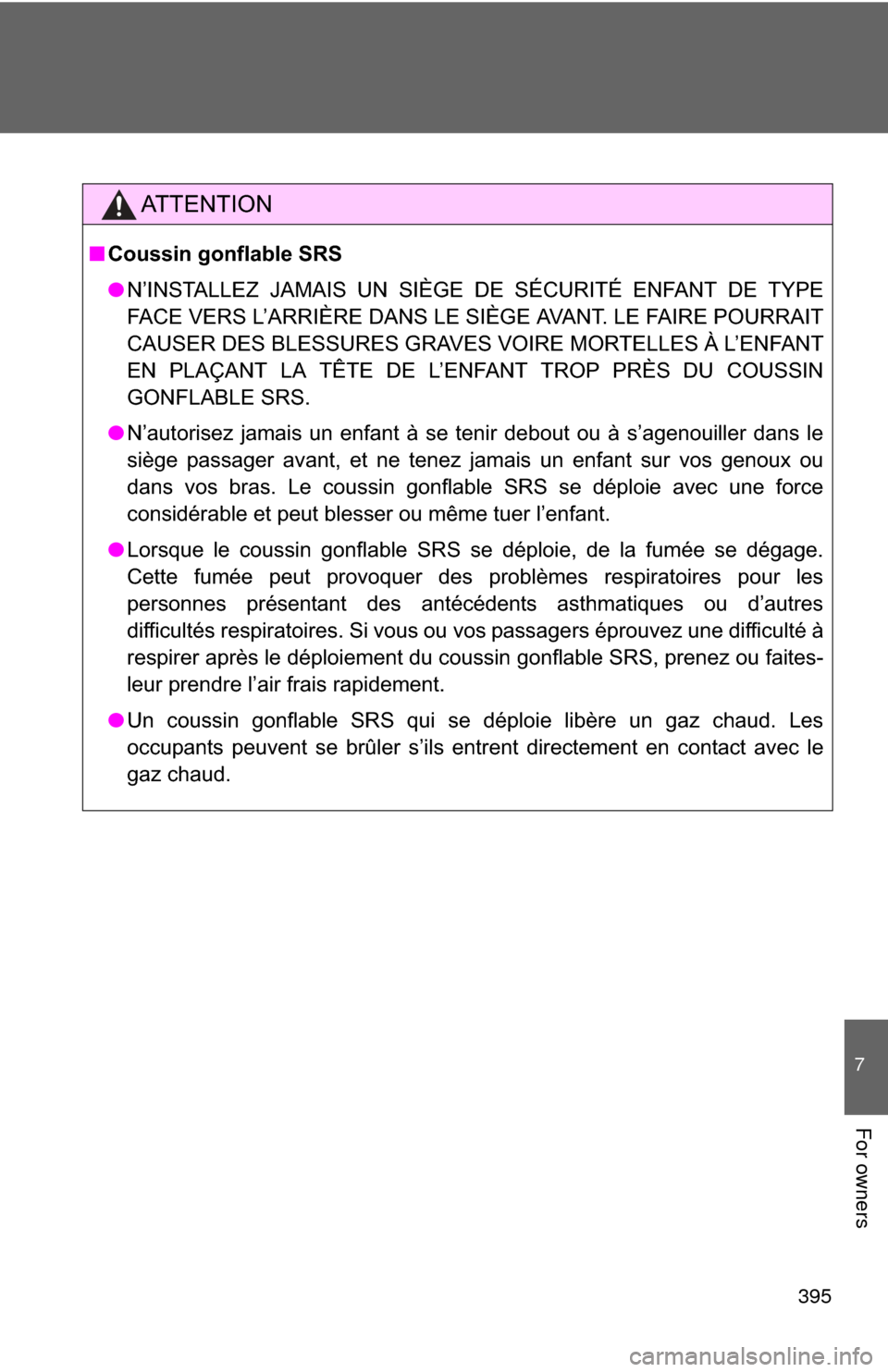
AT T E N T I O N
■Coussin gonflable SRS
● N’INSTALLEZ JAMAIS UN SIÈGE DE SÉCURITÉ ENFANT DE TYPE
FACE VERS L’ARRIÈRE DANS LE SIÈGE AVANT. LE FAIRE POURRAIT
CAUSER DES BLESSURES GRAVES VOIRE MORTELLES À L’ENFANT
EN PLAÇANT LA TÊTE DE L’ENFANT TROP PRÈS DU COUSSIN
GONFLABLE SRS.
● N’autorisez jamais un enfant à se tenir debout ou à s’agenouiller dans le
siège passager avant, et ne tenez jamais un enfant sur vos genoux ou
dans vos bras. Le coussin gonflable SRS se déploie avec une force
considérable et peut blesser ou même tuer l’enfant.
● Lorsque le coussin gonflable SRS se déploie, de la fumée se dégage.
Cette fumée peut provoquer des problèmes respiratoires pour les
personnes présentant des antécédents asthmatiques ou d’autres
difficultés respiratoires. Si vous ou vos passagers éprouvez une difficulté à
respirer après le déploiement du coussin gonflable SRS, prenez ou faites-
leur prendre l’air frais rapidement.
● Un coussin gonflable SRS qui se déploie libère un gaz chaud. Les
occupants peuvent se brûler s’ils entrent directement en contact avec le
gaz chaud.