tires TOYOTA GT86 2020 Warranties & Maintenance Guides (in English)
[x] Cancel search | Manufacturer: TOYOTA, Model Year: 2020, Model line: GT86, Model: TOYOTA GT86 2020Pages: 260, PDF Size: 8.54 MB
Page 148 of 260
NITTO TIRE
146
Tire Warranty, Safety and Care Information for
Original Equipment Passenger & Light Truck Tires
Limited Warranty for Original Equipment Nitto Tires
(Effective July 2017)
WHAT IS COVERED AND FOR HOW LONG?
This Limited Warranty covers all Nitto brand passenger car and light
truck tires installed as original equipment on vehicles that are sold an\
d
used within the United States.
Eligible Tires
Your tires are covered under this Limited Warranty if all of the following
criteria are met:•
The tire was installed on your vehicle at the factory as an original
equipment part.
•
You are the original purchaser of the vehicle.
•
You purchased the vehicle after June 2017*.
•
You have always used the tires with this vehicle.
•
The tires have been used for normal street driving.
•
The vehicle has not been used for commercial service.
•
You properly maintained and used the tire (See “Tire Safety and
Maintenance Information” section below).
•
The tires are not subject to an exclusion (See “What is Not
Covered?” section below).
•
You fulfill the warranty claim procedure (See “How to Make a
Claim” section below).
Eligible Tires are covered under this Limited Warranty for a period of
up to 5 years from the date you purchased your new vehicle. Nitto
will replace it with a comparable new Nitto brand tire in the manner
explained in the “What Nitto Will Do” section below.
* Vehicles purchased before July 2017 may be covered by an earlier
warranty. See your Nitto retailer or contact Nitto for more information.
Page 149 of 260
NITTO TIRE
147
WHAT IS NOT COVERED?
This Limited Warranty does not cover the following categories
of claims:
Rapid Treadwear: Original equipment tires are not guaranteed to last a
specified number of miles.
Damage from road hazards (not limited to cuts, snags, bruises, impact
breaks, bulges, punctures, stone drills, chips, and scales), fire, theft,
or collision.
Conditions arising from improper tire/vehicle maintenance or use, not
limited to:
•
Irregular or excessive treadwear due to: Incorrect inflation;
overloading; vehicle misalignment; failure to rotate tires; and poor
or defective mechanical condition of brakes, shocks, and wheels;
or other factors attributable to the vehicle or wheel.
•
Any tire which has been run with low air pressure or while flat.
•
Damage due to abuse; vandalism; tire alteration; tire spinning;
racing; or other competitive activities.
•
Damage, corrosion, or deterioration from using oil-based
chemicals, water-based sealers, balancing substances, or
flammable gases.
•
Damage from improper use of tire chains.
Tires with the DOT identification number removed or rendered illegible.
Improper mounting, balancing or repair, not limited to: •
Improper tire mounting, or tire/wheel assembly imbalance.
•
Damage from incorrect mounting or dismounting of the tire,
incorrect wheel size, water or other material trapped inside the tire
during mounting, or failure to keep the tires balanced.
•
Damage resulting from improper repair materials or procedures.
Page 150 of 260
NITTO TIRE
148
Failure to meet conditions of this Limited Warranty, not limited to:•
Any tire that is not an Eligible Tire.
•
Any tire for which mileage and tire rotation records are not
available or verifiable.
•
Any tire not presented and available for Nitto’s inspection.
•
Any tire worn beyond the treadwear indicators (less than 2/32” of
remaining tread).
•
Uniformity issues after the first 25% of treadwear.
Nothing in this Limited Warranty is intended to be a representation that
tire failures cannot occur.
WHAT NITTO WILL DO
For every Eligible Tire, Nitto will do the following:
Regular OE Tires 1.
If less than 25% Worn: Nitto will replace, free of charge, any
Eligible Tire when the original usable tread is worn by 25% or
less, and within 5 years from the date you purchased the vehicle
new. If you cannot provide a copy of the new vehicle registration
or vehicle purchase receipt, the manufacture date of the tire, as
indicated by the tire DOT code, will be used instead to determine
if a tire is within the warranty period. Tire mounting and balancing
costs are covered by Nitto. You are responsible for taxes and
all other costs, fees and expenses.
2.
If more than 25% Worn: Nitto will replace any Eligible Tire when
the original usable tread is worn by more than 25%, and within 5
years from the date you purchased the vehicle new. If you cannot
provide a copy of the new vehicle registration or vehicle purchase
receipt, the manufacture date of the tire, as indicated by the tire
DOT code, will be used instead to determine if a tire is within the
warranty period. You are responsible for the pro-rated cost of
a replacement tire, mounting and balancing costs, taxes and
all other costs, fees and expenses.
Page 152 of 260
NITTO TIRE
150
Some states do not allow the exclusion or limitation of incidental
or consequential damages, so the above exclusions may not apply
to you.
The terms of this Limited Warranty may not be changed by anyone,
including any Nitto employee, representative, or dealer.
Nitto does not warrant any work performed by the dealer, including,
but not limited to, their selection, fitment, mounting and balancing,
inspection or repair of any tire.
CONTACT INFORMATION
If you need assistance, please contact your authorized Nitto retailer.
To locate an authorized Nitto dealer, use our dealer locator at
www.nittotire.com, or contact Nitto Technical Services at:
NITTO TIRE U.S.A INC.
PO BOX 6064
Cypress, California 90630-6064
(888) 529-8200 (8:00am to 5:00pm Pacific Time)
Tire Safety and Maintenance Information
IMPORTANT SAFETY AND TIRE USAGE INFORMATION FOR
NITTO NT05R TIRES ON THE DODGE CHALLENGER SRT DEMON
Your drag radial tires are designed for racing conditions and are not
like ordinary passenger car tires. Follow the instructions on this page \
to promote tire safety and to better understand your drag radial tires’
characteristics. To the extent any information on this page differs from
the general tire care information elsewhere in this manual, follow the
instructions on this page for your tires.
CHARACTERISTICS OF COMPETITION TIRES
The drag radial tires installed on this vehicle are designed for
competition use, and feature a race compound, limited tread grooves,
and shallow tread depth, to provide maximum dry traction. Therefore,
these tires are not recommended for use in wet weather conditions
where there is risk of hydroplaning and loss of vehicle control.
Page 153 of 260
NITTO TIRE
151
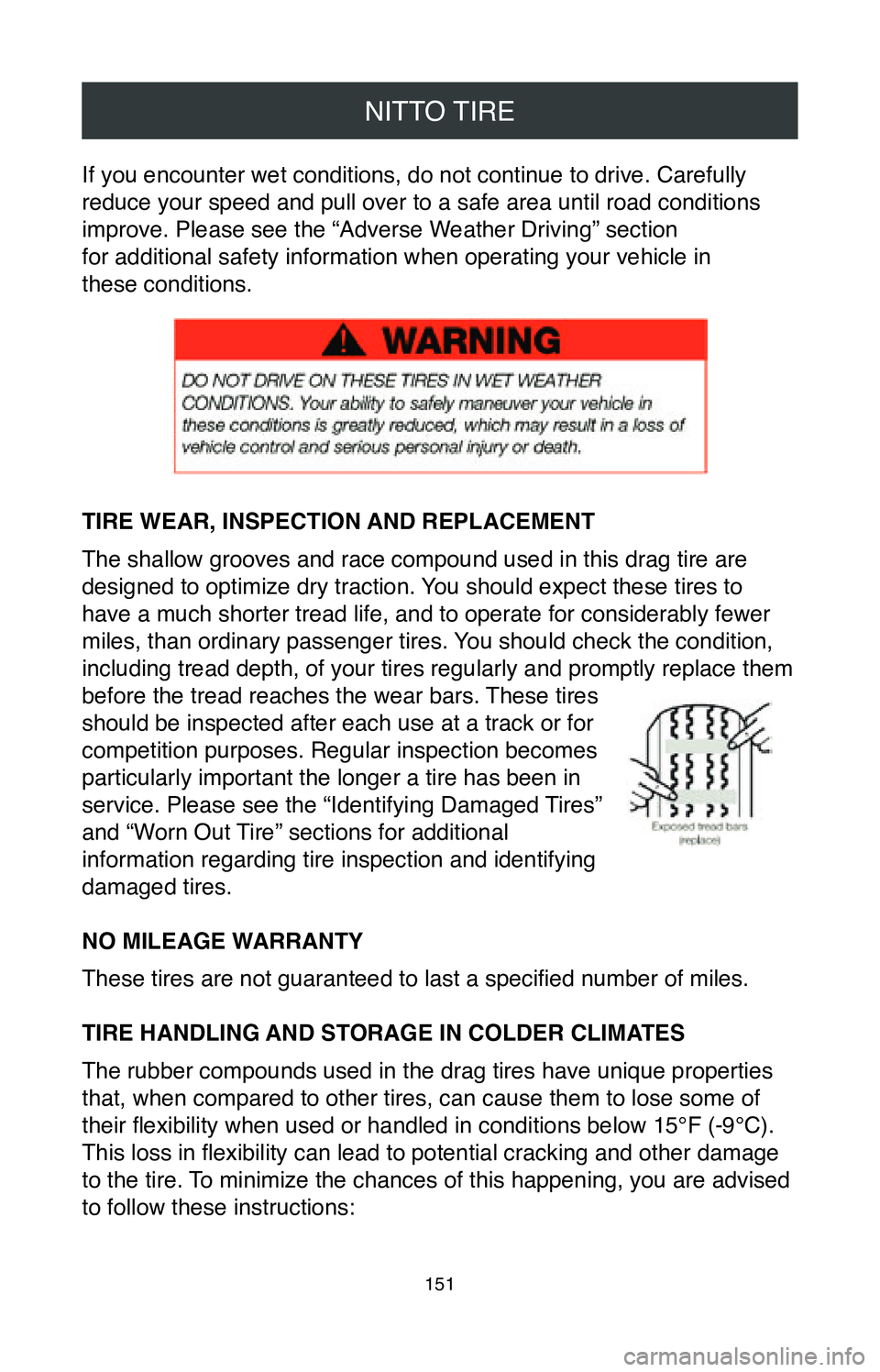
If you encounter wet conditions, do not continue to drive. Carefully
reduce your speed and pull over to a safe area until road conditions
improve. Please see the “Adverse Weather Driving” section
for additional safety information when operating your vehicle in
these conditions.
TIRE WEAR, INSPECTION AND REPLACEMENT
The shallow grooves and race compound used in this drag tire are
designed to optimize dry traction. You should expect these tires to
have a much shorter tread life, and to operate for considerably fewer
miles, than ordinary passenger tires. You should check the condition,
including tread depth, of your tires regularly and promptly replace them\
before the tread reaches the wear bars. These tires
should be inspected after each use at a track or for
competition purposes. Regular inspection becomes
particularly important the longer a tire has been in
service. Please see the “Identifying Damaged Tires”
and “Worn Out Tire” sections for additional
information regarding tire inspection and identifying
damaged tires.
NO MILEAGE WARRANTY
These tires are not guaranteed to last a specified number of miles.
TIRE HANDLING AND STORAGE IN COLDER CLIMATES
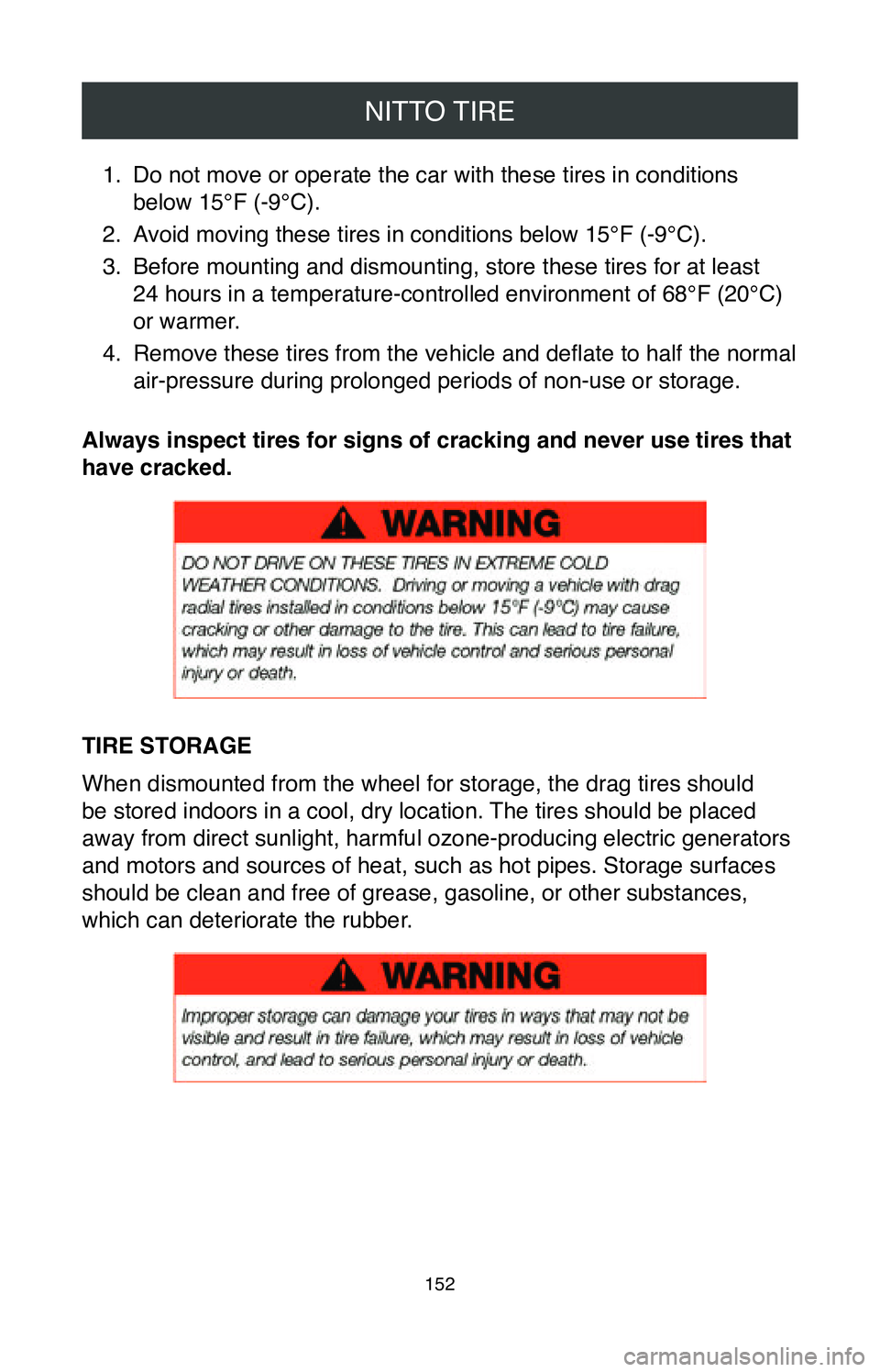
The rubber compounds used in the drag tires have unique properties
that, when compared to other tires, can cause them to lose some of
their flexibility when used or handled in conditions below 15°F (-9°C).
This loss in flexibility can lead to potential cracking and other damage
to the tire. To minimize the chances of this happening, you are advised
to follow these instructions:
Page 154 of 260
NITTO TIRE
152
1. Do not move or operate the car with these tires in conditions
below 15°F (-9°C).
2.
Avoid moving these tires in conditions below 15°F (-9°C).
3.
Before mounting and dismounting, store these tires for at least
24 hours in a temperature-controlled environment of 68°F (20°C)
or warmer.
4.
Remove these tires from the vehicle and deflate to half the normal
air-pressure during prolonged periods of non-use or storage.
Always inspect tires for signs of cracking and never use tires that
have cracked.
TIRE STORAGE
When dismounted from the wheel for storage, the drag tires should
be stored indoors in a cool, dry location. The tires should be placed
away from direct sunlight, harmful ozone-producing electric generators
and motors and sources of heat, such as hot pipes. Storage surfaces
should be clean and free of grease, gasoline, or other substances,
which can deteriorate the rubber.
Page 156 of 260
NITTO TIRE
154
TIRE PRESSURE BASICS
The combined effect of losing 1 psi per month over several months
along with a 1 psi decrease for every 10°F temperature drop could
add up to a severe “run low” condition; consequently, it is important
to check your tires’ inflation pressure at least once per month. Inflation
pressure enables a tire to support its load; therefore, proper inflation
is critical.
HOW TO DETERMINE PROPER TIRE INFLATION PRESSURE
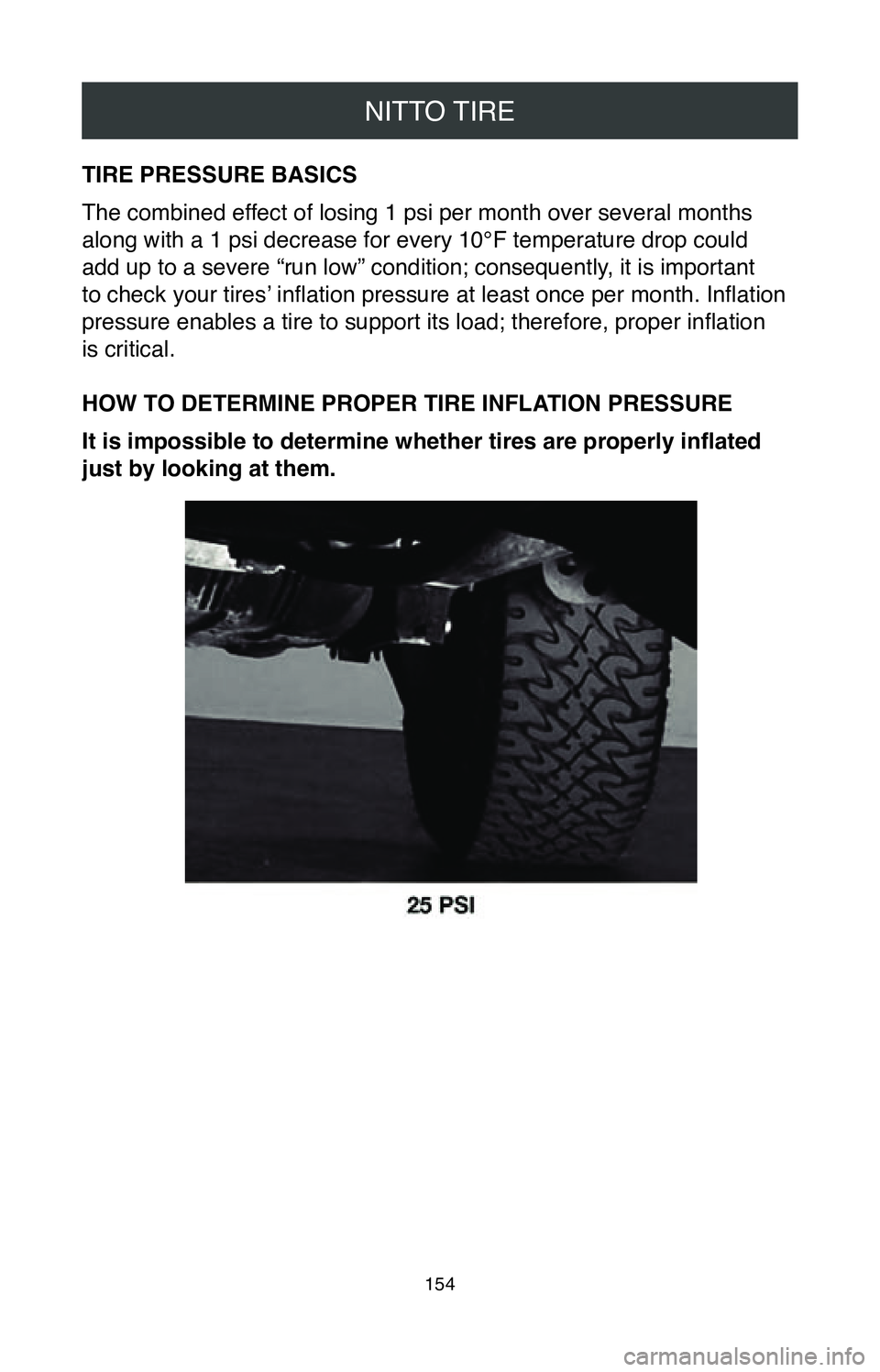
It is impossible to determine whether tires are properly inflated
just by looking at them.
Page 158 of 260
NITTO TIRE
156
It is important to check your tires using an accurate tire
pressure gauge, which can be purchased at your tire dealer
or auto supply store.
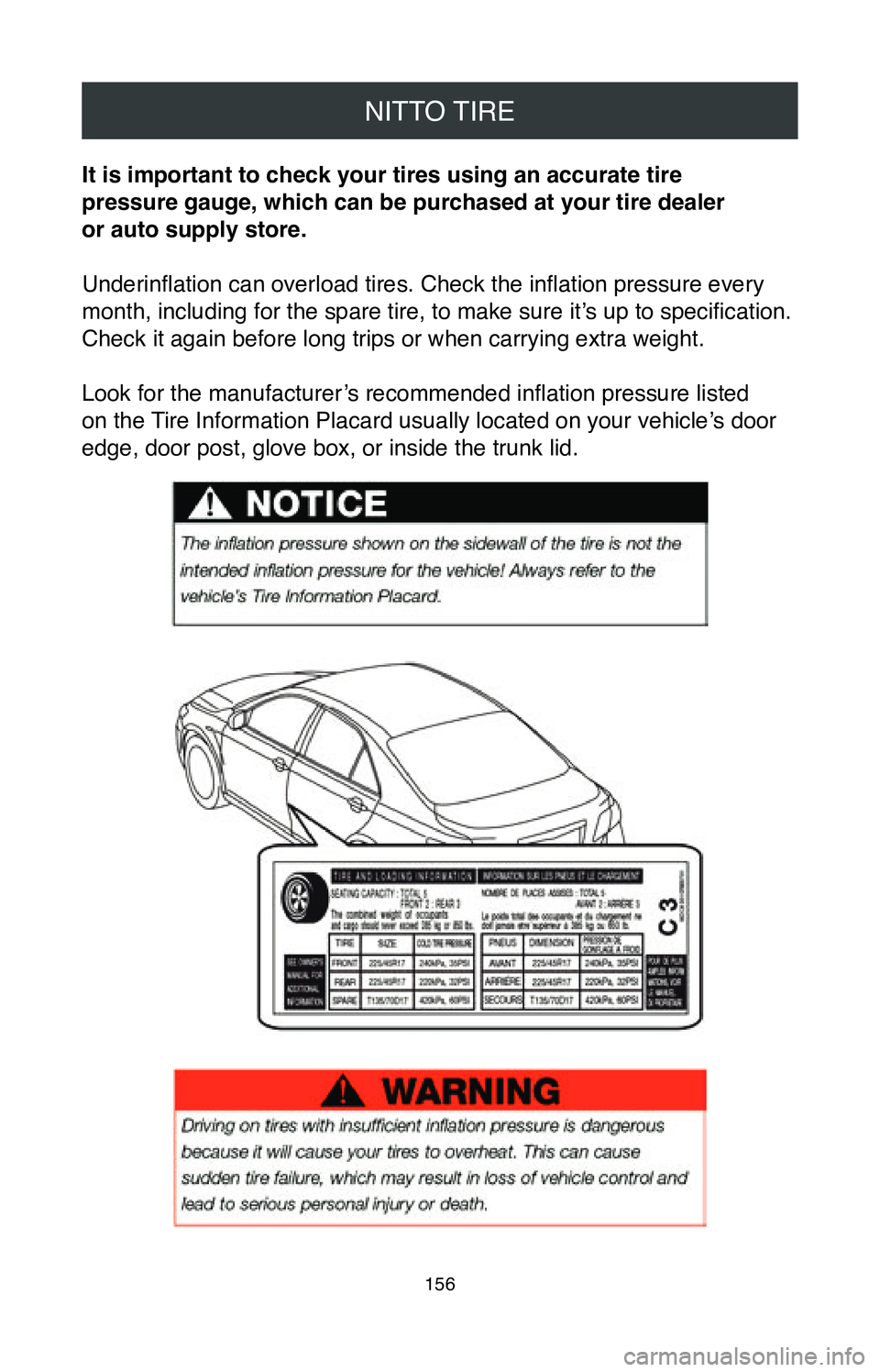
Underinflation can overload tires. Check the inflation pressure every
month, including for the spare tire, to make sure it’s up to specification.
Check it again before long trips or when carrying extra weight.
Look for the manufacturer’s recommended inflation pressure listed
on the Tire Information Placard usually located on your vehicle’s door
edge, door post, glove box, or inside the trunk lid.
Page 159 of 260
NITTO TIRE
157
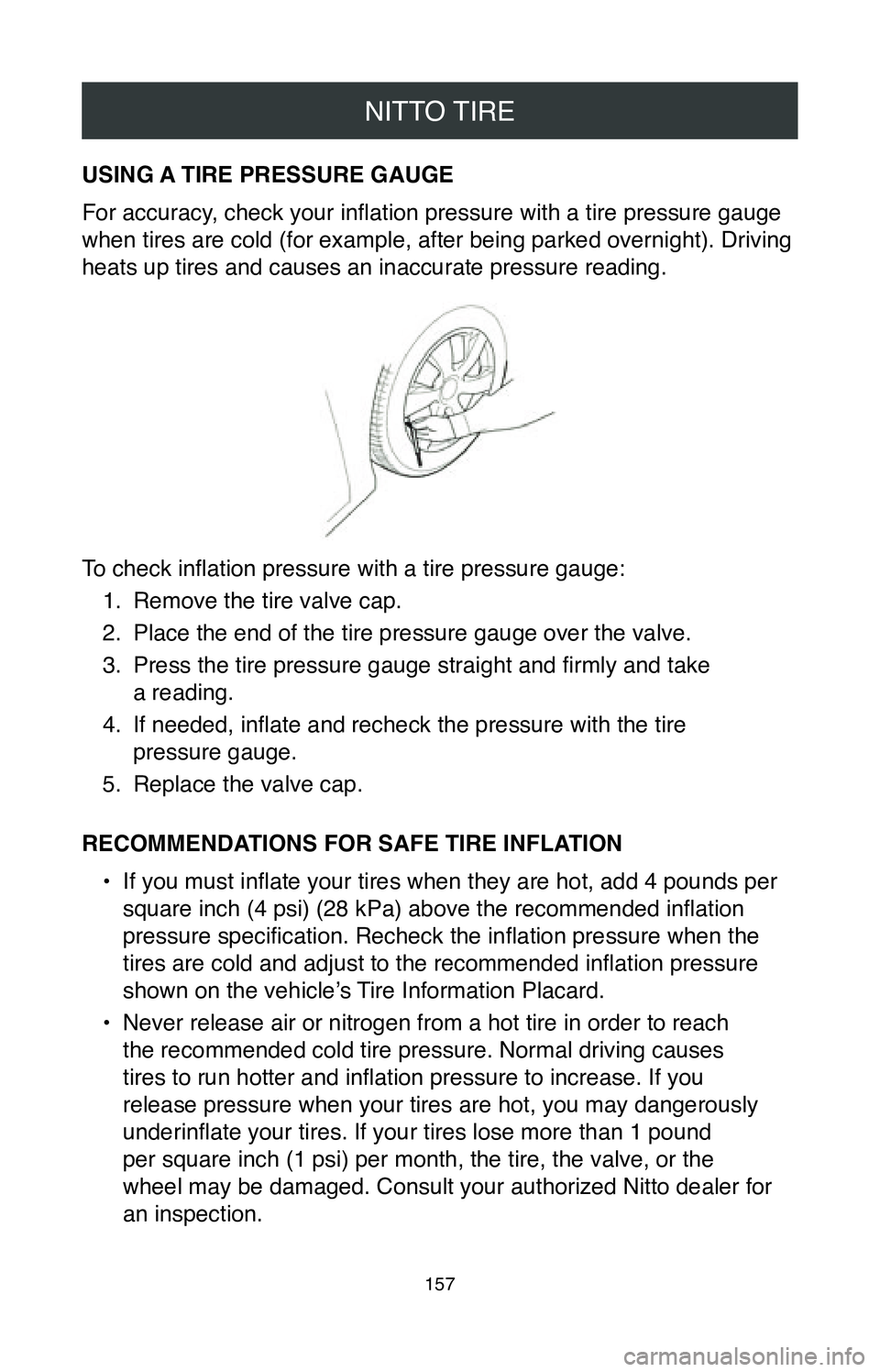
USING A TIRE PRESSURE GAUGE
For accuracy, check your inflation pressure with a tire pressure gauge
when tires are cold (for example, after being parked overnight). Driving
heats up tires and causes an inaccurate pressure reading.
To check inflation pressure with a tire pressure gauge:1.
Remove the tire valve cap.
2.
Place the end of the tire pressure gauge over the valve.
3.
Press the tire pressure gauge straight and firmly and take
a reading.
4.
If needed, inflate and recheck the pressure with the tire
pressure gauge.
5.
Replace the valve cap.
RECOMMENDATIONS FOR SAFE TIRE INFLATION •
If you must inflate your tires when they are hot, add 4 pounds per
square inch (4 psi) (28 kPa) above the recommended inflation
pressure specification. Recheck the inflation pressure when the
tires are cold and adjust to the recommended inflation pressure
shown on the vehicle’s Tire Information Placard.
•
Never release air or nitrogen from a hot tire in order to reach
the recommended cold tire pressure. Normal driving causes
tires to run hotter and inflation pressure to increase. If you
release pressure when your tires are hot, you may dangerously
underinflate your tires. If your tires lose more than 1 pound
per square inch (1 psi) per month, the tire, the valve, or the
wheel may be damaged. Consult your authorized Nitto dealer for
an inspection.
Page 160 of 260
NITTO TIRE
158
• Over-inflation can cause the tire to be more susceptible to
impact damage.
•
Over-inflation or underinflation may adversely affect vehicle
handling.
•
Remember to check your spare tire. Consult your vehicle Owner’s
Manual for the correct inflation pressure and use of a “temporary
use” spare tire. The inflation pressure specified for a spare tire is
typically different from that specified for your regular tires.
•
Use valve caps to keep valve cores clean and clear of debris and
to help guard against air leakage.
VEHICLES EQUIPPED WITH TIRE PRESSURE MONITORING
SYSTEMS (TPMS)
Even if your vehicle is equipped with a tire pressure monitoring
system, you should check your tire pressure at least once per month
when the tires are cold (for example, after being parked overnight).
Tire pressure warning systems are not a substitute for regular tire
pressure maintenance.