instrument panel TOYOTA HIGHLANDER 2008 XU40 / 2.G User Guide
[x] Cancel search | Manufacturer: TOYOTA, Model Year: 2008, Model line: HIGHLANDER, Model: TOYOTA HIGHLANDER 2008 XU40 / 2.GPages: 577, PDF Size: 11.46 MB
Page 178 of 577
178 2-2. Instrument cluster
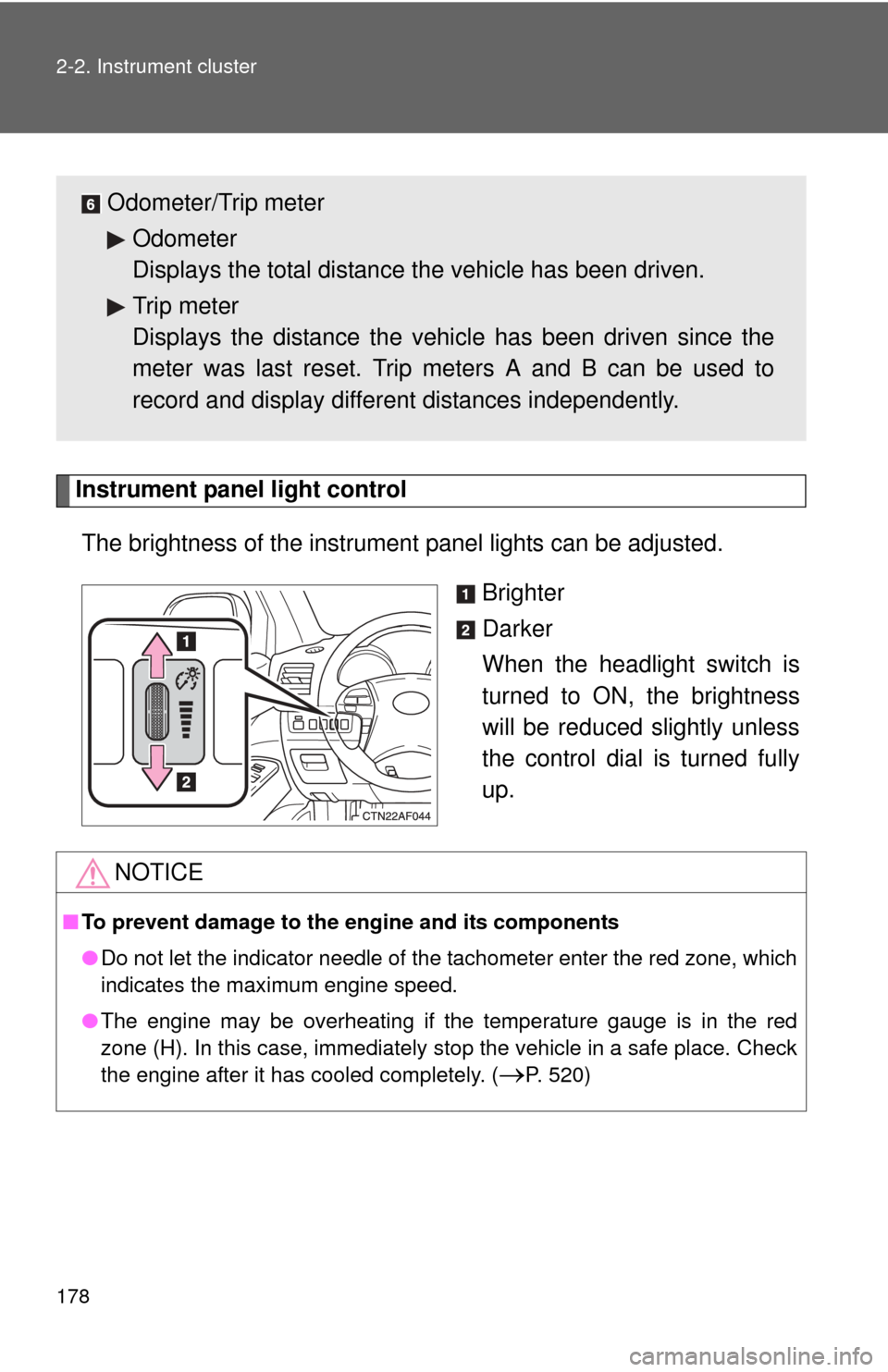
Instrument panel light controlThe brightness of the instrument panel lights can be adjusted.
Brighter
Darker
When the headlight switch is
turned to ON, the brightness
will be reduced slightly unless
the control dial is turned fully
up.
Odometer/Trip meterOdometer
Displays the total distance the vehicle has been driven.
Trip meter
Displays the distance the vehi cle has been driven since the
meter was last reset. Trip meters A and B can be used to
record and display different distances independently.
NOTICE
■ To prevent damage to the engine and its components
●Do not let the indicator needle of the tachometer enter the red zone, which
indicates the maximum engine speed.
● The engine may be overheating if the temperature gauge is in the red
zone (H). In this case, immediately stop the vehicle in a safe place. Check
the engine after it has cooled completely. (
P. 520)
Page 179 of 577
179
2-2. Instrument cluster
2
When driving
Indicators and war ning lights
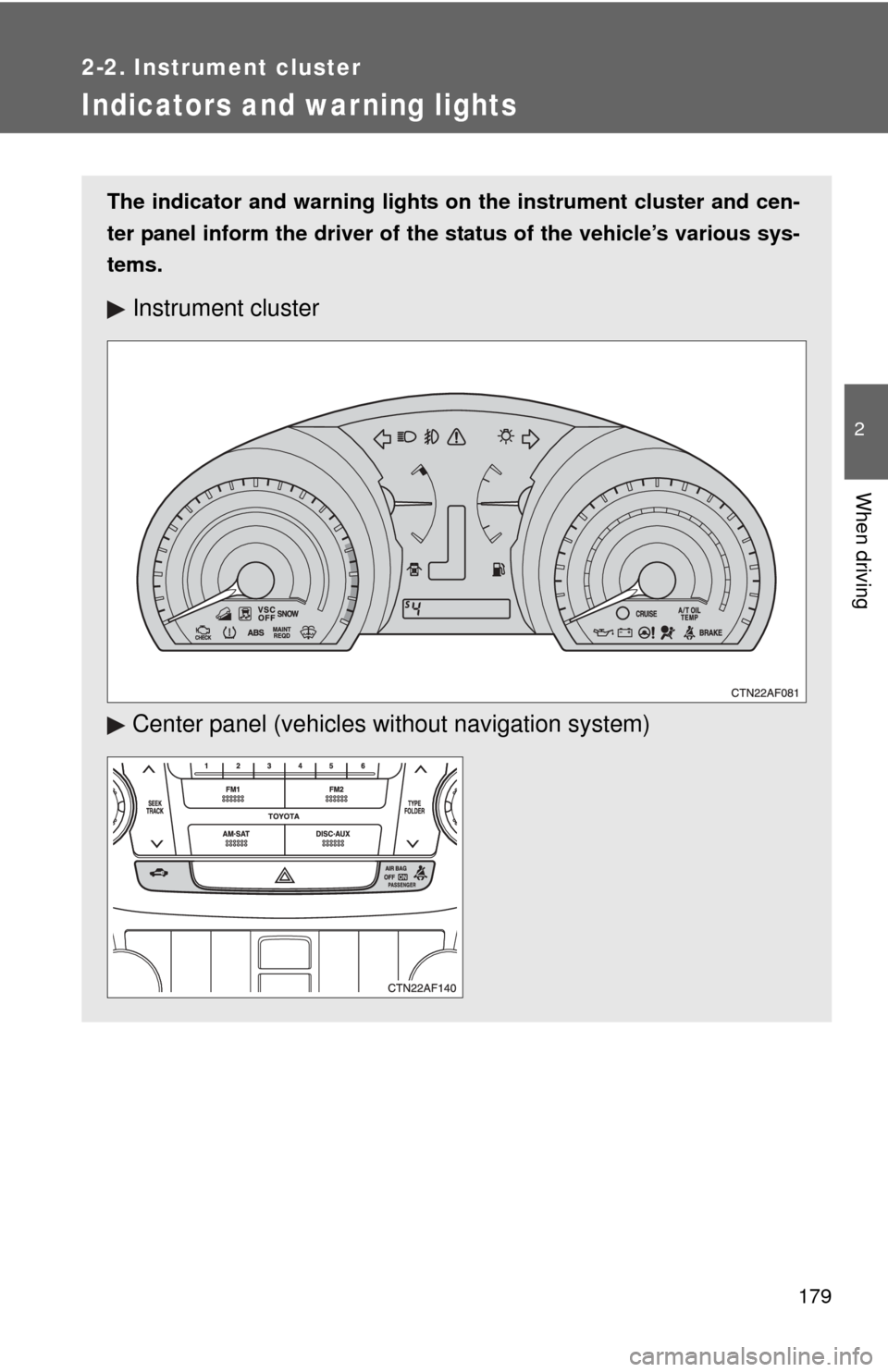
The indicator and warning lights on the instrument cluster and cen-
ter panel inform the driver of the status of the vehicle’s various sys-
tems.
Instrument cluster
Center panel (vehicles without navigat ion system)
Page 180 of 577
180 2-2. Instrument cluster
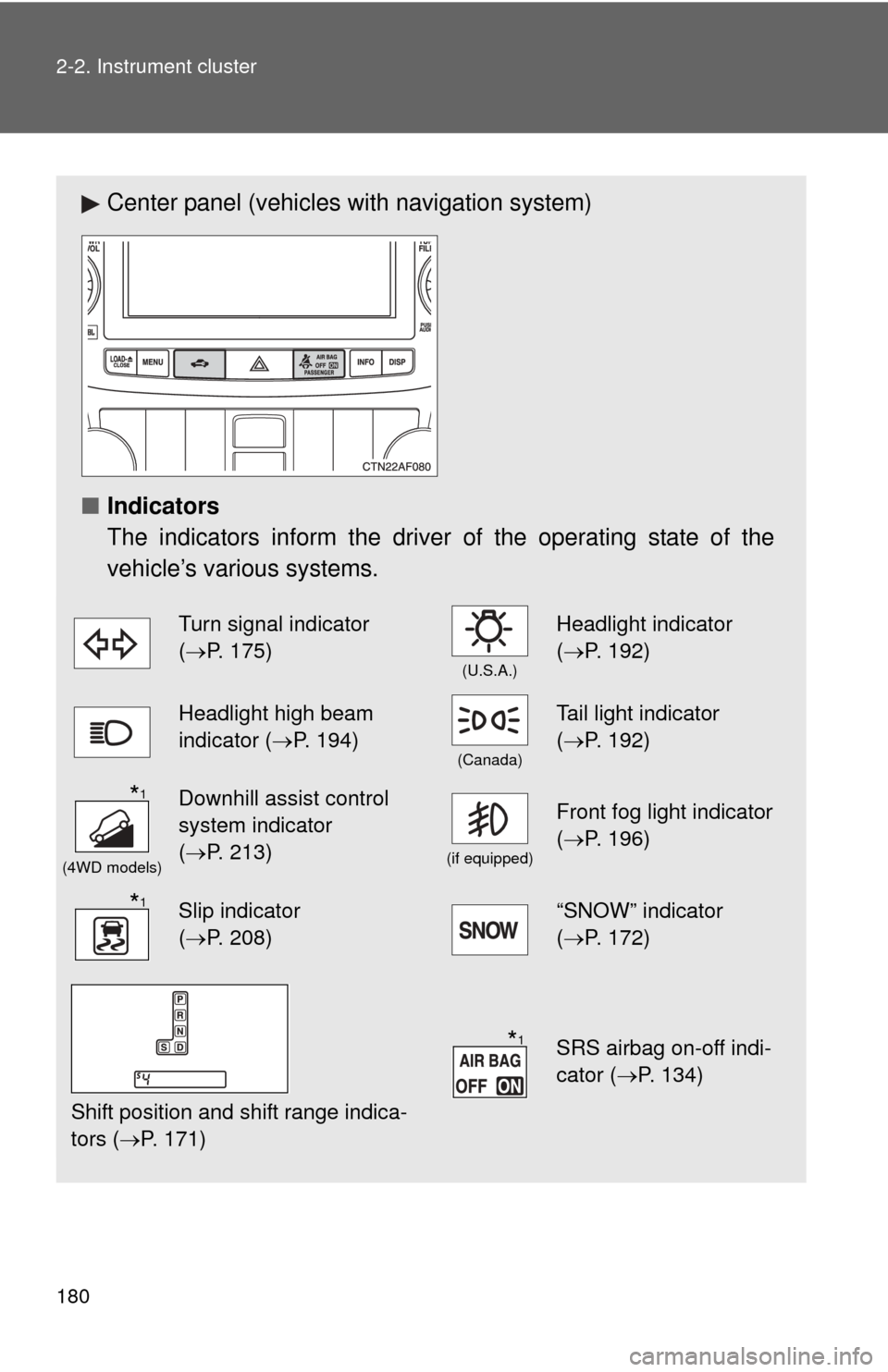
Center panel (vehicles with navigation system)
■ Indicators
The indicators inform the driver of the operating state of the
vehicle’s various systems.
Turn signal indicator
(P. 175)
(U.S.A.)
Headlight indicator
( P. 192)
Headlight high beam
indicator ( P. 194)
(Canada)
Tail light indicator
(P. 192)
(4WD models)
Downhill assist control
system indicator
(P. 213)
(if equipped)
Front fog light indicator
( P. 196)
Slip indicator
(P. 208)“SNOW” indicator
( P. 172)
Shift position and shift range indica-
tors ( P. 171)
SRS airbag on-off indi-
cator (P. 134)
*1
*1
*1
Page 192 of 577
192
2-3. Operating the lights and wipers
Headlight switch
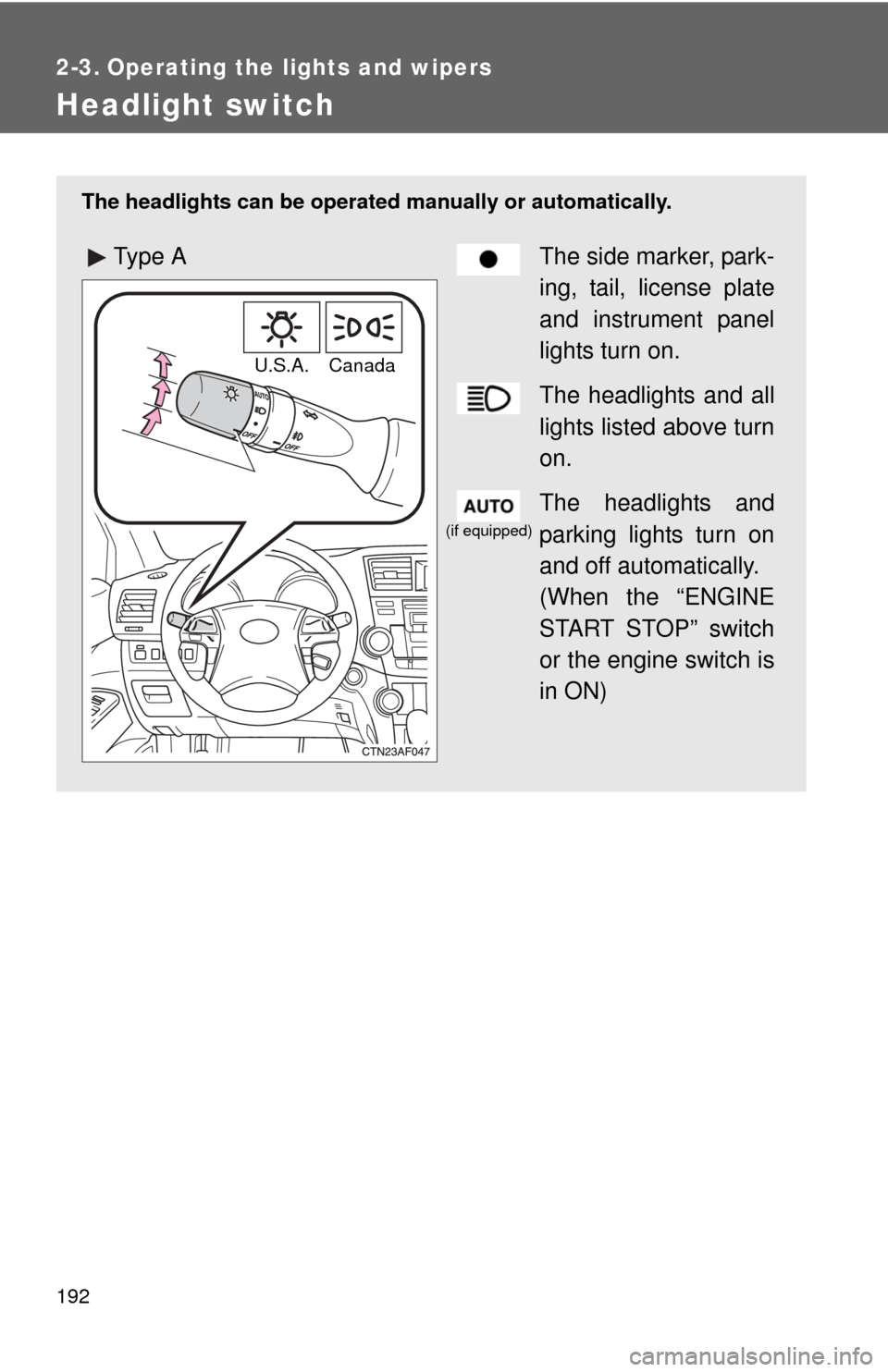
The headlights can be operated manually or automatically.
The side marker, park-
ing, tail, license plate
and instrument panel
lights turn on.
The headlights and all
lights listed above turn
on.
The headlights and
parking lights turn on
and off automatically.
(When the “ENGINE
START STOP” switch
or the engine switch is
in ON)
U.S.A. Canada
Type A
(if equipped)
Page 193 of 577
193
2-3. Operating the lights and wipers
2
When driving
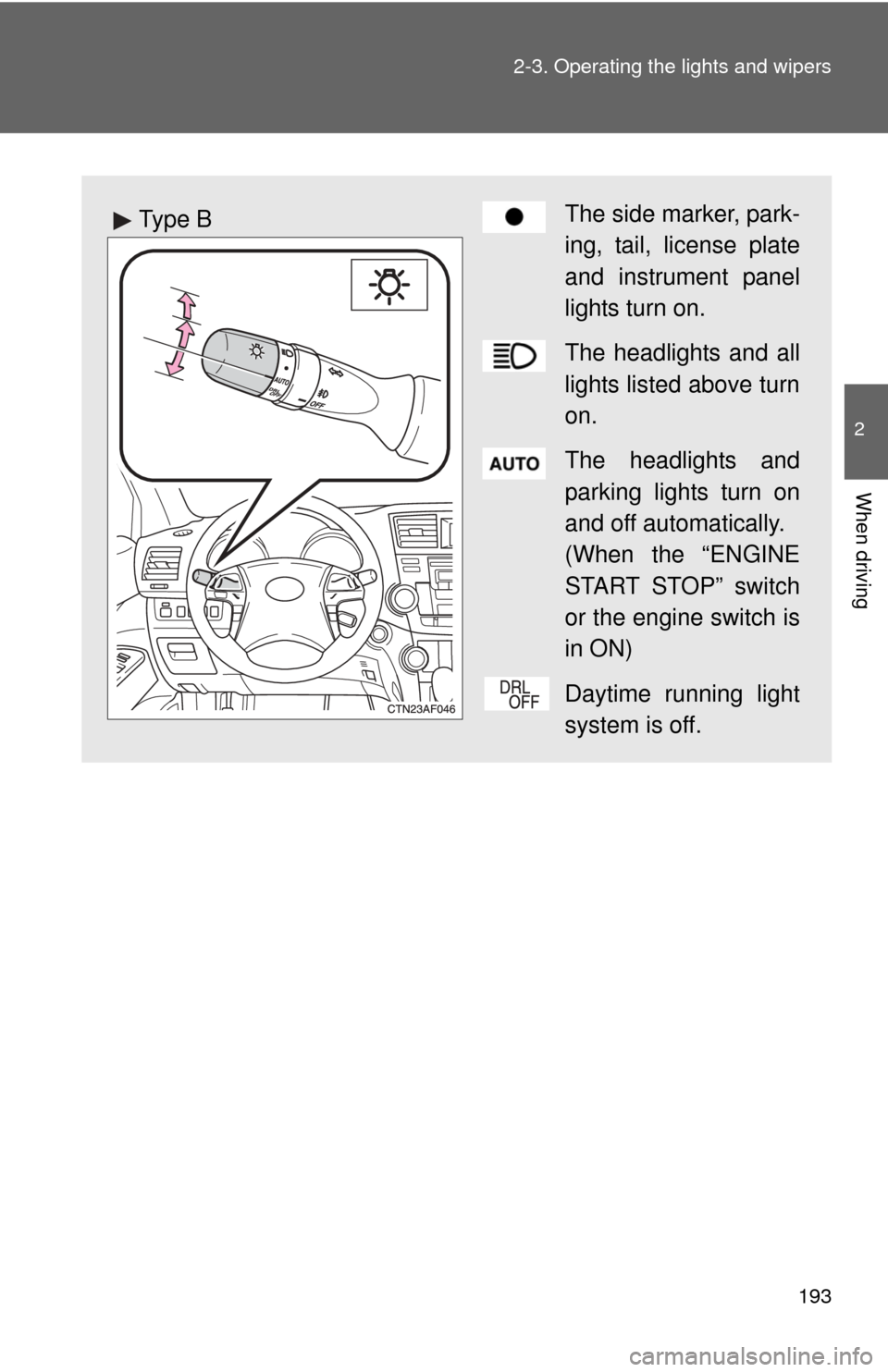
The side marker, park-
ing, tail, license plate
and instrument panel
lights turn on.
The headlights and all
lights listed above turn
on.
The headlights and
parking lights turn on
and off automatically.
(When the “ENGINE
START STOP” switch
or the engine switch is
in ON)
Daytime running light
system is off.Type B
Page 222 of 577
221
2-5. Driving information
2
When driving
CAUTION
■Things that must not be carried in the luggage compartment
The following things may cause a fire if loaded in the luggage compart-
ment.
●Receptacles containing gasoline
●Aerosol cans
■Storage precautions
●Do not place anything on the luggage cover, and do not stack anything
in the luggage compartment higher than the seatbacks.
Such items may be thrown about and possibly injure people in the
vehicle during sudden braking or in an accident.
●Do not place cargo or luggage in or on the following locations as the
item may get under the brake or accelerator pedal and prevent the
pedals from being depressed properly,
block the driver’s vision, or hit
the driver or passengers, causing an accident.
• Driver’s feet
• Front passenger or rear seats (when stacking items)
• Luggage cover
• Instrument panel
• Dashboard
• Auxiliary box or tray that has no lid
●Secure all items in the occupant compartment, as they may shift and
injure someone during an accident or sudden braking.
●Never allow anyone to ride in the luggage compartment. It is not
designed for passengers. They should ride in their seats with their seat
belts properly fastened. Otherwise, they are much more likely to suffer
serious bodily injury, in the even t of sudden braking or a collision.
■Capacity and distribution
●Do not exceed the maximum axle weight rating or the total vehicle
weight rating.
●Even if the total load of occupant's weight and the cargo load is less
than the total load capacity, do not apply the load unevenly.
Improper loading may cause deterioration of steering or braking con-
trol which may cause death or serious injury.
Page 457 of 577
456 4-3. Do-it-yourself maintenance
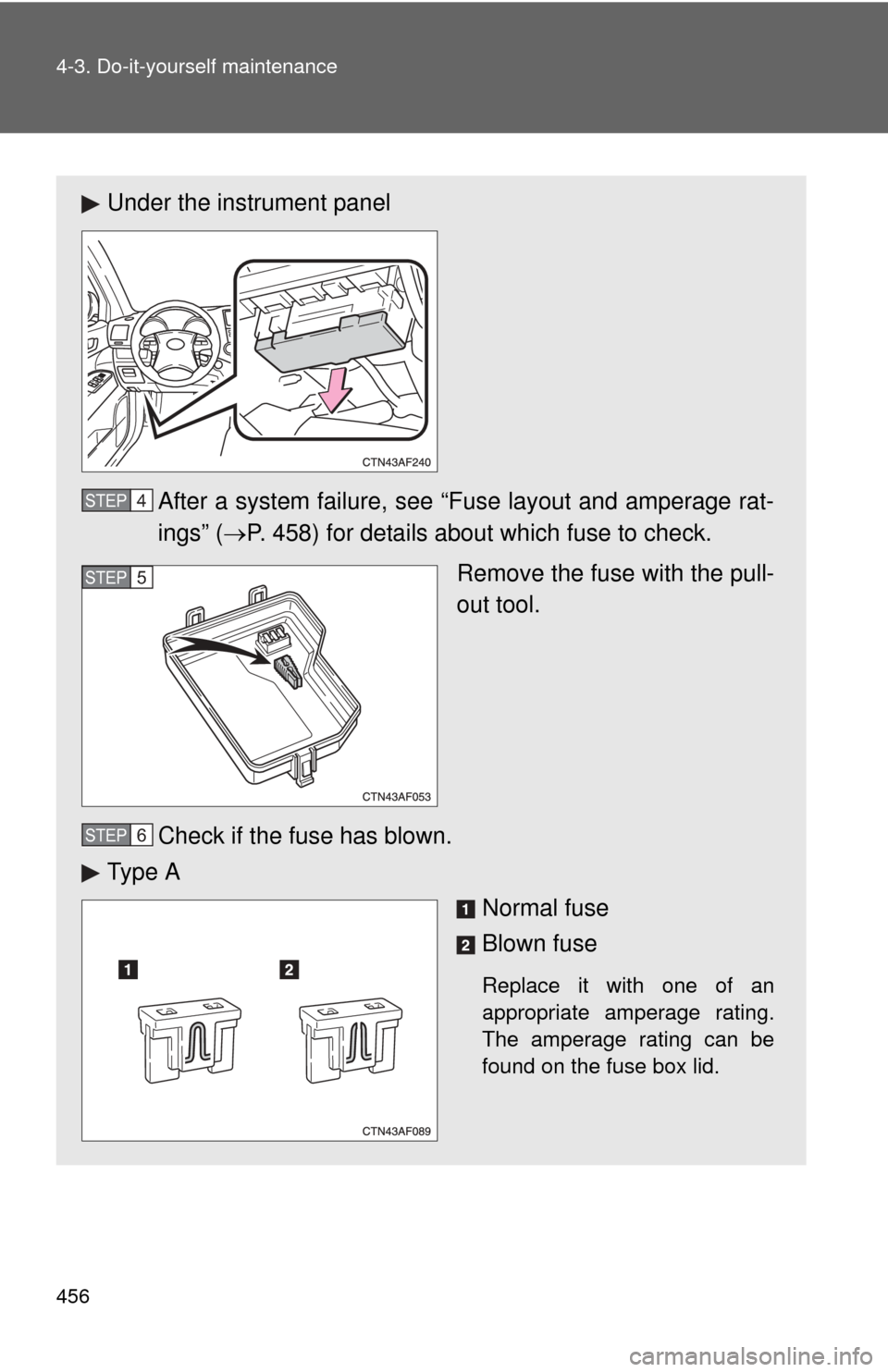
Under the instrument panelAfter a system failure, see “Fuse layout and amperage rat-
ings” ( P. 458) for details about which fuse to check.
Remove the fuse with the pull-
out tool.
Check if the fuse has blown.
Ty p e A Normal fuse
Blown fuse
Replace it with one of an
appropriate amperage rating.
The amperage rating can be
found on the fuse box lid.
STEP4
STEP5
STEP6
Page 463 of 577
462 4-3. Do-it-yourself maintenance
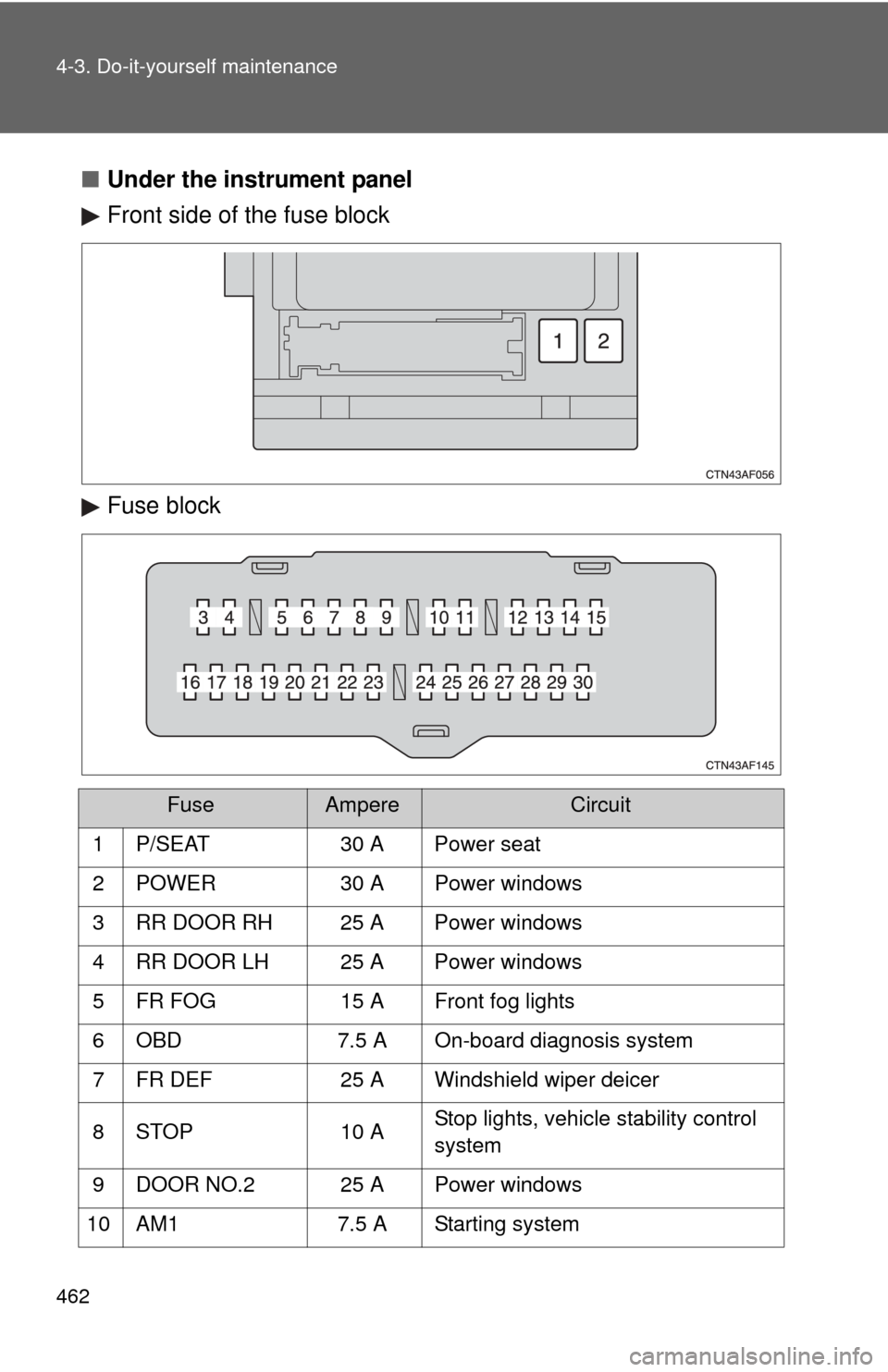
■Under the instrument panel
Front side of the fuse block
Fuse block
FuseAmpereCircuit
1 P/SEAT 30 A Power seat
2 POWER 30 A Power windows
3 RR DOOR RH 25 A Power windows
4 RR DOOR LH 25 A Power windows
5 FR FOG 15 A Front fog lights
6 OBD 7.5 A On-board diagnosis system
7 FR DEF 25 A Windshield wiper deicer
8 STOP 10 A Stop lights, vehicle stability control
system
9 DOOR NO.2 25 A Power windows
10 AM1 7.5 A Starting system
Page 464 of 577
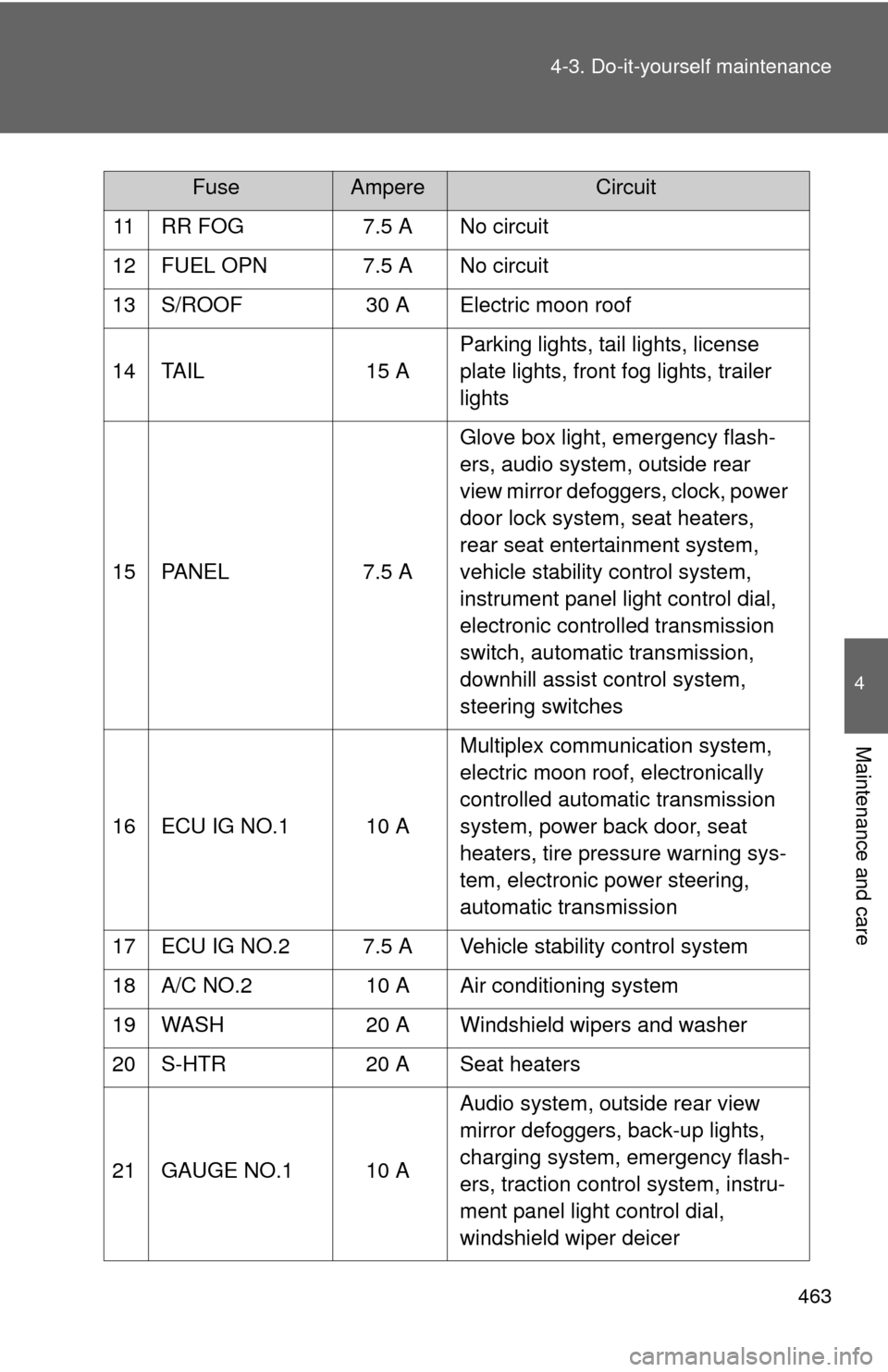
463
4-3. Do-it-yourself maintenance
4
Maintenance and care
11 RR FOG
7.5 A No circuit
12 FUEL OPN 7.5 A No circuit
13 S/ROOF 30 A Electric moon roof
14 TAIL 15 AParking lights, tail lights, license
plate lights, front fog lights, trailer
lights
15 PANEL 7.5 AGlove box light, emergency flash-
ers, audio system, outside rear
view mirror defoggers, clock, power
door lock system, seat heaters,
rear seat entertainment system,
vehicle stability control system,
instrument panel light control dial,
electronic controlled transmission
switch, automatic transmission,
downhill assist control system,
steering switches
16 ECU IG NO.1 10 A Multiplex communication system,
electric moon roof, electronically
controlled automatic transmission
system, power back door, seat
heaters, tire pressure warning sys-
tem, electronic power steering,
automatic transmission
17 ECU IG NO.2 7.5 A Vehicle stability control system
18 A/C NO.2 10 A Air conditioning system
19 WASH 20 A Windshield wipers and washer
20 S-HTR 20 A Seat heaters
21 GAUGE NO.1 10 A Audio system, outside rear view
mirror defoggers, back-up lights,
charging system, emergency flash-
ers, traction control system, instru-
ment panel light control dial,
windshield wiper deicer
FuseAmpereCircuit
Page 528 of 577
527
6-1. Specifications
6
Vehicle specifications
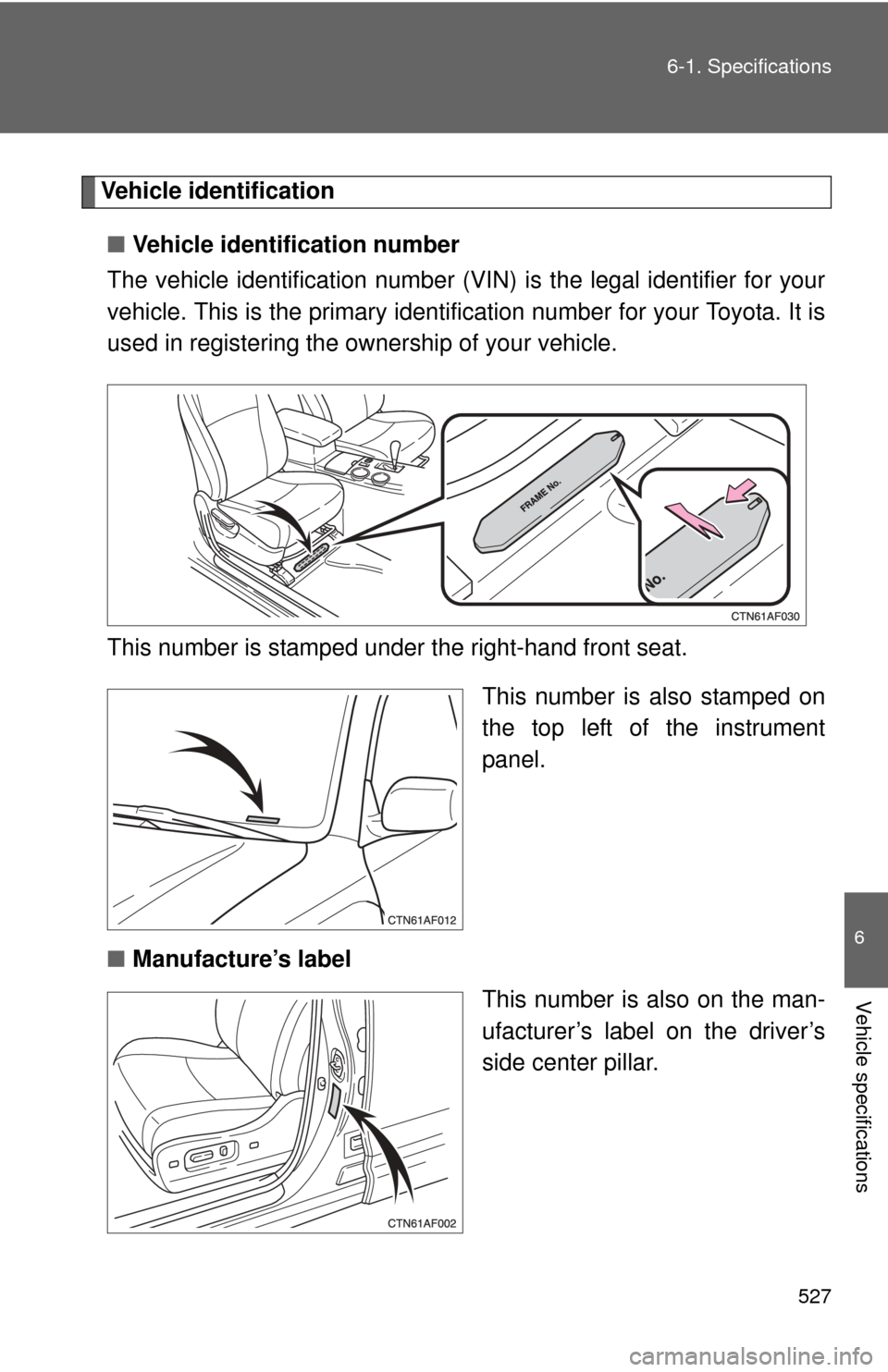
Vehicle identification
■ Vehicle identification number
The vehicle identificati on number (VIN) is the legal identifier for your
vehicle. This is the primary identification number for your Toyota. It is
used in registering the ownership of your vehicle.
This number is stamped under the right-hand front seat.
This number is also stamped on
the top left of the instrument
panel.
■ Manufacture’s label
This number is also on the man-
ufacturer’s label on the driver’s
side center pillar.