air condition TOYOTA HIGHLANDER 2010 XU40 / 2.G User Guide
[x] Cancel search | Manufacturer: TOYOTA, Model Year: 2010, Model line: HIGHLANDER, Model: TOYOTA HIGHLANDER 2010 XU40 / 2.GPages: 608, PDF Size: 11.99 MB
Page 141 of 608

141
1-7. Safety information
1
Before driving
Conditions and operation of
the front passenger occupant
classification system
■ Adult*
1
■Child*3 or child restraint system*4
Indicator/
warning light “AIR BAG ON” and “AIR BAG OFF” indi-
cator lights “AIR BAG
ON”
SRS warning light Off
Front passenger's seat belt reminder light
Flashing*2
Devices Front passenger airbag
Activated
Side airbag on the front passenger seat
Curtain shield airbag in the front passen- ger side
Front passenger's seat belt pretensioner
Indicator/
warning light “AIR BAG ON” and “AIR BAG OFF” indi-
cator lights “AIR BAG
OFF”*
5
SRS warning light Off
Front passenger's seat belt reminder light Flashing*
2
DevicesFront passenger airbag
Deactivated
Side airbag on the front passenger seat
Curtain shield airbag in the front passen- ger side Activated
Front passenger's seat belt pretensioner
Page 194 of 608
194
2-2. Instrument cluster
Multi-information display
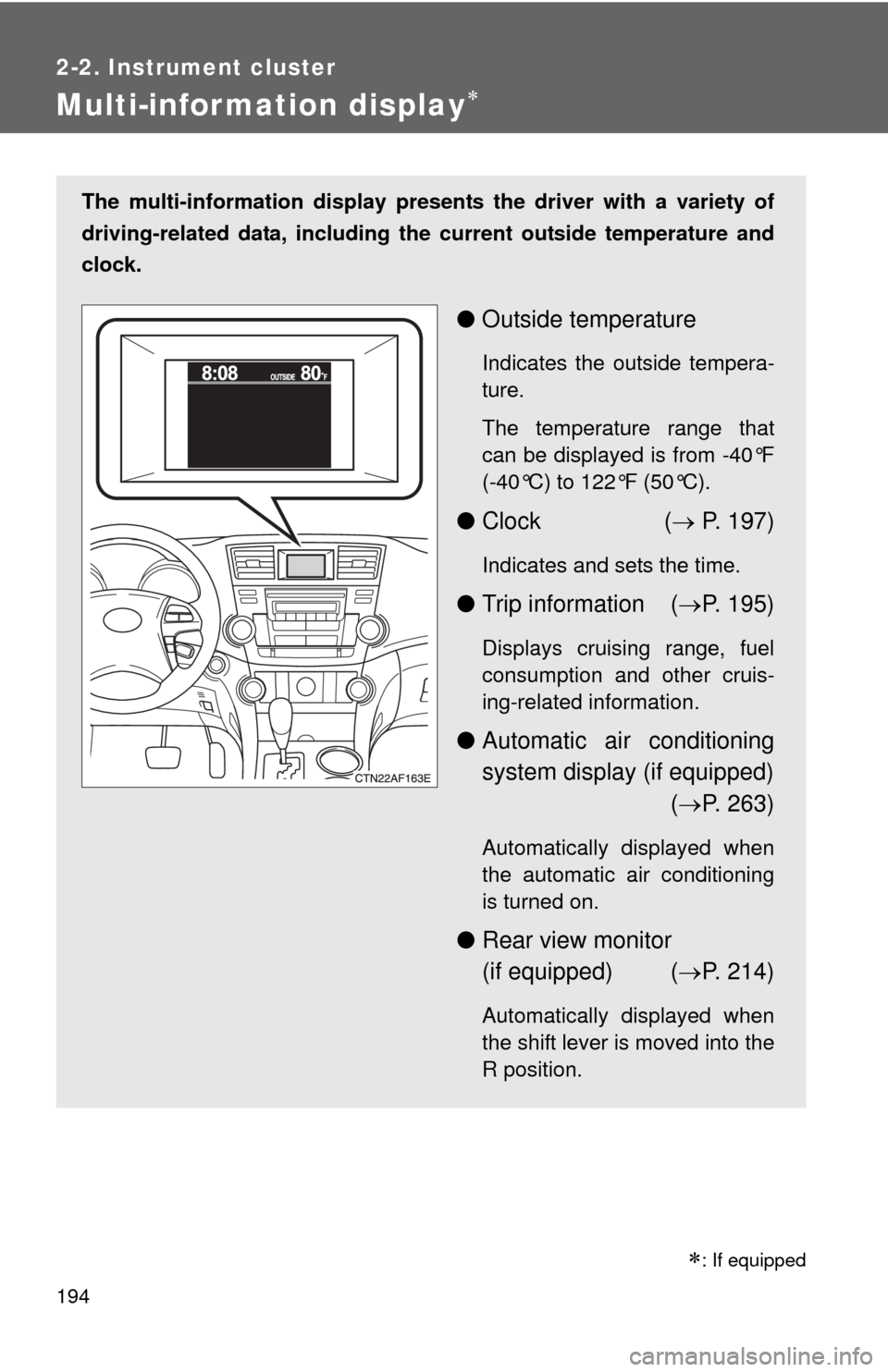
The multi-information display presents the driver with a variety of
driving-related data, including th e current outside temperature and
clock.
● Outside temperature
Indicates the outside tempera-
ture.
The temperature range that
can be displayed is from -40°F
(-40°C) to 122°F (50°C).
●Clock ( P. 197)
Indicates and sets the time.
● Trip information ( P. 195)
Displays cruising range, fuel
consumption and other cruis-
ing-related information.
● Automatic air conditioning
system display (if equipped)
( P. 263)
Automatically displayed when
the automatic air conditioning
is turned on.
● Rear view monitor
(if equipped) ( P. 214)
Automatically displayed when
the shift lever is moved into the
R position.
: If equipped
Page 238 of 608
238
2-5. Driving information
Winter driving tips
Carry out the necessary preparations and inspections before driving
the vehicle in winter. Always drive the vehicle in a manner appropri-
ate to the prevailing weather conditions.
■ Pre-winter preparations
●Use fluids that are appropriate to the prevailing outside tem-
peratures.
• Engine oil
• Engine coolant
• Washer fluid
● Have a service technician inspect the level and specific grav-
ity of battery electrolyte.
● Have the vehicle fitted with four snow tires or purchase a set
of tire chains for the front tires.
Ensure that all tires are the same size and brand, and that chains
match the size of the tires.
■Before driving the vehicle
Observe the following according to the driving conditions.
●Do not try to forcibly open a window or move a wiper that is
frozen. Pour warm water over the frozen area to melt the ice.
Wipe away the water immediately to prevent it from freezing.
● To ensure proper operation of th e climate control system fan,
remove any snow that has accumulated on the air inlet vents
in front of the windshield.
● Remove any ice that has accumu lated on the vehicle chassis.
● Periodically check for and remove any excess ice or snow
that may have accumulated in the wheel well or on the
brakes.
Page 247 of 608

247
2-5. Driving information
2
When driving
●
Note that when making a turn, th e trailer wheels will be closer than
the vehicle wheels to the inside of the turn. Compensate by making
a larger than normal turning radius.
● Crosswinds and rough roads will adversely affect handling of your
vehicle and trailer, causing sway . Periodically check the rear to
prepare for being passed by large trucks or buses, which may
cause your vehicle and trailer to sway. If swaying occurs, firmly grip
the steering wheel, reduce speed immediately but gradually, and
steer straight ahead. Never increase speed. If you make no
extreme correction with the stee ring or brakes, your vehicle and
trailer will stabilize.
● Take care when passing other vehicles. Passing requires consider-
able distance. After passing a vehicle, do not forget the length of
your trailer, and be sure you hav e plenty of room before changing
lanes.
● 2.7 L 4-cylinder (1AR-FE) engine: In order to maintain engine brak-
ing efficiency when driving on a long steep downgrade, do not use
overdrive. Transmission shift range position must be in 5 in S
mode.
● 3.5 L V6 (2GR-FE) engine: In order to maintain engine braking effi-
ciency when driving on a long st eep downgrade, do not use over-
drive. Transmission shift range position must be in 4 in S mode.
● Due to the added load of the trailer, your vehicle's engine may
overheat on hot days (at temperatures over 85°F [30°C]) when
driving up a long or steep grade. If the engine coolant temperature
gauge indicates overheating, immedi ately turn off the air condition-
ing (if in use), pull your vehicle off the road and stop in a safe spot.
( P. 545)
Page 254 of 608
254
3-1. Using the air conditioning system and defogger
Front manual air conditioning system ....... 256
Front automatic air conditioning system ....... 263
Rear manual air conditioning system ....... 271
Rear automatic air conditioning system ....... 274
Rear window and outside rear view mirror
defoggers ....................... 277
Windshield wiper de-icer ............................ 279
Using the steering wheel climate remote control
switches ......................... 280 3-2. Using the audio system
Audio system ................... 281
Using the radio ................. 284
Using the CD player ......... 290
Playing back MP3 and WMA discs ..................... 297
Optimal use of the audio system.................. 304
Using the AUX adapter .... 307
Using the steering wheel audio switches ............... 309
3-3. Using the rear audio system Rear seat entertainment system features ............. 311
Using the DVD player (DVD video) ................... 318
Using the DVD player (video CD)...................... 327
Using the DVD player (audio CD/CD text) ........ 330
Using the DVD player (MP3 discs) .................... 331
Using the video mode ...... 333
Changing the initial setting ............................ 335
Interior features3
Page 256 of 608
256
3-1. Using the air conditioning system and defogger
Front manual air conditioning system
Adjusting the settings■ Adjusting the temperature setting
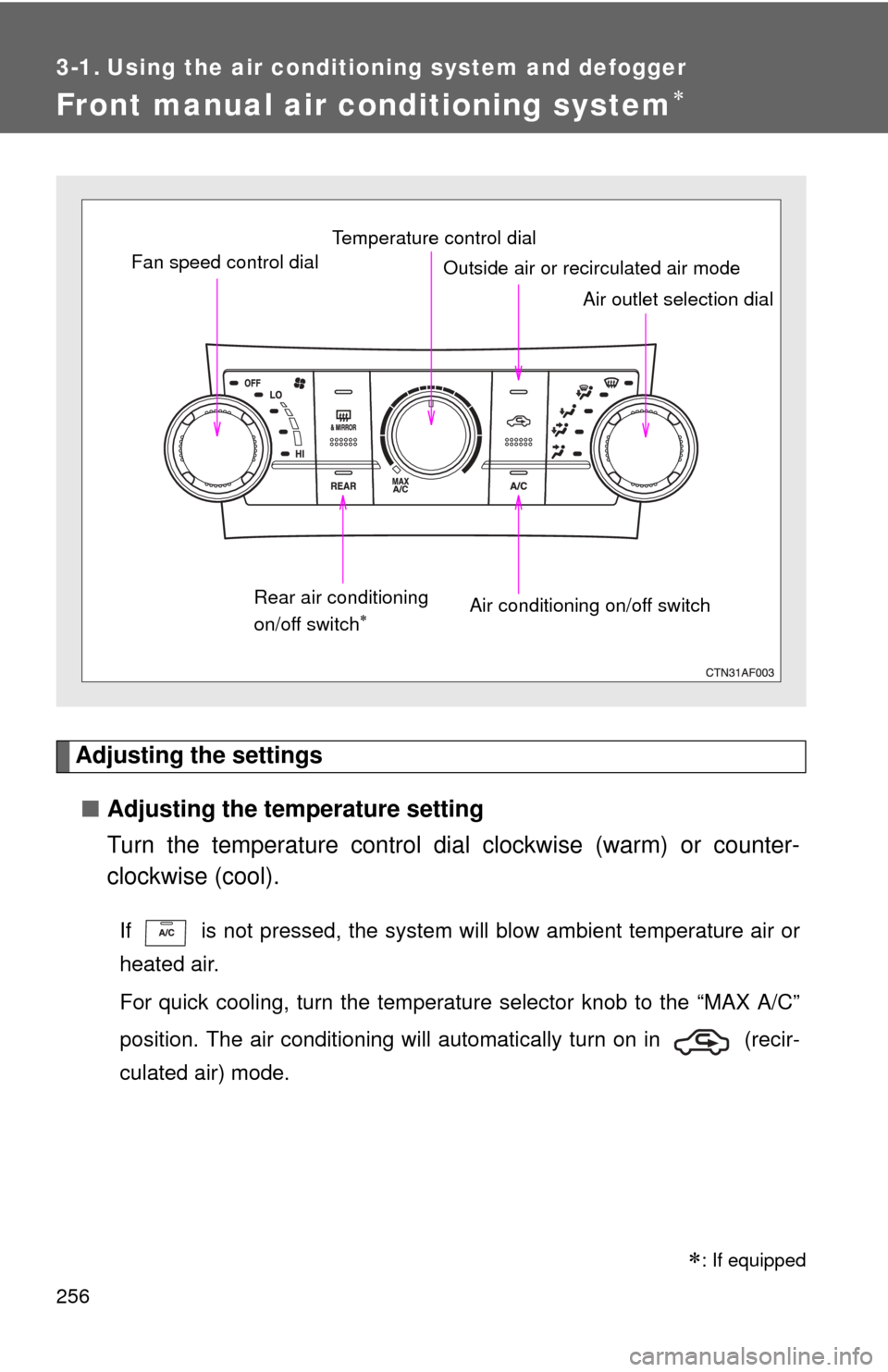
Turn the temperature control dial clockwise (warm) or counter-
clockwise (cool).
If is not pressed, the system will blow ambient temperature air or
heated air.
For quick cooling, turn the temperature selector knob to the “MAX A/C”
position. The air conditioning will automatically turn on in (recir-
culated air) mode.
Fan speed control dial
Air outlet selection dial
Air conditioning on/off switch
Temperature control dial
Outside air or recirculated air mode
Rear air conditioning
on/off switch
: If equipped
Page 257 of 608
257
3-1. Using the air conditioning system
and defogger
3
Interior features
■Adjusting the fan speed
Turn the fan speed control dial clockwise (increase) or counter-
clockwise (decrease).
Turn the dial to “OFF” to turn the fan off.
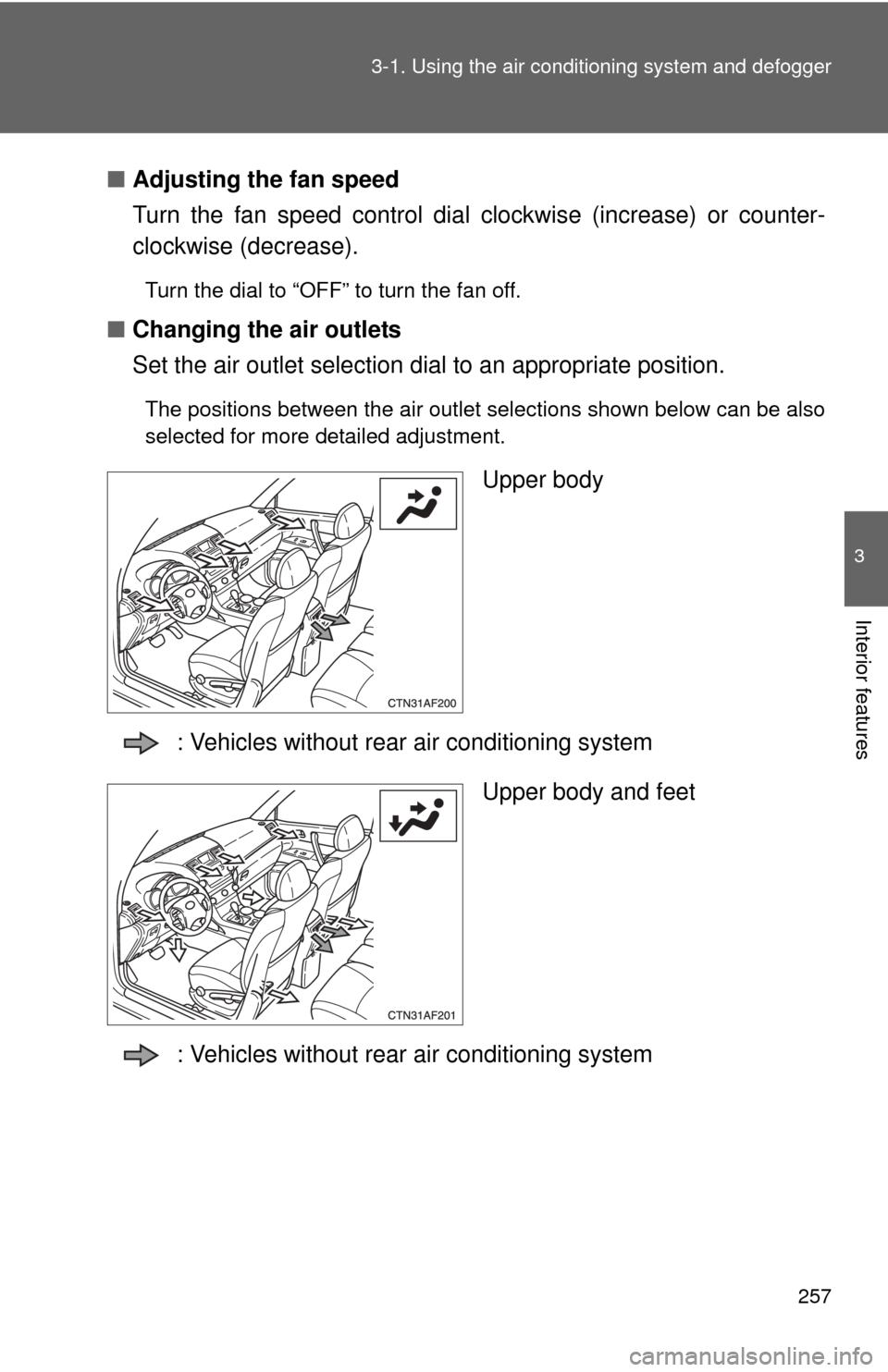
■ Changing the air outlets
Set the air outlet selection di al to an appropriate position.
The positions between the air outlet selections shown below can be also
selected for more detailed adjustment.
Upper body
: Vehicles without rear air conditioning system Upper body and feet
: Vehicles without rear air conditioning system
Page 258 of 608
258 3-1. Using the air conditioning system and defogger
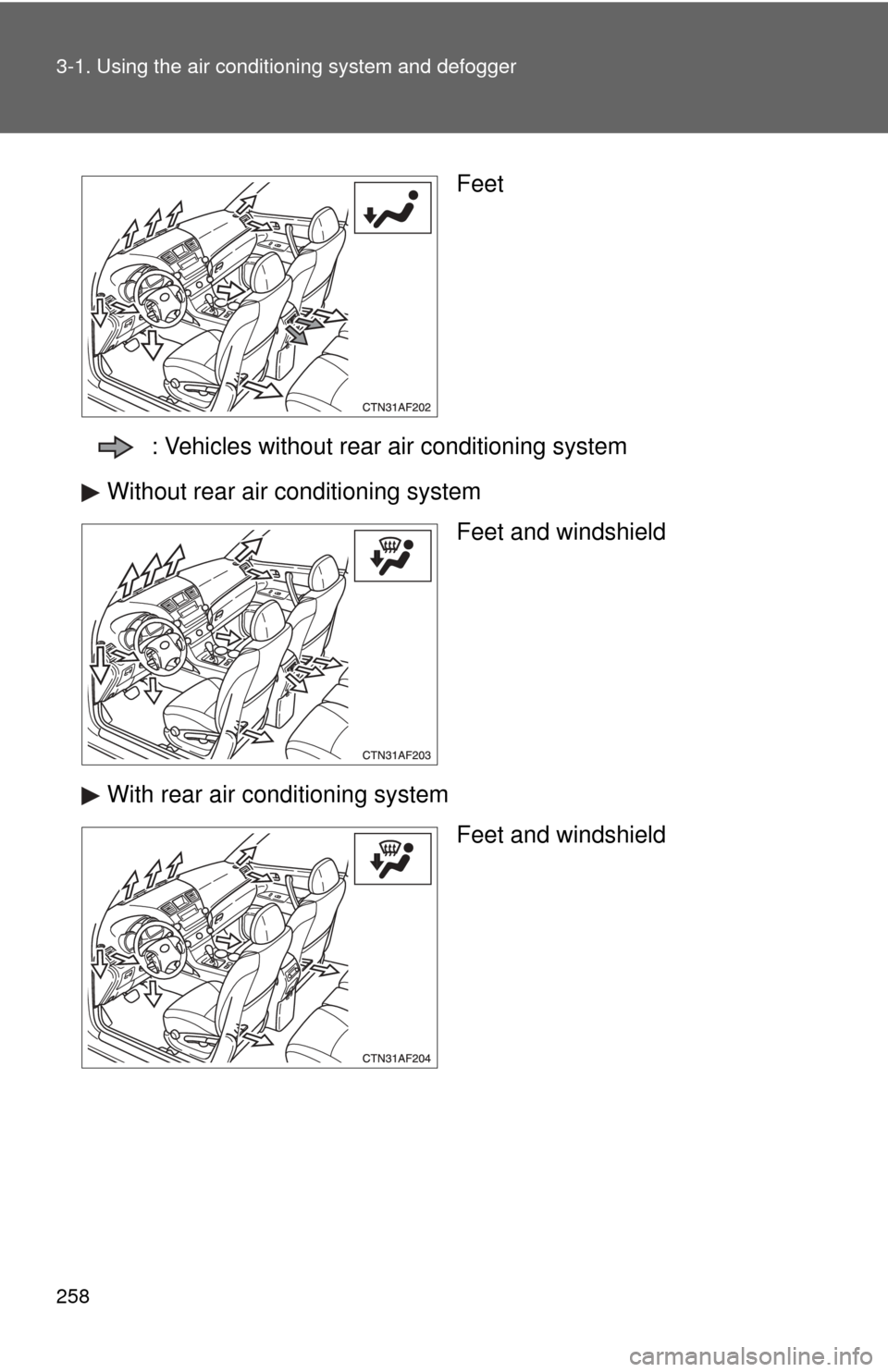
Feet
: Vehicles without rear air conditioning system
Without rear air conditioning system Feet and windshield
With rear air conditioning system Feet and windshield
Page 259 of 608
259
3-1. Using the air conditioning system
and defogger
3
Interior features
■Switching between outside air and recirculated air modes
Press .
The mode switches between outside air mode (indicator off) and recircu-
lated air mode (indicator on) modes each time is pressed.
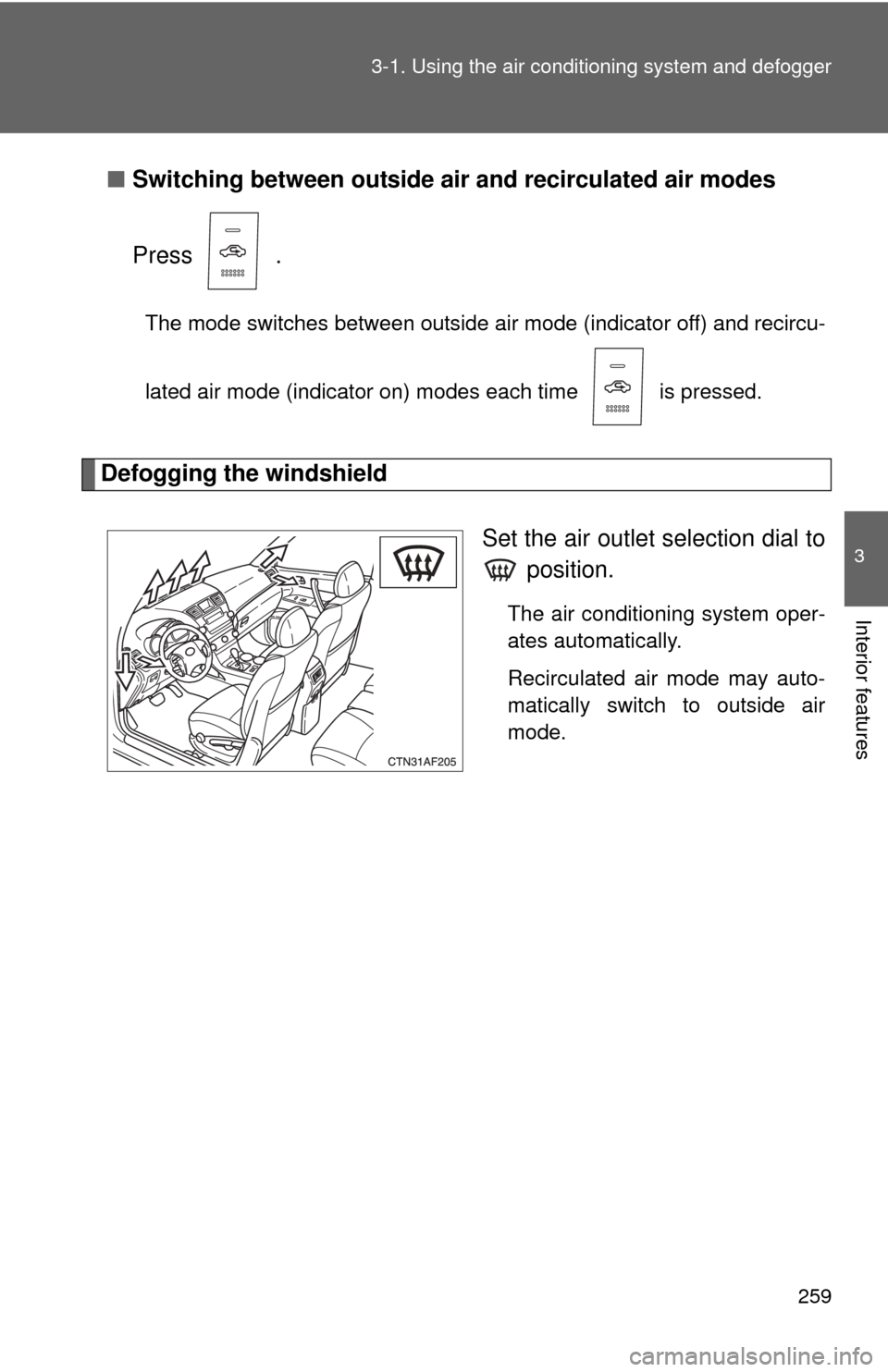
Defogging the windshield
Set the air outlet selection dial to position.
The air conditioning system oper-
ates automatically.
Recirculated air mode may auto-
matically switch to outside air
mode.
Page 260 of 608
260 3-1. Using the air conditioning system and defogger
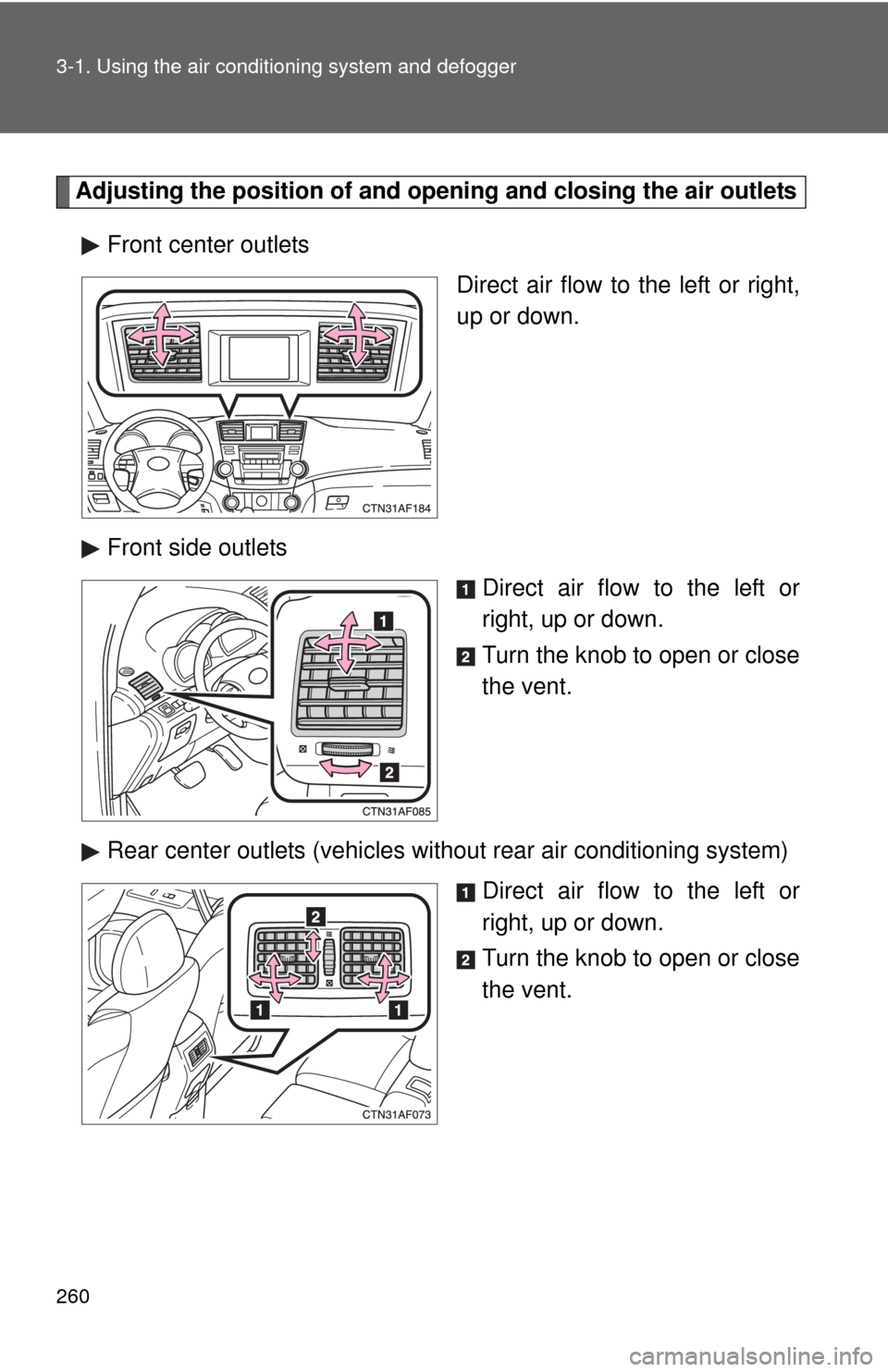
Adjusting the position of and opening and closing the air outlets
Front center outlets Direct air flow to the left or right,
up or down.
Front side outlets Direct air flow to the left or
right, up or down.
Turn the knob to open or close
the vent.
Rear center outlets (vehicles without rear air conditioning system) Direct air flow to the left or
right, up or down.
Turn the knob to open or close
the vent.