engine TOYOTA HIGHLANDER 2010 XU40 / 2.G Owners Manual
[x] Cancel search | Manufacturer: TOYOTA, Model Year: 2010, Model line: HIGHLANDER, Model: TOYOTA HIGHLANDER 2010 XU40 / 2.GPages: 608, PDF Size: 11.99 MB
Page 2 of 608

TABLE OF CONTENTSIndex
2
1-1. Key informationKeys ..................................... 30
1-2. Opening, closing
and
locking the
doors
Smart key system................. 33
Wireless remote control ....... 54
Side doors ............................ 66
Back door ............................. 71
Glass hatch .......................... 77
1-3.
Adjustable components
(seats, mirrors,
steering wheel)
Front seats
........................... 79
Rear seats ............................ 82
Head restraints ..................... 91
Seat belts ............................. 94
Steering wheel ................... 100
Anti-glare inside rear view mirror ................................ 101
Outside rear view mirrors ... 103
1-4. Opening a
nd closing the
windo
ws and moon roof
Power windows .................. 106
Moon roof ........................... 108
1-5. Refueling Opening the fuel tank cap ................................... 111 1-6. Theft deterrent system
Engine immobilizer system .............................. 115
Alarm .................................. 122
Theft prevention labels (U.S.A.)............................. 125
1-7. Safety information Correct driving posture ....... 126
SRS airbags ....................... 128
Front passenger occupant classification system ......... 140
Child restraint systems ....... 146
Installing child restraints ..... 151
2-1. Driving procedures Driving the vehicle .............. 164
Engine (ignition) switch (vehicles with smart key
system) ............................. 173
Engine (ignition) switch (vehicles without smart
key system) ...................... 177
Automatic Transmission ..... 180
Turn signal lever ................. 185
Parking brake ..................... 186
Horn .................................... 187
2-2. Instrument cluster Gauges and meters ............ 188
Indicators and warning lights ................................. 190
Multi-information display ..... 194
1Before driving
2When driving
Page 5 of 608

1
2
3
4
5
6
7
5
4-1. Maintenance and careCleaning and protecting the vehicle exterior............ 416
Cleaning and protecting the vehicle interior............. 419
4-2. Maintenance Maintenance requirements ..................... 422
General maintenance.......... 424
Emission inspection and maintenance (I/M)
programs........................... 427
4-3. Do-it-yourself maintenance Do-it-yourself service precautions ....................... 428
Hood ................................... 432
Positioning a floor jack ........ 434
Engine compartment ........... 437
Tires .................................... 453
Tire inflation pressure ......... 463
Wheels ................................ 467
Air conditioning filter............ 469
Wireless remote control/electronic key
battery ............................... 472
Checking and replacing fuses ................................. 475
Light bulbs........................... 486 5-1. Essential information
Emergency flashers............ 498
If your vehicle needs to be towed........................... 499
If you think something is wrong ............................ 506
Fuel pump shut off system .............................. 507
Event data recorder ............ 508
5-2. Steps to take in an emergency If a warning light turns on or a warning buzzer
sounds... .......................... 510
If a warning message is displayed (vehicles with
multi-information
display) ............................. 521
If you have a flat tire ........... 522
If the engine will not start.... 535
If the shift lever cannot be shifted from P ................... 537
If you lose your keys/wireless remote
control transmitter ............ 538
If the electronic key does not operate properly
(vehicles with smart
key system) ...................... 539
If the battery is discharged........................ 541
If your vehicle overheats .... 545
If the vehicle becomes stuck ................................. 548
4Maintenance and care5When trouble arises
Page 16 of 608
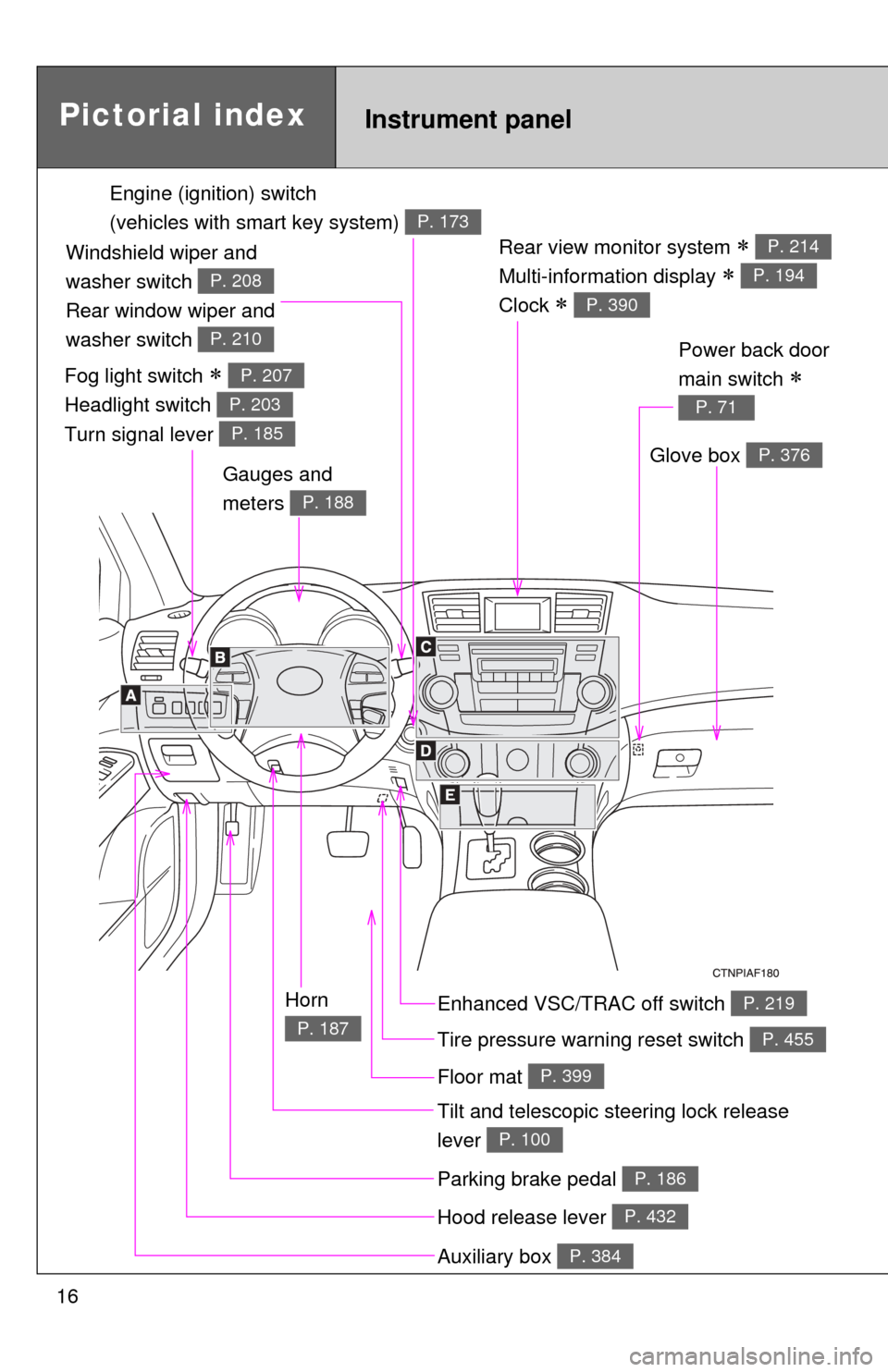
16
Rear view monitor system
Multi-information display
Clock
P. 214
P. 194
P. 390
Gauges and
meters
P. 188
Tilt and telescopic steering lock release
lever
P. 100
Glove box P. 376
Pictorial indexInstrument panel
Power back door
main switch
P. 71
Enhanced VSC/TRAC off switch P. 219
Tire pressure warning reset switch P. 455
Parking brake pedal P. 186
Hood release lever P. 432
Auxiliary box P. 384
Engine (ignition) switch
(vehicles with smart key system)
P. 173
Fog light switch
Headlight switch
Turn signal lever P. 207
P. 203
P. 185
Windshield wiper and
washer switch
Rear window wiper and
washer switch
P. 208
P. 210
Horn
P. 187
Floor mat P. 399
Page 18 of 608
18
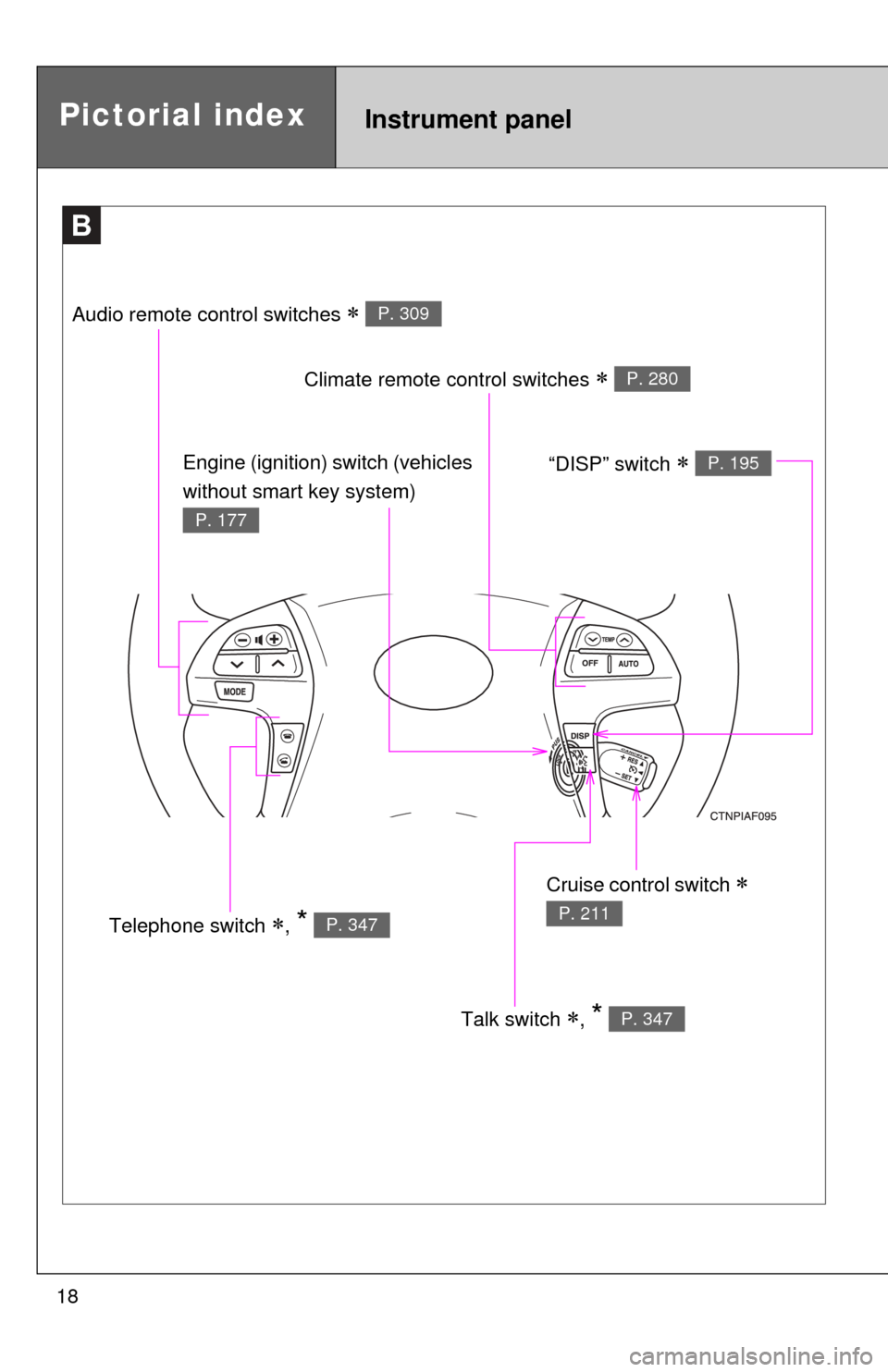
B
Talk switch , * P. 347
Pictorial indexInstrument panel
Audio remote control switches P. 309
Climate remote control switches P. 280
Cruise control switch
P. 211Telephone switch , * P. 347
Engine (ignition) switch (vehicles
without smart key system)
P. 177
“DISP” switch P. 195
Page 24 of 608

24
For your information
Main Owner’s Manual
Please note that this manual covers all models and all equipment, including
options. Therefore, you may find some explanations for equipment not
installed on your vehicle.
All specifications provided in this manual are current at the time of printing.
However, because of the Toyota policy of continual product improvement, we
reserve the right to make changes at any time without notice.
Depending on specifications, the vehicle shown in the illustrations may differ
from your vehicle in terms of equipment.
Noise from under vehicle after turning off the engine
Approximately five hours after the engine is turned off, you may hear sound
coming from under the vehicle for several minutes. This is the sound of a fuel
evaporation leakage check and, it does not indicate a malfunction.
Accessories, spare parts and modification of your Toyota
A wide variety of non-genuine spare parts and accessories for Toyota
vehicles are currently available on the market. You should know that these
parts are not covered by Toyota warranty and that Toyota is not responsible
for their performance, repair, or replacement, or for any damage they may
cause to, or adverse effect they may have on, your Toyota vehicle.
This vehicle should not be modified with non-genuine Toyota products.
Modification with non-genuine Toyota products may affect performance,
safety or durability, and may even violate governmental regulations. In
addition, damage or performance problems resulting from the modification
may not be covered under warranty.
Page 29 of 608
Before driving1
29
1-1. Key informationKeys ................................... 30
1-2. Opening, closing and locking the doors
Smart key system .............. 33
Wireless remote control ..... 54
Side doors .......................... 66
Back door ........................... 71
Glass hatch ........................ 77
1-3. Adjustable components (seats, mirrors,
steering wheel)
Front seats ......................... 79
Rear seats.......................... 82
Head restraints................... 91
Seat belts ........................... 94
Steering wheel ................. 100
Anti-glare inside rear view mirror ............................. 101
Outside rear view mirrors............................ 103 1-4. Opening and closing the
windows and moon roof
Power windows ................ 106
Moon roof ......................... 108
1-5. Refueling Opening the fuel tank cap ................................. 111
1-6. Theft deterrent system Engine immobilizer system ........................... 115
Alarm................................ 122
Theft prevention labels (U.S.A.) .......................... 125
1-7. Safety information Correct driving posture..... 126
SRS airbags ..................... 128
Front passenger occupant classification system ...... 140
Child restraint systems..... 146
Installing child restraints ........................ 151
Page 33 of 608
33
1
Before driving
1-2. Opening, closing and locking the doors
Smart key system
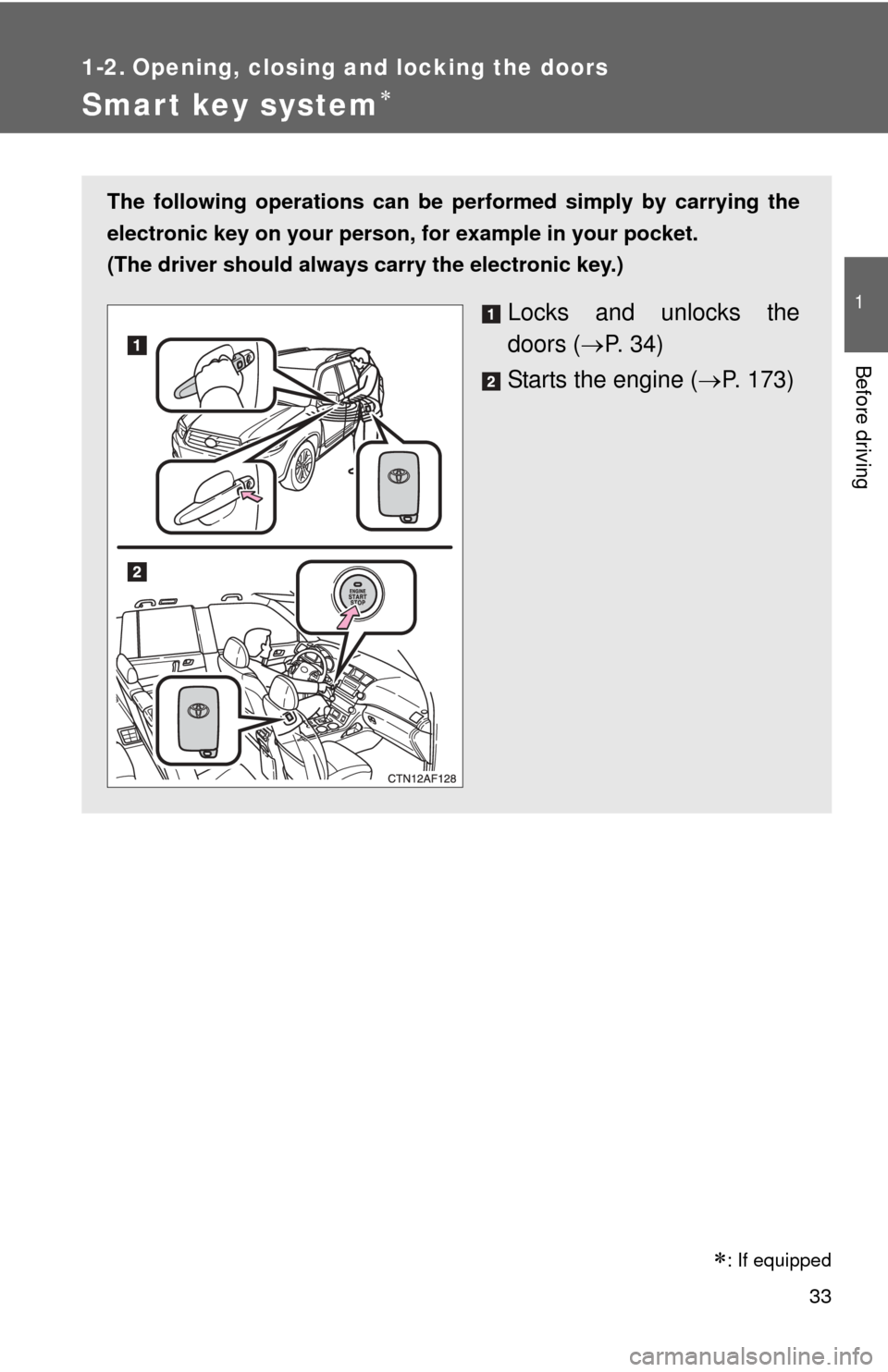
The following operations can be performed simply by carrying the
electronic key on your person, for example in your pocket.
(The driver should always carry the electronic key.)
Locks and unlocks the
doors ( P. 34)
Starts the engine ( P. 173)
: If equipped
Page 37 of 608
37
1-2. Opening, closing and locking the doors
1
Before driving
■
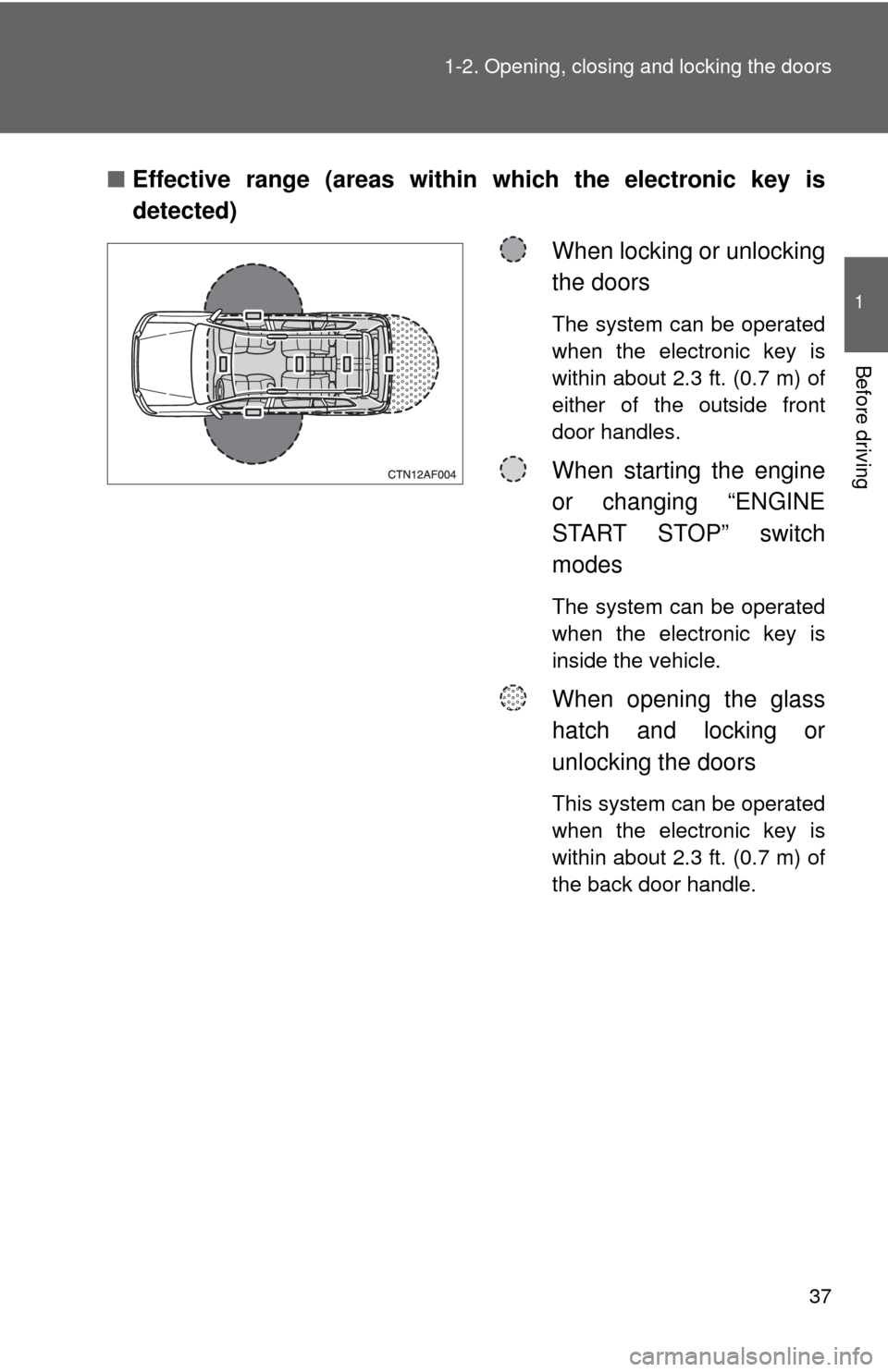
Effective range (areas within which the electronic key is
detected)
When locking or unlocking
the doors
The system can be operated
when the electronic key is
within about 2.3 ft. (0.7 m) of
either of the outside front
door handles.
When starting the engine
or changing “ENGINE
START STOP” switch
modes
The system can be operated
when the electronic key is
inside the vehicle.
When opening the glass
hatch and locking or
unlocking the doors
This system can be operated
when the electronic key is
within about 2.3 ft. (0.7 m) of
the back door handle.
Page 38 of 608
38 1-2. Opening, closing and locking the doors
■Operation signals
A buzzer sounds and the emergency flashers flash to indicate that the doors
have been locked/unlocked. (Locked: Once; Unlocked: Twice)
■ Conditions affecting operation
The smart key system uses weak radio waves. In the following situations,
the communication between the electronic key and the vehicle may be
affected, preventing the smart key system and wireless remote control from
operating properly. (Ways of coping: P. 539)
● When the electronic key battery is depleted
● Near a TV tower, electronic power plant, gas station, radio station, large
display, airport or other facility that generates strong radio waves or elec-
trical noise
● When carrying a portable radio, ce llular phone, cordless phone or other
wireless communication devices
● When the electronic key has come into contact with, or is covered by a
metallic object
● When multiple electronic keys are in the vicinity
● When carrying or using the electronic key together with the following
devices that emit radio waves
• Another vehicle’s electronic key
• A wireless key that emits radio waves
• Personal computer
● If window tint with a metallic content or metallic objects are attached to
the rear window
■ Switching the door unlock function
It is possible to set which doors the entry function unlocks.
Turn the “ENGINE START STOP” switch OFF.
When the indicator on the key surface is turned off, push and hold
, , or for approximately 5 seconds while pushing
on the key.
STEP1
STEP2
Page 40 of 608

40 1-2. Opening, closing and locking the doors
■Electronic key battery depletion
●The standard battery life is 1 to 2 years. (The battery becomes depleted
even if the electronic key is not used.) If the smart key system or the
wireless remote control function does not operate, or the detection area
becomes smaller, the battery may be depleted. Replace the battery when
necessary. ( P. 473)
● To avoid serious deterioration, do not leave the electronic key within 3 ft.
(1 m) of the following electrical appliances that produce a magnetic field.
•TVs
• Personal computers
• Recharging cellular phones or cordless phones
• Table lamps
■ To operate the system properly
Make sure to carry the electronic key when operating the system. Do not get
the electronic key too close to the vehicle when operating the system from
the outside of the vehicle.
Depending on the position and holding condition of the electronic key, the
key may not be detected correctly and the system may not operate properly.
(The alarm may go off accidentally, or the door lock prevention may not func-
tion.)
■ Note for the entry function
●Even when the electronic key is within the effective range (detection
areas), the system may not operate properly in the following cases.
• The electronic key is too close to the window or outside door handle,
near the ground, or in a high place when the doors are locked or
unlocked.
• The electronic key is on the instrument panel, luggage cover, floor or in the glove box when the engine is started or “ENGINE START STOP”
switch modes are changed.
● As long as the electronic key is within the effective range, the doors may
be locked or unlocked by anyone.
● Even if the electronic key is not inside the vehicle, it may be possible to
start the engine if the electronic key is near the window.