engine TOYOTA HIGHLANDER 2012 XU40 / 2.G Workshop Manual
[x] Cancel search | Manufacturer: TOYOTA, Model Year: 2012, Model line: HIGHLANDER, Model: TOYOTA HIGHLANDER 2012 XU40 / 2.GPages: 636, PDF Size: 11.24 MB
Page 178 of 636
178 2-1. Driving procedures
■Shift position uses
*1: Shifting to the D position allows the system to select a gear suitable
for the driving conditions. Setting the shift lever to the D position is
recommended for normal driving.
*2: Selecting shift ranges using S mode restricts the upper limit of thepossible gear ranges, controls engine braking forces, and prevents
unnecessary upshifting.
■ Selecting snow mode
Use snow mode for accelerating and driving on slippery road
surfaces, such as on snow.
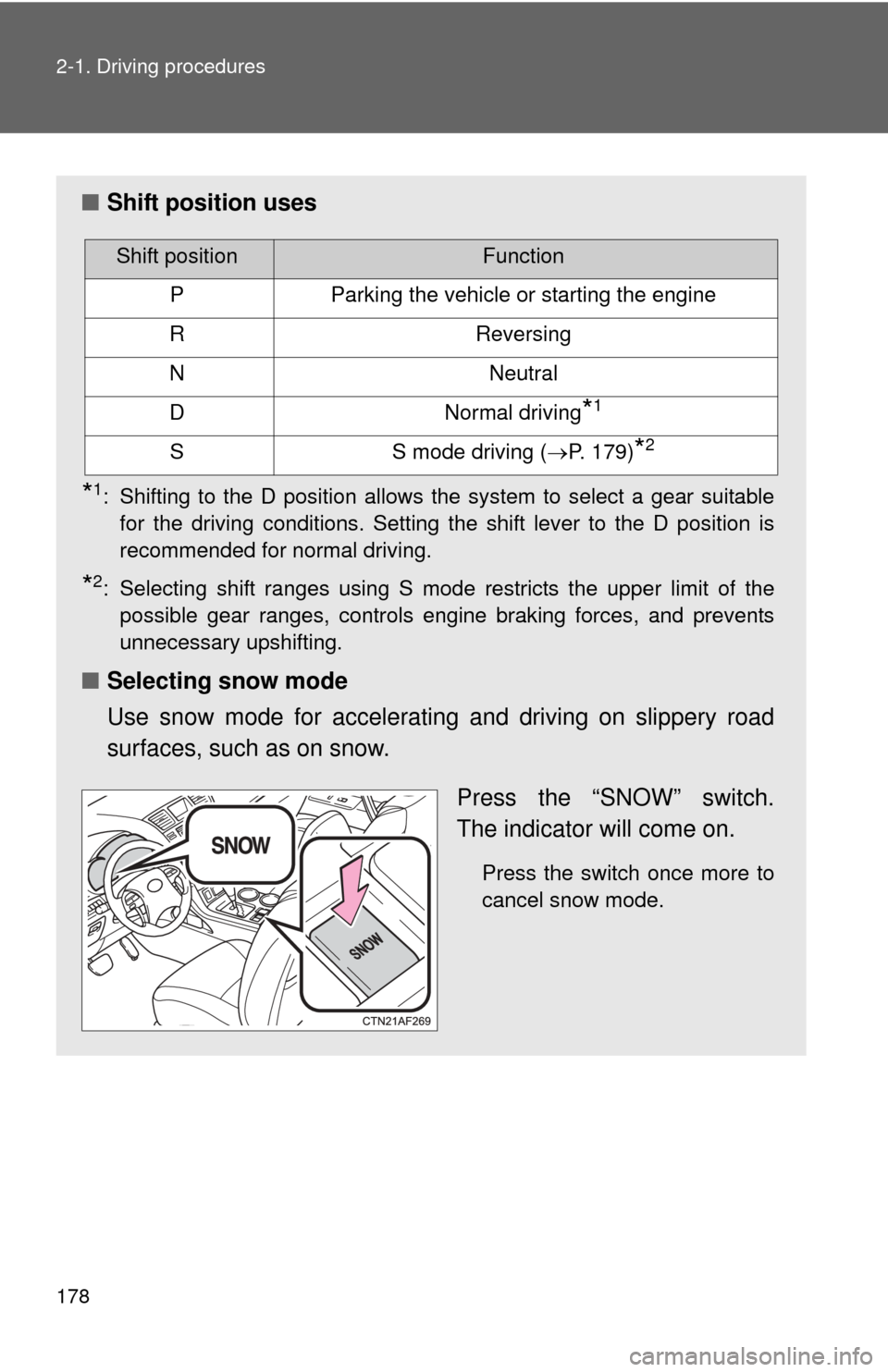
Press the “SNOW” switch.
The indicator will come on.
Press the switch once more to
cancel snow mode.
Shift positionFunction
PParking the vehicle or starting the engine
RReversing
NNeutral
DNormal driving*1
SS mode driving (P. 179)*2
Page 179 of 636
179
2-1. Driving procedures
2
When driving
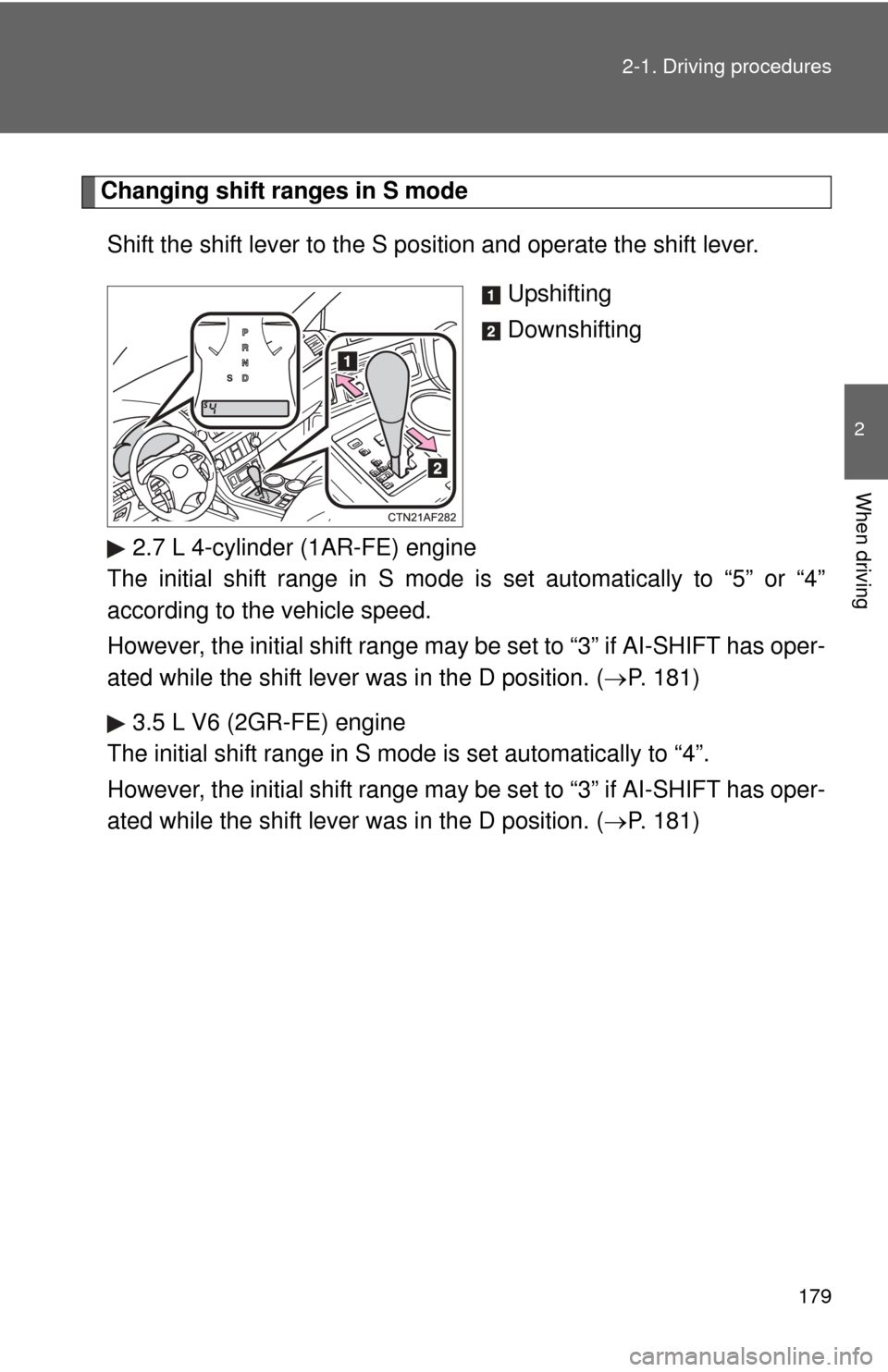
Changing shift ranges in S mode
Shift the shift lever to the S position and operate the shift lever. Upshifting
Downshifting
2.7 L 4-cylinder (1AR-FE) engine
The initial shift range in S mode is set automatically to “5” or “4”
according to the vehicle speed.
However, the initial shift range may be set to “3” if AI-SHIFT has oper-
ated while the shift lever was in the D position. ( P. 181)
3.5 L V6 (2GR-FE) engine
The initial shift range in S mode is set automatically to “4”.
However, the initial shift range may be set to “3” if AI-SHIFT has oper-
ated while the shift lever was in the D position. ( P. 181)
Page 180 of 636
180 2-1. Driving procedures
■Shift ranges and their functions
A lower shift range will provide greater engine braking forces than a higher
shift range, and the engine speed will also increase.
■When driving with the cruise control system
2.7 L 4-cylinder (1AR-FE) engine
Engine braking will not operate in S mode, even when downshifting from “6”
to “5” or “5” to “4”. ( P. 215)
3.5 L V6 (2GR-FE) engine
Engine braking will not operate in S mode, even when downshifting from “5”
to “4”. ( P. 215)
■ Snow mode automatic deactivation
Snow mode is automatically deactivated if the engine is turned off after driv-
ing in snow mode.
Shift range
Function
2.7 L 4-cylinder (1AR-FE)
engine3.5 L V6 (2GR-FE) engine
6 Automatically selecting
gears between 1 and 6
according to vehicle speed
and driving conditions.
5 Automatically selecting gears between 1 and 5 according
to vehicle speed and driving conditions.
4 Automatically selecting gears between 1 and 4 according
to vehicle speed and driving conditions.
3 Automatically selecting gears between 1 and 3 according
to vehicle speed and driving conditions.
2 Automatically selecting gears between 1 and 2 according
to vehicle speed and driving conditions.
1 Setting the gear at 1.
Page 181 of 636

181
2-1. Driving procedures
2
When driving
■
If the shift lever cannot be shifted from P
P. 556
■ If the S indicator does not come on even after shifting the shift lever to
S
This may indicate a malfunction in the automatic transmission system. Have
the vehicle inspected by your Toyota dealer immediately.
(In this situation, the vehicle will operate as if the shift lever is in D.)
■ Downshift restriction warning buzzer (S mode)
To help ensure safety and driving performance, downshifting operation may
sometimes be restricted. In some circumstances, downshifting may not be
possible even when the shift lever is operated. (A buzzer will sound twice.)
■ S mode
●2.7L 4-cylinder (1AR-FE) engine: when the shift range is “5” or lower,
holding the shift lever toward “+” sets the shift range to “6”.
● 3.5L V6 (2GR-FE) engine: when the shift range is “4” or lower, holding
the shift lever toward “+” sets the shift range to “5”.
● To prevent excessive engine speed, a function was adopted that auto-
matically selects a higher shift range before engine speed becomes too
high.
● To protect the automatic transmission, a function is adopted that auto-
matically selects a higher shift range when the fluid temperature is high.
■ AI-SHIFT
AI-SHIFT automatically selects the suitable gear according to driver perfor-
mance and driving conditions.
AI-SHIFT automatically operates when the shift lever is in the D position.
(Shifting the shift lever to the S mode driving position cancels the function.)
The engine speed may remain high after releasing the accelerator pedal.
This does not indicate a malfunction.
Page 182 of 636
182
2-1. Driving procedures
Tur n signal lever
■Turn signals can be operated when
Vehicles without smart key system
The engine switch is in
the “ON” position.
Vehicles with smart key system
The “ENGINE START STOP” switch is in IGNITION ON mode.
■ If the indicators flash faster than usual
Check that a light bulb in the front or rear turn signal lights has not burned
out.
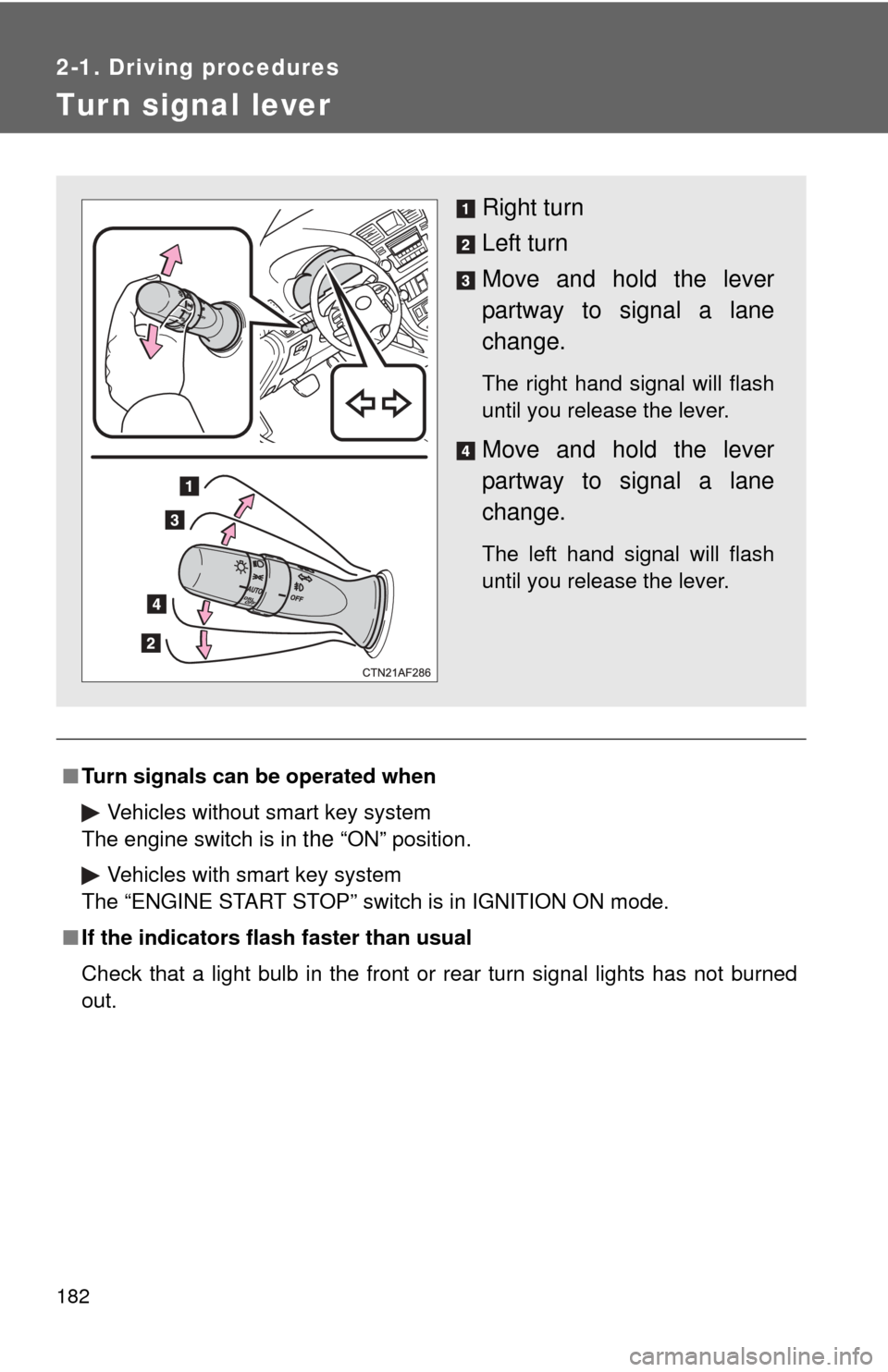
Right turn
Left turn
Move and hold the lever
partway to signal a lane
change.
The right hand signal will flash
until you release the lever.
Move and hold the lever
partway to signal a lane
change.
The left hand signal will flash
until you release the lever.
Page 185 of 636
185
2
When driving
2-2. Instrument cluster
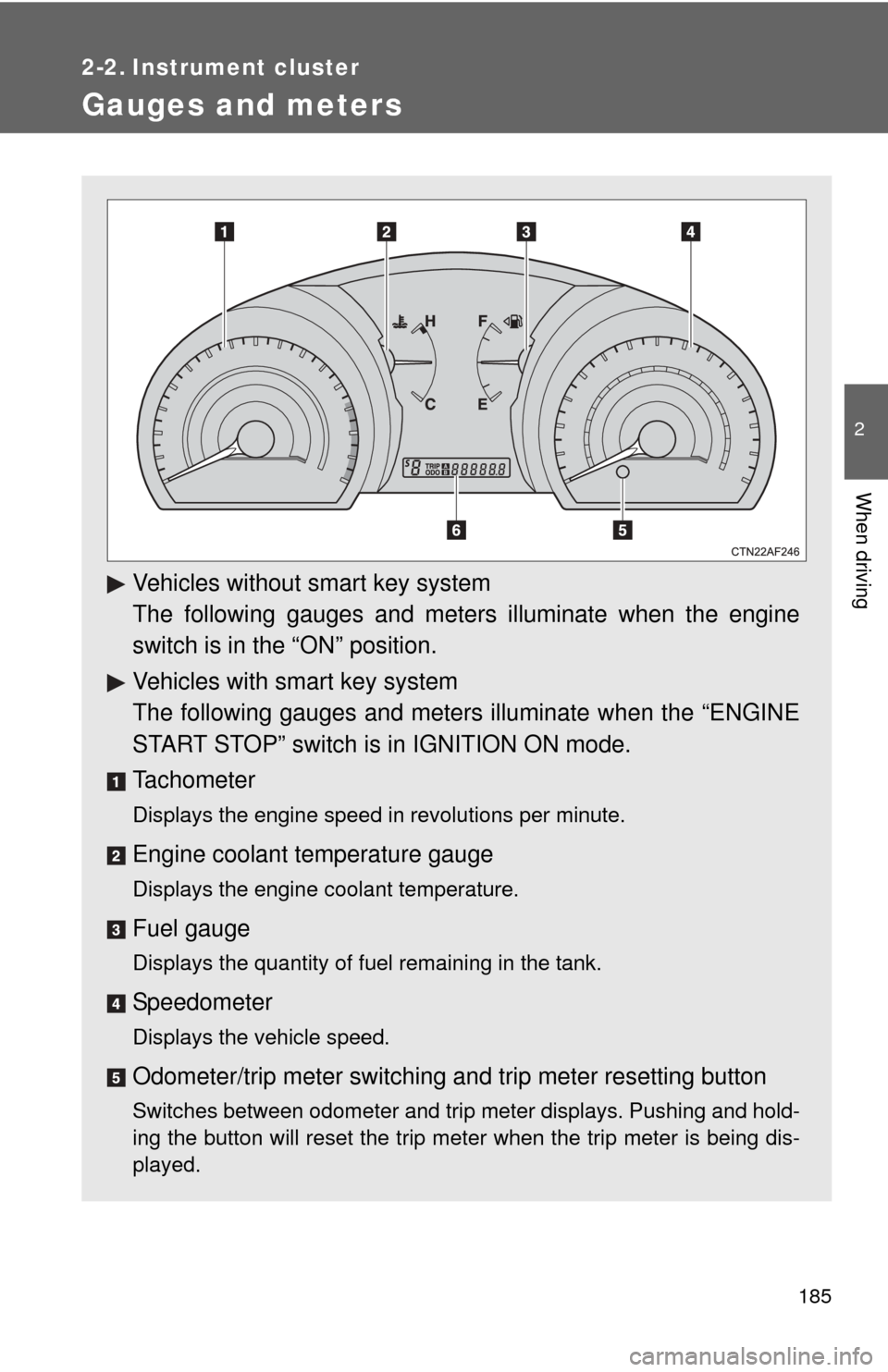
Gauges and meters
Vehicles without smart key system
The following gauges and meters illuminate when the engine
switch is in the “ON” position.
Vehicles with smart key system
The following gauges and meters illuminate when the “ENGINE
START STOP” switch is in IGNITION ON mode.
Tachometer
Displays the engine speed in revolutions per minute.
Engine coolant temperature gauge
Displays the engine coolant temperature.
Fuel gauge
Displays the quantity of fuel remaining in the tank.
Speedometer
Displays the vehicle speed.
Odometer/trip meter switching and trip meter resetting button
Switches between odometer and trip meter displays. Pushing and hold-
ing the button will reset the trip meter when the trip meter is being dis-
played.
Page 186 of 636
186 2-2. Instrument cluster
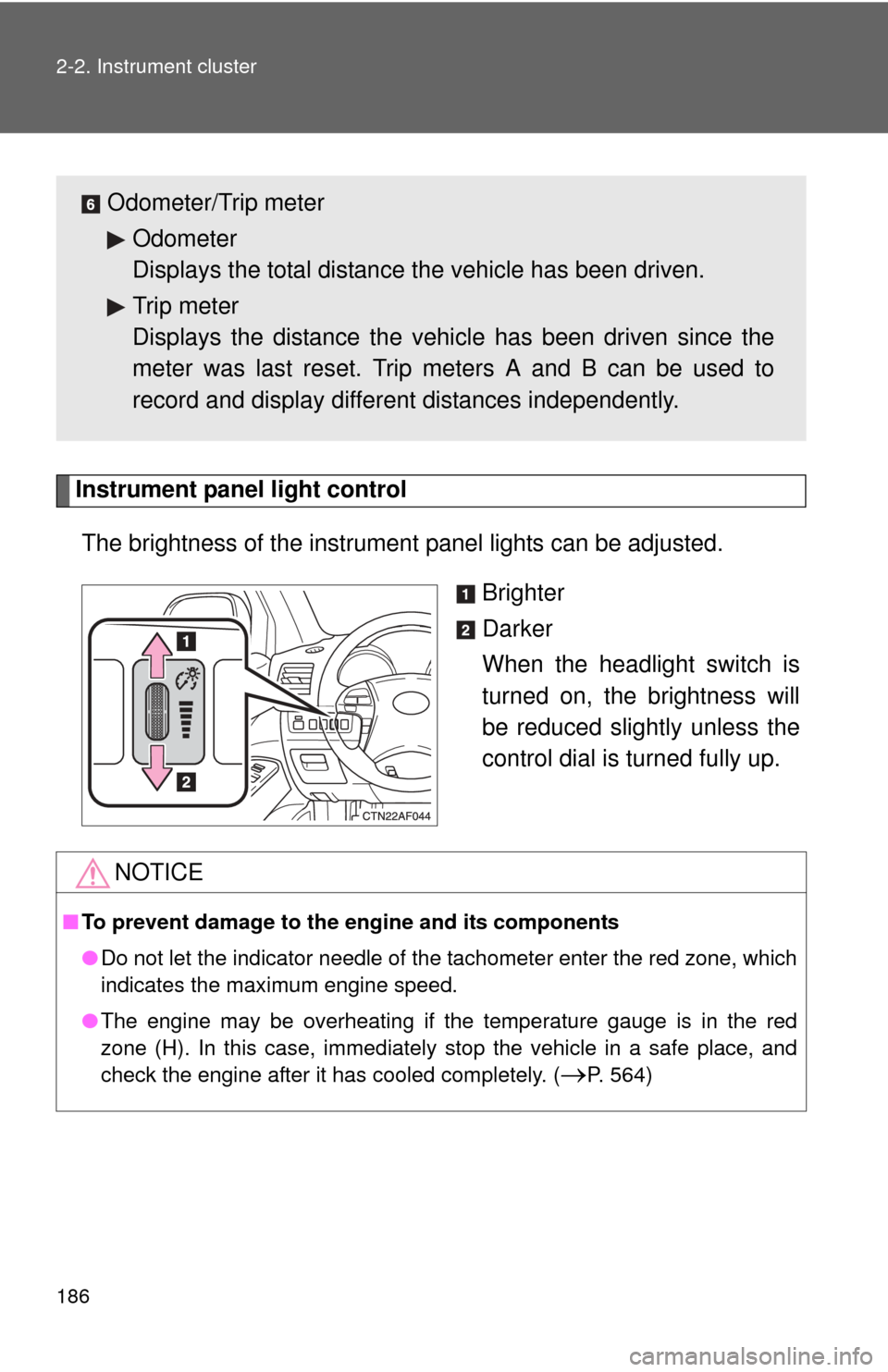
Instrument panel light controlThe brightness of the instrument panel lights can be adjusted.
Brighter
Darker
When the headlight switch is
turned on, the brightness will
be reduced slightly unless the
control dial is turned fully up.
Odometer/Trip meterOdometer
Displays the total distance the vehicle has been driven.
Trip meter
Displays the distance the vehi cle has been driven since the
meter was last reset. Trip meters A and B can be used to
record and display different distances independently.
NOTICE
■ To prevent damage to the engine and its components
●Do not let the indicator needle of the tachometer enter the red zone, which
indicates the maximum engine speed.
● The engine may be overheating if the temperature gauge is in the red
zone (H). In this case, immediately stop the vehicle in a safe place, and
check the engine after it has cooled completely. (
P. 564)
Page 189 of 636
189
2-2. Instrument cluster
2
When driving
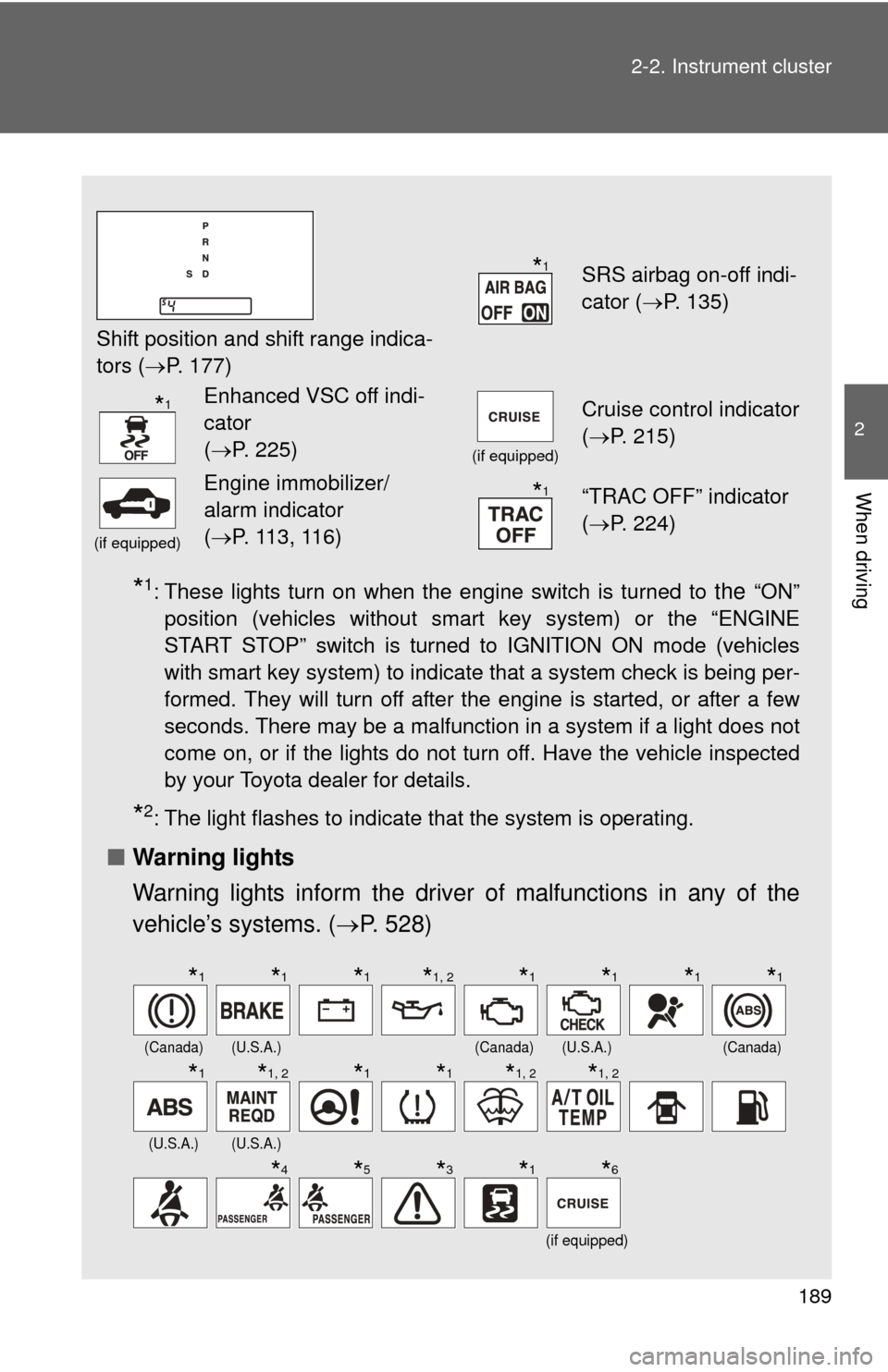
*1: These lights turn on when the engine switch is turned to the “ON”
position (vehicles without smart key system) or the “ENGINE
START STOP” switch is turned to IGNITION ON mode (vehicles
with smart key system) to indicate that a system check is being per-
formed. They will turn off after the engine is started, or after a few
seconds. There may be a malfunction in a system if a light does not
come on, or if the lights do not turn off. Have the vehicle inspected
by your Toyota dealer for details.
*2: The light flashes to indicate that the system is operating.
■ Warning lights
Warning lights inform the driver of malfunctions in any of the
vehicle’s systems. ( P. 528)
Shift position and shift range indica-
tors ( P. 177)
SRS airbag on-off indi-
cator (P. 135)
Enhanced VSC off indi-
cator
(P. 225)
(if equipped)
Cruise control indicator
( P. 215)
(if equipped)
Engine immobilizer/
alarm indicator
(P. 113, 116)“TRAC OFF” indicator
( P. 224)
(Canada)(U.S.A.)(Canada)(U.S.A.)(Canada)
(U.S.A.)(U.S.A.)
(if equipped)
*1
*1
*1
*1*1*1*1, 2*1*1*1*1
*1*1, 2*1*1*1, 2*1, 2
*4*5*3*1*6
Page 190 of 636
190 2-2. Instrument cluster
CAUTION
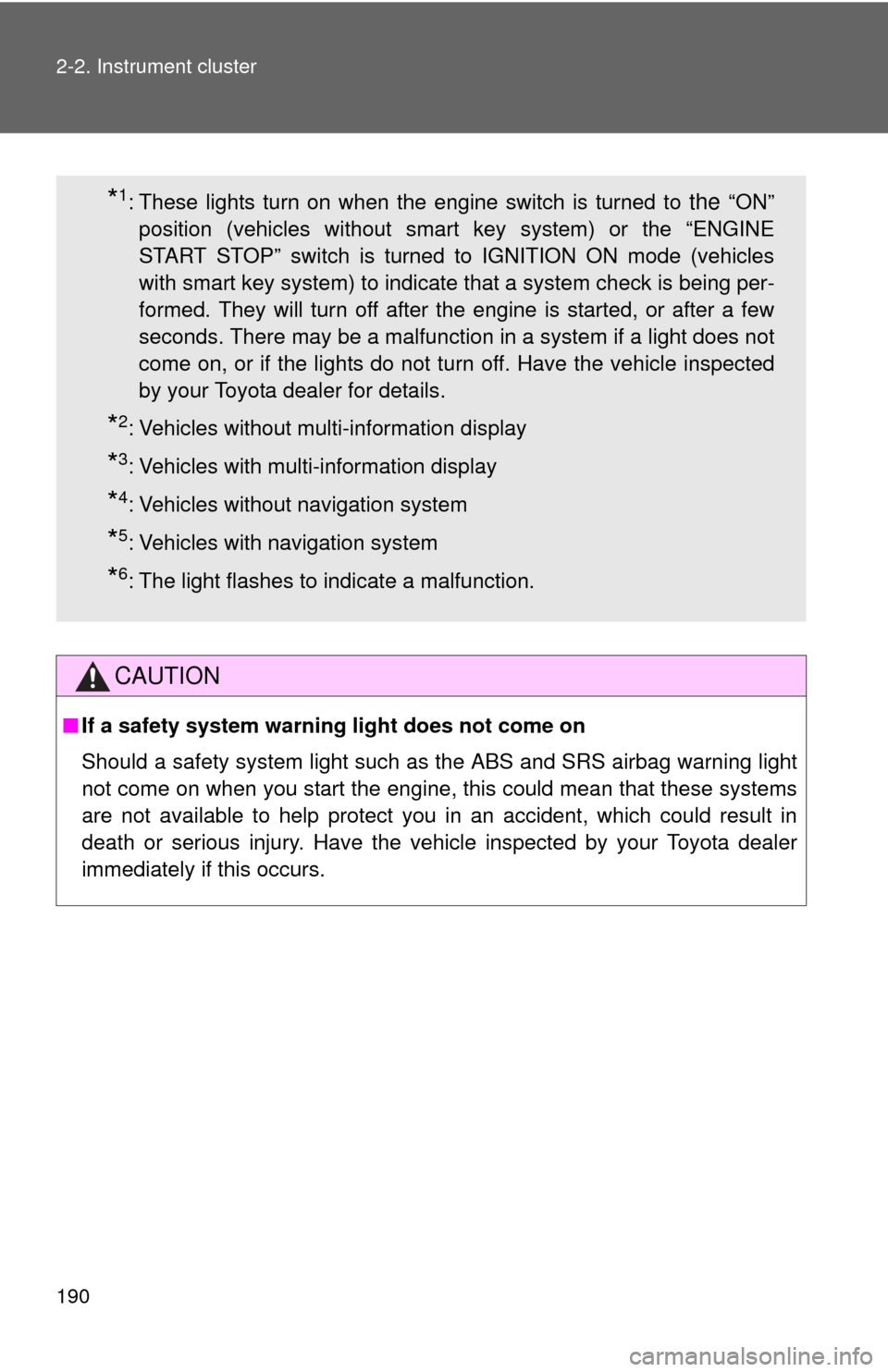
■If a safety system warning light does not come on
Should a safety system light such as the ABS and SRS airbag warning light
not come on when you start the engine, this could mean that these systems
are not available to help protect you in an accident, which could result in
death or serious injury. Have the vehicle inspected by your Toyota dealer
immediately if this occurs.
*1: These lights turn on when the engine switch is turned to the “ON”
position (vehicles without smart key system) or the “ENGINE
START STOP” switch is turned to IGNITION ON mode (vehicles
with smart key system) to indicate that a system check is being per-
formed. They will turn off after the engine is started, or after a few
seconds. There may be a malfunction in a system if a light does not
come on, or if the lights do not turn off. Have the vehicle inspected
by your Toyota dealer for details.
*2: Vehicles without multi-information display
*3: Vehicles with multi-information display
*4: Vehicles without navigation system
*5: Vehicles with navigation system
*6: The light flashes to indicate a malfunction.
Page 193 of 636

193
2-2. Instrument cluster
2
When driving
■
Cruising range
Displays the estimated maximum di stance that can be driven with
the quantity of fuel remaining.
• This distance is computed based on your average fuel consumption.
As a result, the actual distance that can be driven may differ from
that displayed.
• Vehicles without smart key system: When only a small amount of fuel is added to the tank, the display may not be updated.
When adding fuel, turn the engine switch OFF. In case fuel is added
without turning the engine switch OFF, the display may not be
updated.
• Vehicles with smart key system: When only a small amount of fuel is added to the tank, the display may not be updated.
When adding fuel, turn the “ENGINE START STOP” switch OFF. In
case fuel is added without turning the “ENGINE START STOP”
switch OFF, the display may not be updated.
■Driving distance
Displays the driving distance since the engine was started.
■ Average fuel consumption
Displays the average fuel cons umption since the function was
reset.
• This function can be reset by pressing the “DISP” button for longer
than one second when the average fuel consumption is displayed.
When the function is reset, the previous five average fuel consump-
tion values will automatically be displayed for six seconds.
• Use the displayed average fuel consumption as a reference.
■ Average fuel consumption history
Displays the previous five av erage fuel consumption values.