ECU TOYOTA HIGHLANDER 2014 XU50 / 3.G Service Manual
[x] Cancel search | Manufacturer: TOYOTA, Model Year: 2014, Model line: HIGHLANDER, Model: TOYOTA HIGHLANDER 2014 XU50 / 3.GPages: 712, PDF Size: 11.43 MB
Page 81 of 712
811-2. Theft deterrent system
1
For safety and security
HIGHLANDER_U (OM48A12U)
■System maintenance
The vehicle has a maintenance-free type engine immobilizer system.
■ Conditions that may cause the system to malfunction
●If the grip portion of the key is in contact with a metallic object
● If the key is in close proximity to or touching a key to the security system
(key with a built-in transponder chip) of another vehicle
■ Certification for the engine immobilizer system
For vehicles sold in the U.S.A.
FCC ID: WRKRI-44BTY FCC ID: NI4TMIMB-3
This device complies with part 15 of the FCC Rules. Operation is subject to
the following two conditions: (1) This device may not cause harmful interfer-
ence, and (2) this device must accept any interference received, including
interference that may cause undesired operation.
FCC WARNING
Changes or modifications not expressly approved by the party responsible for
compliance could void the user's authority to operate the equipment.
For vehicles sold in Canada
This device complies with Industry Canada licence-exempt RSS standard(s).
Operation is subject to the following two conditions: (1) this device may not
cause interference, and (2) this device must accept any interference, includ-
ing interference that may cause undesired operation of the device.
NOTICE
■ To ensure the system operates correctly
Do not modify or remove the system. If modified or removed, the proper
operation of the system cannot be guaranteed.
Page 83 of 712
831-2. Theft deterrent system
1
For safety and security
HIGHLANDER_U (OM48A12U)
Do one of the following to deactivate or stop the alarms:
●Unlock the doors.
● Vehicles without a smart key system: Turn the engine switch to the
“ACC” or “ON” position, or start the engine. (The alarm will be deac-
tivated or stopped after a few seconds.)
● Vehicles with a smart key system: Turn the engine switch to
ACCESSORY or IGNITION ON mode, or start the engine. (The
alarm will be deactivated or stopped after a few seconds.)
● Open the glass hatch (if equipped) using the entry function (vehi-
cles with smart key system).
■System maintenance
The vehicle has a maintenance-free type alarm system.
■ Items to check before locking the vehicle
To prevent unexpected triggering of the alarm and vehicle theft, make sure of
the following:
●Nobody is in the vehicle.
● The windows and the following openings are closed before the alarm is set.
• The glass hatch (if equipped)
• The moon roof (if equipped)
• The panoramic moon roof (if equipped)
● No valuables or other personal items are left in the vehicle.
Deactivating or stopping the alarm
Page 85 of 712
851-2. Theft deterrent system
1
For safety and security
HIGHLANDER_U (OM48A12U)
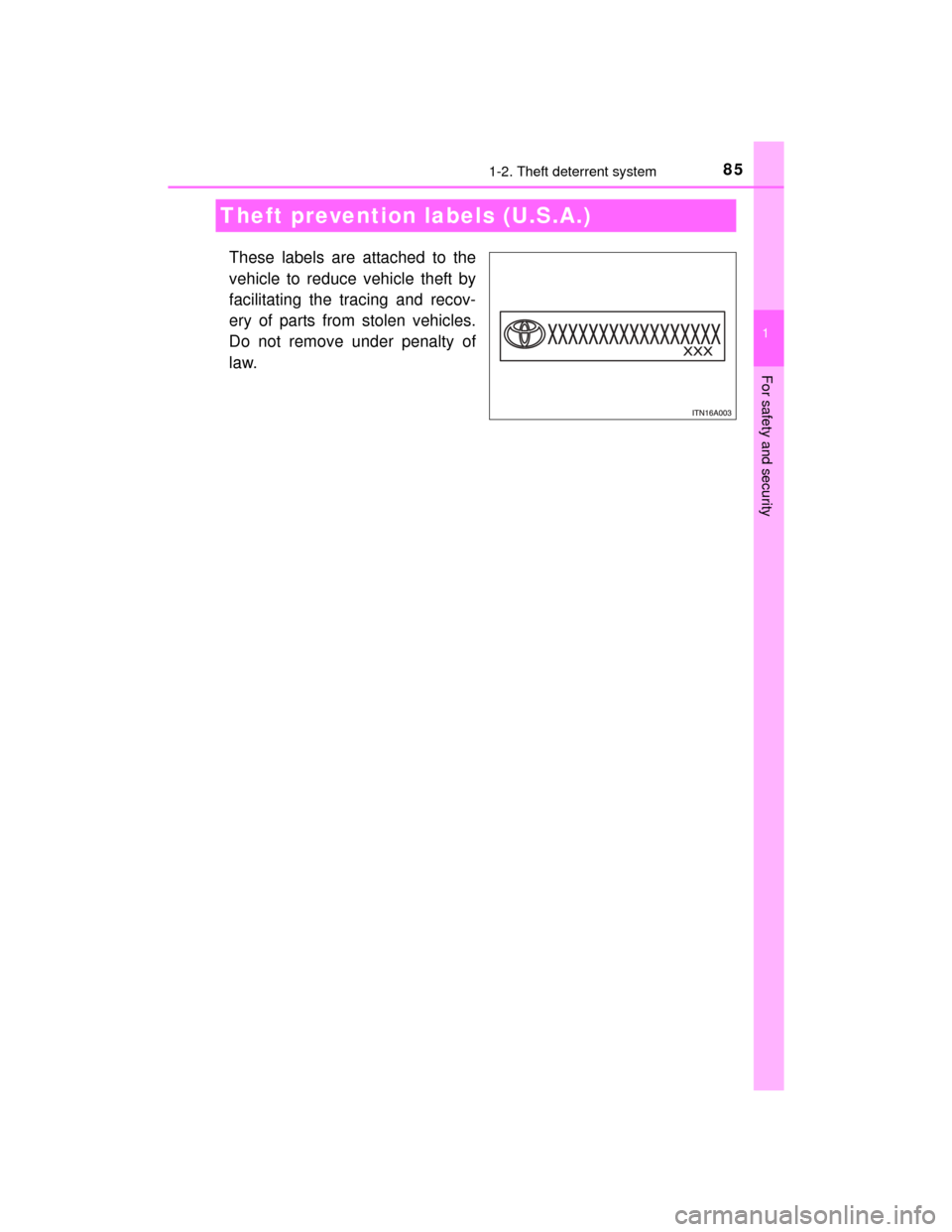
These labels are attached to the
vehicle to reduce vehicle theft by
facilitating the tracing and recov-
ery of parts from stolen vehicles.
Do not remove under penalty of
law.
Theft prevention labels (U.S.A.)
Page 91 of 712
912. Instrument cluster
2
Instrument cluster
HIGHLANDER_U (OM48A12U)
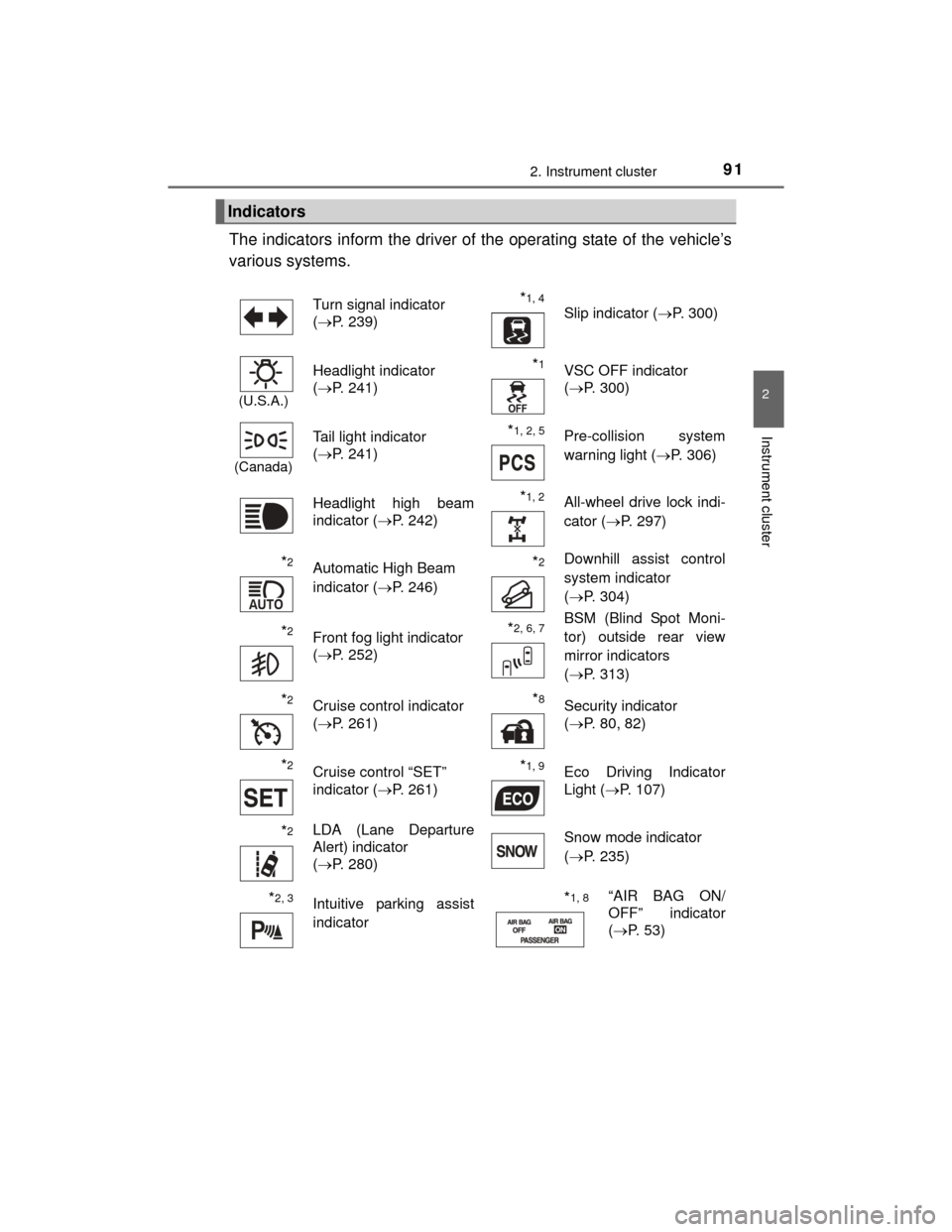
The indicators inform the driver of the operating state of the vehicle’s
various systems.
Indicators
Turn signal indicator
(P. 239)*1, 4 Slip indicator ( P. 300)
(U.S.A.)
Headlight indicator
(P. 241)*1VSC OFF indicator
( P. 300)
(Canada)
Tail light indicator
(P. 241) *1, 2, 5Pre-collision system
warning light ( P. 306)
Headlight high beam
indicator (P. 242)
*1, 2All-wheel drive lock indi-
cator ( P. 297)
*2Automatic High Beam
indicator (P. 246)*2Downhill assist control
system indicator
(P. 304)
*2Front fog light indicator
(P. 252)*2, 6, 7BSM (Blind Spot Moni-
tor) outside rear view
mirror indicators
( P. 313)
*2Cruise control indicator
(P. 261)*8Security indicator
( P. 80, 82)
*2Cruise control “SET”
indicator (P. 261)*1, 9Eco Driving Indicator
Light ( P. 107)
*2LDA (Lane Departure
Alert) indicator
(P. 280) Snow mode indicator
(
P. 235)
*2, 3 Intuitive parking assist
indicator*1, 8“AIR BAG ON/
OFF” indicator
(P. 53)
Page 119 of 712

1193-1. Key information
3
Operation of each component
HIGHLANDER_U (OM48A12U)■
Certification for wireless remote co ntrol (vehicles without a smart key
system)
For vehicles sold in the U.S.A. and Canada
TRW Automotive
Automobile Entry/Security Transmitter
Model: 226624-101, 226624-102
FCC ID: GQ4-52T
IC: 1470A-33T
Auto Alarm/Security system Receiver
Model: 230433
FCC ID: GQ4-45R
MADE IN U.S.A.
This device complies with Part 15 of the FCC Rules and with Industry Canada
license-exempt RSS standard(s). Operation is subject to the following two
conditions:
(1) This device may not cause harmful interference, and
(2) This device must accept any interference received, including interference
that may cause undesired operation of the device.
Le présent appareil est conforme aux CNR d’Industrie Canada applicables
aux appareils radio exempts de licence. L’exploitation est autorisée aux deux
conditions suivantes:
(1) l’appareil ne doit pas produire de brouillage, et
(2) l’utilisateur de l’appareil doit accepter tout brouillage radioélectrique subi,
même si le brouillage est susceptible d’en compromettre le fonctionnement.
WARNING: Changes or modifications not expresly approved by TRW Auto-
motive U.S. LLC could void the user's authority to operate the equipment.
■ Certification for wireless remote control (vehicles with a smart key sys-
tem)
P. 153
Page 123 of 712
1233-2. Opening, closing and locking the doors
3
Operation of each component
HIGHLANDER_U (OM48A12U)
◆Key
Vehicles without a smart key system
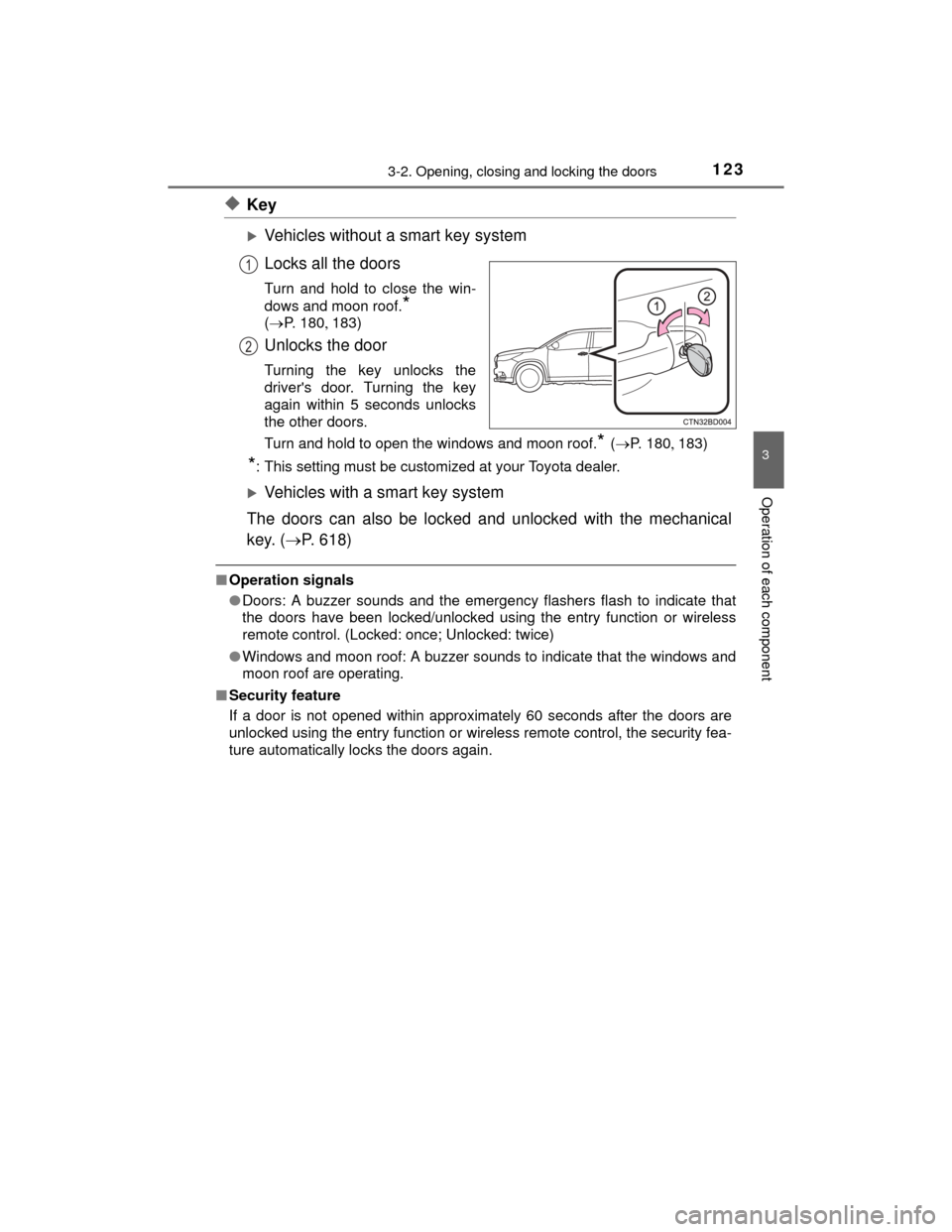
Locks all the doors
Turn and hold to close the win-
dows and moon roof.
*
( P. 180183)
Unlocks the door
Turning the key unlocks the
driver's door. Turning the key
again within 5 seconds unlocks
the other doors.
Turn and hold to open the windows and moon roof.
* (P. 180 183)
*: This setting must be customized at your Toyota dealer.
Vehicles with a smart key system
The doors can also be locked and unlocked with the mechanical
key. ( P. 618)
■Operation signals
●Doors: A buzzer sounds and the emergency flashers flash to indicate that
the doors have been locked/unlocked using the entry function or wireless
remote control. (Locked: once; Unlocked: twice)
● Windows and moon roof: A buzzer sounds to indicate that the windows and
moon roof are operating.
■ Security feature
If a door is not opened within approximately 60 seconds after the doors are
unlocked using the entry function or wireless remote control, the security fea-
ture automatically locks the doors again.
1
2
Page 136 of 712
1363-2. Opening, closing and locking the doors
HIGHLANDER_U (OM48A12U)
WARNING
■Operating the back door
Observe the following precautions.
Failure to do so may cause parts of the body to be caught, resulting in death
or serious injury.
●Remove any heavy loads, such as snow and ice, from the back door
before opening it. Failure to do so may cause the back door to suddenly
shut again after it is opened.
● When opening or closing the back door, thoroughly check to make sure
the surrounding area is safe.
● If anyone is in the vicinity, make sure they are safe and let them know that
the back door is about to open or close.
● Use caution when opening or closing the back door in windy weather as it
may move abruptly in strong wind.
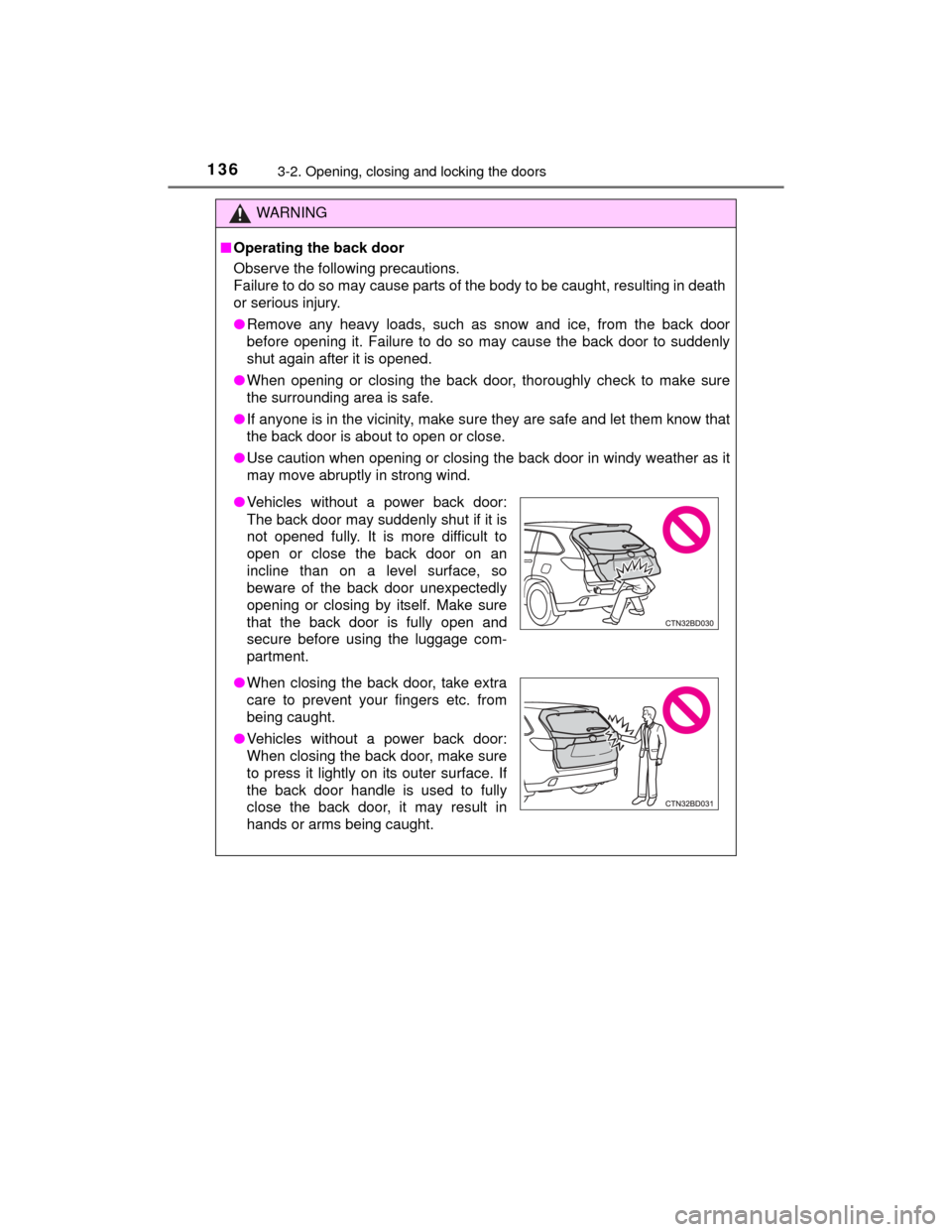
●Vehicles without a power back door:
The back door may suddenly shut if it is
not opened fully. It is more difficult to
open or close the back door on an
incline than on a level surface, so
beware of the back door unexpectedly
opening or closing by itself. Make sure
that the back door is fully open and
secure before using the luggage com-
partment.
● When closing the back door, take extra
care to prevent your fingers etc. from
being caught.
● Vehicles without a power back door:
When closing the back door, make sure
to press it lightly on its outer surface. If
the back door handle is used to fully
close the back door, it may result in
hands or arms being caught.
Page 138 of 712

1383-2. Opening, closing and locking the doors
HIGHLANDER_U (OM48A12U)
WARNING
■Power back door (if equipped)
Observe the following precautions when operating the power back door.
Failure to do so may cause death or serious injury.
●Check the safety of the surrounding area to make sure there are no obsta-
cles or anything that could cause any of your belongings to get caught.
● If anyone is in the vicinity, make sure they are safe and let them know that
the back door is about to open or close.
● If the power back door system is turned off with the main switch while the
back door is operating automatically, the automatic operation is stopped.
The back door then has to be operated manually. Take extra care when on
an incline, as the back door may open or close unexpectedly.
● If the operating conditions of the power back door are no longer met, a
buzzer may sound and the back door may stop opening or closing. The
back door then has to be operated manually. Take extra care when on an
incline, as the back door may open or close abruptly.
● On an incline, the back door may suddenly shut after it opens. Make sure
the back door is fully open and secure.
● In the following situations, the power back door may detect an abnormality
and automatic operation may be stopped. In this case, the back door has
to be operated manually. Take extra care when on an incline, as the back
door may open or close abruptly.
• When the back door contacts an obstacle
• When the battery voltage suddenly drops, such as when the engine
switch is turned to the “ON” position (vehicles without a smart key sys-
tem) or IGNITION ON mode (vehicles with a smart key system) or the
engine is started during automatic operation
● If a bicycle carrier or similar object is attached to the back door, the power
back door may not operate, causing itself to malfunction, or the back door
may move in the closing directi on after being opened, causing someone’s
hands, head or neck to be caught and injured. When installing an acces-
sory part to the back door, ask your Toyota dealer for details.
Page 145 of 712
1453-2. Opening, closing and locking the doors
3
Operation of each component
HIGHLANDER_U (OM48A12U)
WARNING
●Do not pull on the glass hatch damper stay to close the glass hatch, and
do not hang on the glass hatch damper stay.
Doing so may cause hands to be caught or the glass hatch damper stay to
break, causing an accident.
● Do not attach any accessories other than genuine Toyota parts to the
glass hatch. Such additional weight on the glass hatch may cause the
glass hatch to suddenly shut again after it is opened, resulting in death or
serious injury.
● Do not open the glass hatch while the rear wiper is switched on. (If the rear
wiper is switched on while the glass hatch is open, the wiper motor drive
disc will be rotating on the door panel.)
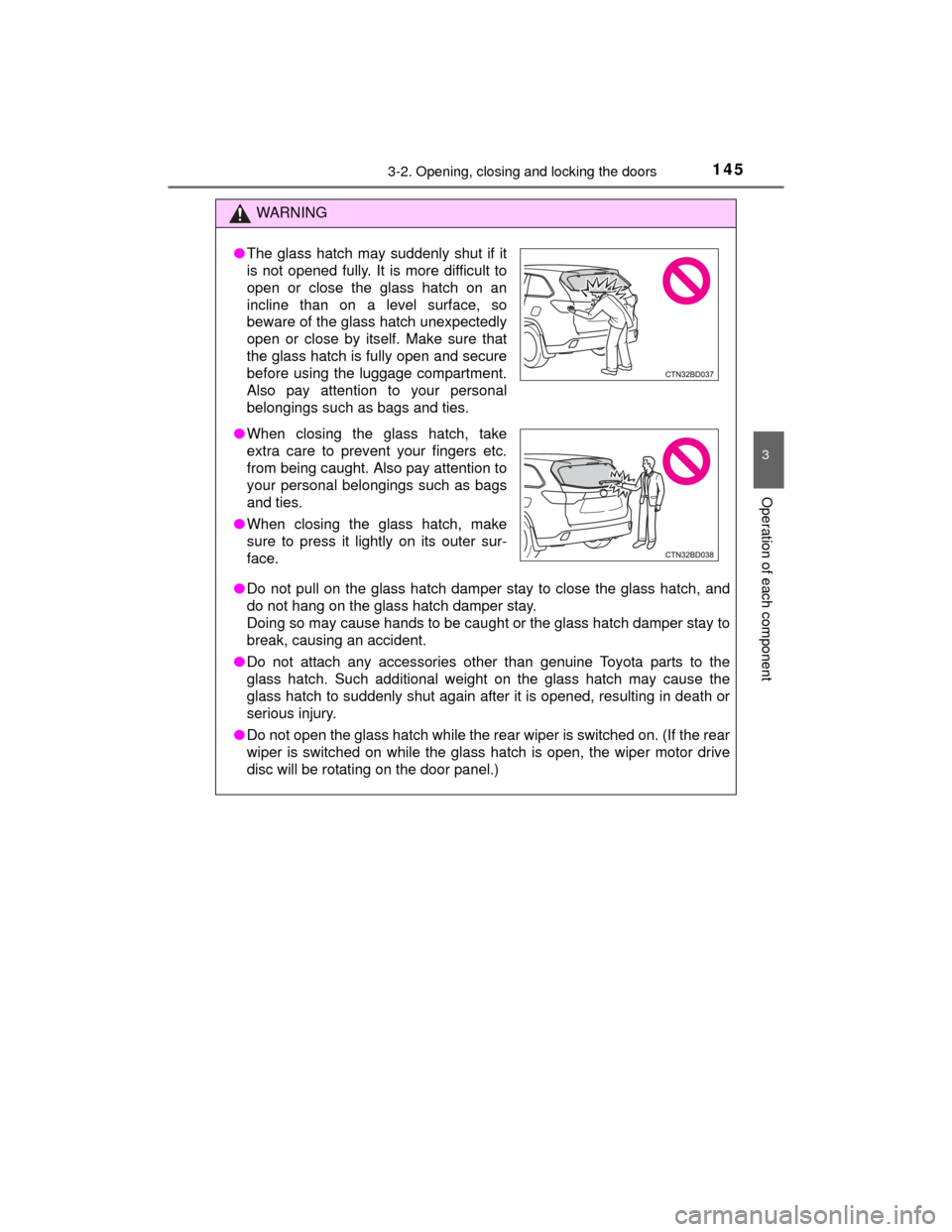
●The glass hatch may suddenly shut if it
is not opened fully. It is more difficult to
open or close the glass hatch on an
incline than on a level surface, so
beware of the glass hatch unexpectedly
open or close by itself. Make sure that
the glass hatch is fully open and secure
before using the luggage compartment.
Also pay attention to your personal
belongings such as bags and ties.
● When closing the glass hatch, take
extra care to prevent your fingers etc.
from being caught. Also pay attention to
your personal belongings such as bags
and ties.
● When closing the glass hatch, make
sure to press it lightly on its outer sur-
face.
Page 151 of 712
1513-2. Opening, closing and locking the doors
3
Operation of each component
HIGHLANDER_U (OM48A12U)■
Note for the entry function
●Even when the electronic key is within the effective range (detection areas),
the system may not operate properly in the following cases:
• The electronic key is too close to the window or outside door handle, near
the ground, or in a high place when the doors are locked or unlocked.
• The electronic key is near the ground or in a high place, or too close to
the rear bumper center when the back door is opened.
• The electronic key is on the instrument panel or floor, or in the auxiliary box of the driver's side instrument panel, door pockets or glove box when
the engine is started or engine switch modes are changed.
● Do not leave the electronic key on top of the instrument panel or near the
door pockets when exiting the vehicle. Depending on the radio wave recep-
tion conditions, it may be detected by the antenna outside the cabin and the
door will become lockable from the out side, possibly trapping the electronic
key inside the vehicle.
● As long as the electronic key is within the effective range, the doors may be
locked or unlocked by anyone. However, only the doors detecting the elec-
tronic key can be used to unlock the vehicle.
● Even if the electronic key is not inside the vehicle, it may be possible to start
the engine if the electronic key is near the window.
● The doors may unlock or lock if a large amount of water splashes on the
door handle, such as in the rain or in a car wash when the electronic key is
within the effective range. (The doors will automatically be locked after
approximately 60 seconds if the doors are not opened and closed.)
● If the wireless remote control is used to lock the doors when the electronic
key is near the vehicle, there is a possibility that the door may not be
unlocked by the entry function. (Use the wireless remote control to unlock
the doors.)
● Touching the door lock or unlock sensor while wearing gloves may prevent
lock or unlock operation. Remove the gloves and touch the lock or unlock
sensor again.
● When the lock operation is performed using the lock sensor, recognition sig-
nals will be shown up to two consecutive times. After this, no recognition
signals will be given.
● If the door handle becomes wet while the electronic key is within the effec-
tive range, the door may lock and unlock repeatedly. In that case, follow the
following correction procedures to wash the vehicle:
• Place the electronic key in a location 6 ft. (2 m) or more away from the
vehicle. (Take care to ensure that the key is not stolen.)
• Set the electronic key to battery-saving mode to disable the smart key system. ( P. 149)