belt TOYOTA HIGHLANDER 2018 (in English) Workshop Manual
[x] Cancel search | Manufacturer: TOYOTA, Model Year: 2018, Model line: HIGHLANDER, Model: TOYOTA HIGHLANDER 2018Pages: 732, PDF Size: 14.5 MB
Page 157 of 732
1573-3. Adjusting the seats
3
Operation of each component
HIGHLANDER_U (OM0E031U)
WARNING
■When folding the rear seatbacks down
Observe the following precautions. Failure to do so may result in death or
serious injury.
● Do not fold the seatbacks down while driving.
● Stop the vehicle on level ground, set the parking brake and shi ft the shift
lever to P.
● Do not allow anyone to sit on a folded seatback or in the lugga ge compart-
ment while driving.
● Do not allow children to enter the luggage compartment.
● Do not fold down a rear seatback when there are passengers sitt ing in the
rear seats or when there is luggage placed on the rear seats.
● Be careful not to catch your hand when folding the rear seatbac ks.
■ Seat adjustment
● To reduce the risk of sliding under the lap belt during a colli sion, do not
recline the seat more than necessary.
If the seat is too reclined, the lap belt may slide past the hi ps and apply
restraint forces directly to the abdomen, or your neck may cont act the
shoulder belt, increasing the risk of death or serious injury i n the event of
an accident.
Adjustments should not be made while driving as the seat may un expect-
edly move and cause the driver to lose control of the vehicle.
● Be careful that the seat does not hit passengers or luggage.
● Be careful not to get your hands or feet caught in the seat.
■ After adjusting or returning the seats
Observe the following precautions. Failure to do so may result in death or
serious injury.
● Make sure that the seat and seatback are securely locked in position by
lightly rocking them back and forth.
● Check that the seat belts are not twisted or caught in the seat back.
Page 197 of 732
1974-1. Before driving
4
Driving
HIGHLANDER_U (OM0E031U)
WARNING
■Things that must not be carried in the luggage compartment
The following things may cause a fire if loaded in the luggage compart-
ment:
●Receptacles containing gasoline
●Aerosol cans
■Storage precautions
Observe the following precautions.
Failure to do so may prevent the pedals from being depressed pr operly,
may block the driver’s vision, or may result in items hitting t he driver or
passengers, possibly causing an accident.
●Stow cargo and luggage in the luggage compartment whenever poss i-
ble.
●Do not stack cargo and luggage in the luggage compartment highe r
than the seatbacks.
●Do not place cargo or luggage in or on the following locations.
• At the feet of the driver
• On the front passenger or rea r seats (when stacking items)
• On the instrument panel
• On the dashboard
●Secure all items in the occupant compartment.
●When you fold down the rear seats, long items should not be pla ced
directly behind the front seats.
●Never allow anyone to ride in the luggage compartment. It is no t
designed for passengers. They should ride in their seats with t heir seat
belts properly fastened.
Page 299 of 732
2994-5. Using the driving support systems
4
Driving
HIGHLANDER_U (OM0E031U)
■Operating conditions
●The Stop & Start system is operational when all of the followin g conditions
are met:
• The brake pedal is being depressed firmly.
• The engine is adequately warmed up.
• The outside temperature is 23°F (-5°C) or higher.
• The shift lever is in D.
• is off.
• The hood is closed.
• The driver's seat belt is fastened.
• The driver's door is closed.
• The accelerator pedal is not being depressed.
● In the following situations the engine may not be stopped by th e Stop & Start
system. This is not a malfunction of the Stop & Start system.
• The air conditioning system is being used when the ambient tem perature
is high or low.
• The battery is not sufficiently charged, such as if the vehicle has been
parked for a long time and the battery charge has decreased, the electric
load is large, the battery temperature is excessively low or th e battery has
deteriorated, or is undergoing a periodic recharge.
• The brake booster vacuum is low.
• The vehicle is stopped on a steep incline.
• The steering wheel is being operated.
• Due to traffic or other circumstances the vehicle is being sto pped repeat-
edly.
• The vehicle is being driven in a high altitude area.
• Engine coolant temperature or transmission fluid temperature i s
extremely low or high.
• The battery fluid temperature is extremely low or high.
• For a while after the battery terminals have been disconnected and
reconnected.
• For a while after the battery replacement.
• Power mode or snow mode is selected.
Page 300 of 732

3004-5. Using the driving support systems
HIGHLANDER_U (OM0E031U)●
In the following situations, the engine will restart automatica lly if the engine
is stopped by the Stop & Start system. (To enable stopping of t he engine by
the Stop & Start system, drive the vehicle.)
• The air conditioning system is turned on.
• is turned on.
• The steering wheel is operated.
• The shift lever is shifted to a position other than D.
• The driver's seat belt is unfastened.
• The driver's door is opened.
• The accelerator pedal is depressed.
• The Stop & Start cancel switch is pressed.
• The vehicle starts to roll on an incline.
● In the following situations, the engine may restart automatically if the engine
is stopped by the Stop & Start system. (To enable stopping of t he engine by
the Stop & Start system, drive the vehicle.)
• The brake pedal is pumped or strongly depressed.
• The air conditioning system is being used.
• The battery is not sufficiently charged.
■ Hood
●If the hood is opened while the engine is stopped by the Stop & Start sys-
tem, the engine will stall and will not be able to be restarted by the automatic
engine start function. In this case, restart the engine using the normal
engine starting procedure. ( P. 218, 221)
● Even if the hood is closed after the engine is started with the hood open, the
Stop & Start system will not operate. Close the hood, turn the engine switch
off, wait 30 seconds or more, and then start the engine.
■ When to use the Stop & Start system
●When the system cannot operate, is canceled, or is malfunctioning, warning
messages and a warning buzzer are used to inform the driver. ( P. 303)
● Vehicles with a smart key system: If the engine switch is press ed when the
engine is stopped by the Stop & Start system, the engine will s tall and will
not be able to be restarted by the automatic engine start funct ion. In this
case, restart the engine using the normal engine starting proce dure.
( P. 218, 221)
● When the engine is restarted by the Stop & Start system, the po wer outlets
may be temporarily unusable, but this is not a malfunction.
● Installation and removal of electrical components and wireless devices may
affect the Stop & Start system. Contact your Toyota dealer for details.
Page 303 of 732
3034-5. Using the driving support systems
4
Driving
HIGHLANDER_U (OM0E031U)■
Multi-information display messages
If the following situations, and a message may be displayed on the multi-
information display.
●When the engine cannot be stopped by the Stop & Start system
MessageDetails
“Depress Brake
Firmly to Activate”
The brake pedal is not depressed enough. If the brake pedal is depressed further, the
system will operate.
“For Climate Con-
trol”
• The air conditioning system is being used when the ambient temperature is high or
low.
If the difference between the set temperature
and cabin temperature is small, the system
will be enabled.
• is ON.
“Battery Charging”
• The battery charge amount may be low.
Engine stop is temporarily prohibited to priori-
tize charging of the battery, but if the engine is
operated for a short while, engine stop is
allowed.
• A refresh charge may be occurring, such as when the battery is undergoing a peri-
odic recharge, for a while after the battery
terminals have been disconnected and
reconnected, for a while after the battery
has been replaced, etc.
After a refresh charge of approximately 5 to
60 minutes completes, the system can be
operated.
• If the message is displayed continuously (more than 60 minutes), the battery may
have deteriorated.
Contact your Toyota dealer.
“Steering Wheel
Turned”
The steering wheel has been operated.
“Driver Seat Belt
Unbuckled”
The driver seat belt is not fastened.
Page 305 of 732
3054-5. Using the driving support systems
4
Driving
HIGHLANDER_U (OM0E031U)●
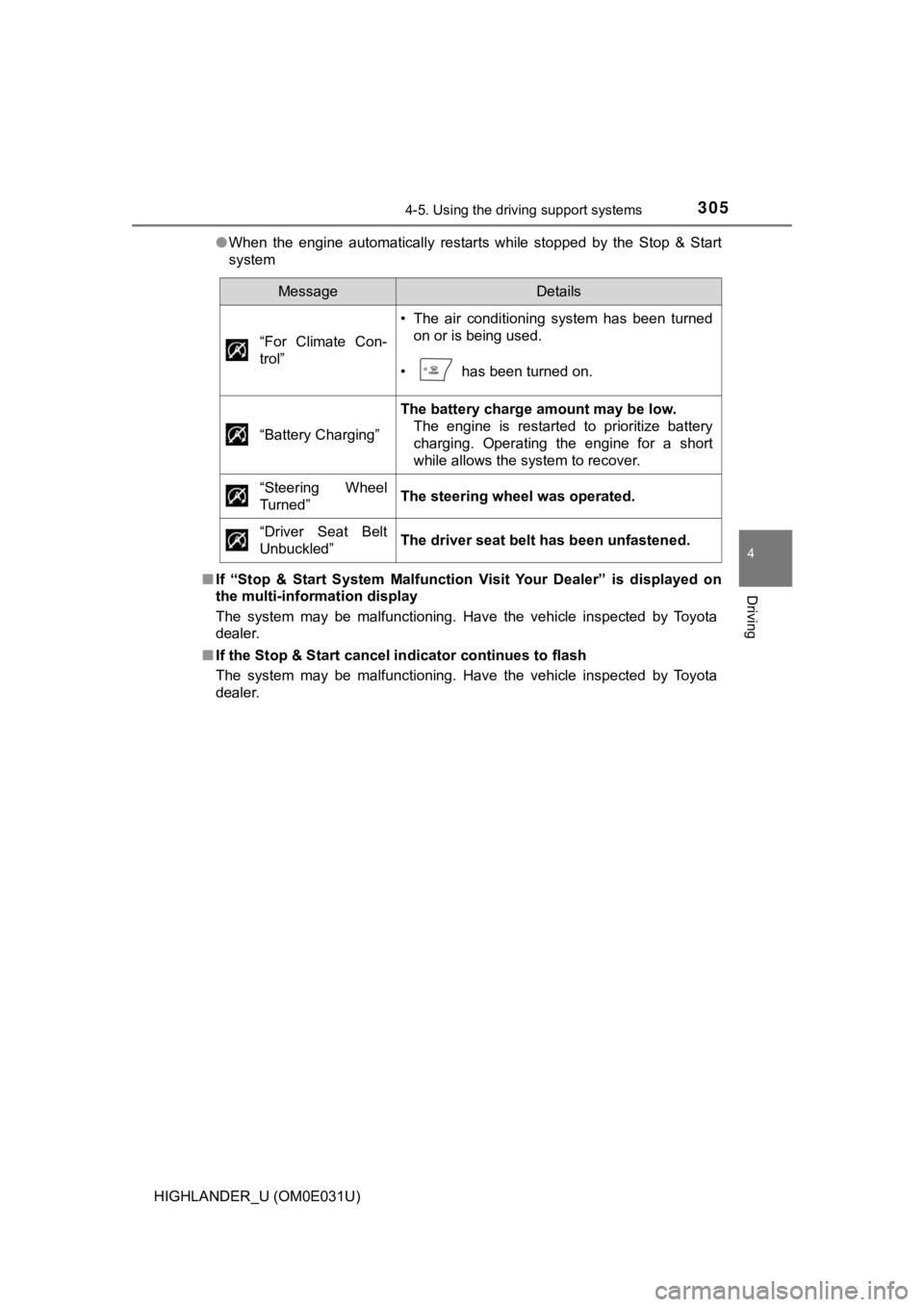
When the engine automatically restarts while stopped by the Sto p & Start
system
■ If “Stop & Start System Malfunction Visit Your Dealer” is displ ayed on
the multi-information display
The system may be malfunctioning. Have the vehicle inspected by Toyota
dealer.
■ If the Stop & Start cancel indicator continues to flash
The system may be malfunctioning. Have the vehicle inspected by Toyota
dealer.
MessageDetails
“For Climate Con-
trol”
• The air conditioning system has been turned on or is being used.
• has been turned on.
“Battery Charging”
The battery charge amount may be low. The engine is restarted to prioritize battery
charging. Operating the engine for a short
while allows the system to recover.
“Steering Wheel
Turned”
The steering wheel was operated.
“Driver Seat Belt
Unbuckled”
The driver seat belt has been unfastened.
Page 306 of 732
3064-5. Using the driving support systems
HIGHLANDER_U (OM0E031U)
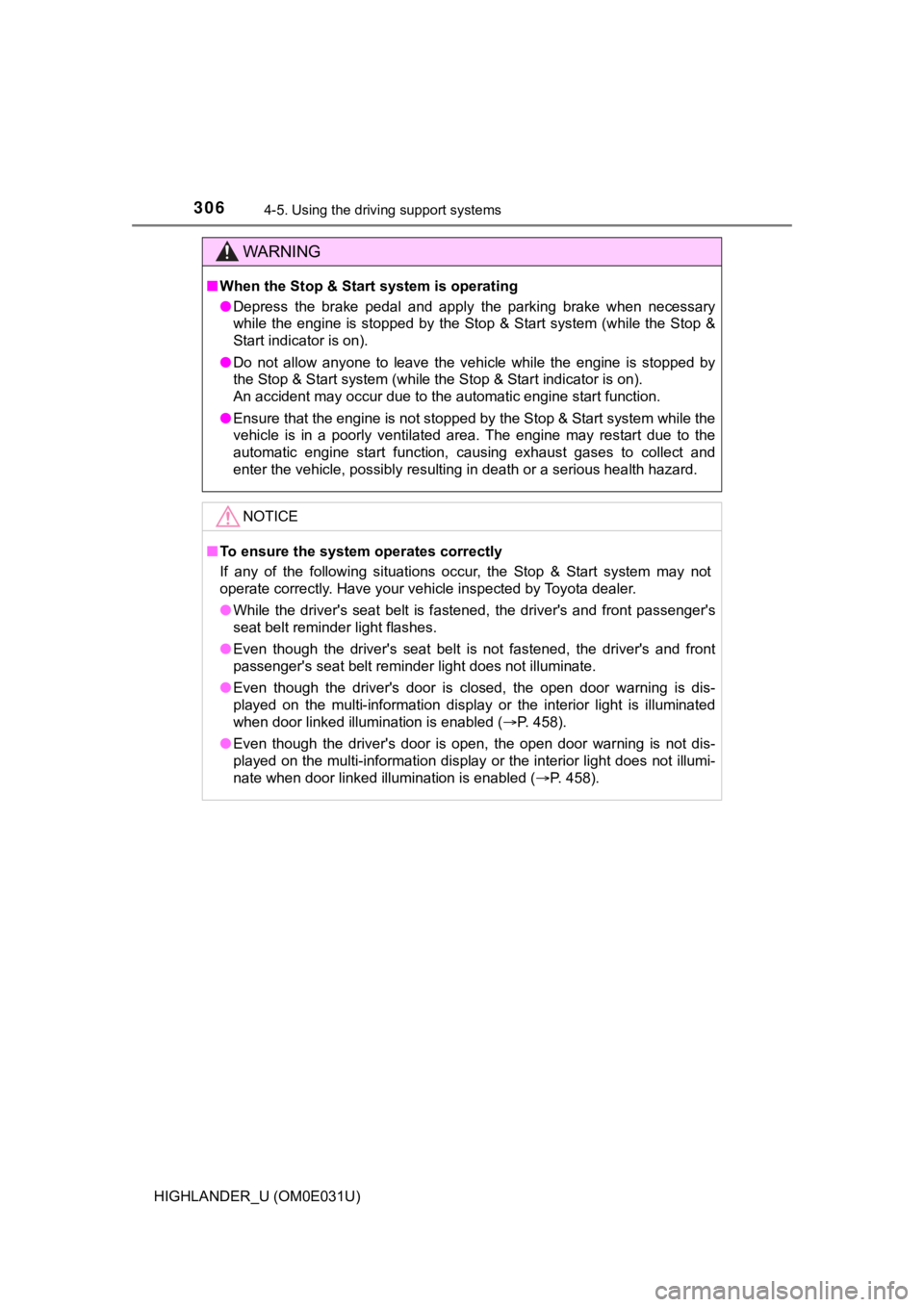
WARNING
■When the Stop & Start system is operating
● Depress the brake pedal and apply the parking brake when necess ary
while the engine is stopped by the Stop & Start system (while t he Stop &
Start indicator is on).
● Do not allow anyone to leave the vehicle while the engine is stopped by
the Stop & Start system (while the Stop & Start indicator is on ).
An accident may occur due to the automatic engine start functio n.
● Ensure that the engine is not stopped by the Stop & Start system while the
vehicle is in a poorly ventilated area. The engine may restart due to the
automatic engine start function, causing exhaust gases to colle ct and
enter the vehicle, possibly resulting in death or a serious hea lth hazard.
NOTICE
■To ensure the system operates correctly
If any of the following situations occur, the Stop & Start syst em may not
operate correctly. Have your vehicle inspected by Toyota dealer .
● While the driver's seat belt is fastened, the driver's and front passenger's
seat belt reminder light flashes.
● Even though the driver's seat belt is not fastened, the driver's and front
passenger's seat belt reminder light does not illuminate.
● Even though the driver's door is closed, the open door warning is dis-
played on the multi-information display or the interior light i s illuminated
when door linked illumination is enabled ( P. 458).
● Even though the driver's door is open, the open door warning is not dis-
played on the multi-information display or the interior light d oes not illumi-
nate when door linked illumination is enabled ( P. 458).
Page 343 of 732
3434-6. Driving tips
4
Driving
HIGHLANDER_U (OM0E031U)
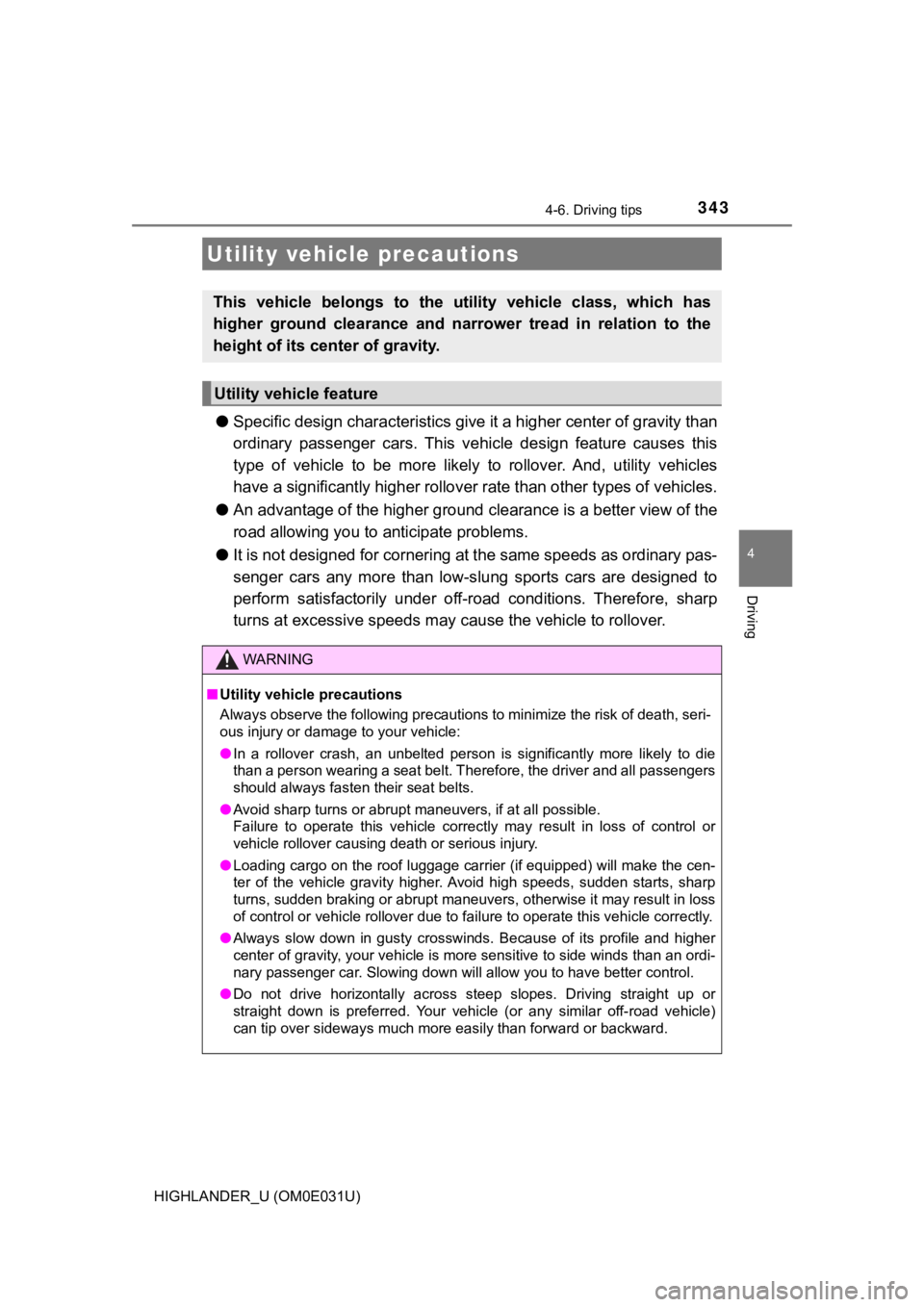
●Specific design charac teristics give it a higher center of grav ity than
ordinary passenger cars. This vehi cle design feature causes this
type of vehicle to be more likel y to rollover. And, utility vehicles
have a significantly higher rollover rate than other types of v ehicles.
● An advantage of the higher ground clearance is a better view of the
road allowing you to anticipate problems.
● It is not designed for cornering at the same speeds as ordinary pas-
senger cars any more than low-s lung sports cars are designed to
perform satisfactorily under o ff-road conditions. Therefore, sh arp
turns at excessive speeds may c ause the vehicle to rollover.
Utility vehicle precautions
This vehicle belongs to the utility vehicle class, which has
higher ground clearance and narrower tread in relation to the
height of its center of gravity.
Utility vehicle feature
WARNING
■Utility vehicle precautions
Always observe the following precautions to minimize the risk o f death, seri-
ous injury or damage to your vehicle:
● In a rollover crash, an unbelted person is significantly more l ikely to die
than a person wearing a seat belt. Therefore, the driver and al l passengers
should always fasten their seat belts.
● Avoid sharp turns or abrupt maneuvers, if at all possible.
Failure to operate this vehicle correctly may result in loss of control or
vehicle rollover causing death or serious injury.
● Loading cargo on the roof luggage carrier (if equipped) will make the cen-
ter of the vehicle gravity higher. Avoid high speeds, sudden starts, sharp
turns, sudden braking or abrupt maneuvers, otherwise it may res ult in loss
of control or vehicle rollover due to failure to operate this vehicle correctly.
● Always slow down in gusty crosswinds. Because of its profile and higher
center of gravity, your vehicle is more sensitive to side winds than an ordi-
nary passenger car. Slowing down will allow you to have better control.
● Do not drive horizontally across steep slopes. Driving straight up or
straight down is preferred. Your vehicle (or any similar off-ro ad vehicle)
can tip over sideways much more easily than forward or backward .
Page 505 of 732

5057-1. Maintenance and care
7
Maintenance and care
HIGHLANDER_U (OM0E031U)
■Caring for leather areas
Toyota recommends cleaning the interior of the vehicle at least twice a year to
maintain the quality of the vehicle’s interior.
■ Shampooing the carpets
There are several commercial foaming-type cleaners available. U se a sponge
or brush to apply the foam. Rub in overlapping circles. Do not use water.
Wipe dirty surfaces and let them dry. Excellent results are obt ained by keep-
ing the carpet as dry as possible.
■ Seat belts
Clean with mild soap and lukewarm water using a cloth or sponge . Also
check the belts periodically for excessive wear, fraying or cut s.
WARNING
■Water in the vehicle
● Do not splash or spill liquid in the vehicle.
Doing so may cause electrical components, etc. to malfunction o r catch
fire.
● Do not get any of the SRS components or wiring in the vehicle i nterior wet.
( P. 42)
An electrical malfunction may cause the airbags to deploy or no t function
properly, resulting in death or serious injury.
■ Cleaning the interior (esp ecially instrument panel)
Do not use polish wax or polish cleaner. The instrument panel m ay reflect
off the windshield, obstructing the driver’s view and leading t o an accident,
resulting in death or serious injury.
Page 511 of 732
5117-2. Maintenance
7
Maintenance and care
HIGHLANDER_U (OM0E031U)
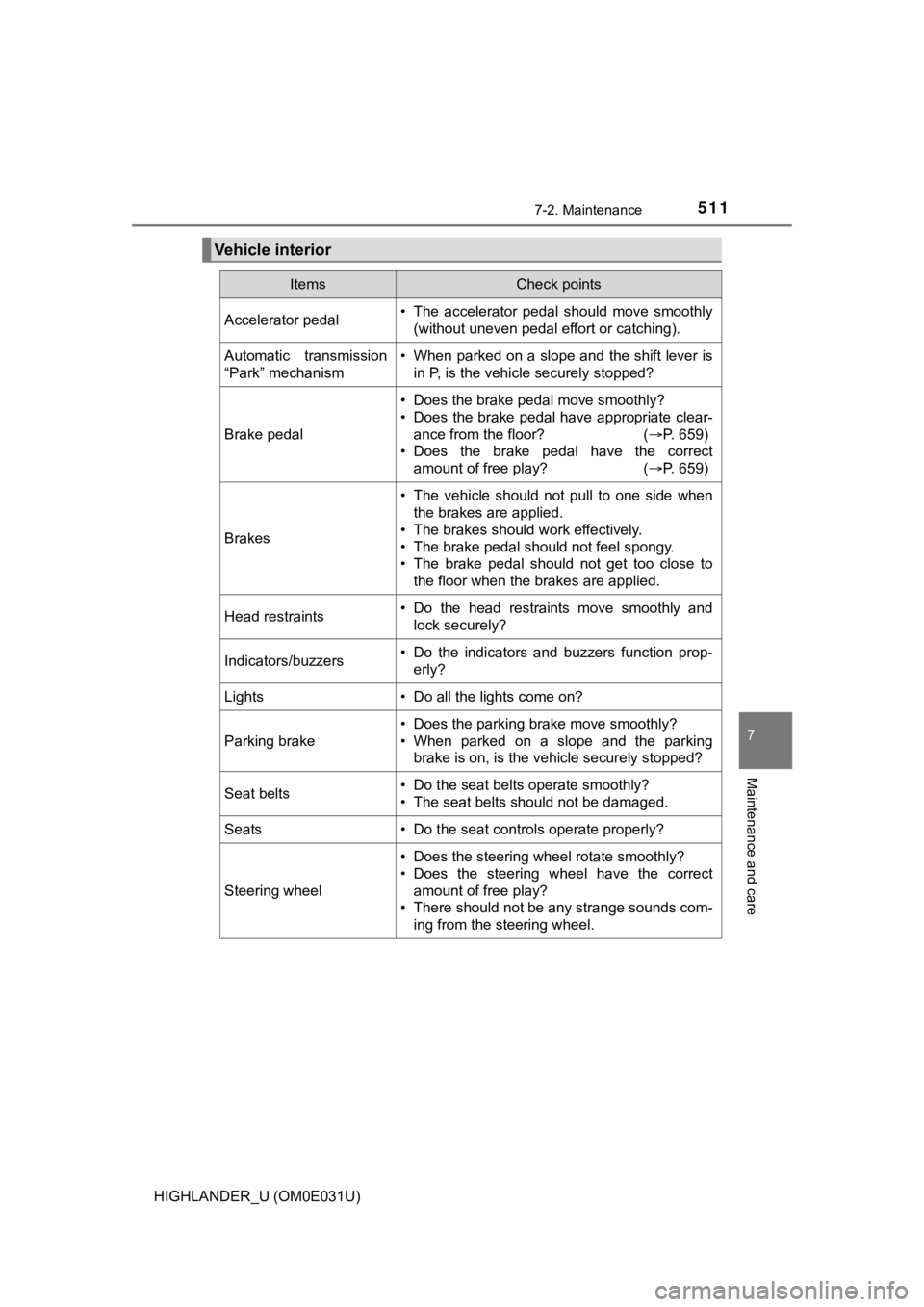
Vehicle interior
ItemsCheck points
Accelerator pedal• The accelerator pedal should move smoothly(without uneven pedal effort or catching).
Automatic transmission
“Park” mechanism• When parked on a slope and the shift lever isin P, is the vehicle securely stopped?
Brake pedal
• Does the brake pedal move smoothly?
• Does the brake pedal have appropriate clear-
ance from the floor? ( P. 659)
• Does the brake pedal have the correct amount of free play? ( P. 659)
Brakes
• The vehicle should not pull to one side when
the brakes are applied.
• The brakes should work effectively.
• The brake pedal should not feel spongy.
• The brake pedal should not get too close to the floor when the brakes are applied.
Head restraints• Do the head restraints move smoothly andlock securely?
Indicators/buzzers• Do the indicators and buzzers function prop-erly?
Lights • Do all the lights come on?
Parking brake
• Does the parking brake move smoothly?
• When parked on a slope and the parking brake is on, is the vehicle securely stopped?
Seat belts• Do the seat belts operate smoothly?
• The seat belts should not be damaged.
Seats• Do the seat controls operate properly?
Steering wheel
• Does the steering wheel rotate smoothly?
• Does the steering wheel have the correctamount of free play?
• There should not be any strange sounds com-
ing from the steering wheel.