mileage TOYOTA HIGHLANDER HYBRID 2020 Warranties & Maintenance Guides (in English)
[x] Cancel search | Manufacturer: TOYOTA, Model Year: 2020, Model line: HIGHLANDER HYBRID, Model: TOYOTA HIGHLANDER HYBRID 2020Pages: 260, PDF Size: 8.54 MB
Page 71 of 260
CONTINENTAL TIRE
69
TO REPRESENT THROUGH THIS LIMITED WARRANTY AND
ADJUSTMENT POLICY THAT TIRE FAILURES CAN OR
CANNOT HAPPEN.
CTA’S Obligations
Replacement of eligible tires will be made by the dealer where you
purchased your vehicle or by an alternate Authorized Dealer. CTA will
replace the tire pursuant to the terms of this Warranty. Tires that are
replaced under this Waranty become the property of CTA.
Owner’s Obligations
To make an eligible claim under this Warranty, the owner must
present a claim, with the tire to an Authorized Dealer. For the nearest
Authorized Dealer, consult the Continental brand internet address(es),
or the 800 telephone number(s) shown on the back of this Warranty.
Owner must present new vehicle registration form or new vehicle
sales invoice indicating the date of purchase. Owner will be required
to sign the CTA Limited Warranty Claim Form or dealer replacement
sales receipt.
Owner is responsible for paying all applicable taxes charged by the
servicing dealer and is also responsible for paying shipping, local tire-
disposal fees and parts or service regardless of mileage or months of
service. This includes payment for tire rotation, alignment, towing, road
service, valve stems and tire repairs.
Owner is responsible for maintaining proper tire air pressure and for
proper maintenance of the tire.
Safety Warning
Ignoring any of the safety and information contained in this Warranty
may result in tire failure, causing serious injury or death.•
Tire failure due to under inflation /overloading . Follow vehicle
owner’s manual or tire placard in vehicle for proper inflation
and loading.
Page 77 of 260
FALKEN
75
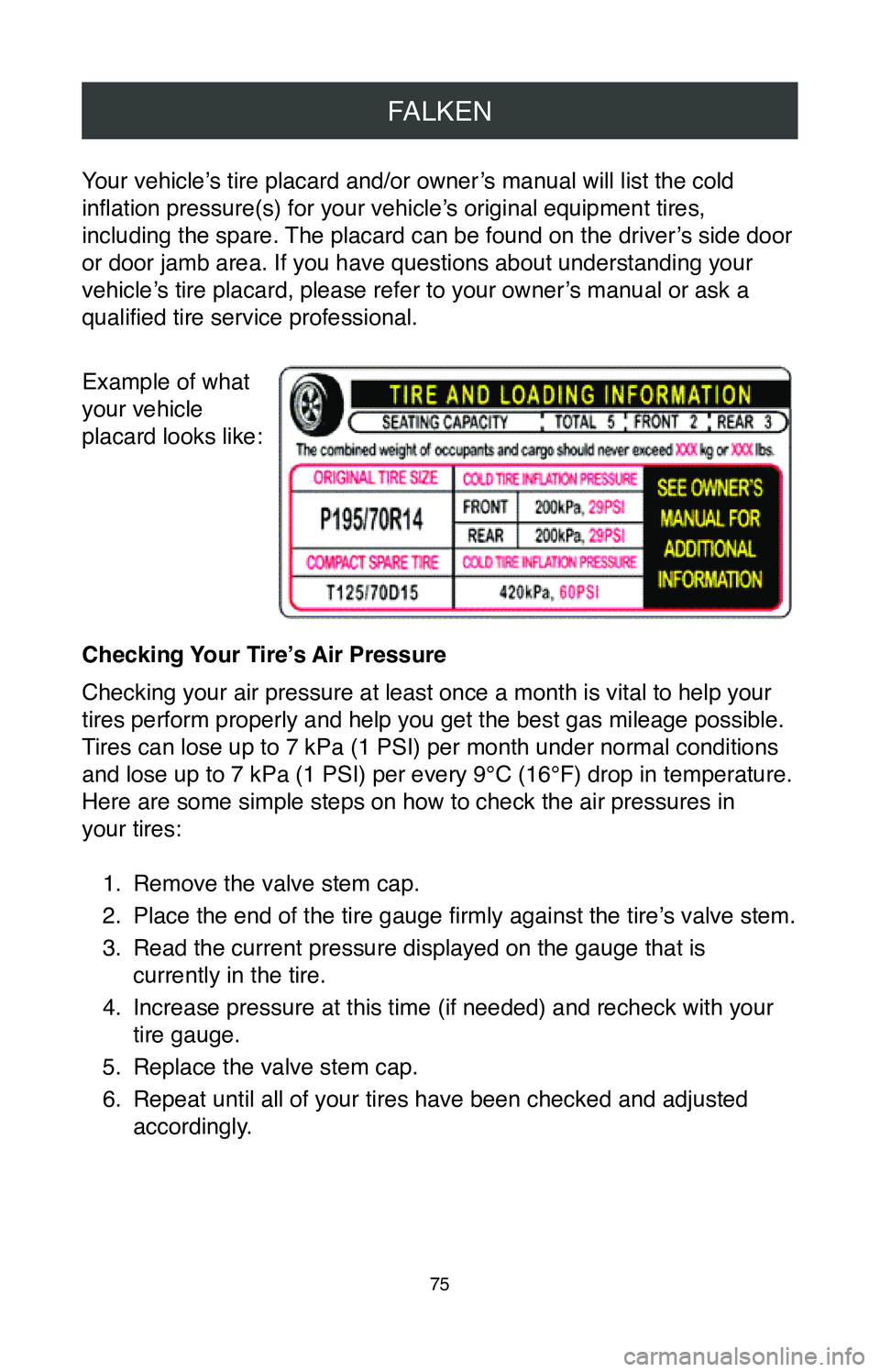
Your vehicle’s tire placard and/or owner’s manual will list the cold
inflation pressure(s) for your vehicle’s original equipment tires,
including the spare. The placard can be found on the driver’s side door
or door jamb area. If you have questions about understanding your
vehicle’s tire placard, please refer to your owner’s manual or ask a
qualified tire service professional.
Example of what
your vehicle
placard looks like:
Checking Your Tire’s Air Pressure
Checking your air pressure at least once a month is vital to help your
tires perform properly and help you get the best gas mileage possible.
Tires can lose up to 7 kPa (1 PSI) per month under normal conditions
and lose up to 7 kPa (1 PSI) per every 9°C (16°F) drop in temperature.
Here are some simple steps on how to check the air pressures in
your tires:1.
Remove the valve stem cap.
2.
Place the end of the tire gauge firmly against the tire’s valve stem.
3.
Read the current pressure displayed on the gauge that is
currently in the tire.
4.
Increase pressure at this time (if needed) and recheck with your
tire gauge.
5.
Replace the valve stem cap.
6.
Repeat until all of your tires have been checked and adjusted
accordingly.
Page 93 of 260
GOODYEAR / DUNLOP
91
Goodyear tires to change its appearance (example: white inlay
on a black tire).
•
Tires with weather cracking which were purchased more than four
(4) years prior to presentation for adjustment. If you have no proof
of purchase date, tires manufactured four (4) or more years prior to
presentation are not covered.
•
Material added to a tire after leaving a factory producing Goodyear
tires (examples: tire fillers, sealants or balancing substances). If
the added material is the cause of the tire being removed from
service, the tire will not be adjusted.
•
Any Goodyear Commercial Truck tire with the word “Mileage” on
the sidewall.
•
Tires removed from service due to improper repairs.
•
Loss of time, inconvenience, loss of use of vehicle, incidental or
consequential damage.
Note: Some states or provinces do not allow the exclusion or limitation \
of incidental or consequential damages, so the above limitations or
exclusions may not apply to you.
This limited warranty is applicable only in the U.S. and Canada.
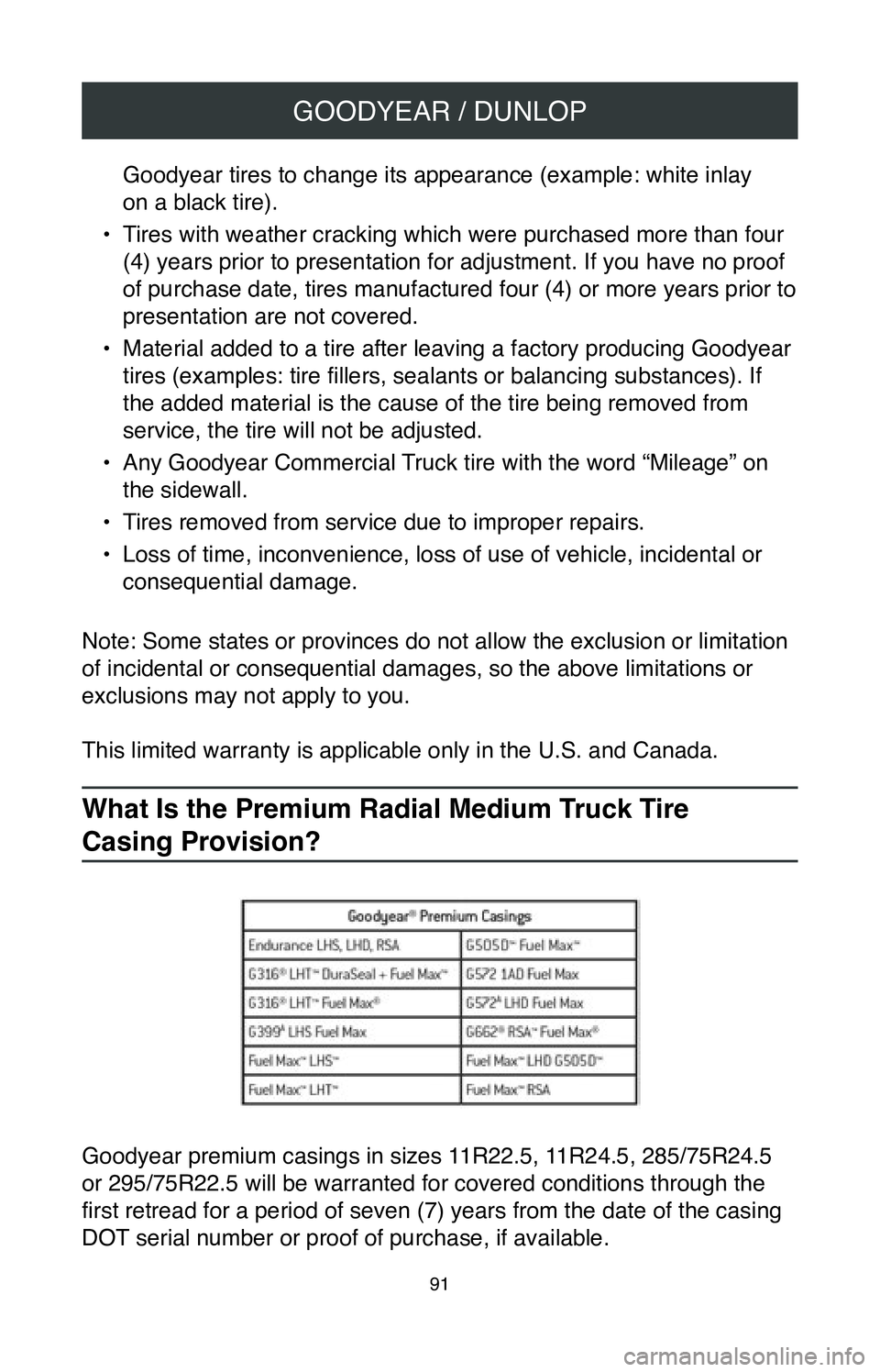
What Is the Premium Radial Medium Truck Tire
Casing Provision?
Goodyear premium casings in sizes 11R22.5, 11R24.5, 285/75R24.5
or 295/75R22.5 will be warranted for covered conditions through the
first retread for a period of seven (7) years from the date of the casing
DOT serial number or proof of purchase, if available.
Page 106 of 260
KENDA
104
To qualify for this Treadwear Limited Warranty, the tire must meet all
of the following conditions:•
Qualifies as an Eligible Tire.
•
ls a model tire included in the product chart.
•
ls driven no more than the warrantedтmiles specified in the
product chart.
•
ls properly serviced and maintained, including periodic rotation.
•
Tread is evenly worn down to the top of the treadwear
indicator bars.
•
Was installed no more than 60 months from the date of purchase.
•
Has been used on road surfaces for which the tire is designed.
•
Has not been used for commercial service.
A comparable Kenda brand tire is the same tire, or a tire of the same
basic construction and quality, as the original tire, as determined by
Kenda Tires.
Mileage Warranties based on tire.
Vezda UHP A/S..................KR400.............................................\
...50,000
Vezda Touring A/S..............KR205................................................65\
,000
VezdaEco...........................KR30..................................\
................60,000
Kenetica.............................KR17...............................\
...................50,000
Klever S/T...........................KR52.........................................\
.........60,000
Klever H/T
2........................KR600........60,000 (p-mertric) 50,000 (LTR)
SAFETY WARNING
Driving on Any Tire That Does Not Have the Correct
Inflation Pressure Is Dangerous
Any underinflated tire builds up excessive heat that may result in
sudden tire destruction. Refer to the tire placard on the vehicle (check
vehicle and/or vehicle owner’s manual for placard location) for the
recommended operating pressures. Do not exceed maximum pressure
indicated on the tire sidewall.
Page 109 of 260
KENDA
107
Wheel Alignment and Balancing Are Important for
Safety and Maximum Mileage From Your Tires
Inspect Your Tires Regularly
At least once a month inspect your tires closely for signs of uneven
wear. Uneven wear patterns may be caused by improper inflation
pressures, misalignment, improper balance or suspension neglect.
If not corrected, further tire damage will occur. These conditions not
only shorten the life of your tires, they adversely affect the handling
characteristics of your vehicle which could be dangerous.
If any of these conditions exist, the cause may often be corrected at
your tire dealer’s or other service facility. Your tires will then last longer.
Tire Rotation
If irregular wear becomes apparent or if the rate of wear on the tires
is uneven, the tires should be rotated to alleviate the problem. Check
your vehicle for any mechanical problems and correct if necessary. The
rotation pattern or procedure indicated in your limited warranty and the\
vehicle manufacturers’ owner’s manual should be followed. For tires
on front wheel drive vehicles and/or all season tires on any vehicle, it\
is
recommended that these tires be rotated every 8,000 miles to equalize
the rate of wear.
Tire Mixing Can Be Dangerous
Most passenger tires today are radial tires and for best performance it \
is recommended that the same size and type of tire be used on all four
wheel positions unless different sizes, front and rear, were specified
as original equipment. Check the vehicle placard. If only two radials
are mounted with two non-radials, the radials should be mounted
on the rear. If tires of different types are mixed on a vehicle in any
configuration, they should not be used for long periods and speeds
should be kept to a minimum.
Mixing or matching of tires on 4-wheel drive vehicles may require
special precautions. Always check vehicle manufacturers’ Owner’s
Manual for their recommendations.
Page 120 of 260
MICHELIN
11 8
What Is Not Covered
This warranty does not cover tires damaged due to misuse, abuse or
accident such as:•
Road hazards (e.g., cuts, snags, bruises, impact damage or
punctures);
•
Incorrect mounting of the tire, tire/wheel imbalance or
improper repair;
•
Misapplication, improper maintenance, racing, underinflation,
overinflation or other abuse;
•
Uneven or rapid wear which is caused by mechanical irregularity
in the vehicle such as wheel misalignment (a measured tread
difference of 2/32nds of an inch or more across the face of the
tread on the same tire);
•
Accident, fire, chemical corrosion, tire alteration or vandalism;
•
Flat spotting caused by improper storage or brakelock;
•
The addition of liquid, solid or gaseous materials other than air,
nitrogen or carbon dioxide (for example, waterbase sealers or
balancing substances);
•
Minor cosmetic ozone or weather cracking;
•
Use of MICHELIN® Self-Supporting Zero Pressure (ZP) tires
without a properly operating low air pressure warning system.
•
Use of MICHELIN tires that is inconsistent with the safety and/or
maintenance information provided in your owner’s manual.
Other limitations include but are not limited to the following: •
Michelin does not cover Original Equipment tires for mileage.
What Will Michelin Do?
If a tire is covered, and 2/32nds of an inch (1.6mm) or less of the
original tread is worn (or 25% or less, whichever is more beneficial to
you), and it is within 12 months of the date of purchase, Michelin will\
,
free of charge, replace your tire with a comparable new MICHELIN
®
replacement tire, mount the tire, and balance the tire. You must pay the
cost of any other service charges and applicable taxes.
Page 136 of 260
 MICHELIN
134
Tires loaded beyond their maximum allowable loads for the particular
application will build up excessive heat that may result in sudden tire \
failure and an accident. Do not exceed the")
MICHELIN
134
Tires loaded beyond their maximum allowable loads for the particular
application will build up excessive heat that may result in sudden tire \
failure and an accident. Do not exceed the gross axle weight rating for \
any axle on your vehicle.
Trailer Towing
If you anticipate towing a trailer, you should visit your Michelin tire
retailer for advice about the correct tire size and pressures. Tire size
and pressures will depend on the type and size of trailer and hitch
utilized, but in no case must the maximum cold inflation pressure
or tire load rating be exceeded. Check the tire information placard
that came on your vehicle, (located in the vehicle’s door jamb, inside
the fuel hatch, or on the glove compartment door) and the owner’s
manual supplied by the manufacturer of your vehicle for further
recommendations on trailer towing.
Self-Supporting Zero Pressure (ZP) Tires and Trailer Towing
Operation of ZP tires at low or zero air pressure with a trailer in tow
is dangerous and should be avoided. If the low pressure warning
indicator is activated when a trailer is in tow, stop, disconnect the
trailer, and do not continue to tow the trailer until the tire has been
properly repaired and re-inflated to the proper inflation. If the tire
cannot be properly repaired, it must be replaced with a new full-size,
matching ZP tire, and inflated to the proper inflation, before the trailer
can be safely towed again.
Wheel Alignment and Balancing Are Important for
Safety and Maximum Mileage from Your Tires.
Page 150 of 260
NITTO TIRE
148
Failure to meet conditions of this Limited Warranty, not limited to:•
Any tire that is not an Eligible Tire.
•
Any tire for which mileage and tire rotation records are not
available or verifiable.
•
Any tire not presented and available for Nitto’s inspection.
•
Any tire worn beyond the treadwear indicators (less than 2/32” of
remaining tread).
•
Uniformity issues after the first 25% of treadwear.
Nothing in this Limited Warranty is intended to be a representation that
tire failures cannot occur.
WHAT NITTO WILL DO
For every Eligible Tire, Nitto will do the following:
Regular OE Tires 1.
If less than 25% Worn: Nitto will replace, free of charge, any
Eligible Tire when the original usable tread is worn by 25% or
less, and within 5 years from the date you purchased the vehicle
new. If you cannot provide a copy of the new vehicle registration
or vehicle purchase receipt, the manufacture date of the tire, as
indicated by the tire DOT code, will be used instead to determine
if a tire is within the warranty period. Tire mounting and balancing
costs are covered by Nitto. You are responsible for taxes and
all other costs, fees and expenses.
2.
If more than 25% Worn: Nitto will replace any Eligible Tire when
the original usable tread is worn by more than 25%, and within 5
years from the date you purchased the vehicle new. If you cannot
provide a copy of the new vehicle registration or vehicle purchase
receipt, the manufacture date of the tire, as indicated by the tire
DOT code, will be used instead to determine if a tire is within the
warranty period. You are responsible for the pro-rated cost of
a replacement tire, mounting and balancing costs, taxes and
all other costs, fees and expenses.
Page 153 of 260
NITTO TIRE
151
If you encounter wet conditions, do not continue to drive. Carefully
reduce your speed and pull over to a safe area until road conditions
improve. Please see the “Adverse Weather Driving” section
for additional safety information when operating your vehicle in
these conditions.
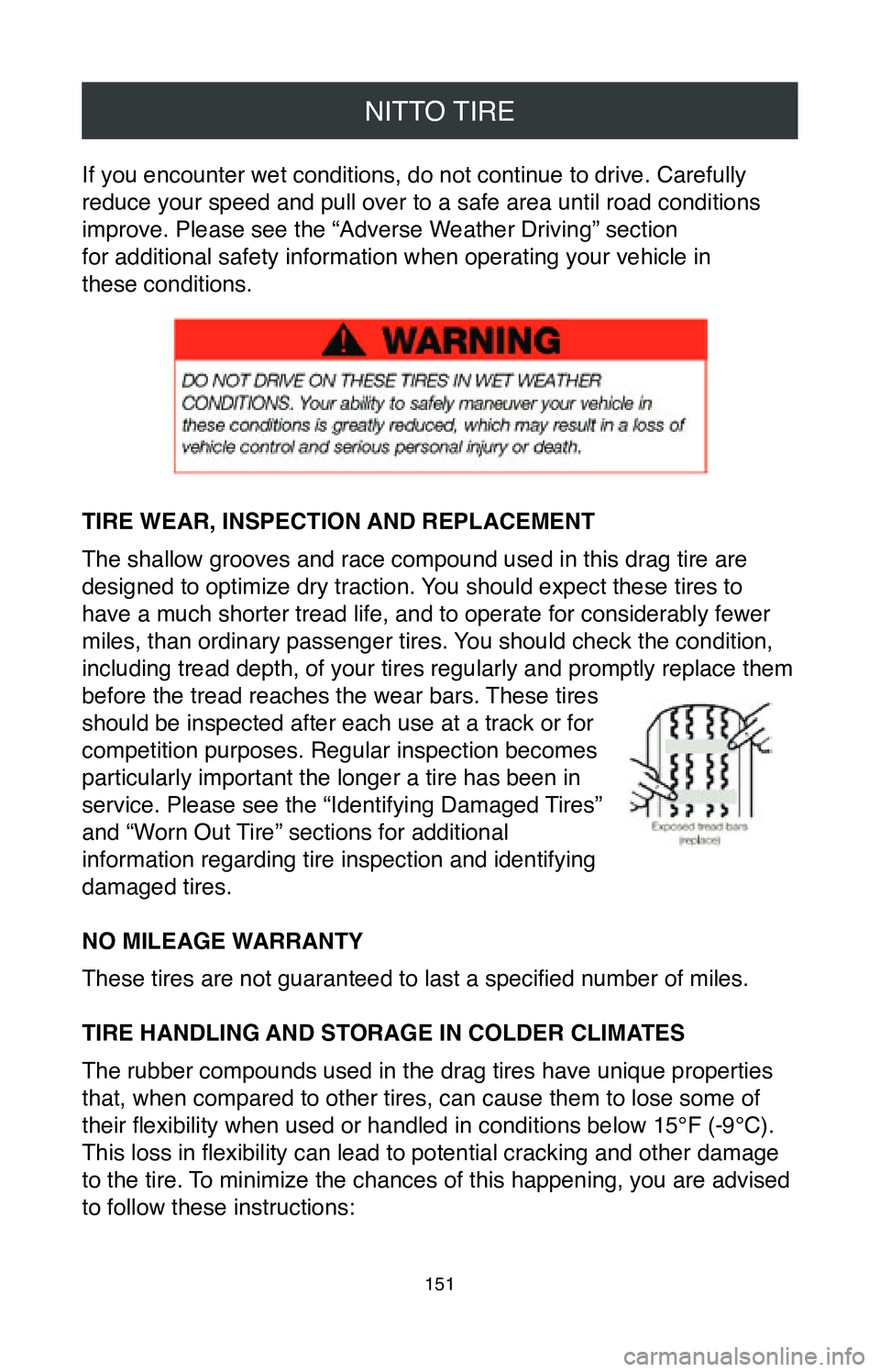
TIRE WEAR, INSPECTION AND REPLACEMENT
The shallow grooves and race compound used in this drag tire are
designed to optimize dry traction. You should expect these tires to
have a much shorter tread life, and to operate for considerably fewer
miles, than ordinary passenger tires. You should check the condition,
including tread depth, of your tires regularly and promptly replace them\
before the tread reaches the wear bars. These tires
should be inspected after each use at a track or for
competition purposes. Regular inspection becomes
particularly important the longer a tire has been in
service. Please see the “Identifying Damaged Tires”
and “Worn Out Tire” sections for additional
information regarding tire inspection and identifying
damaged tires.
NO MILEAGE WARRANTY
These tires are not guaranteed to last a specified number of miles.
TIRE HANDLING AND STORAGE IN COLDER CLIMATES
The rubber compounds used in the drag tires have unique properties
that, when compared to other tires, can cause them to lose some of
their flexibility when used or handled in conditions below 15°F (-9°C).
This loss in flexibility can lead to potential cracking and other damage
to the tire. To minimize the chances of this happening, you are advised
to follow these instructions:
Page 170 of 260
NITTO TIRE
168
REPLACING TWO TIRES•
When a pair of replacement tires is selected in the same size and
construction as those on the vehicle, the two newer tires must be
installed on the rear axle and must be of equal or higher speed
rating than the front tires. Generally, new tires with deeper tread
will provide better grip and evacuate water more effectively, which
is important as a driver approaches hydroplaning situations.
Placing greater traction on the rear axle on wet surfaces is
necessary to prevent a possible oversteer condition and loss of
vehicle stability.
•
When two new tires have been installed onto the rear axle
positions, they are to be kept on the rear but rotated from side
to side. This is recommended after installing two new tires to the
rear position, or if you discover significant tread depth differences
between the front and rear positions during rotation intervals.
REPLACING ONE TIRE •
Replacing a single tire on a vehicle can have an adverse effect on
suspension systems, gear ratios, transmission, and tire treadwear.
•
If single tire replacement is unavoidable, it is recommended that
the single new tire be paired with the tire that has the deepest
tread and both be placed on the rear axle. Placing greater traction
on the rear axle on wet surfaces is necessary to prevent a possible
oversteer condition and loss of vehicle stability.
WHEEL ALIGNMENT AND BALANCING •
Proper wheel alignment and balance are very important
considerations for safety and getting the maximum mileage from
your tires. You need to check how your tires are wearing at least
once a month.
•
Your vehicle may be out of alignment if your tires are wearing
unevenly, such as when the inside shoulder of the tire is wearing
faster than the rest of the tread. This condition not only shortens
the life of your tires, it adversely affects the handling characteristics
of your vehicle, which could be dangerous. If your tires show
irregular wear, have your vehicle’s alignment checked immediately.