towing TOYOTA HILUX 2018 Owner's Manual
[x] Cancel search | Manufacturer: TOYOTA, Model Year: 2018, Model line: HILUX, Model: TOYOTA HILUX 2018Pages: 708, PDF Size: 95.31 MB
Page 351 of 708
3514-5. Using the driving support systems
4
Driving
HILUX_OM_OM0K375E_(EE)
WARNING
■To avoid operating the cruise control by mistake
Switch the cruise control off using the “ON-OFF” button when not in use.
■ Situations unsuitable for cruise control
Do not use cruise control in any of the following situations.
Doing so may result in loss of control and could cause an accident resulting
in death or serious injury.
● In heavy traffic
● On roads with sharp bends
● On winding roads
● On slippery roads, such as those covered with rain, ice or snow
● On steep hills
Vehicle speed may exceed the set speed when driving down a steep hill.
● When your vehicle is towing a trailer (models for model code destination
W*) or during emergency towing
*: See “Checking your vehicle’s model” if you are not sure of which model
your vehicle is. ( P. 1 1 )
Page 542 of 708
5427-3. Do-it-yourself maintenance
HILUX_OM_OM0K375E_(EE)
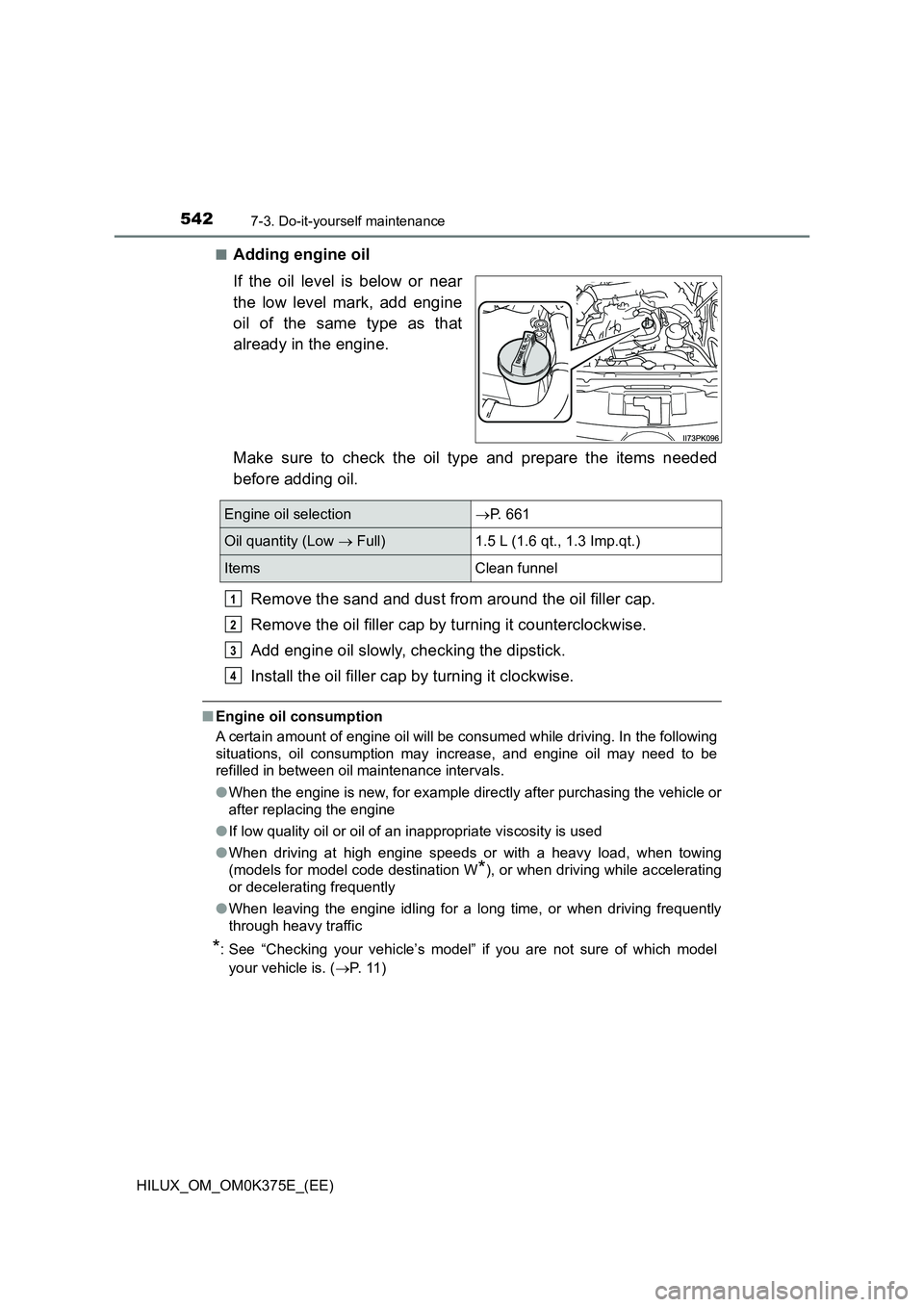
■Adding engine oil
If the oil level is below or near
the low level mark, add engine
oil of the same type as that
already in the engine.
Make sure to check the oil type and prepare the items needed
before adding oil.
Remove the sand and dust from around the oil filler cap.
Remove the oil filler cap by turning it counterclockwise.
Add engine oil slowly, checking the dipstick.
Install the oil filler cap by turning it clockwise.
■ Engine oil consumption
A certain amount of engine oil will be consumed while driving. In the following
situations, oil consumption may increase, and engine oil may need to be
refilled in between oil maintenance intervals.
● When the engine is new, for example directly after purchasing the vehicle or
after replacing the engine
● If low quality oil or oil of an inappropriate viscosity is used
● When driving at high engine speeds or with a heavy load, when towing
(models for model code destination W*), or when driving while accelerating
or decelerating frequently
● When leaving the engine idling for a long time, or when driving frequently
through heavy traffic
*: See “Checking your vehicle’s model” if you are not sure of which model
your vehicle is. ( P. 11 )
Engine oil selectionP. 661
Oil quantity (Low Full) 1.5 L (1.6 qt., 1.3 Imp.qt.)
Items Clean funnel
1
2
3
4
Page 595 of 708
5958-2. Steps to take in an emergency
HILUX_OM_OM0K375E_(EE)
8
When trouble arises
If your vehicle needs to be towed
The following may indicate a problem with your transmission. Contact
any authorized Toyota retailer or Toyota authorized repairer, or any
reliable repairer or commercial towing service before towing.
● The engine is running but the vehicle does not move.
● The vehicle makes an abnormal sound.
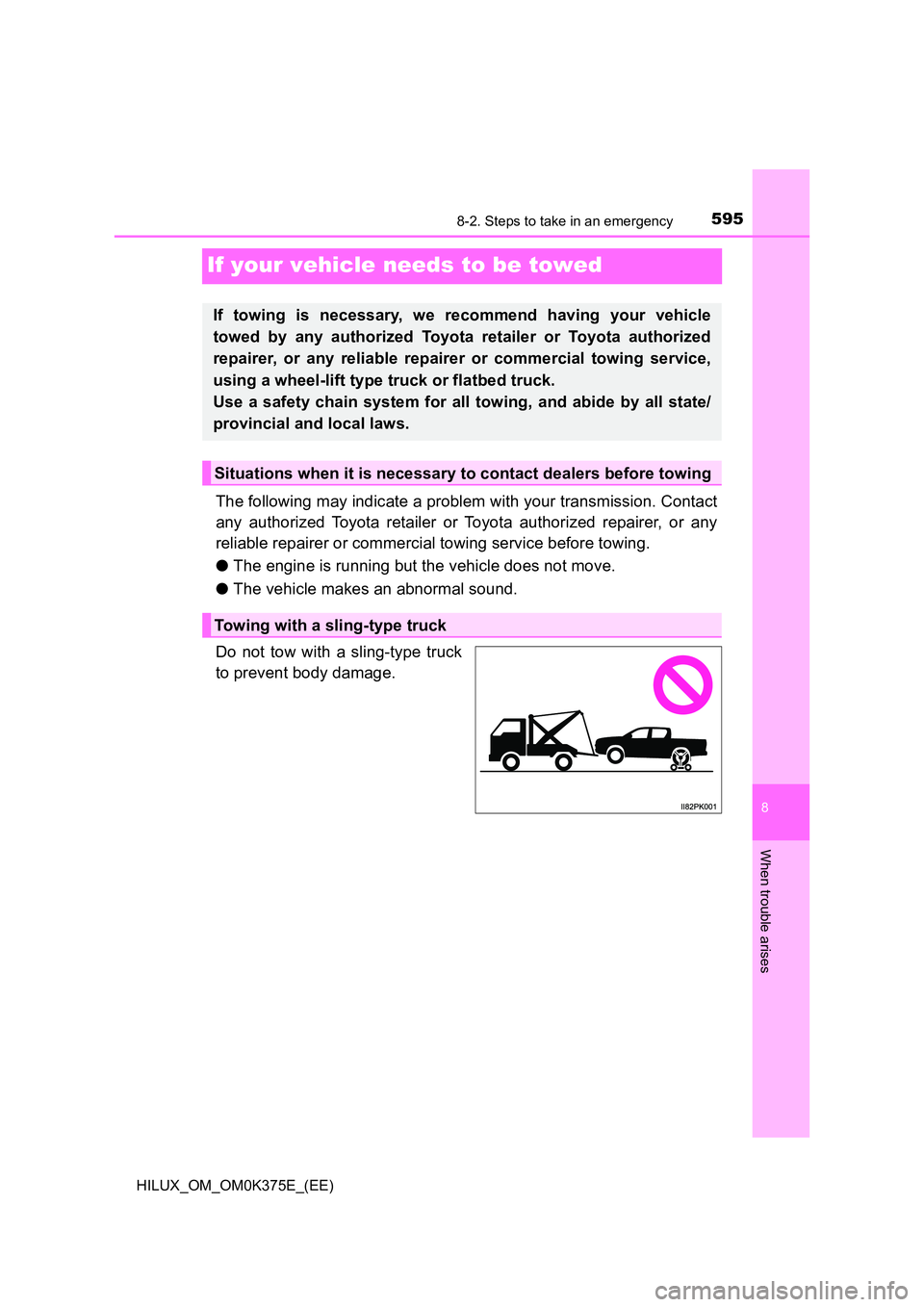
Do not tow with a sling-type truck
to prevent body damage.
If towing is necessary, we recommend having your vehicle
towed by any authorized Toyota retailer or Toyota authorized
repairer, or any reliable repairer or commercial towing service,
using a wheel-lift type truck or flatbed truck.
Use a safety chain system for all towing, and abide by all state/
provincial and local laws.
Situations when it is necessary to contact dealers before towing
Towing with a sling-type truck
Page 596 of 708
5968-2. Steps to take in an emergency
HILUX_OM_OM0K375E_(EE)
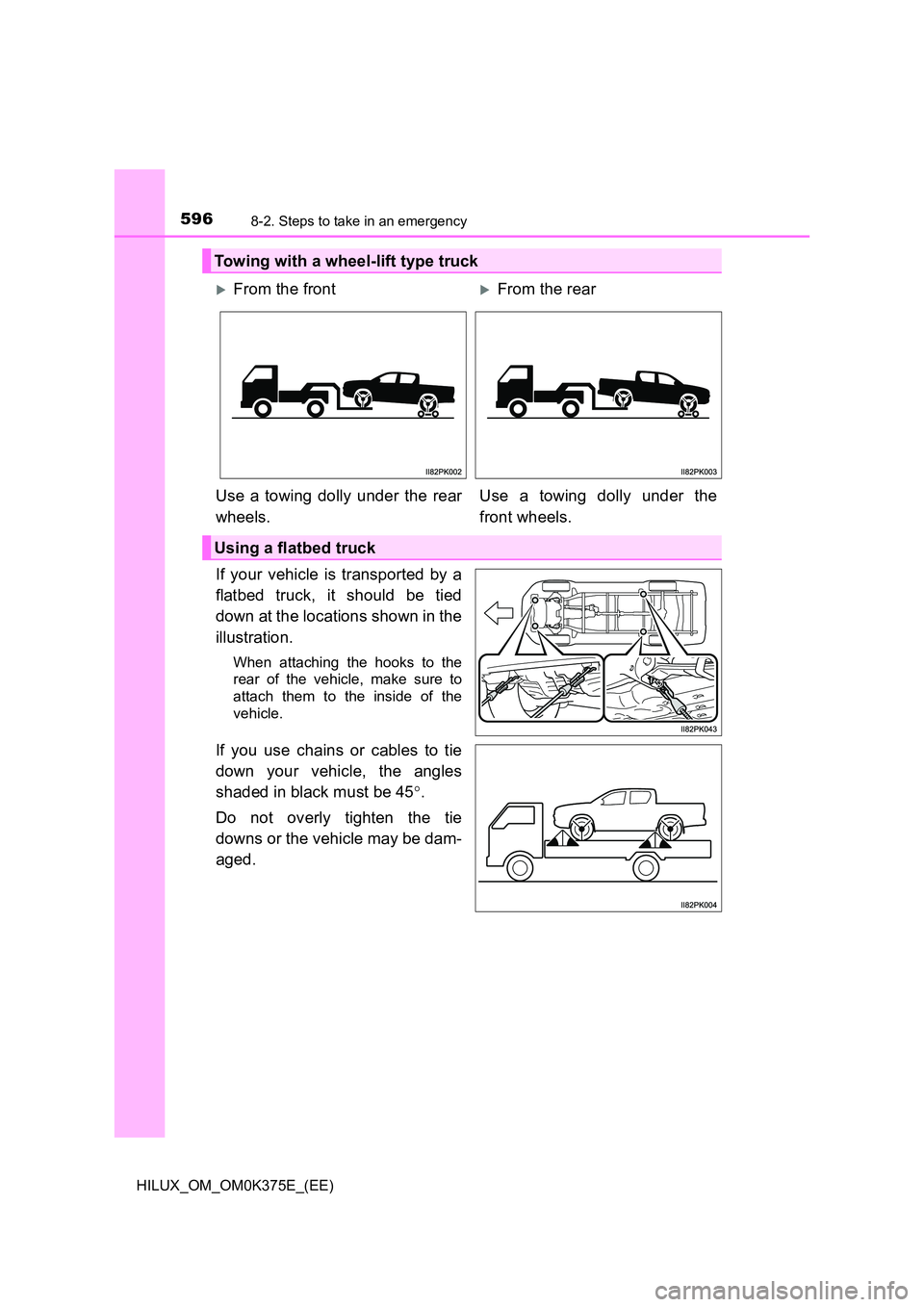
If your vehicle is transported by a
flatbed truck, it should be tied
down at the locations shown in the
illustration.
When attaching the hooks to the
rear of the vehicle, make sure to
attach them to the inside of the
vehicle.
If you use chains or cables to tie
down your vehicle, the angles
shaded in black must be 45 .
Do not overly tighten the tie
downs or the vehicle may be dam-
aged.
Towing with a wheel-lift type truck
From the frontFrom the rear
Use a towing dolly under the rear
wheels.
Use a towing dolly under the
front wheels.
Using a flatbed truck
Page 597 of 708
5978-2. Steps to take in an emergency
HILUX_OM_OM0K375E_(EE)
8
When trouble arises
If a tow truck is not available in an emergency, your vehicle may be
temporarily towed using cables or chains secured to the emergency
towing hooks. This should only be attempted on hard surfaced roads
for at most 80 km (50 miles) at under 30 km/h (18 mph).
A driver must be in the vehicle to steer and operate the brakes. The
vehicle’s wheels, drive train, axles, steering and brakes must be in
good condition.
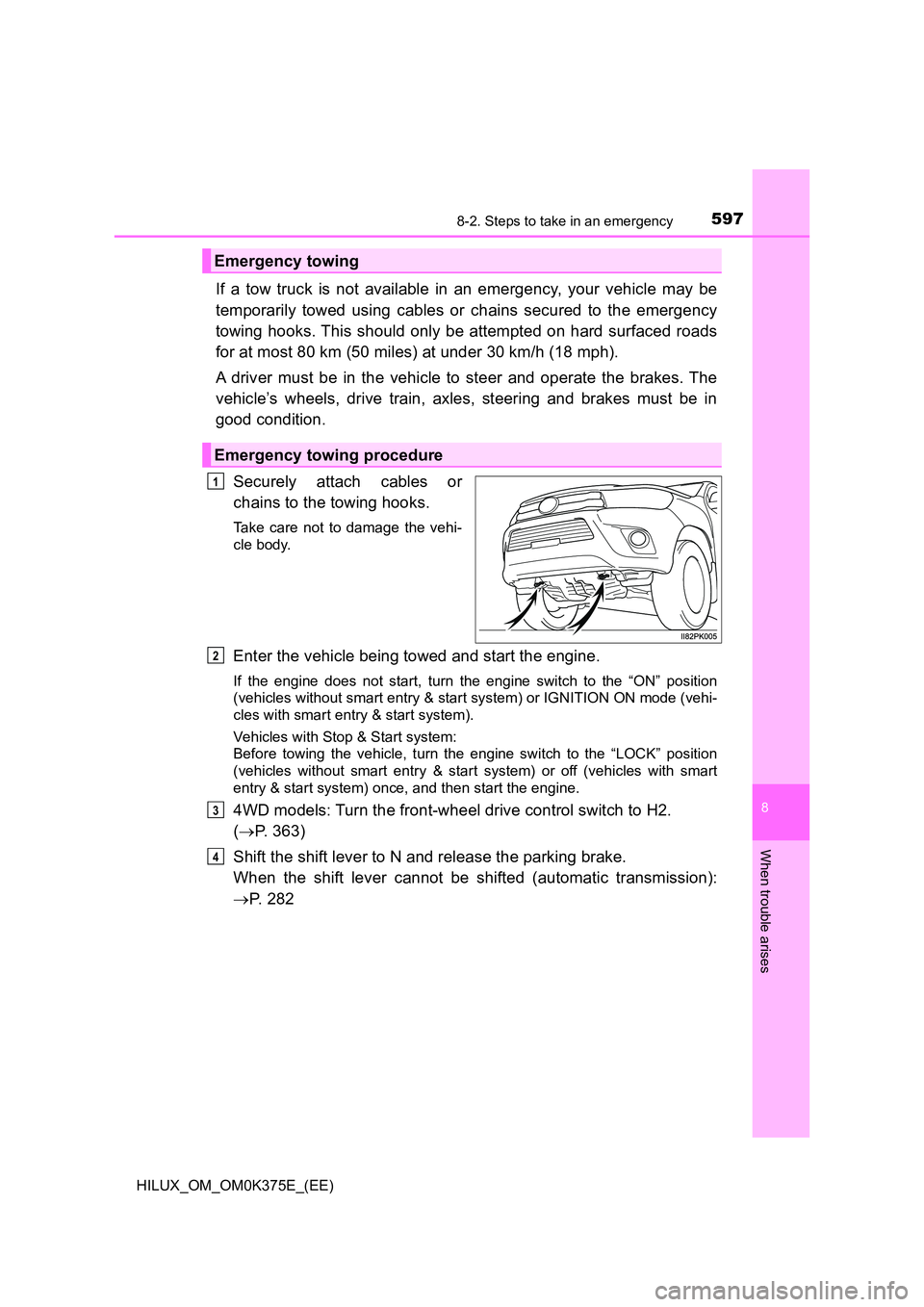
Securely attach cables or
chains to the towing hooks.
Take care not to damage the vehi-
cle body.
Enter the vehicle being towed and start the engine.
If the engine does not start, turn the engine switch to the “ON” position
(vehicles without smart entry & start system) or IGNITION ON mode (vehi-
cles with smart entry & start system).
Vehicles with Stop & Start system:
Before towing the vehicle, turn the engine switch to the “LOCK” position
(vehicles without smart entry & start system) or off (vehicles with smart
entry & start system) once, and then start the engine.
4WD models: Turn the front-wheel drive control switch to H2.
( P. 363)
Shift the shift lever to N and release the parking brake.
When the shift lever cannot be shifted (automatic transmission):
P. 2 8 2
Emergency towing
Emergency towing procedure
1
2
3
4
Page 598 of 708
5988-2. Steps to take in an emergency
HILUX_OM_OM0K375E_(EE)
■While towing
If the engine is not running, the power assist for the brakes and steering will
not function, making steering and braking more difficult.
WARNING
Observe the following precautions.
Failure to do so may result in death or serious injury.
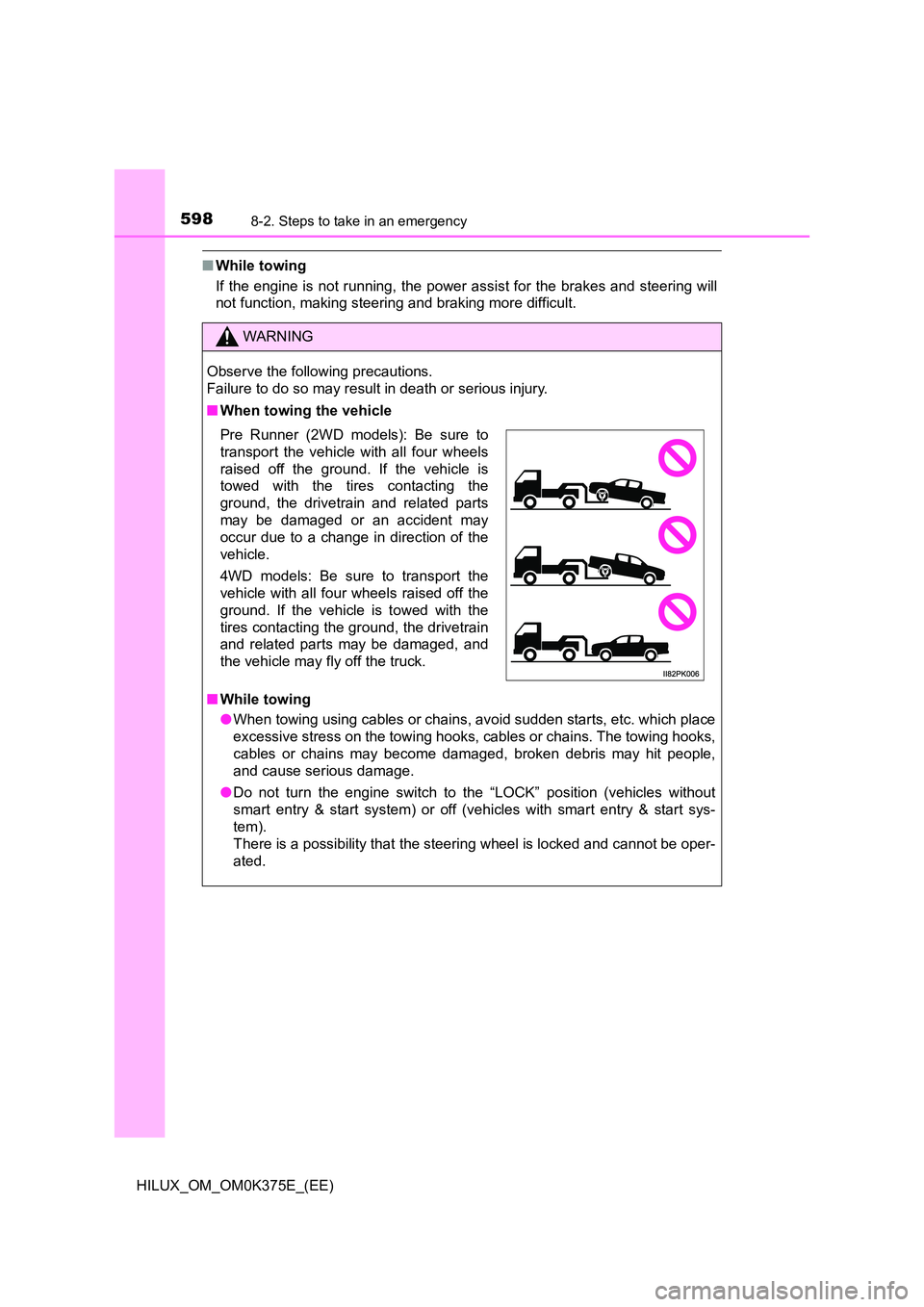
■ When towing the vehicle
■ While towing
● When towing using cables or chains, avoid sudden starts, etc. which place
excessive stress on the towing hooks, cables or chains. The towing hooks,
cables or chains may become damaged, broken debris may hit people,
and cause serious damage.
● Do not turn the engine switch to the “LOCK” position (vehicles without
smart entry & start system) or off (vehicles with smart entry & start sys-
tem).
There is a possibility that the steering wheel is locked and cannot be oper-
ated.
Pre Runner (2WD models): Be sure to
transport the vehicle with all four wheels
raised off the ground. If the vehicle is
towed with the tires contacting the
ground, the drivetrain and related parts
may be damaged or an accident may
occur due to a change in direction of the
vehicle.
4WD models: Be sure to transport the
vehicle with all four wheels raised off the
ground. If the vehicle is towed with the
tires contacting the ground, the drivetrain
and related parts may be damaged, and
the vehicle may fly off the truck.
Page 599 of 708
5998-2. Steps to take in an emergency
HILUX_OM_OM0K375E_(EE)
8
When trouble arises
NOTICE
■To prevent damage to the vehicle when towing using a wheel-lift type
truck
● Do not tow the vehicle from the rear when the engine switch is in the
“LOCK” position or the key is removed (vehicles without smart entry & start
system) or the engine switch is turned to off (vehicles with smart entry &
start system). The steering lock mechanism is not strong enough to hold
the front wheels straight.
● When raising the vehicle, ensure adequate ground clearance for towing at
the opposite end of the raised vehicle. Without adequate clearance, the
vehicle could be damaged while being towed.
■ To prevent damage to the vehicle when towing with a sling-type truck
Do not tow with a sling-type truck, either from the front or rear.
■ To prevent damage to the vehicle during emergency towing
Do not secure cables or chains to the suspension components.
■ When towing a vehicle equipped with the Stop & Start system (if
equipped)
When it is necessary to tow the vehicle with all four wheels contacting the
ground, perform the following procedure before towing the vehicle to protect
the system.
Turn the engine switch to the “LOCK” position (vehicles without smart entry
& start system) or off (vehicles with smart entry & start system) once, and
then start the engine. If the engine does not start, turn the engine switch to
the “ON” position (vehicles without smart entry & start system) or IGNITION
ON mode (vehicles with smart entry & start system).
Page 629 of 708
6298-2. Steps to take in an emergency
HILUX_OM_OM0K375E_(EE)
8
When trouble arises
Type C
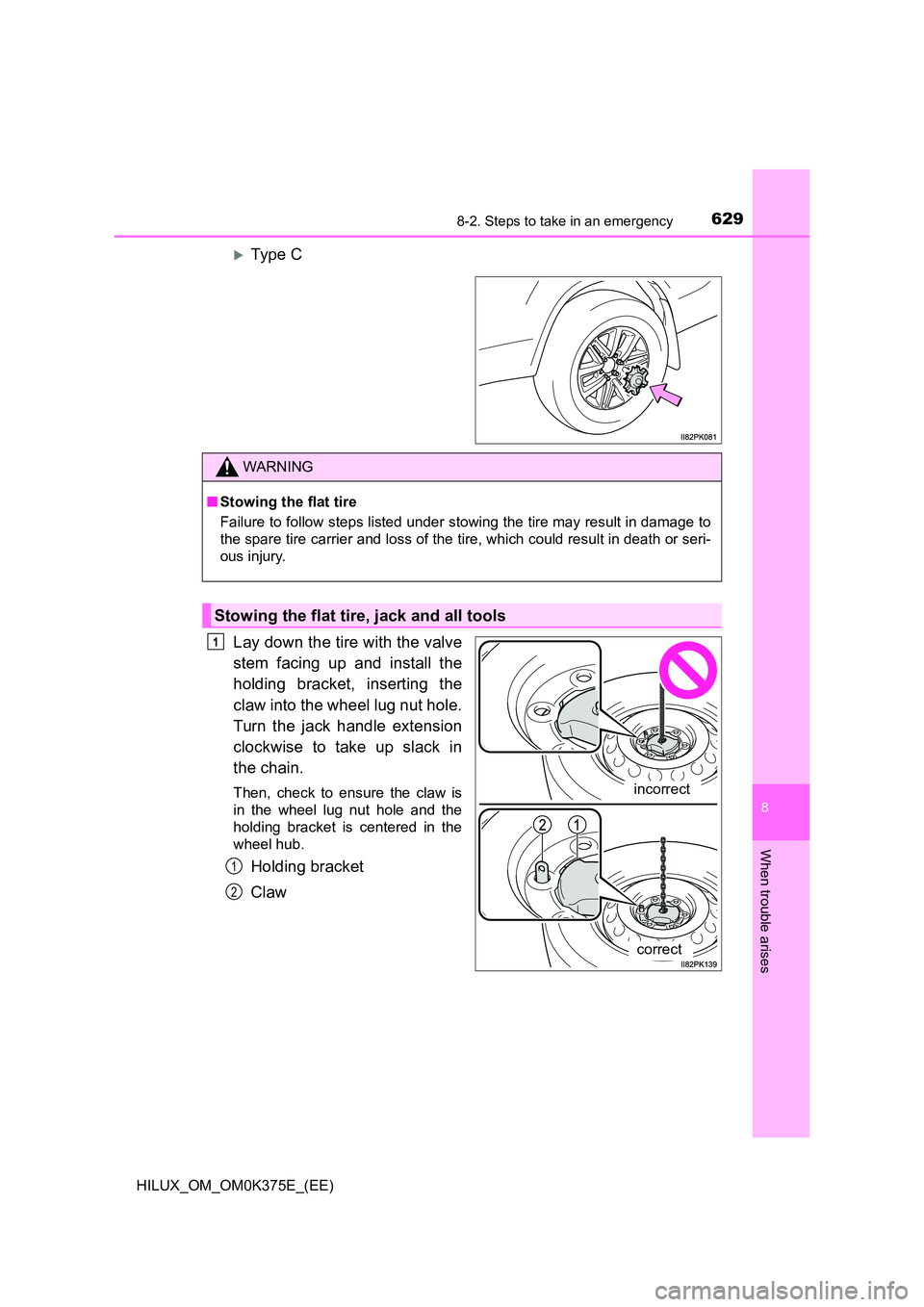
Lay down the tire with the valve
stem facing up and install the
holding bracket, inserting the
claw into the wheel lug nut hole.
Turn the jack handle extension
clockwise to take up slack in
the chain.
Then, check to ensure the claw is
in the wheel lug nut hole and the
holding bracket is centered in the
wheel hub.
Holding bracket
Claw
WARNING
■ Stowing the flat tire
Failure to follow steps listed under stowing the tire may result in damage to
the spare tire carrier and loss of the tire, which could result in death or seri-
ous injury.
Stowing the flat tire, jack and all tools
incorrect
correct
1
1
2
Page 632 of 708
6328-2. Steps to take in an emergency
HILUX_OM_OM0K375E_(EE)
WARNING
■After using the tools and jack
Before driving, make sure all the tools and jack are securely in place in their
storage location to reduce the possibility of personal injury during a collision
or sudden braking.
NOTICE
■ When stowing the flat tire
Ensure that there is no object caught between the tire and the vehicle
underbody.
■ When assembling the jack handle extension
Insert the square head securely until you hear a click. Otherwise the exten-
sion may come off and it may damage the paint or vehicle body.
Page 650 of 708
6508-2. Steps to take in an emergency
HILUX_OM_OM0K375E_(EE)
WARNING
■When attempting to free a stuck vehicle
If you choose to push the vehicle back and forth to free it, make sure the
surrounding area is clear to avoid striking other vehicles, objects or people.
The vehicle may also lunge forward or lunge back suddenly as it becomes
free. Use extreme caution.
■ When shifting the shift lever
For vehicles with automatic transmission, be careful not to shift the shift
lever with the accelerator pedal depressed.
This may lead to unexpected rapid acceleration of the vehicle that may
cause an accident resulting in death or serious injury.
NOTICE
■ To avoid damage to the transmission and other components
● Avoid spinning the wheels and depressing the accelerator pedal more
than necessary.
● If the vehicle remains stuck even after these procedures are performed,
the vehicle may require towing to be freed.
● Vehicles with automatic transmission: When a warning message for the
automatic transmission fluid temperature is displayed while attempting to
free a stuck vehicle, immediately remove your foot from the accelerator
pedal and wait until the warning message disappears. Otherwise, the
transmission may become damaged. ( P. 283)