tire TOYOTA HILUX 2019 Owners Manual
[x] Cancel search | Manufacturer: TOYOTA, Model Year: 2019, Model line: HILUX, Model: TOYOTA HILUX 2019Pages: 708, PDF Size: 95.31 MB
Page 5 of 708
5
1
9
8
6
5
4
3
2
HILUX_OM_OM0K375E_(EE)
7
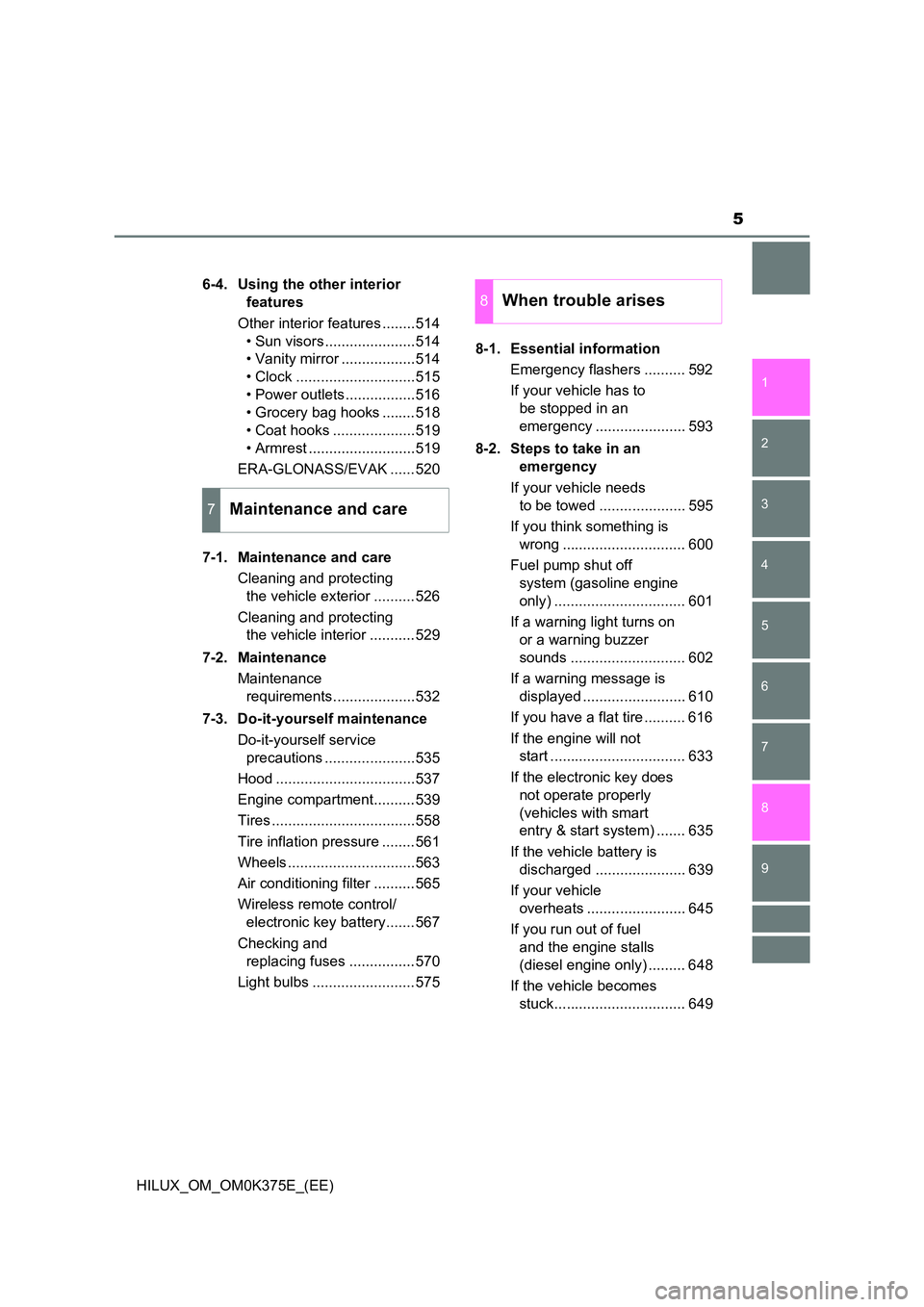
6-4. Using the other interior
features
Other interior features ........514
• Sun visors ......................514
• Vanity mirror ..................514
• Clock .............................515
• Power outlets .................516
• Grocery bag hooks ........518
• Coat hooks ....................519
• Armrest ..........................519
ERA-GLONASS/EVAK ......520
7-1. Maintenance and care
Cleaning and protecting
the vehicle exterior ..........526
Cleaning and protecting
the vehicle interior ...........529
7-2. Maintenance
Maintenance
requirements....................532
7-3. Do-it-yourself maintenance
Do-it-yourself service
precautions ......................535
Hood ..................................537
Engine compartment..........539
Tires ...................................558
Tire inflation pressure ........561
Wheels ...............................563
Air conditioning filter ..........565
Wireless remote control/
electronic key battery.......567
Checking and
replacing fuses ................570
Light bulbs .........................575
8-1. Essential information
Emergency flashers .......... 592
If your vehicle has to
be stopped in an
emergency ...................... 593
8-2. Steps to take in an
emergency
If your vehicle needs
to be towed ..................... 595
If you think something is
wrong .............................. 600
Fuel pump shut off
system (gasoline engine
only) ................................ 601
If a warning light turns on
or a warning buzzer
sounds ............................ 602
If a warning message is
displayed ......................... 610
If you have a flat tire .......... 616
If the engine will not
start ................................. 633
If the electronic key does
not operate properly
(vehicles with smart
entry & start system) ....... 635
If the vehicle battery is
discharged ...................... 639
If your vehicle
overheats ........................ 645
If you run out of fuel
and the engine stalls
(diesel engine only) ......... 648
If the vehicle becomes
stuck................................ 649
7Maintenance and care
8When trouble arises
Page 17 of 708
17Pictorial index
HILUX_OM_OM0K375E_(EE)
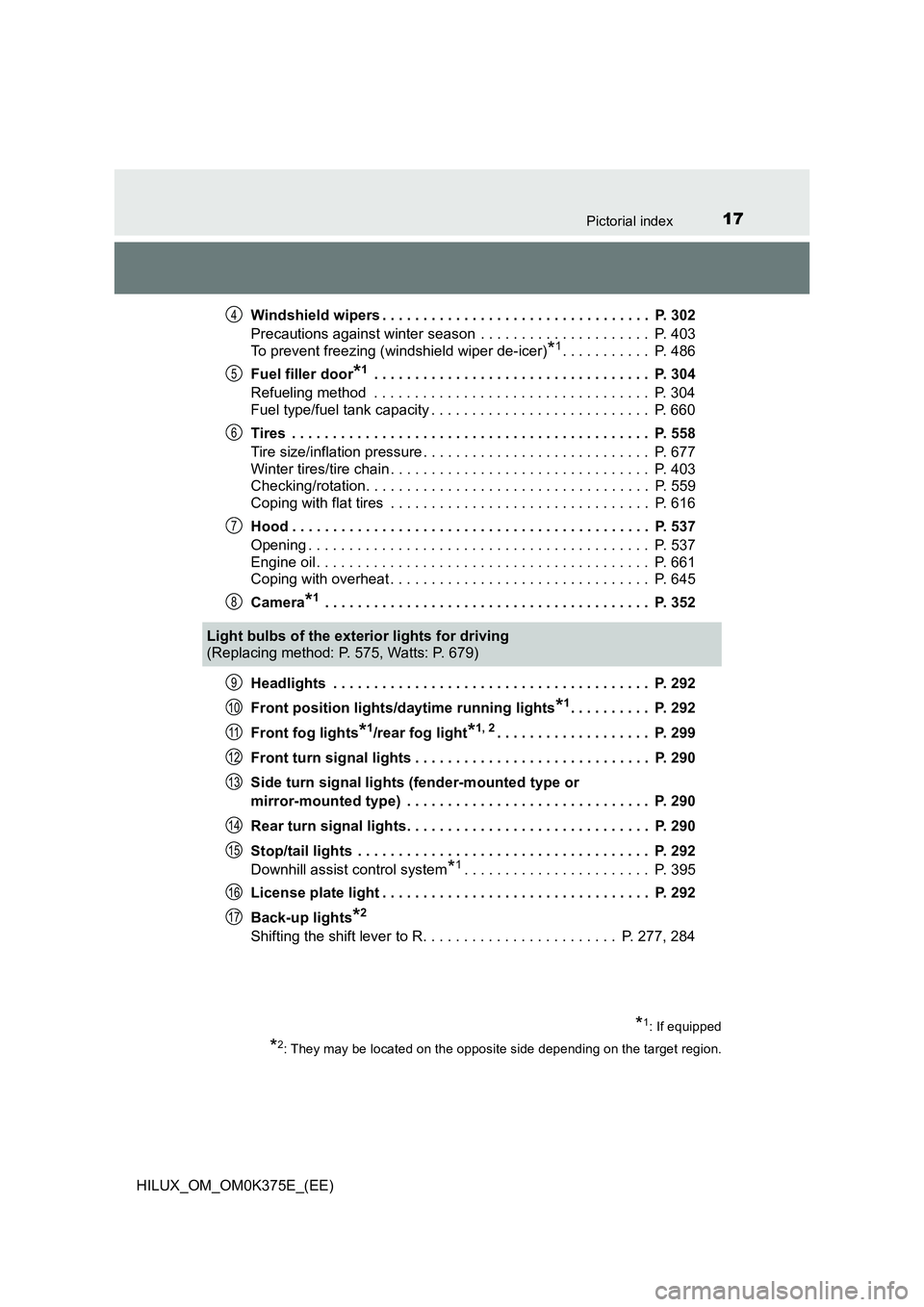
Windshield wipers . . . . . . . . . . . . . . . . . . . . . . . . . . . . . . . . . P. 302
Precautions against winter season . . . . . . . . . . . . . . . . . . . . . P. 403
To prevent freezing (windshield wiper de-icer)*1. . . . . . . . . . . P. 486
Fuel filler door*1 . . . . . . . . . . . . . . . . . . . . . . . . . . . . . . . . . . P. 304
Refueling method . . . . . . . . . . . . . . . . . . . . . . . . . . . . . . . . . . P. 304
Fuel type/fuel tank capacity . . . . . . . . . . . . . . . . . . . . . . . . . . . P. 660
Tires . . . . . . . . . . . . . . . . . . . . . . . . . . . . . . . . . . . . . . . . . . . . P. 558
Tire size/inflation pressure . . . . . . . . . . . . . . . . . . . . . . . . . . . . P. 677
Winter tires/tire chain . . . . . . . . . . . . . . . . . . . . . . . . . . . . . . . . P. 403
Checking/rotation. . . . . . . . . . . . . . . . . . . . . . . . . . . . . . . . . . . P. 559
Coping with flat tires . . . . . . . . . . . . . . . . . . . . . . . . . . . . . . . . P. 616
Hood . . . . . . . . . . . . . . . . . . . . . . . . . . . . . . . . . . . . . . . . . . . . P. 537
Opening . . . . . . . . . . . . . . . . . . . . . . . . . . . . . . . . . . . . . . . . . . P. 537
Engine oil . . . . . . . . . . . . . . . . . . . . . . . . . . . . . . . . . . . . . . . . . P. 661
Coping with overheat . . . . . . . . . . . . . . . . . . . . . . . . . . . . . . . . P. 645
Camera*1 . . . . . . . . . . . . . . . . . . . . . . . . . . . . . . . . . . . . . . . . P. 352
Headlights . . . . . . . . . . . . . . . . . . . . . . . . . . . . . . . . . . . . . . . P. 292
Front position lights/daytime running lights*1. . . . . . . . . . P. 292
Front fog lights*1/rear fog light*1, 2. . . . . . . . . . . . . . . . . . . P. 299
Front turn signal lights . . . . . . . . . . . . . . . . . . . . . . . . . . . . . P. 290
Side turn signal lights (fender-mounted type or
mirror-mounted type) . . . . . . . . . . . . . . . . . . . . . . . . . . . . . . P. 290
Rear turn signal lights. . . . . . . . . . . . . . . . . . . . . . . . . . . . . . P. 290
Stop/tail lights . . . . . . . . . . . . . . . . . . . . . . . . . . . . . . . . . . . . P. 292
Downhill assist control system*1. . . . . . . . . . . . . . . . . . . . . . . P. 395
License plate light . . . . . . . . . . . . . . . . . . . . . . . . . . . . . . . . . P. 292
Back-up lights*2
Shifting the shift lever to R. . . . . . . . . . . . . . . . . . . . . . . . P. 277, 284
4
5
6
7
8
Light bulbs of the exterior lights for driving
(Replacing method: P. 575, Watts: P. 679)
*1: If equipped
*2: They may be located on the opposite side depending on the target region.
9
10
11
12
13
14
15
16
17
Page 39 of 708
391-1. For safe use
1
HILUX_OM_OM0K375E_(EE)
For safety and security
Make sure that you can see backward clearly by adjusting the inside
and outside rear view mirrors properly. ( P. 228, 229)
Adjusting the mirrors
WARNING
Observe the following precautions.
Failure to do so may result in death or serious injury.
● Do not adjust the position of the driver’s seat while driving.
Doing so could cause the driver to lose control of the vehicle.
● Do not place a cushion between the driver or passenger and the seatback.
A cushion may prevent correct posture from being achieved, and reduce
the effectiveness of the seat belt and head restraint.
● Do not place anything under the front seats.
Objects placed under the front seats may become jammed in the seat
tracks and stop the seat from locking in place. This may lead to an acci-
dent and the adjustment mechanism may also be damaged.
● Always observe the legal speed limit when driving on public roads.
● When driving over long distances, take regular breaks before you start to
feel tired.
Also, if you feel tired or sleepy while driving, do not force yourself to con-
tinue driving and take a break immediately.
Page 241 of 708
2414-1. Before driving
4
Driving
HILUX_OM_OM0K375E_(EE)
■When starting off on an uphill (vehicles with hill-start assist control sys-
tem)
The hill-start assist control will activate. ( P. 387)
■ Driving in the rain
● Drive carefully when it is raining, because visibility will be reduced, the win-
dows may become fogged-up, and the road will be slippery.
● Drive carefully when it starts to rain, because the road surface will be espe-
cially slippery.
● Refrain from high speeds when driving on an expressway in the rain,
because there may be a layer of water between the tires and the road sur-
face, preventing the steering and brakes from operating properly.
■ Engine speed while driving (automatic transmission)
In the following conditions, the engine speed may become high while driving.
This is due to automatic up-shifting c ontrol or down-shifting implementation to
meet driving conditions. It does not indicate sudden acceleration.
● The vehicle is judged to be driving uphill or downhill
● When the accelerator pedal is released
■ Restraining the engine output (Brake Override System)
● When the accelerator and brake pedals are depressed at the same time, the
engine output may be restrained.
● Vehicles without multi-information display: A warning light comes on while
the system is operating. ( P. 605)
● Vehicles with multi-information display: A warning message is displayed on
the multi-information display while the system is operating. ( P. 612)
■ Breaking in your new Toyota
To extend the life of the vehicle, observing the following precautions is recom-
mended:
● For the first 300 km (200 miles):
Avoid sudden stops.
● For the first 800 km (500 miles) (models for model code destination W*):
Do not tow a trailer. ( P. 253)
*: See “Checking your vehicle’s model” if you are not sure of which model
your vehicle is. ( P. 1 1 )
● For the first 1000 km (600 miles):
• Do not drive at extremely high speeds.
• Avoid sudden acceleration.
• Do not drive continuously in the low gears.
• Do not drive at a constant speed for extended periods.
• Do not drive slowly with the manual transmission in a high gear.
Page 244 of 708
2444-1. Before driving
HILUX_OM_OM0K375E_(EE)
WARNING
Observe the following precautions.
Failure to do so may result in death or serious injury.
■ When driving the vehicle
● Use engine braking (downshift) to maintain a safe speed when driving
down a steep hill.
Using the brakes continuously may cause the brakes to overheat and lose
effectiveness. ( P. 2 7 8 )
● Do not adjust the positions of the steering wheel, the seat, or the inside or
outside rear view mirrors while driving.
Doing so may result in a loss of vehicle control.
● Always check that all passengers’ arms, heads or other parts of their body
are not outside the vehicle.
● On vehicles with manual transmission, do not operate the clutch halfway
for a long period of time unless it is necessary. Doing so could not only
speed up clutch wear, but could also damage the clutch or even cause a
fatal accident such as vehicle fire.
■ When driving on slippery road surfaces
● Sudden braking, acceleration and steering may cause tire slippage and
reduce your ability to control the vehicle.
● Sudden acceleration, engine braking due to shifting, or changes in engine
speed could cause the vehicle to skid.
● After driving through a puddle, lightly depress the brake pedal to make
sure that the brakes are functioning properly. Wet brake pads may prevent
the brakes from functioning properly. If the brakes on only one side are wet
and not functioning properly, steering control may be affected.
Page 247 of 708
2474-1. Before driving
4
Driving
HILUX_OM_OM0K375E_(EE)
WARNING
Observe the following precautions.
Failure to do so may result in death or serious injury.
■ When the vehicle is parked
● Always apply the parking brake, shift the shift lever to P (vehicles with
automatic transmission only), stop the engine and lock the vehicle.
Do not leave the vehicle unattended while the engine is running.
If the vehicle is parked with the shift lever in P but the parking brake is not
set, the vehicle may start to move, possibly leading to an accident.
● Do not touch the exhaust pipes while the engine is running or immediately
after turning the engine off.
Doing so may cause burns.
■ When taking a nap in the vehicle
Always turn the engine off. Otherwise, if you accidentally move the shift
lever or depress the accelerator pedal, this could cause an accident or fire
due to engine overheating. Additionally, if the vehicle is parked in a poorly
ventilated area, exhaust gases may collect and enter the vehicle, leading to
death or a serious health hazard.
■ When braking
● When the brakes are wet, drive more cautiously.
Braking distance increases when the brakes are wet, and this may cause
one side of the vehicle to brake differently than the other side. Also, the
parking brake may not securely hold the vehicle.
● If the brake booster device does not operate, do not follow other vehicles
closely and avoid hills or sharp turns that require braking. In this case,
braking is still possible, but the brake pedal should be depressed more
firmly than usual. Also, the braking distance will increase. Have your
brakes fixed immediately.
● Do not pump the brake pedal if the engine stalls.
Each push on the brake pedal uses up the reserve for the power-assisted
brakes.
● The brake system consists of 2 individual hydraulic systems: If one of the
systems fails, the other will still operate. In this case, the brake pedal
should be depressed more firmly than usual and the braking distance will
increase.
Have your brakes fixed immediately.
■ If the vehicle becomes stuck (4WD models)
Do not spin the wheels excessively when any of the tires is up in the air, or
the vehicle is stuck in sand, mud, etc. This may damage the driveline com-
ponents or propel the vehicle forward or backward, causing an accident.
Page 249 of 708
2494-1. Before driving
4
Driving
HILUX_OM_OM0K375E_(EE)
NOTICE
■When parking the vehicle
On vehicles with automatic transmission, always set the parking brake, and
shift the shift lever to P. Failure to do so may cause the vehicle to move or
the vehicle may accelerate suddenly if the accelerator pedal is accidentally
depressed.
■ Avoiding damage to vehicle parts
● Do not turn the steering wheel fully in either direction and hold it there for
an extended period of time.
Doing so may damage the power steering pump.
● When driving over bumps in the road, drive as slowly as possible to avoid
damaging the wheels, underside of the vehicle, etc.
● Diesel engine: Make sure to idle the engine immediately after high-load
driving. Stop the engine only after the turbocharger has cooled down.
Failure to do so may cause damage to the turbocharger.
■ If you get a flat tire while driving
A flat or damaged tire may cause the following situations. Hold the steering
wheel firmly and gradually depress the brake pedal to slow down the vehi-
cle.
● It may be difficult to control your vehicle.
● The vehicle will make abnormal sounds or vibrations.
● The vehicle will lean abnormally.
Information on what to do in case of a flat tire. ( P. 616)
Page 254 of 708
2544-1. Before driving
HILUX_OM_OM0K375E_(EE)
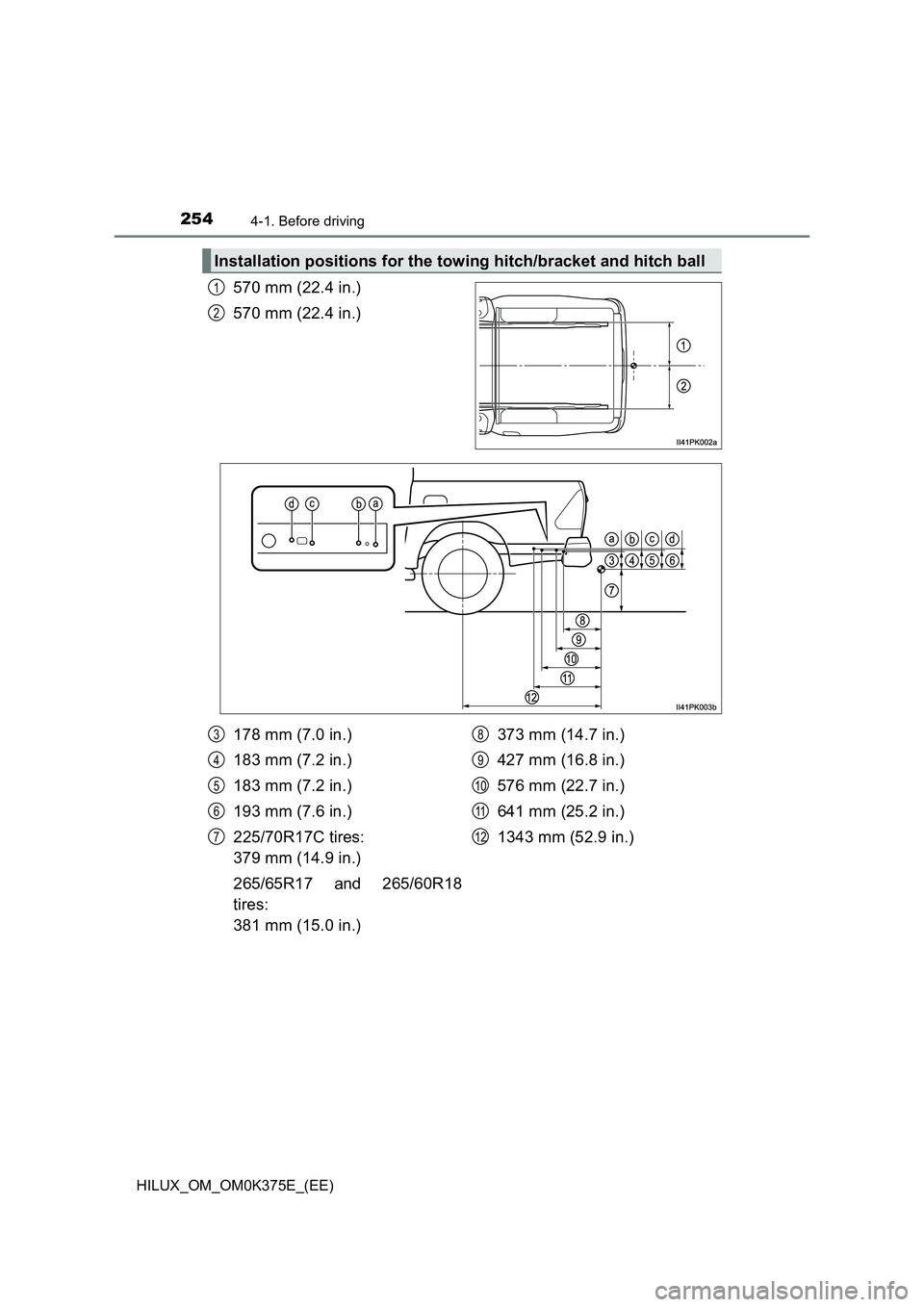
570 mm (22.4 in.)
570 mm (22.4 in.)
Installation positions for the towing hitch/bracket and hitch ball
1
2
178 mm (7.0 in.)
183 mm (7.2 in.)
183 mm (7.2 in.)
193 mm (7.6 in.)
225/70R17C tires:
379 mm (14.9 in.)
265/65R17 and 265/60R18
tires:
381 mm (15.0 in.)
373 mm (14.7 in.)
427 mm (16.8 in.)
576 mm (22.7 in.)
641 mm (25.2 in.)
1343 mm (52.9 in.)
3
4
5
6
7
8
9
10
11
12
Page 259 of 708
2594-1. Before driving
4
Driving
HILUX_OM_OM0K375E_(EE)
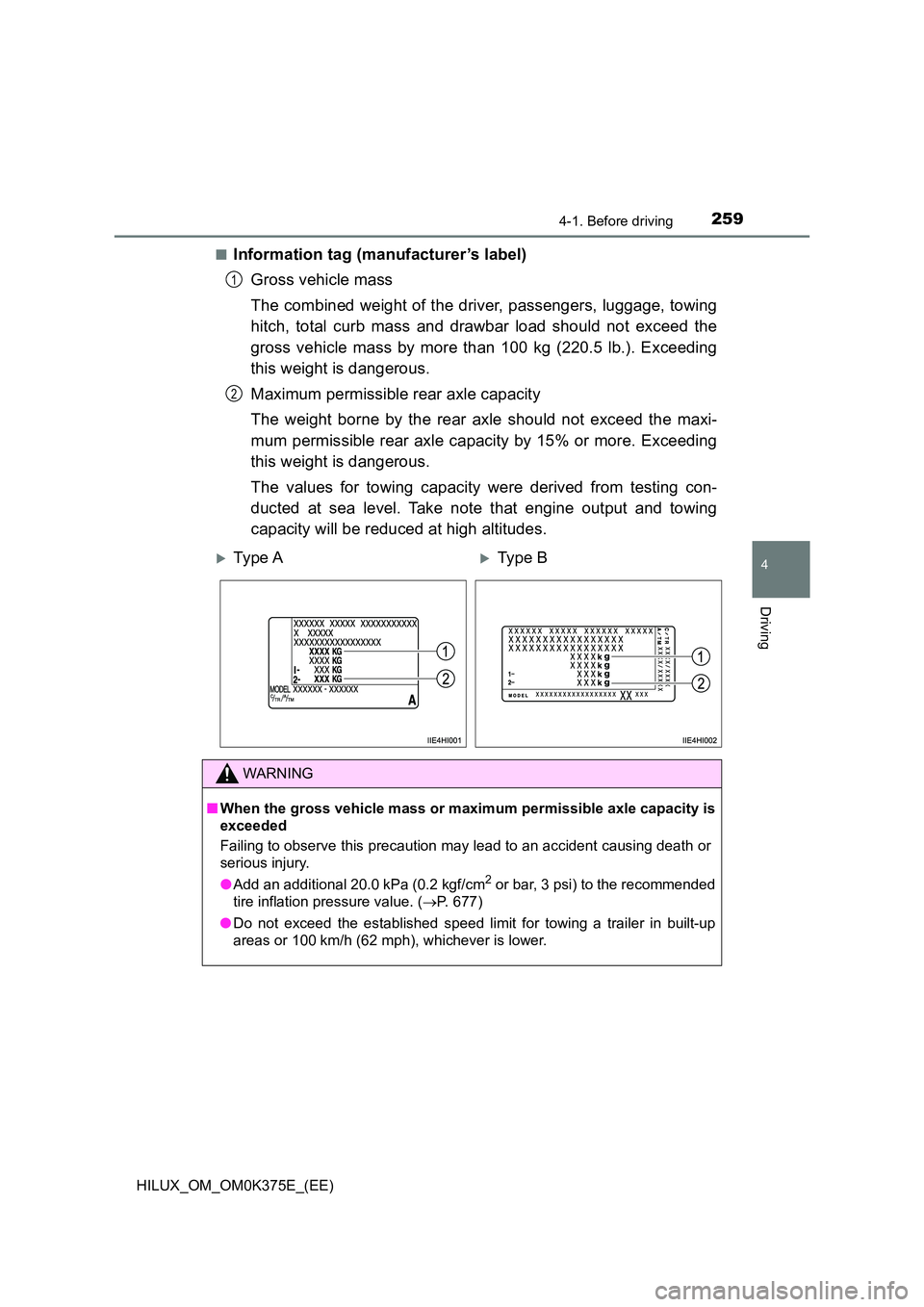
■Information tag (manufacturer’s label)
Gross vehicle mass
The combined weight of the driver, passengers, luggage, towing
hitch, total curb mass and drawbar load should not exceed the
gross vehicle mass by more than 100 kg (220.5 lb.). Exceeding
this weight is dangerous.
Maximum permissible rear axle capacity
The weight borne by the rear axle should not exceed the maxi-
mum permissible rear axle capacity by 15% or more. Exceeding
this weight is dangerous.
The values for towing capacity were derived from testing con-
ducted at sea level. Take note that engine output and towing
capacity will be reduced at high altitudes.
1
2
Ty pe AType B
WARNING
■ When the gross vehicle mass or maximum permissible axle capacity is
exceeded
Failing to observe this precaution may lead to an accident causing death or
serious injury.
● Add an additional 20.0 kPa (0.2 kgf/cm2 or bar, 3 psi) to the recommended
tire inflation pressure value. ( P. 677)
● Do not exceed the established speed limit for towing a trailer in built-up
areas or 100 km/h (62 mph), whichever is lower.
Page 260 of 708
2604-1. Before driving
HILUX_OM_OM0K375E_(EE)
■Tire information
● Increase the tire inflation pressure to 20.0 kPa (0.2 kgf/cm2 or bar, 3 psi)
greater than the recommended value when towing. ( P. 677)
● Increase the air pressure of the trailer tires in accordance with the total
trailer weight and according to the values recommended by the manufac-
turer of your trailer.
■ Tr a i l e r l i g h ts
Check that the turn signal lights and stoplights are operating correctly every
time you hitch up the trailer. Direct ly wiring up to your vehicle may damage
the electrical system and stop the lights from functioning correctly.
■ Break-in schedule
Toyota recommends that vehicles fitted with new power train components
should not be used for towing trailers for the first 800 km (500 miles).
■ Safety checks before towing
● Check that the maximum load limit for the towing hitch/bracket and hitch ball
is not exceeded. Bear in mind that the coupling weight of the trailer will add
to the load exerted on the vehicle. Also make sure that the total load exerted
on the vehicle is within the range of the weight limits. ( P. 258)
● Ensure that the trailer load is secure.
● Supplementary outside rear view mirrors should be added to the vehicle if
the traffic behind cannot be clearly seen with standard mirrors. Adjust the
extending arms of these mirrors on both sides of the vehicle so that they
always provide maximum visibility of the road behind.
■ Maintenance
● Maintenance must be performed more frequently when using the vehicle for
towing due to the greater weight burden placed on the vehicle compared to
normal driving.
● Retighten all bolts securing the hitching ball and bracket after towing for
approximately 1000 km (600 miles).