check engine TOYOTA IQ 2012 Owner's Manual
[x] Cancel search | Manufacturer: TOYOTA, Model Year: 2012, Model line: IQ, Model: TOYOTA IQ 2012Pages: 476, PDF Size: 23.52 MB
Page 315 of 476
315 4-2. Maintenance
4
Maintenance and care
iQ_WE_74014E
Does your vehicle need repair?
Be on the alert for changes in performance and sounds, and visual tip-offs
that indicate service is needed. Some important clues are:
Engine missing, stumbling, or pinging
Appreciable loss of power
Strange engine noises
A fluid leak under the vehicle (However, water dripping from the air condi-
tioning system after use is normal.)
Change in exhaust sound (This may indicate a dangerous carbon mon-
oxide leak. Drive with the windows open and have the exhaust system
checked immediately.)
Flat-looking tires, excessive tire squeal when cornering, uneven tire wear
Vehicle pulls to one side when driving straight on a level road
Strange noises related to suspension movement
Loss of brake effectiveness, spongy feeling brake pedal, pedal almost
touches the floor, vehicle pulls to one side when braking
Engine coolant temperature continually higher than normal
If you notice any of these clues, take your vehicle to any authorized Toyota
dealer or repairer, or another duly qualified and equipped professional, as
soon as possible. Your vehicle may need adjustment or repair.
CAUTION
If your vehicle is not properly maintained
It could result in serious damage to the vehicle and possible serious injury or
death.
Warning in handling of the battery
Battery posts, terminals and related accessories contain lead and lead com-
pounds which are known to cause brain damage. Wash your hands after
handling. (P. 342)
Page 332 of 476
332 4-3. Do-it-yourself maintenance
iQ_WE_74014E
CAUTION
Using the jack
Improper use of the jack may lead to death or serious injuries due to the
vehicle suddenly falling off the jack.
Do not use the jack for any purpose other than replacing tires or installing
and removing tire chains.
Only use the jack that comes with this vehicle for replacing a tire.
Do not use it on other vehicles, and do not use other jacks for replacing
tires on this vehicle.
Always check that the jack is securely set to the jack point.
Do not put any part of your body under the vehicle supported by a jack.
Do not start or run the engine while your vehicle is supported by the jack.
Do not raise the vehicle while someone is in it.
When raising the vehicle, do not put an object on or under the jack.
Do not raise the vehicle to a height greater than that required to replace
the tire.
Use a jack stand if it is necessary to get under the vehicle.
Take particular care when lowering the vehicle to ensure that no one working
on or near the vehicle will be injured.
Replacing a tire
Observe the following precautions to reduce the risk of death or serious
injury.
Have the wheel nuts tightened with a torque wrench to 103 N·m (10.5
kgf·m, 76 ft·lbf) as soon as possible after changing wheels.
Failure to follow these precautions could cause the nuts to loosen and the
wheel may fall off, which could lead to an accident causing death or seri-
ous injury.
Do not attach a heavily damaged wheel ornament, as it may fly off the
wheel while the vehicle is moving.
Page 336 of 476
336 4-3. Do-it-yourself maintenance
iQ_WE_74014E
Engine oil
With the engine at operating temperature and turned off, check the oil
level on the dipstick.
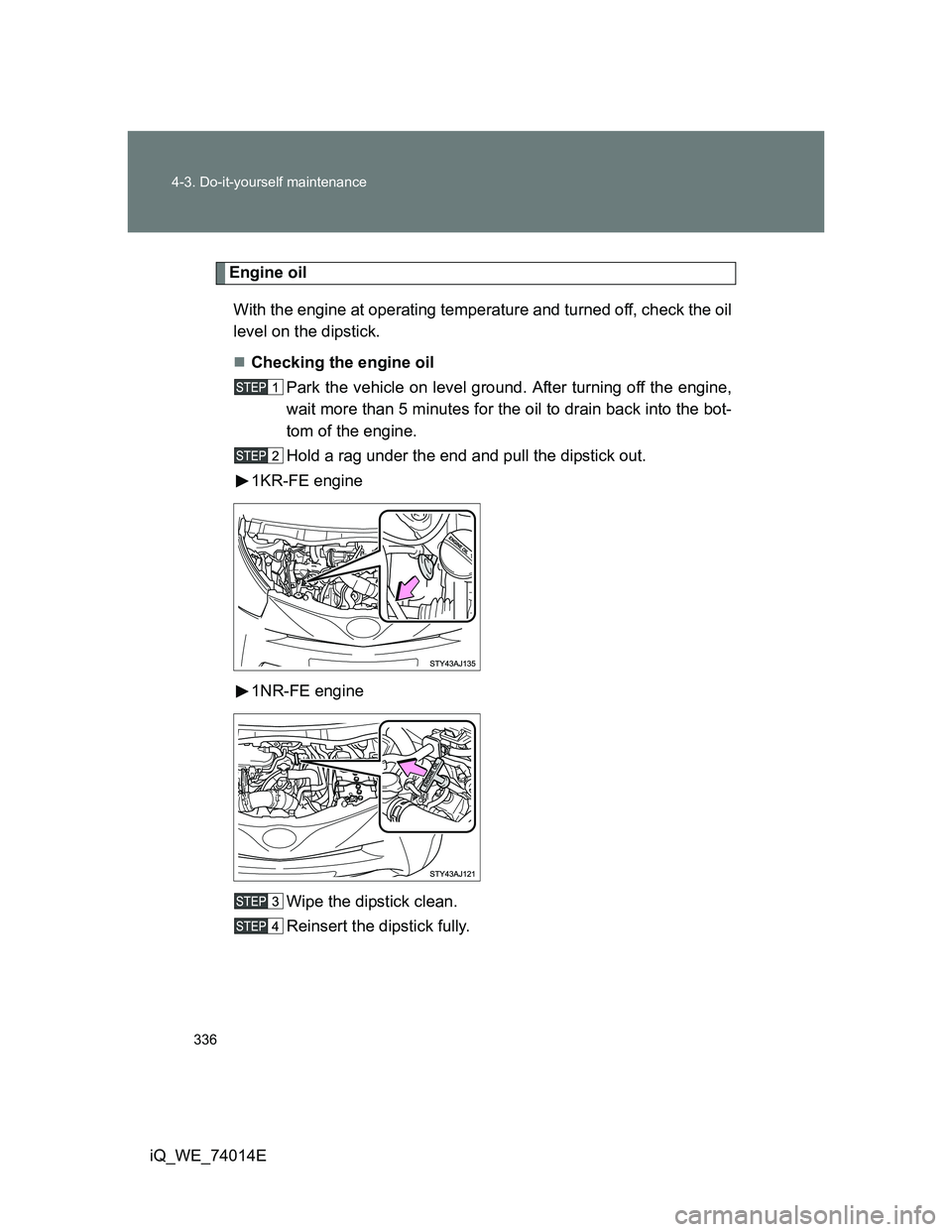
Checking the engine oil
Park the vehicle on level ground. After turning off the engine,
wait more than 5 minutes for the oil to drain back into the bot-
tom of the engine.
Hold a rag under the end and pull the dipstick out.
1KR-FE engine
1NR-FE engine
Wipe the dipstick clean.
Reinsert the dipstick fully.
Page 337 of 476
337 4-3. Do-it-yourself maintenance
4
Maintenance and care
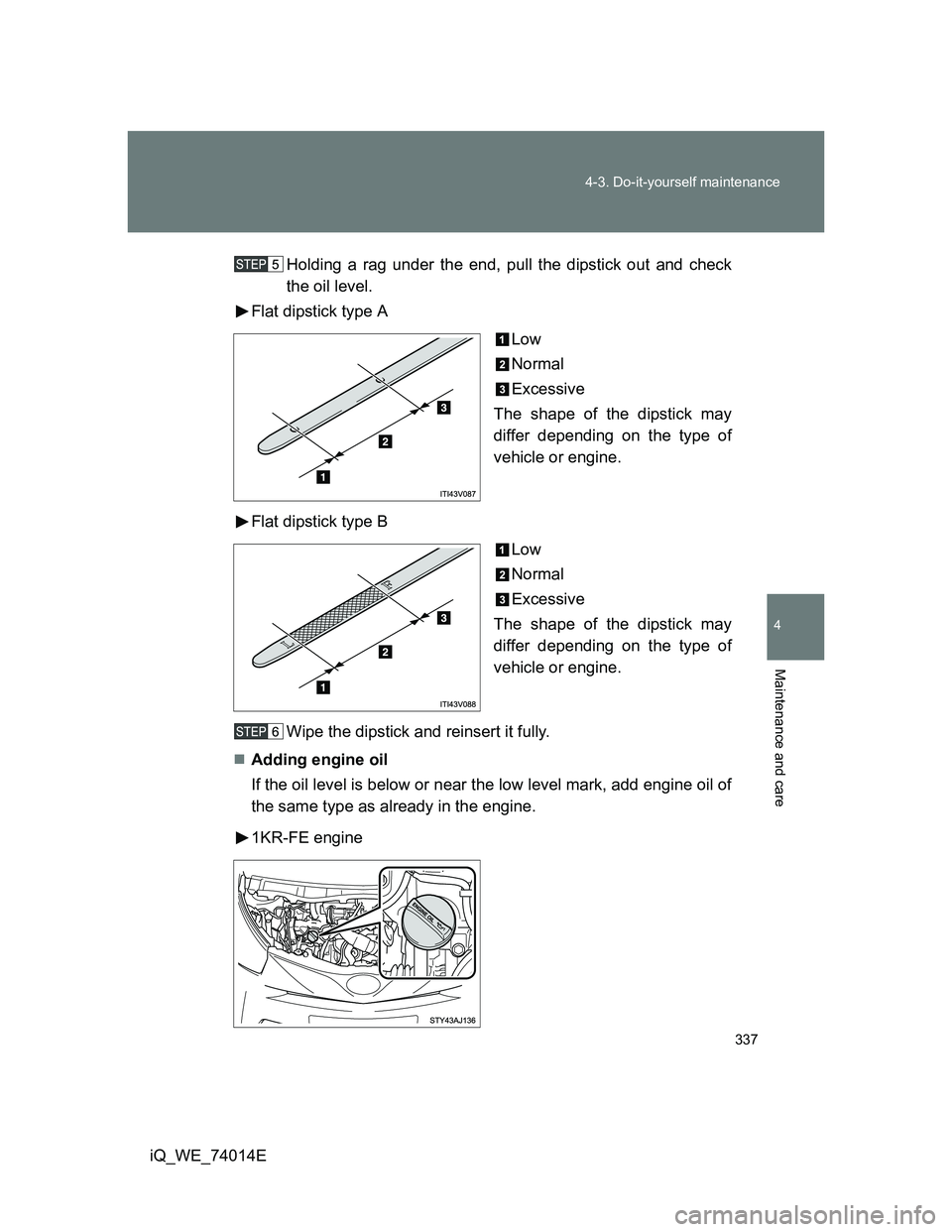
iQ_WE_74014EHolding a rag under the end, pull the dipstick out and check
the oil level.
Flat dipstick type A
Low
Normal
Excessive
The shape of the dipstick may
differ depending on the type of
vehicle or engine.
Flat dipstick type B
Low
Normal
Excessive
The shape of the dipstick may
differ depending on the type of
vehicle or engine.
Wipe the dipstick and reinsert it fully.
Adding engine oil
If the oil level is below or near the low level mark, add engine oil of
the same type as already in the engine.
1KR-FE engine
Page 338 of 476
338 4-3. Do-it-yourself maintenance
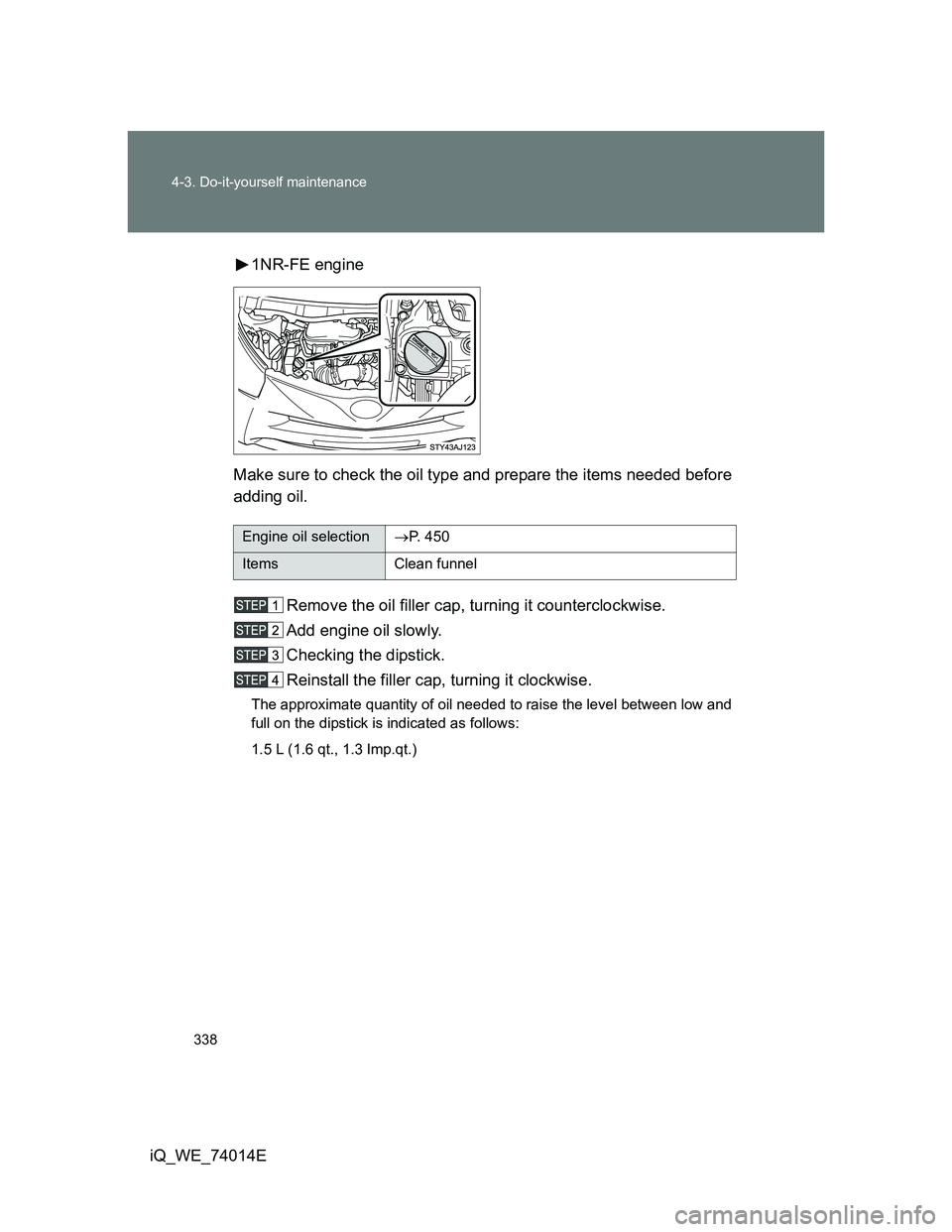
iQ_WE_74014E1NR-FE engine
Make sure to check the oil type and prepare the items needed before
adding oil.
Remove the oil filler cap, turning it counterclockwise.
Add engine oil slowly.
Checking the dipstick.
Reinstall the filler cap, turning it clockwise.
The approximate quantity of oil needed to raise the level between low and
full on the dipstick is indicated as follows:
1.5 L (1.6 qt., 1.3 Imp.qt.)
Engine oil selectionP. 4 5 0
Items Clean funnel
Page 340 of 476
340 4-3. Do-it-yourself maintenance
iQ_WE_74014E
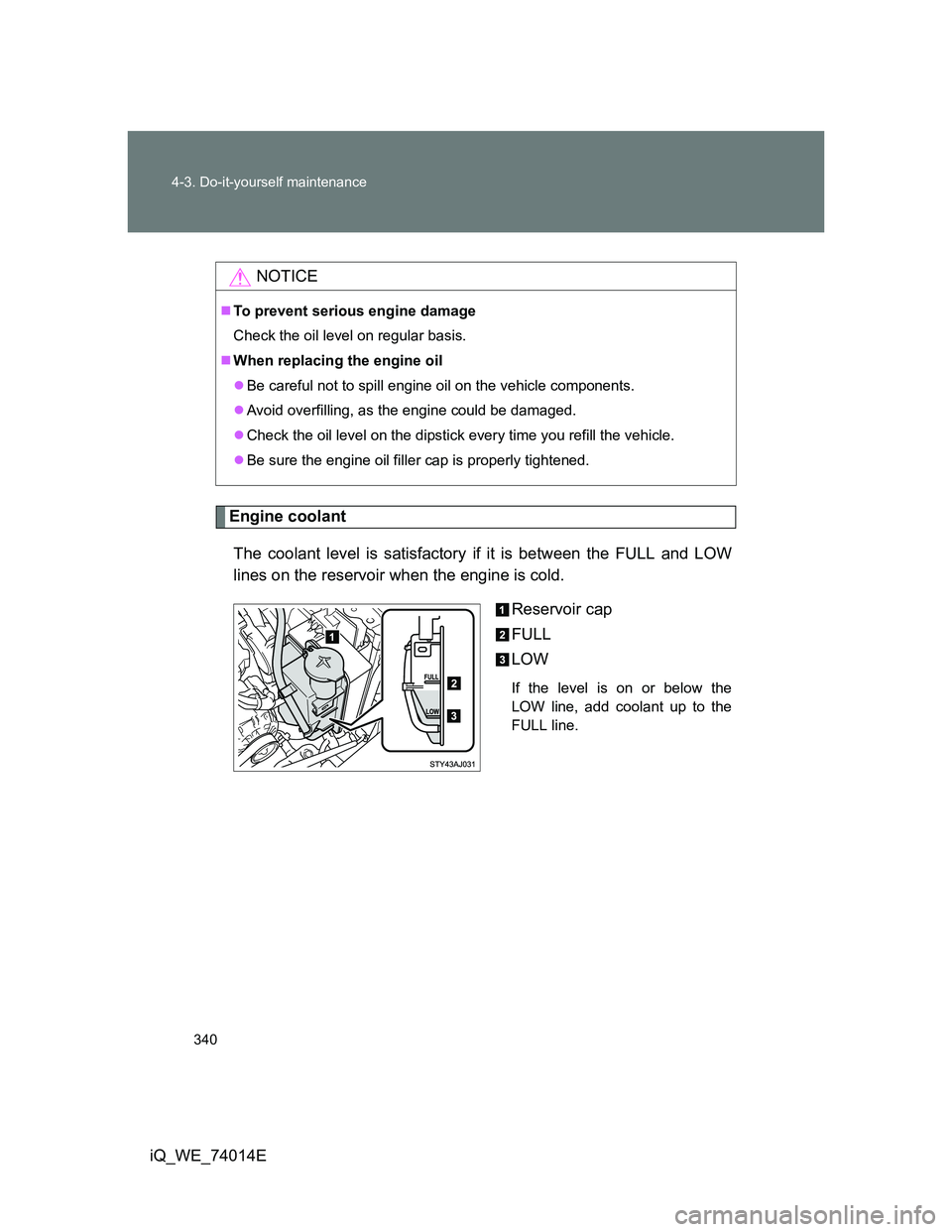
Engine coolant
The coolant level is satisfactory if it is between the FULL and LOW
lines on the reservoir when the engine is cold.
Reservoir cap
FULL
LOW
If the level is on or below the
LOW line, add coolant up to the
FULL line.
NOTICE
To prevent serious engine damage
Check the oil level on regular basis.
When replacing the engine oil
Be careful not to spill engine oil on the vehicle components.
Avoid overfilling, as the engine could be damaged.
Check the oil level on the dipstick every time you refill the vehicle.
Be sure the engine oil filler cap is properly tightened.
Page 341 of 476
341 4-3. Do-it-yourself maintenance
4
Maintenance and care
iQ_WE_74014E
If the coolant level drops within a short time after replenishing
Visually check the radiator, hoses, reservoir cap, radiator cap, drain cock
and water pump.
If you cannot find a leak, have any authorized Toyota dealer or repairer, or
another duly qualified and equipped professional, test the cap and check for
leaks in the cooling system.
Coolant selection
Only use “Toyota Super Long Life Coolant” or similar high quality ethylene
glycol based non-silicate, non-amine, non-nitrite, and non-borate coolant
with long-life hybrid organic acid technology.
“Toyota Super Long Life Coolant” is a mixture of 50% coolant and 50%
deionized water. (Enabled: -35C [-31F])
For more details about engine coolant, contact any authorized Toyota dealer
or repairer, or another duly qualified and equipped professional.
CAUTION
When the engine is hot
Do not remove the coolant reservoir cap.
The cooling system may be under pressure and may spray hot coolant if the
cap is removed, causing serious injuries, such as burns.
NOTICE
When adding engine coolant
Coolant is neither plain water nor straight antifreeze. The correct mixture of
water and antifreeze must be used to provide proper lubrication, corrosion
protection and cooling. Be sure to read the antifreeze or coolant label.
If you spill coolant
Be sure to wash it off with water to prevent damage to parts or paint.
Page 342 of 476
342 4-3. Do-it-yourself maintenance
iQ_WE_74014E
Radiator and condenser
Check the radiator and condenser and clear any foreign objects.
If any of the above parts are extremely dirty or you are not sure of
their condition, have your vehicle checked by any authorized Toyota
dealer or repairer, or another duly qualified and equipped profes-
sional.
Battery
Check the battery as follows.
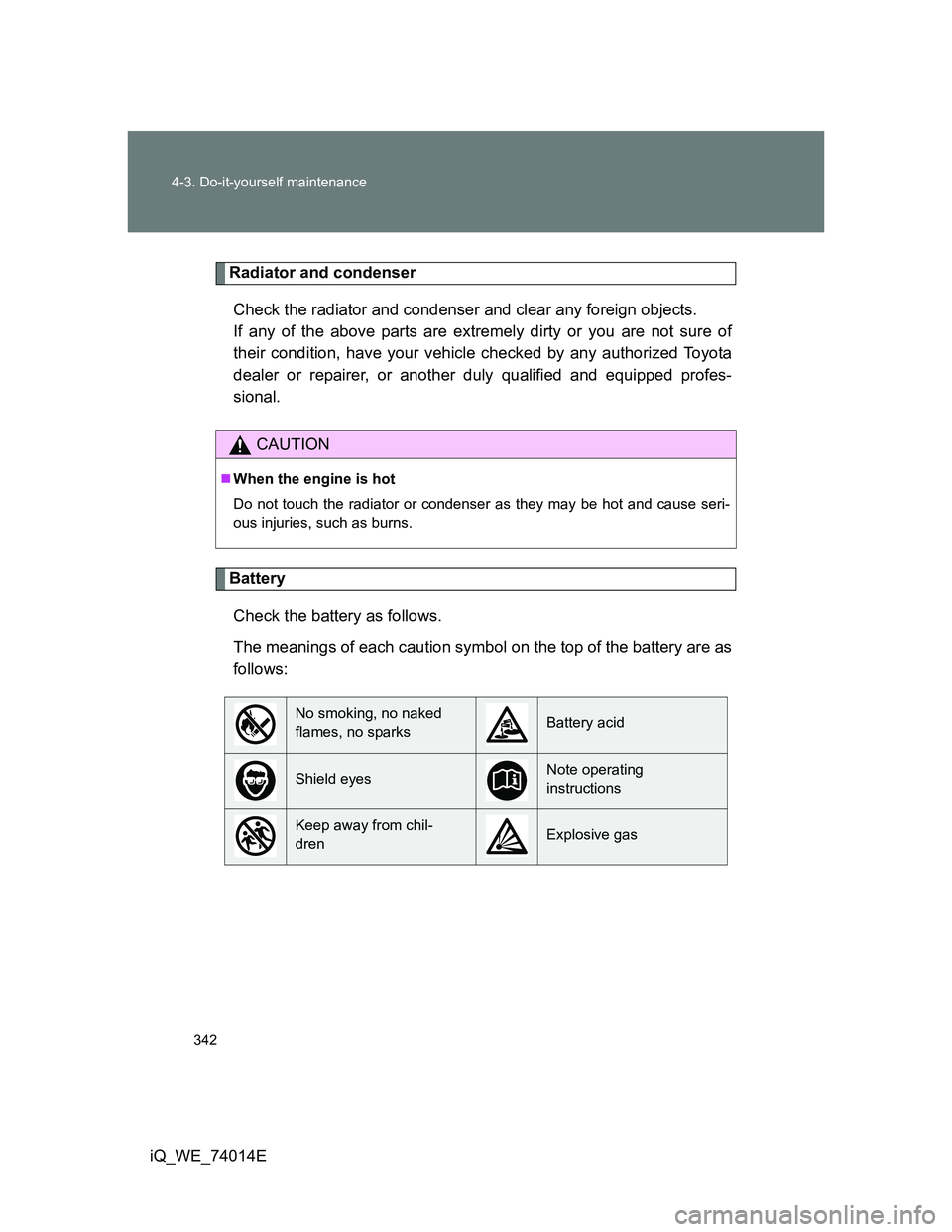
The meanings of each caution symbol on the top of the battery are as
follows:
CAUTION
When the engine is hot
Do not touch the radiator or condenser as they may be hot and cause seri-
ous injuries, such as burns.
No smoking, no naked
flames, no sparksBattery acid
Shield eyesNote operating
instructions
Keep away from chil-
drenExplosive gas
Page 346 of 476
346 4-3. Do-it-yourself maintenance
iQ_WE_74014E
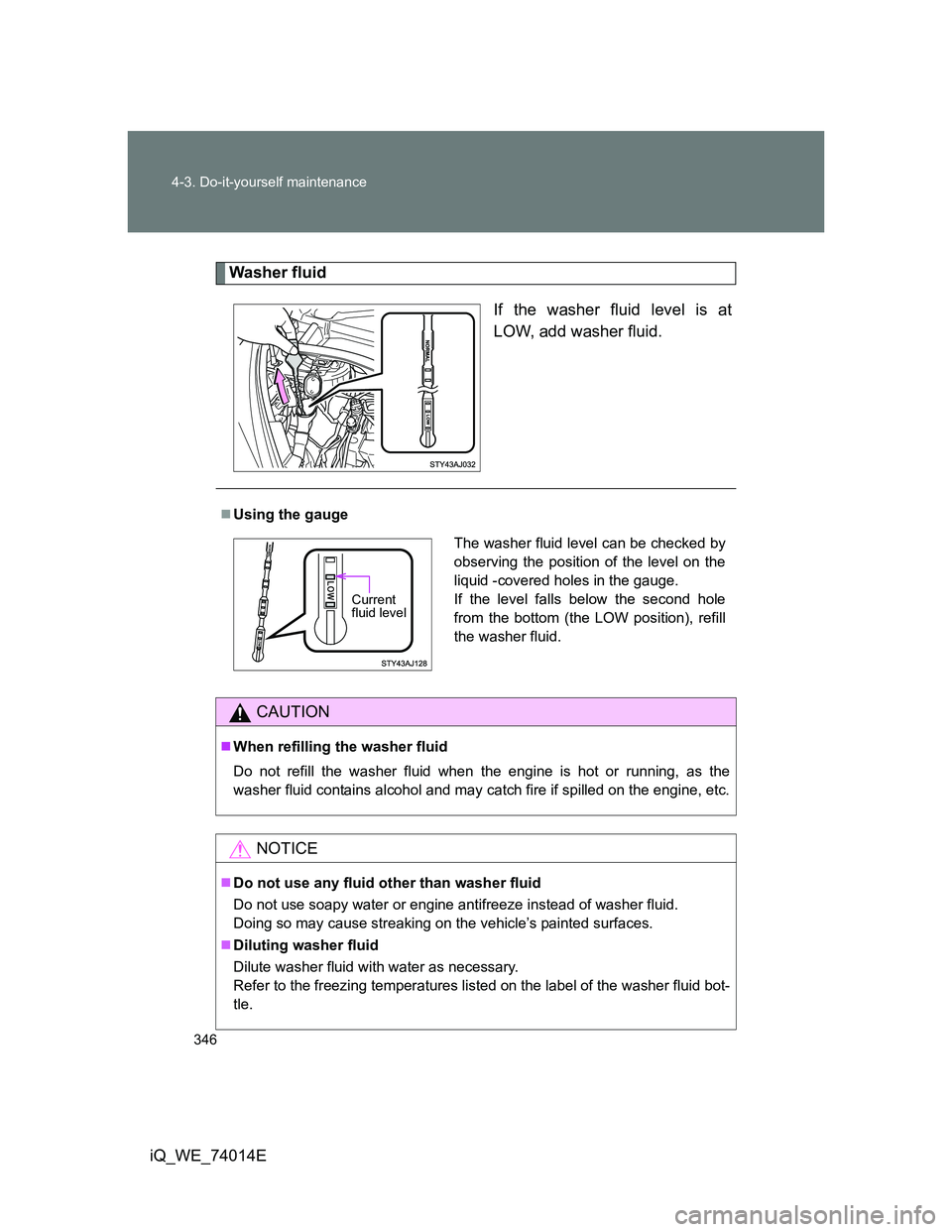
Washer fluid
If the washer fluid level is at
LOW, add washer fluid.
Using the gauge
CAUTION
When refilling the washer fluid
Do not refill the washer fluid when the engine is hot or running, as the
washer fluid contains alcohol and may catch fire if spilled on the engine, etc.
NOTICE
Do not use any fluid other than washer fluid
Do not use soapy water or engine antifreeze instead of washer fluid.
Doing so may cause streaking on the vehicle’s painted surfaces.
Diluting washer fluid
Dilute washer fluid with water as necessary.
Refer to the freezing temperatures listed on the label of the washer fluid bot-
tle.
The washer fluid level can be checked by
observing the position of the level on the
liquid -covered holes in the gauge.
If the level falls below the second hole
from the bottom (the LOW position), refill
the washer fluid.
Current
fluid level
Page 361 of 476
361
4-3. Do-it-yourself maintenance
4
Maintenance and care
iQ_WE_74014E
Checking and replacing fuses
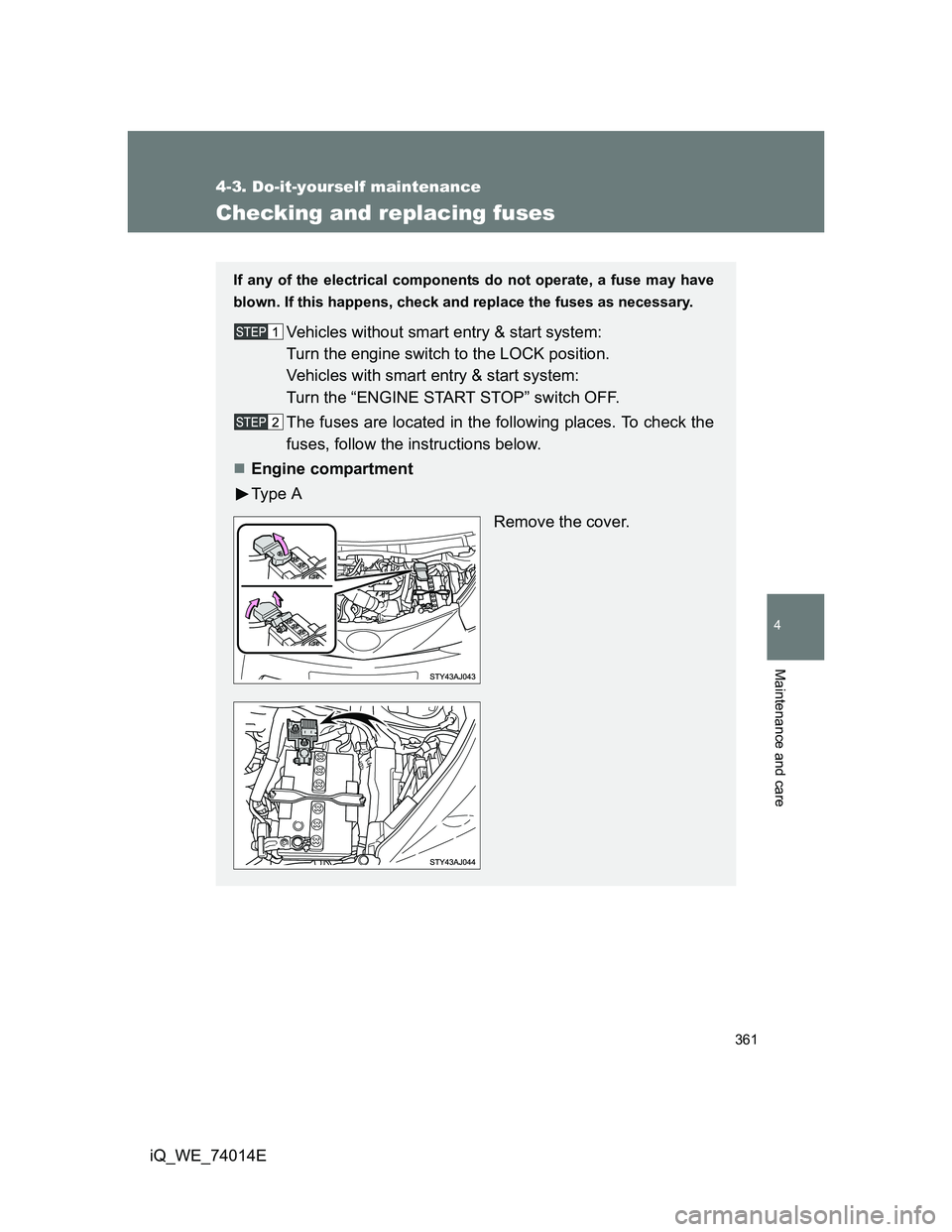
If any of the electrical components do not operate, a fuse may have
blown. If this happens, check and replace the fuses as necessary.
Vehicles without smart entry & start system:
Turn the engine switch to the LOCK position.
Vehicles with smart entry & start system:
Turn the “ENGINE START STOP” switch OFF.
The fuses are located in the following places. To check the
fuses, follow the instructions below.
Engine compartment
Ty p e A
Remove the cover.