seats TOYOTA IQ 2012 Owner's Manual
[x] Cancel search | Manufacturer: TOYOTA, Model Year: 2012, Model line: IQ, Model: TOYOTA IQ 2012Pages: 476, PDF Size: 23.52 MB
Page 95 of 476
95
1
1-3. Adjustable components (seats, mirrors, steering wheel)
Before driving
iQ_WE_74014E
Outside rear view mirrors
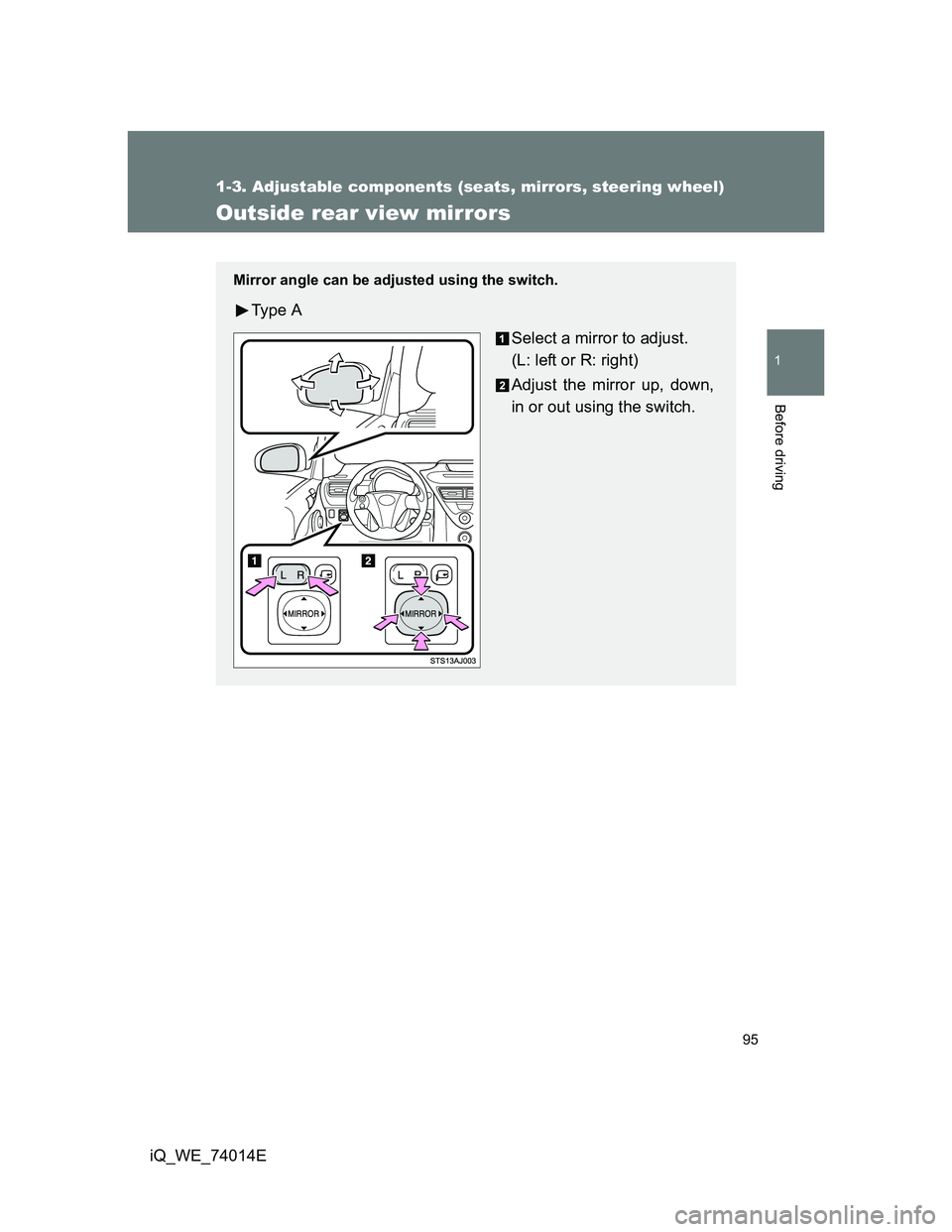
Mirror angle can be adjusted using the switch.
Ty p e A
Select a mirror to adjust.
(L: left or R: right)
Adjust the mirror up, down,
in or out using the switch.
Page 96 of 476
96 1-3. Adjustable components (seats, mirrors, steering wheel)
iQ_WE_74014E
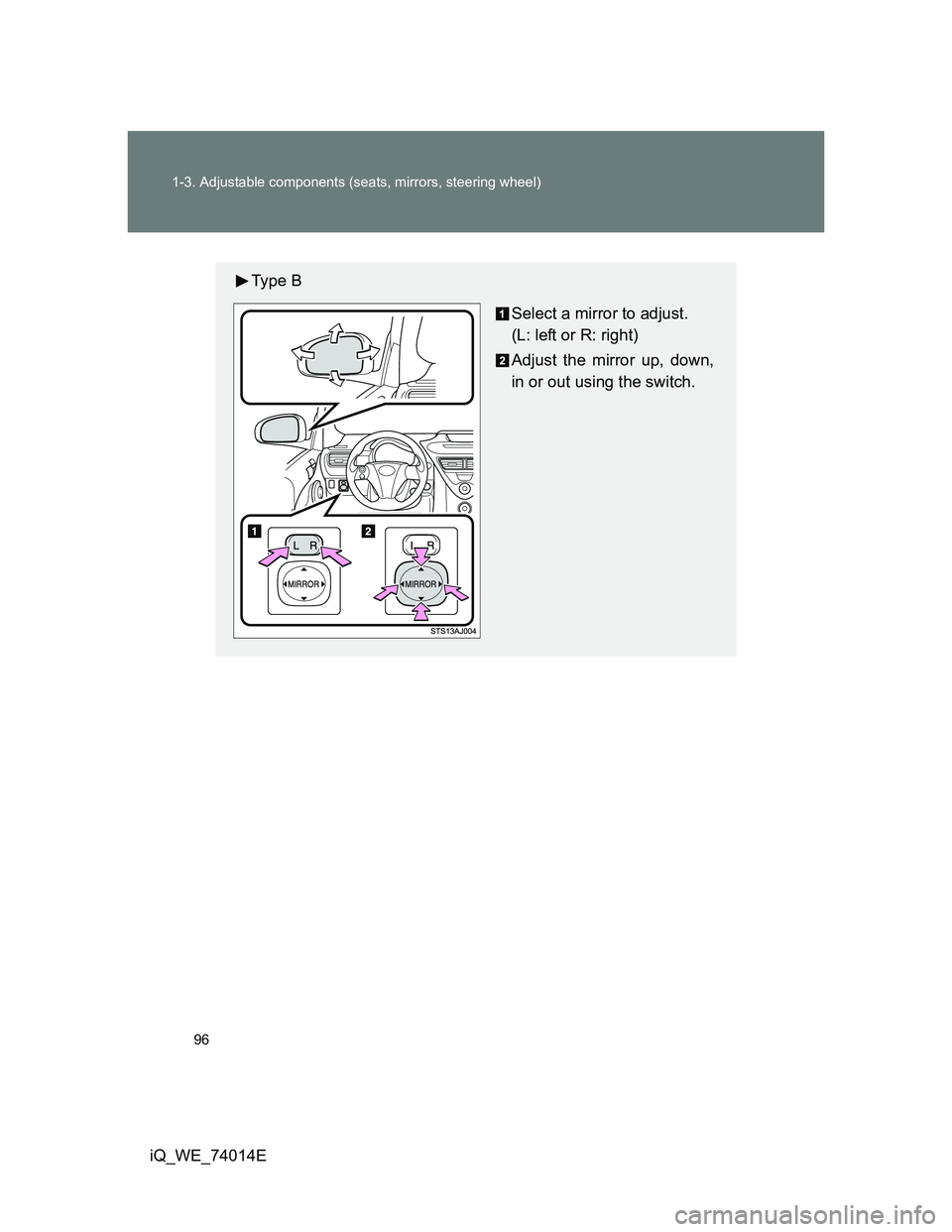
Ty p e B
Select a mirror to adjust.
(L: left or R: right)
Adjust the mirror up, down,
in or out using the switch.
Page 97 of 476
97 1-3. Adjustable components (seats, mirrors, steering wheel)
1
Before driving
iQ_WE_74014E
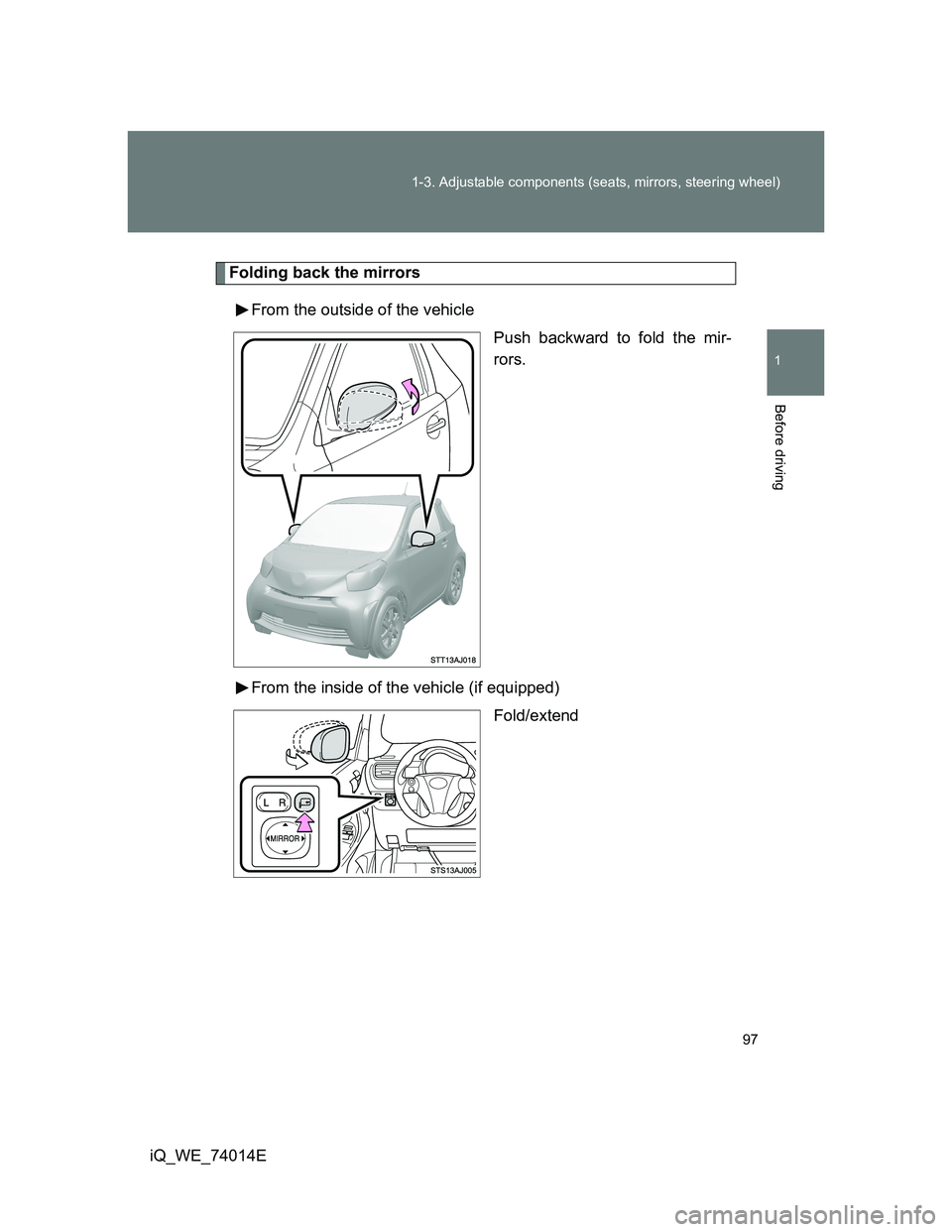
Folding back the mirrors
From the outside of the vehicle
Push backward to fold the mir-
rors.
From the inside of the vehicle (if equipped)
Fold/extend
Page 98 of 476
98 1-3. Adjustable components (seats, mirrors, steering wheel)
iQ_WE_74014E
Mirror angle can be adjusted when
Vehicles without smart entry & start system
The engine switch is in the ACC or ON position.
Vehicles with smart entry & start system
The “ENGINE START STOP” switch is in ACCESSORY or IGNITION ON
mode.
When the mirrors are fogged up (vehicles with outside rear view mirror
defoggers)
Turn on the mirror defoggers to defog the mirrors. (P. 254)
CAUTION
When driving the vehicle
Observe the following precautions while driving.
Failing to do so may result in loss of control of the vehicle and cause an acci-
dent, resulting in death or serious injury.
Do not adjust the mirrors while driving.
Do not drive with the mirrors folded back.
Both the driver and passenger side mirrors must be extended and properly
adjusted before driving.
When a mirror is moving
To avoid personal injury and mirror malfunction, be careful not to get your
hand caught by the moving mirror.
When the mirror defoggers are operating (vehicles with outside rear
view mirror defoggers)
Do not touch the rear view mirror surfaces, as they can become very hot and
burn you.
Page 99 of 476
99 1-3. Adjustable components (seats, mirrors, steering wheel)
1
Before driving
iQ_WE_74014E
NOTICE
If ice should jam the mirror
Do not operate the control or scrape the mirror face. Use a spray de-icer to
free the mirror.
Page 123 of 476
123 1-7. Safety information
1
Before driving
iQ_WE_74014E
CAUTION
While driving
Do not adjust the position of the driver’s seat while driving.
Doing so could cause the driver to lose control of the vehicle.
Do not place a cushion between the driver or passenger and the seatback.
A cushion may prevent correct posture from being achieved, and reduce
the effectiveness of the seat belt and head restraint, increasing the risk of
death or serious injury to the driver or passenger.
Do not place anything under the front seats.
Objects placed under the front seats may become jammed in the seat
tracks and stop the seat from locking in place. This may lead to an acci-
dent. The adjustment mechanism may also be damaged.
Adjusting the seat position
Take care when adjusting the seat position to ensure that other passen-
gers are not injured by the moving seat.
Do not put your hands under the seat or near the moving parts to avoid
injury.
Fingers or hands may become jammed in the seat mechanism.
Page 126 of 476
126 1-7. Safety information
iQ_WE_74014EThe main SRS airbag system components are shown above. The
SRS airbag system is controlled by the airbag sensor assembly. As
the airbags deploy, a chemical reaction in the inflators quickly fills the
airbags with non-toxic gas to help restrain the motion of the occu-
pants.
Rear airbag sensors
(if equipped)
Curtain shield airbag sen-
sors (if equipped)
Curtain shield airbags
(if equipped)
Side airbags
Front passenger airbag
Passenger airbag indicator
light
Seat belt pretensioners and
force limiters
Vehicles without curtain
shield airbags: Side air-
bag sensors
Vehicles with curtain
shield airbags: Side and
curtain shield airbag
sensorsSeat cushion airbag
Front airbag sensors
Airbag sensor assembly
Front passenger’s seat belt
buckle switch
Rear window curtain shield
airbag (if equipped)
SRS warning light
Driver airbag
Knee airbag
Airbag manual on-off switch
If the SRS airbags deploy (inflate)
Bruising and slight abrasions may result from contact with a deploying
(inflating) SRS airbag.
A loud noise and white powder will be emitted.
Vehicles without curtain shield airbags: Parts of the airbag module (steer-
ing wheel hub, airbag cover and inflator) as well as the front seats may
be hot for several minutes. The airbag itself may also be hot.
Page 127 of 476
127 1-7. Safety information
1
Before driving
iQ_WE_74014E
Vehicles with curtain shield airbags: Parts of the airbag module (steering
wheel hub, airbag cover and inflator) as well as the front seats, and parts
of the front and rear pillars, roof side rail and rear roof headlining may be
hot for several minutes. The airbag itself may also be hot.
The front windshield may crack.
Operating conditions (front airbags)
The SRS front airbags will deploy in the event of an impact that exceeds
the set threshold level (the level of force corresponding to an approxi-
mately 20-30 km/h [12-18 mph] frontal collision with a fixed wall that does
not move or deform).
However, this threshold velocity will be considerably higher if the vehicle
strikes an object, such as a parked vehicle or sign pole, which can move or
deform on impact, or if the vehicle is involved in an underride collision (e.g.
a collision in which the front of the vehicle “underrides”, or goes under, the
bed of a truck, etc.).
Depending on the type of collision, it is possible that only the seat belt
pretensioners will activate.
The SRS seat cushion airbag on the front passenger’s seat will not oper-
ate if the occupant is not wearing a seat belt.
Operating conditions (side airbags & curtain shield airbags [if
equipped])
The SRS side airbags & SRS curtain shield airbags will deploy in the event
of an impact that exceeds the set threshold level (the level of force corre-
sponding to the impact force produced by an approximately 1500 kg [3300
lb.] vehicle colliding with the vehicle cabin from a direction perpendicular to
the vehicle orientation at an approximate speed of 20-30 km/h [12-18 mph]).
Operating conditions (rear window curtain shield airbag [if equipped])
The SRS rear window curtain shield airbag is designed to inflate when the
passenger compartment is subjected to a severe impact from the rear or
side.
Page 131 of 476
131 1-7. Safety information
1
Before driving
iQ_WE_74014E
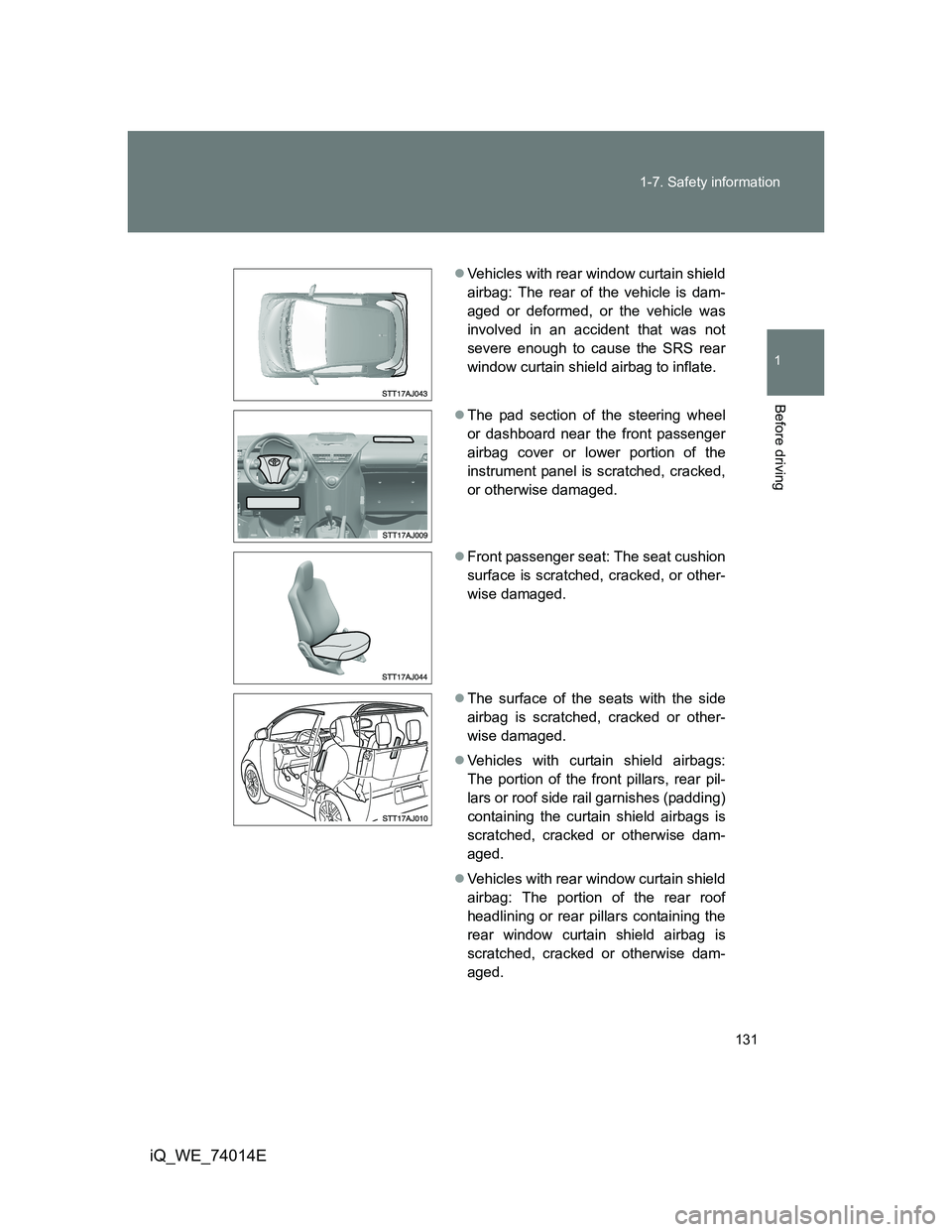
Vehicles with rear window curtain shield
airbag: The rear of the vehicle is dam-
aged or deformed, or the vehicle was
involved in an accident that was not
severe enough to cause the SRS rear
window curtain shield airbag to inflate.
The pad section of the steering wheel
or dashboard near the front passenger
airbag cover or lower portion of the
instrument panel is scratched, cracked,
or otherwise damaged.
Front passenger seat: The seat cushion
surface is scratched, cracked, or other-
wise damaged.
The surface of the seats with the side
airbag is scratched, cracked or other-
wise damaged.
Vehicles with curtain shield airbags:
The portion of the front pillars, rear pil-
lars or roof side rail garnishes (padding)
containing the curtain shield airbags is
scratched, cracked or otherwise dam-
aged.
Vehicles with rear window curtain shield
airbag: The portion of the rear roof
headlining or rear pillars containing the
rear window curtain shield airbag is
scratched, cracked or otherwise dam-
aged.
Page 133 of 476
133 1-7. Safety information
1
Before driving
iQ_WE_74014E
CAUTION
SRS airbag precautions
Improperly seated and/or restrained infants and children can be killed or
seriously injured by a deploying airbag. An infant or child who is too small
to use a seat belt should be properly secured using a child restraint sys-
tem. Toyota strongly recommends that all infants and children be placed in
the rear seats of the vehicle and properly restrained. The rear seats are
the safest for infants and children. (P. 137)
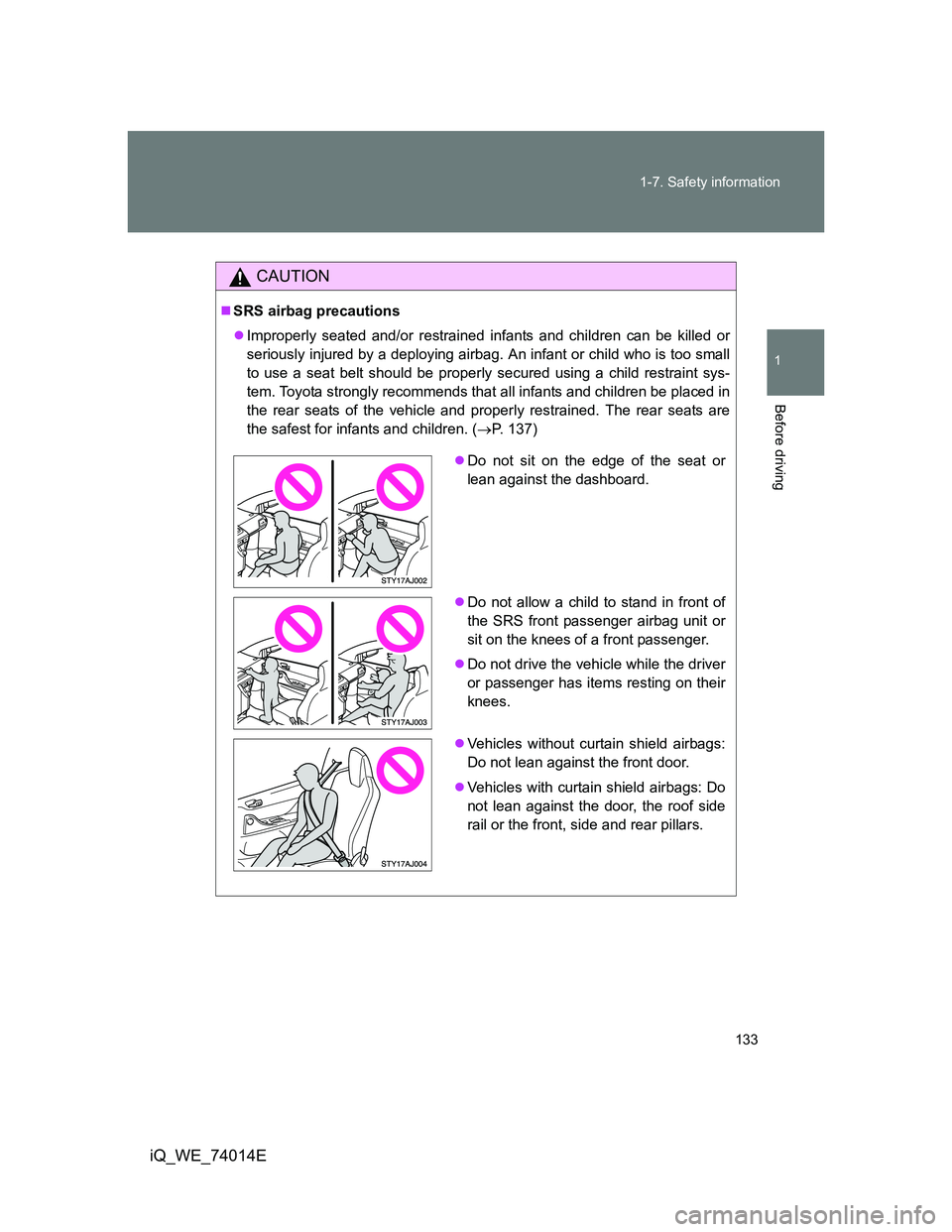
Do not sit on the edge of the seat or
lean against the dashboard.
Do not allow a child to stand in front of
the SRS front passenger airbag unit or
sit on the knees of a front passenger.
Do not drive the vehicle while the driver
or passenger has items resting on their
knees.
Vehicles without curtain shield airbags:
Do not lean against the front door.
Vehicles with curtain shield airbags: Do
not lean against the door, the roof side
rail or the front, side and rear pillars.