brake TOYOTA IQ 2012 Owner's Guide
[x] Cancel search | Manufacturer: TOYOTA, Model Year: 2012, Model line: IQ, Model: TOYOTA IQ 2012Pages: 476, PDF Size: 23.52 MB
Page 232 of 476
232 2-5. Driving information
iQ_WE_74014E
When driving the vehicle
Accelerate the vehicle slowly and drive at a reduced speed suit-
able to road conditions.
When parking the vehicle
Park the vehicle and move the shift lever to P (Multidrive) or to 1
or R (manual transmission) without setting the parking brake
and then chock the tires. The parking brake may freeze up, pre-
venting it from being released. If necessary, block the wheels to
prevent inadvertent sliding or creeping.
Page 292 of 476
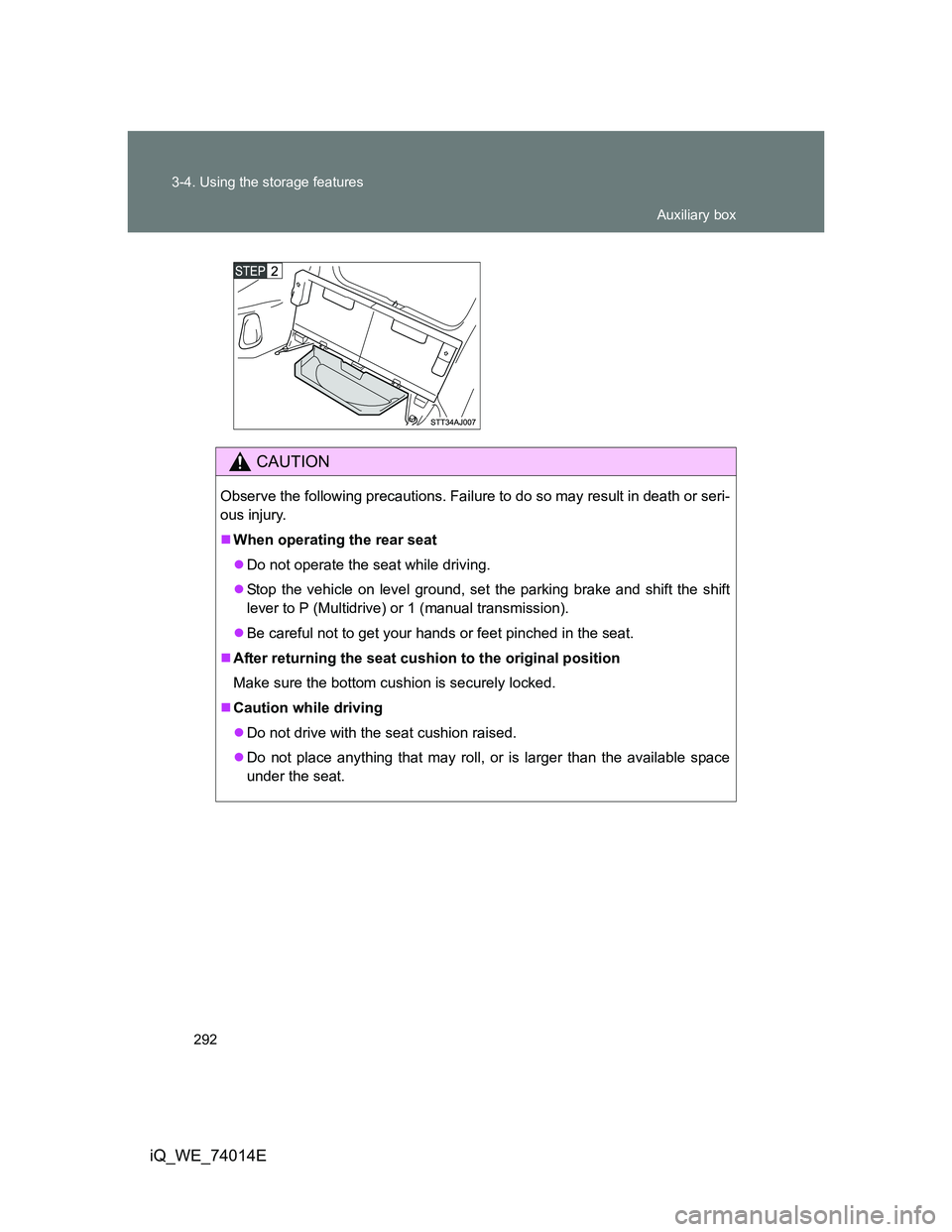
292 3-4. Using the storage features
iQ_WE_74014E
CAUTION
Observe the following precautions. Failure to do so may result in death or seri-
ous injury.
When operating the rear seat
Do not operate the seat while driving.
Stop the vehicle on level ground, set the parking brake and shift the shift
lever to P (Multidrive) or 1 (manual transmission).
Be careful not to get your hands or feet pinched in the seat.
After returning the seat cushion to the original position
Make sure the bottom cushion is securely locked.
Caution while driving
Do not drive with the seat cushion raised.
Do not place anything that may roll, or is larger than the available space
under the seat.
Auxiliary box
Page 315 of 476
315 4-2. Maintenance
4
Maintenance and care
iQ_WE_74014E
Does your vehicle need repair?
Be on the alert for changes in performance and sounds, and visual tip-offs
that indicate service is needed. Some important clues are:
Engine missing, stumbling, or pinging
Appreciable loss of power
Strange engine noises
A fluid leak under the vehicle (However, water dripping from the air condi-
tioning system after use is normal.)
Change in exhaust sound (This may indicate a dangerous carbon mon-
oxide leak. Drive with the windows open and have the exhaust system
checked immediately.)
Flat-looking tires, excessive tire squeal when cornering, uneven tire wear
Vehicle pulls to one side when driving straight on a level road
Strange noises related to suspension movement
Loss of brake effectiveness, spongy feeling brake pedal, pedal almost
touches the floor, vehicle pulls to one side when braking
Engine coolant temperature continually higher than normal
If you notice any of these clues, take your vehicle to any authorized Toyota
dealer or repairer, or another duly qualified and equipped professional, as
soon as possible. Your vehicle may need adjustment or repair.
CAUTION
If your vehicle is not properly maintained
It could result in serious damage to the vehicle and possible serious injury or
death.
Warning in handling of the battery
Battery posts, terminals and related accessories contain lead and lead com-
pounds which are known to cause brain damage. Wash your hands after
handling. (P. 342)
Page 317 of 476
317 4-3. Do-it-yourself maintenance
4
Maintenance and care
iQ_WE_74014E
CAUTION
The engine compartment contains many mechanisms and fluids that may
move suddenly, become hot, or become electrically energized. To avoid death
or serious injury, observe the following precautions.
When working on the engine compartment
Keep hands, clothing, and tools away from the moving fan and engine
drive belt.
Be careful not to touch the engine, radiator, exhaust manifold, etc. right
after driving as they may be hot. Oil and other fluids may also be hot.
Do not leave anything that may burn easily, such as paper or rags, in the
engine compartment.
Do not smoke, cause sparks or expose an open flame to fuel or the bat-
tery. Fuel and battery fumes are flammable.
Be extremely cautious when working on the battery. It contains poisonous
and corrosive sulfuric acid.
Take care because brake fluid can harm your hands or eyes and damage
painted surfaces.
If fluid gets on your hands or in your eyes, flush the affected area with
clean water immediately.
If you still experience discomfort, see a doctor.
When working near the electric cooling fan or radiator grille
Vehicles without smart entry & start system:
Be sure the engine switch is in the LOCK position.
With the engine switch in the ON position, the electric cooling fan may
automatically start to run if the air conditioning system is on and/or the
coolant temperature is high. (P. 342)
Vehicles with smart entry & start system:
Be sure the “ENGINE START STOP” switch is in the OFF.
With the “ENGINE START STOP” switch in the IGNITION ON mode, the
electric cooling fan may automatically start to run if the air conditioning
system is on and/or the coolant temperature is high. (P. 342)
Safety glasses
Wear safety glasses to prevent flying or falling material, fluid spray, etc. from
getting in the eyes.
Page 318 of 476
318 4-3. Do-it-yourself maintenance
iQ_WE_74014E
NOTICE
If you remove the air cleaner
Driving with the air cleaner removed may cause excessive engine wear due
to dirt in the air.
If the fluid level is low or high
It is normal for the brake fluid level to go down slightly as the brake pads
wear or when the fluid level in the accumulator is high.
If the reservoir needs frequent refilling, it may indicate a serious problem.
Page 322 of 476
322 4-3. Do-it-yourself maintenance
iQ_WE_74014E
CAUTION
When raising your vehicle
Make sure to observe the following to reduce the possibility of death or seri-
ous injury.
When using a floor jack, follow the instructions of the manual provided with
the jack.
Do not use the jack that was supplied with your vehicle.
Do not put any part of your body or get underneath the vehicle supported
only by the floor jack.
Always use floor jack and/or automotive jack stands on a solid, flat, level
surface.
Do not start the engine while the vehicle is supported by the floor jack.
Stop the vehicle on level firm ground, firmly set the parking brake and put
the shift lever in P (Multidrive) or R (manual transmission).
Make sure to set the floor jack properly at the jack point.
Raising the vehicle with an improperly positioned floor jack will damage
the vehicle and may cause the vehicle to fall off the floor jack.
Do not raise the vehicle while someone is in the vehicle.
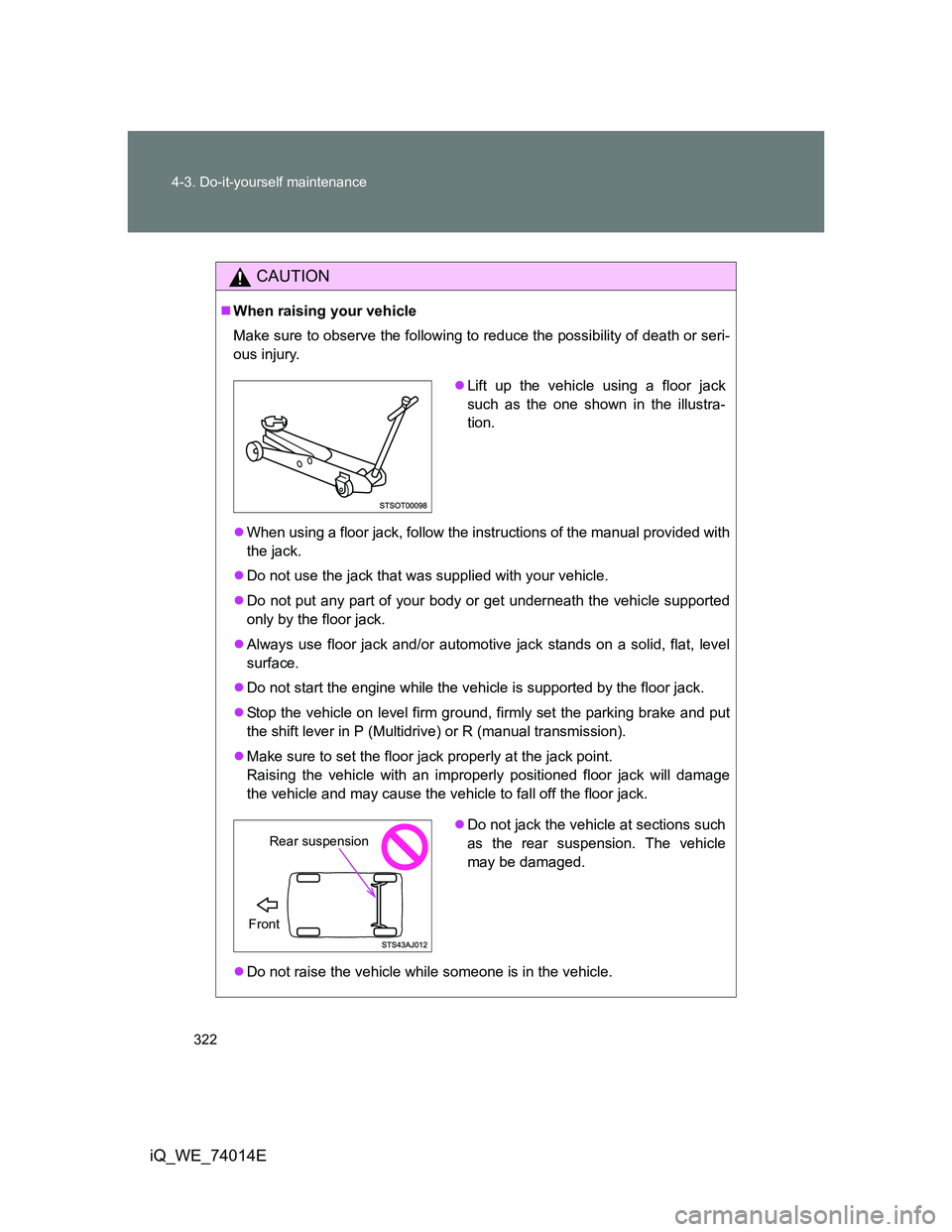
Lift up the vehicle using a floor jack
such as the one shown in the illustra-
tion.
Do not jack the vehicle at sections such
as the rear suspension. The vehicle
may be damaged.
Rear suspension
Front
Page 324 of 476
324
4-3. Do-it-yourself maintenance
iQ_WE_74014E
Replacing the tire
When raising your vehicle with a jack, position the jack correctly.
Improper placement may damage your vehicle or cause injury.
Before jacking up the vehicle
Stop the vehicle on a hard, flat surface.
Set the parking brake.
Shift the shift lever to P (Multidrive) or R (manual transmis-
sion).
Stop the engine.
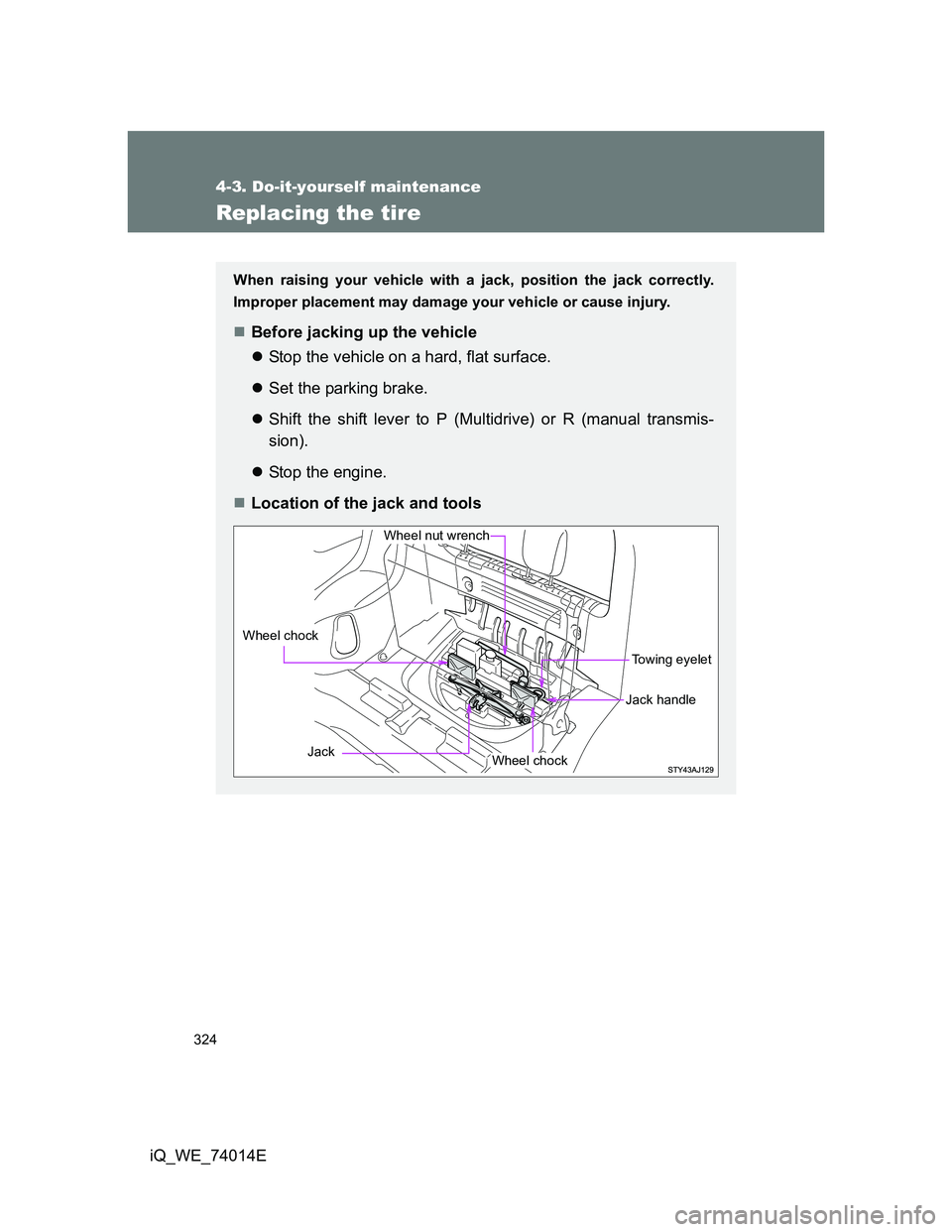
Location of the jack and tools
Towing eyelet
Jack
Wheel nut wrench
Wheel chock
Wheel chock
Jack handle
Page 344 of 476
344 4-3. Do-it-yourself maintenance
iQ_WE_74014E
Before recharging
When recharging, the battery produces hydrogen gas which is flammable
and explosive. Therefore, before recharging:
If recharging with the battery installed on the vehicle, be sure to discon-
nect the ground cable.
Make sure the power switch on the charger is off when connecting and
disconnecting the charger cables to the battery.
After recharging the battery (vehicles with smart entry & start system)
The engine may not start. Follow the procedure below to initialize the sys-
tem.
Shift the shift lever to P (Multidrive) or depress the brake pedal with
the shift lever in N (manual transmission).
Open and close any of the doors.
Restart the engine.
CAUTION
Chemicals in the battery
A battery contains poisonous and corrosive sulfuric acid and may produce
hydrogen gas which is flammable and explosive. To reduce the risk of death
or serious injury, take the following precautions while working on or near bat-
tery:
Do not cause sparks by touching the battery terminals with tools.
Do not smoke or light a match near the battery.
Avoid contact with eyes, skin and clothes.
Never inhale or swallow electrolyte.
Wear protective safety glasses when working near the battery.
Keep children away from the battery.
Where to safely charge the battery
Always charge the battery in an open area. Do not charge the battery in a
garage or closed room where there is not sufficient ventilation.
Page 389 of 476
5
389 5-1. Essential information
When trouble arises
iQ_WE_74014E
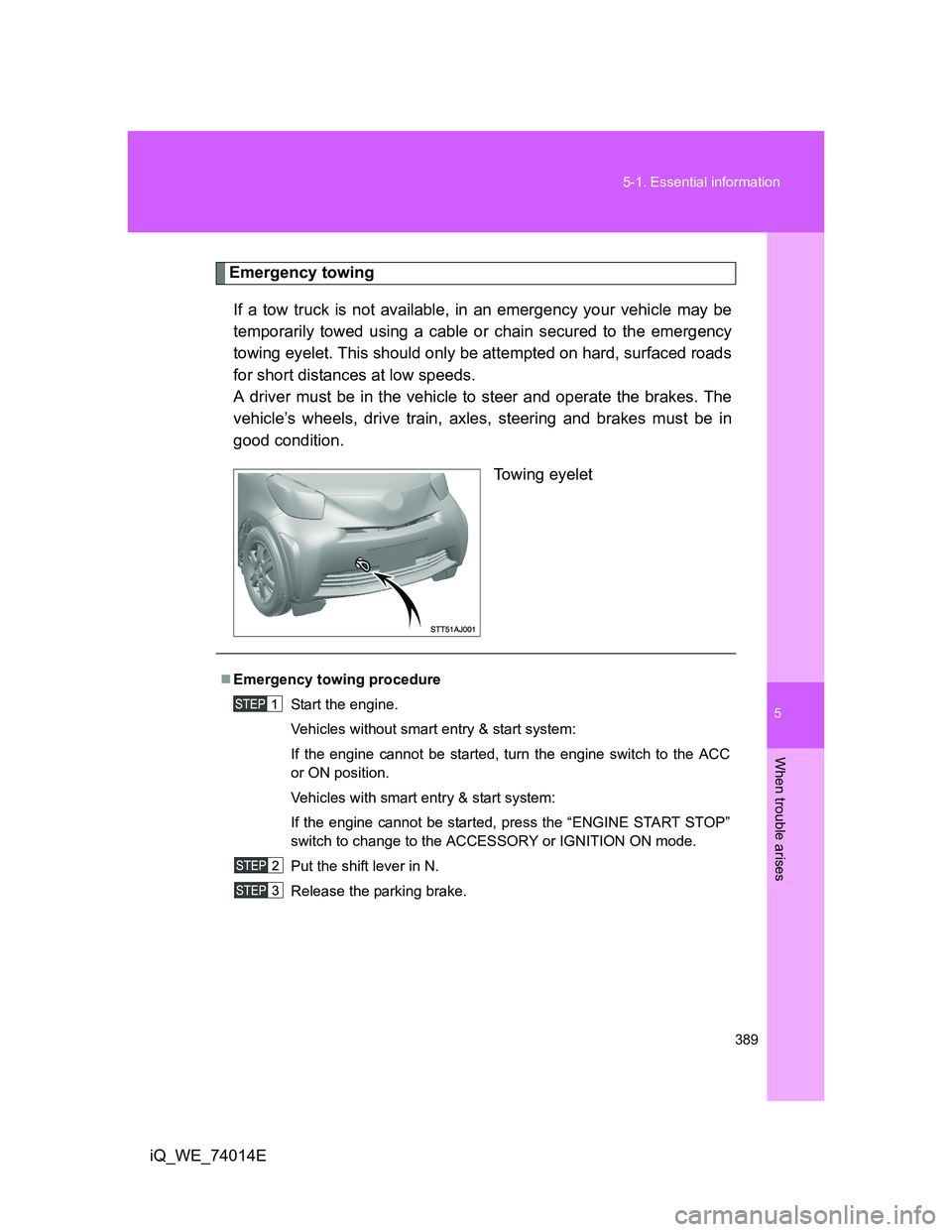
Emergency towing
If a tow truck is not available, in an emergency your vehicle may be
temporarily towed using a cable or chain secured to the emergency
towing eyelet. This should only be attempted on hard, surfaced roads
for short distances at low speeds.
A driver must be in the vehicle to steer and operate the brakes. The
vehicle’s wheels, drive train, axles, steering and brakes must be in
good condition.
Towing eyelet
Emergency towing procedure
Start the engine.
Vehicles without smart entry & start system:
If the engine cannot be started, turn the engine switch to the ACC
or ON position.
Vehicles with smart entry & start system:
If the engine cannot be started, press the “ENGINE START STOP”
switch to change to the ACCESSORY or IGNITION ON mode.
Put the shift lever in N.
Release the parking brake.
Page 390 of 476
390 5-1. Essential information
iQ_WE_74014E
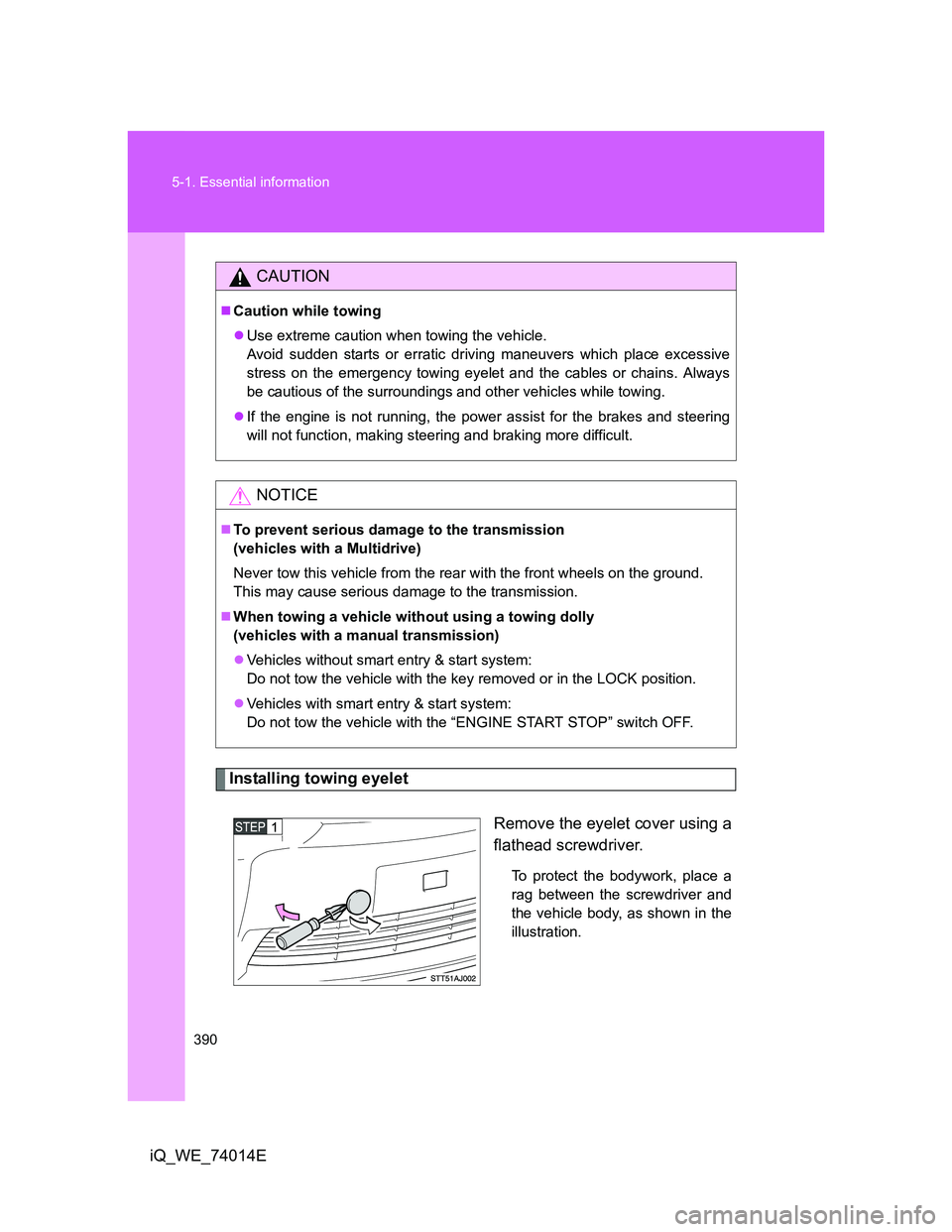
Installing towing eyelet
Remove the eyelet cover using a
flathead screwdriver.
To protect the bodywork, place a
rag between the screwdriver and
the vehicle body, as shown in the
illustration.
CAUTION
Caution while towing
Use extreme caution when towing the vehicle.
Avoid sudden starts or erratic driving maneuvers which place excessive
stress on the emergency towing eyelet and the cables or chains. Always
be cautious of the surroundings and other vehicles while towing.
If the engine is not running, the power assist for the brakes and steering
will not function, making steering and braking more difficult.
NOTICE
To prevent serious damage to the transmission
(vehicles with a Multidrive)
Never tow this vehicle from the rear with the front wheels on the ground.
This may cause serious damage to the transmission.
When towing a vehicle without using a towing dolly
(vehicles with a manual transmission)
Vehicles without smart entry & start system:
Do not tow the vehicle with the key removed or in the LOCK position.
Vehicles with smart entry & start system:
Do not tow the vehicle with the “ENGINE START STOP” switch OFF.