brake TOYOTA IQ 2012 Service Manual
[x] Cancel search | Manufacturer: TOYOTA, Model Year: 2012, Model line: IQ, Model: TOYOTA IQ 2012Pages: 476, PDF Size: 23.52 MB
Page 392 of 476
392 5-1. Essential information
iQ_WE_74014E
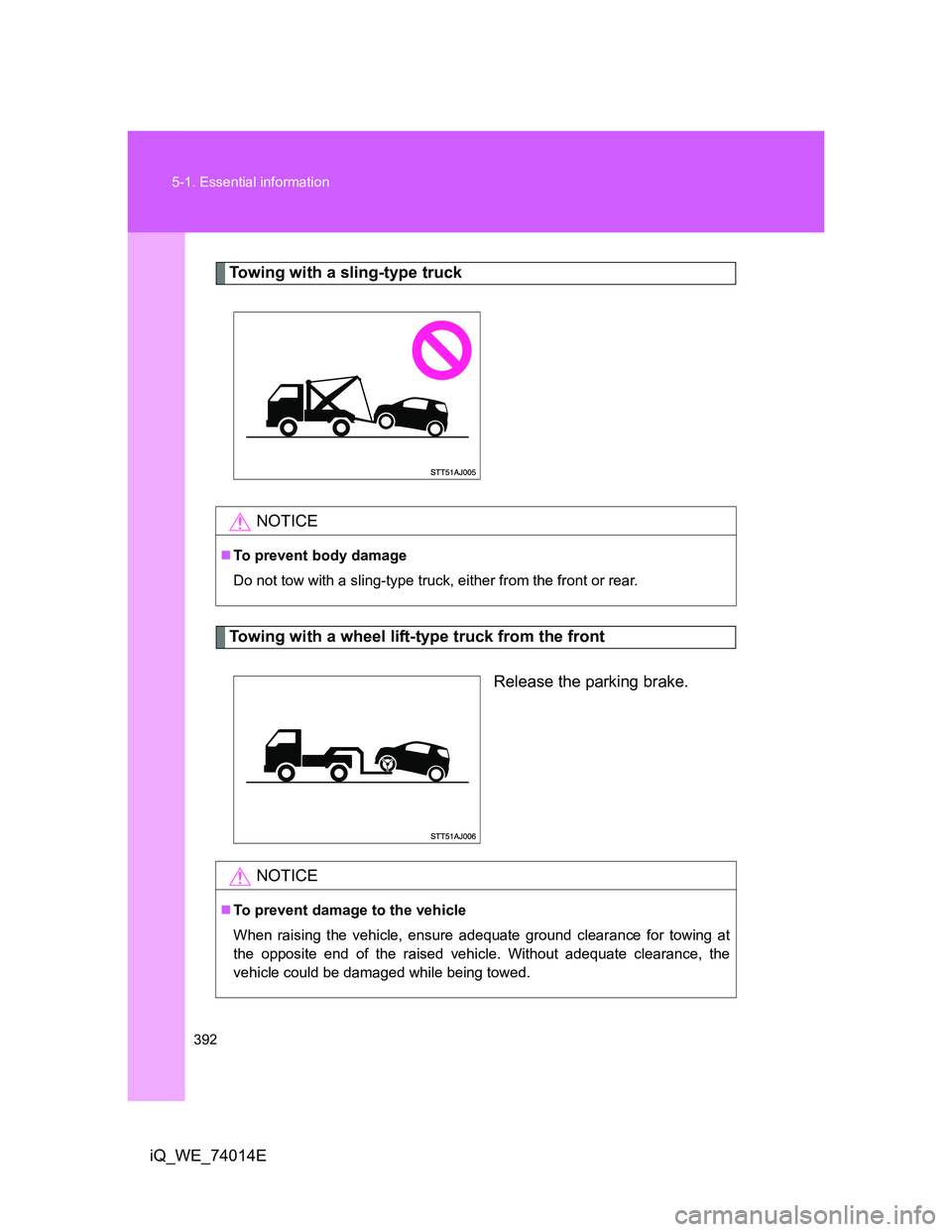
Towing with a sling-type truck
Towing with a wheel lift-type truck from the front
Release the parking brake.
NOTICE
To prevent body damage
Do not tow with a sling-type truck, either from the front or rear.
NOTICE
To prevent damage to the vehicle
When raising the vehicle, ensure adequate ground clearance for towing at
the opposite end of the raised vehicle. Without adequate clearance, the
vehicle could be damaged while being towed.
Page 394 of 476
394 5-1. Essential information
iQ_WE_74014E
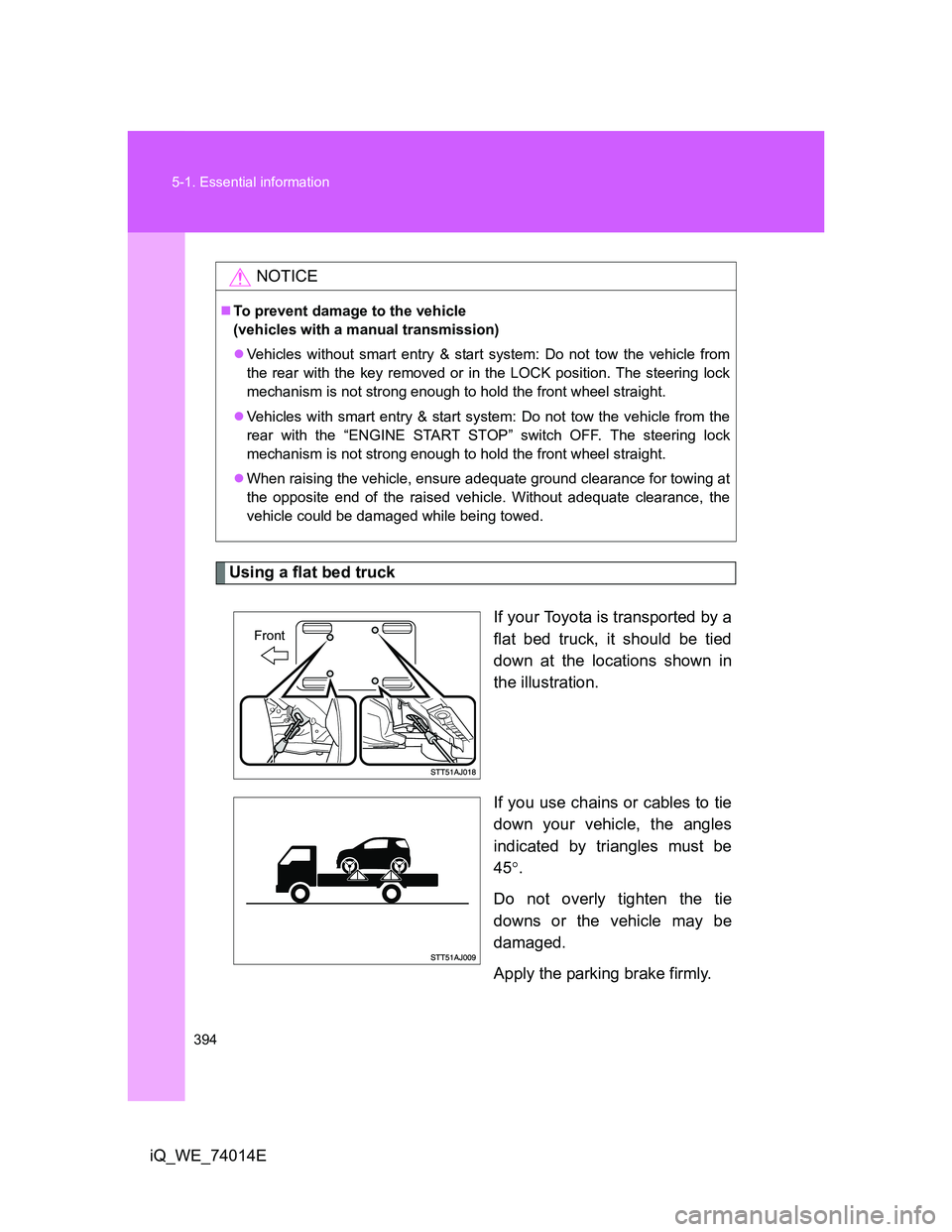
Using a flat bed truck
If your Toyota is transported by a
flat bed truck, it should be tied
down at the locations shown in
the illustration.
If you use chains or cables to tie
down your vehicle, the angles
indicated by triangles must be
45.
Do not overly tighten the tie
downs or the vehicle may be
damaged.
Apply the parking brake firmly.
NOTICE
To prevent damage to the vehicle
(vehicles with a manual transmission)
Vehicles without smart entry & start system: Do not tow the vehicle from
the rear with the key removed or in the LOCK position. The steering lock
mechanism is not strong enough to hold the front wheel straight.
Vehicles with smart entry & start system: Do not tow the vehicle from the
rear with the “ENGINE START STOP” switch OFF. The steering lock
mechanism is not strong enough to hold the front wheel straight.
When raising the vehicle, ensure adequate ground clearance for towing at
the opposite end of the raised vehicle. Without adequate clearance, the
vehicle could be damaged while being towed.
Front
Page 395 of 476
5
395
5-1. Essential information
When trouble arises
iQ_WE_74014E
If you think something is wrong
If you notice any of the following symptoms, your vehicle probably
needs adjustment or repair. Contact any authorized Toyota dealer or
repairer, or another duly qualified and equipped professional, as
soon as possible.
Visible symptoms
Fluid leaks under the vehicle
(Water dripping from the air conditioning system after use is
normal.)
Flat-looking tires or uneven tire wear
High engine coolant temperature warning light flashes or
comes on
Low engine coolant temperature indicator comes on or does
not come on continuously
Audible symptoms
Changes in exhaust sound
Excessive tire squeal when cornering
Strange noises related to the suspension system
Pinging or other noises related to the engine
Operational symptoms
Engine missing, stumbling or running rough
Appreciable loss of power
Vehicle pulls heavily to one side when braking
Vehicle pulls heavily to one side when driving on a level road
Loss of brake effectiveness, spongy feeling, pedal almost
touches the floor
Page 397 of 476
5
397
When trouble arises
iQ_WE_74014E
5-2. Steps to take in an emergency
If a war ning light tur ns on or a warning buzzer sounds...
Stop the vehicle immediately. Continuing to drive the vehicle may be dangerous.
The following warning indicates a possible problem in the brake sys-
tem. Immediately stop the vehicle in a safe place and contact any
authorized Toyota dealer or repairer, or another duly qualified and
equipped professional.
*: Parking brake engaged warning buzzer:
The buzzer sounds to indicate that parking brake is still engaged (with the
vehicle having reached a speed of 5 km/h [3 mph])
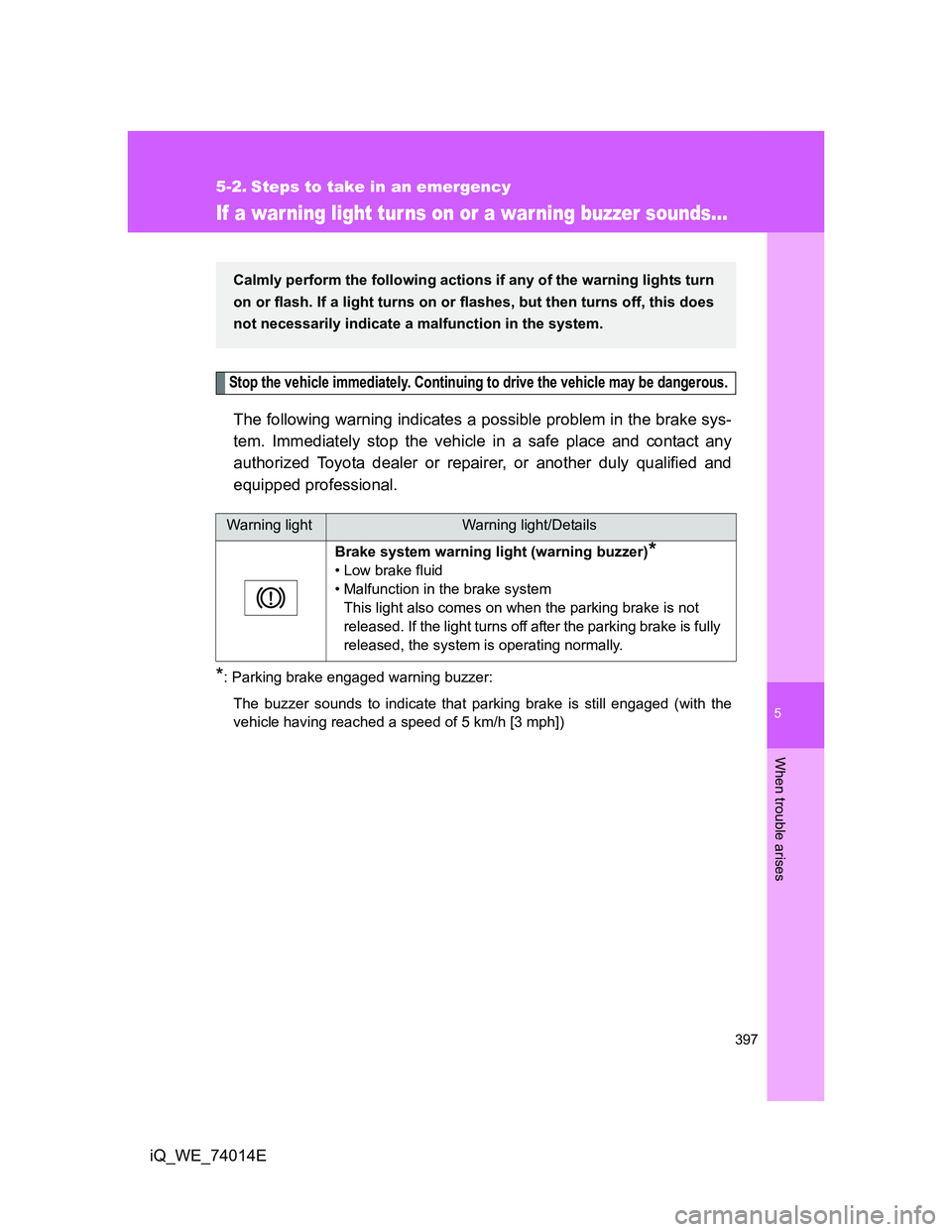
Warning lightWarning light/Details
Brake system warning light (warning buzzer)
*
• Low brake fluid
• Malfunction in the brake system
This light also comes on when the parking brake is not
released. If the light turns off after the parking brake is fully
released, the system is operating normally.
Calmly perform the following actions if any of the warning lights turn
on or flash. If a light turns on or flashes, but then turns off, this does
not necessarily indicate a malfunction in the system.
Page 399 of 476
5
399 5-2. Steps to take in an emergency
When trouble arises
iQ_WE_74014E
Follow the correction procedures.
After taking the specified steps to correct the suspected problem,
check that the warning light turns off.
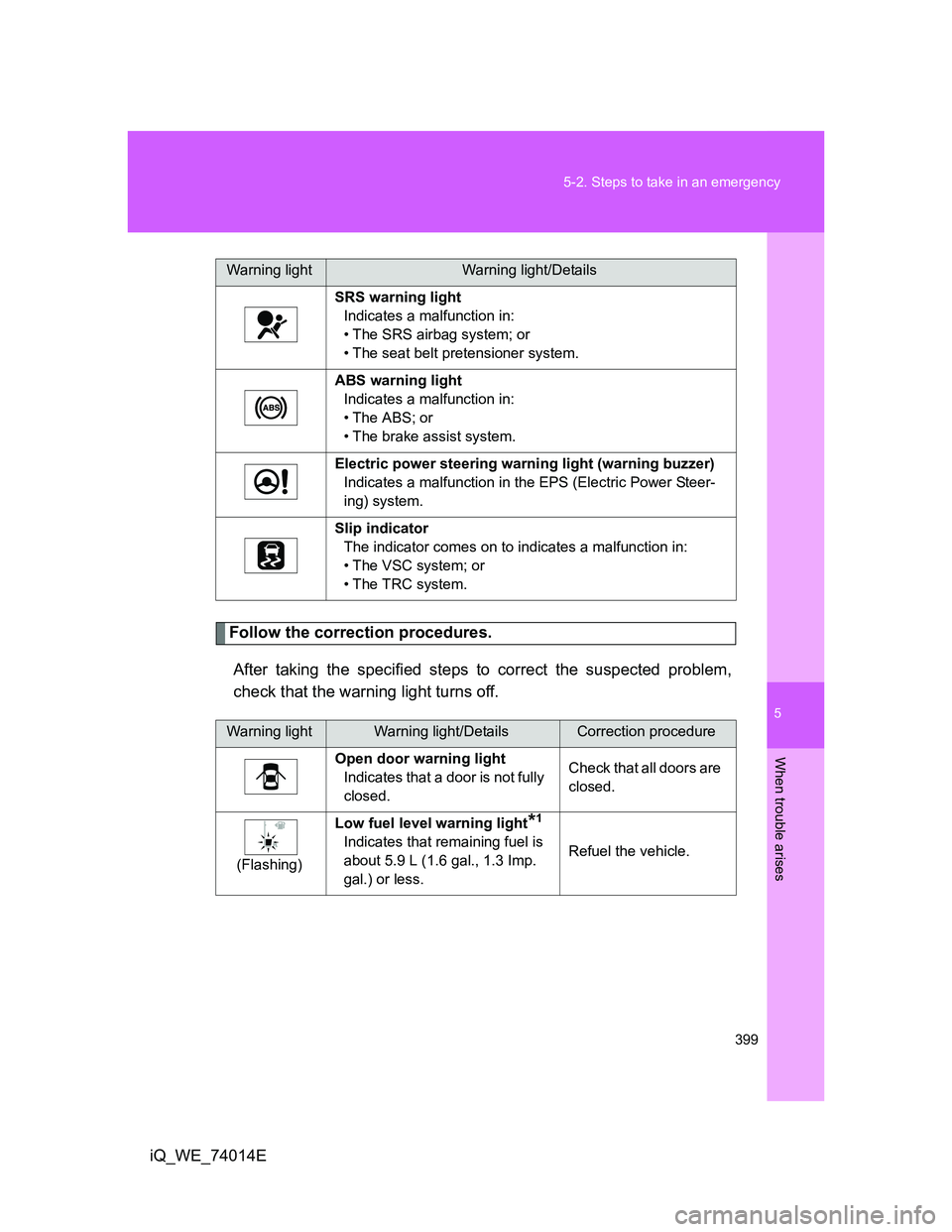
SRS warning light
Indicates a malfunction in:
• The SRS airbag system; or
• The seat belt pretensioner system.
ABS warning light
Indicates a malfunction in:
• The ABS; or
• The brake assist system.
Electric power steering warning light (warning buzzer)
Indicates a malfunction in the EPS (Electric Power Steer-
ing) system.
Slip indicator
The indicator comes on to indicates a malfunction in:
• The VSC system; or
• The TRC system.
Warning lightWarning light/DetailsCorrection procedure
Open door warning light
Indicates that a door is not fully
closed.Check that all doors are
closed.
(Flashing)Low fuel level warning light
*1
Indicates that remaining fuel is
about 5.9 L (1.6 gal., 1.3 Imp.
gal.) or less.Refuel the vehicle.
Warning lightWarning light/Details
Page 405 of 476
5
405
5-2. Steps to take in an emergency
When trouble arises
iQ_WE_74014E
If you have a flat tire
A puncture caused by a nail or screw passing through the tire tread
can be repaired temporarily using the emergency tire puncture repair
kit. (The kit contains a bottle of sealant. The sealant can be used only
once to temporarily repair one tire without removing the nail or
screw from the tire.) After temporarily repairing the tire with the kit,
have the tire repaired or replaced by any authorized Toyota dealer or
repairer, or another duly qualified and equipped professional.
Before repairing the tire
Stop the vehicle in a safe place on a hard, flat surface.
Set the parking brake.
Shift the shift lever to P (Multidrive) or N (manual transmis-
sion).
Stop the engine.
Turn on the emergency flashers.
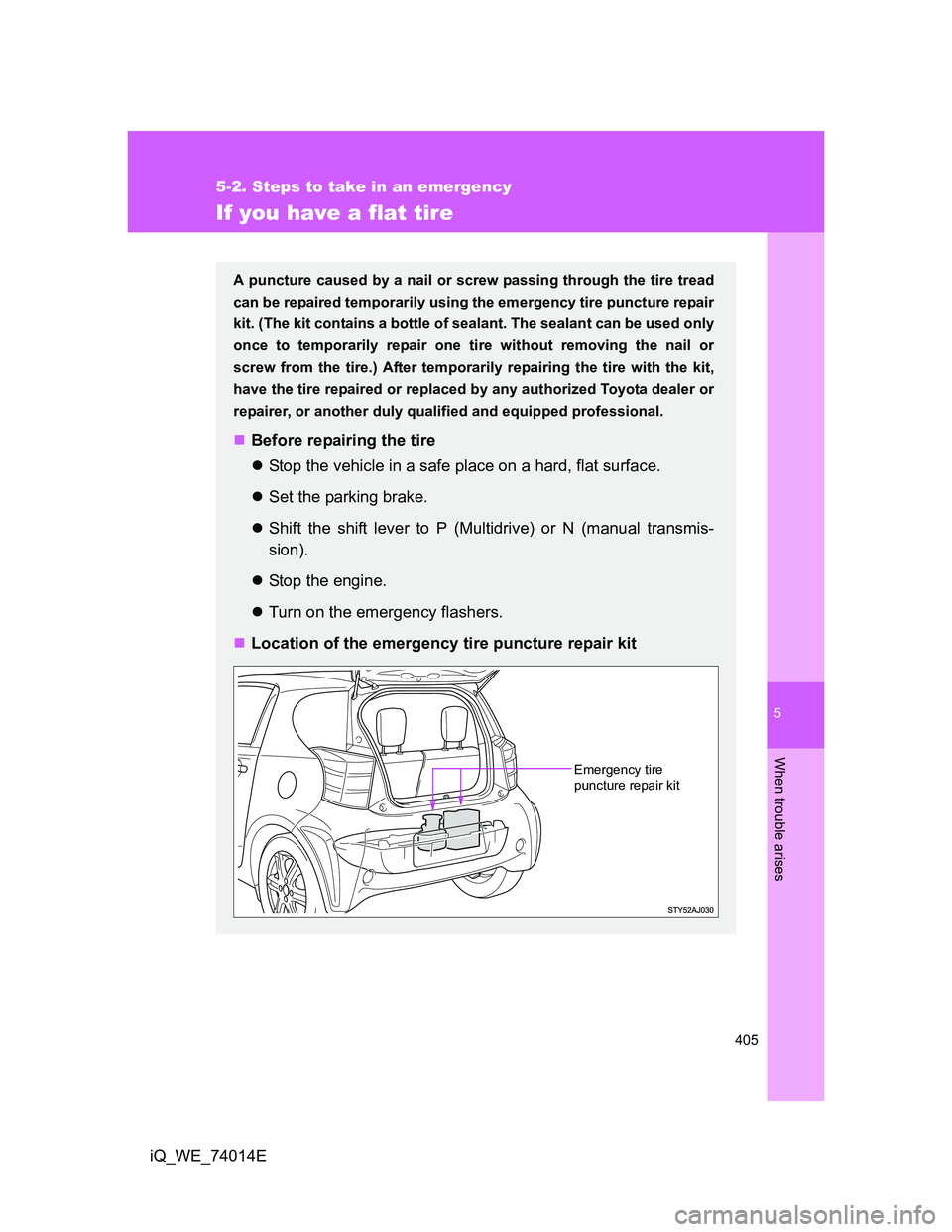
Location of the emergency tire puncture repair kit
Emergency tire
puncture repair kit
Page 420 of 476
420 5-2. Steps to take in an emergency
iQ_WE_74014E
CAUTION
Do not drive the vehicle with a flat tire
Do not continue driving with a flat tire.
Driving even a short distance with a flat tire can damage the tire and the
wheel beyond repair.
Driving with a flat tire may cause a circumferential groove on the side wall. In
such a case, the tire may explode when using a repair kit.
Caution while driving
Store the repair kit in the luggage room.
Otherwise, the repair kit may fly out and break in events such as sudden
braking, and may cause an accident.
The repair kit is exclusively only for your vehicle.
Do not use repair kit on other vehicles, which could lead to an accident
causing death or serious injury.
Do not use repair kit for tires that are different size than the original ones,
or for any other purpose. If the tires have not been completely repaired, it
could lead to an accident causing death or serious injury.
Precautions for use of the sealant
Ingesting the sealant is hazardous to your health. If you ingest sealant,
consume as much water as possible, and then immediately consult a doc-
tor.
If sealant gets in eyes or adheres to skin, immediately wash it off with
water. If discomfort persists, consult a doctor.
When fixing the flat tire
Stop your vehicle in a safe and flat area.
Do not touch the wheels or the area around the brakes immediately after
the vehicle has been driven.
After the vehicle has been driven, the wheels and the area around the
brakes may be extremely hot. Touching these areas with hands, feet or
other body parts may result in burns.
Connect the valve and hose securely with the tire installed on the vehicle.
If the hose is not properly connected to the valve, air leakage may occur
as sealant may be sprayed out.
Page 424 of 476
424 5-2. Steps to take in an emergency
iQ_WE_74014E
Emergency start function (vehicles with smart entry & start system)
When the engine does not start, the following steps can be used as
an interim measure to start the engine if the “ENGINE START STOP”
switch is functioning normally.
Set the parking brake.
Put the shift lever in P (Multidrive) or N (manual transmission).
Set the “ENGINE START STOP” switch to the ACCESSORY
mode.
Vehicles with a Multidrive: Press and hold the “ENGINE
START STOP” switch for about 15 seconds while depressing
the brake pedal firmly.
Vehicles with a manual transmission: Press and hold the
“ENGINE START STOP” switch for about 15 seconds while
depressing the brake pedal firmly and also depressing the
clutch pedal.
Even if the engine can be started using the above steps, the system
may be malfunctioning. Have the vehicle checked by any authorized
Toyota dealer or repairer, or another duly qualified and equipped pro-
fessional.
The starter motor does not turn over, the interior lights and
headlights do not turn on, or the horn does not sound.
One of the following may be the cause of the problem.
One or both of the battery terminals may be disconnected.
The battery may be discharged. (P. 430)
There may be a malfunction in the steering lock system (vehi-
cles with smart entry & start system).
Contact any authorized Toyota dealer or repairer, or another duly
qualified and equipped professional, if the problem cannot be
repaired, or if repair procedures are unknown.
Page 425 of 476
5
425
5-2. Steps to take in an emergency
When trouble arises
iQ_WE_74014E
If the shift lever cannot be shifted from P (vehicles with a Multidrive)
If the shift lever cannot be shifted with your foot on the brake, there
may be a problem with the shift lock system (a system to prevent
accidental operation of the shift lever). Have the vehicle inspected by
any authorized Toyota dealer or repairer, or another duly qualified
and equipped professional, immediately.
The following steps may be used as an emergency measure to
ensure that the shift lever can be shifted.
Set the parking brake.
Vehicles without smart entry & start system: Turn the
engine switch to the ACC position.
Vehicles with smart entry & start system: Turn the “ENGINE
START STOP” switch to the ACCESSORY mode.
Depress the brake pedal.
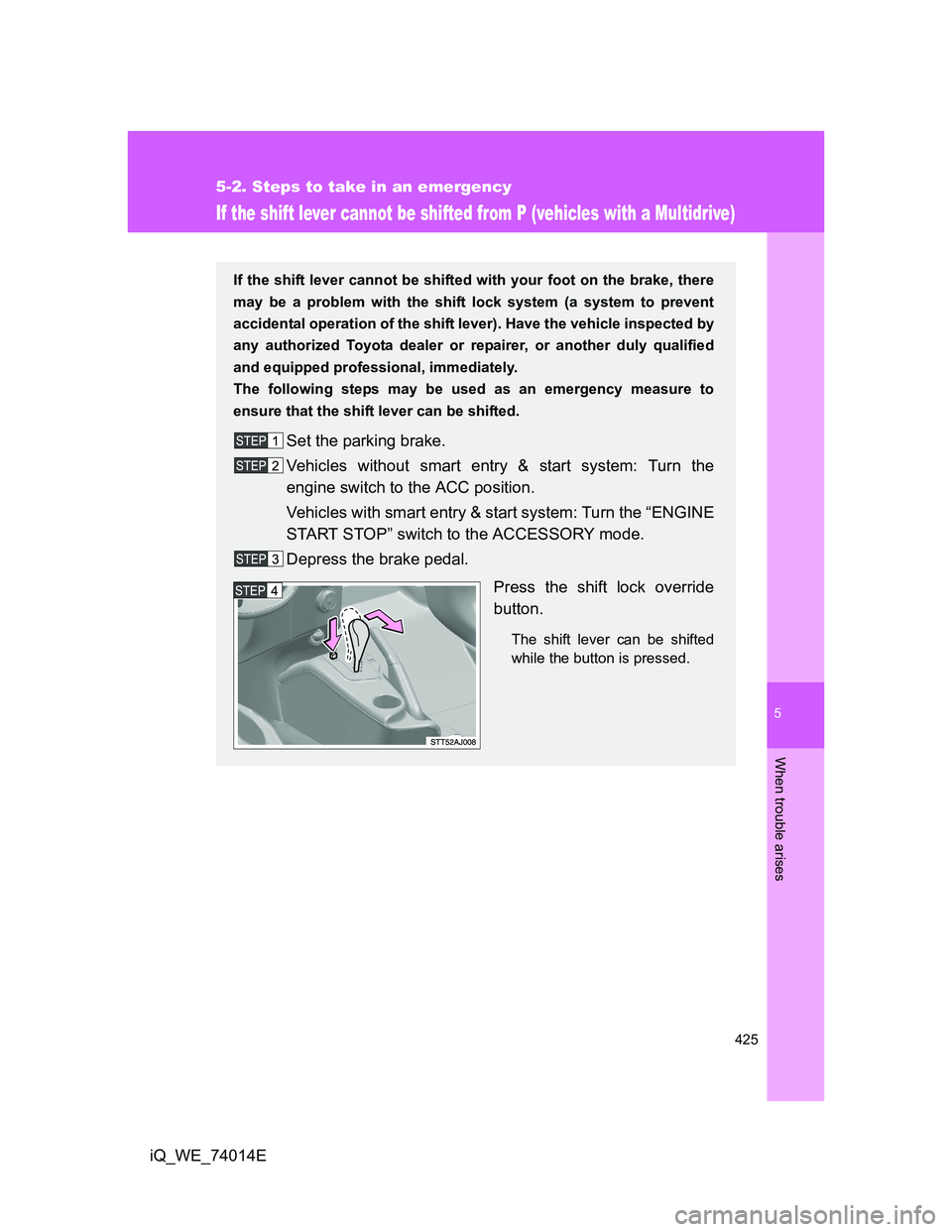
Press the shift lock override
button.
The shift lever can be shifted
while the button is pressed.
Page 427 of 476
5
427
5-2. Steps to take in an emergency
When trouble arises
iQ_WE_74014E
If the electronic key does not operate properly (vehicles with smart entr y & start system)
Locking and unlocking the doors (with the mechanical key)
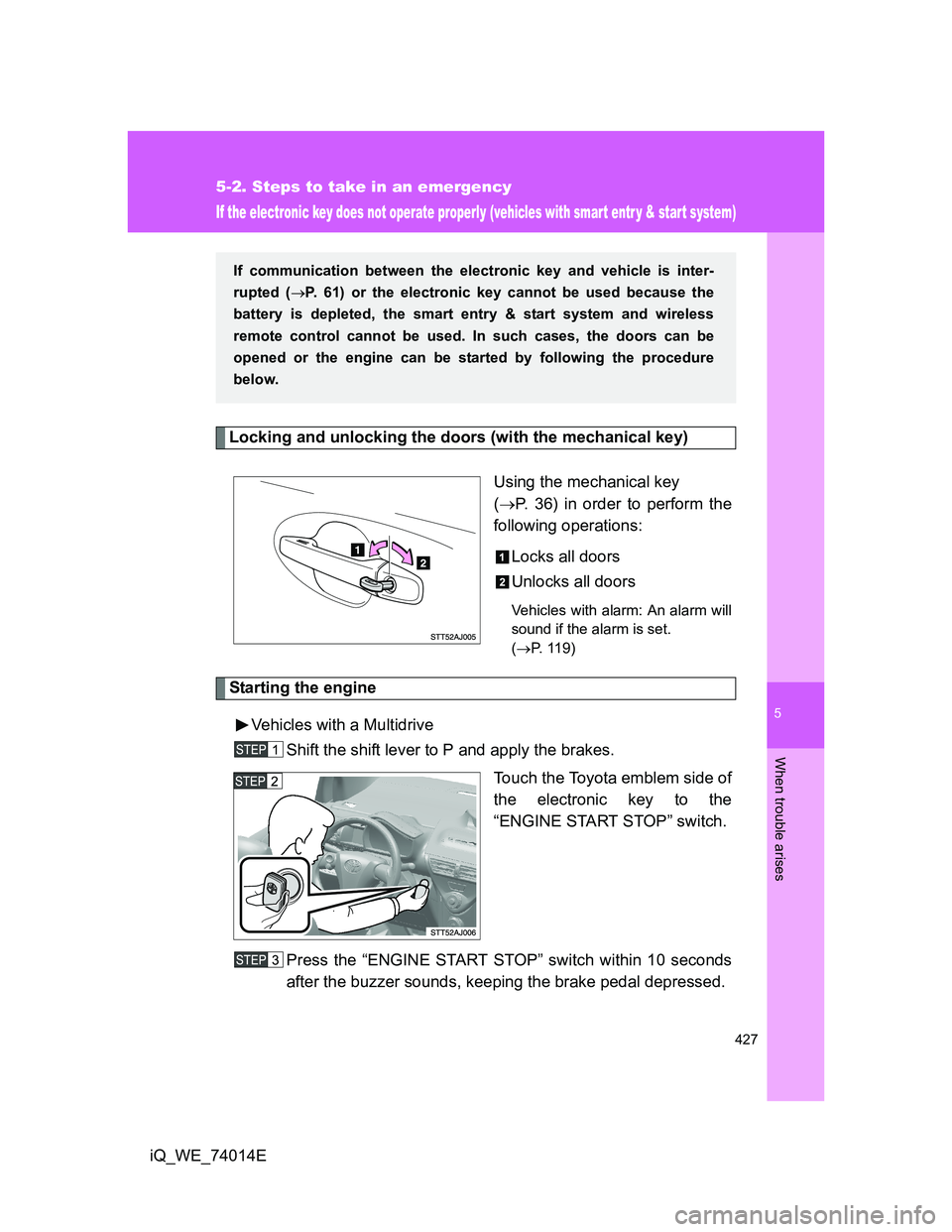
Using the mechanical key
(P. 36) in order to perform the
following operations:
Locks all doors
Unlocks all doors
Vehicles with alarm: An alarm will
sound if the alarm is set.
(P. 119)
Starting the engine
Vehicles with a Multidrive
Shift the shift lever to P and apply the brakes.
Touch the Toyota emblem side of
the electronic key to the
“ENGINE START STOP” switch.
Press the “ENGINE START STOP” switch within 10 seconds
after the buzzer sounds, keeping the brake pedal depressed.
If communication between the electronic key and vehicle is inter-
rupted (P. 61) or the electronic key cannot be used because the
battery is depleted, the smart entry & start system and wireless
remote control cannot be used. In such cases, the doors can be
opened or the engine can be started by following the procedure
below.