wheel TOYOTA IQ 2012 Repair Manual
[x] Cancel search | Manufacturer: TOYOTA, Model Year: 2012, Model line: IQ, Model: TOYOTA IQ 2012Pages: 476, PDF Size: 23.52 MB
Page 328 of 476
328 4-3. Do-it-yourself maintenance
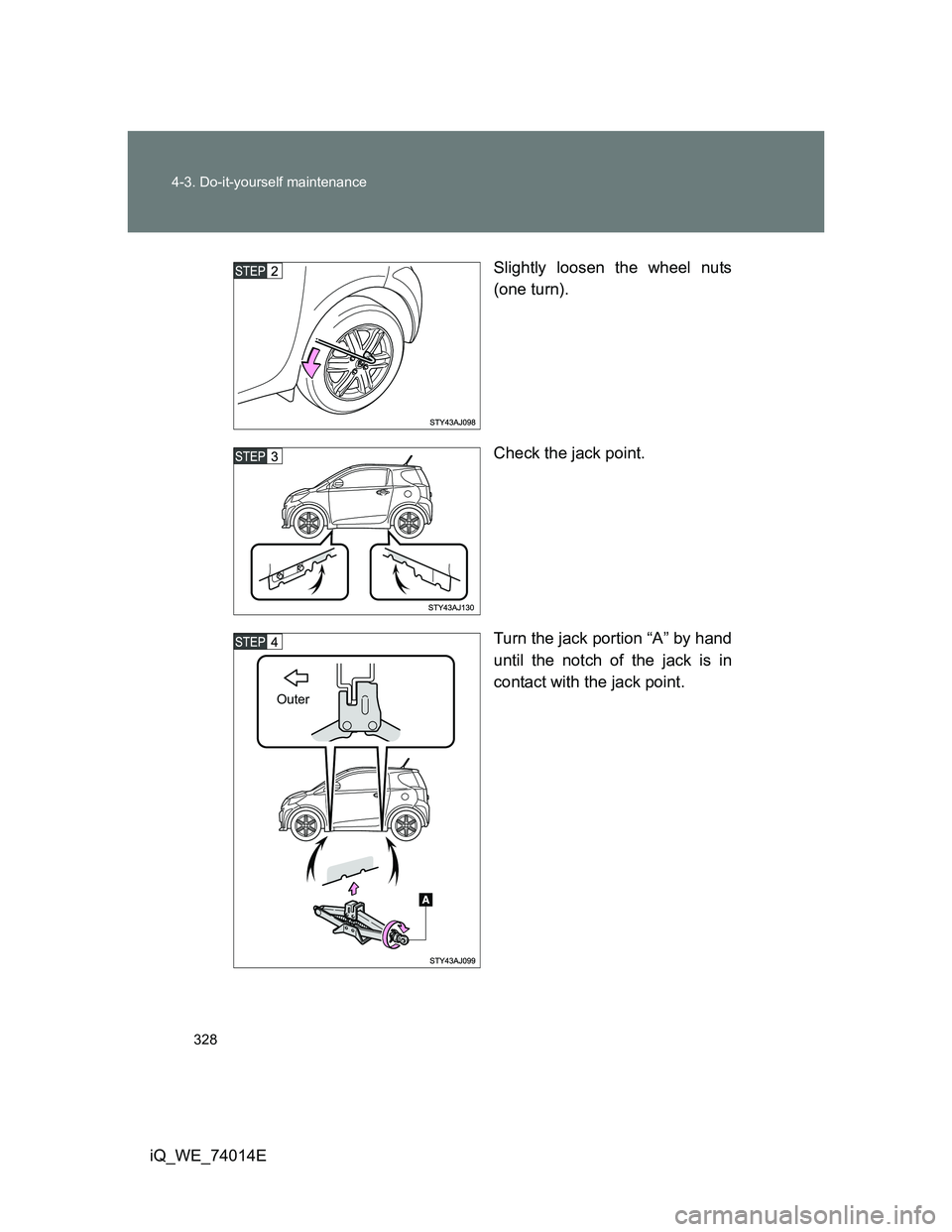
iQ_WE_74014ESlightly loosen the wheel nuts
(one turn).
Check the jack point.
Turn the jack portion “A” by hand
until the notch of the jack is in
contact with the jack point.
Outer
Page 329 of 476
329 4-3. Do-it-yourself maintenance
4
Maintenance and care
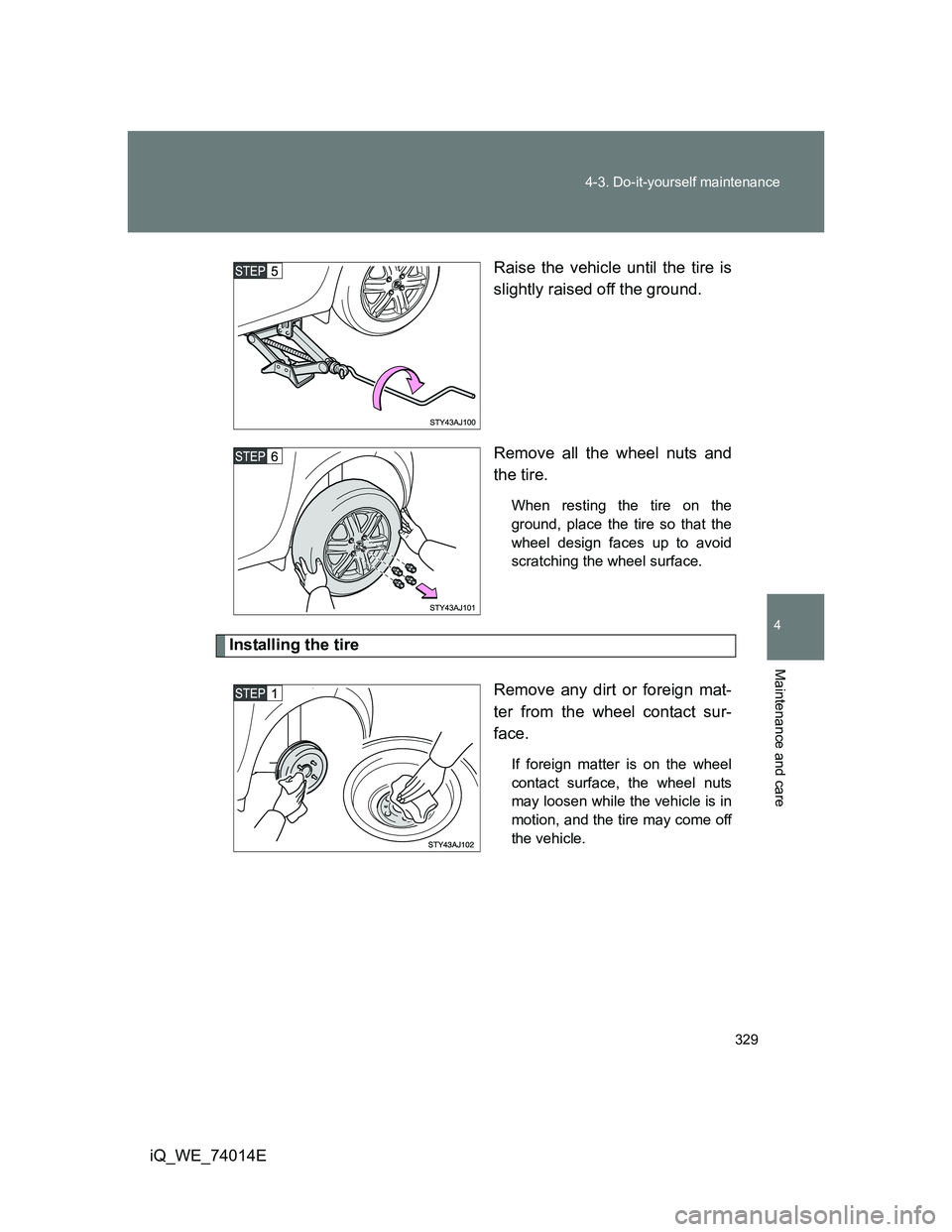
iQ_WE_74014ERaise the vehicle until the tire is
slightly raised off the ground.
Remove all the wheel nuts and
the tire.
When resting the tire on the
ground, place the tire so that the
wheel design faces up to avoid
scratching the wheel surface.
Installing the tire
Remove any dirt or foreign mat-
ter from the wheel contact sur-
face.
If foreign matter is on the wheel
contact surface, the wheel nuts
may loosen while the vehicle is in
motion, and the tire may come off
the vehicle.
Page 330 of 476
330 4-3. Do-it-yourself maintenance
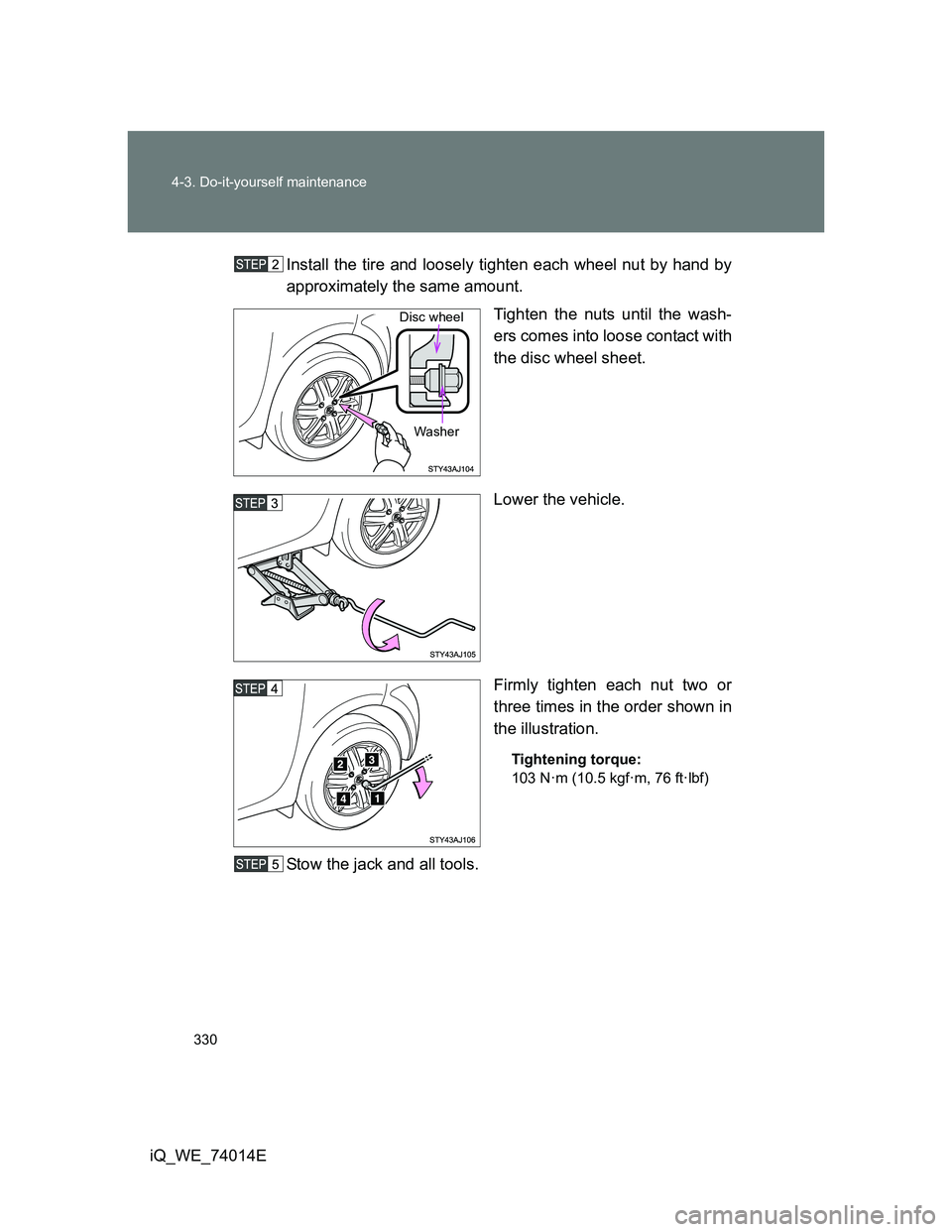
iQ_WE_74014EInstall the tire and loosely tighten each wheel nut by hand by
approximately the same amount.
Tighten the nuts until the wash-
ers comes into loose contact with
the disc wheel sheet.
Lower the vehicle.
Firmly tighten each nut two or
three times in the order shown in
the illustration.
Tightening torque:
103 N·m (10.5 kgf·m, 76 ft·lbf)
Stow the jack and all tools.
Disc wheel
Washer
Page 332 of 476
332 4-3. Do-it-yourself maintenance
iQ_WE_74014E
CAUTION
Using the jack
Improper use of the jack may lead to death or serious injuries due to the
vehicle suddenly falling off the jack.
Do not use the jack for any purpose other than replacing tires or installing
and removing tire chains.
Only use the jack that comes with this vehicle for replacing a tire.
Do not use it on other vehicles, and do not use other jacks for replacing
tires on this vehicle.
Always check that the jack is securely set to the jack point.
Do not put any part of your body under the vehicle supported by a jack.
Do not start or run the engine while your vehicle is supported by the jack.
Do not raise the vehicle while someone is in it.
When raising the vehicle, do not put an object on or under the jack.
Do not raise the vehicle to a height greater than that required to replace
the tire.
Use a jack stand if it is necessary to get under the vehicle.
Take particular care when lowering the vehicle to ensure that no one working
on or near the vehicle will be injured.
Replacing a tire
Observe the following precautions to reduce the risk of death or serious
injury.
Have the wheel nuts tightened with a torque wrench to 103 N·m (10.5
kgf·m, 76 ft·lbf) as soon as possible after changing wheels.
Failure to follow these precautions could cause the nuts to loosen and the
wheel may fall off, which could lead to an accident causing death or seri-
ous injury.
Do not attach a heavily damaged wheel ornament, as it may fly off the
wheel while the vehicle is moving.
Page 333 of 476
333 4-3. Do-it-yourself maintenance
4
Maintenance and care
iQ_WE_74014E
CAUTION
When installing the wheel nuts
Never use oil or grease on the wheel bolts or wheel nuts.
Oil and grease may cause the wheel nuts to be excessively tightened,
leading to bolt or disc wheel damage. In addition, the oil or grease can
cause the wheel nuts to loosen and the wheel may fall off, causing an acci-
dent and resulting in death or serious injury. Remove any oil or grease
from the wheel bolts or wheel nuts.
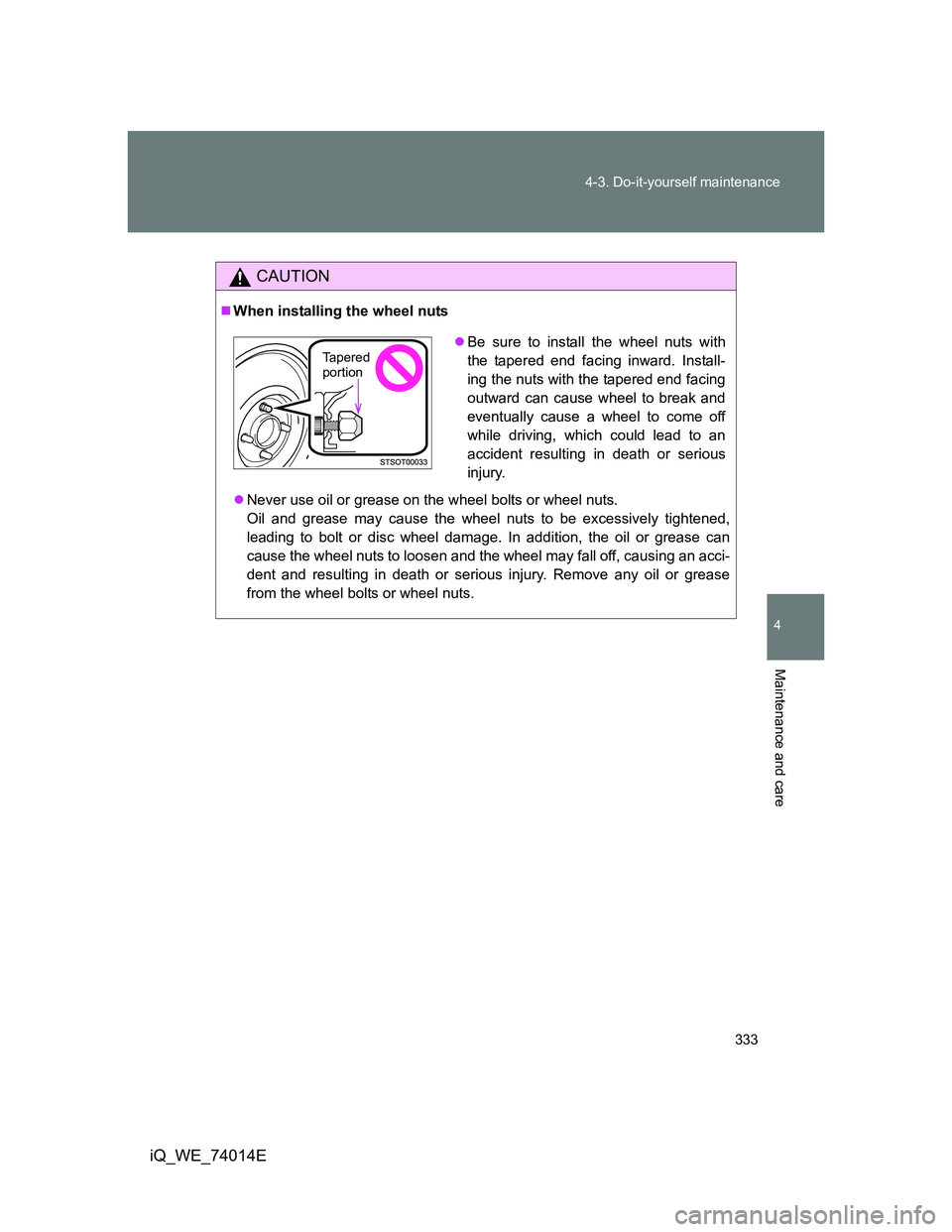
Be sure to install the wheel nuts with
the tapered end facing inward. Install-
ing the nuts with the tapered end facing
outward can cause wheel to break and
eventually cause a wheel to come off
while driving, which could lead to an
accident resulting in death or serious
injury.Tapered
portion
Page 349 of 476
349 4-3. Do-it-yourself maintenance
4
Maintenance and care
iQ_WE_74014E
NOTICE
Driving on rough roads
Take particular care when driving on roads with loose surfaces or potholes.
These conditions may cause losses in tire inflation pressure, reducing the
cushioning ability of the tires. In addition driving on rough roads may cause
damage to the tires themselves, as well as the vehicle’s wheels and body.
If tire inflation pressures become low while driving
Do not continue driving, or your tires and/or wheels may be ruined.
Page 351 of 476
351 4-3. Do-it-yourself maintenance
4
Maintenance and care
iQ_WE_74014E
CAUTION
Proper inflation is critical to save tire performance
Keep your tires properly inflated. Otherwise, the following conditions may
occur and result in an accident causing death or serious injury.
Excessive wear
Uneven wear
Poor handling
Possibility of blowouts resulting from overheated tires
Poor sealing of the tire bead
Wheel deformation and/or tire separation
A greater possibility of tire damage from road hazards
NOTICE
When inspecting and adjusting tire inflation pressure
Be sure to reinstall the tire valve caps.
Without the valve caps, dirt or moisture could get into the valve and cause
air leakage, which could result in an accident. If the caps have been lost,
replace them as soon as possible.
Page 352 of 476
352
4-3. Do-it-yourself maintenance
iQ_WE_74014E
Wheels
If a wheel is bent, cracked or heavily corroded, it should be replaced.
Otherwise, the tire may separate from the wheel or cause loss of
handling control.
Wheel selection
When replacing wheels, care should be taken to ensure that
they are equivalent to those removed in load capacity, diameter,
rim width, and inset
*.
Replacement wheels are available at any authorized Toyota
dealer or repairer, or another duly qualified and equipped profes-
sional.
*: Conventionally referred to as “offset”.
Toyota does not recommend using:
Wheels of different sizes or types
Used wheels
Bent wheels that have been straightened
Aluminum wheel precautions (if equipped)
Use only Toyota wheel nuts and wrenches designed for use
with your aluminum wheels.
When rotating, repairing or changing your tires, check that the
wheel nuts are still tight after driving 1600 km (1000 miles).
Be careful not to damage the aluminum wheels when using
tire chains.
Use only Toyota genuine balance weights or equivalent and a
plastic or rubber hammer when balancing your wheels.
Page 353 of 476
353 4-3. Do-it-yourself maintenance
4
Maintenance and care
iQ_WE_74014E
CAUTION
When replacing wheels
Do not use wheels that are a different size from those recommended in the
Owner’s Manual, as this may result in loss of handling control.
Never use an inner tube in a leaking wheel which is designed for a tube-
less tire. Doing so may result in an accident, causing death or serious
injury.
When installing the wheel nuts
Be sure to install the wheel nuts with the tapered end facing inward.
(P. 333)
Page 388 of 476
388
5-1. Essential information
iQ_WE_74014E
If your vehicle needs to be towed
Before towing
The following may indicate a problem with your transmission. Contact
any authorized Toyota dealer or repairer, or another duly qualified
and equipped professional, before towing.
The engine is running, but the vehicle will not move.
The vehicle makes an abnormal sound.
If towing is necessary, we recommend having your vehicle towed by
any authorized Toyota dealer or repairer, or another duly qualified
and equipped professional, such as or a commercial towing service,
using a lift-type truck or a flat bed truck.
Use a safety chain system for all towing, and abide by all state/pro-
vincial and local laws.
If towing from the front, the vehicle’s rear wheels and axles must be
in good condition. (P. 392)
If they are damaged, use a towing dolly or flat bed truck.