engine TOYOTA IQ 2013 Service Manual
[x] Cancel search | Manufacturer: TOYOTA, Model Year: 2013, Model line: IQ, Model: TOYOTA IQ 2013Pages: 372, PDF Size: 7.77 MB
Page 142 of 372
142 2-4. Using other driving systems
■If the slip indicator comes on
There is a malfunction in the TRAC and VSC systems. Contact your Scion
dealer and have your Scion inspected.
■ EPS operation sound
When the steering wheel is operated, a motor sound (whirring sound) may
be heard. This does not indicate a malfunction.
■ Reduced effectiveness of the EPS system
The effectiveness of the EPS system is reduced to prevent the system from
overheating when there is frequent steering input over an extended period of
time. The steering wheel may feel heavy as a result. Should this occur,
refrain from excessive steering input or stop the vehicle and turn the engine
off. The EPS system should return to normal within 10 minutes.
CAUTION
■The ABS does not operate effectively when
●The limits of tire gripping performance have been exceeded (such as
excessively worn tires on a snow covered road).
● The vehicle hydroplanes while driving at high speed on the wet or slick
road.
■ Stopping distance when the ABS is operating may exceed that of nor-
mal conditions
The ABS is not designed to shorten the vehicle’s stopping distance. Always
maintain a safe distance from the vehicle in front of you, especially in the fol-
lowing situations.
● When driving on dirt, gravel or snow-covered roads
● When driving with tire chains
● When driving over bumps in the road
● When driving over roads with potholes or uneven roads
■ When VSC is activated
The slip indicator flashes. Always drive carefully. Reckless driving may
cause an accident. Exercise particular care when the indicator flashes.
Page 149 of 372
149
2-5. Driving information
2
When driving
Winter driving tips
Carry out the necessary preparations and inspections before driving
the vehicle in winter. Always drive the vehicle in a manner appropri-
ate to the prevailing weather conditions.
■ Pre-winter preparations
●Use fluids that are appropriate to the prevailing outside tem-
peratures.
• Engine oil
• Engine coolant
• Washer fluid
● Have the vehicle fitted with four snow tires or purchase a set
of tire chains for the front tires.
Ensure that all tires are the same size and brand, and that chains
match the size of the tires.
■Before driving the vehicle
Perform the following according to the driving conditions.
●Do not try to forcibly open a window, scrape an outside rear
view mirror surface or move a wiper or outside rear view mir-
ror that is frozen. Pour warm water over the frozen area to
melt the ice. Wipe away the water immediately to prevent it
from freezing.
● To ensure proper operation of th e climate control system fan,
remove any snow that has accumulated on the air inlet vents
in front of the windshield.
● Remove any ice that has accumu lated on the vehicle chassis.
● Periodically check for and remove any excess ice or snow
that may have accumulated in the wheel well or on the
brakes.
Page 161 of 372
161
3-1. Using the air conditioning system
and defogger
3
Interior features
■Air conditioning odors
●During use, various odors from inside and outside the vehicle may enter
into and accumulate in the air conditioning system. This may then cause
odor to be emitted from the vents.
● To reduce potential odors from occurring:
It is recommended that the air conditioning system be set to outside air
mode prior to turning the vehicle off.
CAUTION
■To prevent the windshield from fogging up
Do not set the air outlet selection dial to during cool air operation in
extremely humid weather. The difference between the temperature of the
outside air and that of the windshield can cause the outer surface of the
windshield to fog up, blocking your vision.
NOTICE
■To prevent battery discharge
Do not leave the air conditioning system on longer than necessary when the
engine is stopped.
Page 162 of 372
162
3-1. Using the air conditioning system and defogger
Rear window defogger
: If equipped
■The rear window defogger can be operated when
The engine switch is in the ON position.
NOTICE
■ To prevent battery discharge
Do not leave the rear window defogger on longer than necessary when the
engine is stopped.
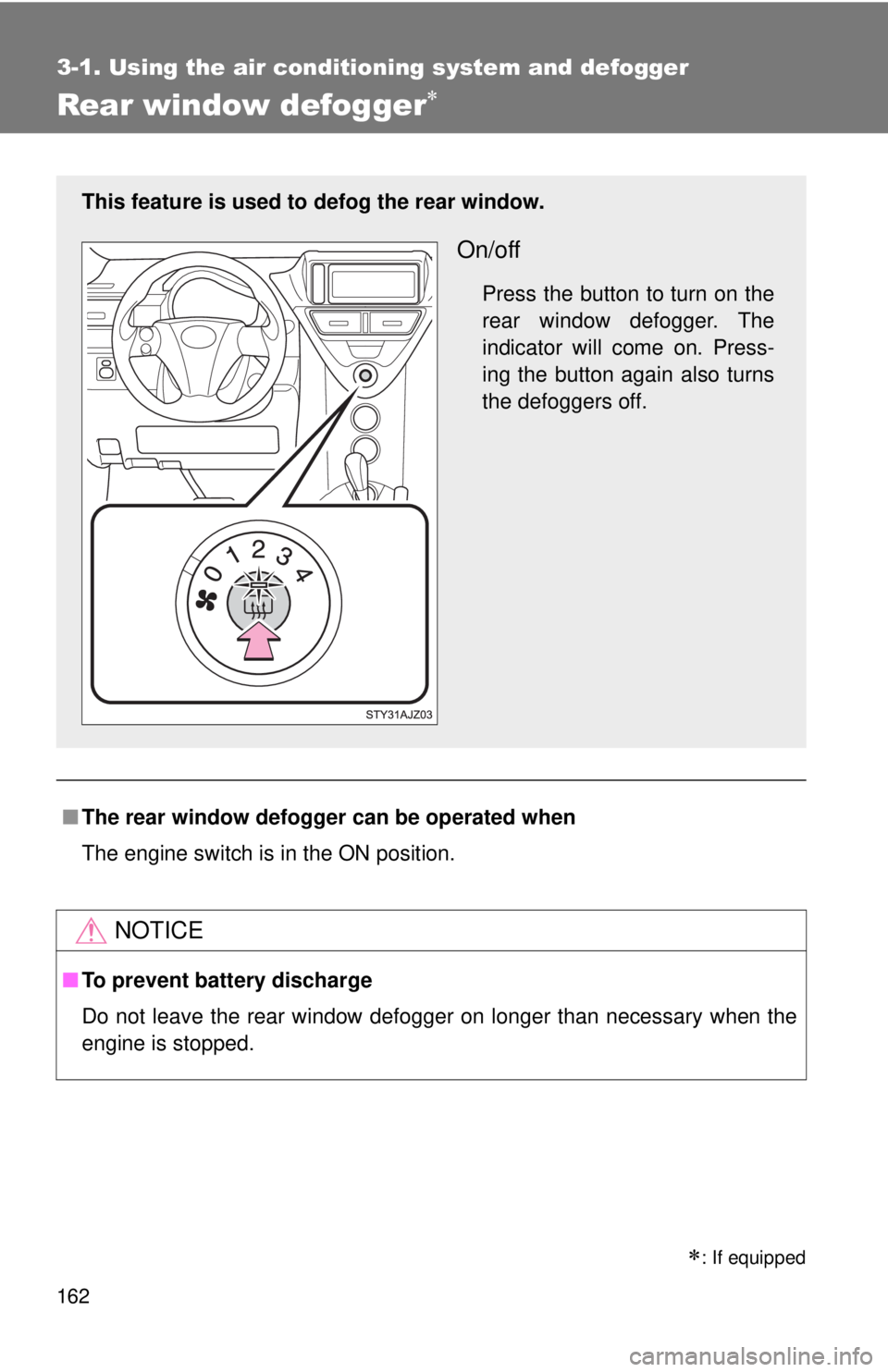
This feature is used to defog the rear window.
On/off
Press the button to turn on the
rear window defogger. The
indicator will come on. Press-
ing the button again also turns
the defoggers off.
Page 163 of 372
163
3-1. Using the air conditioning system and defogger
3
Interior features
Rear window and outside rear view mirror defoggers
: If equipped
■The rear window and outside rear vi ew mirror defoggers can be oper-
ated when
The engine switch is in the ON position.
CAUTION
■ When the outside rear view mirror defoggers are on
Do not touch the rear view mirror surfaces, as they can become very hot and
burn you.
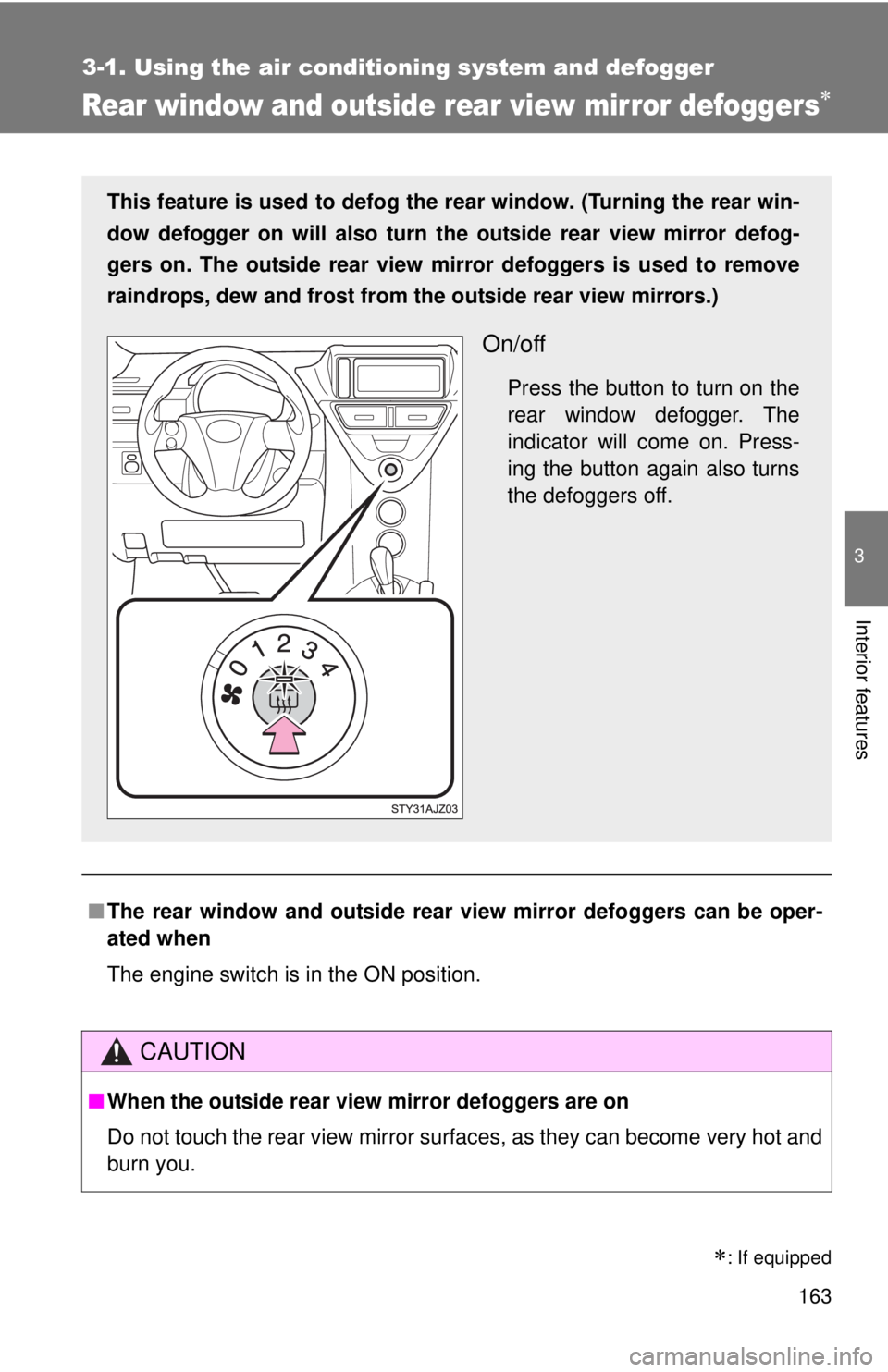
This feature is used to defog the rear window. (Turning the rear win-
dow defogger on will also turn th e outside rear view mirror defog-
gers on. The outside rear view mi rror defoggers is used to remove
raindrops, dew and frost from the outside rear view mirrors.)
On/off
Press the button to turn on the
rear window defogger. The
indicator will come on. Press-
ing the button again also turns
the defoggers off.
Page 164 of 372

164 3-1. Using the air conditioning system and defogger
NOTICE
■To prevent battery discharge
Do not leave the rear window and outside rear view mirror defoggers on
longer than necessary when the engine is stopped.
Page 167 of 372

167
3
Interior features
3-3. Using the interior lights
Interior lights list
■Illuminated entry system
When the interior light switch is in the position, the interior light auto-
matically turns on/off according to whether the doors are locked/unlocked,
whether the doors are open/closed, and the engine switch position.
■ To prevent the battery from being discharged
If the interior light remains on when the door is not fully closed and the inte-
rior light switch is in the position, the light will go off automatically
after 20 minutes.
■ Customization that can be configured at Scion dealer
Settings (e.g. The time elapsed before lights turn off) can be changed.
(Customizable features P. 339)
Interior light (P. 168)
Page 175 of 372
175
3-5. Other interior features
3
Interior features
Power outlet
■The power outlet can be used when
The engine switch is in the ACC or ON position.
NOTICE
■To avoid damaging the power outlet
Close the power outlet lid when the power outlet is not in use.
Foreign objects or liquids that enter the power outlet may cause a short cir-
cuit.
■ To prevent the fuse from being blown
Do not use an accessory that uses more than 12 V 10 A.
■ To prevent battery discharge
Do not use the power outlet longer than necessary when the engine is not\
running.
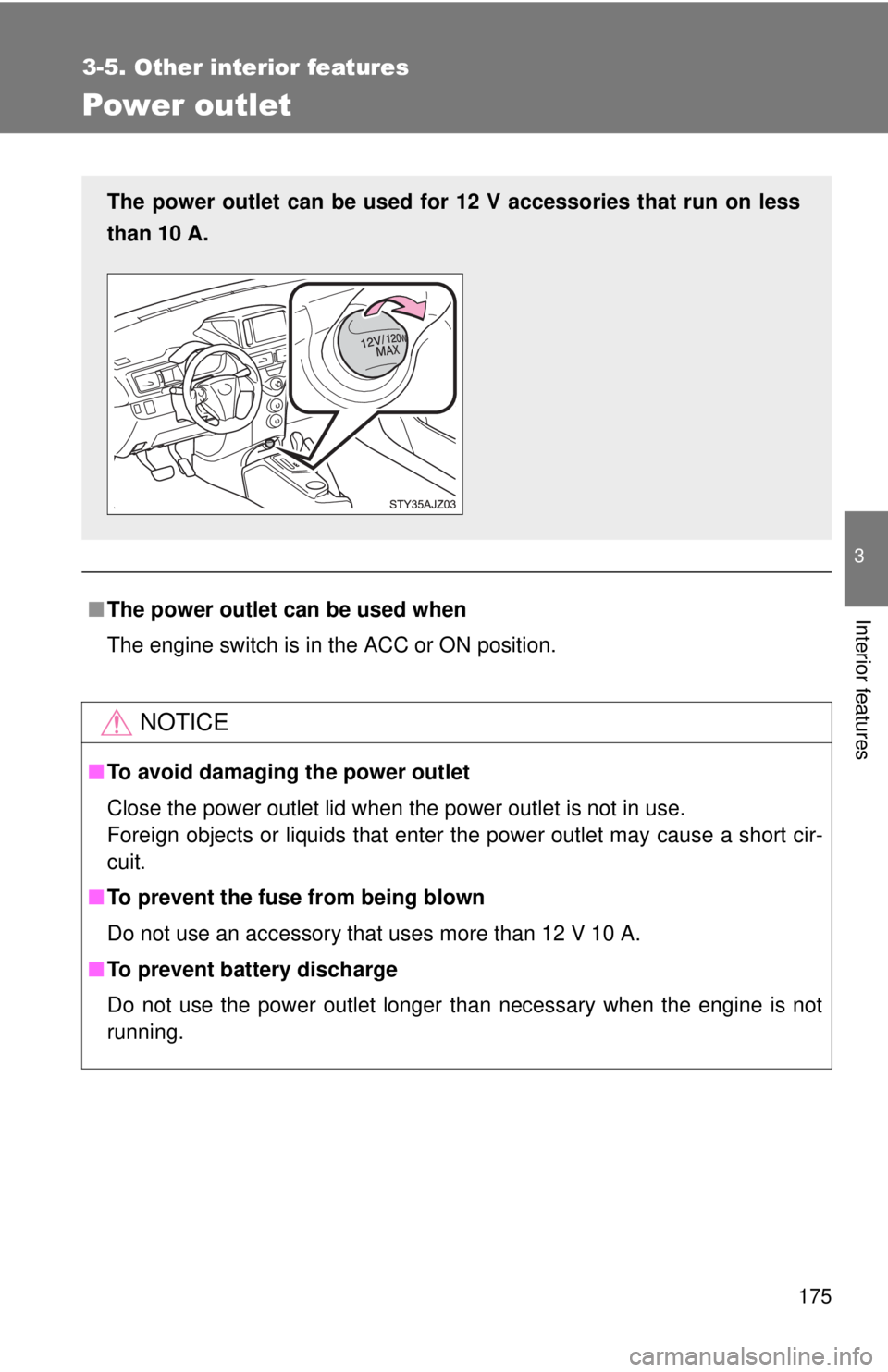
The power outlet can be used for 12 V accessories that run on less
than 10 A.
Page 178 of 372
178 3-5. Other interior features
CAUTION
Observe the following precautions.
Failure to do so may cause the driver’s floor mat to slip, possibly interfering
with the pedals while driving. An unexpectedly high speed may result or it may
become difficult to stop the vehicle, leading to a serious accident.
■When installing the driver’s floor mat
●Do not use floor mats designed for other models or different model year
vehicles, even if they are Scion Genuine floor mats.
● Only use floor mats designed for the driver’s seat.
● Always install the floor mat securely using the retaining hooks (clips) pro-
vided.
● Do not use two or more floor mats on top of each other.
● Do not place the floor mat bottom-side up or upside-down.
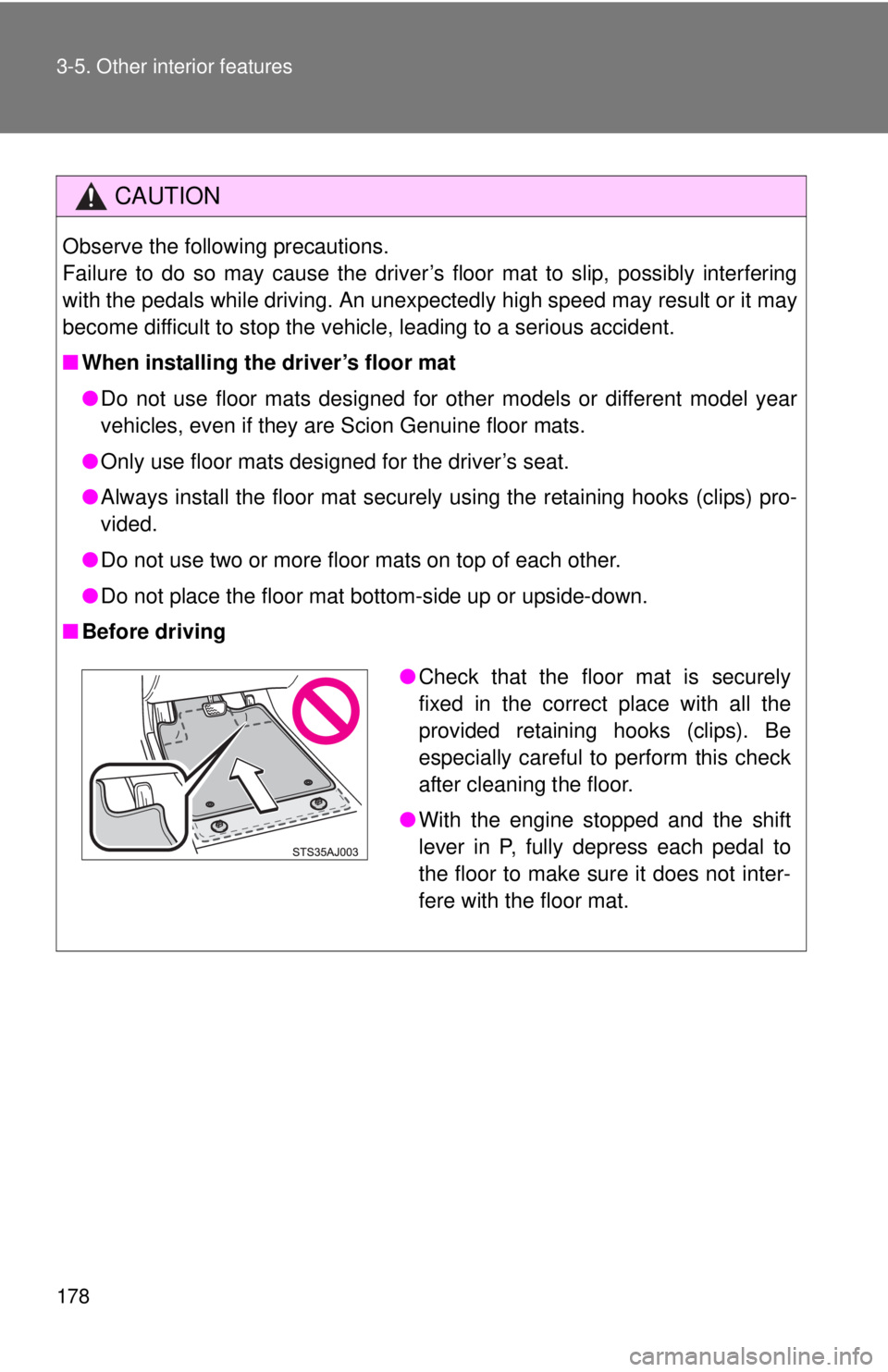
■ Before driving
●Check that the floor mat is securely
fixed in the correct place with all the
provided retaining hooks (clips). Be
especially careful to perform this check
after cleaning the floor.
● With the engine stopped and the shift
lever in P, fully depress each pedal to
the floor to make sure it does not inter-
fere with the floor mat.
Page 181 of 372
Maintenance and care4
181
4-1. Maintenance and careCleaning and protecting the vehicle exterior......... 182
Cleaning and protecting the vehicle interior.......... 185
4-2. Maintenance Maintenance requirements .................. 188
General maintenance....... 190
Emission inspection and maintenance (I/M)
programs........................ 193 4-3. Do-it-yourself maintenance
Do-it-yourself service precautions .................... 194
Hood ................................ 197
Positioning a floor jack ..... 199
Replacing the tire ............. 202
Engine compartment ........ 208
Tires ................................. 220
Tire inflation pressure ...... 228
Wheels ............................. 232
Air conditioning filter......... 234
Key battery ....................... 238
Checking and replacing fuses .............................. 240
Light bulbs........................ 251