key TOYOTA IQ 2014 User Guide
[x] Cancel search | Manufacturer: TOYOTA, Model Year: 2014, Model line: IQ, Model: TOYOTA IQ 2014Pages: 376, PDF Size: 7.76 MB
Page 62 of 376
62
1-6. Theft deterrent system
Engine immobilizer system
: If equipped
■System maintenance
The vehicle has a maintenance-free type engine immobilizer system.
■ Conditions that may cause the system to malfunction
●If the key is in contact with a metallic object
● If the key is in close proximity to or touching a key to the security system
(key with a built-in transponder chip) of another vehicle
■ Certifications for the engine immobilizer system
For vehicles sold in Canada
Operation is subject to the following two conditions: (1) this device may not
cause interference, and (2) this device must accept any interference, includ-
ing interference that may cause undesired operation of the device.
The vehicle's keys have built-in tran sponder chips that prevent the
engine from starting if the key has not been previously registered in
the vehicle's on-board computer.
Never leave the keys inside the vehicle when you leave the vehicle.
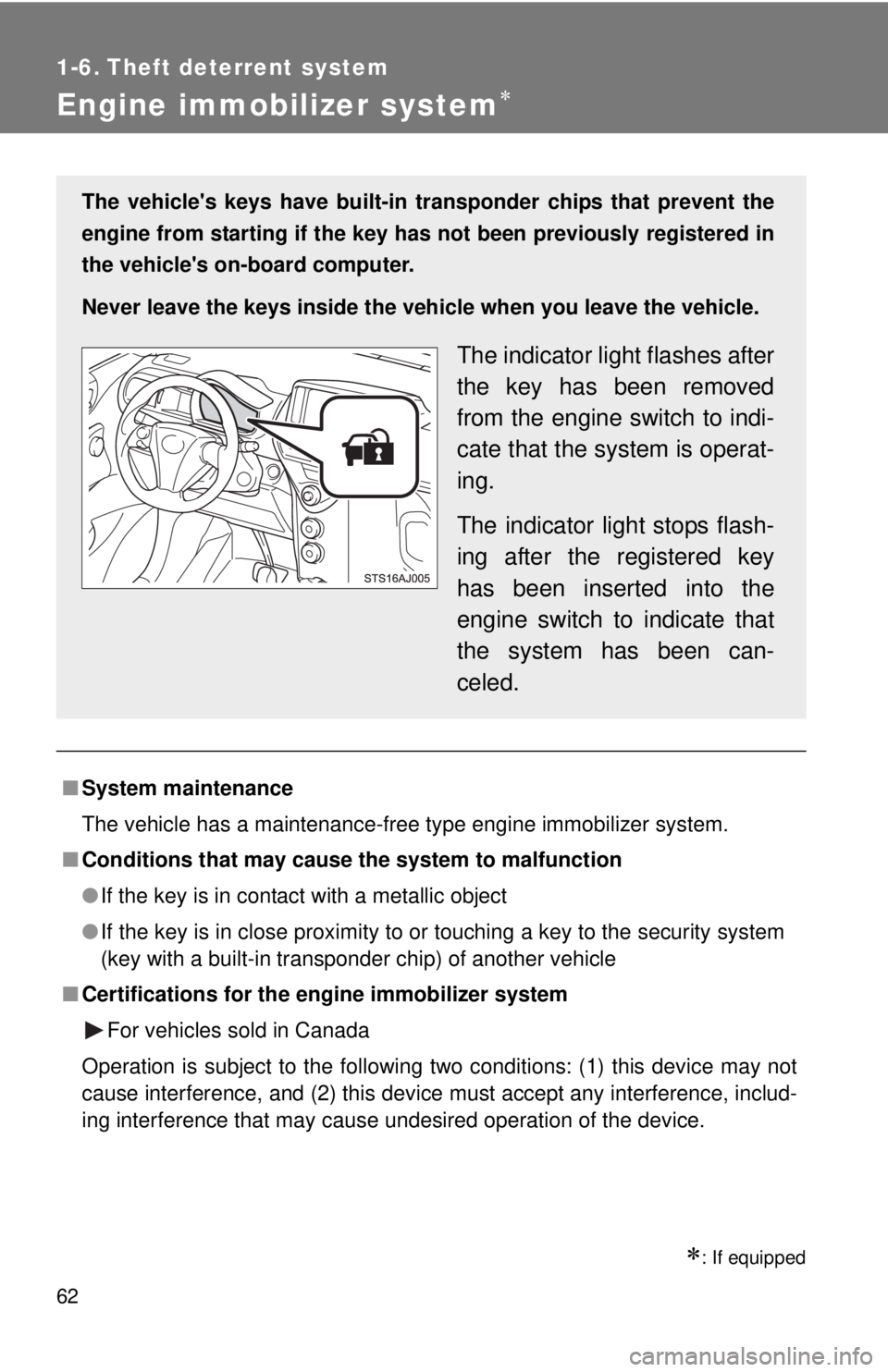
The indicator light flashes after
the key has been removed
from the engine switch to indi-
cate that the system is operat-
ing.
The indicator light stops flash-
ing after the registered key
has been inserted into the
engine switch to indicate that
the system has been can-
celed.
Page 79 of 376
79
1-7. Safety information
1
Before driving
CAUTION
■
SRS airbag precautions
●If a vinyl cover is put on the area where the SRS knee airbags will deploy,
be sure to remove it.
● Do not use seat accessories which cover the parts where the SRS side
airbags and SRS seat cushion airbags inflate as they may interfere with
inflation of the airbags. Such accessories may prevent the side airbags
and seat cushion airbags from activating correctly, disable the system or
cause the side airbags and seat cushion airbags to inflate accidentally,
resulting in death or serious injury.
● Do not strike or apply significant levels of force to the area of the SRS air-
bag components.
Doing so can cause the SRS airbags to malfunction.
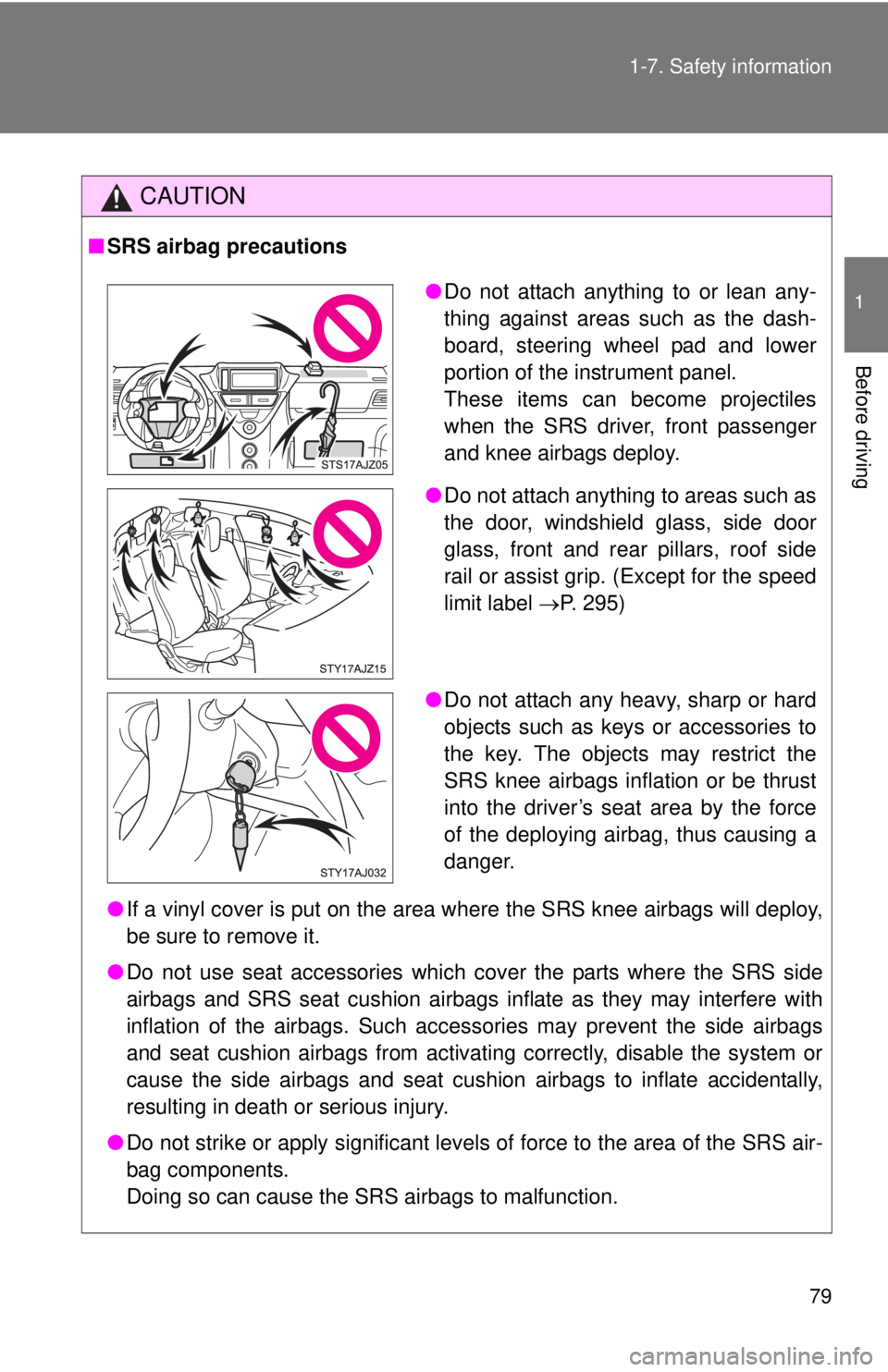
●Do not attach anything to or lean any-
thing against areas such as the dash-
board, steering wheel pad and lower
portion of the instrument panel.
These items can become projectiles
when the SRS driver, front passenger
and knee airbags deploy.
● Do not attach anything to areas such as
the door, windshield glass, side door
glass, front and rear pillars, roof side
rail or assist grip. (Except for the speed
limit label P. 295)
● Do not attach any heavy, sharp or hard
objects such as keys or accessories to
the key. The objects may restrict the
SRS knee airbags inflation or be thrust
into the driver’s seat area by the force
of the deploying airbag, thus causing a
danger.
Page 104 of 376
104
2-1. Driving procedures
Driving the vehicle
Starting on a steep uphillWith the brake pedal depressed, firmly set the parking brake
and shift the shift lever to D.
Gently depress the accelerator pedal.
Release the parking brake.
The following procedures should be observed to ensure safe driv-
ing.
■ Starting the engine ( P. 113)
■ Driving
With the brake pedal depressed, shift the shift lever to D. ( P. 116)
Release the parking brake. ( P. 118)
Gradually release the brake pedal and gently depress the
accelerator pedal to accelerate the vehicle.
■ Stopping
With the shift lever in D, depress the brake pedal.
If necessary, set the parking brake.
When the vehicle is stopped for an extended period of time, shift
the shift lever to P or N. ( P. 116)
■Parking the vehicle
With the shift lever in D, depress the brake pedal.
Set the parking brake. ( P. 118)
Shift the shift lever to P. ( P. 116)
When parking on a hill, if necessary, block the wheels.
Turn the engine switch off to stop the engine.
Lock the door, making sure that you have the key on your
person.
Page 113 of 376
113
2-1. Driving procedures
2
When driving
Engine (ignition) switch
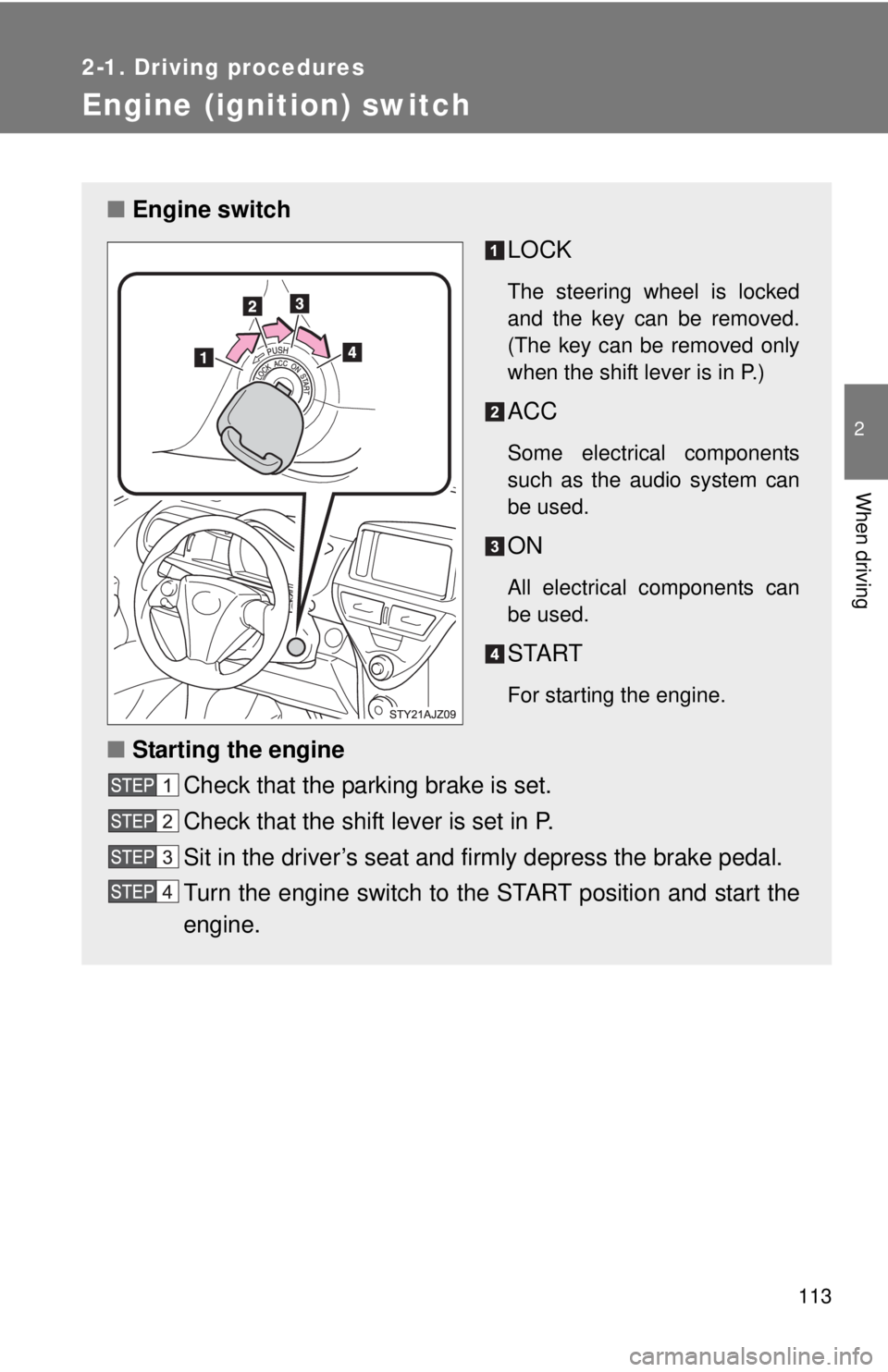
■Engine switch
LOCK
The steering wheel is locked
and the key can be removed.
(The key can be removed only
when the shift lever is in P.)
ACC
Some electrical components
such as the audio system can
be used.
ON
All electrical components can
be used.
START
For starting the engine.
■Starting the engine
Check that the parking brake is set.
Check that the shift lever is set in P.
Sit in the driver’s seat and firmly depress the brake pedal.
Turn the engine switch to the START position and start the
engine.
Page 114 of 376
114 2-1. Driving procedures
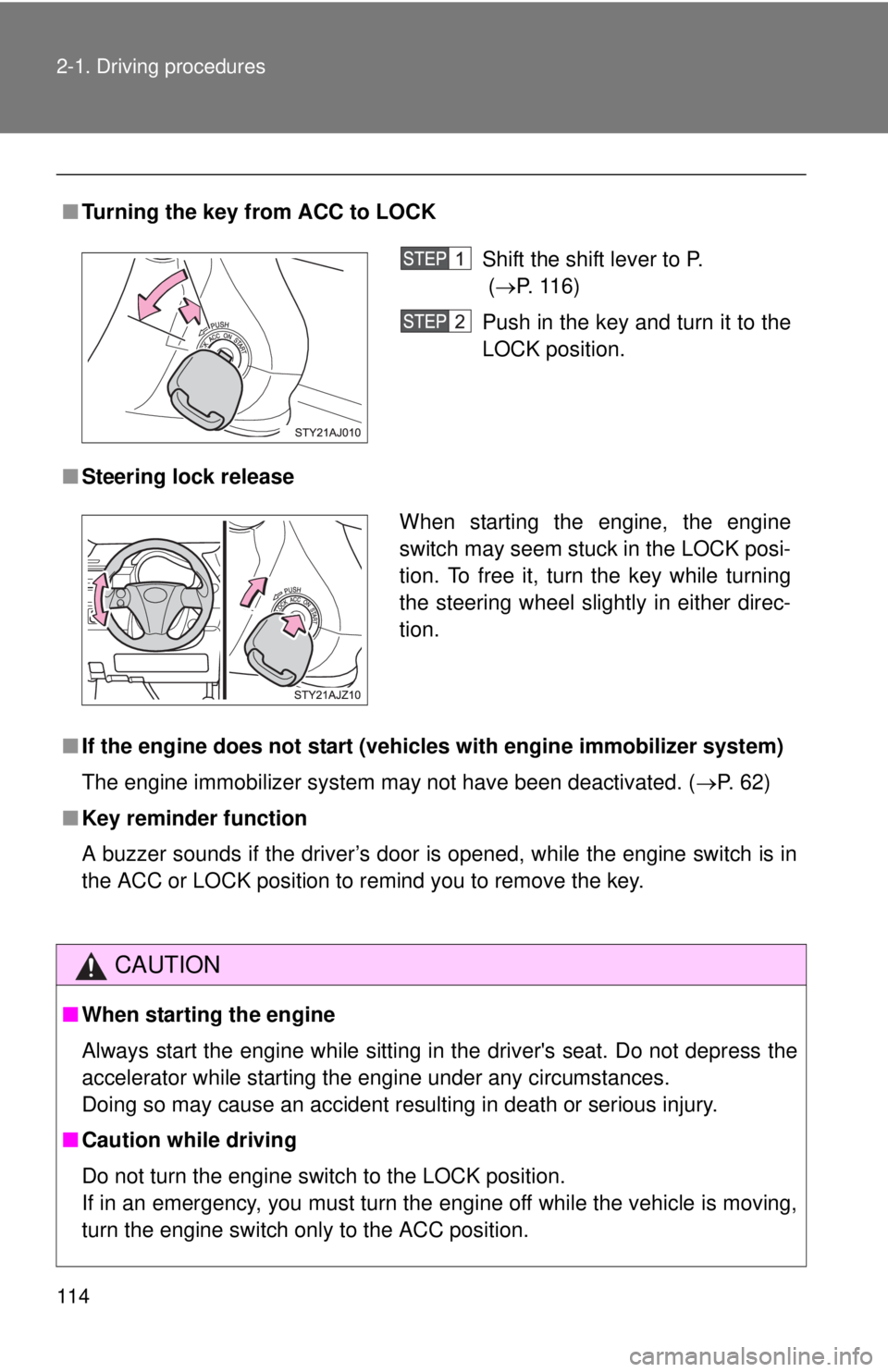
■Turning the key from ACC to LOCK
■ Steering lock release
■ If the engine does not start (vehic les with engine immobilizer system)
The engine immobilizer system may not have been deactivated. ( P. 62)
■ Key reminder function
A buzzer sounds if the driver’s door is opened, while the engine switch is in
the ACC or LOCK position to remind you to remove the key.
CAUTION
■When starting the engine
Always start the engine while sitting in the driver's seat. Do not depress the
accelerator while starting the engine under any circumstances.
Doing so may cause an accident resulting in death or serious injury.
■ Caution while driving
Do not turn the engine switch to the LOCK position.
If in an emergency, you must turn the engine off while the vehicle is moving,
turn the engine switch only to the ACC position.
Shift the shift lever to P.
(P. 116)
Push in the key and turn it to the
LOCK position.
When starting the engine, the engine
switch may seem stuck in the LOCK posi-
tion. To free it, turn the key while turning
the steering wheel slightly in either direc-
tion.
Page 115 of 376

115
2-1. Driving procedures
2
When driving
NOTICE
■
To prevent battery discharge
Do not leave the key in the ACC or ON position for long periods if the engine
is not running.
■ When starting the engine
●Do not crank for more than 30 seconds at a time. This may overheat the
starter and wiring systems.
● Do not race a cold engine.
● If the engine becomes difficult to start or stalls frequently, have the engine
checked immediately.
Page 183 of 376
Maintenance and care4
183
4-1. Maintenance and careCleaning and protecting the vehicle exterior......... 184
Cleaning and protecting the vehicle interior.......... 187
4-2. Maintenance Maintenance requirements .................. 190
General maintenance....... 192
Emission inspection and maintenance (I/M)
programs........................ 195 4-3. Do-it-yourself maintenance
Do-it-yourself service precautions .................... 196
Hood ................................ 199
Positioning a floor jack ..... 201
Replacing the tire ............. 204
Engine compartment ........ 210
Tires ................................. 222
Tire inflation pressure ...... 230
Wheels ............................. 234
Air conditioning filter......... 236
Key battery ....................... 240
Checking and replacing fuses .............................. 244
Light bulbs........................ 255
Page 240 of 376
240
4-3. Do-it-yourself maintenance
Key batter y
Replace the battery with a new one if it is discharged.
■You will need the following items:
●Flathead screwdriver (To prevent damage to the key, cover
the tip of the screwdriver with tape.)
● Small flathead screwdriver
● Lithium battery
For types A and B electronic key ( P. 24): CR2016
For type C electronic key ( P. 24): CR1620
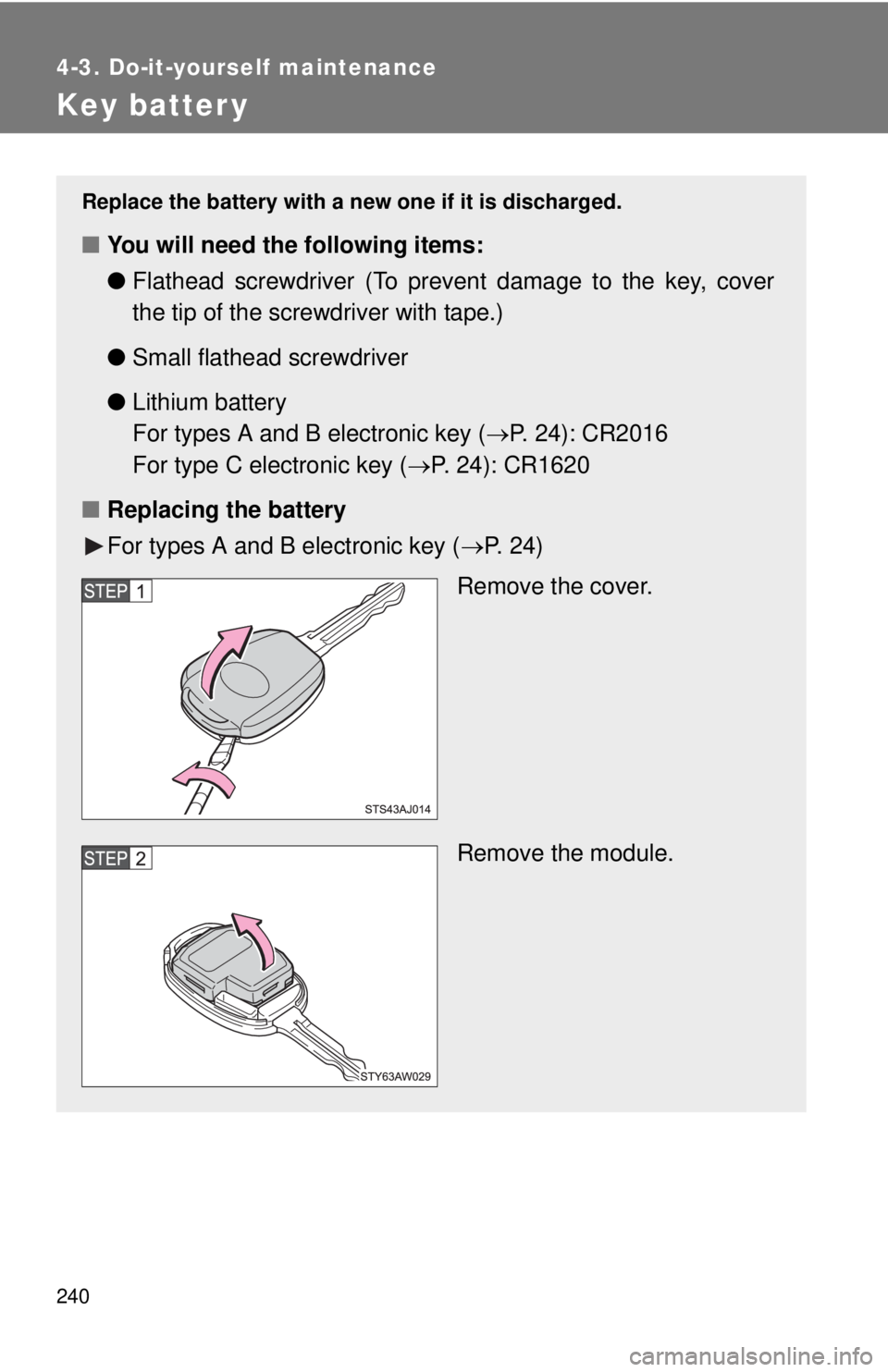
■ Replacing the battery
For types A and B electronic key ( P. 24)
Remove the cover.
Remove the module.
Page 241 of 376
241
4-3. Do-it-yourself maintenance
4
Maintenance and care
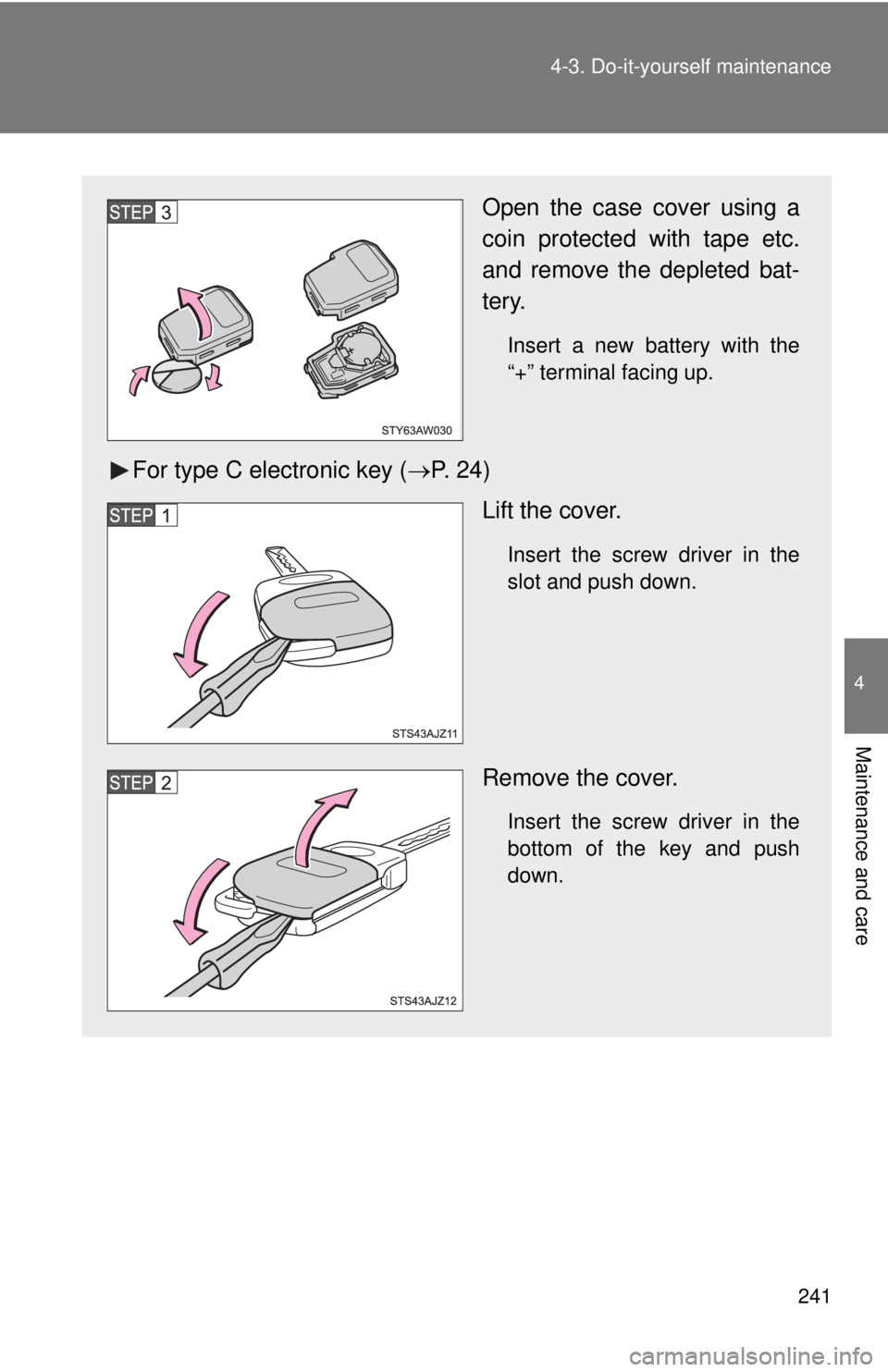
Open the case cover using a
coin protected with tape etc.
and remove the depleted bat-
tery.
Insert a new battery with the
“+” terminal facing up.
For type C electronic key (
P. 24)
Lift the cover.
Insert the screw driver in the
slot and push down.
Remove the cover.
Insert the screw driver in the
bottom of the key and push
down.
Page 242 of 376
242 4-3. Do-it-yourself maintenance
■If the key battery is discharged
The following symptoms may occur.
●The wireless remote control will not function properly.
● The operational range is reduced.
■ Use a lithium battery
●Batteries can be purchased at your Scion dealer, jewelers, or camera
stores.
● Replace only with the same or equivalent type recommended by your
Scion dealer.
● Dispose of used batteries according to local laws.
CAUTION
■Removed battery and other parts
These parts are small and if swallowed by a child, they can cause choking.
Keep away from children. Failure to do so could result in death or serious
injury.
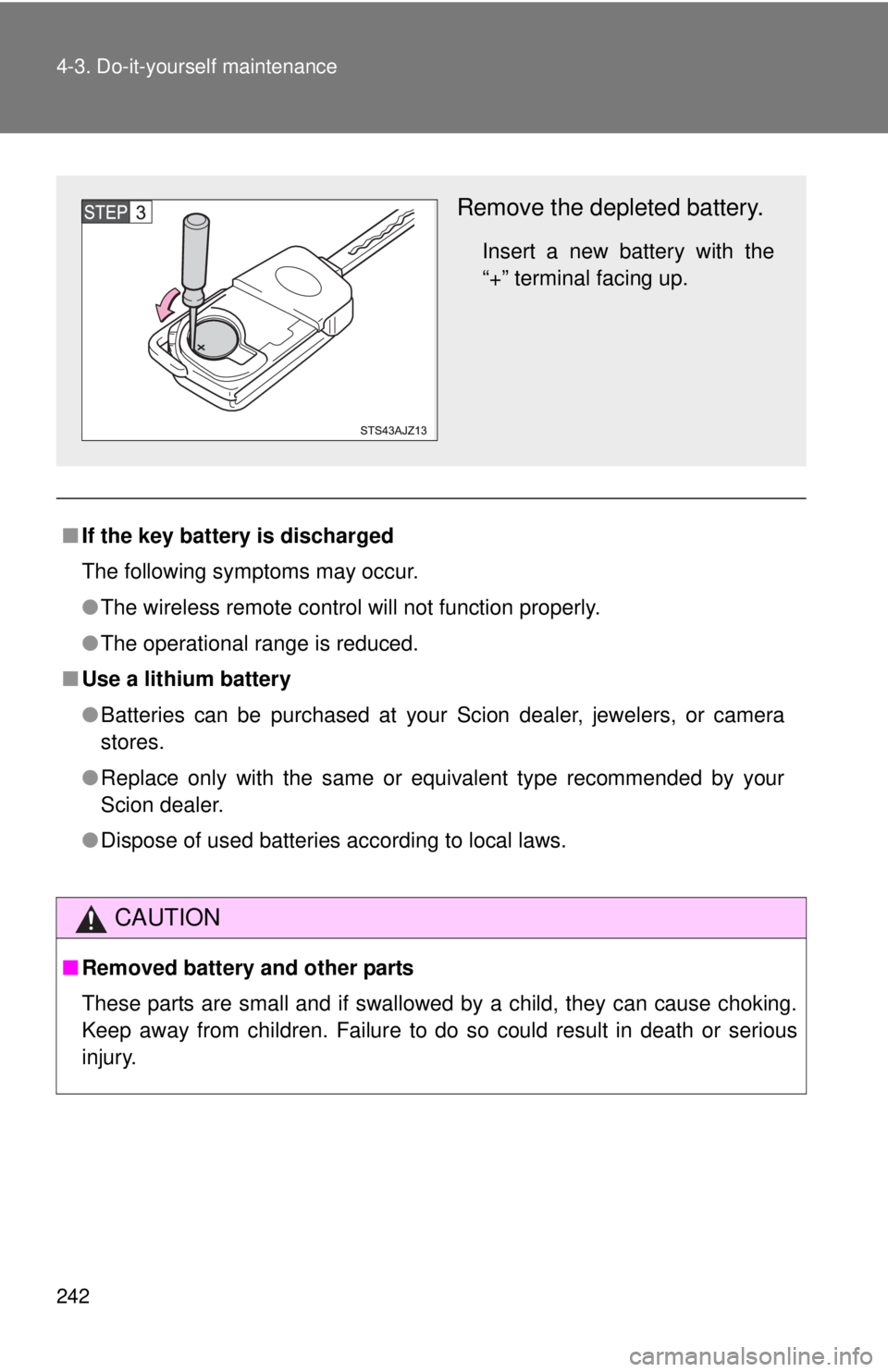
Remove the depleted battery.
Insert a new battery with the
“+” terminal facing up.