warning light TOYOTA LAND CRUISER 2000 User Guide
[x] Cancel search | Manufacturer: TOYOTA, Model Year: 2000, Model line: LAND CRUISER, Model: TOYOTA LAND CRUISER 2000Pages: 235, PDF Size: 5.13 MB
Page 79 of 235
L/C 100_U101
2000 L/C 100 (OM60866U)
(i) Open Door Warning Light
This light remains on until all the side
doors and back door are completely
closed.
(j) Unengaged ”Park” Warning Light
This light warns that the transmission
”Park” mechanism is not engaged. If the
four
−wheel drive control is in the ”N” posi-
tion while the selector lever is in the ”P”
position, the transmission will disengage
and the wheels will not lock.
CAUTION
To restore the park function, shift the
four −wheel drive control out of ”N”,
or the vehicle can move.
(k) Automatic Transmission Fluid Tem-
perature Warning Light
This light warns that the automatic trans-
mission fluid temperature is too high. If this light comes on while you are driv-
ing, slow down and pull off the road. Stop
the vehicle at a safe place and put the
selector lever in ”P” and leave the engine
idling until the light goes off. If the light
goes off, you can start the vehicle again.
If the light does not go off, call a Toyota
dealer or qualified repair shop for assis-
tance.
NOTICE
Continued driving with the warning
light on may damage the automatic
transmission.
(l) Vehicle Skid Control System and
Active Traction Control System
Warning Light
This light warns that there is a problem
somewhere in the vehicle skid control sys-
tem and/or active traction control system.
If the “VSC/TRAC” warning light and “VSC
OFF” indicator light come on, have your
vehicle checked by Toyota dealer as soon
as possible. However, it is no problem
that the “VSC/TRAC” warning light comes
on when the brake actuator temperature
becomes high. (For details, see “Active
traction control system” in Section 1 −6.) The lights will come on with the ignition
key turned to “ON”, and will go off after
a few seconds.
The lights may come on for 60 seconds
after the engine is started. It is normal if
they go out after a while.
Depressing the brake pedal repeatedly
may turn on the lights. it is normal if they
go out after a few seconds.
When the “VSC/TRAC” warning light and
“VSC OFF” indicator light come on, the
vehicle skid control system and/or active
traction control system do not operate, but
there is no problem to continue your driv-
ing.
(m) Key Reminder Buzzer
This buzzer reminds you to remove the
key when you open the driver’s door with
the ignition key in the ”ACC” or ”LOCK”
position.
CHECKING SERVICE REMINDER INDICA-
TORS (except the low fuel level warning
light)
1. Apply the parking brake.
2. Open one of the side doors or back door.
The open door warning light should
come on.
Page 80 of 235

L/C 100_U
102 2000 L/C 100 (OM60866U)
3. Close the door.
The open door warning light should go
off.
4. Place the four −wheel drive control lever
in ”N” position and the selector lever
in ”P” position.
5. Turn the ignition key to ”ACC”. The SRS warning light should come on.
It goes off after 6 seconds.
6. Turn the ignition key to ”ON”, but do not start the engine.
All the service reminder indicators ex-
cept the open door warning light and
SRS warning light should come on. The
”ABS”, ”VSC/TRAC”, ”VSC OFF”, ”AC-
TIVE TRAC”, and slip indicator light go
off after a few seconds.
There may be the case that the ”ABS”,
”VSC/TRAC” and ”VSC OFF” stay on
for about 60 seconds after the engine
is started. It is normal if they go out
after a while.
If any service reminder indicator or warn-
ing buzzer does not function as described
above, either the bulb is burned out or the
circuit is in need of repair. Have it
checked by your Toyota dealer as soon as
possible.
Page 92 of 235

L/C 100_U
11 4 2000 L/C 100 (OM60866U)
If you need acceleration—for example,
when passing—depress the accelerator
pedal enough for the vehicle to exceed
the set speed. When you release it, the
vehicle will return to the speed set prior
to the acceleration.
CANCELLING THE PRESET SPEED
You can cancel the preset speed by:
a. Pulling the control lever in the ”CANCEL” direction and releasing it.
b. Depressing the brake pedal.
If the vehicle speed falls below about 40
km/h (25 mph), the preset speed will auto-
matically cancel out.
If the vehicle speed drops 16 km/h (10
mph) below the preset speed, the preset
speed will also automatically cancel out.
If the preset speed automatically cancels
out other than for the above cases, have
your vehicle checked by your Toyota deal-
er at the earliest opportunity. RESETTING TO A FASTER SPEED
Push the lever up in the ”RES/ACC” direc-
tion and hold it. Release the lever when
the desired speed is attained. While the
lever is held up, the vehicle will gradually
gain speed.
However, a faster way to reset is to ac-
celerate the vehicle and then push the
control lever down in the ”SET/COAST”
direction.
RESETTING TO A SLOWER SPEED
Push the lever down in the ”SET/COAST”
direction and hold it. Release the lever
when the desired speed is attained. While
the lever is held down, the vehicle speed
will gradually decrease.
However, a faster way to reset is to de-
press the brake pedal and then push the
control lever down in the ”SET/COAST”
direction.
Even if you downshift the transmission by
turning off the overdrive switch, with the
cruise control on, engine braking will not
be applied because the cruise control is
not cancelled. To decrease the vehicle
speed, reset to a slower speed with the
cruise control lever or depress the brake
pedal. If you use the brake pedal, cruise
control is cancelled.RESUMING THE PRESET SPEED
If the preset speed is cancelled by pulling
the control lever or by depressing the
brake pedal, pushing the lever up in the
”RES/ACC” direction will restore the speed
set prior to cancellation.
However, once the vehicle speed falls be-
low about 40 km/h (25 mph), the preset
speed will not be resumed.
CRUISE CONTROL FAILURE WARNING
If the ”CRUISE” indicator light in the
instrument cluster flashes when using the
cruise control, press the ”CRUISE
ON·OFF” button to turn the system off and
then press it again to turn it on.
If any of the following conditions then oc-
curs, there is some trouble in the cruise
control system.
The indicator light does not come on.
The indicator light flashes again.
The indicator light goes out after it
comes on.
If this is the case, contact your Toyota
dealer and have your vehicle inspected.
Page 93 of 235
L/C 100_U11 5
2000 L/C 100 (OM60866U)
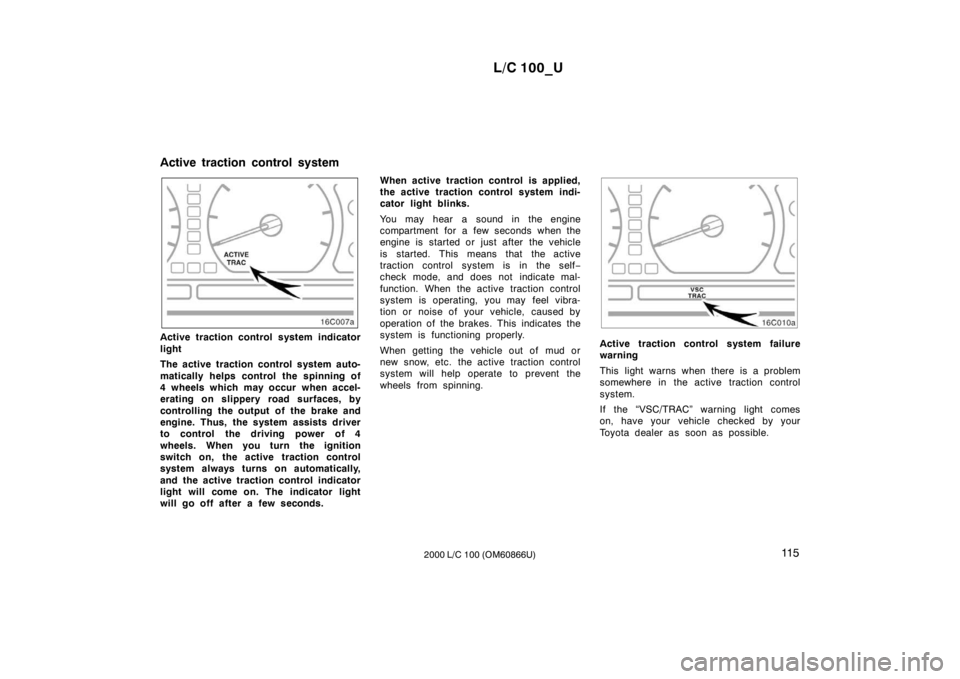
Active traction control system indicator
light
The active traction control system auto-
matically helps control the spinning of
4 wheels which may occur when accel-
erating on slippery road surfaces, by
controlling the output of the brake and
engine. Thus, the system assists driver
to control the driving power of 4
wheels. When you turn the ignition
switch on, the active traction control
system always turns on automatically,
and the active traction control indicator
light will come on. The indicator light
will go off after a few seconds. When active traction control is applied,
the active traction control system indi-
cator light blinks.
You may hear a sound in the engine
compartment for a few seconds when the
engine is started or just after the vehicle
is started. This means that the active
traction control system is in the self
−
check mode, and does not indicate mal-
function. When the active traction control
system is operating, you may feel vibra-
tion or noise of your vehicle, caused by
operation of the brakes. This indicates the
system is functioning properly.
When getting the vehicle out of mud or
new snow, etc. the active traction control
system will help operate to prevent the
wheels from spinning.Active traction control system failure
warning
This light warns when there is a problem
somewhere in the active traction control
system.
If the “VSC/TRAC” warning light comes
on, have your vehicle checked by your
Toyota dealer as soon as possible.
Active traction control system
Page 94 of 235
L/C 100_U
11 6 2000 L/C 100 (OM60866U)
The brake actuator temperature increases
during the active traction control system
or vehicle skid control system operating.
If the brake actuator temperature becomes
too high while the active traction control
system or vehicle skid control system is
operating, a buzzer will start to sound
intermittently to indicate that the active
traction control system can no longer op-
erate. In this case, immediately stop your
vehicle at a safe place. If the system
continues to operate, the buzzer sound
changes from intermittent to continuous
and at the same time, “VSC/TRAC” warn-
ing light will come on. After the continu-
ous buzzer sound stopped after about 3
seconds, the active traction control system
temporarily stops operating in order to
protect the brake actuator. (Although the
active traction control system does not
operate, there is no problem to continue
your driving.) The system will be automati-
cally restored after a short time and
“VSC/TRAC” warning light goes off if the
accelerator pedal is released.
When the “ABS” warning light come on,
the active traction control system is not
operating.
The “VSC/TRAC” warning light will come
on when the ignition key is turned “ON”,
and will go off after a few seconds.
The “VSC/TRAC” warning light may stay
on for 60 seconds after the engine is
started. It is normal if it goes off after a
few seconds.
Depressing the brake pedal repeatedly
may turn on the “VSC/TRAC” warning
light. It is normal if it goes off after a few
seconds.
When the “VSC/TRAC” warning light
comes on the active traction control sys-
tem is not operating, but there is no prob-
lem if you continue to drive.
In the following cases, contact your Toyota
dealer:
The “VSC/TRAC” warning light does not
come on after the ignition key is turned
“ON”.
The “VSC/TRAC” remains on after the
ignition key is turned “ON”.
CAUTION
Under certain slippery road condi-
tions, full traction of the vehicles and
power to 4 wheels may not be main-
tained, even though the active trac-
tion control system is in operation.
Do not drive the vehicle under any
speed or maneuvering conditions
which will cause the vehicle to lose
traction. In situations where the road
surface is covered with ice or snow,
your vehicle should be fitted with
snow tires or tire chains. Always
drive at an appropriate and cautious
speed for the road conditions pres-
ent.
Page 96 of 235
L/C 100_U
11 8 2000 L/C 100 (OM60866U)
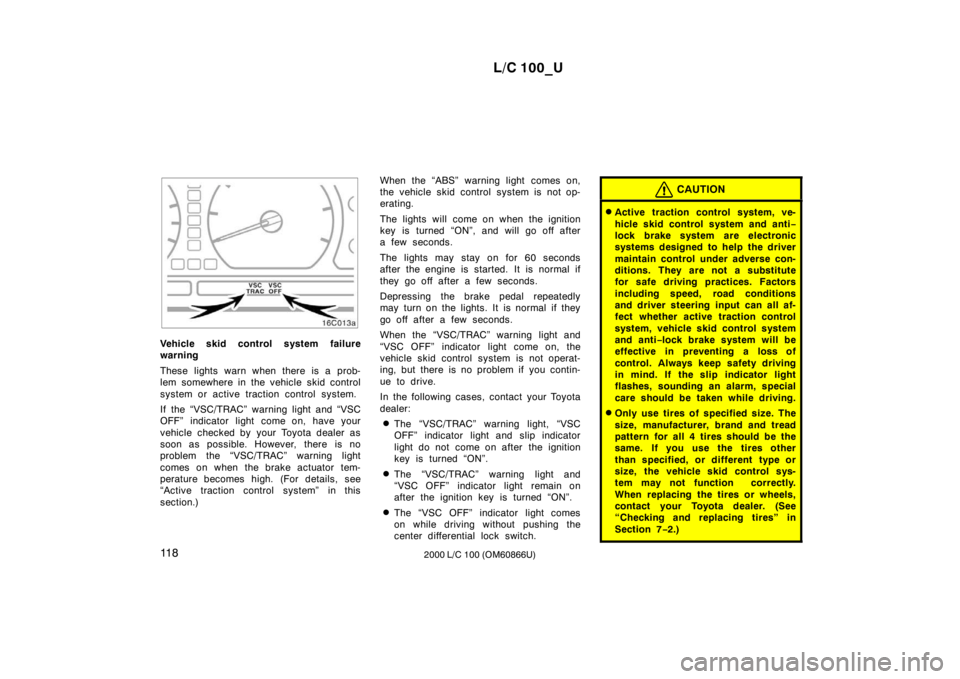
Vehicle skid control system failure
warning
These lights warn when there is a prob-
lem somewhere in the vehicle skid control
system or active traction control system.
If the “VSC/TRAC” warning light and “VSC
OFF” indicator light come on, have your
vehicle checked by your Toyota dealer as
soon as possible. However, there is no
problem the “VSC/TRAC” warning light
comes on when the brake actuator tem-
perature becomes high. (For details, see
“Active traction control system” in this
section.)When the “ABS” warning light comes on,
the vehicle skid control system is not op-
erating.
The lights will come on when the ignition
key is turned “ON”, and will go off after
a few seconds.
The lights may stay on for 60 seconds
after the engine is started. It is normal if
they go off after a few seconds.
Depressing the brake pedal repeatedly
may turn on the lights. It is normal if they
go off after a few seconds.
When the “VSC/TRAC” warning light and
“VSC OFF” indicator light come on, the
vehicle skid control system is not operat-
ing, but there is no problem if you contin-
ue to drive.
In the following cases, contact your Toyota
dealer:
The “VSC/TRAC” warning light, “VSC
OFF” indicator light and slip indicator
light do not come on after the ignition
key is turned “ON”.
The “VSC/TRAC” warning light and
“VSC OFF” indicator light remain on
after the ignition key is turned “ON”.
The “VSC OFF” indicator light comes
on while driving without pushing the
center differential lock switch.
CAUTION
Active traction control system, ve-
hicle skid control system and anti −
lock brake system are electronic
systems designed to help the driver
maintain control under adverse con-
ditions. They are not a substitute
for safe driving practices. Factors
including speed, road conditions
and driver steering input can all af-
fect whether active traction control
system, vehicle skid control system
and anti −lock brake system will be
effective in preventing a loss of
control. Always keep safety driving
in mind. If the slip indicator light
flashes, sounding an alarm, special
care should be taken while driving.
Only use tires of specified size. The
size, manufacturer, brand and tread
pattern for all 4 tires should be the
same. If you use the tires other
than specified, or different type or
size, the vehicle skid control sys-
tem may not function correctly.
When replacing the tires or wheels,
contact your Toyota dealer. (See
“Checking and replacing tires” in
Section 7 −2.)
Page 147 of 235
L/C 100_U169
2000 L/C 100 (OM60866U)
For detailed information on oil level check,
see ”Checking the engine oil level” in Sec-
tion 7
−2.
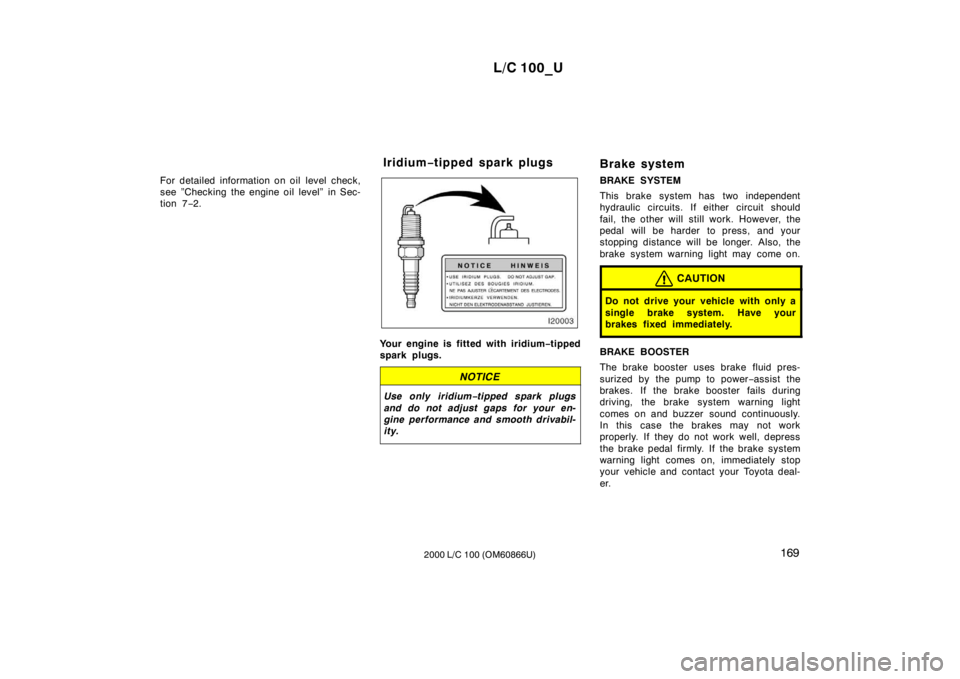
Your engine is fitted with iridium −tipped
spark plugs.
NOTICE
Use only iridium −tipped spark plugs
and do not adjust gaps for your en-
gine performance and smooth drivabil-
ity.
Brake system
BRAKE SYSTEM
This brake system has two independent
hydraulic circuits. If either circuit should
fail, the other will still work. However, the
pedal will be harder to press, and your
stopping distance will be longer. Also, the
brake system warning light may come on.
CAUTION
Do not drive your vehicle with only a
single brake system. Have your
brakes fixed immediately.
BRAKE BOOSTER
The brake booster uses brake fluid pres-
surized by the pump to power −assist the
brakes. If the brake booster fails during
driving, the brake system warning light
comes on and buzzer sound continuously.
In this case the brakes may not work
properly. If they do not work well, depress
the brake pedal firmly. If the brake system
warning light comes on, immediately stop
your vehicle and contact your Toyota deal-
er.
Iridium
−tipped spark plugs
Page 148 of 235
L/C 100_U
170 2000 L/C 100 (OM60866U)
There may be the case that the brake
system warning light stays on for a
bout
60 seconds after the engine is started. It
is normal if the light goes out after a
while.
Depressing the brake pedal repeatedly
may turn on the brake system warning
light and buzzer. It is normal if the light
goes out and the buzzer stops sounding
after a few seconds.
You may hear a small sound in the engine
compartment after the engine is started or
the brake pedal is depressed repeatedly.
This is a pump pulsating sound of the
brake system, and it is not a malfunction.
CAUTION
Do not pump the brake pedal if the
engine stalls. Each push on the
pedal uses up your brake fluid
pressure reserve.
Even if the power assist is com-
pletely lost, the brakes will still
work. But you will have to push the
pedal hard, much harder than nor-
mal. And your braking distance will
be longer.
ANTI −LOCK BRAKE SYSTEM
(with “ABS” warning light)
The anti −lock brake system is designed
to help prevent lock −up of the wheels
during a sudden braking or braking on
slippery road surfaces. This assists in
providing stability and steering perfor-
mance of the vehicle under these cir-
cumstances.
Effective way to press the ”ABS” brake
pedal: When the anti −lock brake system
function is in action, just hold the brake
pedal down more firmly. Especially in a
panic stop, you need to keep it de-
pressed more firmly, and do not pump
the brake. Pumping the brake pedal
makes the stopping distance longer.
The anti −lock brake system becomes op-
erative after the vehicle has accelerated
to a speed in excess of approximately 10
km/h (6 mph). It stops operating when the
vehicle decelerates to a speed below
approximately 5 km/h (3 mph).
Depressing the brake pedal on slippery
road surfaces such as on the manhole
cover, the steel plate under the construc-
tion, joints in the bridge, etc. on a rainy
day tends to activate the anti −lock brake
system. You may hear a click or motor sound in
the engine compartment for a few seconds
when the engine is started or just after
the vehicle is started. This means that the
anti
−lock brake system is in the self
check mode, and does not indicate a mal-
function.
When the anti −lock brake system is ac-
tivated, the following conditions may
occur, however, do not indicate a mal-
function of the system:
You may hear the anti −lock brake sys-
tem operating and feel the brake pedal
pulsating and the vibrations of the body
and steering wheel. You may also hear
the motor sound in the engine compart-
ment even after the vehicle is stopped.
At the end of the anti −lock brake sys-
tem activation, the brake pedal may
move a little forward.
Page 149 of 235
L/C 100_U171
2000 L/C 100 (OM60866U)
CAUTION
Do not overestimate the anti −lock
brake system: Although the anti −lock
brake system assists in providing ve-
hicle control, it is still important to
drive with all due care and maintain
a moderate speed and safe distance
from the vehicle in front of you, be-
cause there are limits to the vehicle
stability and effectiveness of steering
wheel operation even with the anti −
lock brake system on.
If tires grip performance exceeds its
capability, or if hydroplaning occurs
during high speed driving in the rain,
the anti −lock brake system does not
provide vehicle control.
Anti −lock brake system is not de-
signed to shorten the stopping dis-
tance: Always drive at the moderate
speed and maintain a safe distance
from the vehicle in front of you.
Compared with vehicles not fitted
with an anti −lock brake system, your
vehicle may require a longer stopping
distance in the following cases: Driving on rough, gravel or snow −
covered roads.
Driving with tire chains installed.
Driving over the steps such as the
joints on the road.
Driving on roads where the road
surface is pitted or has other differ-
ences in surface height.
Install all 4 tires of specified size at
designated pressure: The anti −lock
brake system detects vehicle speeds
using the speed sensors for respec-
tive wheels’ turning speeds. The use
of tires other than specified may fail
to detect the accurate turning speed,
resulting in a longer stopping dis-
tance.
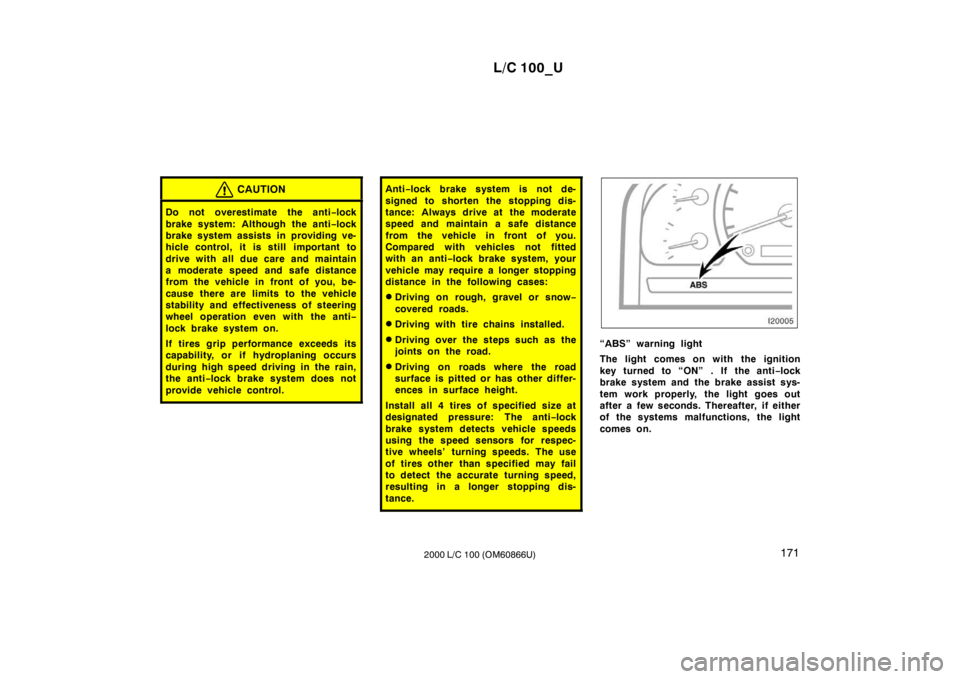
“ABS” warning light
The light comes on with the ignition
key turned to “ON” . If the anti −lock
brake system and the brake assist sys-
tem work properly, the light goes out
after a few seconds. Thereafter, if either
of the systems malfunctions, the light
comes on.
Page 150 of 235
L/C 100_U
172 2000 L/C 100 (OM60866U)
When the “ABS” warning light is on (and
the brake system warning light is off), the
anti
−lock brake system, the brake assist
system, the vehicle skid control system
and/or active traction control system do/
does not operate, but the brake system
still operates conventionally.
When the “ABS” warning light is on (and
the brake system warning light is off), the
anti −lock brake system does not operate
so that the wheels could lock up during
a sudden braking or braking on slippery
road surfaces.
If the following conditions occurs, this
indicates a malfunction somewhere in
the parts monitored by the warning
light system. Contact your Toyota deal-
er as soon as possible to service the
vehicle.
The light does not come on with the
ignition key turned to “ON”, or remainson.
The light comes on while driving.
If the light lit during driving goes out and
does not come on again, it is a normal
operation.
CAUTION
If the “ABS” warning light remains on
together with the brake system warn-
ing light, immediately stop your ve-
hicle at a safe place and contact your
Toyota dealer.
In this case, the vehicle may become
harder to control or skid during hard
braking or braking on slippery road
surfaces.
Either of the following conditions may
occur, but do not indicate the malfunc-
tion. The light may stay on for about 60
seconds after the engine is started. It
is normal if it goes out after a while.
Depressing the brake pedal repeatedly
may turn on the light. It is normal if it
goes off after a few seconds. DRUM
−IN −DISC TYPE PARKING BRAKE
SYSTEM
Your vehicle has a drum −in −disc type
parking brake system. This type of brake
system n eeds bedding −down of the brake
shoes periodically or whenever the parking
brake shoes and/or drums are replaced.
Have your Toyota dealer perform the bed-
ding −down.
BRAKE ASSIST SYSTEM
When you slam the brakes on, the
brake assist system judges as an emer-
gency stop and provides more powerful
braking for a driver who cannot hold
down the brake pedal firmly.
When you slam the brakes on, more pow-
erful braking will be applied. At this time,
you may hear a sound in the engine
compartment and feel the vibrations of the
brake pedal. This does not indicate a mal-
function.
The brake assist system becomes opera-
tive after the vehicle has accelerated to
a speed in excess of approximately 10
km/h (6 mph). It stops operating when the
vehicle decelerates to a speed below
approximately 5 km/h (3 mph).