check engine TOYOTA LAND CRUISER 2000 Owner's Manual
[x] Cancel search | Manufacturer: TOYOTA, Model Year: 2000, Model line: LAND CRUISER, Model: TOYOTA LAND CRUISER 2000Pages: 235, PDF Size: 5.13 MB
Page 163 of 235
L/C 100_U199
2000 L/C 100 (OM60866U)
CAUTION
Do not attempt to remove the radiator
cap when the engine and radiator are
hot. Serious injury could result from
scalding hot fluid and steam blown
out under pressure.
7. After the engine coolant temperature
has cooled to normal, again check the
coolant level in the reservoir. If neces-
sary, bring it up to half full again. Seri-
ous coolant loss indicates a leak in the
system. You s hould have it checked as
soon as possible at your Toyota dealer. If you have a flat tire—
1. Reduce your speed gradually, keeping a straight line. Move cautiously off the
road to a safe place well away from
the traffic. Avoid stopping on the center
divider of a highway. Park on a level
spot with firm ground.
2. Stop the engine and turn on your emergency flashers.
3. Firmly set the parking brake and put the transmission in ”P”.
4. Have everyone get out of the vehicle on the side away from traffic.
5. Read the following instructions thor- oughly.
CAUTION
When jacking, be sure to observe the
following to reduce the possibility of
personal injury: Follow jacking instructions.
Do not put any part of your body
under the vehicle supported by the
jack. Personal injury may occur.
Do not start or run the engine while
your vehicle is supported by the
jack.
Stop the vehicle on a level firm
ground, firmly set the parking brake
and put the transmission in reverse.
Block the wheel diagonally opposite
to the one being changed if neces-
sary.
Make sure to set the jack properly
in the jack point. Raising the ve-
hicle with jack improperly posi-
tioned will damage the vehicle or
may allow the vehicle to fall off the
jack and cause personal injury.
Never get under the vehicle when
the vehicle is supported by the jack
alone.
Use the jack only for lifting your
vehicle during wheel changing.
Do not raise the vehicle with some-
one in the vehicle.
When raising the vehicle, do not
put an object on or under the jack.
Raise the vehicle only high enough
to remove and change the tire.
Page 176 of 235
L/C 100_U
212 2000 L/C 100 (OM60866U)
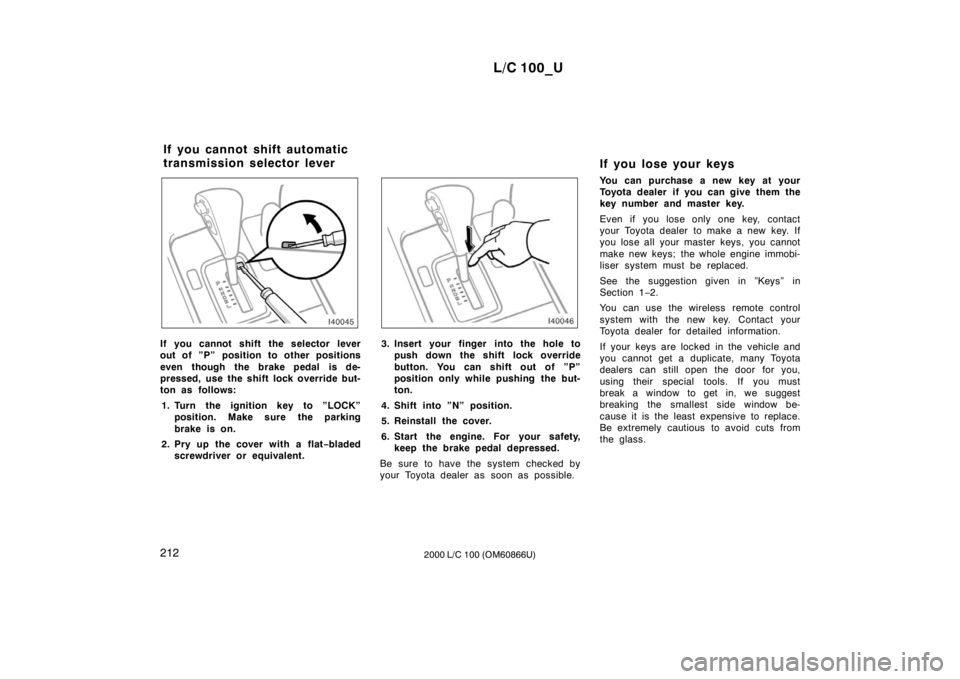
If you cannot shift the selector lever
out of ”P” position to other positions
even though the brake pedal is de-
pressed, use the shift lock override but-
ton as follows:
1. Turn the ignition key to ”LOCK” position. Make sure the parking
brake is on.
2. Pry up the cover with a flat −bladed
screwdriver or equivalent.3. Insert your finger into the hole to push down the shift lock override
button. You can shift out of ”P”
position only while pushing the but-
ton.
4. Shift into ”N” position.
5. Reinstall the cover.
6. Start the engine. For your safety, keep the brake pedal depressed.
Be sure to have the system checked by
your Toyota dealer as soon as possible. If you lose your keys
You can purchase a new key at your
Toyota dealer if you can give them the
key number and master key.
Even if you lose only one key, contact
your Toyota dealer to make a new key. If
you lose all your master keys, you cannot
make new keys; the whole engine immobi-
liser system must be replaced.
See the suggestion given in ”Keys” in
Section 1
−2.
You can use the wireless remote control
system with the new key. Contact your
Toyota dealer for detailed information.
If your keys are locked in the vehicle and
you cannot get a duplicate, many Toyota
dealers can still open the door for you,
using their special tools. If you must
break a window to get in, we suggest
breaking the smallest side window be-
cause it is the least expensive to replace.
Be extremely cautious to avoid cuts from
the glass.
If you cannot shift automatic
transmission selector lever
Page 185 of 235
L/C 100_U221
2000 L/C 100 (OM60866U)
If you are a skilled do
−it−yourself
mechanic, the Toyota service manuals are
recommended. Please be aware that do −it−yourself maintenance can affect your
warranty coverage. See ”Owner ’s Warranty
Information Booklet” or ”Owner ’s Manual
Supplement” for the details. General maintenance
Listed below are the general maintenance
items that should be performed as fre-
quently as specified. In addition to check-
ing the items listed, if you notice any
unusual noise, smell or vibration, you
should investigate the cause or take your
vehicle to your Toyota dealer or a quali-
fied service shop immediately. It is recom-
mended that any problem you notice be
brought to the attention of your dealer or
the qualified service shop for their advice.
CAUTION
Make these checks only where ade-
quate ventilation can be obtained if
you run the engine.
OUTSIDE THE VEHICLE
Items listed below should be performed
from time to time, unless otherwise
specified.
Tire pressure
Check the pressure with a gauge every
two weeks, or at least once a month. See
Section 7
−2 for additional information. Tire surface and wheel nuts
Check the tires carefully for cuts, damage
or excessive wear. See Section 7
−2 for
additional information. When checking the
tires, make sure no nuts are missing, and
check the nuts for looseness. Tighten
them if necessary.
Tire rotation
Rotate the tires every 12000 km (7500
miles). See Section 7 −2 for additional in-
formation.
Fluid leaks
Check underneath for leaking fuel, oil, wa-
ter or other fluid after the vehicle has
been parked for a while. If you smell fuel
fumes or notice any leak, have the cause
found and corrected immediately.
Doors and engine hood
Check that all doors and back door oper-
ate smoothly and all latches lock securely.
Make sure the engine hood secondary
latch secures the hood from opening when
the primary latch is released.
Page 186 of 235

L/C 100_U
222 2000 L/C 100 (OM60866U)
INSIDE THE VEHICLE
Items listed below should be checked
regularly, e.g. while performing periodic
services, cleaning the vehicle, etc.
Lights
Make sure the headlights, stop lights, tail
lights, turn signal lights, and other lights
are all working. Check headlight aim.
Service reminder indicators and warning
buzzers
Check that all service reminder indicators
and warning buzzers function properly.
Steering wheel
Be alert for changes in steering condition,
such as hard steering or strange noise.
Seats
Check that all front seat controls such as
seat adjusters, seatback recliner, etc. op-
erate smoothly and that all latches lock
securely in any position. Check that the
head restraint move up and down smooth-
ly and that the locks hold securely in any
latched position. For folding
−down rear
seatbacks, swing −up rear seat cushions
and detachable third seats, check that the
latches lock securely. Seat belts
Check that the seat belt system such as
buckles, retractors and anchors operate
properly and smoothly. Make sure the belt
webbing is not cut, frayed, worn or dam-aged.
Accelerator pedal
Check the pedal for smooth operation and
uneven pedal effort or catching.
Brake pedal
Check the pedal for smooth operation and
that the pedal has the proper clearance.
Check the brake booster function.
Brakes
At a safe place, check that the brakes do
not pull to one side when applied.
Parking brake
Check that the lever has the proper travel
and that, on a safe incline, your vehicle
is held securely with only the parking
brake applied.
Automatic transmission ”Park” mecha-
nism
Check the lock release button of the se-
lector lever for proper and smooth opera-
tion. On a safe incline, check that your
vehicle is held securely with the selector
lever in ”P” position and all brakes re-
leased.
IN THE ENGINE COMPARTMENT
Items listed below should be checked
from time to time, e.g. each time when
refueling.
Washer fluid
Make sure there is sufficient fluid in the
tank. See Section 7
−3 for additional in-
formation.
Engine coolant level
Make sure the coolant level is between
the ”FULL” and ”LOW” lines on the see −
through reservoir when the engine is cold.
See Section 7 −2 for additional information.
Battery electrolyte level
Make sure the electrolyte level of all bat-
tery cells is between upper and lower lev-
el lines on the case. Add only distilled
water when replenishing. See Section 7 −3
for additional information.
Page 187 of 235
L/C 100_U223
2000 L/C 100 (OM60866U)
Brake fluid level
Make sure the brake fluid level is correct.
See Section 7
−2 for additional information.
Engine oil level
Check the level on the dipstick with the
engine turned off and the vehicle parked
on a level spot. See Section 7 −2 for addi-
tional information.
Power steering fluid level
Check the level through the reservoir. The
level should be in the ”HOT” or ”COLD”
range depending on the fluid temperature.
See Section 7 −2 for additional information.
Exhaust system
If you notice any change in the sound of
the exhaust or smell exhaust fumes, have
the cause located and corrected immedi-
ately. (See engine exhaust cautions in
Section 2.) Be on the alert for changes in perfor-
mance, sounds, and visual tip
−offs that
indicate service is needed. Some impor-
tant clues are as follows:
Engine missing, stumbling, or pinging
Appreciable loss of power
Strange engine noises
A fluid leak under the vehicle (however,
water dripping from the air conditioning
after use is normal.)
Change in exhaust sound (This may
indicate a dangerous carbon monoxide
leak. Drive with the windows open and
have the exhaust system checked im-
mediately.)
Flat −looking tire; excessive tire squeal
when cornering; uneven tire wear
Vehicle pulls to one side when driving
straight on a level road
Strange noises related to suspension
movement
Loss of brake effectiveness; spongy
feeling brake pedal; pedal almost
touches floor; vehicle pulls to one side
when braking
Engine coolant temperature continually
higher than normal
Engine continually runs hot; oil pres-
sure gauge stays low
If you notice any of these clues, take your
vehicle to your Toyota dealer as soon as
possible. It probably needs adjustment or
repair.
CAUTION
Do not continue driving with the ve-
hicle unchecked. It could result in se-
rious vehicle damage and possibly
personal injury.
Does your vehicle need
repairing?
Page 193 of 235
L/C 100_U229
2000 L/C 100 (OM60866U)
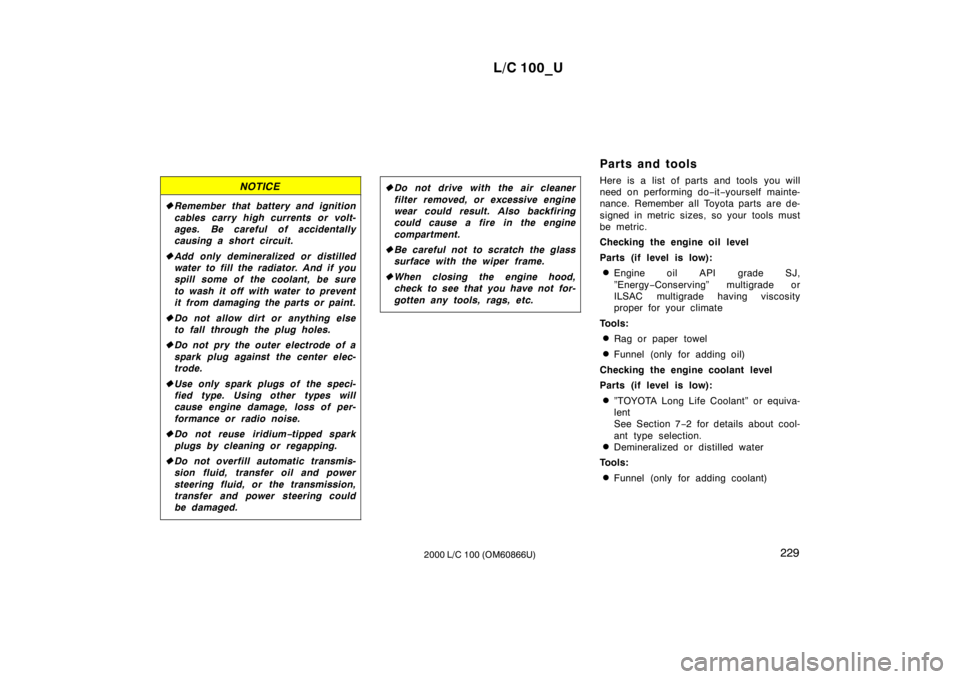
NOTICE
Remember that battery and ignition
cables carry high currents or volt-
ages. Be careful of accidentally
causing a short circuit.
Add only demineralized or distilled
water to fill the radiator. And if you
spill some of the coolant, be sure
to wash it off with water to prevent
it from damaging the parts or paint.
Do not allow dirt or anything else
to fall through the plug holes.
Do not pry the outer electrode of a
spark plug against the center elec-
trode.
Use only spark plugs of the speci-
fied type. Using other types will
cause engine damage, loss of per-
formance or radio noise.
Do not reuse iridium −tipped spark
plugs by cleaning or regapping.
Do not overfill automatic transmis-
sion fluid, transfer oil and power
steering fluid, or the transmission,
transfer and power steering could
be damaged.
Do not drive with the air cleaner
filter removed, or excessive engine
wear could result. Also backfiring
could cause a fire in the engine
compartment.
Be careful not to scratch the glass
surface with the wiper frame.
When closing the engine hood,
check to see that you have not for-
gotten any tools, rags, etc.
Parts and tools
Here is a list of parts and tools you will
need on performing do −it−yourself mainte-
nance. Remember all Toyota parts are de-
signed in metric sizes, so your tools must
be metric.
Checking the engine oil level
Parts (if level is low):
Engine oil API grade SJ,
”Energy −Conserving” multigrade or
ILSAC multigrade having viscosity
proper for your climate
Tools: Rag or paper towel
Funnel (only for adding oil)
Checking the engine coolant level
Parts (if level is low): ”TOYOTA Long Life Coolant” or equiva-
lent
See Section 7 −2 for details about cool-
ant type selection.
Demineralized or distilled water
Tools:
Funnel (only for adding coolant)
Page 195 of 235
L/C 100_U231
2000 L/C 100 (OM60866U) DO
−IT −YOURSELF MAINTENANCE
Engine and Chassis
Checking the engine oil level232
. . . . . . . . . . . . . . . . . . . . . . . . . . . . . . . . .
Checking the engine coolant level234
. . . . . . . . . . . . . . . . . . . . . . . . . . . .
Checking brake fluid235
. . . . . . . . . . . . . . . . . . . . . . . . . . . . . . . . . . . . . . . .
Checking power steering fluid236
. . . . . . . . . . . . . . . . . . . . . . . . . . . . . . . .
Checking tire pressure237
. . . . . . . . . . . . . . . . . . . . . . . . . . . . . . . . . . . . . .
Checking and replacing tires237
. . . . . . . . . . . . . . . . . . . . . . . . . . . . . . . . .
Rotating tires238
. . . . . . . . . . . . . . . . . . . . . . . . . . . . . . . . . . . . . . . . . . . . . . .
Installing snow tires and chains239
. . . . . . . . . . . . . . . . . . . . . . . . . . . . . .
Replacing wheels240
. . . . . . . . . . . . . . . . . . . . . . . . . . . . . . . . . . . . . . . . . . .
Aluminum wheel precautions241
. . . . . . . . . . . . . . . . . . . . . . . . . . . . . . . . SECTION
7− 2
Page 196 of 235
L/C 100_U
232 2000 L/C 100 (OM60866U)
Checking the engine oil level
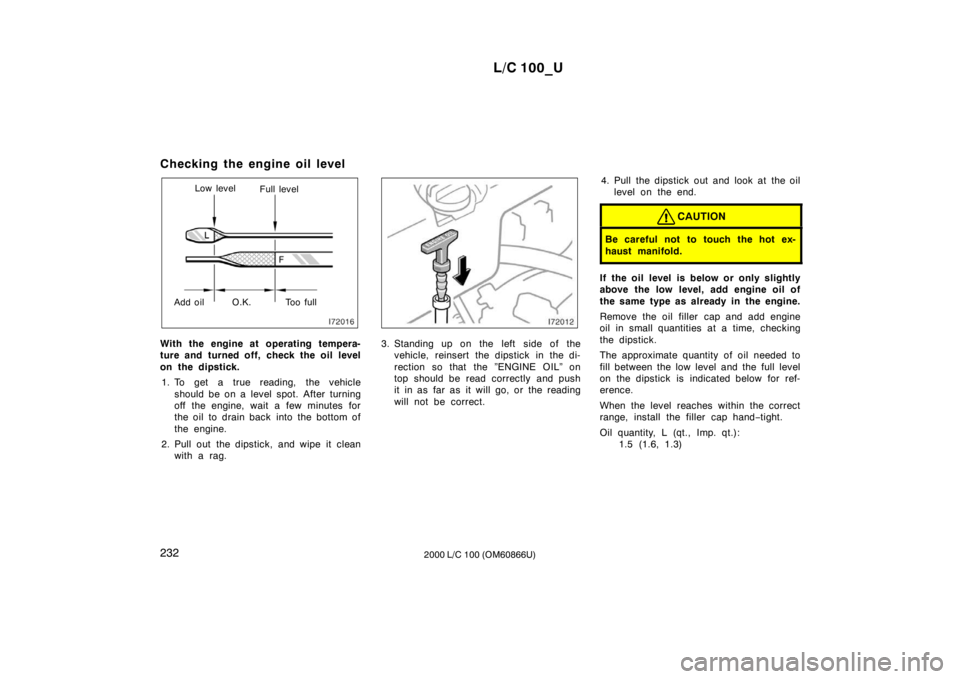
Low level
Full level
Add oil Too full O.K.
With the engine at operating tempera-
ture and turned off, check the oil level
on the dipstick. 1. To get a true reading, the vehicle should be on a level spot. After turning
off the engine, wait a few minutes for
the oil to drain back into the bottom of
the engine.
2. Pull out the dipstick, and wipe it clean with a rag.
3. Standing up on the left side of the vehicle, reinsert the dipstick in the di-
rection so that the ”ENGINE OIL” on
top should be read correctly and push
it in as far as it will go, or the reading
will not be correct. 4. Pull the dipstick out and look at the oil
level on the end.
CAUTION
Be careful not to touch the hot ex-
haust manifold.
If the oil level is below or only slightly
above the low level, add engine oil of
the same type as already in the engine.
Remove the oil filler cap and add engine
oil in small quantities at a time, checking
the dipstick.
The approximate quantity of oil needed to
fill between the low level and the full level
on the dipstick is indicated below for ref-
erence.
When the level reaches within the correct
range, install the filler cap hand −tight.
Oil quantity, L (qt., Imp. qt.): 1.5 (1.6, 1.3)
Page 197 of 235
L/C 100_U233
2000 L/C 100 (OM60866U)
NOTICE
Avoid overfilling, or the engine
could be damaged.
Check the oil level on the dipstick
once again after adding the oil.
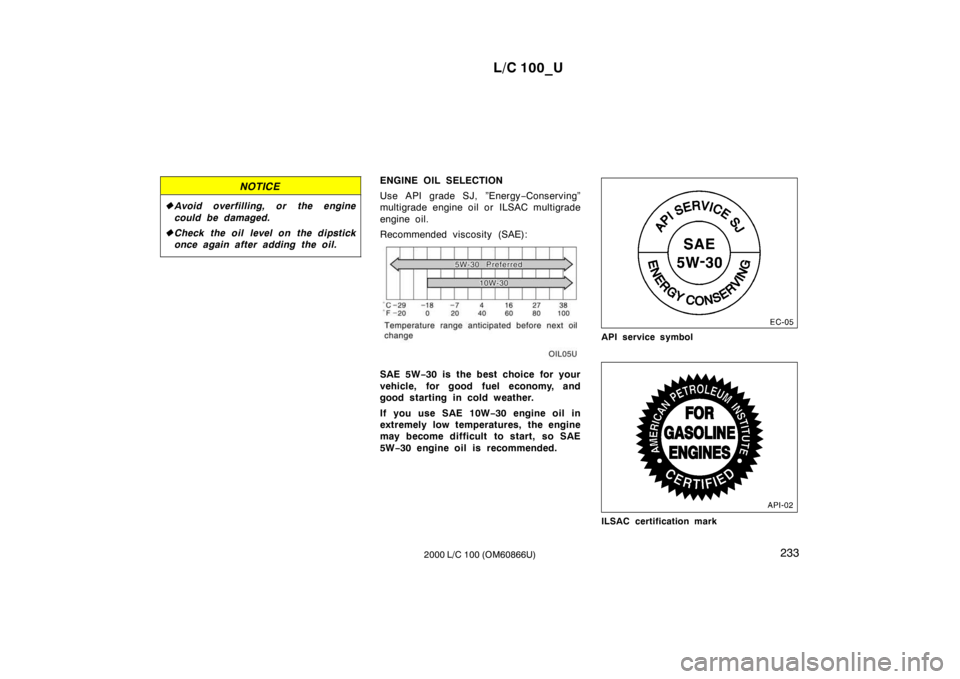
ENGINE OIL SELECTION
Use API grade SJ, ”Energy −Conserving”
multigrade engine oil or ILSAC multigrade
engine oil.
Recommended viscosity (SAE):
SAE 5W −30 is the best choice for your
vehicle, for good fuel economy, and
good starting in cold weather.
If you use SAE 10W −30 engine oil in
extremely low temperatures, the engine
may become difficult to start, so SAE 5W −30 engine oil is recommended.
API service symbol
ILSAC certification mark
Page 198 of 235
L/C 100_U
234 2000 L/C 100 (OM60866U)
Oil identification marks
Either or both API registered marks are
added to some oil containers to help
you select the oil you should use.
The API Service Symbol is located any-
where on the outside of the container.
The top portion of the label shows the oil
quality by API (American Petroleum Insti-
tute) designations such as SJ. The center
portion of the label shows the SAE viscos-
ity grade such as SAE 5W
−30. ”Energy −
Conserving” shown in the lower portion,
indicates that the oil has fuel −saving ca-
pabilities.
The ILSAC (International Lubricant Stan-
dardization and Approval Committee) Certi-
fication Mark is displayed on the front of
the container. Look at the see
−through coolant reser-
voir when the engine is cold. The cool-
ant level is satisfactory if it is between
the ”FULL” and ”LOW” lines on the
reservoir. If the level is low, add ethyl-ene −glycol type coolant for a proper
corrosion protection of aluminum com-
ponents.
The coolant level in the reservoir will vary
with engine temperature. However, if the
level is on or below the ”LOW” line, add
coolant. Bring the level up to the ”FULL”
line.
Always use ethylene −glycol type coolant
for a proper corrosion protection of alumi-
num components. See information in the
next column.
If the coolant level drops within a short
time after replenishing, there may be a
leak in the system. Visually check the
radiator, hoses, radiator cap and drain
cock and water pump.
If you can find no leak, have your Toyota
dealer test the cap pressure and check
for leaks in the cooling system.
CAUTION
To prevent burning yourself, do not
remove the radiator cap when the en-
gine is hot.
Coolant type selection
Use of improper coolants may damage
your engine cooling system. Your coolant
must contain ethylene −glycol type coolant
for a proper corrosion protection of your
engine that contains aluminum
components. Use ”TOYOTA Long Life
Coolant” or equivalent.
In addition to preventing freezing and sub-
sequent damage to the engine, this type
of coolant will prevent corrosion. Further
supplemental inhibitors or additives are
neither needed nor recommended.
Read the coolant container for information
on freeze protection. Follow the manufac-
turer’s directions for how much to mix
with plain water (preferably demineralized
water or distilled water). The total capacity
of the cooling system is given in Section 8.
Checking the engine coolant level