light TOYOTA LAND CRUISER 2000 Workshop Manual
[x] Cancel search | Manufacturer: TOYOTA, Model Year: 2000, Model line: LAND CRUISER, Model: TOYOTA LAND CRUISER 2000Pages: 235, PDF Size: 5.13 MB
Page 123 of 235

L/C 100_U145
2000 L/C 100 (OM60866U) OPERATION OF INSTRUMENTS AND
CONTROLS
Other equipment
Clock146
. . . . . . . . . . . . . . . . . . . . . . . . . . . . . . . . . . . . . . . . . . . . . . . . . . . . . .
Outside temperature display146
. . . . . . . . . . . . . . . . . . . . . . . . . . . . . . . . .
Cigarette lighter and ashtray147
. . . . . . . . . . . . . . . . . . . . . . . . . . . . . . . . .
Power outlets147
. . . . . . . . . . . . . . . . . . . . . . . . . . . . . . . . . . . . . . . . . . . . . .
Fuel pump shut −off system148
. . . . . . . . . . . . . . . . . . . . . . . . . . . . . . . . . .
Rear console box149
. . . . . . . . . . . . . . . . . . . . . . . . . . . . . . . . . . . . . . . . . . .
Glove box150
. . . . . . . . . . . . . . . . . . . . . . . . . . . . . . . . . . . . . . . . . . . . . . . . . .
Garage door opener box150
. . . . . . . . . . . . . . . . . . . . . . . . . . . . . . . . . . . .
Auxiliary boxes153
. . . . . . . . . . . . . . . . . . . . . . . . . . . . . . . . . . . . . . . . . . . . .
Cup holders156
. . . . . . . . . . . . . . . . . . . . . . . . . . . . . . . . . . . . . . . . . . . . . . . .
Tie −down hooks157
. . . . . . . . . . . . . . . . . . . . . . . . . . . . . . . . . . . . . . . . . . . .
Luggage cover158
. . . . . . . . . . . . . . . . . . . . . . . . . . . . . . . . . . . . . . . . . . . . .
Floor mat159
. . . . . . . . . . . . . . . . . . . . . . . . . . . . . . . . . . . . . . . . . . . . . . . . . .
SECTION 1− 9
Page 124 of 235
L/C 100_U
146 2000 L/C 100 (OM60866U)
Clock
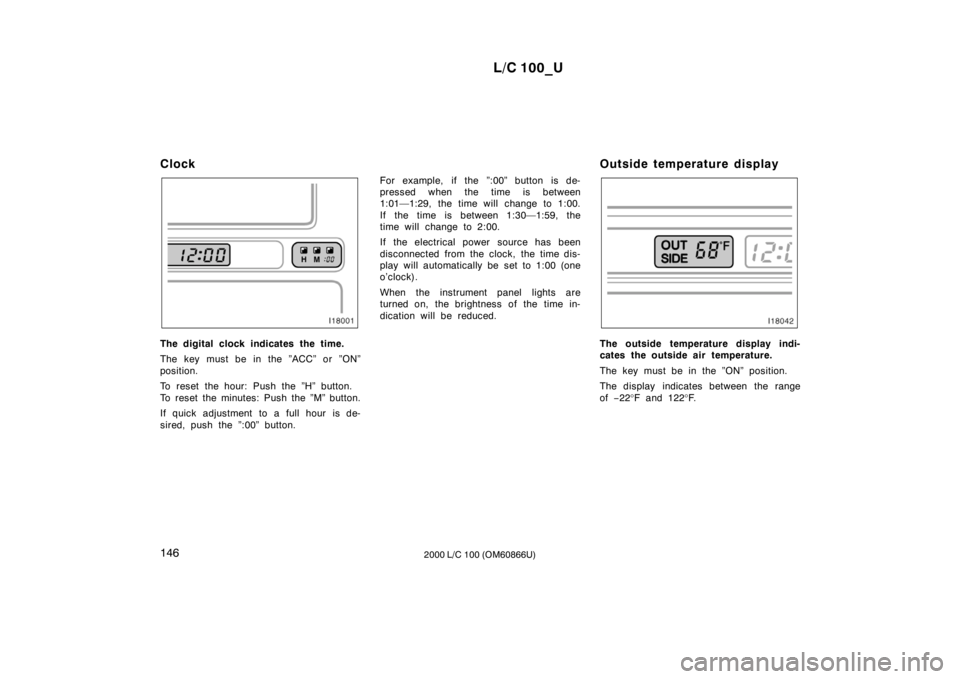
The digital clock indicates the time.
The key must be in the ”ACC” or ”ON”
position.
To reset the hour: Push the ”H” button.
To reset the minutes: Push the ”M” button.
If quick adjustment to a full hour is de-
sired, push the ”:00” button.
For example, if the ”:00” button is de-
pressed when the time is between
1:01—1:29, the time will change to 1:00.
If the time is between 1:30—1:59, the
time will change to 2:00.
If the electrical power source has been
disconnected from the clock, the time dis-
play will automatically be set to 1:00 (one
o’clock).
When the instrument panel lights are
turned on, the brightness of the time in-
dication will be reduced.
Outside temperature displayThe outside temperature display indi-
cates the outside air temperature.
The key must be in the ”ON” position.
The display indicates between the range of
−22 °F and 122 °F.
Page 125 of 235
L/C 100_U147
2000 L/C 100 (OM60866U)
Cigarette lighter and ashtray
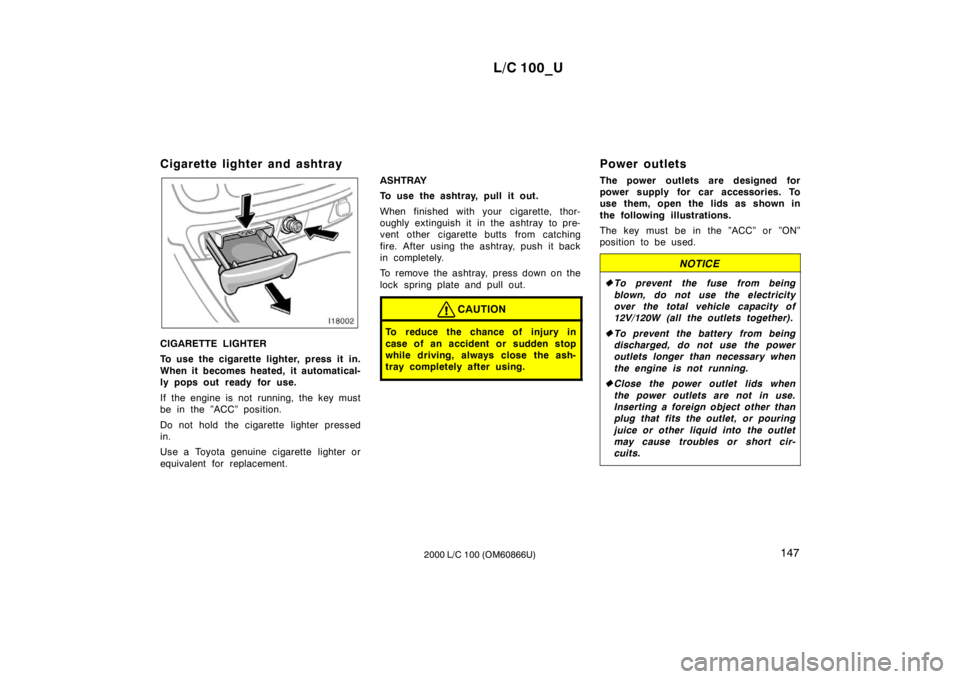
CIGARETTE LIGHTER
To use the cigarette lighter, press it in.
When it becomes heated, it automatical-
ly pops out ready for use.
If the engine is not running, the key must
be in the ”ACC” position.
Do not hold the cigarette lighter pressed
in.
Use a Toyota genuine cigarette lighter or
equivalent for replacement.
ASHTRAY
To use the ashtray, pull it out.
When finished with your cigarette, thor-
oughly extinguish it in the ashtray to pre-
vent other cigarette butts from catching
fire. After using the ashtray, push it back
in completely.
To remove the ashtray, press down on the
lock spring plate and pull out.
CAUTION
To reduce the chance of injury in
case of an accident or sudden stop
while driving, always close the ash-
tray completely after using.
Power outlets
The power outlets are designed for
power supply for car accessories. To
use them, open the lids as shown in
the following illustrations.
The key must be in the ”ACC” or ”ON”
position to be used.
NOTICE
To prevent the fuse from being
blown, do not use the electricity
over the total vehicle capacity of
12V/120W (all the outlets together).
To prevent the battery from being
discharged, do not use the power
outlets longer than necessary when
the engine is not running.
Close the power outlet lids when
the power outlets are not in use.
Inserting a foreign object other than
plug that fits the outlet, or pouring
juice or other liquid into the outlet
may cause troubles or short cir-
cuits.
Page 128 of 235
L/C 100_U
150 2000 L/C 100 (OM60866U)
Glove box
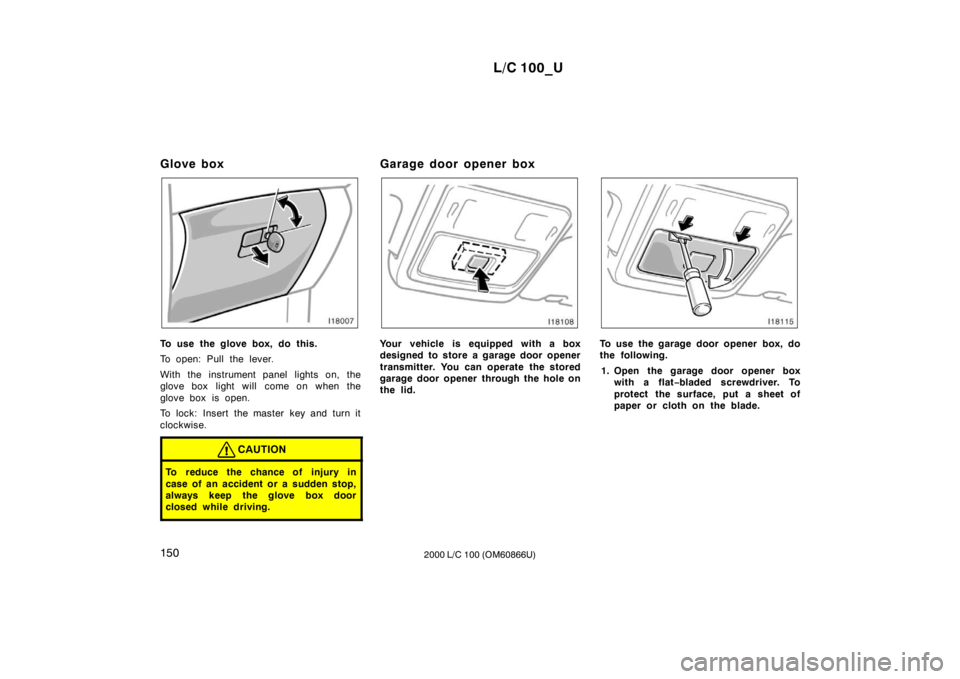
To use the glove box, do this.
To open: Pull the lever.
With the instrument panel lights on, the
glove box light will come on when the
glove box is open.
To lock: Insert the master key and turn it
clockwise.
CAUTION
To reduce the chance of injury in
case of an accident or a sudden stop,
always keep the glove box door
closed while driving.
Garage door opener box
Your vehicle is equipped with a box
designed to store a garage door opener
transmitter. You can operate the stored
garage door opener through the hole on
the lid.To use the garage door opener box, do
the following.
1. Open the garage door opener box with a flat −bladed screwdriver. To
protect the surface, put a sheet of
paper or cloth on the blade.
Page 131 of 235
L/C 100_U153
2000 L/C 100 (OM60866U)
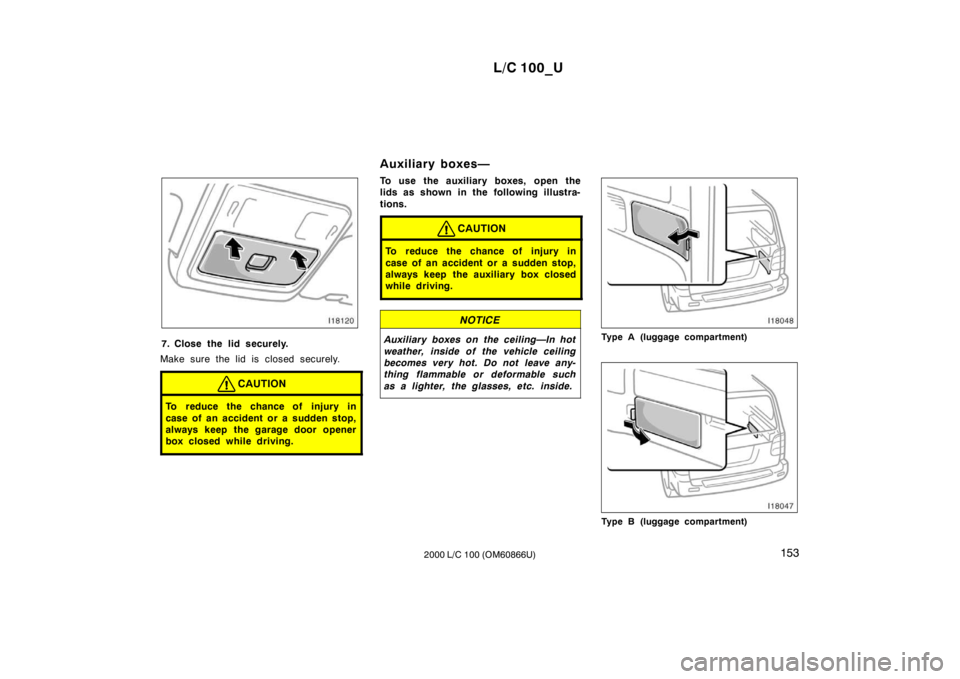
7. Close the lid securely.
Make sure the lid is closed securely.
CAUTION
To reduce the chance of injury in
case of an accident or a sudden stop,
always keep the garage door opener
box closed while driving.
Auxiliary boxes—
To use the auxiliary bo xes, open the
lids as shown in the following illustra-
tions.
CAUTION
To reduce the chance of injury in
case of an accident or a sudden stop,
always keep the auxiliary box closed
while driving.
NOTICE
Auxiliary boxes on the ceiling—In hot
weather, inside of the vehicle ceiling
becomes very hot. Do not leave any-
thing flammable or deformable such
as a lighter, the glasses, etc. inside.Type A (luggage compartment)
Type B (luggage compartment)
Page 142 of 235

L/C 100_U
164 2000 L/C 100 (OM60866U)
OCTANE RATING
Select Octane Rating 91 (Research Oc-
tane Number 96) or higher for optimum
engine performance. However, if such
premium type cannot be obtained, you
may temporarily use unleaded gasoline
with an Octane Rating as low as 87
(Research Octane Number 91).
Use of unleaded gasoline with an octane
rating or research octane number lower
than stated above will cause persistent
heavy knocking. If it is severe, this will
lead to engine damage.
If your engine knocks...
If you detect heavy knocking even when
using the recommended fuel, or if you
hear steady knocking while holding a
steady speed on level roads, consult your
Toyota dealer.
However, now and then, you may notice
light knocking for a short time while accel-
erating or driving up hills. This is no need
of concern.
GASOLINE CONTAINING DETERGENT
ADDITIVES
Toyota recommends the use of gasoline
that contains detergent additives to
avoid build
−up of engine deposits.
However, all gasoline sold in the U.S.
contains detergent additives to keep clean
and/or clean intake systems.
QUALITY GASOLINE
Automotive manufacturers in the U.S.,
Europe and Japan have developed a
specification for quality fuel named
World −Wide Fuel Charter (WWFC) that
is expected to be applied world wide.
The WWFC consists of three categories
that depend on required emission lev-
els. In the U.S., category 3 has been
adopted. The WWFC improves air quali-
ty by providing for better emissions in
vehicle fleets, and customer satisfaction
through better vehicle performance.
CLEANER BURNING GASOLINE
Cleaner burning gasoline, including re-
formulated gasoline that contains oxy-
genates such as ethanol or MTBE is
available in many areas. Toyota recommends the use of cleaner
burning gasoline and appropriately blended
reformulated gasoline. These types of gas-
oline provide excellent vehicle perfor-
mance, reduce vehicle emissions, and im-
prove air quality.
OXYGENATES IN GASOLINE
Toyota allows the use of oxygenate
blended gasoline where the oxygenate
content is up to 10% ethanol or 15%
MTBE. If you use gasohol in your Toyota,
be sure that it has an octane rating no low-
er than 87.
Toyota does not recommend the use of
gasoline containing methanol.
SULFUR IN GASOLINE
If your vehicle is certified to California
Emission Regulation, the vehicle is de-
signed to operate on California cleaner
burning gasoline (CBG) that contains
lower sulfur. If you cannot use Califor-
nia CBG, your emission control system
may suffer damage and turn on the
Malfunction Indicator Lamp.
If the malfunction is caused by the type
of fuel used, repairs may not be covered
by your warranty.
Page 147 of 235
L/C 100_U169
2000 L/C 100 (OM60866U)
For detailed information on oil level check,
see ”Checking the engine oil level” in Sec-
tion 7
−2.
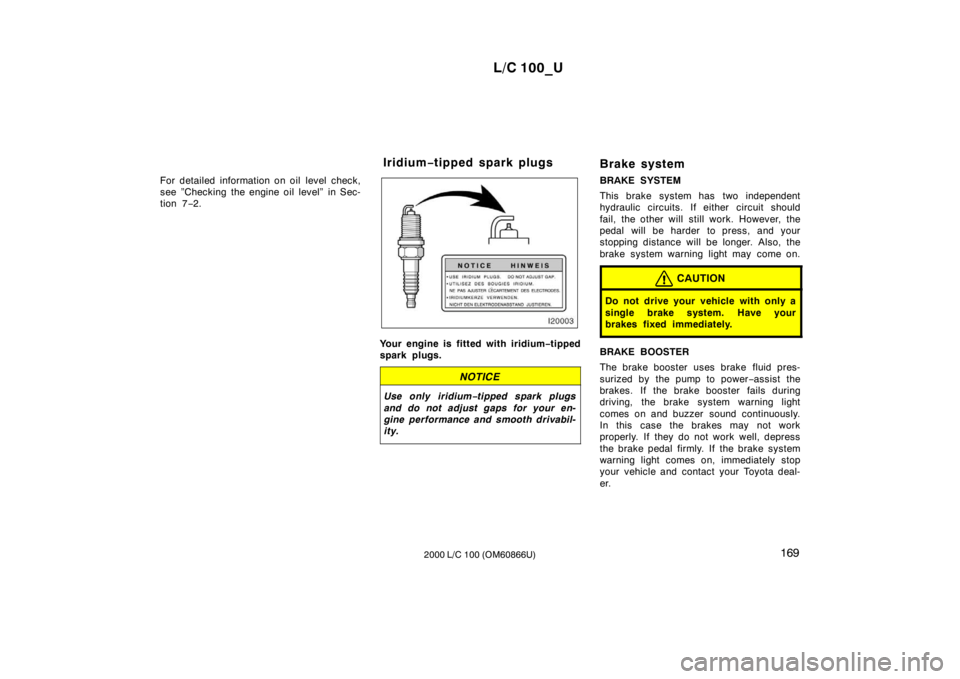
Your engine is fitted with iridium −tipped
spark plugs.
NOTICE
Use only iridium −tipped spark plugs
and do not adjust gaps for your en-
gine performance and smooth drivabil-
ity.
Brake system
BRAKE SYSTEM
This brake system has two independent
hydraulic circuits. If either circuit should
fail, the other will still work. However, the
pedal will be harder to press, and your
stopping distance will be longer. Also, the
brake system warning light may come on.
CAUTION
Do not drive your vehicle with only a
single brake system. Have your
brakes fixed immediately.
BRAKE BOOSTER
The brake booster uses brake fluid pres-
surized by the pump to power −assist the
brakes. If the brake booster fails during
driving, the brake system warning light
comes on and buzzer sound continuously.
In this case the brakes may not work
properly. If they do not work well, depress
the brake pedal firmly. If the brake system
warning light comes on, immediately stop
your vehicle and contact your Toyota deal-
er.
Iridium
−tipped spark plugs
Page 148 of 235
L/C 100_U
170 2000 L/C 100 (OM60866U)
There may be the case that the brake
system warning light stays on for a
bout
60 seconds after the engine is started. It
is normal if the light goes out after a
while.
Depressing the brake pedal repeatedly
may turn on the brake system warning
light and buzzer. It is normal if the light
goes out and the buzzer stops sounding
after a few seconds.
You may hear a small sound in the engine
compartment after the engine is started or
the brake pedal is depressed repeatedly.
This is a pump pulsating sound of the
brake system, and it is not a malfunction.
CAUTION
Do not pump the brake pedal if the
engine stalls. Each push on the
pedal uses up your brake fluid
pressure reserve.
Even if the power assist is com-
pletely lost, the brakes will still
work. But you will have to push the
pedal hard, much harder than nor-
mal. And your braking distance will
be longer.
ANTI −LOCK BRAKE SYSTEM
(with “ABS” warning light)
The anti −lock brake system is designed
to help prevent lock −up of the wheels
during a sudden braking or braking on
slippery road surfaces. This assists in
providing stability and steering perfor-
mance of the vehicle under these cir-
cumstances.
Effective way to press the ”ABS” brake
pedal: When the anti −lock brake system
function is in action, just hold the brake
pedal down more firmly. Especially in a
panic stop, you need to keep it de-
pressed more firmly, and do not pump
the brake. Pumping the brake pedal
makes the stopping distance longer.
The anti −lock brake system becomes op-
erative after the vehicle has accelerated
to a speed in excess of approximately 10
km/h (6 mph). It stops operating when the
vehicle decelerates to a speed below
approximately 5 km/h (3 mph).
Depressing the brake pedal on slippery
road surfaces such as on the manhole
cover, the steel plate under the construc-
tion, joints in the bridge, etc. on a rainy
day tends to activate the anti −lock brake
system. You may hear a click or motor sound in
the engine compartment for a few seconds
when the engine is started or just after
the vehicle is started. This means that the
anti
−lock brake system is in the self
check mode, and does not indicate a mal-
function.
When the anti −lock brake system is ac-
tivated, the following conditions may
occur, however, do not indicate a mal-
function of the system:
You may hear the anti −lock brake sys-
tem operating and feel the brake pedal
pulsating and the vibrations of the body
and steering wheel. You may also hear
the motor sound in the engine compart-
ment even after the vehicle is stopped.
At the end of the anti −lock brake sys-
tem activation, the brake pedal may
move a little forward.
Page 149 of 235
L/C 100_U171
2000 L/C 100 (OM60866U)
CAUTION
Do not overestimate the anti −lock
brake system: Although the anti −lock
brake system assists in providing ve-
hicle control, it is still important to
drive with all due care and maintain
a moderate speed and safe distance
from the vehicle in front of you, be-
cause there are limits to the vehicle
stability and effectiveness of steering
wheel operation even with the anti −
lock brake system on.
If tires grip performance exceeds its
capability, or if hydroplaning occurs
during high speed driving in the rain,
the anti −lock brake system does not
provide vehicle control.
Anti −lock brake system is not de-
signed to shorten the stopping dis-
tance: Always drive at the moderate
speed and maintain a safe distance
from the vehicle in front of you.
Compared with vehicles not fitted
with an anti −lock brake system, your
vehicle may require a longer stopping
distance in the following cases: Driving on rough, gravel or snow −
covered roads.
Driving with tire chains installed.
Driving over the steps such as the
joints on the road.
Driving on roads where the road
surface is pitted or has other differ-
ences in surface height.
Install all 4 tires of specified size at
designated pressure: The anti −lock
brake system detects vehicle speeds
using the speed sensors for respec-
tive wheels’ turning speeds. The use
of tires other than specified may fail
to detect the accurate turning speed,
resulting in a longer stopping dis-
tance.
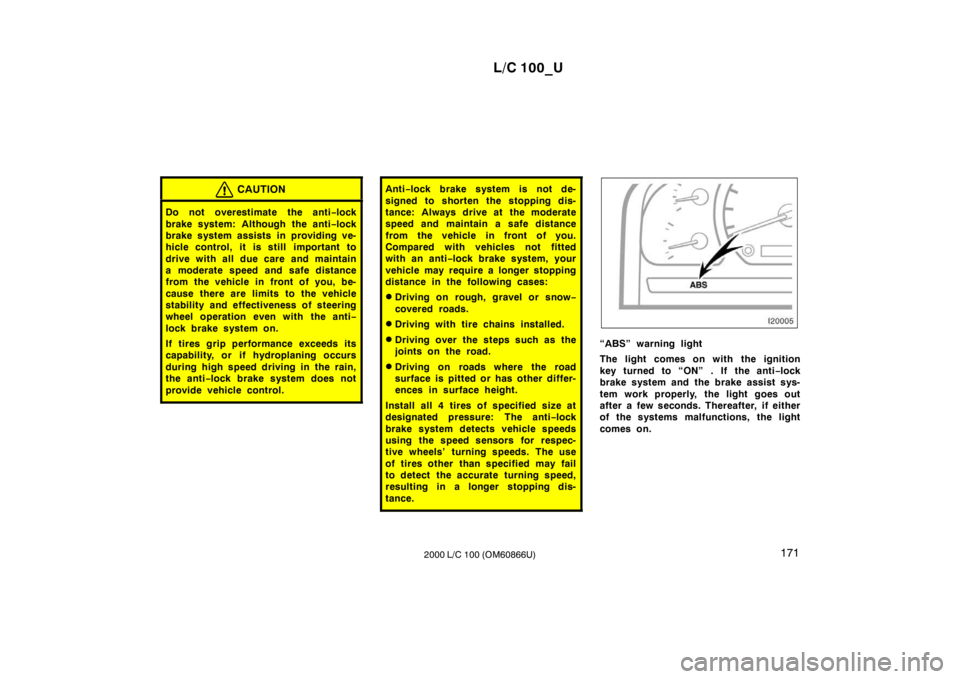
“ABS” warning light
The light comes on with the ignition
key turned to “ON” . If the anti −lock
brake system and the brake assist sys-
tem work properly, the light goes out
after a few seconds. Thereafter, if either
of the systems malfunctions, the light
comes on.
Page 150 of 235
L/C 100_U
172 2000 L/C 100 (OM60866U)
When the “ABS” warning light is on (and
the brake system warning light is off), the
anti
−lock brake system, the brake assist
system, the vehicle skid control system
and/or active traction control system do/
does not operate, but the brake system
still operates conventionally.
When the “ABS” warning light is on (and
the brake system warning light is off), the
anti −lock brake system does not operate
so that the wheels could lock up during
a sudden braking or braking on slippery
road surfaces.
If the following conditions occurs, this
indicates a malfunction somewhere in
the parts monitored by the warning
light system. Contact your Toyota deal-
er as soon as possible to service the
vehicle.
The light does not come on with the
ignition key turned to “ON”, or remainson.
The light comes on while driving.
If the light lit during driving goes out and
does not come on again, it is a normal
operation.
CAUTION
If the “ABS” warning light remains on
together with the brake system warn-
ing light, immediately stop your ve-
hicle at a safe place and contact your
Toyota dealer.
In this case, the vehicle may become
harder to control or skid during hard
braking or braking on slippery road
surfaces.
Either of the following conditions may
occur, but do not indicate the malfunc-
tion. The light may stay on for about 60
seconds after the engine is started. It
is normal if it goes out after a while.
Depressing the brake pedal repeatedly
may turn on the light. It is normal if it
goes off after a few seconds. DRUM
−IN −DISC TYPE PARKING BRAKE
SYSTEM
Your vehicle has a drum −in −disc type
parking brake system. This type of brake
system n eeds bedding −down of the brake
shoes periodically or whenever the parking
brake shoes and/or drums are replaced.
Have your Toyota dealer perform the bed-
ding −down.
BRAKE ASSIST SYSTEM
When you slam the brakes on, the
brake assist system judges as an emer-
gency stop and provides more powerful
braking for a driver who cannot hold
down the brake pedal firmly.
When you slam the brakes on, more pow-
erful braking will be applied. At this time,
you may hear a sound in the engine
compartment and feel the vibrations of the
brake pedal. This does not indicate a mal-
function.
The brake assist system becomes opera-
tive after the vehicle has accelerated to
a speed in excess of approximately 10
km/h (6 mph). It stops operating when the
vehicle decelerates to a speed below
approximately 5 km/h (3 mph).