towing TOYOTA LAND CRUISER 2000 Owners Manual
[x] Cancel search | Manufacturer: TOYOTA, Model Year: 2000, Model line: LAND CRUISER, Model: TOYOTA LAND CRUISER 2000Pages: 235, PDF Size: 5.13 MB
Page 72 of 235
L/C 100_U
94 2000 L/C 100 (OM60866U)
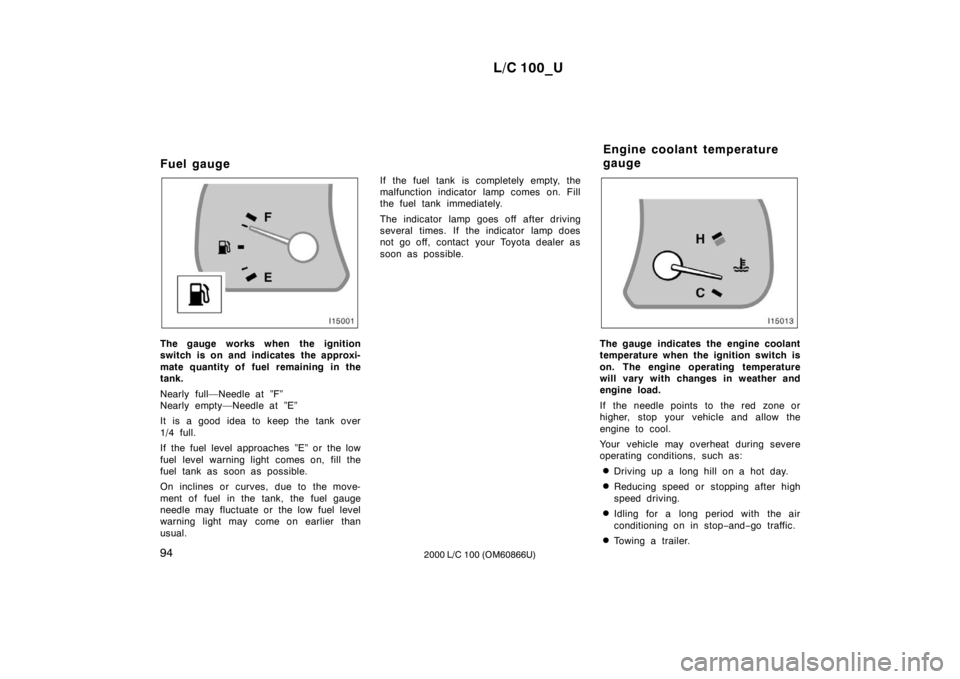
Fuel gauge
The gauge works when the ignition
switch is on and indicates the approxi-
mate quantity of fuel remaining in the
tank.
Nearly full—Needle at ”F”
Nearly empty—Needle at ”E”
It is a good idea to keep the tank over
1/4 full.
If the fuel level approaches ”E” or the low
fuel level warning light comes on, fill the
fuel tank as soon as possible.
On inclines or curves, due to the move-
ment of fuel in the tank, the fuel gauge
needle may fluctuate or the low fuel level
warning light may come on earlier than
usual.
If the fuel tank is completely empty, the
malfunction indicator lamp comes on. Fill
the fuel tank immediately.
The indicator lamp goes off after driving
several times. If the indicator lamp does
not go off, contact your Toyota dealer as
soon as possible.The gauge indicates the engine coolant
temperature when the ignition switch is
on. The engine operating temperature
will vary with changes in weather and
engine load.
If the needle points to the red zone or
higher, stop your vehicle and allow the
engine to cool.
Your vehicle may overheat during severe
operating conditions, such as:
Driving up a long hill on a hot day.
Reducing speed or stopping after high
speed driving.
Idling for a long period with the air
conditioning on in stop −and −go traffic.
Towing a trailer.
Engine coolant temperature
gauge
Page 84 of 235
L/C 100_U
106 2000 L/C 100 (OM60866U)
Your automatic transmission has a shift
lock system to minimize the possibility of
incorrect operation. This means you can
only shift out of ”P” position when the
brake pedal is depressed (with the ignition
switch in ”ON” position and the lock re-
lease button depressed).
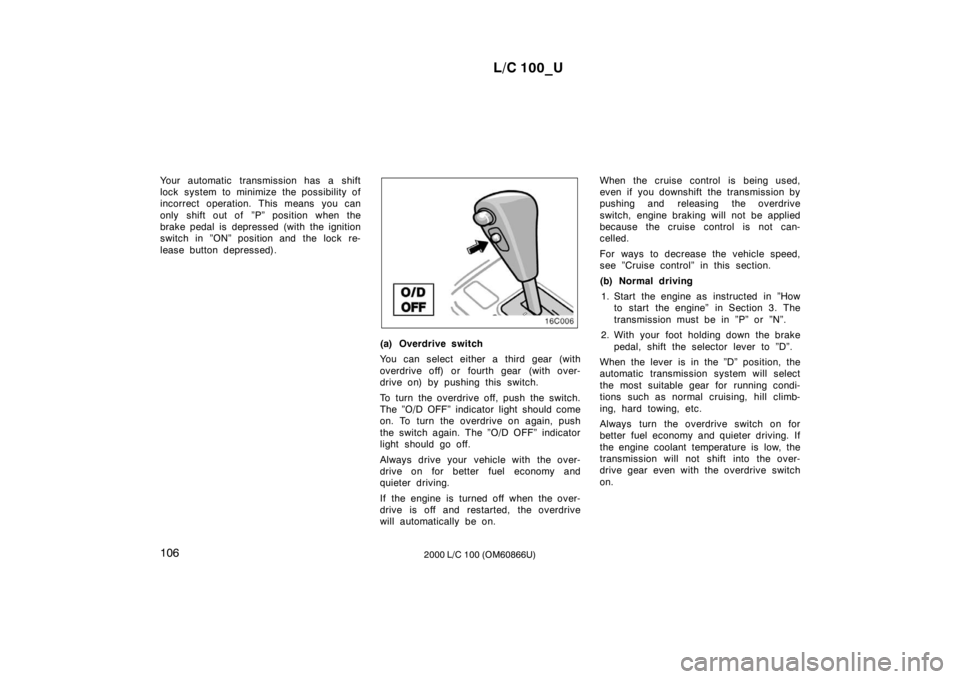
(a) Overdrive switch
You can select either a third gear (with
overdrive off) or fourth gear (with over-
drive on) by pushing this switch.
To turn the overdrive off, push the switch.
The ”O/D OFF” indicator light should come
on. To turn the overdrive on again, push
the switch again. The ”O/D OFF” indicator
light should go off.
Always drive your vehicle with the over-
drive on for better fuel economy and
quieter driving.
If the engine is turned off when the over-
drive is off and restarted, the overdrive
will automatically be on.
When the cruise control is being used,
even if you downshift the transmission by
pushing and releasing the overdrive
switch, engine braking will not be applied
because the cruise control is not can-
celled.
For ways to decrease the vehicle speed,
see ”Cruise control” in this section.
(b) Normal driving
1. Start the engine as instructed in ”How to start the engine” in Section 3. The
transmission must be in ”P” or ”N”.
2. With your foot holding down the brake pedal, shift the selector lever to ”D”.
When the lever is in the ”D” position, the
automatic transmission system will select
the most suitable gear for running condi-
tions such as normal cruising, hill climb-
ing, hard towing, etc.
Always turn the overdrive switch on for
better fuel economy and quieter driving. If
the engine coolant temperature is low, the
transmission will not shift into the over-
drive gear even with the overdrive switch on.
Page 85 of 235
L/C 100_U107
2000 L/C 100 (OM60866U)
CAUTION
Never put your foot on the accelera-
tor pedal while shifting.
3. Release the parking brake and brake
pedal. Depress the accelerator pedal
slowly for smooth starting.
(c) Using engine braking
To use engine braking, you can downshift
the transmission as follows:
Turn off the overdrive switch. The ”O/D
OFF” indicator light will come on and
the transmission will downshift to the
third gear.
Shift into the ”2” position. The trans-
mission will downshift to the second
gear when the vehicle speed drops
down to or lower than following speed
for second gear, and more powerful
engine braking will be obtained.
Four –wheel drive control lever
in ”H” 112 km/h (70 mph) . . . . . . . . . . .
Four –wheel drive control lever
in ”L” 39 km/h (24 mph) . . . . . . . . . . .
Shift into the ”L” position. The trans-
mission will downshift to the first gear
when the vehicle speed drops down to
or lower than following speed for ”L”
position and maximum engine braking
will be applied.
Four –wheel drive control lever
in ”H” 57 km/h (35 mph) . . . . . . . . . . .
Four –wheel drive control lever
in ”L” 12 km/h (7 mph) . . . . . . . . . . .
When the cruise control is being used,
even if you downshift the transmission by
turning off the overdrive switch, engine
braking will not be applied because the
cruise control is not cancelled.
For ways to decrease the vehicle speed,
see ”Cruise control” in this section.
CAUTION
Be careful when downshifting on a
slippery surface. Abrupt shifting
could cause the vehicle to spin or
skid.
(d) Using ”2” and ”L” positions
The ”2” and ”L” positions are used for
strong engine braking as described pre-
viously. With the selector lever in ”2” or ”L”, you
can start the vehicle in motion as with the
lever in ”D”.
With the selector lever in ”2”, the vehicle
will start in the first gear and automatical-
ly shift to the second gear.
With the selector lever in ”L”, the trans-
mission is engaged in the first gear.
NOTICE
Be careful not to overrev the en-
gine. Watch the tachometer to keep
engine rpm from going into the red
zone. The approximate maximum al-
lowable speed for each position is
given below for your reference:
km/h (mph)
Transmission Transfer L H
2 42 (26) 104 (65) . . . . . . .
L 23 (14) 57 (35) . . . . . . .
Do not continue hill climbing or
hard towing for a long time in the
”2” or ”L” position. This may cause
severe automatic transmission dam-
age from overheating. To prevent
such damage, ”D” position should
be used in hill climbing or hard
towing.
Page 86 of 235
L/C 100_U
108 2000 L/C 100 (OM60866U)
(e) Backing up
1. Bring the vehicle to a complete stop.
2. With the brake pedal held down with your foot, shift the selector lever to the
”R” position.
NOTICE
Never shift into reverse while the ve-
hicle is moving.
(f) Parking
1. Bring the vehicle to a complete stop.
2. Pull the parking brake lever up fully to securely apply the parking brake.
3. With the brake pedal pressed down, shift the selector lever to the ”P” posi-
tion.
If the four–wheel drive control is in the
”N” position while the selector lever is in
the ”P” position, the transmission will
damage and the wheels will not lock.
CAUTION
While the vehicle is moving, never
attempt to move the selector lever
into ”P” position under any circum-
stances. Serious mechanical damage
and loss of vehicle control may re-
sult.
(g) Good driving practice
If the transmission repeatedly shifts up
and down between third gear and over-
drive when climbing a gentle slope, the
overdrive switch should be turned off.
Be sure to turn the switch on immedi-
ately afterward.
When towing a trailer, in order to main-
tain engine braking efficiency, do not
use overdrive.
CAUTION
Always keep your foot on the brake
pedal while stopped with the engine
running. This prevents the vehicle
from creeping.
NOTICE
Do not hold the vehicle on an up-
grade with the accelerator pedal. It
can cause the transmission to over-
heat. Always use the brake pedal or
parking brake.
(h) Rocking your vehicle if stuck
CAUTION
If your vehicle becomes stuck in
snow, mud, sand, etc., then you may
attempt to rock the vehicle free by
moving it forward and backward. Do
not attempt this procedure if people
or objects are anywhere near the ve-
hicle. During the rocking operation
the vehicle may suddenly move for-
ward or backward as it becomes un-
stuck, causing injury or damage to
nearby people or objects.
Page 151 of 235
L/C 100_U173
2000 L/C 100 (OM60866U)
The brake assist system may not work for
about 60 seconds after the engine is
started.
For an explanation of this system’s warn-
ing light, see “Service reminder indicators
and warning buzzers” in Section 1
−5. Brake pad wear limit indicators
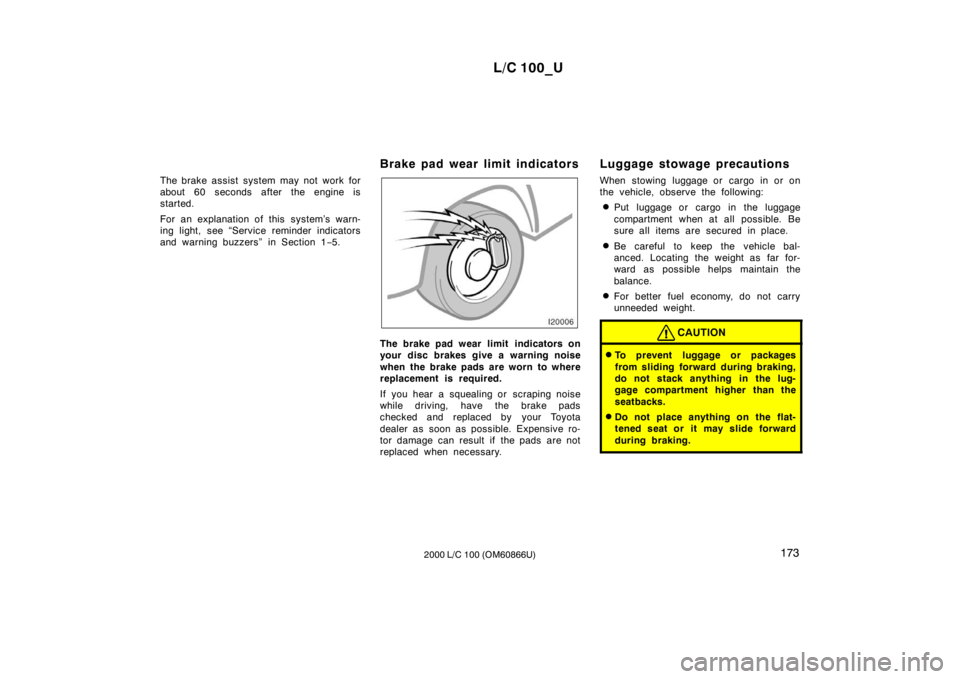
The brake pad wear limit indicators on
your disc brakes give a warning noise
when the brake pads are worn to where
replacement is required.
If you hear a squealing or scraping noise
while driving, have the brake pads
checked and replaced by your Toyota
dealer as soon as possible. Expensive ro-
tor damage can result if the pads are not
replaced when necessary. Luggage stowage pr
ecautions
When stowing luggage or cargo in or on
the vehicle, observe the following: Put luggage or cargo in the luggage
compartment when at all possible. Be
sure all items are secured in place.
Be careful to keep the vehicle bal-
anced. Locating the weight as far for-
ward as possible helps maintain the
balance.
For better fuel economy, do not carry
unneeded weight.CAUTION
To prevent luggage or packages
from sliding forward during braking,
do not stack anything in the lug-
gage compartment higher than the
seatbacks.
Do not place anything on the flat-
tened seat or it may slide forward
during braking.
Page 159 of 235
L/C 100_U195
2000 L/C 100 (OM60866U)
(b) Starting a flooded engine
If the engine will not start, your engine
may be flooded because of repeated
cranking.
If this happens, turn the key to ”START”
with the accelerator pedal held down.
Keep the key and accelerator pedal so for
15 seconds and release them. Then try
starting the engine with your foot off the
accelerator pedal.
If the engine does not start after 15 se-
conds of cranking, release the key, wait
a few minutes and try again.
If the engine still will not start, it needs
adjustment or repair. Call a Toyota dealer
or qualified repair shop for assistance.
NOTICE
Do not crank for more than 30 se-
conds at a time. This may overheat
the starter and wiring systems.
(c) Jump starting
To avoid serious personal injury and
damage to your vehicle which might re-
sult from battery explosion, acid burns,
electrical burns, or damaged electronic
components, these instructions must be
followed precisely.
If you are unsure about how to follow this
procedure, we strongly recommend that
you seek the help of a competent me-
chanic or towing service.
CAUTION
Batteries contain sulfuric acid
which is poisonous and corrosive.
Wear protective safety glasses when
jump starting, and avoid spilling
acid on your skin, clothing, or ve-
hicle.
If you should accidentally get acid
on yourself or in your eyes, remove
any contaminated clothing and flush
the affected area with water im-
mediately. Then get immediate medi-
cal attention. If possible, continue
to apply water with a sponge or
cloth while en route to the medical
office.
The gas normally produced by a
battery will explode if a flame or
spark is brought near. Use only
standardized jumper cables and do
not smoke or light a match while
jump starting.
NOTICE
The battery used for boosting must
be 12 V. Do not jump start unless you
are sure that the booster battery is
correct.
Page 172 of 235
L/C 100_U
208 2000 L/C 100 (OM60866U)
—After changing wheels
11. Check the air pressure of the re- placed tire.
Adjust the air pressure to the specification
designated in Section 8. If the pressure is
lower, drive slowly to the nearest service
station and fill to the correct pressure.
Do not forget to reinstall the tire inflation
valve cap as dirt and moisture could get
into the valve core and possibly cause air
leakage. If the cap is missing, have a new
one put on as soon as possible.
12. Restow all the tools, jack and flat tire securely.
As soon after changing wheels as pos-
sible, tighten the wheel nuts to the torque
specified in Section 8 with a torque
wrench. Have a technician repair the flat
tire.
This is the same procedure for changing
or rotating your tires.
CAUTION
Before driving, make sure all the
tools, jack and flat tire are securely
in place in their storage location to
reduce the possibility of personal in-
jury during a collision or s udden
braking.
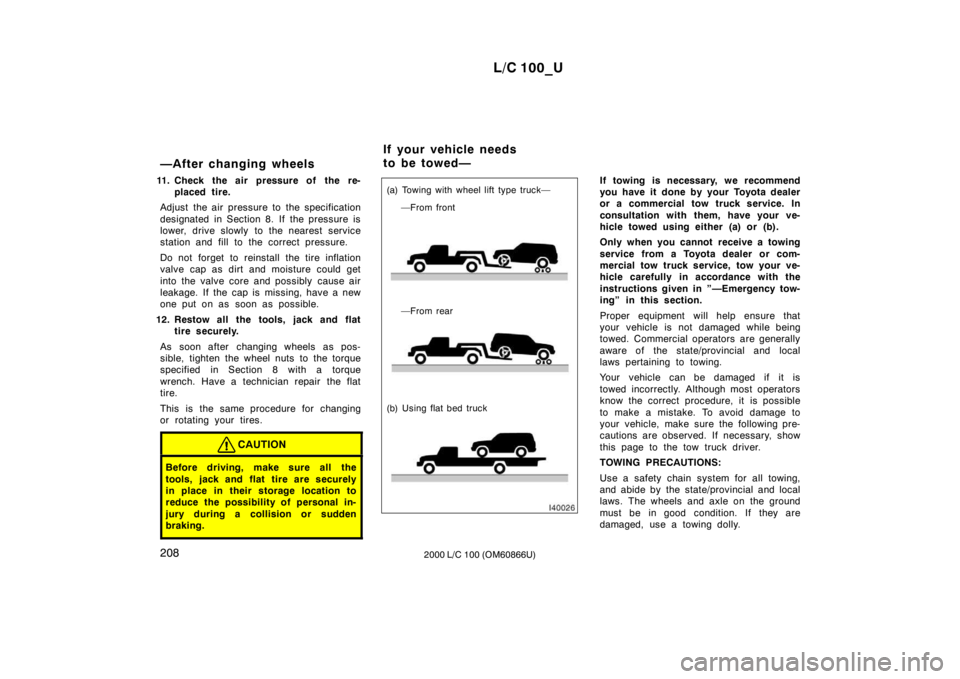
(a) Towing with wheel lift type truck—
—From rear
(b) Using flat bed truck —From front
If towing is necessary, we recommend
you have it done by your Toyota dealer
or a commercial tow truck service. In
consultation with them, have your ve-
hicle towed using either (a) or (b).
Only when you cannot receive a towing
service from a Toyota dealer or com-
mercial tow truck service, tow your ve-
hicle carefully in accordance with the
instructions given in ”—Emergency tow-
ing” in this section.
Proper equipment will help ensure that
your vehicle is not damaged while being
towed. Commercial operators are generally
aware of the state/provincial and local
laws pertaining to towing.
Your vehicle can be damaged if it is
towed incorrectly. Although most operators
know the correct procedure, it is possible
to make a mistake. To avoid damage to
your vehicle, make sure the following pre-
cautions are observed. If necessary, show
this page to the tow truck driver.
TOWING PRECAUTIONS:
Use a safety chain system for all towing,
and abide by the state/provincial and local
laws. The wheels and axle on the ground
must be in good condition. If they are
damaged, use a towing dolly.
If your vehicle needs
to be towed—
Page 173 of 235
L/C 100_U209
2000 L/C 100 (OM60866U)
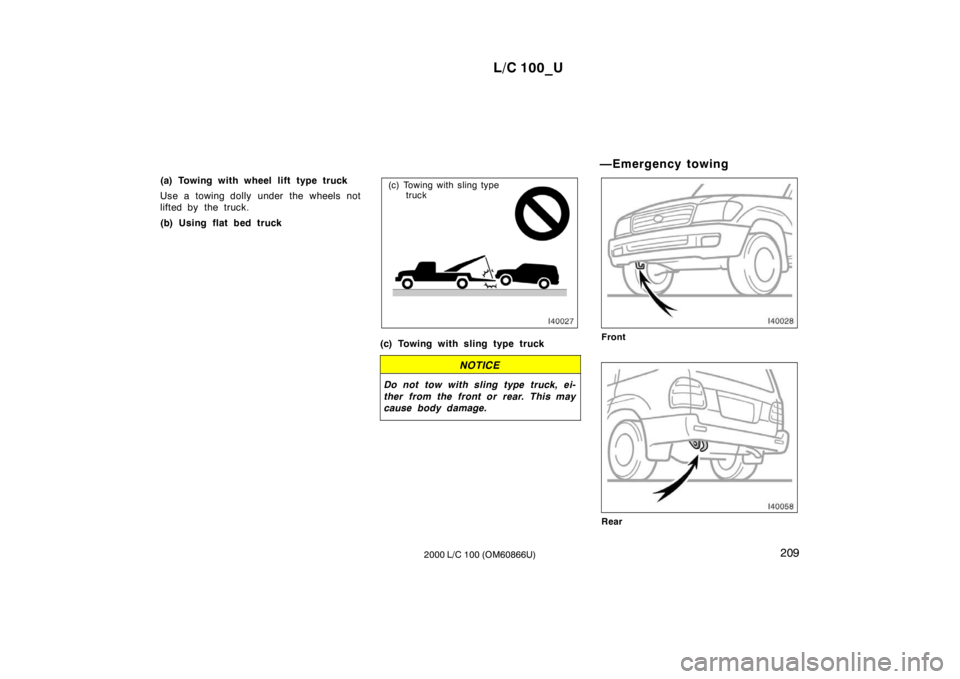
(a) Towing with wheel lift type truck
Use a towing dolly under the wheels not
lifted by the truck.
(b) Using flat bed truck
(c) Towing with sling type
truck
(c) Towing with sling type truck
NOTICE
Do not tow with sling type truck, ei-
ther from the front or rear. This may
cause body damage.
—Emergency towing
Front
Rear
Page 174 of 235
L/C 100_U
210 2000 L/C 100 (OM60866U)
If towing is necessary, we recommend
you to have it done by your Toyota
dealer or a commercial tow truck ser-
vice.
If towing service is not available in an
emergency, your vehicle may be tempo-
rarily towed by a cable or chain se-
cured to one of the following parts:
Front: Front emergency towing hook
Rear: Rear emergency towing hook
Use extreme caution when towing the
vehicle.
A driver must be in the vehicle to steer it
and operate the brakes.
Towing in this manner may be done only
on hard
−surfaced roads for a short dis-
tance and at low speeds. Also, the
wheels, axles, drive train, steering and
brakes must all be in good condition.
CAUTION
Use extreme caution when towing ve-
hicle. Avoid sudden starts or erratic
driving maneuvers which would place
excessive stress on the emergency
towing hook and towing cable or
chain. The hook and towing cable or
chain may break and cause serious
injury or damage.
NOTICE
Do not use front and rear eyelets.
It is not designed for towing.
Use only a cable or chain specifi-
cally intended for use in towing ve-
hicles. Securely fasten the cable or
chain to the towing hook provided.
Before towing, release the parking brake
and put the transmission in ”N”. Unlock
the center differential. The key must be in
”ACC” (engine off) or ”ON” (engine run-
ning).
CAUTION
If the engine is not running, the pow-
er assist for the brakes and steering
will not work so steering and braking
will be much harder than usual.
Page 175 of 235
L/C 100_U211
2000 L/C 100 (OM60866U)
Before emergency towing, check that
the hook is not broken or damage and
that the installation bolts are not loose.
Fasten the towing cable or chain se-
curely to the hook.
Do not jerk the hook. Apply steady and
even force.
To avoid damaging the hook, do not
pull from the side or at a vertical
angle. Always pull straight ahead.
CAUTION
If the emergency towing hook is used
to get out when your vehicle becomes
struck in mud, sand or other condi-
tion from which the vehicle cannot be
driven out under its own power, make
sure to observe the precautions men-
tioned below. Otherwise, excessive
stress will be put on the hook and
the towing cable or chain may break,
causing serious injury or damage. If the towing vehicle can hardly
move, do not forcibly continue the
towing. Contact your Toyota dealer
or a commercial tow truck service
for assistance.
Tow the vehicle as straight ahead
as possible.
Keep away from the vehicle during
towing.
—Tips for towing a stuck vehicle
The following methods are effective to
use when your vehicle is stuck in the
mud, sand or other condition from
which the vehicle cannot be driven out
under its own power. Use extreme cau-
tion when towing the vehicles. In addi-
tion, keep away from the vehicles and
towing cable or chain when towing.
Remove the sand soil in the front and
the back of the tires.
Place stones or wood under the tires.
—Emergency towing hook
precautions